THE IMPLICATIONS OF
PUBLIC PARTICIPATION IN
ENVIRONMENTAL MANAGEMENT AND
DEVELOPMENT
A THESIS SUBMITTED FOR THE
DEGREE OF DOCTOR OF PHILOSOPHY
by
DANOUSH YOUSSEFI-KHALAJABADI
ENVIRONMENTAL RESOURCES UNIT
UNIVERSITY OF SALFORD
The earth is but one country, and mankind its citizens.
DEDICATED TO:
DECLARATIONS
I declare that the study presented in this thesis is the result of my own investigation.
Danoush Youssefi-K.
I declare that this work has under no circumstances been submitted in candidature for any other degree.
CONTENTS
LIST OF TABLES xi
LIST OF FIGURES xii
ABREVIATIONS AND ACRONYMS xiii
ACKNOWLEDGEMENT xvi
SUMMARY xvii
1.
2.
INTRODUCTION AND METHODOLOGY
1.1
GLOBAL PROBLEMS1.1.1 Poverty
1.1.2
Environment
1.1.3
Society
1.2
METHODOLOGYENVIRONMENTAL MANAGEMENT
2.1
INTRODUCTION2.2
ENVIRONMENTALISM AND ENVIRONMENTAL MANAGEMENT THINKING2.2.1
The Character ofEnvironmentalism
2.2.2
Environmentalism
and
GlobalCrisis
2.2.3
Green Policies2.2.4 New Environmentalism
1
1 12
8
11
13
13
13
13
Technocentrism 19
Ecocentrism 19
2.2.5 The effect of Philosophical
Paradigms on Environmental
Management 21
2.2.6 Environmental Management in the
South 23
2.3 ENVIRONMENTAL MANAGEMENT IN PRACTICE • • •
26
2.3.1 Frontier Economics 27
2.3.2 Environmental Protection . . .
•
29
2.3.3 Resource Management 32
Environmental Impact Assessment . 35
2.3.4 Ecodevelopment 36
2.3.5 Deep Ecology 40
2.4 SUSTAINABLE DEVELOPMENT . 45
2.4.1 Local Involvement i
n
Environmental Management . • • • 48
2.5 CONCLUSION: PUTTING PEOPLE FIRST 49
3. DEVELOPMENT 51
3.1 INTRODUCTION 51
3.2 TOP OR CENTRE DOWN DEVELOPMENT APPROACH . •
51
3.2.1. Neoclassical growth model . • • 51
3.2.2 Neo-Marxist Model . . 53
3.2.3 International Capitalist
Structural Model 55
Dependency Theories - South America
▪
55
3.3.1 "Another Development" 61
3.3.2 Ecodevelopment 63
3.3.3 Sustainable Development 64
Sustainable Development from below . 65
3.4 Human Development 69
3.4.1 Participation and self-reliance 70
3.5 CONCLUSION 71
4.
PARTICIPATION
734.1 INTRODUCTION 73
4.2 PARTICIPATION IN DEVELOPMENT 74 4.3 TOP-DOWN DEVELOPMENTAL PARTICIPATION . 75
4.3.1 Project Approach to
Participation 75
What kind of Participation 76
Who participates? 78
The "how" of participation 79 4.4 ORGANISATION OF PARTICIPATION 80 4.5 OBSTACLES TO PARTICIPATION 81
4.5.1 Administrative 82
4.5.2 Socio-cultural 82
4.5.3 Structural 83
4.6 MOBILISATION OF PARTICIPATION 84 4.6.1 Confused Objectives 86 4.6.2 Approaches to Mobilisation of
Participation 87
4.6.3 Non-Governmental Organisations
4.7
Freire's Approach 884.7.1 Awareness Raising
-Conscientisation 90
4 . 8 CONCLUSION 93
5.
INTEGRATING ENVIRONMENTAL MANAGEMENT AND
DEVELOPMENT WITH PARTICIPATION
965.1
INTRODUCTION 965.2
ENVIRONMENTAL IMPACT ASSESSMENT (EIA) .96
5.3
GRASS-ROOTS INITIATIVES FOR SUSTAINABLEDEVELOPMENT 98
5.3.1
Traditional Resource Management 1005.4
CONCLUSION 1016.
PUBLIC PARTICIPATION IN ENVIRONMENTAL
IMPACT ASSESSMENT
1036.1
INTRODUCTION 1036.2
EIA: AN OVERVIEW 1036.3
SOCIAL IMPACT ASSESSMENT (SIA) .108
6.3.1
Public
Involvement andParticipation 109
6.4
PUBLIC PARTICIPATION 1116.5
APPLICATION OF EIA IN PORTUGAL 1126.5.1
EIA Process in Portugal 1136.5.2
Public
Participation with EIA inPortugal 115
6.7 CONCLUSION 118
7. CASE STUDIES
1197.1 BHOOMI-SENA (LAND ARMY): INDIA 140
7.1.1 Description 140
7.1.2 Participation 143
Conscientisation 144 7.1.3 Major Distinctive Features 146
Spontaneity 146
Self-reliance 146
Perseverance 147
Endogenous Knowledge-building . 147 7.2 BANGLADESH RURAL ADVANCEMENT COMMITTEE
-BRAC 149
7.2.1 Description- 149
7.2.2 Participation- 152
7.2.3 Distinctive Features- 155
Replication 156
Horizontal and vertical integration 157 Support infrastructure 158
Piloting 158
Model Building 158
7.3 PIDA- PARTICIPATORY INSTITUTE FOR
DEVELOPMENT ALTERNATIVE: Sri Lanka • • • 160
7.3.1 Description 160
The Change Agent Programme 160
PIDA 161
Conscientisation 164
Organisation 168
Strengthening the economic base of the
poor 169
Towards an alternative value system 169 Multiplication and linkages 170
The overall process 170
7.3.3 Distinctive Features 171 Cadre Creation (The Animators) . 171
Learning process 172
Self-reliance 172
7.4 PROSHIRA - BANGLADESH 174
7.4.1 Description 174
7.4.2 Participation 177
Conscientisation 178
Organisation 178
7.4.3 Distinctive Features 179
Non-partisan ideology 179
Homogeneity 179
7.5 ORAP- THE ORGANISATION OF RURAL ASSOCIATIONS
FOR PROGRESS: ZIMBABWE 181
7.5.1 Description 181
7.5.2 Participation 183
7.5.3 Distinctive Features 186 Discovery of the cultural traditions 186 Self-reliance and self-help 187
7.6 SARILARAS - PHILIPPINES 189
Project AID 189
Sarilakas 191
7.6.2 Participation 192
Conscientisation 192
Organisation 193
Agents 193
7.6.3 Distinctive Features 195
Self-Reliance 195
Legal Assistance 195
Education through Communications . . 196
Cadre-Creation 197
7.7 SARVODAYA SHRAMADANA MOVEMENT (SSM) - SRI
LANKA 199
7.7.1 Description: 199
7.7.2 Participation: 203
Organisation 206
Awakening 207
7.7.3 Distinctive Features: . 208 Spiritual, Cultural-Value based
philosophy 208
Self-reliance 209
Knowledge-building process 209
7.8 NAAM GROUPS AND SIX S ASSOCIATION - BURKINA
FASO 213
7.8.1 Description 213
NAAM Groups 213
in the Savannahs and the
Sahel 216
7.8.2 Participation 218
7.8.3 Distinctive Features 218
Self-Reliance 218
Flexible Funding 219 Environmental Protection 220 7.9 WWF AND SEWA: TWO WOMEN's MOVEMENTS - INDIA
222
7.9.1 Description 222
SEWA-Self Employed Women Association 223
WWF 224
7.9.2 Participation 225
7.9.3 Distinctive Features 226
Self-Reliance and Extension of
Activities to Rural Parts . . . 227
7.10 CONCLUSIONS 228
8. ANALYSIS AND DISCUSSIONS 232
8.1 DEFINITIONS 232
8.2 PEOPLE-CENTRED PARTICIPATORY DEVELOPMENT 233
8.3 BASIC NEEDS 233
8.4 STRUCTURE AND FACILITATION 235
8.5 SUCCESS RATE 235
8.6 ORIGINS AND EVOLUTIONS 236
8.7 EFFECTIVENESS 237
8.8 POLITICAL OBSTRUCTION 238
8.10 COLLECTIVE SELF-RELIANCE 239 8.11 EDUCATION FOR SELF-RELIANCE 241 8.12 PARTICIPATORY ACTION RESEARCH (PAR) 244
8.13 ECONOMIC IMPACTS 246
8.14 THE GENDER FACTOR 247
8.15 PARTICIPATION AND EMPOWERMENT 248 8.16 ENVIRONMENTAL INITIATIVES 250 8.17 DEVELOPMENT AS A LEARNING PROCESS APPROACH 251
8.18 ACTION 256
8.19 CRITERIA FOR SUCCESS: INTEGRATED
PROGRAMMES 256
8.20 CONSULTATION 257
8.21 COMBINED FIELD OPERATION AND POLICY
ADVOCACY 259
8.22 THE STRENGTHS, WEAKNESSES AND OPPORTUNITIES OF PARTICIPATORY DEVELOPMENT AND RESOURCE
MANAGEMENT 259
8.22.1 Strengths 260
8.22.2 Weaknesses 260
8.22.3 Opportunities 261
8.23 CONCLUSION 262
9. RECOMMENDATIONS
265REFERENCES
266APPENDIX B: BAHA'I LOCAL COMMUNITIES
. . . . 298APPENDIX C: SALFORD URBAN MISSION-SUM .
. . 311LIST OF TABLES
Table 2.1 : A Survey of Green Policies 17 Table 2.2 : Ideological Structure of Modern
Environmentalism 20
Table 2.3 : Standard Assumptions of Neoclassical
Economics 28
Table 2.4 : Objectives of Environment and Development Policies that the Concept of Sustainable
Development 33
Table 2.5 : Key Features of Ecodevelopment 38 Table 2.6 : Typical Components of Growth/Environmental
Paradigms 41
Table 2.7 : Basic Distinction Between Five Paradigms of Environmental Management in Development 44
Table 3.1 : Key Features of Development from Below 61 Table 3.2 : Principles of Ecodevelopment 64 Table 3.3 : Ten Principles of Sustainable Development of
Small Scale Projects 68
Table 7.5 : General Guide to Case Studies . . 230
Table A List of Portuguese EISs 288
LIST OF FIGURES
Figure 1.1 : Percentage of Respondents who Say Citizents should have primary responsibility for environmental protection 6 Figure 1.2 : Percentage of Respondents who Say Individual
and citizens groups can have
"a great deal" of effect on solving
environmental problems7 7
Figure 2.1 : Evolutionary Paradigm Diagram 27
Figure 4.1 : The Relationships of Four Kinds of
Participation 78
Figure 5.1 : Categories of action and levels government within a comprehensive
of
EIA system 97
Figure 6.1 : The EIA Process 105
Figure 6.2 : The EIA Process in Portugal . • • 114 Figure 7.1 : Bangladesh Rural Advancement Committee 151 Figure 7.2 : The Inter-Relationships Among Five Core elements of Participatory Process . . . 170 Figure 7.3 : The ORAP Structure 184 Figure 7.4 : Sarvodaya's Four Noble Truths 212 Figure 8.1 : Schematic Representation of Fit
Requirements 252
ABREVIAT IONS AND ACRONYMS
ADC: Area Development Centre
BRAC Bangladesh Rural Advancement Committee
CAFOD: Catholic Fund for Overseas Development CDT: Core Development Trainer
CET: Centro de Educacion y Tecnologia
CIAL: Comision de Investigacion en Agricultura
Alternativa-Chile
CIDA: Canadian International Development Agency DHF: Dag Hammarskj old Foundation
DW: Development Worker
EEC: European Economic Community EIA: Environmental Impact Assessment FAO: Food and Agriculture Organisation
ILO: International Labour Office IAF: Inter-American Foundation
ICLD: International Center for Law and Development (New York)
IFAD: International Fund for Agriculture and Development
IIED: International Institute for Environment and Development
INAMB: Instituto Nacional de Ambiente-Portugal
ISPES: Institue for the Promotion of Economic and social development
MOA: Ministerion de Agricultura- Ecuador NGO: Non-governmental Organisations
NORAD: Norwegian Agency for Development NSA: National Spiritual Assembly
CRAP Organisation of Rural Associations for Progress PIDA: Participatory Institute for Development
Alternative
PIDT: Participatory Institute for Development and Training
PROCESS: Participatory Research Organisation of Communities through Education and Self-help
SEWA: Self-Employed Women's Association
SIDA: Swedish International Development Authority
Six 'S' Se Servir de la Saison Seche en Savane et dans le Sahel--NGO based in Bukina Faso, Africa
SSM: Sarvodaya Shramadana Movement--Sri Lankan NGO
SUM: Salford Urban Mission
TCDC: Technical Cooperation between Developing Countries (ILO programme)
UHJ Universal House of Justice (maximum international Baha'i administrative body)
UNDP: United Nations Development Programme UNEP United Nations Environment Programme
UNESCO: United Nations Educational, Scientific and Cultural Organisation
UNICEF: United Nations International Children Emergency Fund
UNRISD: United Nations Research Institute for Social Development
USAID: United States Agency for International Development
WCED: World Commission of Environment and Development WHO World Health Organisation
. ACKNOWLEDGEMENT
I would like to express my sincere thanks and appreciation to Dr Stan Frost, my supervisor. Stan and Dr Mike Pugh Thomas's approval to do the consultancy work in Portugal and later opportunities in the Unit made the completion of my studies possible. I am most grateful to both.
Joan, Marion, Margot, the entire research group, Dr Shahed Power, Dr Stan Shaw and Mr. Bryn Golton are also to be thanked for providing a friendly atmosphere.
My sincere thanks also to Rev. Geoff Reid, Rev. Keith Argyle, Mr Craig Russel, Miss Bethan Galliers. Mary Carruthers, and all the Inter-library loan staff have been most efficient, thank you. Dr Helena Moreira, Dr Beatriz Chito, Mrs Nogueira, Miss Ana Telhado, Mr Caixinhas and Dr Bettencourt are also to be thanked for their help in my visit to Portugal. Mrs Sara Manchot is thanked wholeheartedly as well.
My wife taught me the real meaning of "participation". She edured hardships and took the family responsibilities while encouraging me to carry on studying. A sincere apologetic thanks to her and our daughter Sahar who also had to sacrifice alot. Anisa arrived when I had to pass most of my fatherly responsibilities to my wife again.
My wife's immediate and extended family, her father and brother especially, followed by her uncles, aunts, and cousins are to be thanked most profoundly. They too were a great source of support and encouragement.
SUMMARY
Many global problems in society relate to issues of environment and development. This research explores different connotations of environmental management and development. Development models for Third World countries are found to be most effective when they promote the participation of people in the communities they serve.
The thesis demonstrates that development is a process through which members of society develop themselves and their institutions to enhance their ability to mobilize and manage resources to produce sustainable and distributed improvements in their life. The thesis shows that environmental impact assessment (EIA) is an environmental management instrument that allows people to participate in
the management of large development proposals. My research demonstrates that the integration of public participation for environmental impact assessment makes the ETA process more meaningful and satisfactory for those who are most
frequently affected by infrastructures and commercial enhancement.
tunnels, barrages, roads and manufacturing plants for compulsory EIA. The thesis identifies then public
participation as a necessary requirement for these assessments. My work shows that the existence of NGOs and
other community groups may guarantee more realistic representation than those circumstances where such groups are discouraged, prohibited or ill formed because of inadequate local leadership.
My investigation indicates that grass-roots participatory movements, in which people are encouraged to take the initiatives to manage the environment, develop their expertise and capacity to survive in particular circumstances are numerous.
In order to investigate EIA in a country well on the way to industrialisation I examined the environmental
impact assessment of development projects incorporating public participation in Portugal. I found that public
participation in EIA in Portugal is weak because of historical political constraints.
Participation is integrated with environmental management and development in grass-roots sustainable development initiatives in Africa and Asia. I demonstrated that local/regional resource management and development is
who have come together with different degrees of participation according to their individual, family,
social, economic, political and environmental concerns. They challenge their situations by making responsible decisions, planning, implementing and monitoring their objectives through processes of consultation, action and reflection. I further demonstrated that community objectives are achieved through involvement in each stage
of the development process.
If it is believed that human potentials are to be discovered and developed, then meaningful participation can realise this by people's active involvement at all level of society in decision making. I demonstrated that NG0s, historically, have been effective in this task by removing
obstacles and educating communities to participate. suggested it is through the promotion of participation
1. INTRODUCTION AND METHODOLOGY
1.1 GLOBAL PROBLEMS
Global international crisis is manifested in different forms of environmental, social and economic problems. This situation does not recognise any boundaries. In the 1990s, continuing poverty; extensive environmental failure and threats; and pervasive socio-economic disintegration indicate the need for a paradigm shift in our moral, social, economic, and political development. These overshadowing problems have left humankind perplexed and helpless in some areas but stimulated and challenged in others.
1.1.1 Poverty
One fifth of the world's population - about a billion people - live in absolute poverty. They lack the basic human needs -- adequate food, shelter, clothing and health services. Millions have no access to even a rudimentary education or to regular employment - they have little or no freedom to improve their position (Davidson, et a/., 1992).
definition are found in the South (developing countries). These people face a vicious circle of problems from which they have no means of escape. Poverty leads to starvation or a poor diet with an increased susceptibility to infections and poor health. Poor health leads to an inability to work efficiently and increases poverty.
In spite of numerous economic development programmes over three decades, poverty alleviation remains more a dream than a reality for most of the people in the South. These initiatives have produced scepticism about the ability of conventional development wisdom to deal with fundamental need. Basic flaws in conventional development methodology are: (1) Human goals are accounted as material; (2) the implications of historical contexts are denied; (3) activities are not treated in a true world context; (4) economic dimensions are treated separately from social, political and ecological contexts; (5) capitalist economics pretends there is a myth of harmony in a world of obvious conflict (Gran, 1983).
1.1.2 Environment
to misuse the natural resource base. These problems are created to a great extent because of the . pressure to produce raw materials for modern industry (Agarwal, 1988).
Environmental problems, however, are not specific to the poor. Even a superficial look at the media indicates that the rich and poor both experience the effects of record high temperatures, severe droughts, lowered water tables, loss of top soil, destruction of coastal fisheries, chemical contamination of drinking water supplies and residential lands, depletion of the protective ozone layer, water logging and salination of prime agricultural lands, pollution of beaches, record floods and the build-up of radioactive wastes.
In the past, environmental problems were often thought
of as those that had the most visible with an aesthetic effect. Today, it is common knowledge that indications of the environmental crisis are more than aesthetic! Environmental degradation is a worldwide issue. It is not only the concern of the rich. There used to be a
misconception with regard to the environment which said that the concern about environmental quality is limited primarily to the rich and wealthy industrialised nations. The poor were assumed to be too preoccupied with economic and physical survival to be concerned about environmental
Environmentalism was the prerogative of industrialised nations with a growing emphasis on improving quality of life (Dunlap et al., 1993).
Global opinion about the environment now rejects this assumption. Salient issues in both wealthy and poor nations provoke equality of concern about environmental quality (Dunlap et a/., 1993) and this reflects increased environmental awareness amongst citizens who are often those who have the primary environmental responsibility.
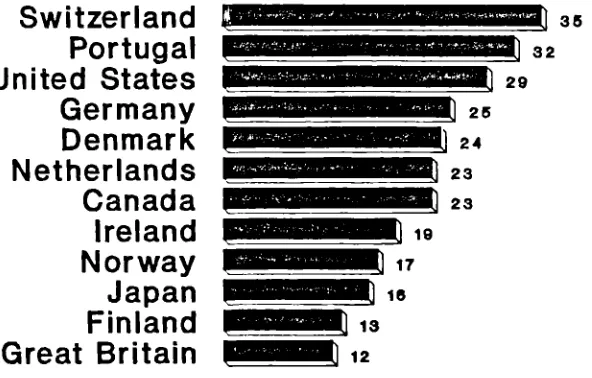
Gallup surveys in 11 high income and 13 medium to low income nations asked 1000 to 1500 people "which do you believe should have the primary responsibility for protecting the environment in our nation--the government, business and industry, or individual citizens and citizens groups?" Citizens of low income nations believed that the primary responsibility for environmental protection should be assumed by the citizens (Fig. 1.1)(Dunlap, et al.,
1993). To assess the perceived efficacy of citizen action the survey asked "How much of an effect can individual citizens and citizens groups have on solving our environmental problems?" The percentages of respondents in developing countries who attached "a great deal" of effect
Environmental concern in many countries reveals that environmental quality is no longer seen as a luxury for the rich. Social science analyses of environmentalism have focused primarily on industrialized nations and downplayed direct human experience of environmental degradation at the local levels in the poorer nations (Adams, 1990). Climatic change in Southern Chile has caused repeated flood damage in an area where the Mapuches -- the indigenous people of
35 32 29 25 24 23 23 19 17 16 13 12 43 43 43 38 34 28 25 24 22 NM 9 9 80
Respondents who say citizens should have
primary responsibility for environmental
protection (percentage)
Switzerland
Portugal
United States
Germany
Denmark
Netherlands
Canada
Ireland
Norway
Japan
Finland
Great Britain
Brazil
Mexico
Philippines
Uruguay
Chile
India
South Korea
Hungary
Turkey
Nigeria
Poland
Russia
[image:29.595.38.334.201.390.2]29 22 19 59 59 57 52
Respondents who say individual and
citizens groups can have "a great deal"
of effect on solving env'l problems (%)
Ireland
s
43Norway
43
Canada
43
United States
38
Switzerland
3
Portugal
35
Great Britain
Denmark
Finland
Netherlands
Germany
Japan
13 11Mexico
Nigeria
V a,+,1..,1,./hArP.00erstPhilippines
Turkey
South Korea
Chile
Brazil
Uruguay
India
Russia
Poland
Hungary
0? 1.444, 48 46 46 41 39 17 17 9 [image:30.595.57.384.205.389.2]1.1.3 Society
Society is facing national and international military conflicts. Drugs trafficking, communal violence corruption, violation of human rights, vandalism, unjust
international trade and other social issues are affecting the economic and environmental base of many nations
(Korten, 1990; Ekins, 1992).
One factor common to each of these situations is the lack of concern for "spiritual" or "human" development. It
has direct influences on economic, social and environmental development. In this respect we all live in an
"underdeveloped" world. There is little evidence as to how this factor is taken into consideration in education, social policy, the promotion of psychological welfare and economics policy and research.
It is a widely held belief that being positive and building on strength is a virtue. In areas with high unemployment and dense populations the human potential and
its untapped energies are the best resources available.
The Neo-classical, Neo-Marxist and international Capitalist structural models provide established top down development approaches. Bottom up approaches with different versions of "Another Development",
"Ecodevelopment" and "Sustainable Development" give different perspectives Development from below is that which involves and encourages the people to cultivate the latent potentials of each individual and to discover them. Subsequent broadening of the concept of development includes concern about environmental quality. In time, it includes the development of future generations and the implications for sustainable development.
Public participation is an inherent aspect of development and environmental management. Participation is
facilitated through appropriate educational processes--conscientisation or awareness building in the appropriate cultural and ideological contexts (Freire, 1972a; 1972b; 1973). Environmental management is often concerned more with the augmentation of those human activities which have
a significant impact on the environment. The most pressing objective of environmental management is to meet basic
needs within the potentials and constraints of environmental systems and natural resources.
The use of EIA in Portugal showed how effectively the human element was utilised in that process. The effectiveness of EIA in protecting the environment whilst promoting economic development for a new European Community member emphasised that the development of human resources and participation are needed for better environmental management, protection and development.
Public participation is sometimes effectively achieved through NG0s. They can then promote policies needed by national or regional government. They allow a generation of social movements that promote global change through the independent action of countless individuals and organisations.
The Bhoomi-Sena of India; Bangladesh Rural Advancement Committee (BRAC); Participatory Institute for Development Alternatives (PIDA) -Sri Lanka; Proshika of Bangladesh; Organisation of Rural Association for Progress (ORAP) of Zimbabwe; SARILAKAS of Philippines; Sarvodaya Shramadana Movement of Sri Lanka; Six "S" of Burkina Faso; the Working Women's Forum (WWF) and Self-Employed Women's Association (SEWA) of India represent the different fields of activity of NG0s.
educational and learning processes within systematic participatory institutions.
Selected case studies indicate a framework for promoting participation as a learning process in research, definition and action for development. Organisations are
required in every population to promote this participatory process.
1.2 METHODS
This research was carried out through:
1. A literature survey on different topics of environmental management, prevalent development theories
and the connotations of the concept of participation.
2. Collection of information on case studies which have
shown a substantial degree of participants in the development and environmental management efforts. The criteria formulated for case study selection were:
a) that they present a series of short case studies both governmental and non-governmental and which look at both
their successes and failures; b) that they are or were
committed in the development of the home region and its population; c) that they are or were committed in the
is encouraged; e) that they have or had at least five years of activities; f) that there is good documentation with information to confirm the performance of the initiatives; g) that the lessons learned from the research could provide a framework for future action.
3. A close study of environmental impact assessment in Portugal and its application in that country. This study was carried out by personal interviews and communications
followed by an examination of environmental impact statements (EIS) which were accessible in Portugal.
Identification of project types, EIA consultant and their partners and the project developers were among the objectives of the research.
2. ENVIRONMENTAL MANAGEMENT
2.1 INTRODUCTION
Environmental management "seeks to balance human demands upon the Earth's natural resource base with the natural environment's ability to meet these demands on a sustainable basis" (Colby, 1990a).
Although some discrepancy may exist in the interpretation of environmentalism and environmental management terminologies, these terms are used interchangeably in this section. Below, an attempt is made to present a brief survey of ideological and historical aspects of environmentalism and the emergence of environmental management thinking.
2.2 ENVIRONMENTALISM AND ENVIRONMENTAL MANAGEMENT THINKING
2.2.1 The Character of Environmentalism
upon for humanity to survive. The third stage is more optimistic, God has made Man in his own image. Humanity is the sign of God on earth seeking to improve upon God's natural legacy so that both Mankind and nature may be made more prosperous. Prosperity (progress and development) is achieved through the exploitation and manipulation of natural systems.
The history of thinking on progress and development is closely linked to that of environmental concern and peoples' attitudes to nature. Both include responses to changing scientific understanding, world knowledge and ideas about society (Adams 1990).
Moral behaviour has become something of our society's own creation. O'Riordan (1986) suggests that Moral obligations are no longer prescribed by religious absolutes. Human kind's vitality cannot easily be ignored and sometimes propels society into acting contrary to our best interests. Attitudes, assumptions and values are derived from an extensively materialistic society. Changes in the mosaic of cultural diversity and the disruption of environmental systems are consequences of our attitudes, predispositions and sometimes our folly.
and political structures based on ethical foundations may be a goal to achieve but, we cannot act in isolation from our human obligations and historic conditioning which continually frustrate these necessary objectives.
2.2.2 Environmentalism and Global Crisis
The new environmentalism of the industrialised world
in the 1960s debated about ecology, conservation and development (Adams, 1990). The environmentalism of the 1960s and 1970s was concerned for global environmental issues. The notion of the "Spaceship Earth" (Boulding, 1966) became commonplace and the theme of the 1972 UN Conference on the Human Environment in Stockholm centred on
"Only One
Earth"
(Ward and Dubos, 1972). Crisis thinking on a global scale became central to the "new environmentalism" (Cotgrove, 1982) of Europe and North America. Parallel with it grew an apocalyptic vision ofneo-Malthusian crisis giving a context for ideas about sustainable development to emerge (Adams, 1990).
2.2.3 Green Policies
Although the 1972 Stockholm Conference was the first
(1) It is an umbrella movement for other partial movements, which each attack one or more elements of society (Table 2.1).
(2) The Green Movement differs from other social movements in adopting a holistic approach. Environmental problems are not solved by attacking single factors separately.
The Green Movement aims to create an alternative
Table 2.1 A Survey of Green Policies Mainstream Characteristics
•
Green Policies, Movements Economic Basis
1. Exploitation of
external proletariat
Cooperative enterprises, movements; labour . buyer/seller difference abolished, customers directly involved 2. Exploitation of
external sector
Co-existence with the Third World; only equitable
exchange relations; liberation
movements
3. Exploitation of nature Ecological balance Person-Nature; building diversity,
symbiosis; complete or 'partial vegetarianism 4. Exploitation of self More labour- and
creativity-intensity;
decreasing productivity in some fields; alternative technologies
Military basis
1. Dependency on foreign Self-reliance; self-sufficiency in food,
health, energy and defence trade
2. Dependency on formal Local self-reliance, decreasing urbanisation, sector, BCI-complex
3. Offensive defence policies, very
destructive defence technology
Intermediate technology; defensive defence policies with less destructive
technology, also non-military non-violent defence.
4. Alignment with super-powers
Non-alignment, even
neutralism de-coupling from superpowers
Structural basis
1. Bureaucracy, state Recentralisation of local level; building federations of local units
(plan) strong and centralised
2. Cornoration, capital Building informal, green economy: - production for selfconsumption
-production for non-monetary exchange - production for local cycles
Table 2.1 cont'd: A Survey of Green Policies Mainstream Characteristics Green Policies, Movements 3. Intelligentsia,
research strong and centralised
High level non-formal education, building own forms of understanding
4. MAMU factor; BCI
peopled by middle-aged males with university education (and dominant race/ethnic group)
Feminist movements,
justice/equality and for new culture and structure; movements of the young and
the old; movements for racial/ethnic equality Bourgeois way of life
1. Non-manual work, Keeping the gains when healthy, mixing manual and non-manual
eliminating heavy, dirty, dangerous work 2. Material comfort,
dampening fluctuations of nature
Keeping the gains when healthy, living closer to nature
3. Privatism, withdrawal Communal life in bigger units, collective
production/consumption into family and peer
groups
4. Security, the Keeping security when
healthy, making life style less predictable
probability that this will last
Chemical, circus way of life 1. Alcohol, tranquilisers,
drugs
Moderation, experiments with non-addictive,
life-enhancing things 2. Tobacco, sugar, salt,
tea/coffee
Moderation, enhancing the body's capacity for joy, e.g. through sex
3. Chemically treated food, panem, natural
Bio-organic cultivation, health food, balanced food, moderation
fibres removed
4. Circenses, TV, sport, Generating own entertain-ment, moderate exercise, spectatorism
2.2.4 New Environmentalism
Environmentalists' thinking patterns have been divided into Technocentrism and Ecocentrism (O'Riordan 1981; Sandbach 1980; Cotgrove 1982; Pepper 1984).
Technocentrism
Technocentrism is based on a managerial approach to resource development and environmental protection where the satisfaction of Man is the centre of all activities. They are usually power-conservatives at central or national level control. Technocentrism can be subdivided into optimism and accommodation:
a) Optimistic Technocentism (or Cornucopia) believes that a prosperous life can be guaranteed for at least a substantial majority through managerial skill, needs and established economic forces.
b) Accommodation Technocentrism holds that through regulation and the modification of the business managerial position, resource wastage can be reduced and pollution controlled without threatening the economic and political power base.
Ecocentrism
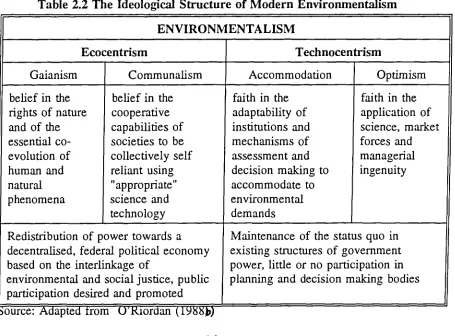
interaction (O'Riordan, 1988b). The problems of society or the environment are solved by individual communities
invested with real power (Table 2.2) (O'Riordan, 1981; 1988b; Cotgrove, 1982; Pepper, 1984; Redclift, 1987).
a) Communalists identify collective abilities to manage and organise economic affairs provided they have the right incentives and freedom. These groups take a "bottom-up" and "periphery-inward" development approach (Stohr, 1981) to sustainable development thinking (Adams 1990).
[image:43.595.61.516.435.771.2]b) Gaianists hold that the Earth has self controlling systems. It does not view Man as the dominant species and human consciousness is not the only means to judge nature.
Table 2.2 The Ideological Structure of Modern Environmentalism
ENVIRONMENTALISM
Ecocentrism Technocentrism
Gaianism Communalism Accommodation Optimism belief in the
rights of nature and of the essential co-evolution of human and natural phenomena
belief in the cooperative capabilities of societies to be collectively self reliant using "appropriate" science and technology
faith in the adaptability of institutions and mechanisms of assessment and decision making to accommodate to environmental demands
faith in the application of science, market forces and managerial ingenuity
Redistribution of power towards a decentralised, federal political economy based on the interlinkage of
environmental and social justice, public participation desired and promoted
Maintenance of the status quo in existing structures of government power, little or no participation in planning and decision making bodies
2.2.5 The effect of Philosophical Paradigms on Environmental Management
The need for environmental management emerges from the effects of economic growth in industrial societies. The ineffectiveness of environmental intervention is closely related to the power of established interests. There is an
exaggerated reliance upon techniques for containing environmental damage, rather than upon more radical interventions. This shows that techniques are easier to research and evaluate than programmes or policies
(Redclift, 1987).
In the developed world environmental planners have intervened in production, consumption and natural conflicts. The avoidance of externalities and access to
natural resources are sought by capitalist firms. For instance, land-use planning design ensures that development
is permitted only on land which is suitable.
Land-use controls and planning permission regulate development projects but do not prevent development. Therefore these mechanisms influence the location and appropriateness of development and not its occurrence.
production groups such as farmers or foresters to advance. Consumption conflict is rare in developing countries because of the political and economical structures.
Conflict with nature results from modern agriculture and its effect on flora, fauna and their habitats. Natural species have been transformed into commodities and sold with the rights to own and control those commodities. In
the developed world, most discussion turns on the conservation of critical habitats in which rare or endangered species can exist but the issues are far deeper in the developing world, where the threat to the species
carries implications for the global gene pool itself.
These interventions are designed to facilitate, rather than curtail, industrial productions. These are merely
"protective and reactive responses" (Holling, 1978). If a radical change in the trend to protect the environment is to be achieved then:
"It is extremely important ... that we do not exaggerate the importance of environmental planning and management in our own societies. The methods employed -- land use planning, the costing of environmental losses, and the development of priorities for species conservation -- [these] are reactive responses which have been developed to deal with the uncomfortable consequences of economic growth. More effort usually goes into making inventories and gathering statistics than into the redirection of the development process. ... Most actual development implies short-term efficiency for a small number of people."
The progress of traditional environmental management-i.e., the "reactive", or "corrective" - has, in reality, been too slow. The need to "manage", arises when traditional understandings and modes of social action and
cultural formation have begun to prove inadequate to control the
subjective
coordination and development ofsociety (Hales, 1986).
2.2.6 Environmental Management in the South
Emulating the countries of the North, environmental management is also generally a responsive ("corrective" or
"reactive") set of techniques. The dominant economic growth perception of development has led the developing countries to adopt the same type of environmental management strategies as the North. Market has become the ultimate "barometer" of people's needs, while some planners are being oblivious of the fact that "the priority of people's needs changes in the course of development"
(Redclift, 1987). After basic needs of food and shelter are satisfied, the satisfaction of aesthetic and
existential wants is required.
Responsive environmental management often ignores or devalues the experience of poor people who are closest to the problems (Redclift, 1987).
In the South the pressure on biosphere reserves from
the poverty of the poor and the greed of the rich is much more formidable than the pressures experienced in the North, where the reserves' users are the supporters of the conservation idea. Therefore environmental management as "a responsive set of techniques" is not particularly effective in the developing countries. The solution to environmental problems based on experience of developed countries and imported methodologies has little relevance to the circumstances. It also ignores a whole set of historical knowledge and experience already existent in developing countries.
Environmental management, especially that of the developing countries, needs to be viewed from an international perspective. The development of international trade policies (which usually are oriented towards meeting the needs and preferences of the rich) help
determine the forms of resource exploitation of the poor. Rural livelihoods of millions of people and their sustainability are derived from these rural environmental
resources (Chambers, 1987, 1988a, and 1988b) .
historical processes which link the industrialized North with the developing South. Both are bound together by economic and political ties which do not seem immediately "environmental": trading relations, the transfer of technology, even the relocation of labour to new productive activities. Much of the "natural" environment of developing countries is a reflection of these processes...
(Redclift, 1987)
The challenges of environmental management in both North and South have been wide-spread over issues which have been treated equally without any regard to urgency or priority. Even if a priority exists, it is that of a privileged minority. Public opinion, in the North, has, indiscriminately, been directed towards preserving non-human species of animals and plants in their natural habitats. It should, instead, be more properly awakened to
the damage which human actions have inflicted on nature by international development.
One issue of environmental management is that of ideological context within which the approach has evolved.
2.3 ENVIRONMENTAL MANAGEMENT IN PRACTICE
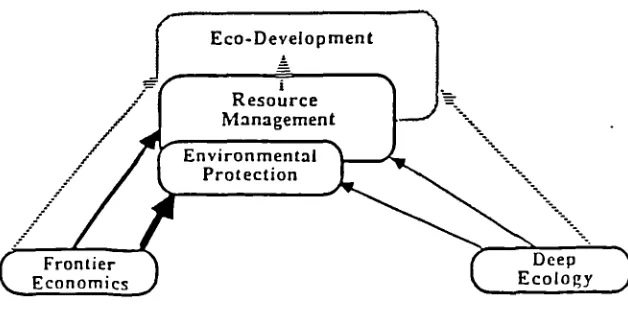
Environmental management being the concern of a growing number of people, is classified as to how different groups and advocates have been emerging. Five fundamental paradigms are based on the economic and socio-cultural context in which they take place (Colby, 1990a, 1990b, 1991). Each paradigm is basically "environmental management in development" (see Figure 2.1). The distinction between the practices although "not completely distinct or unrelated", is helpful to those who like to see the environment protected and sometimes fail to see the relationship of their everyday lifestyles and habits with the destruction of the environment.
i
Eco-Development
A
[image:50.595.135.449.130.285.2]Fig. 2.1 Evolutionary Paradigms Diagram
FIGURE 1. Evolutionary Paradigms Diagram.
The diagram attempts to indicate schematically the non-linearity of paradigm evolution in the following ways. The vertical scale represents the progression in time from one paradigm to the next going upward; the honzontal scale indicates the upper three paradigms' position on a spectrum between the "diametrically opposed" frontier economics and deep ecology paradigms. The size of the boxes signifies (roughly) the degree of inclusiveness and integration of social, ecological and economic systcms in the definition of development and organization of human societies. Non-solid lines indicate the hypothesized future.
Source: Colby (1990a, 1990b, 1991)
2.3.1 Frontier Economics
Standard assumptions underlie neo-classical economics, so that economics models become "workable" (that is, conceptually and analytically tractable) (Newson 1992).
Table 2.3 Standard Assumptions of Neoclassical Economics
A. There exist perfect markets, which implies:
Buyers and sellers (agents) have perfect information about the present and the future; there is perfect homogeneity and divisibility of goods produced;
there is totally free entry into the markets by any agent; there are an infinite number of agents in both the supply and demands side.
B. Economics agents maximize utility. Agents are "rational", which means that they make decisions only by the criteria of maximizing their monetary utility and profits.
C. If occasionally there exists some external effects in production and/or consumption, they can always be identified and internalized.
D. The markets deal with factors of production which are: a) fully employed;
b) more mobile from one sector to another; c) react to marginal changes in the economy. Source: Adapted from Newson (1992)
In Frontier economics Energy, water, soil, air, and raw materials are taken from an infinite reserve and its byproducts are put back into this sink for the benefit, development and consumption of humans -- hence the reserve is a sink. Assumptions of resource scarcity are believed to be overcome by market mechanisms and technological innovations that will always provide Mankind with a substitute.
then marxist economics or the neoclassical economics) are perceived to be human labour and man-made capital --resources are limitless. The neoclassical economics is largely devoted to the refinement and expansion of the environment as a commodity.
This particular industrial economic paradigm was soon adopted by most developing nations for economic growth and development. However, they have failed to achieve the "development" they had planned whilst damaging environmental, social and cultural structures. This adoption has often been with the encouragement of international policy makers and financial institutions of the industrial nations.
The concept of frontier economics was introduced by Colby as an environmental management paradigm (Colby, 1990a, 1990b). It is more illuminating to discern that Frontier Economics, identified as "cowboy economics" is the cause of environmental deterioration rather than being the
"remedy" or an environmental management paradigm.
2.3.2 Environmental Protection
1972). Economic growth as the only desired form of development was less popular, and the conflict of ecology
versus economic growth became more explicit.
This is when "environmental impact assessment" legislation for large development projects in the United States was passed and environmental impact statements (EIS) were required by law. Environmental impact assessment (EIA) is a rational means to assist in balancing and weighing the costs and benefits of development activities. Economists, however, believe "that it is possible to consider the environment within the governing economic paradigm" and point to the substantial progress in the field of "bioeconomics" (Redclift, 1987).
Economists supporting this paradigm believe that
environment's value can be calculated financially. They attach quantitative weight to human desires and preferences which in turn is put into policy work on the environment. Ignoring the environment would entail economic costs. They also believe in "tradeoffs" as the price for "economic
growth". The economic analysis of this paradigm is the neoclassical model which defines "optimal pollution levels" by short term economic acceptability.
The focus of the prescribed environmental management activity is concerned with ameliorating human activities.
on pollution and permissable damage. It has been described as "end-of-the-pipeline", "business-as-usual, plus a treatment plant" or "legalize the environment as an economic externality" strategy. Pollution dispersal is the common approach to amelioration.
Developing countries have been slow to implement protective legislation, in this governing economic
paradigm. Protective rules were seen to be in the interests of the elite class of the industrial countries and too expensive within the context of their immediate needs and agenda. Gradually, they came to realise that there is no dichotomy in environmental management approaches and adopted some of the protective measures e.g. the adoption of EIA or "polluter pays principle" --known in the North.
The "willingness to pay" view of environmental management works best in industrial countries. In the
North, environmental quality is now often placed before economic growth. In the South, satisfying subsistence
needs preclude costly and strenuous efforts to improve and protect the environment. Resource degradation in developing countries arises from lack of equity and unequal landholding. One result is that the poor are forced to colonize forests and untitled land (Redclift, 1992).
considerable attention. The way these are influenced by power structure and social relations at the community level in the South are of paramount importance. It is important to analyze and understand the social relations, otherwise, we are unlikely, for instance, to be able to influence the behaviour of people who cut down primary forests in order to make a living.
2.3.3 Resource Management
The political economy -- the subject of who gets what and how much, or who gains and who loses (Chambers, 1983) -- of developing countries varies substantially from that
of the industrial nations. Resource depletion is more critical than pollution effects. The position of the poor who were harmed more than the rich led into a different paradigm of environmental management.
The Limits to Growth (Meadows et al., 1972) was a
landmark in modelling. But whilst extrapolating the effects of resource exploitation it failed to impact the
harmony among Mankind and between humanity and nature.
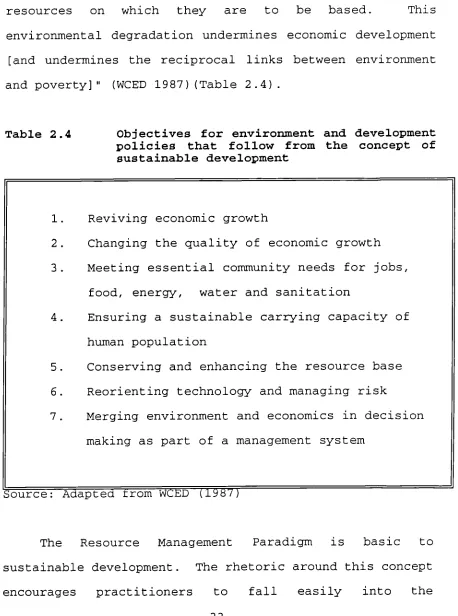
The concern for resource management identifies " many
forms of development which erode the environmental resources on which they are to be based. This environmental degradation undermines economic development [and undermines the reciprocal links between environment
[image:56.595.64.522.156.772.2]and poverty]" (WCED 1987)(Table 2.4).
Table 2.4 Objectives for environment and development policies that follow from the concept of
sustainable development
1. Reviving economic growth
2. Changing the quality of economic growth 3. Meeting essential community needs for jobs,
food, energy, water and sanitation
4. Ensuring a sustainable carrying capacity of human population
5. Conserving and enhancing the resource base 6. Reorienting technology and managing risk
7. Merging environment and economics in decision making as part of a management system
Source: Adapted trom WCED (1987)
traditional neoclassical imperative of economic growth. This is still conventional development, with sustainability the necessary constraint for "green development".
Pollution is a "negative resource". It causes natural resource degradation and is more than just an externality.
Renewable resources and their conservation, population stabilization, technological and industrial adjustment are elements of environmental management strategy of Resource
Management.
Environmental impact assessment and risk management
challenge the assertion of frontier economics that natural resources are infinite or that their exhaustion is of no concern. This concern for the increasing scale of resource development schemes and their resulting impacts to the
physical environment and communities could no longer be ignored. Traditional appraisal
techniques were found to be
inadequate to deal with various environmental and socialEnvironmental Impact Assessment
The objective of any EIA is to promote and ensure that planning decisions take into account environmental
implications. In practice, its effectiveness in influencing decisions rests on the following assumptions: • interested public or "watchdog" agency scrutiny of
environmental issues disclosed by the EIA reinforce accountability of decision-making processes;
• the process can order information on environmental impacts along with economic and technological issues so that more balanced decisions can be made by the development proponents.
Conceptually, the EIA approach resembles a planning
process. This is characterised by four operational elements:
a) problem definition;
b) the assessment is carried out to include evaluation of social and economic effects, either quantitatively or qualitatively;
c) alternatives are explored;
d) decision-making is based on a balancing of costs and benefits and the choice of the "optimal"
alternative.
and waste discharge, the EIA process is in principle an attempt to examine a wider range of environmental and social impacts. Otherwise, subject to the limitations of existing scientific methods and information base for assessment, the exercise becomes trivial. At the same
time, no one should be surprised that the evaluation and choice-making problem can never be a purely mechanical or technological procedure. A common thread running through the EIA concept is social accountability. Thus, the involvement of the affected public is by definition essential in the identification and resolution of issues
for assessment. An investigation into the application of EIA, as a subject of environmental management for development, and the public involvement aspects of it in Portugal, as a country on its path to industrialisation, is presented in chapter 6.
2.3.4 Ecodevelopment
Ecodevelopment (Riddle, 1981; Glaeser, 1984; Sachs, 1984a, 1984b) is interpreted as ecological or
environmentally sound development. Its object is to
achieve harmony between man and nature, society and its physical environment.
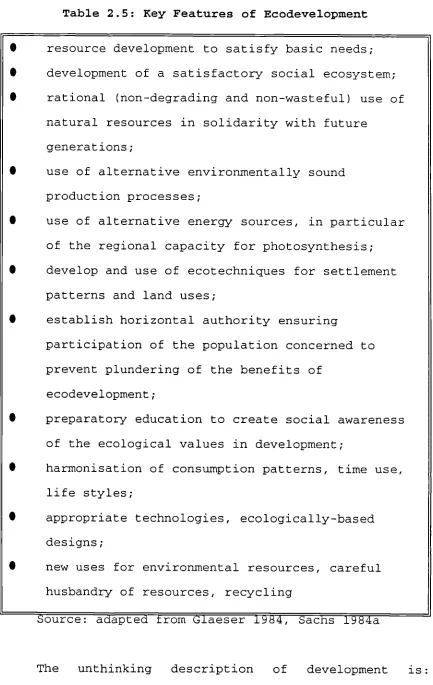
regional and local level in ways consistent with the potentials of the affected area. Attention is given to adequate and rational use of the natural resources, the application and types of technology and the organisational forms respecting natural ecosystem or local sociocultural patterns (Bartelmus, 1986). It is an approach to development aimed at harmonising social and economic objectives with ecologically sound management. There is a spirit of solidarity with future generations through self-reliance, satisfaction of basic needs and symbiotic relationship between Man and the Earth. Ecodevelopment supports another kind of qualitative growth, not zero growth or negative growth (Glaeser, 1984).
The concept of "ecodevelopment planning" promoted by UNEP with pilot projects in different parts of the world was adopted by the non-governmental organisation Centre International de Recherche sur l'Environment et le Developpement which was responsible for many of UNEP's projects. The director, Ignacy Sachs, established key
Table 2.5: Key Features of Ecodevelopment
0 resource development to satisfy basic needs; • development of a satisfactory social ecosystem; • rational (non-degrading and non-wasteful) use of
natural resources in solidarity with future generations;
• use of alternative environmentally sound production processes;
• use of alternative energy sources, in particular of the regional capacity for photosynthesis; 0 develop and use of ecotechniques for settlement
patterns and land uses;
• establish horizontal authority ensuring
participation of the population concerned to prevent plundering of the benefits of
ecodevelopment;
• preparatory education to create social awareness of the ecological values in development;
• harmonisation of consumption patterns, time use, life styles;
• appropriate technologies, ecologically-based designs;
• new uses for environmental resources, careful husbandry of resources, recycling
Source: adapted from Glaeser 1984, Sachs 1984a
the "developed" nations in their drive for material wealth. Development is a historical process. Industrialization is a means towards development but not the development itself
(Glaeser and Vyasulu, 1984).
Ecodevelopment aims at people, the societal
relationships which emphasise the role of the community and the participation of those directly affected. Ecodevelopment addresses basic and essential needs, with those of the poorest having priority. Ecodevelopment can
be considered as a triangle with one side basic needs. The second side is self-reliance and the base is ecological sustainability (Dasmann, 1985).
The introduction of ecodevelopment discussions has helped to raise public awareness of environmental and development issues. A search for appropriate solutions
using ecodevelopment models has resulted in a critique of ecodevelopment, which had remained normative, without
detailed and practical initiatives. Ecodevelopment, gradually became a tool to exert pressure on official
institutions. Political implications and viabilities of ecodevelopment strategies were questioned by its advocates:
Since the publication of Our Common Future the term
Ecodevelopment is sometimes used as a synonym for "environmentally sound development" (Bartelmus, 1986). Ecodevelopment was later dissolved into the sustainable development concept (Blauert, 1990).
2.3.5 Deep Ecology
Deep ecology worldview thinking emerged as the polar opposite to the frontier economics paradigm (Colby 1990a and 1990b). The term "Deep Ecology" was coined by Norwegian philosopher Arne Naess. It distinguishes those who face the challenge of doing something about the
environment from others -- the "shallow ecologists" -- who are content with remedying the environmental symptoms and not aiming at the causes.
"Shallow ecology" attitudes are "narrowly utilitarian". Shallow ecology simply means "a profitable industry for cleaning up pollution", "business as usual" or
"reformist" views. Deep Ecology is radical, proclaiming
Table 2.6: Typical components of growth/environmental paradigms
Dominant social paradigm Deep ecology paradigm
Dominance over nature Natural environment as a resource
Material goals / economic
growth
Ample reserves / perfect substitutes
High-technology/science solutions
Consumerism
Centralised / large scale
Authoritarian / coercive structures
Harmony with nature
Values in nature/biosphere
impartiality
Non-material goals /
ecological sustainability
Appropriate technology solutions
Basic needs recycling
Decentralised / small scale Participatory / democratic structures
Shallow Deep
ource: adaptedrom Sylvan
Deep Ecology is a way of practising life and suggests "ecosophy" which is value priority action. Ecosophy links life and nature. Individual life and identity is developed through a broad manifold, organic and inorganic interaction
(Naess, 1989).
strong criticism of the frontier economic development attitude. Ecological values are to replace the "price
tags" used by economists. The predominant ideologies of production and consumption are held responsible for "the advent of an environmental Armageddon" both in the South and the North (Naess, 1989).
There is a philosophical or religious attitude within every community which identifies conclusions concerned within the deep ecology movement (Naess, 1987). In the United States and Mexico deep ecology is grounded on the religious-spiritual traditions and practices. In Australia
and Europe it draws more on philosophy (Devall, 1990).
The fundamental relationship between Man and nature
include intrinsic "biospecies equality", reductions in human population, bioregional reduction in economics, technological and cultural dependencies and exchanges of common ecological characteristics which have come to be called "Ecotopias". The practicability of the promotion of biological and cultural diversity, decentralised planning, multiple value systems, and non growth economics are significant for deep ecology (Colby 1990a) and are of
serious concern to advocates of deep ecology.
environmental protection. The task is also to practise and develop philosophical arguments within political and social contexts. A deep ecology approach to nature is frustrated when the dominant image of nature is based on reductionist
science or nature as a commodity (Devall, 1990).
co 0 O0 n-U 8 u, •
CI, In v. m . '''' 'D.- CD ••,
cE,-7,°6 0 c,-, a ca X VI , _
...CDO CE 7 .-n CO C co
I71 :6 0 - E°' - -,.., c7o- -7, - I- u 9
-00 ._ 0 co-o-= r0 =
-7, (1) _412 D..0 CC 0073
ra- (-)-(00 mu:a- =
oolc)-.L. U)- 0 . ° - g cc, U) 7, o o - o 7. - ..=
;etc
c c 6 c -8 P.-..- ,,,, . 0 -,,a 1"' 0 , 3. g .g
.- 0 -- ... S
-, 4 T. Z a 5 5 - 0 ca Ro •-• --kuo u 0 `-' (i) CD c: -cUJ 0 CL C
-• - c-- ,-. 0 )-. 0 i,i u 8 0 C , To i: -2- 0 cn 5 ,,, 0
uco-uop,3c c0co oc
Q EEw,,-,--28-00072—(alcn.' Eo m oS 0 '7).= 32‘acm O c c .0 c - -g) .5 c ;:. a, 2 2 u o
c 8 C)›. i'D ., u" 8 -3 --m ...- .,....4 - -L-,-, ''' u .
uLu v,uzg-ELLI 0 ..E.----'0 c
UJ E ..3 P- 0 0 -0 0 0 - ,flo 0-5
ea - 6
To u 0 -8 - 2 6 8 o >,. 2 Li CD
s29 .CA>cvl .u)74 3 ... , :I 73? -E00-.Et--.0o- --- -:.! .2 O a C - 0'.. CD C ; m o, E 7 ---- m
= P.-• .- r0 ›.. 71..- 0
3 -1 0 ro - 0
(SL C.I) in LU (..)
= :2 °
_ vi ...,
0
• 3 c r•
0 1 6... g . 0 9 0- .>- 0 o u 0 0
U
--a _ _ 10 .3 cc, S C 7, a. - 0
0-.c.ce. ;
D 1 a - 0 a 0 (-_, LI, 10 0 0 0-E ••• lc • P." 1;' 73 =CC c o ., 0 -
.! ....o a E 0
.‘-i-U = - >. Cn > ••• CD 0 f 1
g . c. _ 0 - a . , - 1
J
_Qn -: j-- .se° E_ 5 , ,-,3 .. CA
U = D 0
' C..1 (-) IU 5 0 0
O 0- .-.
E ,.., c c g - ..c- •
E g c°Ipoc ti, g CD ._ . ' 'cID i, 7,,,,, 'c',,' c17, _ - cp
„,,, -s 0, . ro 7,; 2 c c 5 0 In a Cl• , „." C 2 = 0, 0 E
7D .0 a.- =
C0 c00-EU _ u., E- 2 j —c' „- 1 -' " 3 "_ T, - 2 .. -'5 EiC
CD C,_ ... E . - o c co C vi vl ,_,, CD 0 a:: 130 0_ : , 7, 7, c -. ... -.., 0 (,) 0 co, _, oC = ._0. >
C c = , ,
. o o - ° . o ••-c n - ra c - c./1 c
r, 70 1" c ,_° ...,- .0 '
C D C
c.0
,n E -- u"-- -- o."; ,-,, o c >: c 13 (.11 73 m - , , Q -.n .... E-o :
<
_. .... >. 52 0 .
... 0 Li C a' 8
a, ... TO -- 1, C D ° 0 3 '. -6 •
10 ° 5 co 73 l° '< t
I. C D _ - -.• , . C - - CD
CD , C ,=° 2 2 70 -8 =. - CC =L ' ....: ,.., ...?: E -.L. ..-- .„.,'- .40 . >.
a _ o = LLJ .5 w
a s.. 0 -a. 0
.4 LLI 4....-.- U) 0 0 0. E
_ Cl)- 0 M w
u
= 0 -Q
0
7
0 To .- 0
TA E- .2 -- 0 - >.
- °2 -0 7o -ID 0 . W. M ... . 5 -0 Z C' ..7' o
M cr) = 0 = 70 C a' 0
=4 = kn. o> 2 co • .Y 9. E 8 § _ 3 E U.J Li z-, C ... "... V I
173 0 C D , 0 U, . = 13
C -7 0 I - L `;... 0 . ;:c -CT) 8 „„ 8 .7., -_ 0 L., - c„, c 6, ,n _ u -0 c a .. cm CD ...-.07,13, .4=0
p0
> 17 c - 0 ' -0 0 0 L- 2Z 7 .._ v. CC 6-_ c 7.3 o `E"z s2 ro . 0 03
u_ _
0, co,
-ro