Journal of Chemical and Pharmaceutical Research, 2014, 6(4):340-345
Research Article
CODEN(USA) : JCPRC5
ISSN : 0975-7384
Analysis on structural parameters and operating parameters on
gasoline engine detonation's effects
Jing Wu*, Xunmin Sun and Hongyuan Zhang
School of Automobile and Traffic, Shenyang Ligong University, Shenyang, Liaoning, China
_____________________________________________________________________________________________
ABSTRACT
Based on the gasoline engine with 100mm cylinder diameter, the model is established by GT-POWER software, and through many times of simulation calculations, the reliability of the model is tested and verified. A comparative study is carried on the curve diagram of the gasoline engine detonation indexes changed with the related changes, when the cylinder diameter, the compression ratio, ignition advanced angle, rotational speed and the concentration of the mixed gas are changed. The analysis is that the engine detonation indexes are increased with the cylinder diameter rising. Also they are increased with the increase of the compression ratio and when the compression ratio is more than 9.5, it is sharply rising. It is decreased with the rotational speed increase. Especially at a low speed, the detonation index is sharply decreased with the rotational speed rising. It is reduced with ignition advance angle decreasing. Thick or thin mixed gasoline engine detonation indexes are all reduced and the detonation tendency is also decreased.
Keywords:Gasoline engine, GT-POWER, Detonation, Detonation index
_____________________________________________________________________________________________
INTRODUCTION
The internal combustion engine is currently the highest efficiency combustion heat engine, which is widely applied in various fields of national economy. As the automobiles further enter people’s life, more and more car problems are exposed. Its discharging harmful substance is the greatest source of the environment pollution. From 1994, China's imported patrol increased year by year [1]. Domestic energy demand is affected greatly by the international politic and economic environment, the save of the energy and the reduce of energy consumption reflected on the engine is to increase the ignition efficiency, to reduce the fuel consumption and the discharge [2,3]. The rising of gasoline engine performance is limited by the detonation. When the detonation is happening, the pressure inside the cylinder stator is unusual. Generated pressure shock wave makes gas combustion chamber vibrate and then it causes vibration noise increase, power declining, fuel consumption increasing, emission pollution strengthening and the parts service life reducing. To increase product performance of internal combustion engine, the structure parameter and the operation parameters are continually improved, so the study of the structure parameter and the operation parameters has great significance to the gasoline engine detonation [4-6].
The referred method in this article is the use of GT-POWER engine simulation analysis software developed by American Gamma Technologies Corporation. Through establishing the GT-POWER model, the simulation analysis of the effects of the structural parameters and the operation parameters to gasoline engine detonation is carried on. The results show that the analyzing results by this method are reliable, the calculation time is short and the working difficulty and the cost are declined.
2.PROTOTYPE PARAMETERS AND RESEARCH METHODS
Testing engine is a single-cylinder gasoline engine. The structure parameters of gasoline engine are seen in Table1.
Table1 :The main structure parameter of the gasoline engine
Project Parameter
Form of an engine Single cylinder, four stroke, non supercharged gasoline engine
Cylinder diameter 100mm
Route 100mm
The compression ratio 9.5
The maximum diameter of the gas saving valve 40mm
Ignition advanced angle -20
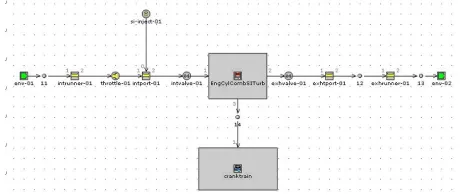
[image:2.612.113.494.193.263.2]Prototype GT-POWER model is seen in Fig. 1.
Fig. 1: GT-POWER simulation model of a single cylinder gasoline engine
Fig. 2: The best curve diagram
[image:2.612.187.419.297.395.2]3.THE STRUCTURE PARAMETERS EFFECT ON THE GASOLINE ENGINE DETONATION 3.1 The Cylinder Diameter Effect on the Gasoline Detonation
The cylinder diameter is the important structure parameter. It is the direct method to enlarge the engine power. Because the gasoline engine is affected by the detonation, the diameter of the air cylinder is not more than 110mm. For the simulation reality, the maximum changing cylinder diameter is 110.The rotational speed of gasoline engine is 2600r/min. When the other parameters will not be changed, select 6 kinds of the cylinder diameters between 85~
[image:3.612.204.407.173.311.2]110mm (the step is 5mm) to carry on the simulation calculation, the calculating results are seen in Fig. 3
Fig. 3: The detonation parameters and the cylinder diameter
Seen from Fig. 3, the detonation indexes are increased with the cylinder diameter rising when the cylinder diameters are between 85mm~110mm. Because the cylinder diameter is enlarging, the flame propagation distances also become longer, which makes the time longer from the flame forming to the normal flame transmitting to the final fuel mixture. So the detonation tendency increases.
3.2 Compression Ratio Effect on the Gasoline Engine Detonation
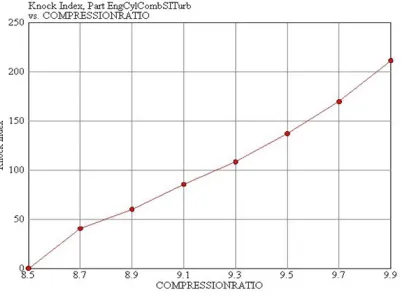
Compression ratio is an important structure parameter of gasoline engine performance. The normal compression ratio scope of the gasoline engine is 7~11. According to the simulation gasoline engine compression ratio, select 8kinds of compression ratios (the step is 0.2) between 8.5~9.9 to carry on the working simulating calculation. The calculating results are seen in Fig. 4.
Fig. 4: Detonation index and compression ratio
[image:3.612.210.411.466.616.2]4.OPERATION PARAMETERS EFFECTS ON GASOLINE ENGINE CYLINDER PRESSURE AND DETONATION.
4.1 Rotational Speed Effect on Gasoline Engine Detonation
[image:4.612.203.408.154.340.2]Rotational speed is one important operation parameter. In the conditions of the other parameters unchanging, select 8 kinds of rotational speed (the step is 500) between 1100r/min~4600r/min to carry on the simulation calculation. The calculating results are seen in Fig. 5:
Fig. 5: detonation index and rotational speed
Seen from Fig. 5, the detonation index is declined with the rising of the rotational speed. The higher the rotational speed is, the smaller the detonation index is. The rotational speed is rising; the time becomes less from the flame forming to the normal flame transmitting to the final fuel mixture; the rotational speed is rising, charging coefficient is declining, the maximum combustion pressure in the cylinder is decreasing, and the final fuel mixture temperature is also abating. The time becomes longer from the flame forming to the normal flame transmitting to the final fuel mixture. So the comprehensive result is that when the rotational speed is rising, the detonation tendency is declining.
4.2 Ignition Advanced Angle Effect on the Detonation
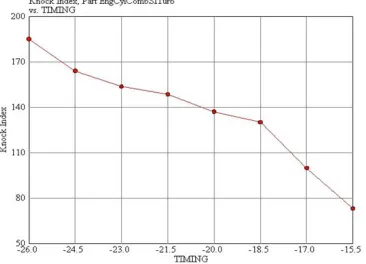
When the engine rotational speed is 2600r/min, the other conditions are not changed. Select 8 kinds of ignition advanced angle (the step is 1.5°CA) between -26°CA~-15.5°CA to carry on the simulation calculation. The calculating results are seen in Fig. 6.
Fig. 6: The detonation index and the ignition advanced angle
[image:4.612.218.401.505.637.2]power to the final mixture gas is rising, the temperature is increasing. The time is reduced from the flame forming to the normal flame transmitting to the final fuel mixture and then the detonation index is rising.
4.3 The Gas Mixture Concentration Effect on the Cylinder Pressure and the Detonation
Air-fuel ratio is used to control the density of the gas mixture. When the gasoline engine rotational speed is 2600r/min, in the conditions of the parameters unchanging, select 8 kinds of the air-fuel ratio (the step is 0.2) between11.9~13.3 to carry on the simulation calculation. The calculation results are seen in Fig. 7.
[image:5.612.213.395.292.438.2]Seen from Fig. 7, the detonation index is rising with the air-fuel ration increase and the detonation index is firstly rising and then reducing. The change of the air –fuel ratio (the change of the mixed gas concentration) will cause to change the flame transporting speed, the temperature between the flame and the gas cylinder wall, and the final fuel mixed gas. When the mixed gas is with high concentration, the flame transporting speed is high. The time becomes less from the flame forming to the normal flame transmitting to the final fuel mixture but the combustion lagging period time of the final fuel mixed gas from the flame forming center to the final mixed gas ignition becomes less. The test shows that the latter one have the main function, so the high concentrated mixed gas will help reduce the detonation tendency. At the same time, when the thin mixed gas reaches the maximum ignition pressure, the pressure is reduced and the temperature is also declined. The time from the flame center to the final ignition mixed gas ignition is increased, and the detonation tendency is reduced.
Fig. 7: Detonation index and air-fuel ratio
CONCLUSION
(1)The detonation index of gasoline engine is increased with the cylinder diameter rising; (2)When the compression ratio is more than 9.5, it is sharply rising.
(3)It is decreased with the rotational speed increase. Especially at a low speed, the detonation index is sharply decreasing with the rotational speed rising;
(4)It is reduced with ignition advance angle decreasing;
(5)Thick or thin mixed gasoline engine detonation indexes are all reducing and the detonation tendency is also decreasing.
REFERENCES
[1]Xudong Zhen, Yang Wang, Shuaiqing Xu.Applied Energy.2012, 92: 628-636.
[2]M.M. Ettefagh, M.H. Sadeghi, V. Pirouzpanah, H. Arjmandi Tash.A parametric modeling approach ,Mechanical Systems and Signal Processing.2008, 22 (6): 1495-1514.
[3]Yingai JIN, Qing GAO, Zhehao XUAN.Journal of Combustion Science and Technology.2003,9 (6 ): 521~524. [4]Elaine S. Oran, Vadim N. Gamezo.Combustion and Flame.2007, 148( 1-2): 40-47.
[5]Xudong Zhen, Yang Wang, Shuaiqing Xu, Yongsheng Zhu.Fuel. 2013, (103): 892-898.
[6]Gequn Shu, Jiaying Pan, Haiqiao Wei.Applied Thermal Engineering.2013, 51( 1-2): 1297-1306.
[8]Eric M. Brauna, Frank K. Lu, Donald R. Wilsona, José A. Camberosb.AIAA.2010:1-13.
[9]Daojing Wang, Hongguang Zhang, Yushi Han, Peng Xie, Chongtao Zhou.Small Internal Combustion Engine and Motorcycle. 2009, 14(4):16-18.