Journal of Chemical and Pharmaceutical Research, 2014, 6(4):941-949
Research Article
CODEN(USA) : JCPRC5
ISSN : 0975-7384
One-pot three-component synthesis of new oxindoles through a tandem
etherification-coupling sequence ignited by tungstophosphoric acid
Chengyuan Liang
a*, Zhishu Tang
b*, Lan Wang
a, Gennian Mao
a, Weidong Qian
aand
Huihui Song
aa
Department of Pharmacy, Shaanxi University of Science & Technology, Xi' an, P. R. China
b
School of Pharmacy, Shaanxi University of Chinese Medcine, Xianyang, P. R. China
_____________________________________________________________________________________________
ABSTRACT
A facile approach was developed to assemble brand new oxindoles 4 and 12 via a three-component condensation of isatin 1, alcohol 2 and symmetrical dione (2,4-pentanedione 3 or cyclohexanedione 11 ). The oxindoles are formed in excellent yields (56-89%) in the presence of tungstophosphoric acid as an efficient recyclable catalyst within a short period. The revealed synthetic protocol and the novelty of the corresponding oxindoles will largely assist our drug discovery and development program.
_____________________________________________________________________________________________
INTRODUCTION
Isatins are important structural nucleus and synthetically versatile substrates, of which can be extensively used for the synthesis of a wide range of heterocyclic compounds[1], such as indoles[2] and quinolines[3]. Due to their unique size, electronic properties, and excellent metabolic stability, various isatin-based derivatives including natural alkaloids4 have been extensive used in a large variety of pharmacologically and biologically active compounds (anti-HIV[5], antiviral[6], antitumor[7], antifungal[8], antiangiogenic[9], anticonvulsants[10], anti-Parkinson’s[11] disease therapeutics). Therefore, the synthesis and selective functionalization of isatin derivatives have received much attention these years.
_____________________________________________________________________________
organic synthesis, mainly due to their low-cost and readily reusable availability[14]. In this paper, for the first time we report an efficient synthesis of new oxindole scaffolds based on an etherification followed by a Knoevenagel-type condensation. This includes a tandem two-step reaction sequence of isatin 1, alcohol 2 and symmetrical dione (2,4-pentanedione 3 or cyclohexanedione 11) in the presence of catalytic tungstophosphoric acid (TPA). Although several isatin-based reactions have been reported by our research groups for the synthesis of indirubin 7 and 7-azaindirubins[15] 8, the synthesis of 3-(2-alkoxy-3-indolylidene)-2,4-pentanedione 4 and 3-(2,6-dialkoxycyclohexa-2,5-dienylidene)2-indolinone 12 have not been reported yet.
EXPERIMENTAL SECTION
All the substrates and solvents were commercially available and purified before use. Reactions were carried out under N2 using standard Schlenk technique. Mass spectra were recorded using electron impact ionization (EI) techniques. Compounds were visualized under UV lamp (254 nM). 1H NMR and 13C NMR spectra were obtained on a Bruker AV-300 NMR spectrometer. Analytical TLC was carried out with plates precoated with silicagel 60 F254 (0.25 mm thick).
General experimental procedure for synthesis of of 4 and 12:
A typical procedure for the formation of 3-(2-alkoxy-3-indolylidene)-2,4-pentanedione 4: To a 100mL Standard Schlenk flask containing refluxing alcohol 3 (50mL) solution of isatin 1(10 mmol) and TPA (0.1mmol) was added 2,4-pentanedione 2 (9.5 mmol) under N2, which was stirred for 2 h. On completion of the reaction, as indicated by TLC (n-hexane/ethyl acetate, 40:60), the reaction mixture was cooled to r.t. The miscible liquids was concentrated under reduced pressure, which was poured into cold water (50mL). The crude product was extracted by ethyl acetate that further purified by flash chromatography. A similar procedure for the formation of 12 can also be administrated. All compounds' structures were established by IR, 1H and13C NMR spectroscopy, as well as HRMS.
3-(2-methoxy-3-indolylidene)pentane-2,4-dione (4a)
Pale oil ; 1H-NMR (300MHz, DMSO-d6) δ: 7.37-7.31 (m, 4H), 4.15 (s, 3H ), 2.31 (s, 6H); 13C-NMR (75MHz, DMSO-d6) δ:197.8, 188.2, 157.6, 147.5, 145.1, 140.1, 129.5, 127.1, 125.5, 56.1, 30.7; HRMS (EI) for (M+H)+: calcd 244.0974, found 244.0977.
3-(2-ethoxy-3-indolylidene)pentane-2,4-dione (4b)
Yellow wax; 1H-NMR(300MHz, DMSO-d6) δ: 7.38-7.31 (m, 4H), 4.08 (q, 2H, J=10.5Hz), 2.31(s, 6H), 1.24 (t, 3H,
J=10.5Hz); 13C-NMR (75MHz, DMSO-d6) δ:197.8, 188.1, 157.6, 147.5, 145.1, 140.1, 129.1, 127.4 ,126.0, 64.9, 30.9, 15.4;HRMS (EI) for (M+H)+: calcd 258.1130, found 258.1133.
3-(2-propoxy-3-indolylidene)pentane-2,4-dione (4c)
Pale wax; 1H-NMR (300MHz, DMSO-d6) δ: 7.38-7.32 (m, 4H), 4.05 (t, 2H, J=10.0Hz), 2.30 (s, 6H), 1.71-1.62 (m,2H), 1.09(t, 3H, J=10.0Hz); 13C-NMR (75MHz, DMSO-d6) δ: 198.1, 188.2, 157.6,147.7,140.2, 129.2, 127.7, 126.3, 68.0, 29.7, 23.2; HRMS (EI) for (M+H)+: calcd 272.1287, found 272.1291.
3-(2-methoxy-5-methyl-3-indolylidene)pentane-2,4-dione (4d)
Pale oil ;1H-NMR(300MHz, DMSO-d6) δ: 7.16-7.10(m, 3H), 4.11(s, 3H), 2.36 (s, 3H), 2.30 (s, 6H); 13C-NMR (75MHz, DMSO-d6) δ: 197.8, 187.4, 159.4, 146.2, 143.7, 139.0, 136.8, 129.5, 128.1, 125.1, 65.1, 29.9, 22.7; HRMS (EI) for (M+H)+: calcd 258.1130, found 258.1136.
3-(2-ethoxy-5-methyl-3-indolylidene)pentane-2,4-dione (4e)
Pale wax; 1H-NMR (300MHz, DMSO-d6 ) δ: 7.16 (d, 1H, J=7.5Hz ), 7.11(d, 1H, J=7.5Hz), 6.99 (s, 1H), 4.08 (q, 2H,
J=10.0Hz), 2.35 (s, 3H), 2.29 (s, 6H), 1.14 (t, 3H, J=10.0Hz); 13C-NMR (75MHz, DMSO-d6) δ:198.1, 187.3, 159.6, 146.2, 143.7, 139.0, 136.8, 129.5, 127.3, 125.9, 64.9, 30.8, 22.9 15.6; HRMS (EI) for (M+H)+: calcd 272.1287, found 272.1289.
3-(2-propoxy-5-methyl-3-indolylidene)pentane-2,4-dione (4f)
Yellow wax; 1H-NMR (300MHz, DMSO-d6) δ: 7.16 (d, 1H, J=7.4Hz), 7.11 (d, 1H, J=7.4Hz), 7.00 (s, 1H), 3.98 (q, 2H, J=10.0Hz), 2.35 (s, 3H), 2.28 (s, 6H), 1.69-1.63 (m, 2H), 1.09 (t, 3H, J=10.0Hz); 13C-NMR (75MHz, DMSO-d6)
δ: 198.0, 187.3, 159.7, 146.3, 143.7, 139.1, 136.8, 129.5, 128.3, 127.7, 125.0, 68.0, 30.8, 24.2, 22.8, 11.1; HRMS (EI) for (M+H)+: calcd 286.1443, found 286.1441.
3-(2-methoxy-5-fluoro-3indolylidene)pentane-2,4-dione (4g)
_____________________________________________________________________________
2.29 (s, 6H); 13C-NMR (75MHz, DMSO-d6) δ: 198.3, 187.8, 161.6, 159.8, 146.3, 139.1, 130.0, 123.8, 117.8, 112.2, 65.1, 30.1; HRMS (EI) for (M+H)+: calcd 262.0879, found 262.0882.
3-(5-fluoro-2-ethoxy-3-indolylidene)pentane-2,4-dione (4h)
Red wax; 1H-NMR (300MHz, DMSO-d6) δ: 7.26 (d, 1H, J=7.5Hz), 7.12 (d, 1H, J=7.5Hz), 7.00(s, 1H), 4.07 (q, 2H,
J=9.9Hz), 2.27 (s, 6H), 1.10 (t, 3H, J=9.9Hz); 13C-NMR (75MHz, DMSO-d6) δ:198.4, 187.4, 161.3, 159.2, 146.1, 142.3, 130.7, 123.8, 116.7, 112.6, 64.7, 30.7, 15.5; HRMS (EI) for (M+H)+: calcd 276.1036, found 276.1033
3-(2-propoxy-5-fluoro-3-indolylidene)pentane-2,4-dione (4i)
Red wax;1H-NMR (300MHz, DMSO-d6) δ: 7.27 (d, 1H, J=7.5Hz), 7.12 (d, 1H, J=7.5Hz), 6.98 (s, 1H), 3.96 (t, 2H,
J=9.5Hz), 2.28 (s, 6H), 1.70-1.64 (m, 2H), 1.10 (t, 3H, J=9.5Hz); 13C-NMR (75MHz, DMSO-d6) δ: 198.1, 187.8, 161.3, 159.3, 146.2, 139.3, 130.0, 123.8, 116.7, 112.6, 64.4, 30.8, 22.8, 11.1; HRMS (EI) for (M+H)+: calcd 290.1192, found 290.1195.
3-(2-methoxy-7-fluoro-3-indolylidene)pentane-2,4-dione (4j)
Red oil; 1H-NMR (300MHz, DMSO-d6) δ: 7.27 (t, 1H, J=7.5Hz), 7.15-7.10 (dd, 2H, J=7.5Hz), 4.10 (s, 3H), 2.28 (s, 6H); 13C-NMR (75MHz, DMSO-d6) δ:198.5, 188.0, 159.6, 146.2, 139.2, 136.7, 129.0, 125.1, 117.8, 65.1, 29.7; HRMS (EI) for (M+H)+: calcd 261.0801, found 261.0806.
3-(7-fluoro-2-ethoxy-3-indolylidene)pentane-2,4-dione (4k)
Red wax; 1H-NMR (300MHz, DMSO-d6) δ:7.27 (t, 1H, J=7.5Hz), 7.15-7.11 (dd, 2H, J=7.5Hz), 4.08 (q, 2H,
J=10.0Hz), 2.30(s, 6H), 1.12 (t, 3H, J=10.0Hz); 13C-NMR (75MHz, DMSO-d6) δ:198.6, 187.9, 159.7,146.1, 139.0, 135.9, 128.7, 124.3, 117.8, 64.7, 29.8, 15.5; HRMS (EI) for (M+H)+: calcd 276.1036, found 276.1037
3-(2-propoxy-7-fluoro-3-indolylidene)pentane-2,4-dione (4l)
Red wax; 1H-NMR (300MHz, DMSO-d6) δ: 7.28 (t, 1H, J=7.5Hz), 7.16-7.12 (dd, 2H, J=7.5Hz), 3.98 (t, 2H,
J=9.7Hz), 2.31(s, 6H), 1.69-1.64(m, 2H), 1.10 (t, 3H, J=9.7); 13C-NMR (75MHz, DMSO-d6) δ:198.1, 187.8, 159.6, 153.8, 146.2, 139.3, 130.0, 123.7, 116.9, 112.7, 64.5, 30.9, 22.8, 11.2; HRMS (EI) for (M+H)+: calcd 290.1192, found 290.1195.
3-(2-methoxy-5-chloro-3-indolylidene)pentane-2,4-dione (4m)
Pink oil; 1H-NMR (300MHz, DMSO-d6) δ: 7.37-7.30 (dd, 2H, J=7.5Hz), 7.22(s, 1H),4.08(s, 3H), 2.31(s, 6H);13C-NMR (75MHz, DMSO-d6) δ: 198.2, 187.1, 160.3, 146.2, 144.8, 142.3, 139.0, 132.7, 129.3, 127.6, 65.1, 29.9; HRMS (EI) for (M+H)+: calcd 278.0584, found 278.0587.
3-(2-ethoxy-5-chloro-3-indolylidene)pentane-2,4-dione (4n)
Pink wax; 1H-NMR (300MHz, DMSO-d6) δ: 7.37-7.31 (dd, 2H, J=7.5Hz), 7.22 (s, 1H), 4.01 (q, 2H, J=10.0Hz), 2.29 (s, 6H), 1.12 (t, 3H, J=10.0Hz); 13C-NMR (75MHz, DMSO-d6) δ:198.3, 187.9, 161.0, 144.8, 139.1, 132.9, 129.4, 64.9, 30.1, 15.4; HRMS (EI) for (M+H)+: calcd 292.0740, found 292.0745.
3-(2-propoxy-5-chloro-3-indolylidene)pentane-2,4-dione (4o)
Pink wax; 1H-NMR (300MHz, DMSO-d6) δ: 7.36-7.30 (dd, 2H, J=7.5Hz), 7.22 (s, 1H), 3.98 (t, 2H, J=9.5Hz), 2.27 (s, 6H), 1.63 (m, 2H), 0.98 (t, 3H, J=9.5Hz); 13C-NMR (75MHz, DMSO-d6) δ:198.7, 188.0, 159.8, 144.8, 142.3, 139.0, 130.0, 123.8, 116.5, 68.0, 29.9, 23.2, 12.0; HRMS (EI) for (M+H)+: calcd 306.0897, found 306.0895
3-(2,6-diethoxycyclohexa-2,5-dienylidene)indolin-2-one (12a)
Pale wax; 1H-NMR (300MHz, DMSO-d6) δ: 9.83 (br, 1H), 8.14 (d, 1H, J=7.5Hz), 7.29 (t, 1H, J=7.5Hz), 7.14 (t, 1H,
J=7.5Hz), 6.93 (d, 1H, J=7.5Hz), 4.62 (t, 2H, J=5.2Hz), 4.06 (q, 4H, J=10.0Hz), 2.65 (d, 2H, J=5.2Hz), 1.27 (t, 6H, J=10.0Hz); 13C-NMR (75MHz, DMSO-d6) δ:171.4, 158.1, 144.5, 142.5, 130.1, 127.6, 124.5, 122.9, 110.1, 89.6, 65.9, 23.7, 15.8; HRMS (EI) for (M+H)+: calcd 298.1443, found 298.1445
3-(2,6-diethoxycyclohexa-2,5-dienylidene)-5-fluoroindolin-2-one (12b)
Red wax; 1H-NMR (300MHz, DMSO-d6) δ: 9.87 (br, 1H), 7.86 (d, 1H, J=7.0Hz), 7.10 (d, 1H, J=7.0Hz), 6.94(s, 1H), 4.61 (t, 2H, J=5.5Hz), 4.04 (q, 4H, J=10.0Hz), 2.65 (d, 2H, J=5.5Hz), 1.27 (t, 6H, J=10.0Hz); 13C-NMR (75MHz, DMSO-d6) δ:171.3, 158.0, 145.5, 142.4, 129.7, 128.0, 124.4, 123.0, 110.4, 88.9, 67.6, 24.1, 15.8; HRMS (EI) for (M+H)+: calcd 316.1349, found 316.1353
3-(2,6-diethoxycyclohexa-2,5-dienylidene)-5-chloroindolin-2-one (12c)
_____________________________________________________________________________
1H), 4.60 (t, 2H, J=5.5Hz), 4.04 (q, 4H, J=10.0Hz), 2.64 (d, 2H, J=5.5Hz), 1.28 (t, 6H, J=10.0Hz); 13C-NMR (75MHz, DMSO-d6) δ: 170.9, 158.2, 145.4, 141.8, 129.3, 128.1, 124.1, 122.8, 111.3, 88.6, 68.1, 24.1, 15.9; HRMS (EI) for (M+H)+: calcd 332.1053, found 332.1057
3-(2,6-diethoxycyclohexa-2,5-dienylidene)-5-methylindolin-2-one (12d)
Pink wax;1H-NMR (300MHz, DMSO-d6) δ: 9.77 (br, 1H), 7.59 (d, 1H, J=7.5Hz), 7.10 (s, 1H), 6.91 (d, 1H,
J=7.5Hz), 4.59 (t, 2H, J=5.5Hz), 4.01 (q, 4H, J=10.0Hz), 2.63 (d, 2H, J=5.5Hz), 2.31 (s, 3H), 1.27 (t, 6H, J=10.0Hz); 13C-NMR (75MHz, DMSO-d6) δ: 170.8, 158.1, 145.3, 141.7, 129.3, 128.2, 124.5, 122.4, 111.2, 87.9, 67.9, 24.1, 16.0; HRMS (EI) for (M+H)+: calcd 312.1600, found 312.1607.
3-(2,6-diethoxy-4,4-dimethylcyclohexa-2,5-dienylidene)indolin-2-one (12e)
Pale wax; 1H-NMR (300MHz, DMSO-d6) δ: 9.56 (br, 1H), 8.45 (d,1H ), 7.12-6.95 (m, 3H) , 4.54 (s, 2H), 4.07(q, 4H,
J=8.5Hz), 1.43 (S, 6H), 1.24 (t, 6H, J=8.5Hz); 13C-NMR (75MHz, DMSO-d6) δ: 169.1, 153.7, 146.8, 143.1, 132.6, 128.1, 124.2, 119.5, 109.3, 101.9, 75.3, 30.8, 27.9, 16.5; HRMS (EI) for (M+H)+: calcd 326.1756, found 326.1761
3-(2,6-diethoxy-4,4-dimethylcyclohexa-2,5-dienylidene)-5-methylindolin-2-one (12f)
Red wax; 1H-NMR (300MHz, DMSO-d6) δ:9.66 (br, 1H), 8.50 (d, 1H, J=6.8Hz), 7.12 (s, 1H), 6.78(d, 1H, J=6.8Hz), 4.60 (s, 2H), 4.07 (q, 4H, J=8.5Hz), 2.42 (s, 3H), 1.43(s, 6H), 1.20 (t, 6H, J=8.5Hz); 13C-NMR (75MHz, DMSO-d6)
δ: 169.0, 153.3, 145.7, 142.8, 132.6, 128.1, 124.2, 119.5, 109.3, 101.9, 75.3, 30.8, 27.9, 23.4, 16.5; HRMS (EI) for (M+H)+:340.1913, found 340.1918
RESULTS AND DISCUSSION
Our initial experiments were focused on the representative procedures of isatin 1a (1 mmol), 2,4-pentanedione 3 (1 mmol), and boiling methanol (reactant and solvent) as the model substrates facilitated by different catalysts, which are listed in Table 1.
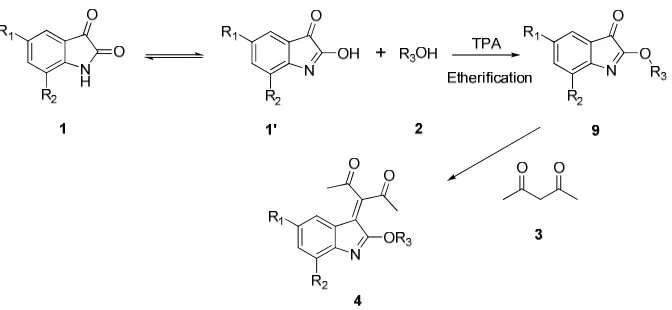
[image:4.595.118.497.391.623.2]Scheme 1: Synthesis of 3-(2-alkoxy-3-indolylidene)-2,4-pentanediones 4 in the presence of TPA
Table 1: Screening of catalysts
Entry Catalyst(mol%) Time(h) Yields(%)
1 H3PMo12O40 (1) 2 43
2 H3PW12O40 (1) 2 64
3 H3PW12O40 (5) 2 89
4 ZnCl2 (5) 2 70
5 FeCl3 (5) 2 30
6 Montmorillonite (5) 4 43
7 L(+)-Ascorbic acid (5) 4 trace
8 Acetic acid (5) 2 <10
9 HCl (5) 2 65
10 Et3N (5) 2 none
11 None 4 trace
Among these catalysts, it was observed that when heteropoly acids were used, phosphotungstic acid (TPA) showed potent activity in comparison to phosphomolybdic acid, which led to the formation of desired product 4a in high yield. As can be seen from Table 1, when the amount of the TPA increased from 1mol % to 5mol %, the yields increased from 64% to 89 % respectively. Varying Lewis acid and BrØnsted acid either did not promote this reaction or afforded low yields (entries 4, 5, 6, 8 and 9). When the reaction was carried out with L-Ascorbic or without acidic additives the yield of the proposed product was negligible even after 4h (entries 7, 10 and 11). Therefore, the use of the commercially available, inexpensive, and easily handled TPA in alcohol provided an efficient and convenient procedure for the synthesis of 4.
_____________________________________________________________________________
2,4-pentanedione 3. According to Table 2, isatins bearing either electron-releasing or electron-withdrawing groups on the aromatic ring proved to be suitable substrates for this reaction. On the other hand, the alcohols carrying electron-donating and less sterically hindered substituents are more reactive to afford desired products with excellent yields and shortened reaction time in this protocol.
[image:5.595.140.476.467.622.2]Recovery of TPA was conveniently performed by precipitation with ethyl acetate directly from the reaction mixture, followed by filtration. Average recovery yields ranged from 80% to 95%. In the catalyst recycling study, a quantity of decrease in chemical yield was observed when the catalyst was reused for the third time (entries 1, 6, 8, and 11). However, when the recycled catalyst was employed for a longer reaction time (3h instead of 2h), a parallel yield as high as initial reaction was achieved.
Table 2: Synthesis of 3-(2-alkoxy-3-indolylidene)-2,4-pentanediones 4 via scheme 1
Entry Substrate Time(h) Temp.(℃) Product Yield(%)
a
R1 R2 R3
1 H H Me 2 56 4a 67 /65/60b
2 H H Et 2 78 4b 71
3 H H n-Propyl 3 80 4c 75
4 Me H Me 2 56 4d 72
5 Me H Et 2 78 4e 79
6 Me H n-Propyl 3 80 4f 81 /78/74
7 F H Me 2 56 4g 84
8 F H Et 2 78 4h 85 /79/70
9 F H n-Propyl 3 80 4i 78
10 H F Me 2 56 4j 86
11 H F Et 2 78 4k 89 /85/79
12 H F n-Propyl 3 80 4l 77
13 Cl H Me 2 56 4m 62
14 Cl H Et 3 78 4n 60
15 Cl H n-Propyl 3 80 4o 56
a
Isolated yields after flash chromatography.
b With a catalyst sample recovered over three times in entries 1, 6, 8, and 11
The plausible mechanism of this compatible etherified-Knoevenagel-type condensation is demonstrated in Scheme 2. Alcohol reacts with isatin’s tautomer 1’ to generate an ether intermediate 9, followed by a nucleophilic addition with 2,4-pentanedione to afford the respective oxindole 4.
Scheme 2: Plausible mechanism for the formation of product 4
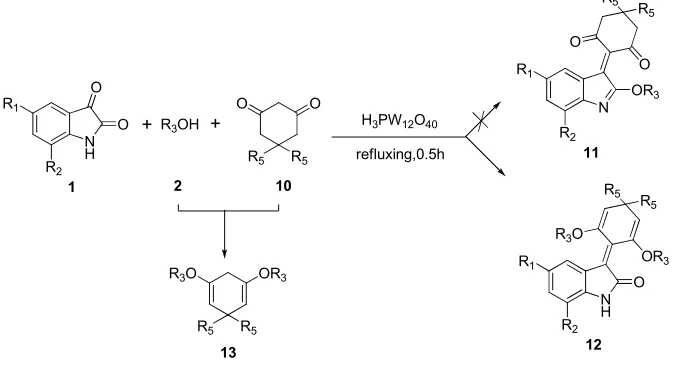
These results encouraged us to further explore the potential of the reaction by utilizing 1,3-cyclohexanedione and dimedone instead of 2,4-pentanedione. Quite surprisingly, replacing 2,4-pentanedione 3 with cyclohexanedione 10, the corresponding reaction under the same condition did not yield the proposed product 11, instead the unexpected 3-(2,6-dialkoxycyclohexa-2,5-dienylidene)2-indolinone 12 were obtained as the main product in one pot without adding any additional reagents. Cyclohexanedione reacted much quicker and provided the product 12 with moderate yield, likely due to the intensive affinity and reactivity between the two alcohol moieties and the carbonyl groups of
10 (Scheme 3). We envisioned the reaction mechanism that treating symmetrical dione 10 with two equivalents of
_____________________________________________________________________________
Scheme 3: Synthesis of 3-(2,6-dialkoxycyclohexa-2,5-dienylidene)-2-indolinone 12 via symmetrical cyclohexanedione in the presence of TPA N H O O R1 R2
+ R3OH
O O
R5 R5
+
1 2 10
H3PW12O40
refluxing,0.5h
N H
OR3 R3O
O R1 R2 R5 R5 12 N O O OR3 R1 R2 R5 R5 11
R3O OR3
R5
R5
[image:6.595.138.475.105.289.2]13
Table 3: Synthesis of 3-(2,6-dialkoxycyclohexa-2,5-dienylidene)-2-indolinone 12 via scheme 1
Entry Substrate Time(h) Temp. (℃) Product Yield(%) R1 R2 R3 R5
16 H H Et H 0.5 78 12a 53
17 Me H Et H 0.5 78 12b 61
18 F H Et H 0.5 78 12c 77
19 Cl H Et H 0.5 78 12d 69
20 H H Et Me 0.5 78 12e 51
21 Me H Et Me 0.5 78 12f 59
CONCLUSION
In conclusion, we have developed a one-pot three-component reaction applying TPA as an effective and recyclable catalyst. The operationally simple approach would be very useful since no similar approach has been reported so far to assemble such complex oxindoles. Moreover, the novelty of the corresponding products would significantly promote our drug design and development progress. The biological evaluation of all the new compounds against a number of cancer cell lines is undergoing and will be reported in due course.
Acknowledgments
This work was supported by Youth Foundation of Shaanxi University of Science & Technology (No. BJ13-20). National Science Foundation of China (Grant No. 31100040 and 81373978). Xi'an Weiyang Science & Technology Program ( Item No. 201310). We appreciate the support from Center for Instrumental Analysis, China Pharmaceutical University, for their contribution in the structural confirmation.
REFERENCES
[1] a) M. G. A. Shvekhgeimer, Chem. Heterocycl. Compd. 1996, 32, 249-276; b) S. Pandeya, D. Sriram, G. Nath and E. De Clercq, Pharm. Acta. Helv. 1999, 74, 11-17; c) P. Shanmugam, B. Viswambharan and S. Madhavan, Org. Lett.
2007, 9, 4095-4098; d) V. Nair, A. Biju, A. Vinod and E. Suresh, Org. Lett. 2005, 7, 5139-5142; e) R. Shintani, S.
Hayashi, M. Murakami, M. Takeda and T. Hayashi, Org. Lett. 2009, 11, 3754-3756; f) C. Crestini and R. Saladino,
Synth. Commun. 1994, 24, 2835-2841.
[2] E. Abele, R. Abele, O. Dzenitis and E. Lukevics, Chem. Heterocycl. Compd. 2003, 39, 3-35.
[3] a) H. El Sayed, E. Ashry, E. S. Ramadan, H. A. Hamid and M. Hagar, Synth. Commun. 2005, 35, 2243-2250; b) N. Kaila, K. Janz, S. DeBernardo, P. W. Bedard, R. T. Camphausen, S. Tam, D. H. H. Tsao, J. C. Keith Jr, C. Nickerson-Nutter and A. Shilling, J. Med. Chem. 2007, 50, 21-39.
[4] a) G. Kapadia, Y. Shukla, S. Basak, E. Sokoloski and H. Fales, Tetrahedron 1980, 36, 2441-2447; b) G. J. Kapadia, Y. Shukla, S. Basak, H. M. Fales and E. Sokoloski, Phytochemistry 1978, 17, 1444-1445.
[5] T. R. Bal, B. Anand, P. Yogeeswari and D. Sriram, Bioorg. Medicinal Chem. Letter 2005, 15, 4451-4455. [6] A. Jarrahpour, D. Khalili, E. De Clercq, C. Salmi and J. M. Brunel, Molecules 2007, 12, 1720-1730. [7] A. S. Girgis, Eur. J. Med. Chem. 2009, 44, 91-100.
_____________________________________________________________________________
[9] L. Hou, C. Ju, J. Zhang, J. Song, Y. Ge and W. Yue, Eur. J. Pharmacol. 2008, 589, 27-31.
[10] S. K. Sridhar, S. N. Pandeya, J. P. Stables and A. Ramesh, Eur. J. Pharm. Sci. 2002, 16, 129-132. [11] N. Igosheva, C. Lorz, E. O'Conner, V. Glover and H. Mehmet, Neurochem. Int. 2005, 47, 216-224.
[12] a) M. Dabiri, Z. Noroozi Tisseh, M. Nobahar and A. Bazgir, Helv. Chim. Acta 2011, 94, 824-830; b) X. Guo, H. Huang, L. Yang and W. Hu, Org. Lett. 2007, 9, 4721-4723; c) F. Hatamjafari, Synth. Commun. 2006, 36, 3563-3570. [13] a) Y. Liu, Z. Ren, W. Cao, J. Chen, H. Deng and M. Shao, Synth. Commun. 2011, 41, 3620-3626; b) Y. Li, H. Chen, C. Shi, D. Shi and S. Ji, J. Comb. Chem. 2010, 12, 231-237.
[14] a) T. Yamaguchi, Appl. Catal. 1990, 61, 1-25; b) B. M. Reddy and P. M. Sreekanth, Tetrahedron Lett. 2003, 44, 4447-4449; c) K. Arata, H. Matsuhashi, M. Hino and H. Nakamura, Catal. Today 2003, 81, 17-30.
[15] a) Z. H. Wang, W. Y. Li, F. L. Li, L. Zhang, W. Y. Hua, J. C. Cheng and Q. Z. Yao, Chin. Chem. Lett. 2009, 20, 542-544; b) Z. H. Wang, Y. Dong, T. Wang, M. H. Shang, W. Y. Hua and Q. Z. Yao, Chin. Chem. Lett. 2010, 21, 297-300.