Wei, P. and Yu, H. and Muller, Hermann and Pollmann, S. and Zhou, X.
(2018) Differential brain mechanisms for processing distracting information
in task-relevant and-irrelevant dimensions in visual search. Human Brain
Mapping 40 (1), pp. 110-124. ISSN 1065-9471.
Downloaded from:
Usage Guidelines:
Please refer to usage guidelines at or alternatively
For Peer Review
Differential brain mechanisms for processing distracting information in task-relevant and -irrelevant dimensions in
visual search
Journal: Human Brain Mapping
Manuscript ID HBM-18-0216.R1 Wiley - Manuscript type: Research Article Date Submitted by the Author: n/a
Complete List of Authors: Wei, Ping; Capital Normal University, Psychology Yu, Hongbo; Peking University, Psychology Mueller, Hermann; LMU München
Pollmann, Stefan; Otto-von-Guericke-Universitat Magdeburg Center for Behavioral Brain Sciences, Experimental Psychology
Zhou, Xiaolin; Peking Uinversity, Department of Psychology
Keywords: visual search, feature search, conjunction search, relevant, task-irrelevant, fMRI
For Peer Review
RUNNING HEAD: Mechanisms for processing distracting informationDifferential brain mechanisms for processing distracting information in
task-relevant and -irrelevant dimensions in visual search
Ping Wei1, 2, Hongbo Yu3, Hermann J. Müller4, Stefan Pollmann5, Xiaolin Zhou3, 6, 7
1
Beijing Key Laboratory of Learning and Cognition and School of Psychology, Capital Normal University, Beijing 100048, China
2
Beijing Advanced Innovation Center for Imaging Technology, Capital Normal University, Beijing 100048, China
3
School of Psychological and Cognitive Sciences, Peking University, Beijing 100871, China
4
General & Experimental Psychology, Department of Psychology, LMU München, D-80802 München, Germany
5
Department of Experimental Psychology and Center for Behavioral Brain Sciences, Otto-von-Guericke-University Magdeburg, D-39016 Magdeburg, Germany
6
Key Laboratory of Machine Perception (Ministry of Education), Peking University, Beijing 100871, China
7
PKU-IDG/McGovern Institute for Brain Research, Peking University, Beijing 100871, China
Address Correspondence to Dr. Xiaolin Zhou
School of Psychological and Cognitive Sciences Peking University
Beijing 100871 China
Fax: + 86 - 10 - 6276 1081 Email: [email protected] 3
For Peer Review
AbstractA crucial function of our goal-directed behavior is to select task-relevant targets amongst distractor stimuli, some of which may share properties with the target and thus compete for attentional selection. Here, by applying functional magnetic resonance imaging (fMRI) to a visual search task in which a target was embedded in an array of distractors that were homogeneous or heterogeneous along the task-relevant (orientation or form) and/or task-irrelevant (color) dimensions, we demonstrate that for both (orientation) feature search and (form) conjunction search, the fusiform gyrus is involved in processing the
task-irrelevant color information, while the bilateral frontal eye fields (FEF), the cortex along the left intraparietal sulcus (IPS), and the left junction of intraparietal and transverse occipital sulci (IPTO) are involved in processing task-relevant distracting information, especially for target-absent trials. Moreover, in conjunction (but not in feature) search, activity in these frontoparietal regions is affected by stimulus heterogeneity along the task-irrelevant dimension: heterogeneity of the task-irrelevant information increases the activity in these regions only when the task-relevant information is homogeneous, not when it is
heterogeneous. These findings suggest that differential neural mechanisms are involved in processing task-relevant and task-irrelevant dimensions of the searched-for objects. In addition, they show that the top-down task set plays a dominant role in determining whether or not task-irrelevant information can affect the processing of the task-relevant dimension in the frontoparietal regions.
Keywords: visual search; feature search; conjunction search; task-relevant; task-irrelevant; fMRI
For Peer Review
IntroductionThe human visual system is often confronted with many different objects at a time, but only some of the objects most relevant to the task at hand are selected for further processing. For example, when we search for a round building in a street, we need to ignore distracting buildings, which may vary in terms of shape (a task-relevant dimension) or color (a task-irrelevant dimension). Competition among multiple stimuli is known to be resolved by attentional selection mechanisms that enhance the representation and processing
efficiency of attended information (e.g., Moran and Desimone, 1985; Nakayama and Martini, 2011; Serences et al., 2005), and suppress the processing of unwanted information (e.g., Beck and Kastner, 2005; Friedman-Hill et al., 2003; Shulman et al., 2007, 2010; Vossel et al., 2016; Reeder, Olivers, and Pollmann, 2017). A network of frontoparietal areas, including posterior parietal cortex (PPC), intraparietal sulcus (IPS), frontal eye field (FEF), and supplementary motor area (SMA)/supplementary eye field (SEF), are thought to be important in biasing processing towards the top-down defined information and away from potentially distracting information in the visual field (Fairhall et al., 2009; Maximo et al., 2016; Reeder, Hanke, and Pollmann, 2017; Shafritz et al, 2002; Yantis et al., 2002).
Recent neuroimaging studies on visual search have demonstrated that these
frontoparietal areas are more activated in inefficient feature search and conjunction search, relative to simple feature search. In conjunction search (e.g., searching for a blue circle among blue squares and yellow circles), the target shares one feature with half of the
distractors and another feature with the other half. To find the target, observers need to focus on the relevant features while suppressing the distracting ones. Obviously, this type of search places greater demands on attentional selection than simple feature search, in which the target is defined by a single feature and may ‘pop out’ amongst the distractors. In inefficient feature search, the distractors are either heterogeneous (e.g., Leonards et al., 2000), or they are visually similar to the target (e.g., Nobre et al., 2003; Geringswald et al., 2013). In both 3
For Peer Review
conditions, there is an increased likelihood that a target-like distractor (falsely) activates the target template (Müller and Humphreys, 1993), thus making greater demands on attentional selection.
While studies have looked at the brain activation in these frontoparietal regions using different visual search tasks, there are only a handful of studies that examined the neural substrates of resolving interference from target-like distractors in visual search (Anderson et al., 2007; Maximo et al., 2016; Nobre et al., 2003; Wilkinson et al., 2002). For example, varying the similarity between distractors and the target, Nobre et al. (2003; see also Anderson et al., 2007) observed increased activation in the superior parietal lobule when distractors were more similar to the target than when they were not. Wilkinson et al. (2002), on the other hand, found activation in both TPJ and bilateral parietal cortex with different distractor types. They had participants search for an upright T amongst either differently oriented Ts (heterogeneous display) or identically oriented non-target Ts (homogeneous display). Behaviorally, participants took longer to find the target in heterogeneous than in homogeneous displays (see also Duncan and Humphreys, 1989, 1992; Wolfe et al., 1992). More importantly, activation in superior parietal cortex was more associated with
heterogeneous displays, whereas activation in TPJ was more related to homogeneous
displays. Moreover, Maximo and colleagues (2016) asked participants to search for the target letter L among fewer (easy search) or more (difficult search) differently oriented distractor Ts; they reported enhanced activation in FEF, IPS, and SMA in the latter as compared to the former search condition.
These studies, however, did not manipulate the relevance of distracting information to the top-down task set. If we take the above example of searching for a round building, then the shape of buildings is the task-relevant dimension, and their color is the task-irrelevant dimension. Previous behavioral studies have shown that, under certain circumstances, distracting information from a perceptually salient task-irrelevant dimension can interfere 3
For Peer Review
with the search process in the less salient, task-relevant dimension (Theeuwes, 1991, 1992; Wei and Zhou, 2006). Heterogeneity in the perceptually salient color dimension affects the efficiency of shape or orientation search (Wei and Zhou, 2006), whereas heterogeneity in the less salient shape or size dimensions does not impact color search (Treisman, 1988; Wei and Zhou, 2006). The effect of the task-irrelevant color upon shape search depends on the heterogeneity of distracting information in the shape dimension, with color playing a role only when the distractors are shape-homogenous (Wei and Zhou, 2006). According to saliency summation accounts such as Wolfe’s Guided-Search theory (e.g., Wolfe, 2007) – which assume that search is guided by an overall-saliency map of the search array integrating local feature-contrast signals across separable dimensions – heterogeneity along a given dimension makes the individual items’ local feature-contrast signals in this dimension more variable. This would create ‘noise’ in the selection process (which picks individual items based on their overall saliency for focal-attentional checking), especially when the feature-heterogeneous dimension concerned has a high weight in the cross-dimensional signal integration (like color) and there is little noise produced by the other, feature-homogeneous dimension (orientation). As a result, a non-target item may achieve a higher overall-saliency and be selected falsely, requiring further
selections and re-checking to either find the target or establish target absence. Given that bottom-up saliency computations operate relatively rapidly (at least when item density is relatively high; see Rangelov, Müller, & Zehetleitner, 2013), early selection processes may be only little influenced by top-down, template-driven biasing of search – which takes time to become effective, especially with conjunctively defined targets (Eimer & Grubert, 2014; Kiss, Grubert, & Eimer, 2013; Nako, Grubert, & Eimer, 2016). Given this, variation along the task-irrelevant dimension would interfere with search for the target along the relevant dimension.
To date, no brain imaging study has been conducted to investigate how the brain deals 3
For Peer Review
with task-relevant and task-irrelevant distracting information during visual search. It is not clear whether distracting information along the task-relevant and task-irrelevant dimensions would involve the same neural mechanisms, and how the interaction between the
heterogeneity of distracting information across the two dimensions would be expressed in brain activation. A related issue is how different types of visual search, in particular: feature versus conjunction search, would modulate the functioning of these neural mechanisms.
In the present study, we systematically manipulated stimulus heterogeneity along task-relevant and task-irrelevant dimensions in both feature search and within-dimension conjunction search (Duncan, 1987; Wilkinson et al., 2002; Maximo et al., 2016). The aim was to examine whether processing distracting information along the two dimensions involves differential brain mechanisms, and, if so, to what extent the functioning of these mechanisms is modulated by differential cognitive processes between the two types of visual search. We conducted two experiments in which participants were asked to search for a simple target. In Experiment 1, this target was a vertically oriented bar and the distractors were either homogeneously or heterogeneously oriented, non-vertical bars. In Experiment 2, in the homogeneous condition, the target was an upright T and the distractors were uniformly oriented, non-upright distractor Ts (in some trials) or Ls (in other trials). In the heterogeneous condition, the upright T target was placed among a mixture of differently oriented, non-upright Ts and Ls. Importantly, in both experiments, for the manipulation of the task-irrelevant dimension, the item colors were the same in the homogeneous conditions but different in the heterogeneous conditions. We chose color for the task-irrelevant dimension because, compared with other features, color is of higher perceptual saliency, and its variation is more likely to attract attention and affect performance for a task-relevant dimension (Theeuwes, 1991, 1992; Treisman, 1988; Wei and Zhou, 2006). Behaviorally, we expected heterogeneity along both the task-relevant dimension (Duncan and Humphreys, 1989, 1992; Wolfe et al., 1992) and the task-irrelevant dimension (Wei and Zhou, 2006) to 3
For Peer Review
affect search times; that is, RTs would be slower for heterogeneous compared to
homogeneous conditions. Moreover, we expected the two dimensions to interact such that heterogeneity along the task-irrelevant color dimension would have a more prominent influence on RTs with homogeneous distractors in the task-relevant dimension (Wei and Zhou, 2006). At the neural level, we separately compared brain activity associated with detecting a target in heterogeneous versus homogeneous displays along the task-relevant and -irrelevant dimensions, on the assumption that heterogeneous displays involve stronger activations of frontoparietal attentional network regions (e.g., bilateral FEF, bilateral IPS, and SMA/SEF) compared to homogeneous displays. The distractors in
heterogeneous displays consist of more variations of information along the
task-relevant and -irtask-relevant dimensions, thus increasing the chance for some distractors to be falsely selected and/or falsely activate the target template (cf., Müller and
Humphreys, 1993), and then to make greater demands on these frontoparietal regions in target selection. On the other hand, the ventral attentional areas, such as TPJ and posterior cingulate cortex (PCC), may be more related to homogeneous displays in allowing similar distractors to be segmented and rejected from the search in a group (Müller and Humphreys, 1993; Wilkinson et al., 2002). We expected these comparisons (and appropriate further contrasts) to reveal 1) possible differential brain mechanisms for processing distracting information along the two dimensions, as well as 2) a potential interaction between the two dimensions and modulation of the activation in these brain regions by the type of search.
Materials and Method
Participants
Seventeen right-handed undergraduate and graduate students participated in Experiment 1 (with an orientation search task), and another 15 in Experiment 2 (with a 3
For Peer Review
within-object conjunction search task). All of them had normal or corrected-to-normal vision, and participants with known color blindness or weakness were excluded in the recruiting procedure. None of the participants had a history of neurological or psychiatric disorders, and all gave written informed consent prior to the scanning. The study was approved by the Ethics Committee of the School of Psychological and Cognitive Sciences, Peking University. Three participants in Experiment 1 and one participant in Experiment 2 were excluded from data analysis due to excessive head movements (> 3mm) during fMRI scanning. The remaining participants were 8 females and 6 males (age ranging between 20 and 26 years) for Experiment 1, and 7 females and 7 males (between 21 and 28 years) for Experiment 2.
Design and Procedure
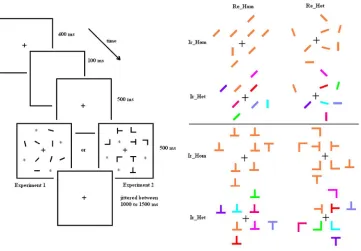
Participants were required to search for a vertically oriented bar in Experiment 1 and for an upright T in Experiment 2. For both search tasks, a 2×2×2 within-participant design was used (see the right panel of Fig. 1 for exemplar stimuli). The first factor was the heterogeneity of the feature values in the task-irrelevant (color) dimension: the color of the display items was either identical (ir_hom) or variable (ir_het). The second factor was the heterogeneity of the distractor features in the task-relevant dimension (bar orientation in Experiment 1; the composition of horizontal and vertical bars to make T and L shapes in Experiment 2): the distractors were either homogeneous (re_hom) or heterogeneous (re_het). The third factor was target presence: a target was present in half the trials and absent in the other half. With two response buttons under the participants’ right index and middle finger, half of them were instructed to respond with their index finger to indicate ‘target-present’ and the middle finger to indicate ‘target-absent’, and vice versa for the other half. Participants were told that the stimuli’s color was entirely task-irrelevant and should therefore be ignored.
The stimuli were presented through an LCD projector onto a rear projection screen 3
For Peer Review
located behind the participant’s head. Participants viewed the screen through an angled mirror on the head-coil. Presentation of stimuli and recording of responses were controlled by Presentation software (http://nbs.neuro-bs.com/). At the start of each trial, a white fixation cross, measuring 0.20° of visual angle, appeared at the center of the black screen for 1000 ms. A black screen of 100 ms was inserted 400 ms after the onset of the fixation marker, so that the cross appeared to flash briefly. This was to warn participants about the upcoming search display, which was presented for 500 ms. The search display consisted of 8 items, each measuring 0.8° × 0.2°, that were randomly presented on each trial at the 12 locations surrounding the fixation cross at an eccentricity of 1.4° (the inner one) and 3° (the outer one) of visual angle. In the present trials, one of the eight items was the target. In the target-absent trials, all of the items presented were distractors. The locations of these items were randomly selected in each trial. After the search display, the fixation cross was presented in the center of the screen for 1000, 1100, 1200, 1300, 1400, or 1500 ms, with a mean of 1250 ms (see the left panel of Fig. 1).
---Insert Fig.1 about here---
Each experimental condition consisted of 48 trials, intermixed with a total of 48 null trials in which only the fixation cross was presented. The eight experimental
conditions and null trials were randomized in one continuous scanning session. In order to accustom participants to the scanning noise and to allow for the MR signal to reach a steady state, only the fixation point was displayed during the first 7.5 seconds. Participants were asked to search for the target and respond as quickly and accurately as possible upon
presentation of the search display. They were instructed to maintain eye fixation on the cross in the display center throughout the whole experiment (see also Nobre et al., 2003; Soto et al., 2007). Before scanning, the observers were familiarized with the task and performed several 3
For Peer Review
practice blocks in which they were explicitly told to maintain fixation during the task. All participants completed a training section of 10 minutes outside the scanner.
fMRI Data Acquisition
A 3T Siemens Trio system with a standard head coil at the MRI Center for Brain Research in Beijing Normal University was used to obtain T2*-weighted echo-planar images (EPI) with blood oxygenation level-dependent (BOLD) contrast (matrix size: 64 × 64, pixel size: 3.4 × 3.4mm. Twenty-four transversal slices of 4 mm thickness, oriented parallel to the anterior and posterior commissures, were acquired sequentially in ascending order with a 1 mm gap (TR=1.5 s, TE=30 ms, FOV=220 mm, flip angle=90º). The slices enabled whole-brain coverage. High-resolution anatomic images were obtained using a standard 3D T1-weighted sequence with 0.9 × 0.9 mm in plane resolution and 1.3 mm slice thickness (256 × 256 matrix). The total of 880 volumes of EPI images were obtained with the first five volumes discarded to allow for T1 equilibration effects. Images were spatially realigned to the sixth volume for head movement correction, coregistered with the anatomical 3D image. The functional images were then normalized by applying the transforming matrix obtained through normalizing anatomical scans to a standard T1 template (Montreal Neurological Institute template provided by Statistical Parametric Mapping [SPM], see below), and by using the “unified-segmentation” function in SPM8 (see below) with a resampling of 2×2×2 mm3 voxels. The data were then smoothed with a Gaussian kernel of 8 mm full-width half-maximum to accommodate inter-subject anatomical variability.
fMRI data analysis
Data were analyzed with SPM8, Wellcome Department of Imaging Neuroscience, London (Friston et al., 1995), employing a random-effects model. At the first level, eight event types were defined. The eight event types represent all combinations of (1) the 3
For Peer Review
heterogeneity of the task-irrelevant dimension, (2) the heterogeneity of the task-relevant dimension, and (3) the target presence. The event type was time-locked to the onset of the search display by a canonical synthetic hemodynamic response function (HRF) implemented in SPM8. Additionally, all error trials (including excluded outliers and “twin data”, see Results section) were included as an extra regressor of no interest in the design matrix. For each participant, simple main effects for each of the eight experimental conditions were computed by applying appropriate baseline contrasts, i.e., the experimental conditions versus the implicit baseline (null trials). The obtained event-type images of all participants were entered into the flexible factorial design with the standard implementation in SPM8 (including an additional factor modeling the participant mean) for calculating the main effects of the task-relevant and -irrelevant dimensions, the simple main effects of the two dimensions separately for target-present and target-absent trials (see Results section), and the interaction effects between the two dimensions in both experiments. The group activations are reported at a family-wise error (FWE) corrected threshold of p<0.05.
Moreover, we examined certain contrasts for individual participants, with the obtained contrast images of the first-level analysis in the two experiments entered into a second-level two-sample t-test for performing between-participants comparisons and for between-participants conjunction analyses across the two experiments (Price and Friston, 1997; Friston et al., 2005). The between-participants contrasts were performed to identify differential activations between the two experiments for the interaction between the task-relevant and task-irrelevant dimensions. The conjunction analysis was carried out to locate the common brain activations related to the main effects of task-irrelevant/task-relevant heterogeneous information across the two experiments, with the “conjunction null” hypothesis being tested (Nichols et al., 2005). Although this between-participants conjunction analysis may not be typical, it can be justified since we 3
For Peer Review
normalized the functional images of different groups of participants in Experiments 1 and 2 to the same standard template in SPM8, so the activation locations for the same contrasts should be comparable between experiments. The between-participants effects were thresholded with p < 0.001, uncorrected at voxel level, and with p<0.05 corrected at cluster level, following previous studies (e.g., Kim et al., 2011; Weissman et al., 2002). The same analyses with FWE correction (p<0.05) would produce a null effect. Note, this conjunction analysis was conducted to identify brain regions that allow us to carry out detailed region-of-interest (ROI) analyses and to illustrate how the activations in these brain areas were modulated by display heterogeneity along the two dimensions and target-presence in each experiment. The ROI analyses were done by extracting beta values within a sphere centered at the peak voxel and with a radius of 5 mm at the activated brain areas in the conjunction analysis. Correlation analyses were then performed for each ROI. Here, each participant’s mean behavioral RT in each experimental condition was taken as one data point, so the mean beta value for each condition. Partial correlations were performed by controlling for the variations along the task-irrelevant dimension, the task-relevant dimension, and target-presence.
Results
Behavioral results
Mean reaction times (RTs) and response error rates were calculated for each of the participants. As shown in Table 1, the error rates were higher for target-present trials (target misses) than for the target-absent trials (false alarms) in both experiments, suggesting a tendency towards “no-target” responses. To correct for potential speed-accuracy trade-offs, we carried out a “kill-the-twin” procedure (Grice et al., 1977; Eriksen, 1988). Twins of error RTs were computed by searching for an RT in correct-rejection or correct-hit trials which corresponded to an error RT (within a range of ±3 ms) on target-miss or false-alarm trials, 3
For Peer Review
respectively. These “twins” RTs were then removed from the “correct” data set. This
procedure, which was carried out separately for different displays for each participant, led to the elimination of 2.7% of the data points for orientation search, and 3.0% for conjunction search. The remaining data were then processed further by the elimination of outlier RTs more than three standard deviations above or below individuals’ mean in each experimental condition (0.9% of the remaining data points for orientation search, 0.7% for conjunction search). RTs in the various experimental conditions with and without error correction are shown in Table 1 and Fig. 2. As can be seen, RT performance did not change as a result of removing the error “twins”; that is, the patterns of RT effects were largely undistorted by potential speed-accuracy trade-offs.
After eliminating the error twin RTs and deleting outliers, RT’s were entered into a 2 (heterogeneous vs. homogeneous along the task-irrelevant dimension) × 2 (heterogeneous vs. homogeneous along the task-relevant dimension) × 2 (target absent vs. present) analysis of variance (ANOVA).
---Insert Table 1 and Fig. 2 about here---
Experiment 1
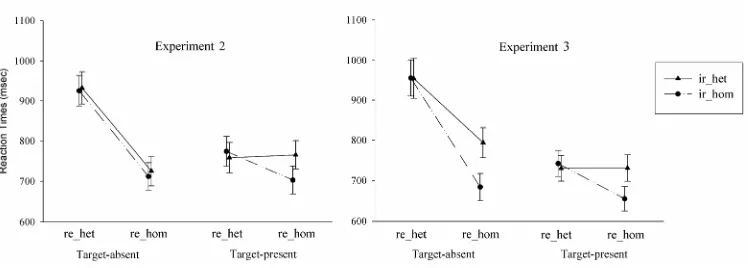
The RT ANOVA revealed all three main effects to be significant: heterogeneity in the task-irrelevant color dimension, with longer RTs in the ir_het versus the ir_hom condition (796 vs. 779 ms), F(1,13)=34.14, p<.001; heterogeneity in the orientation dimension, with longer RTs in re_het versus the re_hom condition (848 vs. 727 ms), F(1,13)=91.27, p<.001; and target presence, with longer RTs on target-absent than on target-present trials (824 vs. 750 ms), F(1,13)=80.10, p<.001. Moreover, heterogeneity in the orientation dimension interacted with heterogeneity in the color dimension, F(1, 13)=30.42, p<.001, and with target presence, F(1, 13)=77.68, p<.001. The three-way interaction was also significant, F(1, 3
For Peer Review
13)=12.55, p<.005. As can be seen from Fig. 2, heterogeneity in the orientation dimension did not interact with heterogeneity in the color dimension for target-absent trials, F(1, 13) < 1, but did interact for target-present trials, F(1, 13)=27.21, p<.001. Further pairwise
comparisons for target-present trials showed that when the task-relevant dimension was heterogeneous, heterogeneity along the irrelevant dimension had no impact on search RTs (759 vs. 744 ms), t(13)=1.93, p>.05; in contrast, when the task-relevant dimension was homogeneous, heterogeneity in the task-irrelevant dimension prolonged the search RTs (766 vs. 703 ms), t(13)=6.51, p<.001.
The error-rate ANOVA revealed a significant main effect of heterogeneity in the color dimension, F(1, 13)=51.57, p<.05, and a significant main effect of target presence, F(1, 13)=456.04, p<.005. Participants made more errors when the item colors were heterogeneous rather than homogeneous (9.6% vs. 6.8%). Also, more errors were produced on target-present than on -absent trials (misses vs. false alarms: 12.4% vs. 4.0%). No other effects reached significance.
Experiment 2
The RT ANOVA again revealed all three main effects to be significant: heterogeneity in the irrelevant color dimension (ir_het vs. ir_hom: 802 vs. 759 ms), F(1,13)=35.94, p<.001, heterogeneity in the task-relevant dimension (re_het vs. re_hom: 846 vs. 716 ms),
F(1,13)=82.92, p<.001, and target presence (target-absent vs. –present: 847 vs. 715 ms ),
F(1,13)=48.40, p<.001. Moreover, heterogeneity in the task-relevant dimension interacted
with heterogeneity in the task-irrelevant dimension, F(1, 13)=45.61, p<.001, and with target presence, F(1, 13)= 60.59, p<.001. The interaction between task-irrelevant dimension and target presence was also significant, F(1, 13)=6.28, p<.05, although the three-way interaction was not, F(1, 13)=1.50, p>.1. As illustrated in Fig. 2, the interaction between heterogeneity in the task-relevant dimension and heterogeneity in the task-irrelevant dimension was 3
For Peer Review
significant for both target-absent and -present trials, F(1, 13)=101.69, p<.001, and F(1, 13)=15.63, p<.005, respectively. Heterogeneity along the task-irrelevant (color) dimension affected RTs only when the distractors in the task-relevant dimension were homogeneous.
The error-rate ANOVA also revealed significant main effects of heterogeneity in the task-irrelevant dimension, F(1, 13)=21.83, p<.001, heterogeneity in the task-relevant
dimension, F(1, 13)=65.15, p<.001, and target presence, F(1, 13)=58.51, p<.001. Participants made more errors when the item colors were different rather than the same (9.3% vs. 5.5%). More errors were made when the distractors were heterogeneous as compared to
homogeneous in the task-relevant dimension (9.3% vs. 5.5%), and more errors on target-present than on -absent trials (false alarms vs. misses: 13.1% vs. 1.7%). The interaction between target presence and heterogeneity along the task-irrelevant dimension was significant, F(1, 13)=17.36, p<.005, as was the interaction between target presence and heterogeneity in the task-relevant dimension, F(1, 13)=6.95, p<.05. These interactions indicated that the heterogeneity along the task-relevant or -irrelevant dimensions gave rise to increased rates of target-miss errors, but not false-alarm errors.
Imaging results
Effects of the heterogeneity in the task-irrelevant dimension
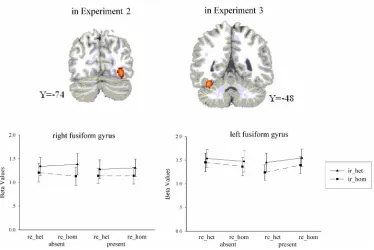
To be consistent with previous imaging studies on visual search (Donner et al., 2000, 2002, 2003; Maximo et al., 2016; Nobre et al., 2003; Wilkinson et al., 2000), target-absent and target-present trials were collapsed first in examining brain activations for the main effects of heterogeneity in the task-relevant and -irrelevant dimensions. The main effect of the task-irrelevant dimension, ir_het (re_het + re_hom) > ir_hom (re_het + re_hom), yielded activation in the posterior part of the right fusiform gyrus in Experiment 1, and the anterior part of the left fusiform gyrus in Experiment 2 (see Table 2 and Fig. 3).
The conjunction analysis of this contrast across the two experiments did not reveal 3
For Peer Review
any common activation. The reversed contrast, ir_hom (re_het + re_hom) > ir_het (re_het + re_hom), did not disclose any activation in either of the experiments.
---Insert Tables 2 and Fig. 3 about here---
Effects of the heterogeneity along the task-relevant dimension
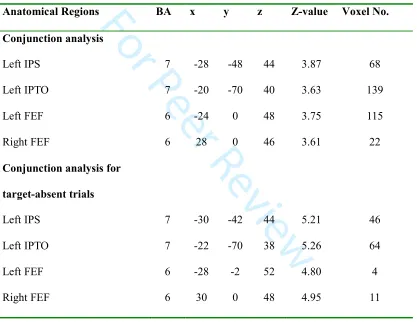
As can be seen from Table 2, separate analysis for each experiment revealed overlapping brain regions responsive to heterogeneity along the task-relevant dimension (orientation in Experiment 1 and form conjunction in Experiment 2). The between-experiment conjunction analysis of the main effect of heterogeneity in the task-relevant dimension, re_het (ir_het + ir_hom) > re_hom (ir_het + ir_hom), showed that the bilateral frontal eye fields (FEF), left anterior part of intraparietal sulcus (IPS), and left junction of intraparietal and transverse occipital sulci (IPTO) were both activated in the two experiments (see Table 3).
The conjunction analysis of the reversed contrast, re_hom (ir_het + ir_hom) > re_het (ir_het + ir_hom), revealed activations in the right superior frontal gyrus (centered at
34/20/42, BA 9, Z=3.76, voxel number=45), left TPJ (centered at -50/-46/48, BA 39, Z=3.45, voxel number=8), and right TPJ (centered at 42/-50/34, BA 39, Z=3.42, voxel number=36), p<0.001, uncorrected, consistent with a similar contrast in Wilkinson et al. (2000) and Wei et
al. (2009) with manipulation in only one dimension.
---Insert Tables 3 and Fig. 4 about here---
The effects of target-presence
Since behavioral data revealed that the heterogeneity in the task-relevant dimension and/or the heterogeneity in the task-irrelevant dimension interacted with 3
For Peer Review
target presence in both experiments, the effects of the task-irrelevant and -relevant dimensions were separately calculated for target-present and target-absent trials. While the effects for target-absent trials exhibited an activation pattern very similar to that when target-absent and target-present trials were collapsed (see Table 2), the same contrasts calculated for target-present trials failed to reveal activations at the same threshold, with the exception of the contrast Re_Hom vs. Re_Het for target-present trials in Experiment 1 which revealed significant activation in the right anterior cingulate cortex (centered at 9/41/4, BA 39, Z=5.81, voxel number=46).
The interaction analysis
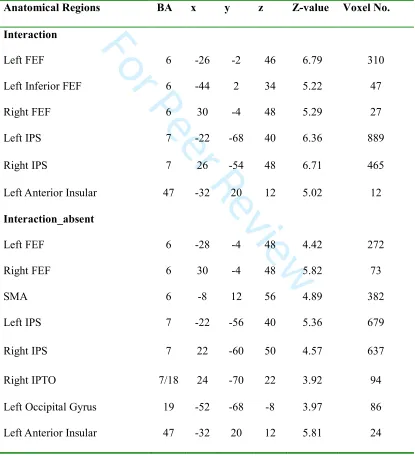
An interaction analysis, re_hom (ir_het – ir_hom) > re_het (ir_het – ir_hom), was conducted for each experiment in order to uncover the neural correlates of the differential effects of heterogeneity in the task-irrelevant dimension when the task-relevant dimension consisted of homogeneous or heterogeneous distractors. This analysis revealed activations in bilateral frontal eye fields, intraparietal sulci, and left anterior insula with FWE correction of p<.05 in conjunction search (see Table 4), but no activation in orientation search. Separate
analyses for target-absent and target-present trials in conjunction search revealed similar pattern of activation for target-absent trials in conjunction search (see Table 4), but no activation in target-present trials.
Moreover, two-sample t-tests over the obtained contrast images of the
interaction between the task-relevant and -irrelevant dimensions revealed that left FEF (centered at -26/-2/42, BA 6, Z=4.20, voxel number=86) and left IPS (centered at -20/-70/48, BA 7, Z=4.33, voxel number=88) were more highly activated for this interaction in conjunction search relative to feature search. These differential effects were again significant for target-absent trials, with activation in left FEF (centered at -30/-6/48, BA 6, Z=4.65, voxel number=161), left IPS (centered at -22/-68/50, BA 7, Z=4.40, voxel 3
For Peer Review
number=205), and right IPS (centered at 26/-68/50, BA 7, Z=4.37, voxel number=109), but not for target-present trials.
---Insert Table 4 about here---
Region-of-interest (ROI) analysis
The bilateral FEFs, left IPS, and left IPTO were activated in both separate analysis for individual experiments and the conjunction analysis of heterogeneous versus homogeneous distractors in the task-relevant dimension across experiments, demonstrating that these
frontoparietal regions are both involved in feature and conjunction search with heterogeneous, task-relevant distractors. To further examine how these effects were modulated by variations in the task-irrelevant dimension and target presence, beta values were extracted from these regions. These beta values, which are illustrated in Fig. 4, were then entered into a 2 (heterogeneous vs. homogeneous along the task-irrelevant color dimension) × 2
(heterogeneous vs. homogeneous along the task-relevant orientation dimension) × 2 (target absent vs. present) ANOVA. As can be seen from Fig. 4, in Experiment 1, all four regions showed a significant interaction between heterogeneity in the task-relevant dimension and target-presence (p<.005 for all regions). For target-absent trials, the beta values were higher when distractors were heterogeneous than when they were homogeneous in the task-relevant dimension. For target-present trials, by contrast, the beta values were comparable whether distractors were heterogeneous or homogeneous in the task-relevant dimension. This pattern is consistent with the whole-brain analyses conducted separately for target-absent and target-present trials in the current study, as well as with our previous findings that it is mainly on the target-absent trials that displays with heterogeneous versus homogeneous distractors along the task-relevant dimension elicited differential involvement of these frontoparietal regions (Wei et al., 2009). Importantly, heterogeneity along the task-irrelevant 3
For Peer Review
and along the task-relevant dimension did not interact with each other.In Experiment 2, the four regions also showed a significant interaction between heterogeneity in the task-relevant dimension and target-presence (p<.001 for all regions). Consistent with the results in Experiment 1 and Wei et al. (2009), the beta values were higher for displays with heterogeneous distractors than for displays with homogeneous distractors in the task-relevant dimension on target-absent trials. These differences, however, disappeared on target-present trials. Importantly, unlike Experiment 1, the heterogeneities in the task-irrelevant and -relevant dimensions interacted with each other (p<.005 for all regions): when distractors were homogeneous in the task-relevant dimension, variation of the task-irrelevant color information increased the activation levels of these regions; when distractors were heterogeneous in the task-relevant dimension, variation of the task-irrelevant color
information had no effect upon the activations in these regions. This interaction pattern was consistent with the pattern in the behavioral data.
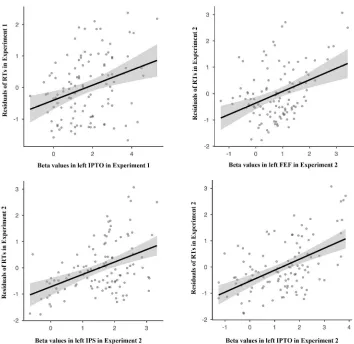
We then performed partial correlation analyses for each experiment, over participants and for each of the four regions (bilateral FEFs, left IPS, and left IPTO), between the mean beta values of each experimental condition and the mean RTs in the respective condition after controlling the variations along the task-irrelevant dimension, the task-relevant
dimension, and target-presence. Partial correlation showed that, for Experiment 1, there were uncorrected correlations between behavioral RTs and the left FEF activation, r=.19, p=.043, the left IPS, r=.19, p=.042, and left IPTO, r=.32, p=.001, but not between RTs and right FEF, r=.16, p=.1. However, only the correlation between RTs and left IPTO was significant after
FDR corrections for multiple comparisons (Benjamini & Hochberg, 1995). The pattern was similar for Experiment 2: there were correlations for left FEF, r=.38, p<.001, left IPS, r=.43, p<.001, and left IPTO, r=.52, p<.001, but not for right FEF, r=.10, p>.1. The correlations for
the former three regions remained significant after FDR corrections. These correlations suggest that these left-hemisphere frontoparietal regions play a significant role in selecting 3
For Peer Review
the target from salient distracting information (see Fig. 5).---Insert Fig. 5 about here---
Discussion
The present study employed feature and conjunction search tasks, together with an orthogonal manipulation of heterogeneity in the task-relevant and task-irrelevant dimensions. In doing so, we found evidence for differential neural substrates involved in the processing of distracting information across the two selected dimensions, and for the differential
involvement of frontoparietal regions in different types of visual search. The behavioral results replicated previous findings (Wei and Zhou, 2006), namely, that heterogeneity in both the task-relevant and task-irrelevant dimensions impacts search RTs, and that task-irrelevant heterogeneous color information affects search RTs only when distractors are homogeneous in the task-relevant dimension. At the neural level, the imaging results showed that
processing the task-irrelevant distracting information engages fusiform areas related to color processing, and that processing the task-relevant distractors activates frontoparietal regions, including bilateral FEF, left IPS, and IPTO, in both feature and conjunction search. Moreover, these frontoparietal regions are involved in the interaction between relevant and task-irrelevant dimensions in conjunction search, but not in feature search.
Processing the task-irrelevant dimension
As mentioned in the Introduction, we chose color as the task-irrelevant feature in order to maximize the chance of observing interference of the task-irrelevant dimension on the target search in the task-relevant dimension – owing to color’s inherently higher bottom-up perceptual saliency compared to orientation or form. Indeed, for the task-irrelevant color dimension, the fusiform gyrus, which is related to color processing (Bartels and Zeki, 2000), was more activated when the to-be-searched items were differently colored than when they 3
For Peer Review
were the same color. This activation was not modulated by heterogeneity along the task-relevant dimension (i.e., orientation or form conjunction). It may thus be taken to reflect automatic processing of the task-irrelevant color information, which interferes with search in the task-relevant orientation or shape dimension, as evidenced by slower RTs in the
heterogeneous conditions. At the present, it is not clear whether the stronger activation in the fusiform areas for heterogeneous displays reflects more active processing of color
information and/or an attempt to suppress the variation of the color information when color is task-irrelevant.
An interesting finding with regard to the processing of color information was that the activation locus was more anterior in the fusiform gyrus for conjunction search (on the left hemisphere) than for orientation search (on the right hemisphere; see Fig. 3). According to Bartels and Zeki (2000), the human color center in the brain consists of two subdivisions, a posterior one (V4) and an anterior one (V4α). While the functional specializations of the two subdivisions are still under investigation, Zeki and Marini (1998) reported that the anterior subdivision is more activated to the ‘correctly’ colored objects (e.g., red strawberries) than to the unconventionally colored objects (e.g., violet strawberries), while the posterior
subdivision shows the reverse pattern. It is possible that only the anterior center processes color information to a higher order, e.g., analyzing its relations with other attributes of the same object. In the current study, the differential activations in the posterior and anterior parts of the fusiform gyrus for feature and conjunction search may reflect different levels of color information processing in the two tasks. Further studies are required to test this
suggestion and to investigate why the right fusiform gyrus was more activated in orientation search, whereas the left fusiform gyrus was more activated in conjunction search.
Processing the task-relevant dimension
In both feature and conjunction search, heterogeneous distractors along the task-3
For Peer Review
relevant dimension engaged activation of frontoparietal regions including bilateral FEF, the left IPS, and IPTO. These regions have been reported for different types of attentional selection, such as biasing attention to a feature dimension (Le et al., 1998; Liu et al., 2003), encoding behavioral relevance (Assad, 2003; Culham and Kanwisher, 2001; Liu et al., 2016; Silk et al., 2010), and top-down filtering of distractors (Friedman-Hill et al., 2003). These regions may work together in effectively setting the top-down attentional bias to the task-relevant dimension, including selection of the top-down defined target among distractors and rejection of distracting information (Ellison et al., 2014; Lane et al., 2012).
There are two reasons why these frontoparietal regions became more activated when the distractors along the task-relevant dimension were heterogeneous rather than
homogeneous. The first is that the distractors in heterogeneous displays consisted of
differently oriented bars in orientation search, and different form conjunctions of the T- and L-types in conjunction search. There was, thus, a greater chance for some distractors to falsely activate the target template (i.e., the accumulator for target-present evidence; Müller and Humphreys, 1993), and then to require these regions to differentiate the target from the confounding distractors. Single-unit recording studies suggest that visual responses in the macaque’s FEF are significantly enhanced when the to-be-searched items include distractors that resemble the target than when the distractors are greatly different from the target (Bichot and Schall, 1999; Sato et al., 2003). Moreover, when target-like distractors happen to falsely activate the target template, or attract focal attention, the necessary distractor rejection and re-checking processes would involve a higher incidence of attention shifts under heterogeneous (vs. homogeneous) distractor condition (Shulman et al., 2003; Geng and Mangun, 2009). The current results suggest that such attentional re-sampling processes are particularly manifested on target-absent trials: on target-absent trials on which search cannot be terminated early (compared with target-present trials), there would be a higher incidence of false attention allocations and thus a greater need for re-3
For Peer Review
checking to establish that there is actually no target present in the display. By contrast, on target-present trials, when the target can be selected and identified relatively more rapidly, variations along the task-relevant dimension would involve fewer extra demands of attentional (re-)selection in these frontoparietal regions, making the
corresponding activations harder to discern. Previous neuroimaging studies (Donner et al., 2000, 2002, 2003; Maximo et al., 2016; Nobre et al., 2003; Wilkinson et al., 2000; but see Wei et al., 2009) typically collapsed the target-absent and target-present trials in examining for differential neural mechanisms involved in different types of visual search (e.g., conjunction vs. feature search, difficult vs. easy search), leaving the issue of the extent to which the reported activations were driven by absent vs. target-present trials unaddressed.
A related reason for this frontoparietal region activation may be that distractors in heterogeneous displays possess higher saliency than distractors in homogeneous displays. Moreover, these frontoparietal regions play a role in biasing processing towards the top-down defined information and in preventing salient distractors from interfering with target search (Chun and Morois, 2002; Friedman-Hill et al., 2003; Madden et al., 2014; Morois et al., 2000). The saliency value of a distractor, signaling the extent to which it differs from other items in its vicinity, would be higher in heterogeneous displays than in homogeneous displays (Sillito et al., 1995; Zhaoping and May, 2007; Wei et al., 2008). Accordingly, suppressing or rejecting heterogeneous distractors would require greater involvement of these frontoparietal regions, especially on target-absent trials. In addition, the correlation analysis revealed a more prominent role of left (as compared to right) frontoparietal regions – including left IPTO in Experiment 1, and left FEF, left IPS, and left IPTO in Experiment 2 – in selecting the task-relevant information in the presence of other, task-irrelevant distracting information during visual search processes. This is consistent with recent studies demonstrating the asymmetrical role of left and right posterior 3
For Peer Review
parietal cortex (PPC) in biasing salience-based selection (Mevorach et al., 2006, 2009). Mevorach et al. (2006) showed that repetitive transcranial magnetic stimulation (rTMS) to the left PPC, but not right PPC, affects the ability to direct attention away from salient stimuli. Thus, our results would suggest that the left PPC plays a special role in selecting the task-relevant information in the presence of other salient, but task-irrelevant information.
The behavioral interaction between the task-relevant and task-irrelevant dimensions observed in both feature and conjunction search is consistent with the ‘perceptual-load theory’ of visual selection (Lavie and Tsal, 1994; Lavie, 2005). According to this theory, attentional resources are limited, and the perceptual load imposed by the processing of relevant
information determines the extent to which irrelevant distracting information is processed. For the current study, when the distractors are heterogeneous in the task-relevant dimension, attentional resources should be largely used up in searching for the target, while the task-irrelevant color information should receive little processing, with little effect of color heterogeneity (see also Xu, 2010). By contrast, when the distractors are homogeneous in the task-relevant dimension, there would be spare attentional resources to be diverted to process the color information, which in turn would interfere with target search when the distractors are heterogeneously colored (see also Wei and Zhou, 2006).
In a recent fMRI study, Xu (2010) asked participants to view a display containing one, two, or six colored sample shapes and then, later, to judge whether a test color matched one of the sample colors. The shapes of the sample items were either the same or different. Activation in lateral occipital cortex (LOC) signaled an interaction between task-relevant color encoding load and the irrelevant shape variations. Also, the processing of task-irrelevant features of sample items depended on the encoding demands of the task-relevant feature. However, the activation in IPS was affected only by the task-relevant color encoding load, not by the task-irrelevant shape variations. The latter finding is consistent with the current Experiment 1, in which the involvement of bilateral FEF, left IPS, and IPTO showed 3
For Peer Review
no interaction between the task-relevant and task-irrelevant dimensions. We believe that the similarity in findings between the two studies is attributable to the fact that both Xu’s (2010) experiment and the present Experiment 1 used a task in which participants were responding to a target defined in terms of a single feature dimension (color in Xu, 2010, orientation in Experiment 1). Taken together, the two studies suggest that activation in IPS for the task-relevant dimension is not affected by whether it is more or less salient than the task-irrelevant dimension, at least for tasks defined by a single feature dimension.
However, when the target is defined in terms of feature combinations, as in the current Experiment 2, activations in frontoparietal regions may exhibit an interaction between the task-relevant and -irrelevant dimensions. As demonstrated by Experiment 2, when there is a high-load task-relevant dimension, activations in these regions may be unaffected by task-irrelevant heterogeneity; however, when the task-relevant dimension imposes a low load, activations in these regions may increase in response to the
heterogeneous task-irrelevant dimension. This pattern of activation suggests a role of these regions, including bilateral FEF, left IPS, and IPTO, in setting up the top-down search mode or attentional control setting.
Previous studies (e.g., Folk et al., 1992, 1994; Eimer and Kiss, 2008) demonstrated that involuntary attention shifts (i.e., attentional capture) are contingent upon the relationship between the properties of the eliciting event and the top-down defined task mode. In the current conjunction search for an upright T, observers had to integrate the horizontal bar with the vertical bar. This conjunction search mode may be extended to the task-irrelevant
dimension, such that the color information is also automatically bound into the object representation. Given that the frontoparietal regions might be involved in binding different features for conjunction search (Arguin et al., 1993; Corbetta et al., 1995; Shafritz et al, 2002; Coull et al, 2003), it is then conceivable that in searching for the target, these regions are more involved in binding, or suppressing the binding, of color information in the 3
For Peer Review
heterogeneous condition than in the homogeneous condition. By contrast, in feature search, observers need to adopt a narrow set focusing on the target-defining feature (i.e., without involving a conjunction process), so that the processing of the task-irrelevant color
information does not affect the level of activation in these frontoparietal regions. It would be of theoretical interest to test whether the IPS activation exhibits an interaction between the task-relevant and task-irrelevant dimensions when participants are asked to encode feature conjunctions under different load conditions, while the heterogeneity along the
task-irrelevant dimension is manipulated, as in Xu (2010). Further, as the current study did not involve conditions in which color was task-relevant, it would be of interests to see whether variation in the shape dimension (a less salient task-irrelevant information) would affect activations in these frontoparietal regions when target detection requires color combination.
In summary, the present study found that processing distracting information along task-relevant and task-irrelevant dimensions involves differential brain mechanisms and that the top-down task set plays a dominant role in determining whether task-irrelevant color information can affect the processing of the task-relevant dimension (orientation, form) in frontoparietal cortex.
3
For Peer Review
AcknowledgementsThis study was supported by grants from the Natural Science Foundation of China (31470979, 31470980, 90920012), from National Basic Research Program of China (973 Program: 2010CB833904), from Beijing Advanced Innovation Center for Imaging
Technology (BAICIT-2016018), and the Support Project of High-level Teachers in Beijing Municipal Universities in the Period of 13th Five-year Plan. Hermann Müller were supported by German Research Foundation (DFG) grants MU 773/14-1 and MU 773/16-1, and Stefan Pollmann by DFG grant CRC779-A4, respectively. We thank Xian Li and Lidan Cui for their help in data analyses. All authors declare no conflict of interests. Electronic mail concerning this study should be addressed to Dr. Xiaolin Zhou, [email protected] or Dr. Ping Wei, [email protected].
For Peer Review
ReferencesAnderson EJ, Mannan SK, Husain M, Rees G, Sumner P, Mort DJ, . . . Kennard C. Involvement of prefrontal cortex in visual search. Experimental Brain Research, 180(2):289-302, 2007.
Arguin M, Jeanette Y, and Cavanagh P. Visual search for features and conjunction targets with an attention deficit. Journal of Cognitive Neuroscience, 5:436-452, 1993.
Assad JA. Neural coding of behavioral relevance in parietal cortex. Current Opinion in Neurobiology, 13:194-197, 2003.
Bartels A and Zeki S. The architecture of the colour centre in the human visual brain: new results and a review. European Journal of Neuroscience, 12:172-193, 2000. Beck DM and Kastner S. Stimulus context modulates competition in human extrastriate
cortex. Nature Neurocscience, 8:1110-1116, 2005.
Benjamini, Y., & Hochberg, Y. (1995). Controlling the false discovery rate: a practical and powerful approach to multiple testing. Journal of the Royal Statistical Society,57(1), 289-300.
Bichot NP and Schall JD. Effects of similarity and history on neural mechanisms of visual selection. Nature Neuroscience, 2:549-554, 1999.
Chun MM and Marois R. The dark side of visual attention. Current Opinion in Neurobiology, 12:184-189, 2002.
Corbetta M, Shulman GL, Miezin FM, and Petersen SE. Superior parietal cortex activation during spatial attention shifts and visual feature conjunction. Science, 270:802-805, 1995.
Coull JT, Walsh V, Frith CD, and Nobre AC. Distinct neural substrates for visual search amongst spatial versus temporal distractors. Cognitive Brain Research, 17 368–379, 2003.
Culham JC and Kanwisher NG. Neuroimaging of cognitive functions in human parietal cortex. Current Opinion in Neurobiology, 11:157-163, 2001.
Donner TH, Kettermann A, Diesch E, Ostendorf F, Villringer A, and Brandt SA. Involvement of the human frontal eye field and multiple parietal areas in covert visual selection during conjunction search. European Journal of Neuroscience, 12:3407-3414, 2000. Donner TH, Kettermann A, Diesch E, Ostendorf F, Villringer A, and Brandt SA.Visual feature
and conjunction searches of equal difficulty engage only partially overlapping frontoparietal networks. NeuroImage, 15:16-25, 2002.
Donner TH, Kettermann A, Diesch E, Villringer A, and Brandt SA. Parietal activation during 3
For Peer Review
visual search in the absence of multiple distractors. Neuroreport, 14:2257-2261, 2003. Duncan J. Attention and reading: Wholes and parts in shape recognition: A tutorial review In
Coltheart M (Ed), Attention and Performance XII: The Psychology of Reading. London: Lawrence Erlbaum Associates, 1987: 39-61.
Duncan J and Humphreys GW. Visual-search and stimulus similarity. Psychological Review, 96:433-458, 1989.
Duncan J and Humphreys GW. Beyond the search surface: visual search and attentional engagement. Journal of Experimental Psychology: Human Perception and Performance, 18:578-588, 1992.
Eimer M and Kiss M. Involuntary attentional capture is determined by task set: Evidence from event-related brain potentials. Journal of Cognitive Neuroscience, 20:1423-1433, 2008.
Eimer, M., & Grubert, A. (2014). The gradual emergence of spatially selective target processing in visual search: from feature-specific to object-based attentional control. Journal of Experimental Psychology Human Perception &
Performance, 40(5), 1819-1831.
Ellison A, Ball KL, Moseley P, Dowsett J, Smith DT, Weis S, & Lane AR. Functional interaction between right parietal and bilateral frontal cortices during visual search tasks revealed using functional magnetic imaging and transcranial direct current stimulation. PLoS One, 9(4), e93767, 2014.
Eriksen CW. A source of error in attempts to distinguish coactivation from separate activation in the perception of redundant targets. Perception and Psychophysics, 44:191-193, 1988.
Fairhall SL, Indovina I, Driver J, & Macaluso E. The brain network underlying serial visual search: comparing overt and covert spatial orienting, for activations and for effective connectivity. Cereb Cortex, 19(12), 2946-2958, 2009
Folk CL, Remington RW, and Johnston JC. Involuntary covert orienting is contingent on attentional control settings. Journal of Experimental Psychology: Human Perception and Performance, 18:1030-1044, 1992.
Folk CL, Remington RW, and Wright JH. The structure of attentional control: contingent attentional capture by apparent motion abrupt onset and color. Journal of
Experimental Psychology: Human Perception and Performance, 20:317-329, 1994. Friedman-Hill SR, Robertson LC, Ungerleider LG, and Desimone R. Posterior parietal cortex
and the filtering of distractors. Proceedings of the National Academy of Sciences USA, 3
For Peer Review
100:4263-4268, 2003.Friston KJ, Holmes AP, Poline JB, Grasby PJ, Williams SC, Frackowiak RS, and Turner R. Analysis of fMRI time series revisited. NeuroImage, 2:45-53, 1995.
Friston KJ, Penny WD, and Glaser DE. Conjunction revisited. NeuroImage, 25:661-667, 2005.
Geng JJ and Mangun GR. Anterior intraparietal sulcus is sensitive to bottom-up attention driven by stimulus salience. Journal of Cognitive Neuroscience, 218:1584-1601, 2009. Geringswald, F., Herbik, A., Hoffmann, M. B., & Pollmann, S. (2013). Contextual cueing
impairment in patients with age-related macular degeneration. J Vis, 13(3). Grice GR, Nullmeyer R, and Spiker VA. Application of variable criterion theory to choice
reaction time. Perception and Psychophysics, 22:431-449, 1977.
Kim, C., Johnson, N.F., Cilles, S.E., Gold, B.T. (2011). Common and distinct mechanisms of cognitive flexibility in prefrontal cortex. Journal of Neuroscience, 31, 4771– 4779.
Kiss, M., Grubert, A., & Eimer, M. (2013). Top-down task sets for combined features: behavioral and electrophysiological evidence for two stages in attentional object selection. Attention Perception & Psychophysics,75(2), 216-228.
Lane, A. R., Smith, D. T., Schenk, T., & Ellison, A. (2012). The involvement of posterior parietal cortex and frontal eye fields in spatially primed visual search. Brain Stimul, 5(1), 11-17.
Lavie N. Distracted and confused?: selective attention under load. Trends in Cognitive Sciences, 9:75-82, 2005.
Lavie N and Tsal Y. Perceptual load as a major determinant of the locus of selection in visual attention. Perception and Psychophysics, 56:183-197, 1994.
Le TH, Pardo JV, and Hu X. 4 T-fMRI study of non-spatial shifting of selective attention: Cerebellar and parietal contributions. Journal of Neurophysiology, 79:1535-1548, 1998.
Leonards U, Sunaert S, Hecke PV, and Orban GA. Attention mechanisms in visual search - An fMRI study. Journal of Cognitive Neuroscience, 12:61-75, 2000.
Liu T, Slotnick S, Serences J, and Yantis S. Cortical mechanisms of feature-based attentional control. Cerebral Cortex, 13:1334-1343, 2003.
Liu Y, Bengson J, Huang H, Mangun GR, Ding M. Top-down Modulation of Neural Activity in Anticipatory Visual Attention: Control Mechanisms Revealed by Simultaneous EEG-fMRI. Cerebral Cortex, 26:517-529, 2016.
For Peer Review
Madden, D. J., Parks, E. L., Davis, S. W., Diaz, M. T., Potter, G. G., & Chou, Y., et al. (2014). Age mediation of frontoparietal activation during visual feature
search. Neuroimage, 102:262-274.
Maximo, J. O., Neupane, A., Saxena, N., Joseph, R. M., & Kana, R. K. (2016). Task-dependent changes in frontal-parietal activation and connectivity during visual search. Brain Connectivity, 6(4), 335-344.
Marois R, Chun MM, and Gore JC. Neural correlates of the attentional blink. Neuron, 28:299-308, 2000.
Mevorach C, Humphreys GW, and Shalev L. Opposite biases in salience-based selection for the left and right posterior parietal cortex. Nature Neuroscience, 9:740-742, 2006. Mevorach C, Shalev L, Allen HA, and Humphreys GW. The left intrapariatel sulcus
modulates the selection of low salient stimuli. Journal of Cognitive Neuroscience, 21: 303-315, 2009.
Moran J and Desimone R. Selective attention gates visual processing in extrastriate cortex. Science, 229:782-784, 1985.
Müller HJ and Humphreys GW. A connectionist model of visual search for simple form conjunctions. In Brogan D, Gale A, and Carr K (Eds), Visual Search 2. London: Taylor and Francis, 1993: 61-71.
Nakayama, K., & Martini, P. (2011). Situating visual search. Vision Res, 51(13), 1526-1537. Nako, R., Grubert, A., & Eimer, M. (2016). Category-based guidance of spatial attention
during visual search for feature conjunctions. Journal of Experimental Psychology Human Perception & Performance,42(10), 1571–1586.
Nichols, T.E., Brett, M., Andersson, J., Wager, T., Poline, J.B. (2005). Valid conjunction inference with the minimum statistic. NeuroImage, 25, 653–660.
Nobre AC, Coull JT, Walsh V, and Frith CD. Brain activations during visual search: Contributions of search efficiency versus feature binding. NeuroImage, 18:91-103, 2003.
Pantazatos, S. P., Yanagihara, T. K., Zhang, X., Meitzler, T., & Hirsch, J. (2012). Frontal- occipital connectivity during visual search. Brain Connectivity, 2(3), 164-175. Price CJ and Friston KJ. Cognitive conjunction: A new approach to brain activation
experiments. NeuroImage, 5,261-270, 1997.
Rangelov, D., Müller, H. J., & Zehetleitner, M. (2013). Visual search for feature singletons: Multiple mechanisms produce sequence effects in visual search.
Journal of Vision, 13(3):22, 1–16. 3
For Peer Review
Reeder, R. R., Hanke, M., & Pollmann, S. (2017). Task relevance modulates the cortical representation of feature conjunctions in the target template. Scientific Reports, 7(1), 4514.
Reeder, R. Olivers, C.N.L. & Pollmann, S. (2017). Cortical evidence for negative search templates. Visual Cognition, 25 (1-3), 278-290,
doi:10.1080/13506285.2017.1339755.
Sato TR, Watanabe K, Thompson KG, and Schall JD. Effect of target-distractor similarity on FEF visual selection in the absence of the target. Experimental Brain Research, 151:356-363, 2003.
Serences JT, Shomstein S, Leber AB, Golay X, Egeth HE, and Yantis S. Coordination of voluntary and stimulus-driven attentional control in human cortex. Psychological Science, 16:114-122, 2005.
Shafritz KM, Gore JC, and Marois R. The role of the parietal cortex in visual feature binding. Proceedings of the National Academy of Sciences USA, 99:10917-10922, 2002. Shulman GL, McAvoy MP, Cowan MC, Astafiev SV, Tansy AP, d'Avossa G, and Corbetta M.
Quantitative analysis of attention and detection signals during visual search. Journal of Neurophysiology, 90:3384-3397, 2003.
Shulman GL, Astafiev SV, McAvoy MP, d'Avossa G, and Corbetta M. Right TPJ deactivation during visual search: Functional significance and support for a filter hypothesis. Cerebral Cortex, 17:2625-2633, 2007.
Shulman, G. L., Pope, D. L. W., Astafiev, S. V., Mcavoy, M. P., Snyder, A. Z., & Corbetta, M. (2010). Right hemisphere dominance during spatial selective attention and target detection occurs outside the dorsal frontoparietal network. Journal of Neuroscience, 30(10), 3640-51.
Silk TJ, Bellgrove MA, Wrafter P, Mattingley JB, & Cunnington R. (2010). Spatial working memory and spatial attention rely on common neural processes in the intraparietal sulcus. Neuroimage, 53(2), 718-724.
Sillito AM, Grieve KL, Jones HE, Cudeiro J, and Davis J. Visual cortical mechanisms detecting focal orientation discontinuities. Nature, 378:492-496, 1995.
Soto D, Humphreys GW, and Rotshtein P. Dissociating the neural mechanisms of memory-based guidance of visual selection. Proceedings of the National Academy of Sciences USA, 104:17186-17191, 2007.
Theeuwes J. Cross-dimensional perceptual selectivity. Perception and Psychophysics, 50:184-193, 1991.
For Peer Review
Theeuwes J. Percptual selectivity for color and form. Perception and Psychophysics, 51:599-606, 1992.
Treisman A. Features and objects: The fourteenth Bartlett memorial lecture. Quarterly Journal of Experimental Psychology, 40:201-237, 1988.
Vossel, S., Weidner, R., Moos, K., & Fink, G. R. (2016). Individual attentional selection capacities are reflected in interhemispheric connectivity of the parietal
cortex. Neuroimage, 129, 148-158.
Wei P and Zhou X. Processing multidimensional objects under different perceptual loads: The priority of bottom-up perceptual saliency. Brain Research, 1114:113-124, 2006. Wei P, Lü J, Müller HJ, and Zhou X. Searching for two feature singletons in the visual scene:
The localized attentional interference effect. Experimental Brain Research, 185:175-188, 2008.
Wei P, Müller HJ, Pollmann S, and Zhou X. Neural basis of interaction between target presence and display homogeneity in visual search: An fMRI study. NeuroImage, 45:993-1001, 2009.
Weissman, D.H., Mangun, G.R., Woldorff, M.G. (2002). A role for top-down attentional orienting during interference between global and local aspects of hierarchical stimuli. Neuroimage, 17, 1266–1276.
Wilkinson DT, Halligan PW, Henson RNA, and Dolan RJ. The effects of interdistracter similarity on search processes in superior parietal cortex. NeuroImage, 15:611-619, 2002.
Wolfe, J. M. (2007). Guided Search 4.0: Current Progress with a model of visual search. In W. Gray (Ed.), Integrated Models of Cognitive Systems (pp. 99-119). New York: Oxford.
Wolfe JM, Friedman-Hill SR, Stewart MI, and O’Connell KM. The role of categorization in visual search for orientation. Journal of Experimental Psychology: Human Perception and Performance, 18:34-49, 1992.
Xu Y. The neural fate of task-irrelevant features in object-based processing. Journal of Neuroscience, 30:14020-14028, 2010.
Zeki S and Marini L. Three cortical stages of color processing in the human brain. Brain, 121:1669-1685, 1998.
Zhaoping L and May KA. Psychophysical tests of the hypothesis of a bottom-up saliency map in primary visual cortex. PLoS Computational Biology, 3:616-633, 2007.
For Peer Review
Figure LegendsFig. 1. (a) Example of trial sequence and exemplar display with target-present in Experiment 1 or Experiment 2. Stars (not shown in the real search display) in the display examples here are the remaining 4 positions after 8 were randomly selected from the total 12 possible positions for search items to be displayed. The four experimental conditions of target-present trials in Experiment 1 (b) and in Experiment 2 (c) in terms of variations along the task-relevant and task-irtask-relevant conditions. Re_hom = task-relevant dimension has homogeneous distractors, Re_het = relevant dimension has heterogeneous distractors, Ir_hom = irrelevant dimension has homogeneous colors, and Ir_het = irrelevant dimension has heterogeneous colors.
Fig. 2. Behavioral results. RTs (msec) with standard errors in terms of the experimental conditions in Experiments 1 and 2. See abbreviations in the legends of Figure 1. The exact positions of the same x-axis values are jittered.
Fig. 3. The brain activations related to processing task-irrelevant heterogeneous information (ir_het vs. ir_hom) in Experiments 1 and 2, and the extracted beta values from these two regions.
Fig. 4. The activated regions (bilateral FEF, left IPS, and left IPTO) involved in the
conjunction analysis of re_het vs. re_hom across two experiments. The extracted beta values from these regions are reported in terms of the experimental conditions in both experiments.
Fig. 5. Correlation between beta values in frontoparietal brain regions (left IPTO in 3