BIROn - Birkbeck Institutional Research Online
Floricel, S. and Michela, J. and Piperca, Sorin (2016) Complexity,
uncertainty-reduction strategies and project performance.
International
Journal of Project Management 34 , pp. 1360-1383. ISSN 0263-7863.
Downloaded from:
Usage Guidelines:
Please refer to usage guidelines at or alternatively
Complexity, uncertainty-reduction strategies, and project performance
Serghei Floricel
University of Quebec, Montreal
John L. Michela
University of Waterloo, Ontario, Canada
Sorin Piperca
University of Quebec, Montreal
Acknowledgements: Research reported in this paper was supported by an Ordinary Research Grant from the Social Sciences and Humanities Research Council of Canada (Project title: “Increasing the response capacity of complex projects: Preparing for the unknown in the planning stage.”) and by a an academic research grant from the Project Management Institute (Project title: “Increasing project flexibility: Preparing for the unknown in the concept stage.”)
Complexity, uncertainty-reduction strategies, and project performance
ABSTRACT
This paper investigates how complexity influences projects and their performance. We develop a classification of project complexity by relying on fundamental insights about complexity and then use results from practice-oriented literature to assign concrete project complexity factors to the resulting categories. We also identify specific strategies for knowledge production and for organizing that project planners use to address complexity-related uncertainties. We theorize about the way these strategies interact with various types of complexity to increase project performance. Anticipated influences are mostly corroborated using survey data on 81 complex projects from five continents and a diversity of sectors. Keywords: complexity; uncertainty; planning; knowledge; organization.
1. Introduction
This paper aims to advance our understanding of project complexity and how planning-stage
strategies can address it. Complexity is a major source of uncertainty and risk in projects, which
produces additional costs and affects project performance if participants fail to address it from
the planning stage (Shenhar 2001; Williams 1999). While project management scholars have
made inroads in understanding complexity, efforts to understand its concrete manifestations, the
difficulties it creates, and how these could be managed are hindered by the inability to connect
two relevant streams of research (Geraldi, Maylor & Williams 2011). One stream builds on
fundamental advances, such as highly abstract complexity studies at the Santa Fe Institute, to
critically reassess project management prescriptions (Cooke-Davies et al. 2007). While this
stream addresses the practices for managing project complexity, its abstract roots hamper a move
from criticism to concrete, empirically validated and actionable recommendations. A second,
practice-oriented stream focuses on mapping a vast diversity of concrete factors that increase
project complexity (Maylor, Vigden & Carver 2008; Bosch-Rekveldt et al. 2011). This
identification and prioritization effort relies on surveying managers’ opinions, based on the
implicit assumption that each factor adds separately to project uncertainty and risk, raising
planning and management difficulties, and affecting performance. But the supposed relations
between complexity factors and project outcomes lack theoretical base and empirical validation
(Geraldi et al. 2011; Xia & Lee 2005). The choice of practices is also left implicit, based on the
assumption that factor awareness already takes a big step towards managing complexity.
In this paper, we attempt to provide a theoretical basis for the relation between concrete
aspects of project complexity, the efficacy of planning practices and project performance. In this
theoretical development, we rely on three premises, each underpinning a distinct contribution of
this paper. First, we assume that conceptual issues can be solved by a theoretical framework set
midway between generic abstractions and practical classifications of project complexity. With
this premise, we rely on the general literature on complexity (Anderson 1999), and on efforts to
grasp its specifics in domains such as large systems and infrastructure, biotechnology, software,
and sociology, to derive a small set of dimensions that characterize complexity and its effects.
Then, based on the practical literature on project complexity (Bosch-Rekveldt et al. 2011) we
relate these dimensions to concrete project aspects, such as technology and organization, as well
as market and regulatory environments. Our second assumption is that the efficacy of
planning-stage strategies in addressing complexity is rooted in the extent to which they enable project
organizations to, broadly speaking, represent the specific complexities of a project, of its environment and of relevant processes. With this basis, we build on innovation and organization
literatures to characterize the representational ability of project organizations and to theorize how
it translates into a capacity to develop and apply preventive measures and corrective actions that
minimize risks and keep projects on track for success. In particular, we suggest how concrete
planning-stage strategies that put in place knowledge production processes and
contractual-organizational forms relate to these capacities (Floricel & Miller 2001; Sommer & Loch 2004).
Our third assumption is that strategies adopted in a project help improve performance only if
they match the particular complexity affecting that project. This premise and the emerging
theoretical framework enable us to derive hypotheses about mutual influences between project
complexity, planning-stage strategies, and project performance, and then to corroborate these
Results indicate that the direct influence of complexity on performance is not as
straightforward as the literature suggests. Moreover, some planning-stage strategies interact with
certain complexity factors and these interactions have a beneficial effect on completion,
innovation and operation performance in projects. These results help untangle the nexus of
influences between complexity and performance, and have practical implications, by suggesting
that strategies adapted to the type and level of complexity mitigate risk with respect to various
performance indicators. The paper proceeds as follows. In section 2, we review the literature on
complexity, its representation and ensuing challenges in order to establish a basis for our
theoretical framework. In section 3, we characterize planning-stage strategies and derive
hypotheses about their effect on project performance. Section 4 describes empirical methods,
whereas section 5 outlines results. Section 6 discusses results and draws conclusions from them.
2. Complexity in theory and project management practice
The nature and consequences of complexity have become prominent topics in fields such as
philosophy and mathematics (Bunge 1979; Thom 1974); physics, chemistry and biology
(Prigogine 1997; Mayr 2000); to computer science (Ashby 1958; Simon 1962); technology and
engineering (Kim & Wilemon 2003; Lu & Suh, 2009); and social sciences, including economics
and management (Luhmann 1995; Levinthal 1997). The generic literature on complexity still
debates its definition and nature (Whitty & Maylor 2009). A fundamental issue is whether
complexity is an intrinsic property of an objective reality, of the ‘world out there’, or stems from
limitations of, broadly speaking, the cognitive systems that represent the world. But most
contributions on both sides of the debate see the origin of complexity in particular relations or
interactions between the elements composing systemic entities, which produce unpredictable
properties and evolutions in these systems, or preclude their adequate representation. Research
focusing on complexity as an intrinsic property of the reality can be, in turn, divided in two
Structural complexity. The static stream focuses on interactions between component entities that produce unexpected forms and properties in higher-level systems, which cannot be
explained, reduced to, or deduced from the properties of component entities, including their
propensities for interaction. For example, properties of cells, organs and living beings cannot all
be reduced to the properties of component molecules, including genes and proteins (Sauer et al.
2007). Likewise, some properties of project organizations cannot be reduced to properties of the
individuals composing them (Crossley 2011). System philosophers call this possibility
‘emergence’ and argue that it gives higher-level entities a distinct ontological status; emergent
entities exist in their own right, apart from their components (Bunge 1979; Simon 1981).
Complexity in this structural sense increases with the ‘non-additive’ character of component
aggregation. While fundamental researchers still debate the nature of emergence and
non-additivity (Sawyer 2001; Wimsatt 2006), studies of concrete relations, couplings or interactions
between lower level entities have produced conclusions that help us grasp project complexity.
These studies trace the complexity of artificial systems, including project artifacts, to functional
or secondary interactions between components or their properties (Alexander 1964; Simondon
1989), and track aggregate properties of project networks and organizations, such as flexibility
and creativity, to patterns of interactions between actors (Burt 1992).
On top of ‘upward’ emergence, scholars have traced structural complexity to ‘downward
conditioning’ of components by higher level systems, or to mutual influences between levels
(Kontopoulos 1993). Such ‘vertical’ interactions boost unpredictability and reduce control in
projects dealing, for instance, with biological entities, featuring up to nine emergent organization
levels (Kohl & Noble 2009), or information and communication systems, having as many as
seven distinct architectural layers (Hanseth et al. 1996). In the social realm, several aggregation
levels, from individuals, teams and organizations to sectors, nations and global systems, interact
to shape phenomena (Meyer & Rowan, 1977; Giddens, 1984; Lundvall, 1993; Malerba, 2002).
systems. Some researchers focus on structural conditions, such as the number of relevant
variables and of interactions between them, to suggest how they produce cyclical,
path-dependent, chaotic or random change patterns (Dooley & Van de Ven 1999). Others seek generic
causal mechanisms or ‘change engines’, such as evolutionary variation-selection-retention
sequences, or dialectic processes relying on conflict and paradoxes (Campbell, 1960; Smith &
Lewis 2011; Van de Ven & Poole 1995), whose outcomes are more difficult to predict and
master than those, let’s say, of teleological (goal-directed) or life-cycle engines. Mastering
dynamic complexity helps projects involving unpredictable material processes—from ground
instability and materials fatigue, to flows of gases, fluids and energy, and to biological
pathways—achieve useful functions, predict dangerous events and avoid catastrophic failure. But
particular attention to dynamic complexity has come from social scientists, who study dynamic
engines and temporal patterns (Hernes 2008), from cycles and lifecycles (Klepper 1997; Vohora
et al. 2004; Helfat & Peteraf 2003); unpredictable yet path-dependent structuring from repeated
interactions between actors (Barley 1986; Coleman 1966; Feldman & Pentland 2003); sudden or
radical restructuring (Gersick 1991); to nonlinear, self-reinforcing dynamics that amplify minor
events into sweeping changes (Arthur 1989). Some writers even see organizing as an ongoing
process in a world of intersecting event strands, and entities as mere cognitive artifacts or a
fragile result of recurring processes (Tsoukas & Chia 2002; Hernes & Weik 2007).
Representational complexity. Both static and dynamic views discussed so far implicitly assume that complexity is an intrinsic property of reality. But others see complexity as resulting
from the inability of actors and organizations to represent the reality and its dynamics, what we
call the correspondence problem. Even those assuming that the world is knowable agree that our
most advanced representations are not perfect. For example, research on innovation has found
that abstract scientific knowledge and even more specific engineering formulas cannot capture
the properties (irregular form, composition, texture, flows, reactions) and multiple interactions
that characterize natural and artificial objects (Kline 1987; Nightingale 1998). Biochemistry and
workings, or to define the functional organization of the human brain, to try and reproduce its
performance (Noble 2002; Schwartz 2015). Artificial intelligence researchers point out that even
assuming that relevant objects could somehow be mirrored, say, by a string of bits, using some
of these representations is beyond actors’ conceptual and computational abilities (Biggiero 2001;
Tergaden et al. 1995; Katina et al. 2014). Hence they define and measure complexity as the
difficulty of identifying object regularities and capturing these in a simplified representation, and
as the computational effort required for retrieving the initial object form with some degree of
precision (Kolmogorov 1965; Goertzel 1992; Gell-Mann & Lloyd 1996). Such hardships explain
why iterative trial and error still dominates the design of complex technical objects (Vincenti
1990), and why, despite scientific advances, pharma and biotech projects have such low success
rates and still rely on massive trial and error instead of rational design (Nightingale & Martin
2004; Mandal et al. 2009). Partial, implicit or practical representations obtained through
empirical or experimental approaches may reduce the ‘distance’ between complex reality and its
depiction. But the frequent experiment replication failures (Begley & Ellis 2012), the fragility of
statistical inference (Taleb 2007), and snags in high-reliability technical systems (Perrow 1984;
Leveson et al. 2009; Saunders 2015) all show that they hardly solve the correspondence problem.
The origin of this ‘distance’ becomes even more evident when the entities that produce
representations are no longer seen as abstract knowers but as concrete systems. Perception and
cognition studies in psychology and neuroscience (Rosch 1978; Weick et al. 2005; Hodgkinson
& Healey 2011), and theories of social construction of reality (Berger & Luckmann 1966;
Bourdieu 1977) reveal that representations are not mirroring the external reality but result from
constructive processes such as selecting, amplifying, attributing causes, legitimizing, habituating
and forgetting. Even scientific and technological knowledge, including that supporting societal
perceptions of risk in projects, is seen as a product of similar cognitive and social construction
processes (Latour & Woolgar 1979; Douglas & Wildavsky 1982; Bijker et al. 1987; Beck 1992).
Organizational fields promote and institutionalize a wide range of doubtful representations, from
& Rao 1997) to models of organizing (Meyer & Rowan 1977; Abrahamson 1991). Such beliefs
and assumptions shape project rationales and forms, while models such as
Build-Operate-Transfer, Public-Private Partnerships or Scrum influence their organizing. Some theorists go
even further, by arguing that mirroring reality is not even the purpose of representations, which
is, in fact, enabling the survival of entities producing them. Entities from microorganisms and
individuals to organizations, organizational fields, and entire societies are self-organizing and
self-referential communication systems, which set boundaries and differentiate internally, as well
as detect, interpret and react to external signals only in reference to their own reproduction goal
(Maturana & Varela 1980; Luhmann 1995). This perspective plays a key role in our framework.
Classifying project complexity in practice. The structural-dynamic and representational- intrinsic distinctions identified in our review of complexity can be seen as reflecting fundamental
aspects of the world in which we live. For this reason, we adopted them as basic dimensions of a
framework used to understand project complexity and its effects. But, research on self-referential
communication systems suggests that the ‘objective’ properties of the ‘reality out there’ are not
necessarily what an ‘internal’ system formed by project planners (as we focus on planning-stage
strategies) would distinguish and address. The sensitivity to complexity aspects of a representing
system formed by the emerging project organization (Koskinen 2012) is conditioned instead by
the goal of ensuring its own survival, namely acquiring resources and growing to develop and
execute the project. Representing the relevant complexity can be seen as the starting point in the
self-reproduction of this communication system. This nature of this representation is shaped by
two influences. First, objective conditions, and ensuing problems, if these are disregarded, push
the system to reduce the ‘distance’ between its internal complexity and the complexity of the
represented system—the project with its environments and processes (Ashby 1958). Second, the
representation feeds on planners’ understanding of complexity, which builds on their subjective
interpretation of past experience, but also on a socially constructed world of distinctions about
project complexity and practices for addressing it. This second influence suggests that our two
the world, its intelligibility and its dynamics, but mainly from a phenomenological perspective,
to understand whether and how planners make similar distinctions in the course of their normal
activities, what project factors they associate more frequently with which categories, and what
practices they adopt to ensure the survival of the project system. Concretely, for our theorizing,
this meant adopting practitioners’ perspective and imagining how planners perceive and interpret
relevant complexity aspects but also using practice-oriented project management literature and
research-oriented contributions that respond to practical problems or study everyday practice to
identify concepts and models that practitioners would use to make sense of, and legitimate their
interpretations. This helped us reinterpret the two dimensions derived from fundamental theory
into similar distinctions that reflect the planners’ perspective, as explained below.
First, we assumed the intrinsic-representational distinction to imply that planners see
complexity aspects either as intrinsic in the ‘world out there’ or as resulting from imperfections
in their own representations. Reliability and systems safety engineers make just this distinction
when they set apart stochastic from epistemic uncertainty (Helton & Oberkampf 2004). From
this vantage point, a project aspect is intrinsically complex if confusion with respect to factors,
interactions levels and engines appears to deny planners any possibility of internal representation
that would enable an adequate anticipation or control of that aspect in practice (Biggiero 2001).
In light of system survival goals, an added marker of intrinsic complexity is planners’ preference
for representations in the form of basic frameworks that help them make sense of forms and
evolutions in relevant systems but also provide a terminology that legitimates decisions while
limiting accountability for eventual failures. On the other hand, representational complexity
relates to aspects for which prediction- and control-enabling internal representations appear
possible in practice, but raise modeling and computation challenges, often leading to anticipation
and control failures. Planners would, in this case, attempt to supplement anticipatory models with
experimental, empirical and practical approaches to gradually improve internal representations.
A similar approach was used for the structural-dynamic distinction. If complexity to be
factors and interactions that shape the relevant project aspect. This translates in system properties
that differ from planners’ anticipation. Survival is advanced by stressing cognitive and structural
differentiation that increases the sensitivity and selectivity of the planning team to various levels
and factors, communicative ties that help detect and convey interactions, and integrative abilities
that detect patterns and translate them as operational routines (Henderson & Clark 1990). When
complexity is dynamic, the ‘distance’ comes from differences between internal anticipations and
velocities and patterns of change in external systems. Its’ indicators are event unexpectedness,
perceptual discontinuity and self-referential confusion (Luhmann 1993). Its reduction hinges on
the ability to update internal representations, by maintaining alertness and sensitivity to incoming
signals, rapidly making sense of novel conditions and engines, and restructuring communicative
ties and routines accordingly (Weick & Roberts 1993; Lampel et al. 2009, Teece 2007).
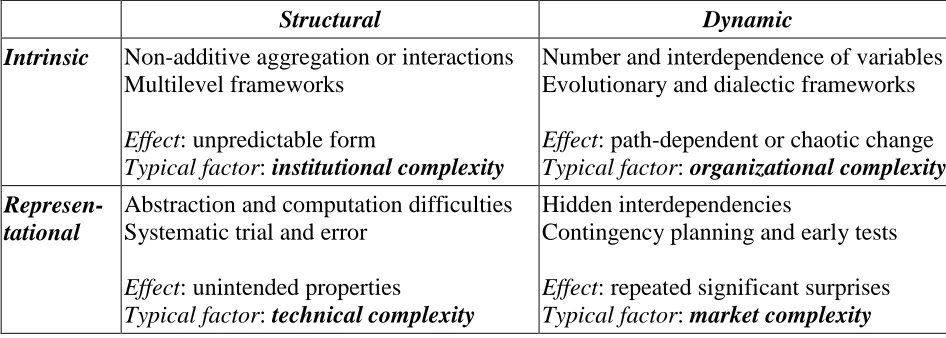
These reinterpreted distinctions and markers enable us to classify concrete manifestations
of project complexity into four quadrants. Since we adopted the planners’ perspective, we sought
expressions of complexity in the project management field. As mentioned in the introduction, the
practical stream attempts to map a vast diversity of complexity factors, and distinguish them by
project domains or aspects (Tegarden et al. 1995). Its reliance on eliciting managers’ opinions
suits our goals because results are close to planners’ situated understanding. In one of the most
exhaustive efforts of this stream, Bosch-Rekveldt’s et al. (2011) inventoried 50 factors and
classified them in three categories: technological, organizational, and environmental, creating
what they call the TOE framework. We relied on this framework but instead of analyzing each of
these factors, we tried, as a first step, to position their categories relative to our four quadrants.
We only subdivided their ‘environment’ category, into ‘institutional’ and ‘market’, because, in
our view presented later, institutional factors point to dynamic complexity, while market factors,
to structural complexity. For each category, we also derive direct consequences for planning and
an overall impact on performance. The resulting complexity framework is presented in Table 1.
In practice, planners have no hope to design or control the respective project aspect but leave its
shaping to mutual interactions between relevant elements and levels, including their own inputs.
Among the four factor categories, we believe that institutional complexity is best placed in this
quadrant. The complexity of this factor stems from interactions with the management systems of
parent organizations, stakeholders and broader networks of interested organizations, and political
and regulatory bodies. While planners try actively to influence this area (Pfeffer & Salancik
1978; Oliver 1991; Aaltonen 2011), institutional actors seek to retain their autonomy; planners
may even ignore who these actors are or represent, what they want, and how they interact among
themselves (Jepsen & Eskerod 2009). Interaction complexity increases because, on top of their
own interests, some legitimate and others not, actors bring to the negotiation arena a variety of
pragmatic, moral and cognitive logics to legitimate their arguments (Suchman 1995): budget
limits, efficiency, development, job creation, urban planning, aesthetics, equal access, equitable
treatment, environment protection etc. Actors also change positions in response to other actors’
arguments. All this diminishes planners’ control over the negotiation process and its outcome
predictability, and makes planning for institutionally complex projects a long process, forcing
project concepts through several restructurings before an acceptable arrangement is found
(Miller & Lessard 2001). Planners attempt represent this environment by using frameworks such
as stakeholder analysis, but this do not necessarily increase success rates (Jepsen & Eskerod
2009). Excessive use of analytical representations sometimes even leads to negotiation paralysis
(Denis, Lamothe & Langley 2001), which supports our assignment of institutional complexity to
the intrinsic end. Project research also supports this indirectly, because the impact of broader
organizations and networks of interested and institutional actors is among the few topics studied
with multilevel, mostly structurationist perspectives (Engwall 2003; Manning 2008). Complex
products and systems (CoPS) research adopts a similar perspective to study how networks of
institutional actors interact to shape technical systems (Miller et al. 1995; Brusoni et al. 2001).
we believe technical complexity best fits these markers. Technology and innovation literature suggests that managers address technical complexity by representing interactions at three levels:
between project functions that interoperate, between solution elements that concur in achieving
functions, and from interactions inside parts and materials (Simondon 1989, Ulrich 1995). While
some interactions may be intrinsically and dynamically complex, the availability of such
design-and control-oriented representations makes all these interactions appear as structural problems.
Because some of them are too costly to capture systematically and exhaustively, planners use
low-correspondence representations first, to identify approximate solutions, and then rely on trial
and error to reduce the ‘distance’ (Fleming & Sorenson 2004). Even failure to achieve perfect
control over artifact functioning is not attributed to uncontrollable dynamics but to unforeseen
structural problems, to be solved through better design and further trials (Bohn 1994).
For intrinsic and dynamic complexity, markers include special combinations of variables and interdependencies causing nonlinear or chaotic dynamics, and the presence of evolutionary
or dialectic engines. In our view, the factor that best fits these markers is project organization, defined as the socio-economic system formed by project participants. For a long time and still
today, such systems have been implicitly depicted as hierarchical structures, using, for example,
authority charts or contract networks. Such structures were deemed to result from rational design
processes responsive to functional and normative pressures (Thompson 1967; DiMaggio &
Powell 1983; Mintzberg & Lampel 1999). Some representations have also been dynamic, such as
PERT or Gantt charts and a variety of life cycles or development processes (Boehm 1988). These
aimed to order project activities in a goal-driven temporal sequence, assuming that some implicit
teleological or lifecycle engine would push the project along the desired path. Both functional
hierarchies and temporal sequences assume that a representation is somehow able to constrain
actors’ behavior, and all that’s left is to maximize the efficiency of its structure and sequence, in
light of number and diversity of participants, tasks and resources, precedence relations, and effort
or duration uncertainties (Brucker et al. 1999; Chapman & Ward 1994). The focus on solving
However, even those who agree argue that such representations do not offer sufficient guidance
for action, and the problems are much deeper, perhaps intractable (Ballard & Tommelein 2012).
This view also fails to take into account that projects are not carried out by perfectly rational and
malleable human actors, interacting in predictable ways based on orderly interests. Anecdotal
and qualitative evidence suggests that relations between actors are ripe with conflicts of interest,
opportunism, misunderstandings, cheating, interpersonal conflicts, excessive emotion, and other
forms of non-rational or even criminal behaviors. Failure to explain the difficulties in following
the goal-driven path led the field to focus on the human side of projects (House 1988), and to
rethink projects as temporary organizations whose essence consists of social interactions (Lundin
& Söderholm 1995). More recently researchers asserted that the material substrate of objects and
even of actors intertwines with these social relations in many poorly understood ways (Callon
1986; Barad 2003; Orlikowski 2007; Doolin & McLeod, 2012). The new perspectives addressed
in priority the issue, worsened by a focus on representational efficiency, of project adaptation to
continuous change and unexpected events (MacCormack, Iansiti & Verganti 2001; Soderholm
2008; Piperca & Floricel 2012). Suggested solutions call for enhancing problem detection, agility
and response capacity (Schwaber 1997; Highsmith 2001; Kappelman, McKeeman & Zhang
2006; Floricel, Piperca & Banik 2011; Browning & Ramasesh 2015), and even keeping projects
on the edge of chaos (Brown & Eisenhardt 1997). Most solutions propose frameworks that stress
dialectic or evolutionary engines (Sommer & Loch 2004), which, in our view, are markers of
intrinsic dynamics. But applying such new frameworks pushes organizational complexity to the
extreme rather than solve the problems it causes, because such abstract representations interact in
unexpected ways with existing interests, practices and culture, causing unpredictable dynamics
(Floricel, Piperca & Banik 2011; Conforto et al. 2014). Then again, process ontology trends
inspired project researchers to see change as the normal state of project organizations, a state of
continuing organizing or becoming (Weick & Quinn 1999; Tsoukas & Chia 2002; Hernes &
Weik 2007; Pellegrinelli 2011). Those who made the ‘practice turn’ (Blomquist et al. 2010) add
and improvisational practices (Floricel et al. 2014;Leybourne 2009). As continuous organizing,
becoming and reweaving replace structural depictions, some even researchers began to question
whether a real entity exists beyond the variety of metaphors, arguing that a project organization
is no more than a conceptual reification (Hernes 2008; Vignehsa 2015). For us, the inability to
predict, control and even represent this dynamic reality is a mark of intrinsic complexity.
Finally, the marker for dynamic representational complexity is the repeated advent of surprising events. We argue that the market environment factor best matches this marker. For this factor, representations also shifted from predictable life-cycle views (Abernathy & Utterback
1978; Klepper 1996) to those focusing on the conditions and engines that produce turbulence and
velocity (Eisenhardt 1989; Emery & Trist 1965;Bogner & Barr 2000; MacCormack, Verganti &
Iansiti 2001). But planners still believe evolutions can be predicted with anticipatory frameworks
(Moore 1991; Rogers 1995) and a host of sales estimation models (Cooper 2001; Bass 1969,
Urban, Huser & Roberts 1990), some claiming forecast precisions as high as ten percent (Bass et
al. 2001; Mas-Machuca et al. 2014). Contrary to organization dynamics, the effects of actions
and interactions in a market may average out because of the larger number of actors and of their
relative isolation from each other. Of course, hidden interdependences, due to interactions
between novel project elements and ill-defined social aggregates, for example in innovation
projects (Aldrich & Fiol 1994), or even to planners’ own interests (Flyvbjerg, Skamris Holm &
Buhl 2005) often set off evolutionary engines and result in path-dependent patterns (Arthur
1989), which cause surprises and prompt forecast reevaluation. But planners trust they can elude
surprises by refining representations, preparing for contingencies, using market tests or limited
product launches, as well as discovery-oriented processes (Lynn et al. 1996, Kahn 2014).
The next section discusses how planning-stage strategies that shape the cognitive and
organizational representation of complexity help participants address its various forms. But the
preceding discussion enables us conclude this section by arguing that all complexity factors have
representational capacities and go on create unpredictable forms, surprising properties, temporal
evolutions or unexpected events. This is expressed in the following hypothesis:
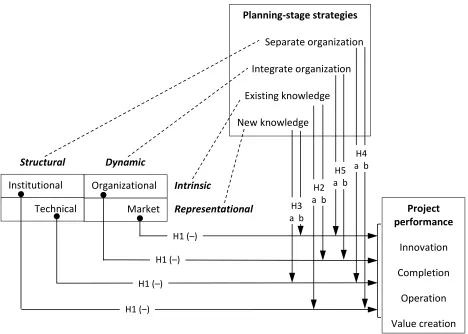
H1 Complexity overall and its various concrete factors have a negative influence on performance
3. Planning stage strategies and complexity representations
As we argued in the introduction, we assume that complexity management efficacy, and eventual
performance, depends on the capacity of a project organization to represent the complexity of its
project. From the communication systems perspective, this means that project planners are able
to translate their interpretation of project complexity into a project organization that can continue
to grasp key interactions and engines, limit uncertainties and surprises caused by emergence and
dynamics, and address consequences in cognizant, proactive, coordinated and flexible ways. We
treat the required representational capacities broadly, by distinguishing two aspects. The first,
cognitive aspect was inspired by psychological, engineering and applied science perspectives. It includes actors’ mental representations, shared or not (Weick & Roberts 1991), as well as
representations on external supports, such as plans, organization charts and engineering drawings
(Floricel, Michela & George 2011). The second, organizational aspect was inspired by communication systems research. It refers to representations embedded in work routines and
communication patterns in project organizations and networks (Luhmann 1995).
We further assume that planning-stage strategies adopted in projects have a key impact
on this representational capacity, not only through their influence on representations produced by
the planning activities but also through the conditions they create for producing and updating
representations in subsequent stages. Based on the project and innovation management literature
we argue that two kinds of strategies have the strongest impact on this capacity. First, strategies
that put in place project development processes impact mainly the subsequent ability to produce cognitive representations, because the essence of these processes is knowledge production and
the kernel of the future project organization. In particular, they shape the channels and incentives
for communication, which are the key sources of the coordination and integration capabilities
that lay at the core of organizational representation capacities (Floricel, Piperca and Banik 2011).
Another argument we advance concerns the fit between the specific complexity faced by
a project and the representational capacities of the latter, as well as the impact of this contingent
fit upon project performance. We expect that some strategies are more appropriate in creating the
capacity to represent a specific complexity factor affecting the project, because they meet the
challenges raised by this factor in light of its characteristics along the two dimensions presented
in Table 1. As explained when we introduced them, every end of each dimension is better
addressed with specific representation capacities. For example, intrinsic complexity favors
generic frameworks that help participants make sense of properties and evolutions, while
representational complexity favors more specific, prediction- and control-enabling depictions.
Equally, structural complexity demands the capacity to comprehend and integrate all aspects and
interactions, while dynamic complexity, favors fast change-seizing, sensemaking and
tie-restructuring capabilities (Teece 2007). As we will explain below, these representation capacities
are more likely to grow from concrete choices on the two types of planning-stage strategies
mentioned above. However, not every planning group will adopt the right strategies. They
usually adopt organizing models legitimated by the institutional field, for example, development
processes such as Scrum, and contractual frameworks such as public-private partnerships. Such
models of organizing, “however flawed, unstable and biased they may be, form the means by
which actors navigate and connect entities in a fluid and complex world” (Hernes 2008: 49). It is
out of such models, through some sort of bricolage, rather than through omniscient, original
design, that planners create the kernel of the representational capability of a project: an
assemblage of knowledge production activities and communication ties. But, in certain cases,
planners have a better understanding of complexity and pick up models that are more
appropriate, while in other cases, they adopt models by imitating others, out of insecurity and
(DiMaggio & Powell 1983; Strang & Macy 2001). This creates variance on the
complexity-strategy match, enabling us to hypothesize that strategies are interacting with complexity to
influence performance. More precisely, we believe that the project performance will decrease
(linearly) to a lesser extent in relation to each complexity factor when planners adopt strategies
that match to a greater extent the characteristics of that factor.
We now turn to developing this proposition into testable hypotheses, by identifying
concrete planning-stage strategies that allow planners to match the challenges posed by the four
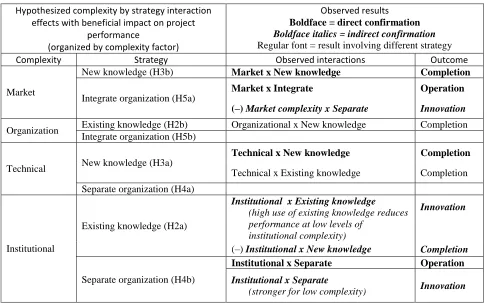
complexity factors listed in Table 1. Resulting relations are presented in Figure 1. We distinguish
the first type of strategies mentioned above, namely development processes, by the nature of the
knowledge they use and by their knowledge production sequence. Both elements condition their
ability to match intrinsic versus representational complexity. Based on strategy and innovation
research (March 1991; Katila & Ahuja 2002), these characteristics set apart two categories of
development processes: more linear sequences relying on preexisting, rather abstract knowledge
versus more iterative sequences that favor the production of new project-specific knowledge.
The first category, exploitation of existing knowledge, relies mainly on past learning captured in databases, models and rules. It features a rather linear sequence, which translates
quite abstract premises into more concrete project elements. Evolutionary search literature
suggests that abstract representations expedite and enhance the search for an overall concept, by
offering some guidance over a broader solution space (Fleming & Sorenson 2004). But the
‘distance’ between these representations and the reality ‘out there’ reduces the efficacy of their
guidance for shaping, predicting and controlling concrete project elements (Gavetti & Levinthal
2000). We believe this kind of process is most effective when planners deal with factors they
perceive as intrinsically complex. Such perceptions occur when planners are either at loss for
grasping the given factor, or when prior experience has taught them that creating representations
that enable the precise prediction and control of relevant properties or dynamics is beyond their
cognitive and computational abilities. Research shows that when faced with seemingly random
prepares them to believe and seek guidance in any representation, even one based on superstition
or tradition, which restores some order to a seemingly random world (Kay et al. 2009). Actors
are even more inclined to adopt such frameworks if these have been socially legitimated by
professional and regulatory bodies (Strang and Macy 2004), or by the units charged with
knowledge absorption, circulation and codification in parent organizations (Cohen & Levinthal
1990; Brown & Duguid 1991). There rather abstract and generic frameworks enable managers to
make sense of incoming signals and avoid decision- and action-stalling insecurity. Thus, indirect
evidence for the hypothesized interaction between intrinsic complexity and existing knowledge
exploitation strategies is provided by the rise, along with the recognition of institutional
environment complexity, of prescribed practices for stakeholder analysis (Jepsen & Eskerod
2009) and of governance frameworks for developing and approving public projects (Klakegg et
al. 2008). For the other factor deemed intrinsic, organizational complexity, we see a comparable
proliferation of contractual and organizing frameworks (Lindstrom & Jeffries 2004; Cooper
2008; Tang, Shen & Cheng 2010). Besides, for both factors, project-based organizations have
adopted practices that capture, diffuse and codify learning from past projects (Prencipe & Tell
2001), as well as project management offices that formalize and promote practices based on this
learning (Aubry et al., 2010), to give planners a menu of generic analysis frameworks and
procedures. Our case on existing knowledge exploitation strategies results in this hypothesis:
H2: Development processes that exploit existing knowledge will interact with intrinsic complexity factors, namely institutional (H2a) and organizational (H2b) categories, with beneficial effects for project performance.
A second category of development processes stresses the production of new knowledge. This type of process features a deliberate sequence of experiments, simulations, and prototyping,
along with concurrent engineering or seeking clients’ feedback, which are similar to ‘trials’ with
downstream participants. By emphasizing new knowledge production activities, participants aim
to reduce the ‘distance’ between cognitive representations and specific project complexities. But
if results are unacceptable (Lynn, Morone & Paulson, 1996). Thus, such processes often involve
an iterative sequence of trials, producing successively closer representations of the concrete form
and performance of the system. We argue that new knowledge production processes are more
effective in addressing representational complexity, namely technical and market factors. For
these categories, representations can be brought close enough to reality to enable prediction and
control of relevant project aspects. For example, technical design is often depicted as an iterative
process of knowledge production or problem solving that constructs an increasingly concrete and
complex representation of artifact form (Visser 2006; Chandrasegaran et al. 2013). The sequence
can be optimized by varying relative reliance on preexisting abstract knowledge versus trials that
produce new concrete knowledge (Fleming & Sorenson 2004), the radicalness, precision and
number of trials (Thomke & Fujimoto 1998; Luehrman 1998), or the degree of parallelism,
overlap, and communication between activities (Thomke 1998; Krishnan et al. 1997; Loch &
Terwiesch 1998). In turn, market research supplements generic estimation models with methods
that rely on lead users, virtual customers, and simulated or test markets to produce more concrete
knowledge (von Hippel 1986; Dahan & Hauser 2002). Likewise, market search strategies for
radical and disruptive innovation projects, likely to generate the highest market complexity, rely
on launching repeated probes to obtain concrete feedback from possible markets and segments
(Christensen 1997; Leifer et al 2000). This enables us to propose the following hypothesis:
H3: Development processes that produce new knowledge will interact with representational complexity factors, namely technical (H3a) and market (H3b) categories, with beneficial effects for project performance.
We also divided in two categories the other group of planning-stage strategies, those shaping the
project organization and creating its organizational representation capabilities. Modularity and
communication literatures research (Simon 1962; Luhmann 1995) inspired us to distinguish
strategies aiming to enhance these capabilities by separating participants into more or less
The first category, separation-allocation strategies, assume that complexity is best addressed by decomposing relevant objects and tasks into stand-alone blocks and allocating their
execution to distinct organizations or teams. This type includes modular project organizations
(Söderlund 2002) and approaches, such as BOT, PPP or turnkey, relying on contracts to allocate
project tasks between participant organizations. We argue that such strategies are best suited for
structural complexity categories, namely technical and institutional. In fact, attempts to tackle
technical complexity inspired design methods that reduce undesired interactions and architectural
principles that help control emergent properties by separating complex artificial systems into
stand-alone modules (Simon 1962; Ulrich 1995; Suh 2005). These methods ‘frontload’ the
development effort, augmenting its system engineering and architecting part, and enable planners
to uncover and represent early on the key interactions between project elements. Then, project
organizations and networks can also be separated into modules that parallel technical architecture
(Sanchez & Mahoney 1996; Schilling 2000). Those working on each module develop detailed
representations of their respective parts. Because technical solutions within each module are
developed in an integrated manner, modular units maintain strong internal communication ties
that help participants grasp interactions (Hansen 1999). Communication across modules is less
frequent and occurs through well-defined interfaces, but hidden interactions can still be captured
and mastered if planners maintain and cultivate overall integration capabilities (Murmann &
Frenken 2006; O’Sullivan 2006). A similar approach tackles institutional factors by partitioning
the project environment into uncertainty areas and relying on well-defined contractual interfaces
between participants to allocate respective risks to specific actors (Chapman & Ward 1994;
Floricel & Miller 2001). High transactional requirements for understanding, negotiating and
defining inter-participant interfaces, such as specifications, rights, price calculation, certification
and contingencies, increase the development effort and duration (Miller & Lessard 2001). But
this effort also creates a systemic representation akin to a modular architecture, which provides a
clear overall picture early on and then enables participants to focus on developing detailed
H4: Organizing strategies relying on separation and allocation will interact with static complexity factors, namely technical (H4a) and institutional (H4b) categories with beneficial effects for project performance.
Strategies in the other organizational category, integration-collaboration, aim to increase the density and strength of communication ties throughout a project organization by stimulating
collaborative work, as well as responsibility and risk sharing (Lahdenperä 2012). This helps
integrate a diversity of perspectives and knowledge and, while it does not uniformly reduce the
‘distance’ between project complexity and its organizational representations, it eases the ongoing
adaptation of representations to change. Therefore we argue that integration strategies are best
suited for addressing dynamic factors, such as organizational and market complexity. To address
market dynamics, such as unpredictable changes in user needs and market conditions, project
management literature suggests practices such as small-step, gradual-commitment (Olsson 2006;
Highsmith, 2010), and multiple frequent iterations based on real-time input (Biazzo 2009). But
these practices are harder to implement if participants are constrained by preset contractual
interfaces that strictly allocate risks and prescribe communications (Floricel, Piperca & Banik
2011). Thus, organizational strategies that foster collaboration, such as partnering and integrated
project delivery (Naoum 2003; Cohen 2010), or encourage frequent communication, such as
agile methods (Ballard & Tommelein 2012), help projects adjustments to unexpected market
developments. For organization complexity, setting interfaces early on also risks routinizing the
communication patterns, which precludes adaptation by entrenching old implicit representations
and preventing new systemic sensemaking (Henderson & Clark 1990). The alternative is, once
more, to foster organizational representation updating through networks with strong
communication ties between participants (Dietricht et al. 2013; Verganti 1999), orchestrated by
actors with strong integrative abilities (Brusoni et al. 2001), and driven to collaborate by shared
responsibilities (Dougherty 2001). These arguments led us to propose the following hypothesis:
Together these hypotheses suggest a systematic association between complexity factors
and strategy elements in the form of interactions that reverse the negative impact of complexity
on different types of performance. All hypothesized relations are depicted in Figure 1. Their
empirical corroboration is described in the next section.
4. Methods
We attempt a preliminary examination of the hypotheses using data from a survey of complex
projects, which studied the response capacity of complex projects (see Floricel, Piperca & Banik
2011 for details). The initial theoretical framework of that research did not include variables for
complexity, but implicitly accounted for it by targeting certain types of projects. Yet, distinct
complexity factors emerged as important from the initial qualitative stage of the research, which
performed 17 qualitative case studies of complex projects in three sectors: biopharmaceutical,
information and communication systems, as well as energy and transportation infrastructure. In
that stage, a total of 47 interviews and tens of documents were analyzed based on a
semi-grounded approach (Corbin & Strauss 1990), using case narratives to capture contexts, systemic
interactions and processes; inductive content analysis to develop constructs; as well as intra- and
inter-case comparisons to work out the relations between constructs. This helped to reformulate
the theoretical framework, and enabled the quantitative survey that provides data for this article.
Instrument development and data gathering. Based on the theoretical framework and
language obtained from interviews, questionnaire items were generated for each variable. Similar
psychometric measures, seven-point Likert-type scales, were used throughout the questionnaire
(Meyers, Gamst, & Guarino, 2005: 23). The questionnaire was reviewed by three scholars with
practical experience in project management, and by one practitioner. Their comments were used
to prepare the final version of the questionnaire that was implemented on line. During the fall of
2011, this version was administered to practitioners who participated in projects that were just
completed at the time. Analyses presented here rely on a maximum of 81 answers (see Sample).
reasonably good for email surveys, which often go as low as 2 percent (Tucker, 2010), even
when using the best practices proposed by Dillman, Smyth, and Christian (2009) as we sought to
do. The pool of respondents was limited by the low number of complex projects that were
identified using periodicals and databases specialized in tracking such projects.
Sample. Although the total sample consists of 81 cases, 1 respondent did not complete
strategic practices section and 9 did not complete project performance section. This attrition may
have occurred because the overall questionnaire was lengthy, including hundreds of items. Even
among those who went through the entire questionnaire, some respondents occasionally missed
an item or two. Such missing values (< 1 % of responses) were replaced by sample means for the
respective items. The number of cases usable in each form of data analysis is stated below or else
implied by degrees of freedom reported. This sample size is acceptable for the analyses that we
performed, in that we maintained an approximate ratio of 5 cases to each variable. The sample is
diversified geographically, and by project type and sector. Locations span 5 continents: North
America (39), Europe (26), Latin America (7), Africa (6), and Australia (3). Sectors and types of
projects include: energy (power generation including offshore and nonconventional, oil and gas
including offshore, biofuel including demonstration); transportation infrastructure (highways,
underpasses, tunnels, bridges, railroads, urban transit, airport terminals, ports), water
infrastructure (water and sewer, flood protection); information systems and telecommunication
infrastructure; mining and manufacturing facilities; sports, cultural, urban and tourism facilities.
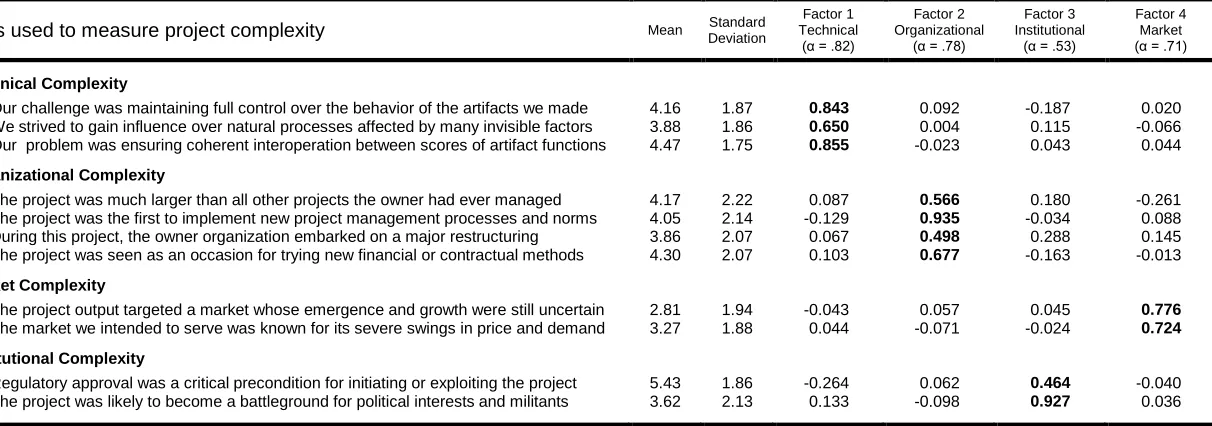
Measures. Because all scales were new and, especially for complexity, emerged from a
semi-grounded procedure, we used for validation a combination of exploratory and confirmatory
analyses. Survey items for project complexity were entered into a common factor analysis.
Non-orthogonal (promax) rotation was used to reduce—but not artificially eliminate—correlations
among factor scores saved from the factor procedure. After initial analyses, items that violated
simple structure, namely those with factor loadings above 0.40 on a secondary factor were
removed and the analysis was repeated until arriving at the structure shown in Appendix Table
measuring performance were first examined to determine whether aspects of performance should
be differentiated by factor analysis or consolidated in one factor. A maximum likelihood factor
model with a single factor did not fit the data (Chi-square (54) = 113.37, p < .001), so we
retained all performance factors with eigenvalues over 1. Scores for performance variables were
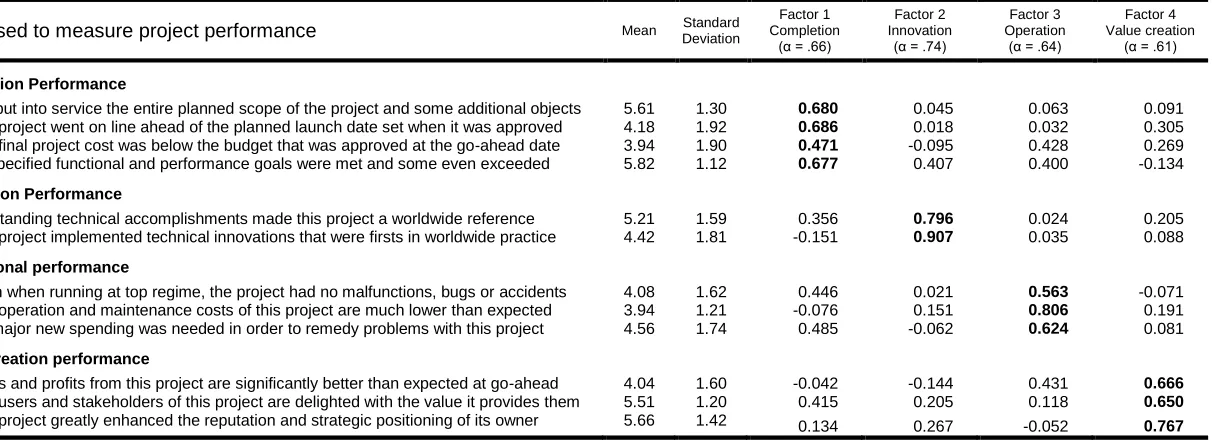
produced as averages of survey items that appeared together on a factor, so that findings could be
expressed in terms of answers on a seven-point scale. Constituent items for the four resulting
performance variables, validated via factor analyses, and estimates of measure reliabilities are
shown in Appendix Table A3. They correspond to four indicators highlighted in project literature
(Wateridge, 1998; Atkinson, 1999). Completion performance measures whether the project met
planned resource expenditures and deadlines, and accomplished the entire planned scope and all
artifact functions. Innovation measures whether a project produced outstanding or pioneering
achievements for artifact uses, functionality and performance. Operation captures the extent to
which the project runs uniformly and reliably, with low maintenance and exploitation costs, and
few repairs. Value Creation measures the extent to which a project meets expected financial
returns, satisfies users’ and stakeholders’ needs, and enhances promoters’ reputation. Most scales
have reasonable Cronbach’s alpha values; all are above .50, the acceptable value for newer scales
(Hair et al. 1999). Correlations within and between the three sets of scores appear in Table 2.
Analyses. Canonical correlation analysis examined, first, the association of complexity
factors with performance factors in order to corroborate Hypothesis 1. We also used canonical
correlation to analyze the association of complexity factors with planning strategy variables;
results helped us interpret results for the remaining hypotheses. In both cases, this multivariate
statistical method reduced the 16 pairwise correlations between complexity and performance or
strategy variables to the canonical correlations reported. Further, to corroborate Hypotheses 2 to
5, multiple regression (MR) analyses examined associations of performance outcomes with
complexity factors, planning factors, and the various two-way interactions each involving a
complexity factor and a planning factor. The 16 possible two-way interaction terms were
components. After entering linear terms simultaneously (4 each for complexity and planning) in
a first hierarchical MR step, we then entered all 16 interaction terms with stepwise backward
elimination analysis. Following Fleiss (1986) and others, we set .10 as a criterion for maintaining
interaction terms for further analysis (described with Results). It should be noted that all linear
terms were maintained in all four MR analyses (one for each outcome) throughout the analysis.
This approach maintained interpretability of the interaction terms as such (Dawson, 2014).
Due to the use of stepwise regression, the MR analysis should be considered exploratory,
because the resulting number of statistical tests increases the possibility that some findings at the
given error rate have been obtained by chance. However, a further aspect of our further analyses
sought to reduce this concern. Specifically, for each of the statistically significant (p < .05) or
marginal (p < 10) two-way interactions, finer-grained analysis of “simple slopes” was conducted
based on Preacher, Curran, and Bauer (2006). We describe results only for instances when these
analyses pointed to sizable differences in, and statistical significance of (at p < .05), one or more
regression slopes in connection with each reported interaction.
5. Results
Global Associations of Complexity Factors with Project Performance Factors. As a global test
of Hypothesis 1 concerning the general effect of complexity on project performance, canonical
correlation analysis was conducted with the measures listed in the first four and last four rows of
Table 2. This analysis may be understood to reduce the correlations between all eight variables
involved in the analysis to produce the summary results, or ‘global’ results, in Table 3. This
summary is accomplished by forming optimal linear composites of the variables involved.
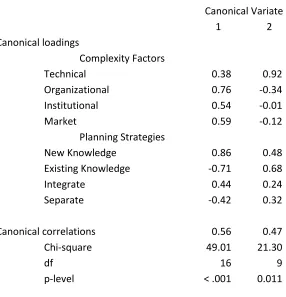
In the findings in Table 3, a single canonical correlation, at .52, is seen to be statistically
significant. The pattern of canonical loadings in the table provides a compelling description of
the overall association here. Given the generally similar and uniformly positive loadings in the
This common effect, according to the table's middle section, is to undermine completion
performance, as expected given H1, yet enhance innovation performance, contrary to prediction.
Global Associations of Complexity Factors with Planning Strategy Factors. As a
preliminary analysis intended to aid interpretation of later findings, the measures of complexity
types and planning strategy were also entered into canonical correlation analysis, to bring a large
number of correlations (i.e., the first 8 rows of Table 2) to a smaller set of summary findings.
The resulting column in Table 4 for canonical variate 1 shows that a first pair (top and
middle sections of first column) of sizably correlated (.56, bottom section) and statistically
significant linear composites was obtained in the analysis. In the composite weighting scheme
for Complexity factors, Organizational complexity, especially, and Institutional and Market
complexity, secondarily, received substantial weight; Technical complexity did not. In the
corresponding scheme for Planning factors, New knowledge received high positive weight but
Existing knowledge received high negative weight. These values give emphasis to the pattern of correlations in Table 2 in which New knowledge has a positive and statistically significant
correlation with all of the planning strategy variables, but Existing knowledge's corresponding
correlations are mostly negative. There is also a suggestion of greater use overall of Integration
and lesser use of Separation with greater amounts of these forms of complexity, again consistent
with the correlations in Table 2 upon which this global analysis was based.
Values in the table column for canonical variate 2 were obtained by analysis of residual
associations after application of variate 1 to account for the correlations in Table 2. These values
and the statistical tests below them indicate that higher Technical complexity (with its loading of
.92) is associated with greater use of both New knowledge and Existing knowledge. No further residual associations were statistically significant.
These results suggest that project managers have some characteristic ways of responding
to particular forms of complexity. When PMs perceive technical complexity they are especially
likely to use Existing knowledge and they develop New knowledge. With other forms of
Performance prediction from Complexity and Planning Strategies and their
interactions. As detailed under Methods, after forming 4 performance outcome scores
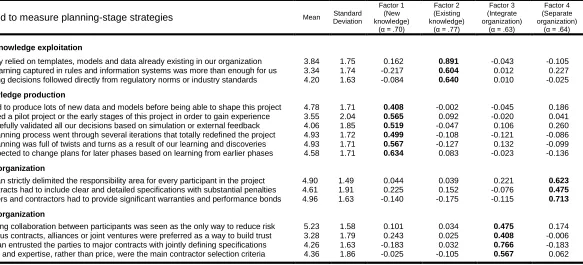
(according to table A3 in the Appendix), 8 linear predictor terms (see appendix Tables A1 for
complexity factors and A2 for strategy variables), and the multiplicative terms for interactions
between complexity factors and strategy variables, a multi-step multiple regression (MR)
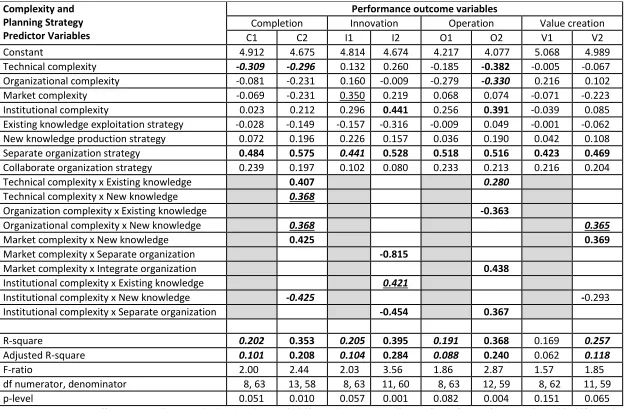
analysis was conducted for each outcome variable. Table 5 provides the unstandardized
regression coefficients and the full equation parameters and statistics.
Linear terms’ associations with outcomes. The 8 linear terms were entered in the first step of each MR analysis. Results are shown in the columns C1, I1, O1 and V1 of Table 5.
Although relatively few tests for direct effects coefficients reached statistical significance, it
should be kept in mind that statistical significance concerns the unique variance in the outcomes
explained by each predictor, that is, controlled for other complexity and planning variables
(unlike in the preceding canonical correlation analyses, which took a different, global approach).
Coefficients reflecting the direct influence of complexity on performance provide
additional corroboration for Hypothesis 1. Coefficients were mostly negative for the impact of
complexity variables on completion outcome, including one marginally significant coefficient
for technical complexity. However, consistent with earlier canonical analysis, coefficients were
positive for the impact of complexity on innovation performance. Coefficients for relations
between complexity and other performance variables had mixed signs and no significant values.
Regarding the direct impact of planning-stage strategies, existing knowledge exploitation
had mostly negative signs, but the other three types of strategies had only positive signs. Of
these, Separate organizational strategy has a significant positive influence on all dimensions of
performance, except for innovation for which the level of significance is marginal.
Analyses of interactive terms’ associations. By entering only the linear terms in the first step and then following with interactions, it was possible to assess the predictive contribution of
interactions. While keeping in mind the caveat stated under Methods, concerning the statistical
from an approximate 50% to a 100% increase (i.e., a doubling) of overall variance explained by
regression equations that included interactions. For example, explained variance increased from
0.202 to 0.353 for Completion performance—or from 0.101 to 0.208 in the metric of adjusted
R-square. Further, predicting all four outcomes by linear terms alone was of marginal statistical
significance, while equations with interactions, except Value creation, were clearly significant.
The specific interaction terms that reached the specified alpha level for further scrutiny (p
< .10) are shown in the second column under each outcome variable’s heading in Table 5
(columns C2, I2, O2 and V2).
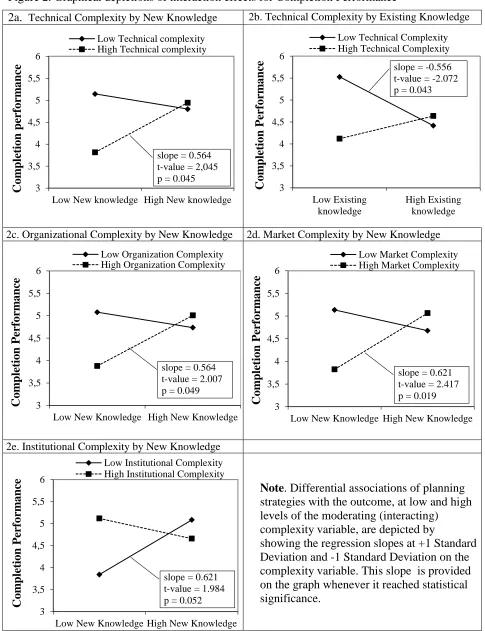
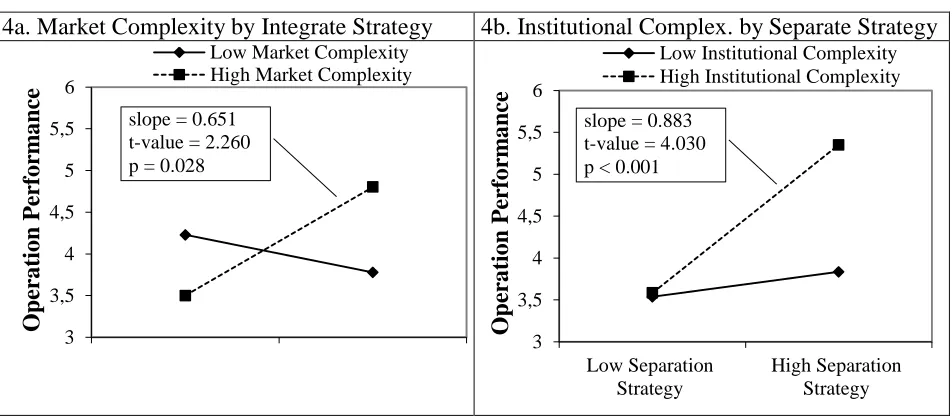
Figures 2, 3, and 4 describe the particular forms taken by interactions of complexity with
planning strategies. Each sub-figure (e.g., Fig. 2a) corresponds with an interaction coefficient in
the table. However, not all coefficients have a corresponding sub-figure, because only interaction
terms for which one of the simple slopes reached p < .05 are presented in a corresponding graph.
In these figures, a simple slope describes the association between a planning strategy and an
outcome variable for projects with a level of complexity that is either 1 standard deviation (SD)
below the mean for the particular form of complexity, or 1 SD above the mean (Dawson, 2014;
Preacher et al., 2006). Significant simple slopes are indicated as such in the figures.
Completion performance. Figure 2a describes an interaction between New Knowledge and Technical Complexity. In projects with high Technical Complexity (structural and
representational), a higher use of New Knowledge increases the chances of high Completion
performance. This slope is as predicted by our H3a.
Figure 2b shows a prevalence of low Completion performance among projects with low
Technical complexity but high use of Existing knowledge. This negative slope was not predicted
with respect to this representational type of complexity, but the graphical pattern (unlike the
respective coefficient in Table 5) cannot be considered as an indirect disconfirmation of H3a.
Figure 2c shows an interaction between New Knowledge and Organizational Complexity.
Namely, for projects with high Organizational complexity (dynamic and intrinsic) projects with