The
Analytical Engine
JOURNAL OF THE COMPUTER HISTORY ASSOCIATION OF CALIFORNIA
Hewlett-Packard 3000
HP Archives
The
Analytical Engine
JOURNAL OF THE COMPUTER HISTORY ASSOCIATION OF CALIFORNIA
Editorial: X-VICTORY!!
We scarcely dared to hope, but we dared to work, and work brought forth what hope alone never could have. The magnificent SDS 930 came home to California .... by a whisker.
On August thirty-first we received e-mail from the Federal agency that owned the 930, saying that for administrative reasons, a firm acceptance of permanent loan would be required within a month. Well, move it or lose it. The CHAC had been working on this since late last year, and every request we had made in e-mail, all the pep talks we'd given at conferences, every stern warning we'd published in the ENGINE, had netted .... a few hundred dollars; and we couldn't hope to load, and ship, and unload the 930 for less than a few thousand. Could we raise, in a month, what we had not raised in half a year?
We have three phone lines here, and 1,600 names in our database. The only answer was obvious, ar-duous, time-consuming, expensive, and a bit scary - but it was the only answer. Telephone calls, confirmed with e-mail and backed up by stamped return envelopes, brought in over $7,000 in pledges by the end of September. It was more than we ever thought we could raise - and yet it was barely enough, because as we progressed from mover to mover and described the job, the estimate of costs almost tripled. Yet energy, community and gene-rosity prevailed.
At 8:30 on Wednesday morning, October eleventh, a moving van pulled onto a blacktopped lot in the South Bay and finished its fourteen-hundred-mile trip from the Space Environment Center in Colo-rado. We joyously took delivery of fourteen racks, two Teletypes, a console, a VDT, and approxi-mately forty boxes of tapes, docs and spares, to a total of 10,300 pounds -- which only (yikes!) filled about a third of the truck. A picked crew of CHAC stalwarts spent two hours removing
ductape, non-historical stickers, deteriorated insula-tion, etc., and eased the whole computer into a locked, ventilated steel container. We're planning a Tiger Team Party in November to clean, dust, lu-bricate, and otherwise prepare for long-term storage with zero deterioration. Although the amazing thing is, how clean and pretty the 930 is even now ....
This has to be counted a stunning success -meaning that it stunned us. It's true that the CHAC was in an advantageous position to raise money, since we had a good cause, a serious dead-line, and a great list. Even so, in the two weeks that lifted us from bare hope to the edge of triumph, we felt dizzying relief. The words "emergency" and "computer history" don't often occur in the same sentence; we had no idea what might happen when they did.
The donations were as encouraging in their pattern as in their total; they ranged from $20 and $25 to literally thousands of dollars. It proves at a stroke that support for the history of computing exists at every level, whether corporate or individual, and across a whole spectrum of professions.
Page 2 The Analytical Engine November 1995
LATE BUT GREAT (we hope)
Through clenched teeth we admit that, even by normal standards, this issue of the ENGINE is late. The reasons are straightforward: The fundraising campaign for the 930 Rescue, and the writing and installation of our Web page, together required about as much time and energy as one ENGINE. We didn't have it in reserve and magazine produc-tion had to slip. Three points follow from this:
1)
For the first time, as we're publishing one issue, we have almost all the material in hand for the next. November may be late, but February won't be as late.2)
The CHAC can only increase its resources of time and energy by enlisting volunteers. We are eternally grateful for those we have; we can always use more. Please contact us if you can spare even a couple of hours a month.3) We promised thicker ENGINEs and we're de-livering. This issue starts a provocative interview with Lee Felsenstein and winds up the HP's EARLY COMPUTERS series with an article by Chris Edler on the development, release, redesign and re-introduction of the 3000 series; the letters and queries are here too, along with a review of Max Maxfield's superb introductory text on mi-croelectronics, and a lot of current news that we only had time to summarize. More people seem to be interested in writing, they are not running out
of computer history to write about, and we'll con-tinue to publish as many pages per year as our cash on hand permits. Enjoy!
CONVIVIAL CYBERNETIC DEVICES:
From Vacuum Tube Flip-Flops
to the Singing Altair
An Interview with Lee Felsenstein (Part 1)
[Lee Felsenstein - sysadmin of the pioneering wide-area network Community Memory, contractor for Processor Technology, hard-working moderator of the Homebrew Computer Club, and designer of the Pen-nywhistle modem and the Osborne One - has lived a life constantly interwoven with the history and phi-losophy of computing. Through it all he's pursued Ivan Illich's ideal of "conviviality, »insisting that technol-ogy attains its highest purpose only when it becomes understandable, approachable, repairable and usable
by
ordinary people.This first part of a projected three-part interview takes us from 1959, and a computer club without a com-puter, to 1975, Homebrew, and Steve Dompier's history-making implementation of "Fool on the Hill."]
CENTRAL HIGH
KC: Let's start with flip-flops in high school ....
cigar boxes. I had a basement workshop at that point, I was familiar with the tools, and I even had a rather crude audio oscilloscope. And we tried to make flip-flops so we could make logic elements, counters and registers and so forth. Probably they would have worked quite well, except that I was completely ignorant of so many fine points. For example, we were trying to create pulses for count-ing by flickcount-ing wires against Fahnestock clips on the cigar boxes - and I can't think of any better way to create a random stream of pulses than that! But that point never entered my mind and I didn't really have any mentors who would point this out. We certainly could have used help from an engi-neer, preferably in the computer business, but we never really considered going out and asking for it.
It had only been two years since Sputnik, and the school was dominated by a competitive aspect that ruled us all. I mean, some of the boys were keeping running grade point averages up to three decimal points in the backs of their notebooks, that sort of thing. We were all supposed to go claw and scram-ble over each other and get into the best colleges. Actually, that kind of thing had been happening at Central High School for generations.
In any case, the Central High School Computer Club managed to produce a couple of two-bit counters that probably worked about fifty per cent of the time, using our techniques. I concluded from that whole experience that computers were not for me. I knew I had a future in electronics - I wanted to be an electronics technician at that point - and that gradually evolved into, well, I'm going to col-lege so I might as well study electrical engineering. I had gotten into electricity and electronics at the age of 12, when I read in a chemistry book that if you wanted to be a chemist you had to learn a lot of mathematics, and I was having trouble with per-centages at that time. Only much too late in the game did I learn that electrical engineering required the most math of any engineering. So much for career planning! My experience with the Central High School Computer Club made computers simply too frightening for me, from a hardware standpoint, because they had to get it right every time, every clock pulse. I had no particular interest in the software, so that turned me away from computers for a while. (My brother, incidentally, went on to become a professor of genetics, special-izing in mathematics of genetics, population genet-ics and so forth.)
BERKELEY, FSU, AND AMPEX
My next experience even close to computers was in 1965, when I worked with what was called the Free Student Union, which was the successor to the Free Speech Movement at Berkeley. I learned how to punch cards on an [IBM] 026 card punch. You could walk right into the card punch room and use it without any questions asked, so I punched and sorted the membership lists and we used them for local meetings that nobody came to.
At the end of 1967 I had dropped out of school, I was in a psychological depression, and in the be-ginning of '68 I went off to work as a junior engi-neer at the Special Products Division of Ampex Corporation; then at the end of 1969 I dropped out of that job, and then dropped back in when my money ran out.
Ampex is almost gone now, but it wasa big com-pany in those days and a division might have two or three thousand people - the Magnetic Tape Di-vision as an example. The Special Products Divi-sion, which was a hundred and fifty people in a little building on the Redwood City campus, took responsibility from beginning to end for one-of-a-kind products. We might just take an item from stock and paint it purple, or we might design something from the ground up. We'd gotten into the design of a large-scale audio-visual instructional system, called a Pyramid system, controlled by a [Data General] Nova minicomputer. About three of these were built. Well, in 1970 I was put on this project - that I didn't want to be on, because of that computer controlling it - and I was rather quickly given responsibility for catching the bugs in designs that other people had prototyped, and then teaching other people about how they worked and to support the ongoing effort; it's called maintenance of product design, MPD. I started with the tone detectors, which were nice comfortable analog things; but I moved on to something I had done previously, which was design of audio circuits for high speed tape duplicators -IS oscillators at 1 megahertz, that sort of thing. In effect it was hi-fi design at 40 times frequency step-up, which was very interesting. But now I couldn't avoid getting into computers ....
Page 4
The
Analytical Engine November 1995LF: And first of all I was sent to class to learn BASIC at the Service Bureau Corporation, SBC, which was the setting for some very important re-alizations. The instructors at that place were young guys in three-piece suits who liked to show off how much they knew. And they .would say, "You see how the system sort of hiccupped there and it's running more slowly? That's because the computer in Los Angeles has been turned 'off and it's been transferred over to the computer in Kansas City.» This was my first experience with networked computers, and I understood that geography could be irrelevant on a computer network, providing it extended to the various places. They also showed me how files could be made public with levels of accessibility, by pre-pending asterisks to filenames; three asterisks on a filename and anybody in the system could get the file - in effect, it had been published. So I saw a hierarchy of distributed pub-lication possible there.
KC: Now, what operating system was this?
LF: I don't know what operating system it was. I presume that SBC had won some kind of anti-trust suit with mM and somehow gotten an mM net-work out of it, probably running on [Systeml] 360's, but I don't know the details beyond that and you may have to look them up if anybody's inter-ested. Almost certainly these were mM computers, we used Selectric terminals, 2741's. All I knew was, I was learning BASIC. But I still had some impor-tant realizations there, and several of them related to media and publishing.
I had spent much of my time in Berkeley working for the underground press, on the grounds that this was a certain kind of community media - media with less hierarchy. There was still a hierarchy, by definition, because that's built into any publication system, whether print or broadcast, where the in-formation is replicated identically and sent out from a single point. In fact I had given up on the underground press because it was subject to many of the same tendencies as the mainstream press, including centralization, and the temptation to make a spectacle of itself in order to increase its circulation. That wasn't the game I was interested in playing, or assisting. I wanted to help define, and help create, media that contributed to the de-velopment of a local community. And now I was presented with networking technology that could
be a foundation for communities of interest -communities that could exist in defiance of geogra-phy. We could, at least in theory, untie the knot that tied a single person to a single community. This was a vision that I wanted to elaborate, and continued to pursue.
Meanwhile, at Ampex I also learned enough machine-language programming on the Nova to do little drivers and so forth. By the end of 1970 I did the programming to demonstrate the control struc-ture between, if I recall, 12 key pads and 12 buffer tape recorders. The system worked through a series of master recorders, each of which had 8 tracks on quarter-inch tape and could run bi-directionally at high speeds. A matrix switch with reed relays sent output to a buffer recorder at each student posi-tion, or carrel. Each carrel had earphones, a video monitor, and a 12-button key pad whose interface I had designed. You would sit down at the position and punch up the number of a program you wanted. That would set up a transfer between the track on the relevant master unit and your buffer unit. So the master would energize and do a high-speed tape duplication, 40 times high-speed, across to your local machine. In a minute and a half [of du-plication] you'd have an hour's worth of program copied over. I think the transfer was carried out backwards, so that when the duplication finished, your buffer machine was at the beginning and would start playing, and you would hear the pro-gram material on the earphones. Buried in the program, meanwhile, were periodic bursts of 55 Hz tone which a tone detector picked out and turned into a slow serial bit string; and this would command the computer to do various things - not only tape motion commands, but also primarily transfers of pictures from a moving-head video disk recorder with a 14-inch platter to a set of buffer tracks on another video disk, so you'd get a still picture transferred from a repertoire of about 300 still pictures. That picture might present you with a question, and the tape would be stopped, until you responded on the keypad. The keypad, like the rest of the system, was interfaced to the com-puter, and depending upon what your answer was and the instructional program that was running, the tape would either continue with the right answer, or rewind to another track and play back an explanation of why you had been wrong. It's interesting that, by 1990, I was able to build all this
works off a compact disk, has a private-eye display and headphones, and audio synthesis and speech synthesis and audio playback, and a little pointer that you hold in your hand - an isometric pointer; so that's a closing of a circle, in effect. But the machine language programming that I had done, that allowed the buttons on the keypads to com-mand the tape recorders to do the transfer and then start playing, saved my job [at Ampex] during a reduction in force that was going on.
So I gradually became more familiar with comput-ers, through designing interfaces. I also did a design analysis program in BASIC for the active filter components in the tone detector. Those things are easy enough to design, certainly out of cookbooks; the hard part is to build them so that the filters' performance remains acceptable while components range over their tolerances. I had been given a de-sign with ideal values, and as part of MPD I was supposed to figure out how to build it with actual parts so that it would work every time without adjustments.
KC: In other words, it'll work this way
if
it's perfect, but what about when it's not perfect?LF: That's right. Engineering is mostly about how far off the ideal you can stray and still be safe. So I constructed a test suite with a lot of nested loops that would vary each component through its pos-sible range - that's on the inside loop - then go out and vary the next component one tick, go back in and vary the first one through its range. There was a nested loop for every component. Running this in BASIC on the Nova, I was able to demon-strate that no possible set of combinations for that design would work over its entire range. Mean-while, of course the units that had already gone in the field - the prototypes, in effect - were giving all kinds of trouble. So they sent out an engineer who was clever enough, and simply didn't want to hear about anything else; and he sent back a card-board extension to the card-board wired with potenti-ometers and one-shots and some other parts. He had done almost everything that I wasn't allowed to do, and I was told "Okay, just put that in the design and build it." Naturally we did wind up with adjustments, and that was an excellent lesson in the relationship between engineering and management.
KC: They realized that there had to be in-line adjust-ments built onto the board to compensate for the drift of the components.
LF: Basically, yes. The problem, though, was that this didn't work particularly well either. What he had done, in effect, was tune to the performance of the master tape recorder - the AG-440 master. We proved with a recording oscillograph that feeding the [55 Hz tone] bursts into the master tape re-corder caused the circuitry in there to go into an oscillation, so that the baseline of the signal would wobble drastically, and the audio jumped around at a very low frequency.
So this guy had been totally empirical, and tuned his circuit to that bouncing behavior. He just scoped it and caught the level. This worked until we changed the master tape recorder for the next system, and suddenly it stopped working. I could tell that this was getting us into trouble and I began to advocate using automatic gain control - control of the signal's variations. I kept an automatic gain control in development as long as I could. I had to stand up at review meetings and be told "Kill that, freeze the design the way it is and go on." Eventu-ally I did as I was told.
A couple of years later I went back to see what had happened, and discovered that an engineer named Al Alcorn had been given the circuit to fix up, ap-parently by putting in automatic gain control and increasing the size of it from one board to two -in short, the th-ings that I had wanted and tried to do.
KC: This is the Al Alcorn
-LF: - who co-founded Atari. And in fact, a year or two later I was sitting in front of his desk apply-ing for a job. Al was lookapply-ing for manufacturapply-ing engineers at that time. He didn't remember much about the tone detector, but it was certainly an embarrassing and instructive moment. That event and a lot of others have kept me from ever really feeling good about the wisdom of management.
Page 6 The Analytical Engine November 1995
of class work and experience had put me five years ahead of my classmates; I had eaten up four of those years, from the end of '67 to the end of '71, so it was time to get my degree - which I did, in June of 1972.
The Pyramid System project was moved into the Videofile building, where Alcorn was, and I spent a few weeks commuting down to Videofile. Then I left, and Ampex basically collapsed. Everybody got laid off.
WIDE-AREA GOES PUBLIC
Meanwhile, in 1971, a guy I had known in my ac-tivism days came running up to me and said, "There's some people over in San Francisco that have a computer, and they're going to use it for non-profit activity." I decided to investigate. This was a group of four computer science students who had left Berkeley during the Cambodia crisis, and essentially dropped out of the system as it was; they had come to rest at a "warehouse project," or warehouse community, called Project One in San Francisco - where a group of people basically formed an unincorporated non-profit association and leased a warehouse. Within this Project One, these four guys created Computer Group One, and were trying to deliver computing power to people and organizations who lacked access - to non-profits, to radical groups, to social-action groups of every kind.
Through an inspired act of hustling carried out mostly by Pam Hardt, they managed to get an ob-solete time-sharing computer - an XDS 940 - do-nated together with money to set it up and run it. This machine was serial number 4 and was donated by T ransamerica Leasing; it had been down at SRI and apparently run a robot known as Shakey. We understood that name very well, because the 940 had a DMA channel which occupied a whole cabi-net, and we went deep into it and found the termi-nators for the bus were wired to the wrong voltage - to four volts instead of eight, which put them square in the transition region. That would make anything connected to it "shaky." I think this 940 had also been used by Doug Engelbart, so it had had an interesting life.
They had also begged a time-shared BASIC and were starting out with time-sharing, which was
ambitious to say the least. I signed on basically as chief engineer. I was to be trained in system main-tenance by a guy named Al Montoya who lived at Project One - it was living and working space both, kind of like four stories of lofts - but Al disappeared the day it was installed and didn't turn up for months. When I complained about his leav-ing all he said was "Here I am." Meanwhile I had absolutely no tutelage and no source of any; for one thing those computers weren't all that com-mon, there were only 58 ever produced including conversions of 930's and 9300's. The language we used for our information retrieval system, called QSPL, was only available on 940's or on IBM 360's which wasn't necessarily a time-sharing implemen-tation.
KC: Now, at that point the computer had been moved from SRI to San Francisco?
I think that, to today's computer user, the most amazing thing would be the disk file we bought for it. This was a double width cabinet, so it was about four feet wide, and it had two pull-out drawers each of which would hold a 2314-style disk drive with a stack of 14-inch platters that were remov-able; you took a plastic dome cover and slipped it down over the pack, and you could detach the pack and pull it out. We got one with double den-sity, so it was 58 megabytes. To fill just one of the two pull-outs cost us twenty thousand dollars.
KC: You say like a [IBM] 2314, but not in fact a 2314?
LF: It was manufactured by Control Data, I think. We worked with people from Systems Concepts, which was a mile away in San Francisco, and Fred Wright - I think - designed and supervised the construction of an interface which emulated the Data General Nova back panel, and let us plug in a Nova disk controller that we had bought. I did the mechanical design of the whole thing, and that and the interface got it working. The system also had a swapping drum, hundreds of fixed heads arranged around a big conical drum, which would spin up; centrifugal actuators would fling out and the drum
would hop up into engagement with the heads, because it was tapered towards the top. But this drum was flaky - the surface was deteriorating, and nobody knew how to fix it. We had a whole bunch of problems! The Ampex TM-4 tape drives had gas thyratrons driving little solenoids that actuated pinch rollers, and if you missed releasing one of them you could snap your tape, because the tape was going in one direction and the other pinch roller would come in pulling in the opposite direction. Mostly it would just squeak and stay there, but it could snap the tape.
KC: These were capstan drives, not vacuum-column drives?
LF: No, they had tension arms to buffer the speed variations. The tape wound back and forth along these little roller guides in the arms and interleav-ing stationary guides. So the arms followed these arcs and their positions were sensed, and when they got too far out, the tape would be speeded up. So no vacuum columns. I muddled through some-how, and certainly it was all a good education in antique electronics. But I never really got trained
strategically, to answer questions like: What is the structure? What is going on inside this computer? Those answers would have been distinctly useful, but they had to wait till later .
ROGIRS, A PUBLIC DATABASE
In 1972 we had the thing installed, and we em-barked on writing an information retrieval system. Richard Greenblatt came through town at just that time and gave us a combination lecture and pep talk with a focus of, "Let's write an information retrieval system in one day.» And he sketched out a free-form keyworded information retrieval system whose data could be arranged according to new index words on the fly. The easy way to do an information retrieval system is to determine what words you're going to use as indexes, put up a list, and have the user enter an item by choosing from the list. The hard thing is to make that list expand-able in the middle of everything, so Greenblatt lectured on how to do this. I had brought a friend, a systems programmer named Efrem Lipkin, who had an appropriate background, and he took on the direction of the project. The final code was called ROGIRS, the Resource One Generalized Information Retrieval System.
We were going to use this for the benefit of the Bay Area switchboards - volunteer information and referral agencies. Anybody with a card file box and a telephone could set up as a switchboard on whatever topic or in whatever area, publish a free notice in the underground press, and be in busi-ness. The trouble was that, for the great majority of switchboards, the filing system existed only in one person's head. When that person got burned out and left, which was only a matter of time, another person would have to come in and start
Page 8 The Analytical Engine November 1995
DIFFICULTY AT THE BEGINNING
Now, Resource One had been attending meetings of switchboards in San Francisco, because they had taken over the corporate shell of something called the San Francisco Switchboard, the other half of which had become the Haight-Ashbury Switch-board. We were going to give the switchboards a common filing system and enable them to share resources, thus the name Resource One. We took the better part of a year to get that retrieval system written and debugged, at which point we went back to the switchboards, and discovered that all our contacts had burned out and left and nobody remembered us - although one person in the meeting apparently remembered hearing about us. So for practical purposes we walked in cold, all smiles, proposing that each switchboard pay $150 a month to rent a teletype and a modem, so that they could then laboriously key in their files, and only then could their users get anything out of the system. Nobody knew how to deal with this, none of the switchboards had $150 a month to spend, and we were not really treated seriously.
So we then had a reasonably powerful, empty in-formation retrieval system and went about looking for things to do with it. We talked to many people, including some librarians at the Bay Area Refer-ence Council - which is the library of libraries; if your library doesn't have a book, the Bay Area Reference Council is the organization through which it gets the book from another library. The librarian understood what we wanted to do, but said "You have something a lot like a set of shelves with no books on it. Why don't you get some books on it and see what it looks like?" Efrem was inspired by this and had the idea to set up a public terminal in Berkeley, where he lived.
At that time, about June 1973, I had burned out from the stress of living and working at Project One. Efrem and I realized that, if we could estab-lish a combination office and apartment in Ber-keley, I could live there and disengage myself from the pressures of communal1ife, and Efrem
wouldn't have to commute to San Francisco. We proposed this to Resource One and convinced them to finance it.
ON LINE AT LEOPOLD'S
By August of 1973 we were ready to put the public terminal up. We had a possible location in a record store that was being run by the [UC Berkeley] Student Union, called the Leopold Stokowski Memorial Service Pavilion - later it became Leo-pold's Records. We went to the Student Senate and said "We'd like to put a computer terminal for an electronic bulletin board there," and they said "That sounds great, why don't you do it?" I built a foam plastic enclosure for a Teletype 33, with a clear vinyl flap that attached with Velcro, to muffle the sound of the print hammers. It had two ports in the front covered with overlapping vinyl flaps, like a cat door, so you could stick your hands in and use the keyboard. Now, Berkeley didn't have local phone service to San Francisco but some Oakland exchanges did, so we used an Oakland prefix number installed at the store - apparently it was a residential number and I still don't know exactly how this worked - to make one call per day; that is, in the morning we would dial up the phone and plug the handset into the modem, and have a free connection to the 940 in San Francisco all day. We were using an Omnitech modem, or something like that, which was good for 300 baud under the most favorable circumstances. I remem-ber that the modem cost $300, which would be the equivalent of $600 to $900 today.
PENNYWHISTLE MODEM
The first part of building a modem is to convert digital data to tones, and that's easy. The hard part comes when you have to detect the two tones and discriminate between them. In essence we have a phase-locked loop oscillator circuit, which pro-duces a voltage that varies with the frequency of what it's locked to. Against this we need a refer-ence that says, when the voltage crosses this line, the bit changes from a one to a zero. The hard part was setting that reference and keeping it set, be-cause it would be perturbed by component toler-ance, by temperature, and by any number of other factors.
KC: You were trying to draw a line down the middle of a graph, and
if
that line was any less than straight, you risked misinterpreting bits.LF: This is, again, "how far off the ideal you can stray and still be safe." You can draw as straight a line as you want, but the signal in the graph is going to meander somewhat, jiggling back and forth all the time. You're dealing not only with short-term oscillation but with long-term drift. What I realized was that the modems of that day -and mostly of this day too - were all specified down to zero baud. That would be preferable for something like a burglar alarm, where you have a rented phone line, a modem and a switch, and if
that switch ever opens you want to know about it at the other end. But that's not what we're using it for. We're using it for data communication, and that implies a minimum rate of transmission below which, who cares? So that became the first break-through.
The second insight came from the work I had been doing to survive. At this point I was consulting for my former bosses at Ampex, who had formed a little consulting company after the layoffs, and I was learning a lot about serial data transmission. What I learned among other things was that for asynchronous data transmission, in the absence of an error condition, the signal goes back to a one level between every character. (If it doesn't do that it's a break condition, which means "The line may have broken, look out.") I set up a floating refer-ence, such that the "one" condition would always re-set the reference, and whatever voltage that "one" wanted to be was fine for the circuit; it would tend to drift slowly down towards "zero,"
but then the data signal would come in and bat it back up to a "one." It maintained very good refer-encing, unless you went into a line break situation and after a few seconds your data would turn to zero - which was appropriate, because a break is a break. Rather than referencing the signal to the external standard of a potentiometer, I was tying it to the last known "one" condition that had come down the line, which was much more accurate and more flexible. My goal was to run it off a cassette tape recorder, because that was a popular and inex-pensive storage standard of the day, but the poten-tial variations in speed and pitch meant you couldn't do that with regular modems. You could do that with this modem. I developed this in 1973, and we used it for the Berkeley terminal to the 940, and after further development it appeared as the Pennywhistle modem - the commercial kit modem - in 1976.
Kc- Okay, the setup of the XDS 940 at the center of this ad hoc network of modems and teletypes was what became Community Memory. Now - are we to the Hazeltine VDY yet?
LF: Just about. We opened the public terminal at Leopold's somewhere between the 8th and 14th of August, 1973, I think it was the 8th. I planted an article in the Berkeley Barb that week, describing it and giving a political rationale for that model of distributed information, which still holds true with me. But in January of 1974 we decided to move the terminal to the Whole Earth Access store on Shattuck A venue, which was then in its first year of operation, basically as a catalogue store for hippies and for communes. And we leased a Ha-zeltine 1500 CRT terminal capable of operation at a princely 300 baud - actually, the terminal was capable of much higher baud rates, but the modem wasn't. We connected it to the Pennywhistle pro-totype, which I don't think was called that yet, it was just "the modem."
ac-Page 10 The Analytical Engine November 1995
tual die in there with the leads bonded to wires, and somebody who was looking over the tech's shoulder asked, "Isn't that going to be a problem?" And he said, "Oh no, it works." That experience soured my belief in contract maintenance, and we began talking about various ways to make a system like this develop and grow and survive in a public access environment. Efrem was in favor of armor-ing the equipment, to keep everybody out.
CONVIVIALIIT
I took the opposite tack. My father had recently sent me a book called Tools for Conviviality, by Ivan Illich and published by Harper & Row. IIlich was a former Jesuit rising star who got off the offi-cial track and began writing books about de-school-ing society, that was in 1970, and went on to estab-lish some little center that he worked from in Cuernavaca, Mexico. He had a perspective that admitted technology and yet was very much out-side the industrial model of society. He described radio as a "convivial," as opposed to an "industrial" technology, and proceeded to describe basically the way I had learned radio, but from the standpoint of its penetration into the jungles of Central Amer-ica. Two years after the introduction of radio in Central America, some people knew how to fix it. These people had always been there. They hadn't always known how to fix a radio, but the technol-ogy itself was sufficiently inviting and accessible to them that it catalyzed their inherent tendencies to learn. In other words, if you tried to mess around with it, it didn't just burn out right away. The tube might overheat, but it would survive and give you some warning that you had done something wrong. The possible set of interactions, between the person who was trying to discover the secrets of the technology and the technology itself, was quite different from the standard industrial interac-tive model, which could be summed up as "If you do the wrong thing, this will break, and God help you." So radio could and did, in effect, survive in that environment because it "grew up" a cohort of people around it who knew how to maintain and sustain it. And this showed me the direction to go in. You could do the same thing with computers as far as I was concerned.
KC: Although possibly the computer technology of the period was less forgiving than tube radio technology.
LF: Certainly; remember, I had backed away from it as a kid because it was clear it had to work at every clock cycle. Such reliability was unheard of to me, in light of factors like noise in circuits.
STRATEGY SESSIONS
Well, I convened a discussion group around this whole concept, and announced it in Community Memory. Bob Marsh, whom I had known in college, turned up, and so did Ray Bruman - I think there were about five people in all. So we had several discussions about a computer appropri-ate for a public access environment, how it would be built, what it would be like; and my proposi-tion, following IIlich, was that a computer could only survive if it grew a computer club around itself. What is this computer like? How will it work? And we decided that the central aspect of the computer would be memory - random access memory chips were just then becoming available. Also, as part of the Resource One effort, I had heard from Don Lancaster who had written the September 1973 article in Radio Electronics about the TV Typewriter.
KC" Which he then expanded into the TV
Type-writer Cookbook.
LF: Yes. In correspondence with him, and in a phone call from Resource One, I was trying to find out how to use TV Typewriters as terminals, be-cause several people had come by and mentioned his article and said "You know, maybe you could use this."
KC: Okay, now. Just for my sake - in what way did
this Hazeltine terminal not resemble a TV T
LF: $1500 or $1600 was far too expensive. The promise of a TV Typewriter was that you could take a TV set and connect it to this little box, which you could build yourself with a couple of hundred dollars - not even a couple of hundred, a hundred dollars worth of parts - and you would have a usable terminal. Technically, the structures were the same. It was an excellent exercise for someone who wanted to learn digital electronics, not just digital but general electronics, and Radio Electronics got ten thousand paid responses for the two-dollar plans in the article whereas they might have been expecting twenty or thirty [responses]. So ten thousand people right away wanted to build it, and that was positive proof to me that we were watching the emergence of a convivial technology.
Having said that, I emphasize that the TV Type-writer was a very difficult thing to construct. There must have been quite a discrepancy between the number of people who ordered the plans and the number who actually built something. It used sequential memory, shift register memory, and was extremely tricky to build and debug because it used lots of little analog delay pulses. Bob Marsh had built one and he tried to expand it to improve its performance, and he never really got it working -but that's how he learned electronics! and that must have happened to quite a few people. Also, the TV Typewriter was not entirely usable as a terminal, because it was a paged display system; when you got to the end of one page, and that last character went up on the screen, you had only one-thirtieth of a second before the screen blanked and you saw the next [ character]. So you were actually likely to be outrun by it.
KC: It didn't have any buffering/or back scroll?
LF: No back scroll, that's right. I asked Don, "Why did you do it this way if it's supposed to be a computer terminal?" and he said, "It isn't supposed to be a computer terminal, people just want to put up characters on their TV sets." And he was right. So I had to think about why they wanted to, why "convivial technology" depended on doing some-thing so simple. I concluded that people felt an urge to gain control over technologies that they knew were really important and were affecting, or would affect, their lives: computer technology, somewhat metaphorically in this case, and
televi-sian. The TV Typewriter combined the two, and it was perfect. Lancaster was a significant figure as a result, so far as I was concerned. He had created a synergy between convivial technology and com-puter technology and he had shown that there was a tremendous demand for this.
THE TOM SWIFT TERMINAL
So I was picking into the design and working out some details, and I called Lancaster back, and he said, "I've got a new version that I'm working on and it uses random access memory." Now that idea planted a seed with me and I said, "Aha, here's a route into the convivial computer." Computers need random access memory, and once you in-stalled RAM in the computer, you could use the same memory to run this terminal. I believe that that was, in effect, the genesis of the architecture of the personal computer, and if any academics want to make their careers by arguing this point, they're welcome to see me and I'll help them. My idea was to begin with a memory card and add a card that was built to put data into the memory, either from a keyboard or from a UART, and a third card to
get information out of the memory and put it to the screen. Connecting the three cards implied a bus, so I defined a 44-pin bus structure that used Vector connectors, which we could get quite cheaply, and which was good for DMA transfers. That three-card set constituted a terminal. I defined what the terminal would do when it got various control characters, like, what happens when it gets a carriage return? - well, it sets the character counter to zero, but the line counter doesn't change. When it gets a line feed, the line counter would increment, and all these would be pointing to the memory. I put together a specification that I called "The Tom Swift Terminal, or a Convivial Cybernetic Device," and I mimeographed it and sold it for 25 cents. That was in the fall of 1974.
Page 12 The Analytical Engine November 1995
together to expand them. I never really finished designing the whole specification, but the goal was that the builder, the user, would control the rate at which the device grew upwards into an intelligent terminal and then into a computer per se. You'd
just keep plugging! And that would be the realiza-tion of the convivial ideal.
RESOURCE ONE DOWNS THE 940
In January of 1975, Resource One decided to shut down the 940. We had gotten permission to put [terminals] into the Co-op Markets, which would have meant a significant expansion, and we didn't trust that 940 to support a larger system, given that in certain ways it was marginal already. We
weren't sure that the drum storage unit was going to survive, although apparently it did for many years after that. We weren't willing to risk the farm. We also didn't want to continue develop-ment along the dead-end line of QSPL, since what was that going to run on? Finally, I had worked on the [Data General] Nova and we were aware of the [DEC] PDP-ll, both of which made it clear that minicomputers were the way to go. The Commu-nity Memory Project decided to split off from Resource One and go its own way, attempt to
secure a minicomputer and move the software over to that, and come back with a system that was genuinely replicable. I think that, overall, it was a wise decision for the long term; for the short term, actually, it was not, but we weren't operating from a tactical perspective.
BEHOLD,
IT STREAMS ACROSS THE FIRMAMENT
As you know, January 1975 also saw the publica-tion of the Altair issue of the Popular Electronics. I
was consulting and publishing out of my studio apartment, which was somehow full of a desk, a filing cabinet, a little work bench and a rack of shelves which stood over my heater grate. That was LGC Engineering - LGC stood for "Loving Grace Cybernetics," which was inspired by Richard Brautigan's poem "All Watched Over By Machines of Loving Grace" and had been tested out a little bit, it was hanging up on the wall at Efrem's place. It was intended that the Community Memory project would call itself Loving Grace Cybernetics, and when it incorporated in 1977 I
believe it did use that name for a short while. We figured that LGC Engineering would be the future hardware arm of this.
THE FOUNDING OF PROC TECH
Meanwhile, through these meetings in the fall of '74, I got re-acquainted with Bob Marsh and he was looking for something to do. Apparently his in-laws were helping to support his family, so he wasn't in desperate straits, but he was unemployed and casting about for something to build. He con-vinced me to go in on a garage with him, at 2465 Fourth Street in Berkeley, which cost $150 a month as I recall for 1,100 square feet. I set up my bench downstairs and he took this little loft office that was already in there, and put an air condi-tioner in it.
He and a friend of his, Gary Ingram, had access to a supply of center-cut walnut boards that were exactly eight inches high and about a quarter-inch thick - this had come from the Wisconsin woods through a third party. They were trying to decide on products to build with this walnut, and consid-ering an electronic clock that would have a walnut case, trying to sell that through Bill Godbout or by mail order. That never went anywhere. They were also looking toward some improvement on the TV Typewriter, whether it was a redesign or just a kit to improve the existing one - that's when Don Lancaster told me "People just want to put charac-ters up on TV."
I remained a consultant and never became an em-ployee or part of the corporation, but I took on contract work drawing schematics - I knew how to draw a schematic properly after doing some drafting in 1967 - and writing the assembly manuals. I wrote the caution that basically said "If
you are not an experienced kit builder, find someone who is and get them to help you," in effect warning that unless you apply convivial techniques to this you're not going to make it. I sub-contracted Jude Milhon - who was Efrem's girlfriend, and actually I met Efrem through her -to draw some little animated drawings of, say, a ceramic capacitor lifting a top hat and making a dance step, which demonstrated how you had to form the leads so that the capacitor would fit be-tween the chips diagonally and still plug in.
Now, I did not do a lot of the engineering. On the 3P+S [Processor Technology port card] circuit, I figured out how to jumper the divider counters to get the various baud rates, although it's not easy to explain how that worked. Other than that, I may have made very slight modifications to some of the designs. But I was doing enough then to pick up a certain amount of money.
KC: We must be about to the first meeting of the Homebrew Computer Club -
if
I remember it hap· pening during the first week of March '75 in Gordon French's garage.LF: That's correct - I think it was March fifth. I can't recall whether Bob was doing any of this [Proc Tech] work prior to that, I don't think so, but he and I kept talking about the Altair.
PEOPLE'S COMPUTER COMPANY
Meanwhile, ever since Resource One days, on Wednesday nights I had been going down to pot-luck dinners at the Community Computer Center in Menlo Park, that was run by Bob Albrecht.
KC: Was that the same thing as People's Computer Company?
LF: Yes, I think sometimes they also called it People's Computer Center, PCC. On Menalto Avenue, on the Menlo Park-Palo Alto border, they had set up a couple of minicomputers running
time-shared BASIC service to be a game parlor, in effect, for kids. What Bob Albrecht cared most about was kids and computers. He had written a book called My Computer Understands Me When I Speak BASIC, and some games for kids, and he
pub-lished a newsletter that was also called People's Computer Company. There's a picture of Bob on
the inside back cover of one of the earliest Whole Earth Catalogues, sitting teaching a bunch of kids to use a four-function calculator - which in those days was a big thing. He's got this brush cut, looks like a porcupine. The connection to the Whole Earth Catalogue lent a certain prestige because we all thought of Stewart Brand as the guy who knew exactly where it was at. So Bob set up the Center, and a guy named Fred Moore sort of attached himself to it; he would sign people up when they came in the door and was building a list, and he wanted to organize some hardware classes,
although he knew next to nothing about hardware. The people at the Center tolerated him.
Meanwhile, one night Gordon French went to visit the Kaylor Electric Vehicle Shop a few doors down, and happened in on this place; so he ended up on Fred's list.
THE FIRST HOMEBREW MEETING
When the Altair was announced, Fred convinced Gordon to make his garage available, and then put out a call to the list. Thirty people responded -including Bob Marsh and me, because we drove down in a pick-up truck that I'd borrowed from a friend - and we all stood around looking at this unit.
Page 14 The Analytical Engine November 1995
time, apparently, it had a sort of critical mass around it. Thirty people stood and looked at it and started to tell each other what they knew about it. Steve Dompier was there and reported on the trip he had made to Albuquerque to try to get his Al-tair kit from MITS.
KC: Right. As I recall, he had sent MITS a tremendous amount of money and said "Send me one of
every-thing, » and back in due course, or undue course, came
a letter from MITS that said "We don't have one of
everything. »
LF: Exactly. I don't know whether he had to go down there to find that out, but he went down, and I don't think he was able to bring his kit back with him - he got it a little later. But he reported on what he had seen there, on what was in process, and he said it was a very small operation - which came as a surprise to a lot of people.
So the people in the room, including Steve Wozniak and Roger Melen, began to understand that maybe as a group we knew as much as these [MITS] guys, and that possibly the Altair wasn't even an action item. It changed our focus and we said, "First of all let's be in touch with each other, and sign this list, and tell each other what we're doing." The written record of that was reprinted and distributed to everybody as the first newsletter. I talked about Community Memory and the Tom Swift Terminal. Wozniak talked about the Break-out game he had done, and discussed the video terminal he was working on. Marty Spergel, who used to put together kits of parts for the Popular
Electronics articles and sell them, actually gave
away an 8008 chip at that meeting, which was a very nice gesture.
"WE WEREN'T NECESSARILY IMPRESSED"
Meanwhile, those of us who opened up the Altair box and looked inside weren't necessarily im-pressed. We discovered, for example, that out of four possible places for motherboards, only one was filled with a group of four sockets, and of the four sockets only two were occupied - one by the processor card, and one by the memory card. The memory card in tum had sockets for eight 256x4 static RAM chips, so the maximum capacity of the card was 1K bytes; but MITS only supplied two chips, so the stock Altair had 256 bytes of RAM,
which was not enough to support the kind of pro-gramming that most people wanted to do; The processor card was nothing more than the 8080 processor driving the lines on the bus through buffers. They had installed separate data-in and data-out buses, which was really inefficient, because you never did data transfers both ways at the same time. That told me that whoever designed this didn't know what he was doing - didn't really understand what a computer bus was.
As we worked with [the Altair] we found problems that only confirmed that impression. For example, the Phase 1 and Phase 2 clocks were sitting right next to each other on the bus. Transmission line effects therefore caused coupling between the two, and the last place you want coupling is on a clock line. The designer also used a positive-polarity Phase 2 clock - the critical one - and he should have used a negative-polarity clock, because TTL is much more effective on its pull-down than on its pull-up, and you have much more noise margin going from 5 volts down to 2.4 volts than you do when you're going from zero volts up to .8 volt. Many existing techniques could have been used to fix these problems, but none of them were, so it was a flaky design.
Also, the Altair needed everything. It needed I/O, it needed memory that worked. MITS offered a 1K dynamic memory card, not when the first
machines were shipped but I think shortly there-after, and they worked okay. Naturally, then as now, everybody wanted more memory and there was tremendous pent-up demand for a 4K board, so that people could run things like paper-tape BASIC. MITS began producing 4K dynamic mem-ory boards from a different design, and they loaded all kinds of disk capacitors on them, but that's not all it takes to make it work. MITS never really got the 4K boards to work, but they sold them any-way. Almost all of them went out to customers and straight back to Albuquerque.
At the same time the Homebrew Club - which wasn't called that yet - was growing amazingly. It met every two weeks. The first meeting was thirty people in Gordon French's garage; the second meeting was in the auditorium of the AI lab, John McCarthy's lab, at Stanford; and the third meeting was at the Peninsula School. At the third meeting there might have been a hundred and fifty people, although don't hold me to that, but I'm convinced there were more than a hundred, because they were going out into the halls to talk. Gordon French was trying to hold a lecture on computer science up front, and people were screaming tp.at half the audience was outside - which I was too, because I wanted to meet these people. I already knew that somehow we had to impose some order on this process.
Now [Steve] Dompier in the meantime had gotten his kit and built it, and he set it up at the third meeting with a low frequency weather radio sitting on top of it. He plugged in the Altair and hand-entered the program [with the switches] and of course somebody kicked his plug out, and he had to toggle it in over again. We all wanted to know what was going to happen and he wouldn't tell us, he said, "Wait, wait, listen, wait."
Finally he pushed the Run button, and we heard music, and we could identify "Fool on the Hill" quite quickly. It was the strangest feeling we'd ever had, like "My God, where's the music coming from? What is this?" The radio was picking up the RF noise generated by the computer, and the tones could be modulated by programming the computer to do things at different rates. It was both abso-lutely brilliant and completely serendipitous, and more than anything it spoke to the quality of Dompier's intelligence, because it takes a particular kind of mind to catch this stuff. I'm not at all sure I ever would have figured it out.
When "Fool on the Hill" was over, the Altair began to play "Daisy." Now "Daisy" was the first song that had been played by a computer, I think in 1957 at Bell Labs. They accomplished basically the same thing, but with a much bigger computer and a speaker legitimately wired up to one of the bits. That tune was historically recognizable as the beginning of all computer music, which was why, in the movie 2001, the computer HAL is being gradually lobotomized and regresses to singing
Page 16 The Analytical Engine November 1995
HP's EARLY COMPUTERS
Part Three:
THE STRONGEST CASTLE:
The Rise, Fall and Rise of the HP 3000
by Christopher Edler [email protected]
"The HP 3000 was God's gift to computing" - Hank Cureton, HP engineerl
"Listen,
lad:
I built this kingdom up from nuthin '. When I started here, all of this was swamp! Other kingssaid it was daft to build a castle in a swamp, but I built
it all the same, just to show 'em! It sank into the swamp. SO, I built a second one! That sank into the
swamp. So I built a third one. That burned down, fell
over, then sank into the swamp. But the fourth one
stayed up. And that's what you're gonna get, lad: the" strongest castle in these islands. "
- Monty Python and the Holy GraiF
THE ALPHA PROJECT
The HP3000 minicomputer was the first computer developed from the ground up by
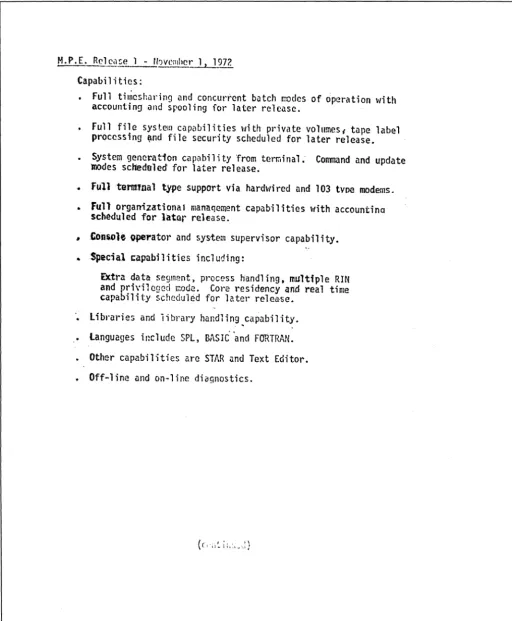
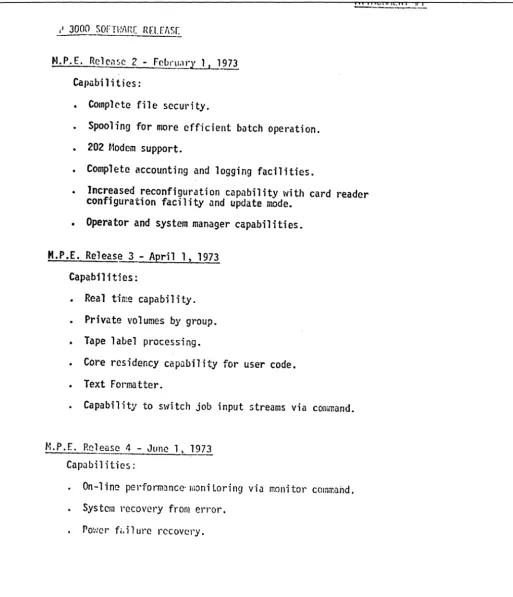
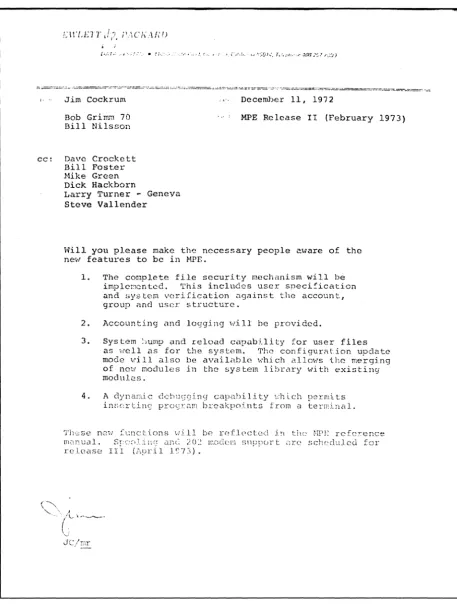
Hewlett-. PackardHewlett-.3 It was conceived of in 1969, designed in 1970 and 1971, and first sold in November, 1972--only to be withdrawn from market several months later, and not re-released until 1973.4 5 It has since become one of Hewlett-Packard's most successful products, and to this day contributes significant revenue to the company.
The history of the project is fascinating. This article will describe the early days of the HP3000, what the machine was to be originally, what it actually be-came, and what changed (and why) in the mean-time. It is a narrative of a machine that faced daunt~ ing failures in the beginning yet, after re-release, found relatively quick acceptance in the business data processing market - a field then unfamiliar to Hewlett-Packard.6
The HP3000 was, and still is, HP's premier business data processing machine. It runs a proprietary oper-ating system, called MPE for MultiProgramming
Environment, and supports both batch and
termi-i The task of deciding a name for the operating
system was rather arduous, and was the cause of many a bellicose staff meeting. Finally, the name
nal-based users. It can support these different users running different computer languages and applica-tions. The 3000 has been very successful in indus-trial applications, competing against such industry giants as mM in manufacturing shop floor applica-tions, order entry, warehousing, and production controF
The 3000 was a very important factor in Hewlett-Packard's rise to eminence among the world's com-puter firms. In terms of dollar volume, MPE and MPE-based systems have only very recently been surpassed in sales by the HP-UX line of Unix-com-patible systems that conform to HP's current "open systems" concept.8
But to the historian, the HP3000 is significant not only for its long and lucrative success, but for the advanced computing principles it embodied at the outset. The HP3000 was:
• the first ·16 bit machine to have a stack and virtual memory.
• the first minicomputer to implement COBOL.
• the first minicomputer to run a Database Man-agement System.
• one of the first computers to be completely . programmed in a high-level language.
• one of the first machines designed by hardware and software engineers.
... all for under $100,000.91011
The HP3000 was, and is, undeniably a significant machine, but its achievements were hard-won. It was actually released twice, with an abortive intro-duction, quick recall, massive redesign, and reintro-duction.
ALPHA IS BORN
After the HP21XX series of real-time computers, released in the latter half of the Sixties, the next-generation Hewlett-Packard machine project com-prised the 32-bit machine called Omega and a smaller, 16-bit machine named Alpha. Omega was a truly ambitious machine, essentially realizing the
concepts of DEC's VAX while pre-dating it by almost 10 years. Unfortunately, it was a bit too am-bitious for such a conservative company as Hewlett-Packard, and was cancelled in 1970, after nearly 2 years of work.
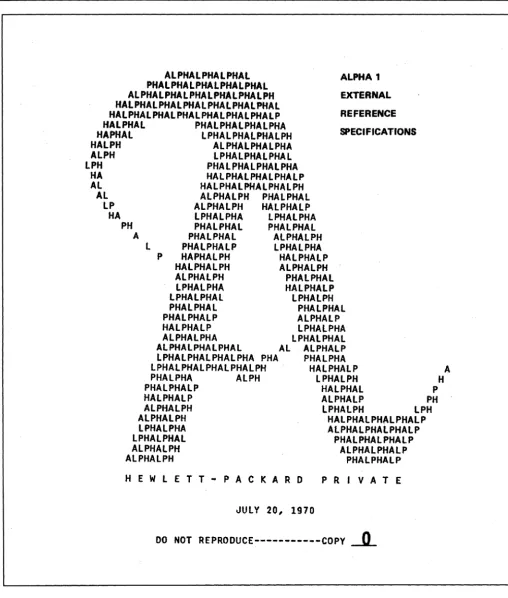
The Alpha project was supposed to be simultaneous with Omega, but there were actually a few engi-neers at most working on Alpha at any given time during the Omega development. 12 In fact, the Alpha 1 's External Reference Specifications, included as Figure 2, show a release date of July 20, 1970, less than four months before the Omega was canceled. i
Tom Perkins, General Manager of HP's Data Products Division and star of the HP21XX line, was the man who cancelled the Omega project. He was promoted in the Fall of 1970 to head Corporate Development, after which George Newman was made "GM," as HP-ers called their divisional manager. 13
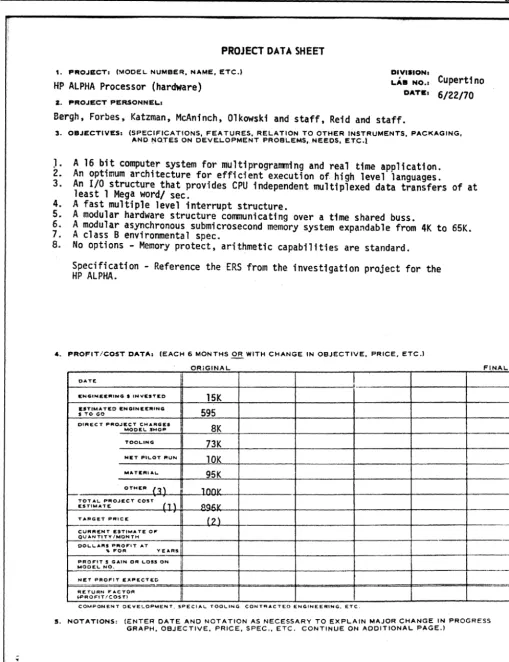
Figure 3 shows the original Project Data Sheet for the Alpha hardware system. Highlights from the
"Objectives" section are:
1. a 16-bit computer system for multiprogramming and real-time application,
2. an optimum architecture for efficient execution of high level languages,
3. an 110 structure that provides CPU independent multiplexed data transfers of at least 1
mega-word/sec,
4. a fast multiple level interrupt structure, 5. a modular hardware structure communicating over a time-shared buss (sic)14 I
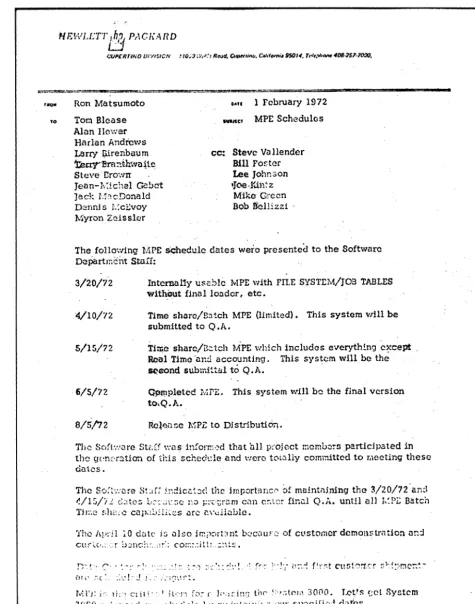
Note the estimated costs for the Alpha hardware of . $896,000 in mid-1970. Figure 4 is a preliminary
timeline that accompanied the Project Data Sheet, showing an MR (manufacturing release) date of February 1, 1972. 15
As mentioned, there was great dismay over the can-cellation of the Omega. machine, and the decision to go ahead with the Alpha was not received enthusi-astically. Going back to "just another 16-bit
machine" 16 had its discouraging aspects even beyond preoccupation with the word-size; the engineers at HP felt that they had been designing and working with a machine similar to Alpha (HP21XX) for a number of years. The prospect of going "back" to
i The original Figure 1 has been reproduced as the cover.
the Alpha might also have seemed pedestrian in contrast to eagerly anticipated work on the 32-bit' Omega. For whatever reasons, Omega was sorely and widely missed.
But the Alpha, and subsequently the HP3000, were to become Omega's memorial- intentionally or not - thanks to one significant decision. The de-velopers, consciously or unconsciously, decided that the Alpha would be as much like the Omega as a 16-bit machine possibly could. As one engineer of that time put it, "We had an Omega mentality in an Alpha box;"17 in practical terms this meant that al-most everything about the Omega was "cut in half" but survived into the Alpha plan. Both were to be virtual memory, stack-based machines with three modes of operation - timeshare, batch and real-time. The major differences were in the "virtual-ness" of Alpha memory (only application code was "virtual", user data was limited to 64K), and in the inputloutput scheme - a particular disappointment for the 110 engineers, who had designed elaborate inputloutput hardware systems18 for Omega's 32 bit data path, which could never be incorporated into the Alpha.19
Upper management saw the initial Alpha specifica-tions and had some concerns over the functionality and feasibility of the machine. Arndt (Arnie) Bergh, one of the prime hardware designers for the project, recalls that, n ... he [the general manager and one of
the people who ordered the cancellation of the Omega] said 'You did it to me again. All I wanted was a simple, clean, inexpensive instrumentation computer that would do the job. ",20
In spite of reservations, the project was approved and specifications for the Alpha were completed. By the time the External Reference Specifications were released in July 1970, the vision for the Alpha was complete in broad outline. It would have a 16-bit data word with a single storage register. It was to be stack-based with a maximum memory of 128 Kbytes, or 64K words, of ferrite-core memory.21 (A
Page 18 The Analytical Engine
ALPHALPHALPHAL
PHALPHALPHALPHALPHAL
AL PHALPHALPHA LPHA LPHAL PH
HALPHALPHAlPHAlPHAlPHAlPHAl
HALPHALPHALPHALPHALPHAlPHALP
HALPHAL
PHAlPHAlPHAlPHA
HAPHAl
lPHALPHALPHALPH
HALPH
ALPHAlPHALPHA
ALPH
LPHALPHALPHAL
lPH
PHALPHALPHALPHA
HA
HALPHALPHALPHALP
AL
HALPHALPHALPHALPH
AL
AlPHAlPH PHALPHAL
LP
ALPHALPH
HALPHALP
HA
LPHALPHA
LPHAlPHA
PH
PHALPHAL
PHALPHAL
A
PHALPHAL
AtPHALPH
L
PHALPHAlP
LPHAlPHA
P
HAPHALPH
HAlPHAlP
HALPHALPH
ALPHAlPH
ALPHAlPH
PHALPHAL
LPHALPHA
HAlPHALP
lPHALPHAl
lPHAlPH
November 1995
ALPHA 1
EXTERNAL
REFERENCE
SPECIFICATIONS
PHAlPHAL
PHAlPHAl
PHAlPHAlP
AlPHAlP
HAlPHAlP
lPHALPHA
AlPHAlPHA
lPHAlPHAL
ALPHAlPHAlPHAL
AL
ALPHALP
LPHAlPHAlPHALPHA PHA
PHALPHA
lPHAlPHALPHAlPHALPH
HALPHAlP
A
PHALPHA
AlPH
lPHALPH
H
PHAlPHAlP
HALPHAl
P
HAlPHAlP
ALPHALP
PH
ALPHALPH
LPHAlPH
LPH
ALPHAlPH
HAlPHAlPHAlPHALP
lPHAlPHA
ALPHALPHAlPHAlP
LPHALPHAL
PHAlPHALPHAlP
ALPHALPH
AlPHAlPHALP
ALPHALPH
PHALPHAlP
HEW lET T - PAC K A R 0
P R I V ATE
JULY 20, 1970
[image:19.623.48.557.54.653.2]DO NOT REPRODUCE---COpy
~
PROJECT DATA SHEET
1. PftO.lECTa (MODEL. NUMee:~. NAME. ETC.I DIV' •• ONI
Cupertino
HP ALPHA Processor (hardware)
LA. NO.1DATE. 6/22170
a. PROJECT PERSONNEL.
Bergh, Forbes. Katzman, McAninch. Olkowski and staff, Reid and staff.
3. OBJECTIVES, (SPECIFICATIONS, FEATURES. RELATION TO OTHER INSTRUMENTS. PACKAGING. AND ~O.TES ON DEVELOPMENT PROBI..EMS, .. NEEOS. ET.C.l
J.
A 16 bit computer system for niultiprograrrmfng and rea' time
applH:at1on.2.
An optimum architecture for efficient execution of· high level languages.
3.
An I/O structure that provides CPU independent multiplexed data transfers of at
least 1 Mega word/ sec.
4.
A fast multiple level interrupt structure.
5.
A modular hardware structure communicating over a time shared buss.
6.
A modular asynchronous submicrosecond memory system expandable from 4K to 6SK.
7.A class B environmental spec.
8.
No options - Memory protect. arithmetic capabilities are standard.
Specification - Reference the ERS from the investigation project for the
HP ALPHA.
••
PROFIT/COST DATAl (EACH 6 MONTHS..2.f!. WITH CHANGE IN OBJECTIVE. PRICE, ETC.!ORIGINAL. FINAL.
DATI:
!
. . . ." .. 4 • 'NvItSTltO
15K
UT, ... ATItD 1ItN1l'''.'Ut'''G595
S TO GO
D*"ECT PRO.,l.&CT CH ... GE.
8K
1oOO01t\. ."'0"
TOOLING
73K
" . T ... \.OT .. UN 10K
... -.
[image:20.627.58.568.55.718.2]"'ATE-RiA&. I 95K
...
OTHE" _!31 1MII' , ...
~~J,:'';..::O.U!CT c o n .11.'
AClf\J/'
TAfIIGII!:T fPRteE (2)
.... -..
CURfIlCNT ESTIMATE 0".
QV_..,"tITY/MONTH
QOLt-AIIt. "'"0".T A.T
.. P'OR Ya"'''S
.. ftOPIT.$ OAt"" OR LOSS ON
I
.. OOEI.. "0. . ....
-MIET PROFIT ItX"ECTEC
_. ~,.; ...
tltETURH " ... CTOA
HD"ROFIT'/COST)
COMPQNENT OEVELOPMENT, SPSCIII.t.. TOOI..ING. <;(lNT".CTEO ENGfNEE-'1NG. eTC.
5. NOTATIONS: (ENTER DATE AND NOTATION AS NECESSARY TO EXPLAIN MAJOR CHANGE IN PROGRESS GRAPH; OBJECTIVE, PRICE, SPEC .. ETC. CONTINUE ON ADDITIONAL PAGE.I
:; ~ ~
~iO
71
72
I,",UN I.jUL
I
AU~
I
SEPIocr I
NOVI
DECI
tJ.\NI
FES 1l'!:\R IAPRI;';;
IJUMI
JUI..I
AUC.I
Sf?Iocr I
NOV IOECI
JANI
ERS
Ba®
[ , - I-I
I
1~8K