Volume 63 Number 6236 DOI: 10.22444/IBVS.6236
Konkoly Observatory Budapest
7 February 2018
HU ISSN 0374 – 0676
REVISED COORDINATES OF VARIABLE STARS IN CASSIOPEIA
NESCI, R.
INAF/IAPS, via Fosso del Cavaliere 100, 00133 Roma, Italy, e-mail: [email protected]
Abstract
The identification of the variable stars published on IBVS #3573 has ben revised on the basis of the original (unpublished) finding charts. Cross check with the 2MASS catalog has been made to get more accurate coordinates and to confirm their nature from their J
−H,H−K colors. The Mira
stars, given their known periods, could be used with the astrometric parallaxes of the forthcoming Gaia catalog to improve the Period-Luminosity relation.
1
Introduction
Mira stars are among the brightest star in a stellar population, and their absolute lumi-nosity is fairly related to their pulsation period, so that are useful as standard candles to derive the distances of nearby galaxies.
A list of red variables, including a number of Miras, in a field centered on IC 1805, was published by Gasperoni, Maffei and Tosti (1991, IBVS #3573), giving a measure of their periods on the basis of 7 years of observations using infrared (I-N + RG5) and blue (103aO) Schmidt plates of the Asiago Observatory.
This variable stars sample is statistically well defined, being magnitude limited and followed with 75 plates along 7 years. Gasperoni et al. (1991) did not publish finding charts but only coordinates at B1950, with arcmin approximation, rather poor for a safe identification near the galactic plane. Based on that paper, the stars were imported in the General Catalog of Variable Stars (Samus et al. 2017) by Samus et al. (2003). The individual stars can be searched in SIMBAD by their original provisional name (SV* Mxxx) or by coordinates. They can also be searched in the VSX database, but only with the variable name or the coordinates, and the historic link to Gasperoni et al. (1991) is generally not present.
In the course of a larger on-going research on the Mira stars in Cassiopeia, I found for some of these stars strong inconsistencies between the optical and near infrared (J H K)
2
Identification
In the family archive of the late prof. Paolo Maffei (http://www.archiviomaffei.org) I was able to recover the original paper enlargements of the Asiago plates, with pen-cil annotations by Maffei of the detected variables and comparison sequences, so it was possible to check for all the stars their actual positions. I also found the two original thesis works (unpublished) of the two Maffei’s students V. Gasperoni and G. Tosti on the stars of this field. Comparison of the finding charts with the Digitized Sky Survey infrared plates, available on-line from the Space Telescope Science Institute (http://archive.stsci.edu/cgi-bin/dss plate finder), and with the 2MASS cata-log and images, available from SIMBAD (http://simbad.u-strasbg.fr/simbad/), and IRSA database (http://irsa.ipac.caltech.edu/) allowed to perform a satisfactory identification for all the variables listed in Gasperoni et al. (1991) with a 2MASS coun-terpart.
In some cases the coordinates differences between Gasperoni et al. (1991) (precession corrected) and the actual coordinates were small, compatible with the quoted accuracy, but often they were rather large, several arcmin! Two stars have outstanding errors: M279 (presently identified in the GCVS as V0687 Cas) and M289 (identified in the GCVS as V0685 Cas).
In the case of the SR variable M279 the published coordinates are 187 arcmin (3 degrees !) off from the position in the finding chart: the finding chart says that it must be associated to IRAS 02205+6014, a bright and very red star. At the coordinates of M279 published in Gasperoni et al. (1991) the CGVS reports V0676 Cas, but nothing similar to a red star is nearby. In Maffei’s finding charts no variable star is reported near the published coordinates.
Similarly dramatic is the situation of the SR variable M289, which is 169 arcmin (again about 3 degrees) off from the published position: at the finding chart position there is a bright and red source in 2MASS, as should be for a SR variable. At this position the VSX catalog reports a low amplitude variable, NSVS 1890163. On his thesis, G. Tosti reports large irregularities in the light curve of this star, which prevented to define a time scale for its variability: the variability amplitude, 0.8 mag, is similar to that reported in the NSVS. The associated name in GCVS is V0685 Cas, but its position corresponds to a rather bright and blue star (B = 13.188, V = 12.697, B −V = 0.49 in the UCAC4
catalog) clearly inconsistent with the Maffei’s variable because it is reported to be always below the detection limit (B ∼18 mag) in the Asiago blue plates. Clearly NSVS 1890163
is the actual identification of M289.
I tried to understand from the documents in Maffei’s archive how such large errors for these two stars could arise. In Tosti’s thesis no coordinates are given, while in Gasperoni’s one the coordinates are given as published in Gasperoni et al. (1991): the most likely explanation is therefore that the misprints in the thesis were carried on in the article.
3
Results
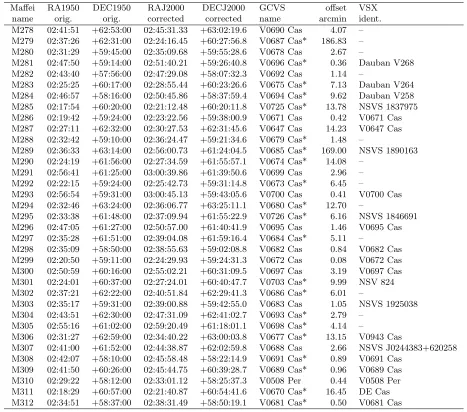
Table 1: Revised coordinates and identifications of variable stars in the field of IC 1805.
Maffei RA1950 DEC1950 RAJ2000 DECJ2000 GCVS offset VSX name orig. orig. corrected corrected name arcmin ident. M278 02:41:51 +62:53:00 02:45:31.33 +63:02:19.6 V0690 Cas 4.07 – M279 02:37:26 +62:31:00 02:24:16.45 +60:27:56.8 V0687 Cas* 186.83 – M280 02:31:29 +59:45:00 02:35:09.68 +59:55:28.6 V0678 Cas 2.67 –
M281 02:47:50 +59:14:00 02:51:40.21 +59:26:40.8 V0696 Cas* 0.36 Dauban V268 M282 02:43:40 +57:56:00 02:47:29.08 +58:07:32.3 V0692 Cas 1.14 –
M283 02:25:25 +60:17:00 02:28:55.44 +60:23:26.6 V0675 Cas* 7.13 Dauban V264 M284 02:46:57 +58:16:00 02:50:45.86 +58:37:59.4 V0694 Cas* 9.62 Dauban V258 M285 02:17:54 +60:20:00 02:21:12.48 +60:20:11.8 V0725 Cas* 13.78 NSVS 1837975 M286 02:19:42 +59:24:00 02:23:22.56 +59:38:00.9 V0671 Cas 0.42 V0671 Cas M287 02:27:11 +62:32:00 02:30:27.53 +62:31:45.6 V0647 Cas 14.23 V0647 Cas M288 02:32:42 +59:10:00 02:36:24.47 +59:21:34.6 V0679 Cas* 1.48 –
M289 02:36:33 +63:14:00 02:56:00.73 +61:24:04.5 V0685 Cas* 169.00 NSVS 1890163 M290 02:24:19 +61:56:00 02:27:34.59 +61:55:57.1 V0674 Cas* 14.08 –
M291 02:56:41 +61:25:00 03:00:39.86 +61:39:50.6 V0699 Cas 2.96 – M292 02:22:15 +59:24:00 02:25:42.73 +59:31:14.8 V0673 Cas* 6.45 –
M293 02:56:54 +59:31:00 03:00:45.13 +59:43:05.6 V0700 Cas 0.41 V0700 Cas M294 02:32:46 +63:24:00 02:36:06.77 +63:25:11.1 V0680 Cas* 12.70 –
M295 02:33:38 +61:48:00 02:37:09.94 +61:55:22.9 V0726 Cas* 6.16 NSVS 1846691 M296 02:47:05 +61:27:00 02:50:57.00 +61:40:41.9 V0695 Cas 1.46 V0695 Cas M297 02:35:28 +61:51:00 02:39:04.08 +61:59:16.4 V0684 Cas* 5.11 –
M298 02:35:09 +58:50:00 02:38:55.63 +59:02:08.8 V0682 Cas 0.84 V0682 Cas M299 02:20:50 +59:11:00 02:24:29.93 +59:24:31.3 V0672 Cas 0.08 V0672 Cas M300 02:50:59 +60:16:00 02:55:02.21 +60:31:09.5 V0697 Cas 3.19 V0697 Cas M301 02:24:01 +60:37:00 02:27:24.01 +60:40:47.7 V0703 Cas* 9.99 NSV 824 M302 02:37:21 +62:22:00 02:40:51.84 +62:29:41.3 V0686 Cas* 6.01 –
M303 02:35:17 +59:31:00 02:39:00.88 +59:42:55.0 V0683 Cas 1.05 NSVS 1925038 M304 02:43:51 +62:30:00 02:47:31.09 +62:41:02.7 V0693 Cas* 2.79 –
M305 02:55:16 +61:02:00 02:59:20.49 +61:18:01.1 V0698 Cas* 4.14 –
M306 02:31:27 +62:59:00 02:34:40.22 +63:00:03.8 V0677 Cas* 13.15 V0943 Cas
M307 02:41:00 +61:52:00 02:44:38.87 +62:02:59.8 V0688 Cas 2.66 NSVS J0244383+620258 M308 02:42:07 +58:10:00 02:45:58.48 +58:22:14.9 V0691 Cas* 0.89 V0691 Cas
M309 02:41:50 +60:26:00 02:45:44.75 +60:39:28.7 V0689 Cas* 0.96 V0689 Cas M310 02:29:22 +58:12:00 02:33:01.12 +58:25:37.3 V0508 Per 0.44 V0508 Per M311 02:18:29 +60:57:00 02:21:40.87 +60:54:41.6 V0670 Cas* 16.45 DE Cas M312 02:34:51 +58:37:00 02:38:31.49 +58:50:19.1 V0681 Cas* 0.50 V0681 Cas
the median difference for the whole set is 3 arcmin and for 14 stars it is larger than 6 arcmin, 2 of them being about 3 degrees off as discussed above.
After having found the actual positions of the Maffei’s variables, I looked if they were present in the VSX catalog with another name, adopting a coordinates tolerance of 1 arcmin: these names are reported in column 8 of Table 1.
For 11 stars the name in VSX is the same as in SIMBAD: generally this happens be-cause the old coordinates were near to the actual ones. For 11 cases a different variable name is listed in VSX, meaning that the variable was ‘rediscovered’ and not recognized as already known because the old coordinates were significantly different from the actual ones: for these stars the two names should be merged in a single identification in variable star catalogues like VSX or GCVS. For 13 stars no counterpart is present in VSX, indi-cating that they have not been ‘rediscovered’: for these stars the GCVS variable name can be retained.
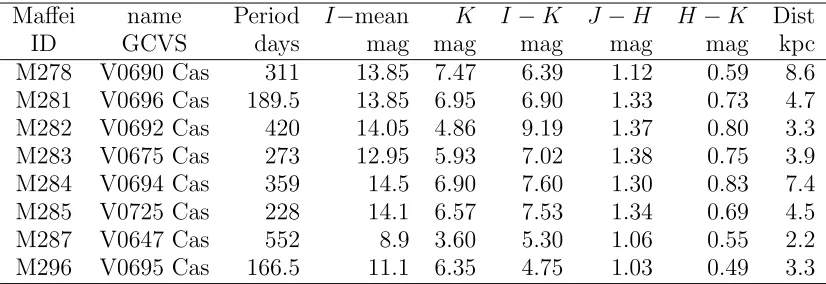
Table 2: Table 2. NIR colors, periods and distances for Mira stars.
Maffei name Period I−mean K I−K J −H H−K Dist
ID GCVS days mag mag mag mag mag kpc
M278 V0690 Cas 311 13.85 7.47 6.39 1.12 0.59 8.6
M281 V0696 Cas 189.5 13.85 6.95 6.90 1.33 0.73 4.7
M282 V0692 Cas 420 14.05 4.86 9.19 1.37 0.80 3.3
M283 V0675 Cas 273 12.95 5.93 7.02 1.38 0.75 3.9
M284 V0694 Cas 359 14.5 6.90 7.60 1.30 0.83 7.4
M285 V0725 Cas 228 14.1 6.57 7.53 1.34 0.69 4.5
M287 V0647 Cas 552 8.9 3.60 5.30 1.06 0.55 2.2
M296 V0695 Cas 166.5 11.1 6.35 4.75 1.03 0.49 3.3
have coordinates different by more than 1 arcsec from my determination and therefore must be updated.
I remark that the alignment of VSX and CGVS is not always updated to the last version: this is a source of confusion.
In Table 2, I report for each Mira star the period in days and the apparent average I magnitude from Gasperoni et al. 1991, the K magnitude, the I − K, J − H and H − K colors form 2MASS, and a distance estimate. The distances were computed
assuming the absolute K magnitude from the Period-Magnitude relation by Whitelock
2012 (MK = −3.69(logP −2.38) − 7.3), and a common foreground K absorption of
0.3 mag. These distances are rather indicative because the K magnitude in the 2MASS catalog is taken at an unknown phase in the light curve so may be off up to half magnitude from the average value: a likely error is 0.2 dex in log 10(Dist). Apparently these Mira stars belong to two broad groups, the main one (6 stars) clustered around 3.5 kpc, likely associated to the Perseus arm, while two stars are much farther, around 8 kpc, likely associated to the Outer arm.
There is no clear correlation between the estimated distance of each Mira star and its
J−H (or H−K) color, so it is unlikely that a different reddening is the main reason for
the spread in distances found.
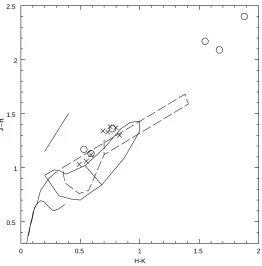
The J − H,H −K color-color plot in Fig. 1 shows the positions of all the Maffei
variables with respect to the regions defined by Bessell and Brett (1988). Three groups of stars can be identified in this plot: the first group comprises rather hot stars located on or near the Main Sequence and are generally irregular or eclipse variables; the second group has the Mira and Semiregular variables, with colors typical for this class of stars; the third group has the 4 reddest stars located in the typical area of the carbon stars with dusty envelopes, all classified in Gasperoni et al. (1991) as Semiregular or Irregular: one of them (M280) is already known as carbon star (CGCS 6035, Alksnis et al. 2001), the others (M 279, M286, M294) are most likely carbon stars too. Also M307 (V688 Cas, CGCS 0396) classified as SR, is a carbon stars, but its colors are not extreme so it is located among the Mira stars in this diagram.
4
Conclusions
visual comparison of finding charts, an update of the coordinates of these variables in the GCVS and VSX catalogs is necessary to allow recovering the variability history of these stars and to allow cross-identifications with present and future galactic plane surveys.
0 0.5 1 1.5 2
0.5 1 1.5 2 2.5
[image:5.595.167.429.151.417.2]H-K
Figure 1. TheJ−H, H−K diagram with the different areas according to Bessel and Brett (1988). Continuous lines are the Main Sequence and the Giant Branch. The star positions are indicatd by letters: M=Miras, S=Semiregulars, I=Irregulars, E=eclipsing stars. The reddening vector is indicated for E(B−V)=1 mag (AK ∼0.3 mag). All the stars in our sample fall nicely in this diagram, indicating
a small absorption; the carbon stars with dusty envelopes are located in the upper right corner .
Thanks to the new more accurate coordinates all these Mira stars can be safely recog-nized in the forthcoming Gaia catalog of astrometric parallaxes and used to increase the database for studies of the Mira Period-Luminosity relation.
Acknowledgements: This work has made use of the SIMBAD, IRSA, VSX and STScI databases.
References:
Alksnis, A., Balklavs, A., Dzervitis, U., et al., 2001,Baltic Astronomy,10, 1 Bessell, M.S., and Brett, J.M., 1988, PASP, 100, 1134 DOI
Cutri, R.M., Skrutskie, M.F., vanDyk, S., et al., 2003, CDS on-line catalog, II/246 Gasperoni, V., Maffei, P., Tosti, G., 1991, IBVS,3573