N A N O E X P R E S S
Open Access
Singly ionized double-donor complex in vertically
coupled quantum dots
Ramón Manjarres-García
1, Gene Elizabeth Escorcia-Salas
1, Ilia D Mikhailov
2and José Sierra-Ortega
1*Abstract
The electronic states of a singly ionized on-axis double-donor complex (D2+) confined in two identical vertically coupled, axially symmetrical quantum dots in a threading magnetic field are calculated. The solutions of the Schrödinger equation are obtained by a variational separation of variables in the adiabatic limit. Numerical results are shown for bonding and antibonding lowest-lying artificial molecule states corresponding to different quantum dot morphologies, dimensions, separation between them, thicknesses of the wetting layers, and magnetic field strength.
Keywords:Quantum dots, Adiabatic approximation, Artificial molecule PACS:78.67.-n, 78.67.Hc, 3.21.-b
Background
Quantum dots (QDs) have opened the possibility to fab-ricate both artificial atoms and molecules with novel and fascinating optoelectronic properties which are not accessible in bulk semiconductor materials. An attractive route for nano-structuring semiconductor materials offers self-assembled quantum dots which are formed by the Stranski-Krastanow growth mode by depositing the material on a substrate with different lattice parameters [1-5]. The electrical and optical properties of these structures may be changed in a controlled form by dop-ing the shallow impurities whose energy levels are defined by the interplay between the reductions of the physical dimension, the Coulomb attraction, and the inter-particle correlation.
Recently, it has been proposed to use the singly ionized double-donor system (D2+) confined in a single semiconductor QD [6] or ring [7] as an adequate func-tional part in a wide range of device applications, includ-ing spintronics, optoelectronics, photovoltaics, and quantum information technologies. This two-level sys-tem encodes logical information either on the spin or on the charge degrees of freedom of the single electron and allows us to manipulate conveniently its molecular
properties, such as the energy splitting between the bonding and antibonding lowest-lying molecular-like states or the spatial distribution of carriers in the system [8-12]. One can expect that the singly ionized double-donor system (D2+) confined in vertically coupled QDs should have similar properties. In this paper, we analyze the electronic states of an artificial hydrogen molecular ion (D2+) compound by two positive ions that inter-change their electron, which is constrained to exinter-change between two identical vertically coupled, axially symmet-rical QDs in the presence of a threading magnetic field.
Methods
Below, we analyze the model of two separated on-axis singly ionized donors, confined in two coaxial, vertically stacked QDs, whose identical morphologies present axially symmetrical layers whose shape is given by the dependence of the layer thickness h on the distance ρ from the axis as follows: h(ρ) = db + d0fn(ρ)ϑ(R0 − ρ). Here,R0is the base radius, dbis the wetting layer
thick-ness, d0 is the maximum height of the QD over this
layer, ϑ(x) is the Heaviside step function, equal to 0 for x< 0 and to 1 forx> 0,andfn(ρ) = [1−(ρ/R0)n]1/n. The
morphology is controlled in this model by means of the integer shape-generating parameter n which is equal to 1, 2, or tends to infinity for conical pyramid-like, lens-like, and disk-like geometrical shapes, respectively. As an example, the 3D image of an artificial singly ionized
* Correspondence:[email protected]
1
Group of Investigation in Condensed Matter Theory, Universidad del Magdalena, Santa Marta, Colombia
Full list of author information is available at the end of the article
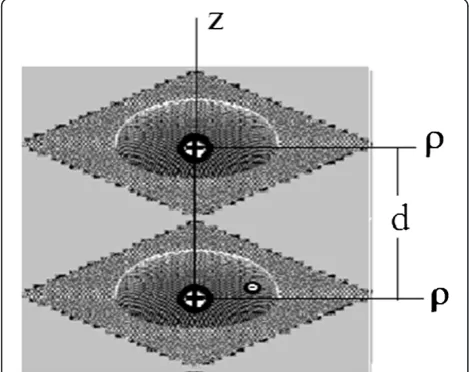
molecule confined in lens-like QDs is presented in Figure 1.
Besides, we assume that the external homogeneous magnetic fieldB=Bẑis applied along the quantum dot's axis. The dimensionless Hamiltonian of the single elec-tron in this D2+ complex in the effective-mass approxi-mation can be written as
H¼ ΔþVcðρ;zÞ r2R 1
j j
2
rR2 j j;Ri
¼ð0;zi;0Þ ð1Þ
where Vc(ρ, z) is the confinement potential, equal to 0
and V0inside and outside the QD, respectively. The last two terms in Equation 1 correspond to the attraction be-tween electron and ions. The effective Bohr radiusa0* = ℏ2ε
/m*e2, the effective Rydberg Ry* = e2/2εa0*, and γ = eℏB/2m*cRy* have been taken above as units of length,
energy, and the conventional dimensionless magnetic field strength, respectively.
As both donors are located at the axis, the potential is
axially symmetrical, the angular momentum Lz
commu-tes with the Hamiltonian, and the corresponding
eigen-values give us one good quantum number m. At this
representation, the Hamiltonian (Equation 1) cylindric-ally coordinates only on two coordinates:
Hmðρ;zÞ ¼
1 ρ
@ @ρρ
@ @ρ
@2
@z2þγmþ γ2ρ2
4 þVρðρ;zÞ;
Vρðρ;zÞ ¼Vcðρ;zÞ
2
ffiffiffiffiffiffiffiffiffiffiffiffiffiffiffiffiffiffiffiffiffiffiffiffiffiffiffi
ρ2þ zZ2 1
ð Þ
p ffiffiffiffiffiffiffiffiffiffiffiffiffiffiffiffiffiffiffiffiffiffiffiffiffiffiffi2
ρ2þ zZ2 2
ð Þ
p :
ð2Þ
Taking into account that the thickness of QDs is typic-ally much smaller than their lateral dimension and
therefore the electron motion in the first direction is much faster than in-plane motion, one can use the advantage of the adiabatic approximation [13] in which the wave function is presented as a product of two functions:
Ψmðρ;zÞ ¼fðρ;zÞΦmð Þ;ρ m¼0;1;2;. . .; ð3Þ
where the first functionf(ρ, z) describes the fast motion inzdirection and satisfies the wave equation
@2f@ðρ;zÞ
z2 þVðρ;zÞfðρ;zÞ ¼Efð Þρ fðρ;zÞ ð4Þ with‘frozen out’radial coordinateρ, while the radial part of the wave function is found in the second step from the equation
1 ρ
@ @ρρ
@Φmð Þρ
@ρ þ γmþ m2
ρ2 þ γ2ρ2
4 þEfð Þρ
Φmð Þρ
¼EmΦmð Þρ :
ð5Þ
In our numerical procedure, we solve Equation 4
re-peatedly for each value ρ by using the trigonometric
sweep method [13] in order to restore the unknown function Ef(ρ). Once this function is found, then the
en-ergies Em of the molecular complex can be established
by solving Equation 5.
As the potentialV(ρ,z) for each fixed value ofρpresents an even function V(ρ, −z) = V(ρ, z) with respect to the variablez corresponding to a symmetrical (no-rectangle) quantum well, then all solutions of Equation 4 can be arranged in two sets: odd solutions f−(ρ,−z) =−f−(ρ,z) and even solutions f+(ρ, − z) = f+(ρ, z), called anti-bonding and anti-bonding states, respectively. These sets of functions can be found as the solutions of the boundary value problems corresponding to the differ-ential Equation 4 within the range 0 < z < ∞ with the frontier conditions d fþdzð Þρ;0 ¼0;fðρ;0Þ ¼0.
Results and discussion
We have performed numerical calculations of
two-electron renormalized energies Em as a function of
the magnetic flux and for QDs with different morph-ologies, dimensions, and separation between layers in
order to analyze the Aharonov-Bohm and the
quantum size effects. We consider for our simula-tions the In0.55Al0.45As/Al0.35Ga0.65As structures with the following values of physical parameters: dielectric constant = 12.71, the effective mass in the dot region and the region outside the dot for the electronm* = 0.076m0, the conduction and the valence band offset in junctions is V0= 358meV, the effective Bohr radiusa0* 10nm, and the effective RydbergRy*5meV.
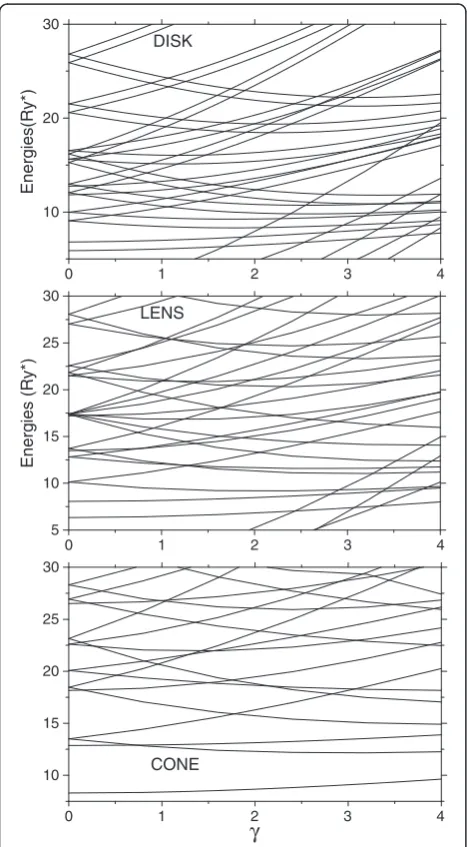
First, we calculate the energies of the molecular complex as functions of the magnetic field in disk-like, lens-like, and clike vertically coupled QDs and in a single one-electron QR with smooth non-homogeneity of the surface. Results for vertically coupled QDs with the heights d0 = 4nm, the wetting layer thicknesses db = 1nm, radii
R0= 20nm, and the separation between themd= 6nm are shown in Figure 2.
It is seen that in all cases, the energy levels are very sensitive to the magnetic field and their dependencies on the magnetic field strength exhibit multiple crossovers and reordering. Comparing these dependencies for the disk, the lens, and the cone in Figure 2, one can also observe a successive increase of the number of
crossovers and the lowering of the region energies where such crossovers occur. It is related to the variation of the electron probability distribution inside and around their InAs layers, which is similar to charge distribution in a metallic surface when its geometry varies from the flat to the spiked-type one. Such variation of the prob-ability distribution is a consequence of the stronger con-finement in structures with spiked-type QD geometry where the electron-ion separation is defined by inter-plays between the electrostatic interaction between them and the strong structural confinement, making it more stable with respect to the external magnetic field and the ring-like electron probability density distribution. There-fore, the energy dependencies for cone-like QDs have a shape similar to those that exhibit structures with ring-like geometry known as the Aharonov-Bohm effect.
The Aharonov-Bohm effect observed usually in ring-like heterostructures is a manifestation of the competi-tion between the paramagnetic and diamagnetic terms in the Hamiltonian, resulting in the oscillation of the ground state energy. Such oscillations are impossible in the disk-like structures because of a significant decrease of the diamagnetic term contribution as the magnetic field increases and the electron probability distribution becomes more contracted. In QDs with a spike-like morphology, the electron probability density is already strongly confined, the external magnetic field can no longer decrease more the diamagnetic term contribu-tion, and the energy dependencies on the increasing magnetic field become similar to those of ring-like structures.
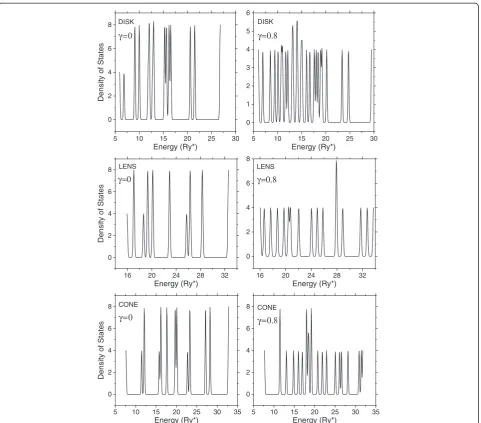
In Figure 3, we present results of the calculation of the density of electronic states in the zero-magnetic field for QDs with three different morphologies on the left side case γ = 0 and on the right side for γ = 0.8. It is seen that the density of electronic states in the case of the zero-magnetic field for the disk-like structure has a lar-ger value in the region of the low-lying energy levels and it decreases successively while the morphology becomes more and more spike-liked. It is due to the fact that the electron confinement in the disk is weaker than that in the lens and that in the lens is weaker than that in the cone.
Also, it is seen that the lowest peak corresponding to the ground bonding state in the cone-like structure is more significantly separated from other excited states than in two other structures. It is due to the stronger confinement of the electron in the cone-like structure where the electron is mainly located nearer to the donor than in disk-like and lens-like structures.
Comparing the densities of states presented on the left and right sides of Figure 3, one can see remarkable mod-ifications that suffer the corresponding curves. Particu-larly, in the disk-like structure, the presence of the 5
10 15 20 25 30
Energies (Ry*)
LENS
10 15 20 25 30
γ
CONE
0 1 2 3 4
0 1 2 3 4
0 1 2 3 4
10 20 30
Energies(Ry*)
[image:3.595.57.291.272.696.2]DISK
Figure 2Energies as functions of the magnetic field of aD2+in
vertically coupled quantum dots.(Heights 4 nm, wetting layer
magnetic field provides a displacement of the peaks at the region of the low-lying energies. In the lens-like and cone-like structures, the modification is inversed; the peaks are reorganized in such a way that their distribu-tion becomes almost homogeneous. Redistribudistribu-tion of the peaks' positions in the lens is defined mainly by the additional confinement that provides the external mag-netic field, while analogous redistribution in other two spike-liked structures is mainly due to the Aharonov-Bohm effect.
Conclusions
In short, we propose a simple numerical procedure for calculating the energies and wave functions of a singly
ionized molecular complex formed by two separated on-axis donors located at vertically coupled QDs in the pres-ence of the external magnetic field. Our calculation includes some important characteristics of the hetero-structure such as the presence of the wetting layer and the possibility of the variation of the QD morphology. The curves of the energy dependencies on the external mag-netic field for the disk-like, lens-like, and cone-like struc-tures are presented. We find that the effect of the in-plane confinement on the electron-ion separation is stronger in spike-shaped QDs and therefore the energy dependencies in such structures exhibit a behavior similar to that in ring-like structures. The analysis of the curves of the dens-ity of electronic states also confirms this result.
5 10 15 20 25 30 35
0 2 4 6
8 CONE
γ=0
Density of States
Energy (Ry*)
5 10 15 20 25 30 35
Energy (Ry*) 0
2 4 6 8
LENS γ=0.8
16 20 24 28 32
LENS γ=0
Energy (Ry*)
16 20 24 28 32
Energy (Ry*)
0 2 4 6
8 CONE
γ=0.8
5 10 15 20 25 30
0 2 4 6
8 DISK
γ=0
Density of States
0 2 4 6 8
Density of States
Energy (Ry*)
5 10 15 20 25 30
Energy (Ry*) 0
1 2 3 4 5 6
DISK
[image:4.595.59.541.87.510.2]γ=0.8
Figure 3Density of the electronic states for aD2 +
in vertically coupled quantum dots.(Heights 3 nm, wetting layer thicknesses 2 nm, radii
Competing interests
The authors declare that they have no competing interests.
Authors’contributions
All authors contributed equally to this work. JSO created the analytic model with contributions from IM. RMG and GES performed the numerical calculations and wrote the manuscript. All authors discussed the results and implications and commented on the manuscript at all stages. All authors read and approved the final manuscript.
Authors’information
JSO obtained his Ph.D. in 2004 at the Universidad Industrial de Santander, where IM was his advisor. His research interests include the theory of semiconductor nanostructures. JSO is the head of the research group
‘Condensed Matter Theory’at the University of Magdalena. GES and RMG are master's degree and Ph.D. students, respectively, and teachers at the University of Magdalena.
Acknowledgements
This work was financed by the Universidad del Magdalena through the Vicerrectoría de Investigaciones (Código 01).
Author details 1
Group of Investigation in Condensed Matter Theory, Universidad del Magdalena, Santa Marta, Colombia.2Universidad Industrial de Santander, A.
A. 678, Bucaramanga, Colombia.
Received: 10 July 2012 Accepted: 3 August 2012 Published: 31 August 2012
References
1. Jacak L, Hawrylak P, Wójs A:Quantum Dots. Berlin: Springer; 1997. 2. Leonard D, Pond K, Petroff PM:Critical layer thickness for self-assembled
InAs islands on GaAs.Phys Rev B1994,50:11687–11692.
3. Lorke A, Luyken RJ, Govorov AO, Kotthaus JP:Spectroscopy of nanoscopic semiconductor rings.Phys Rev Lett2000,84:2223–2226.
4. Granados D, García JM:In(Ga)As self-assembled quantum ring formation by molecular beam epitaxy.Appl Phys Lett2003,82:2401.
5. Raz T, Ritter D, Bahir G:Formation of InAs self-assembled quantum rings on InP.Appl Phys Lett2003,82:1706.
6. Movilla JL, Ballester A, Planelles J:Coupled donors in quantum dots: quantum size and dielectric mismatch effects.Phys Rev B2009,79:195319. 7. Gutiérrez W, García LF, Mikhailov ID:Coupled donors in quantum ring in a
threading magnetic field.Physica E2010,43:559.
8. Calderón MJ, Koiller B,:External field control of donor electron exchange at the Si/SiO2 interface.Phys Rev B2007,75:125311.
9. Tsukanov AV:Single-qubit operations in the double-donor structure driven by optical and voltage pulses.Phys Rev B2007,76:035328. 10. Openov LA:Resonant pulse operations on the buried donor charge
qubits in semiconductors.Phys Rev B2004,70:233313.
11. Koiller B, Hu X,:Electric-field driven donor-based charge qubits in semiconductors.Phys Rev B2006,73:045319.
12. Barrett SD, Milburn GJ:Measuring the decoherence rate in a semiconductor charge qubit.Phys Rev B2003,68:155307. 13. Mikhailov ID, Marín JH, García LF:Off-axis donors in
quasi-two-dimensional quantum dots with cylindrical symmetry.Phys Stat Sol (b)
2005,242:1636.
doi:10.1186/1556-276X-7-489
Cite this article as:Manjarres-Garcíaet al.:Singly ionized double-donor complex in vertically coupled quantum dots.Nanoscale Research Letters
20127:489.
Submit your manuscript to a
journal and benefi t from:
7Convenient online submission
7Rigorous peer review
7Immediate publication on acceptance
7Open access: articles freely available online
7High visibility within the fi eld
7Retaining the copyright to your article