BIROn - Birkbeck Institutional Research Online
Hartigan, Alex and Richards, Anne (2017) Individual differences in
processing emotional images after reading disgusting and neutral sentences.
Neuropsychologia , ISSN 0028-3932. (In Press)
Downloaded from:
Usage Guidelines:
Please refer to usage guidelines at or alternatively
1
Individual differences in processing emotional images after reading
disgusting and neutral sentences
Alex Hartigan
a,* and Anne Richards
aa
Affective and Cognitive Neuroscience Laboratory, Mace Experimental Research Labs in
Neuroscience, Department of Psychological Sciences, Birkbeck College, University of London, United
Kingdom
*Corresponding author at: Affective and Cognitive Neuroscience Laboratory, Mace Experimental
Research Labs in Neuroscience, Department of Psychological Sciences, Birkbeck College, University
2
Abstract
The present study examined the extent to which Event Related Potentials (ERPs) evoked by disgusting, threatening and neutral photographic images were influenced by disgust propensity, disgust sensitivity and attentional control following exposure to disgusting information. Emotional cognition was manipulated by instructing participants to remember either disgusting or neutral sentences; participants in both groups then viewed emotional images while ERPs were recorded. Disgust propensity was associated with a reduced Late Positive Potential (LPP) gap between threatening and neutral stimuli (an effect driven by a rise in the LPP for neutral images) but only amongst individuals who were exposed to disgusting sentences. The typical LPP increase for disgust over neutral was reduced by attentional shifting capacity but only for individuals who were not previously exposed to disgust. There was also a persistent occipital shifted late positivity that was enhanced for disgust for the entire LPP window and was independent of exposure. Results suggest that emotion specific ERP effects can emerge within the broad unpleasant emotional category in conjunction with individual differences and prior emotional exposure. These results have important implications for the ways in which the perception of emotion is impacted by short term cognitive influences and longer term individual differences.
3
1. Introduction
Prior emotional exposure is associated with a wide range of behavioural and psychological
outcomes. This exposure can take the form of mood manipulations (Forgas, 1998a, 1998b; Forgas & Koch, 2013) which tend to result in emotionally congruent (to the mood induction) subsequent behaviours, but there is also an extensive literature on emotional priming which tends to find similar emotional congruence effects, but with effects that bias perceptual processing (Murphy & Zajonc, 1993; Neumann & Lozo, 2012; Rohr et al., 2012; Rohr & Wentura, 2014). A clear example of consequential emotional exposure comes from research on disgust in which there has been a substantial amount of research over the last decade that suggests that exposing individuals to disgust has a number of significant short-term psychological effects. Most notable is the link
between disgust and morality, where a great deal of research appears to demonstrate that exposure to disgust is associated with individuals rendering more punitive moral judgements (Horberg et al., 2009; Moretti & di Pellegrino, 2010; Schnall et al., 2008; van Dillen et al., 2012), an association that is in accordance with other research that has discovered a link between disgust sensitivity and political beliefs (Brenner & Inbar, 2014; Crawford et al., 2014; Herzog & Golden, 2009; Inbar et al., 2009, 2012; Iyer et al., 2012; Terrizzi et al., 2010).
However, disgusting stimuli has also been demonstrated to have a disrupting influence on processing such that perceptual tasks (such as probe detection paradigms) become more difficult (van Hooff et al., 2013, 2014). A key finding of these studies is that the disrupting influence of disgust has a slower onset to that of other negative emotions, but the resulting perceptual biases are longer lasting. Physiologically, disgust is unusual among the other typically studied basic negative emotions in that it stimulates both the sympathetic and parasympathetic nervous system (de Jong et al., 2011) and manifests with decreased cardiac activity (Rohrmann & Hopp, 2008) unlike emotions such as fear and anger (Sinha et al., 1992). It is also associated with hyper-vigilance and metabolic suppression (Schneiderman & McCabe, 1989) which could explain the longer lasting disruption to ongoing processes as a result of feeling disgusted. Disgust exposure appears to have a number of behavioural and perceptual consequences and can influence spheres as disparate as product evaluation (Argo et al., 2006; Morales & Fitzsimons, 2007) and the ability to detect shades of grey (Sherman et al., 2012). Thus, disgust seems to have consequences on both perceptual and cognitive assessments. However, there has been little research on the extent to which prior disgust exposure can influence the processing of subsequent emotional information in the environment. Given that physical disgust is often conceptualised as a disease avoidance mechanism that insulates the individual from harm (Curtis et al., 2004; Fessler & Haley, 2006; Rozin et al., 1995; Susskind et al., 2008; Tyber et al., 2013), it is possible to hypothesise that it will result in a hyper-vigilance to aversive stimuli – either by expanding the range of stimuli that provoke an aversive response or by allocating more attentional resources to processing such aversive stimuli.
4
some suggestion that other early components (such as the P1, N1, P2 and the N2 family) are also modulated by emotion (see Carretié et al., 2004; Keil et al., 2002; Kiss & Eimer, 2008), but these components are more generally associated with other (non-emotional) processes (such as stimulus detection and spatial attention) which emotion has the potential to disrupt (rather than reflecting emotional processing per se).
The EPN is a negative going deflection that occurs between 250-300 ms after stimulus presentation over occipital sites that is enhanced for emotional compared to non-emotional stimuli (Foti et al., 2009; Schupp et al., 2003, 2004b, 2006) and is thought to reflect the tagging of emotional stimuli for the recruitment of attentional resources (Schupp et al., 2006). As the component itself is often defined and represented as the point in the waveform where emotional and non-emotional stimuli diverge, it is almost a marker of emotion processing by definition. Research has suggested that while other early emotionally sensitive components can interact with other processes, the EPN does remain largely independently sensitive to emotion (for example see Bublatzky & Schupp, 2012). However, there are studies that have suggested that it is further enhanced by highly arousing images (Junghöfer et al., 2001; Schupp et al., 2004a). There is also some suggestion that it is a component that is sensitive to valence, with some studies finding an enhancement for pleasant over unpleasant images (Schupp et al., 2006; Schupp et al., 2004a; Pastor et al., 2007; Weinberg & Hajcak, 2010). The EPN has also been speculated to be a marker of a task-independent automatic process as it is observable for emotional stimuli in passive viewing paradigms and even when attention is diverted to another task (Schupp et al., 2003).
The LPP typically refers to the positive drift that occurs across centro-parietal regions after 400 ms post-stimulus onset (Brown et al., 2012; Schupp et al., 2006) but it has been observed from as early as 200 ms for a period lasting for as long as several seconds (Cuthbert et al., 2000). However, this late positivity has also been observed across frontal (Hauswald et al., 2011; Leutgeb et al., 2012) and occipital areas (Bublatzky & Schupp, 2012; Foti et al., 2009). Principal Component Analysis (PCA) has suggested that the LPP actually represents numerous overlapping components with a variety of functions (Foti et al., 2009; MacNamara et al., 2009; Weinberg & Hajcak, 2011) but the LPP as it is commonly examined is a component that is clearly enhanced for emotional over non-emotional stimuli (Cuthbert et al., 2000; Foti et al., 2009; Keil et al., 2002; Pastor et al., 2007; Schupp et al., 2000). In addition to this emotional enhancement, the LPP is also influenced by consciously directed top-down processes, with the later phase (approximately 600 ms or later) generally seeing an enhanced contribution from these influences (Moser et al., 2006, 2009, 2010; Olofsson et al., 2008; Weinberg & Hajcak, 2011; Weinberg et al., 2012) along with the influence of contextual
5
The LPP (particularly in its early portion) has been speculated to represent increased allocation of attentional resources to motivationally salient stimuli (which emotional images are inherently exemplars of; Ferrari et al., 2008; Weinberg et al., 2012), although it may alternatively reflect global inhibition of visual cortex activity following emotion processing (Brown et al., 2012). Given what is known about the LPP, there is no reason to believe that semantic information about the basic emotional categories is indexed by the component (that is to say that there is no reason to believe that there should be divergent LPPs for different emotions that are equally motivationally salient). Thus, emotion-specific modulation of the LPP as a result of emotional exposure is likely to represent enhanced attentional resources towards a specific category of emotional stimuli.
Prior research has suggested that inducing disgust in participants can influence the LPP when processing disgusted but not angry expressions, but only when participants are engaged in emotional evaluation (Hartigan & Richards, 2016). However, ERP research (particularly on the emotional effects in the LPP) tends to use emotional photographic images. While expressions provide easily matched and controllable stimuli that clearly embody specific emotional categories, the structural similarities between specific exemplars of each emotion could potentially reduce the task into a classification exercise (particularly when an explicit emotion identification task is used). This is especially true for disgust, where behavioural data has shown that classification of disgusted expressions is dependent on the relative inclusion of anger within the stimuli selection (Pochedly et al., 2012). However, the differences between emotional scene images of the same emotional category (each typically embodying a unique event – even if certain emotional elicitors remain similar) may require a more complex assessment that relies less on simple structural elements. A meta-analysis by Sabatinelli et al. (2011) revealed that although the processing of facial expressions and emotional scenes stimulates a substantial degree of neural overlap, scene images were
associated with increased activation in occipital areas associated with the perception of objects. With regard to function, the role of facial expressions as a social communication tool signalling rejection or disapproval (Blair, 2003; Roelofs et al., 2010; van Dillen et al., 2017) likely stimulates a different neural and psychological response in the perceiver. The expression of disgust also appears to have an extremely specific role in avoiding the uptake of contaminants through the eyes, nose and mouth (Fessler & Haley, 2006; Rozin et al., 1995; Susskind et al., 2008) and perception of such an expression may serve as a communicative signal of a hazardous environment. Emotional scenes may be a better category of stimuli to actually evoke the specific emotional response (generating the physiology and behavioural tendencies associated with the emotion) and thus there is good reason to examine how perception of both is impacted by recent emotional experience.
The present study examined the extent to which prior disgust exposure can influence subsequent emotional processing as represented by activation of the EPN and LPP. Participants were instructed to remember a series of sentences, describing disgusting or neutral scenarios, before viewing a series of emotional scene images that represented either disgusting, threatening (or fear-inducing) or neutral emotional content. The experiment aimed to examine whether this exposure had the potential to enhance the LPP either broadly (simply increasing it for each stimuli category), with general emotional modulation (enhancing it for both disgusting and threatening images) or at the level of the specific emotional category (enhancing the LPP for disgusting stimuli specifically). Many studies have found that individual differences in psychological variables such as anxiety can
6
2008; Weinberg & Hajcak, 2011), with the LPP also susceptive to influences such as interoceptive sensitivity (Herbert et al., 2007; Pollatos et al., 2005). Thus, measures of individual differences judged relevant to the specific task were taken from each participant. Given that many studies have found trait disgust to be a modulating influence in the effectiveness of disgust induction (Armstrong et al., 2014; Cisler et al., 2009; Olatunji et al., 2013; Sherman et al., 2012), markers of both disgust sensitivity (the visceral unpleasantness associated with experiencing disgust) and disgust propensity (the tendency to ascribe a disgust response to a wider range of elicitors) were used. As the
experiment required participants to memorise the sentences for later recognition before engaging in an emotional assessment task (thus resulting in a task that could require the reallocation of
attentional resources), and also due to the prevailing interpretation of the LPP as a marker of attentional allocation, measures of both attentional focus and attentional shifting were taken and examined in the analysis.
In sum, this experiment aimed to examine whether prior disgust exposure could modulate the LPP and EPN for stimuli of discrepant emotional content, and whether this modulation was contingent on either trait disgust or attentional control. Given the contextual and top-down sensitivity of the LPP, if disgust exposure has the capacity to influence subsequent emotional perception (and if this influence can be reflected electrophysiologically), this component was hypothesised to be the one most likely to manifest such influences. However, given the prevailing theory that the EPN indexes
automatic attentional capture of emotionally salient stimuli (prior to further processing), this
component should not be impacted by prior disgust exposure (see Hartigan & Richards, 2016). Given that the LPP reflects attentional allocation, and is sensitive to attentional manipulations
(MacNamara et al., 2011a, van Dillen & Derks, 2012), individual differences in attentional control may play an important role in moderating emotional responses to task stimuli. With regard to prior disgust exposure, it has been found that higher levels of attentional control (including self reported attentional control) can override the influence of a disgust manipulation on a subsequent task by facilitating disengagement (van Dillen et al., 2012). In a task such as the one presented here – where disgusting sentences are necessarily actively held in working memory – the ability to control
attention (and, in particular, the ability to shift attention to a task that requires an emotional assessment of images) could facilitate a greater ability to override such disgust influences and suppress an increased affective response to disgusting or threatening images. As individual
7
2. Method
2.1. Participants
Forty participants, with a mean age of 28.98 (SD = 9.34), took part in this study (15 male; 38 right handed). Ethical approval was granted by the Birkbeck College ethics board in the Department of Psychological Sciences.
2.2. Stimuli
A total of 90 images were used in this experiment (30 each of disgusting, threatening and neutral). Images were initially drawn from the International Affective Picture Database (IAPS; Lang et al., 2008), but additional images were found elsewhere online to supplement emotional categories. All images were 1024 x 768 resolution, and none were windowboxed (i.e. none included black borders). Disgusting images included depictions of mud, faeces, vomit and animal entrails. Threatening images included images of aggressive dogs, snakes, alligators, sharks and guns. Neutral images depicted simple objects (e.g. cups and plates). Due to the known influences on emotional ERP components from picture complexity (Wiens et al., 2011), all images were of a simple composition depicting only a single central entity against a background. The images were selected to provoke automatic affective responses (of either disgust or fear) without requiring the integration of information from multiple parts of the image to understand the scene. Images did not include clear depictions of humans, and while some had sections of a human hand (holding the object central to the picture), none included human faces (or human figures in their entirety). All images were rated (on a 7-point scale) after the experiment for the level of disgust and threat, with disgusting images being more disgusting, and threatening images more threatening than both the other categories according to paired t tests (all ps < .001). Disgust images were rated with means of 6.0 for disgust and 2.8 for threat; threatening images were rated at 2.4 for disgust and 5.4 for threat; neutral images were rated 1.1 for disgust and 1.2 for threat. Images were also rated for how pleasant they were with ratings of 4.3 (SD = 1.8) for neutral, 2.5 (SD = 1.4) for threatening, and 1.4 (SD = .5) for disgust, with all differences significant by t tests (ps < .001).
8
sentences were rated as considerably more disgusting than the neutral sentences (5.6 vs. 1.6; p < .001).
2.3. Design and Procedure
Prior to arrival, participants were assigned at random to either the disgust exposure or neutral exposure groups (n = 20 for each condition). After being fitted with the EEG skullcap, participants completed the experimental task. The image task consisted of four blocks of trials, which all included a single presentation of each of the 90 images in a random order (with the emotion categories of the stimuli mixed in each block). Before each block, participants were presented on screen with three sentences and were instructed to remember each one as they would be tested on their ability to do so after the block of images. In the disgust exposure condition, each sentence participants were instructed to remember had a unique disgust elicitor.
For the sentence recognition task (which took place after each block), participants were presented (individually and sequentially) with six sentences, three of which were the familiar sentences and three of which were unfamiliar (but, in the case of the disgust sentences, contained the same elicitor so that participants could not recognise the disgust sentences by simply remembering the elicitor). As each disgust elicitor was associated with two unique sentences, whether each sentence appeared as a sentence to remember or as an unfamiliar sentence in the recognition task was
counterbalanced between participants (such that each sentence was remembered by half the participants in the disgust group). In this recognition task, the six sentences were presented in a random order and participants simply had to indicate whether each one was familiar or not by way of a left or right response key. For the neutral exposure condition, the matched neutrals were used with the same counterbalance as the disgust condition (so that each unique sentence was
remembered by half the participants in the group). After the recognition task, three additional (unique) sentences were presented for participants to remember prior to the next block (and before each subsequent block). Thus, a total of twelve sentences were presented to each participant over the course of the experiment. After each recognition task, participants took a short break before the next three sentences were presented to remember. The purpose of this task was not actually to test participants' memory of these sentences, but simply to ensure that participants were ruminating on disgusting scenarios (in the disgust exposure condition); success in this task was extremely high (with 98% correct assignment of familiar and unfamiliar sentences across both conditions) but this was not subject to further analysis.
For the trials in the image task blocks, participants initially saw a fixation cross for 1000 ms, followed by a target image for 1000 ms and then a 50 ms blank screen. An SOA that varied between 1110 and 1400 ms was used between trials. After each trial (prior to the SOA), there was a 10% chance that participants would be prompted to decide whether the image they had just seen was unpleasant or not (using a left or right response key that was counterbalanced between participants). This
procedure was used in order to ensure that participants were fully engaged with processing the images, rather than simply trying to remember the sentences; participants were informed, in instructions prior to the task, that they would be prompted to respond after some images.
9
each was. Finally, participants completed the revised Disgust Propensity and Sensitivity Scale (DPSS-R; van Overveld et al., 2006) and the Attentional Control Scale (ACS; Derryberry & Reed, 2002).
2.4. EEG recording
EEG data were sampled with a digitization rate of 500 Hz using a synamp amplifier (Neuroscan) and a 100 Hz low-pass filter (with a 50 Hz notch filter enabled). Data was DC-recorded and used a linked-earlobe reference. Signals were recorded from 26 electrodes (FP1, FP2, F7, F3, Fz, F4, F8, FC5, FC1, FCz, FC2, FC6, O2,C3, Cz, C4, O1, CP5, CP1, CP2, CP6, P7, P3, Pz, P4 and P8 according to the
international 10-20 system). Horizontal eye movements (HEOG) were measured from two electrodes placed at the outer canthi of the eyes. Impedances on all electrodes were kept below 5 kΩ.
Independent Component Analysis (ICA) was used to identify and eliminate eye blinks, eye
movements, and muscle activity from the data (see section 2.5). The EEG data were epoched using a pre-stimulus base-line of 100 ms and a window that continued until 1000 ms after stimulus
presentation. Data were filtered offline using a bandpass filter of .01-40 Hz.
2.5. Artefact correction
Prior to the ICA, highly anomalous portions of data (containing clearly identifiable visual noise not indicative of either common brain components or artefacts) were excluded for each participant. An initial ICA was performed using the extended runica EEGLAB function, and was run on data
segmented into epochs identical to those used in the analysis. This first ICA run was used to identify trials with anomalous data for deletion – based on statistical thresholding strategies (identifying potentially anomalous segments as a result of standard deviation, linear drifts, kurtosis and abnormal spectra). All epochs flagged by these measures were also examined manually prior to removal, and only those representing clear deviations (rather than simply higher amplitude deflections in the typical regular component activity) were excluded. The average number of trials excluded was 28 (representing 8% of the total data).
Following this, a second ICA (using the same algorithm) was run on the pruned data in order to identify common artefacts that would be corrected in the data. Twenty-eight components were examined (and subtracted components were predominantly in early positions of the decomposition array). The components that were corrected almost exclusively conformed to the pattern
representing eye blinks and lateral eye movements, although some participants also had vertical eye movements or (clearly identifiable) pulse artefacts corrected. The average number of corrected components was 2.1 (with only one participant having greater than three components removed). All analyses were conducted on the corrected data.
2.6. EEG data analysis
10
centro-parietal electrodes (P3, Pz, P4, Cz, CP1 and CP2) from 400-1000 ms after stimulus – which was divided into early (400-700 ms) and late (700-1000 ms) windows which were analysed separately.
The primary analysis was conducted using linear mixed effects ANOVA with R statistics software (http://www.r-project.org/). Disgusting, threatening and neutral data were initially analysed in the same model. For each ERP component a preliminary 3 (emotion) x 2 (exposure group) mixed effect analysis was conducted to examine main experimental effects. Following significant emotion effects, further analysis was conducted on both disgusting and threatening trials separately (against a contrast of the neutral trials). Markers of disgust sensitivity and disgust propensity (from the DPSS-R) as well as attentional control and attentional focus (from the ACS) were derived from the completed questionnaires. These four variables were entered separately as fixed effect continuous variables (thus comparing the four individual measures separately) to the basic 3 x 2 ANOVA model.
Orthogonal contrasts were used (see Singmann & Kellen, in press) and only effects related to the individual difference measures were analysed with only the highest order interaction reported. For all comparisons, participants were entered as a random effect. Following significant individual difference effects, correlations were examined post hoc to elucidate the findings.
3. Results
3.1. EPN
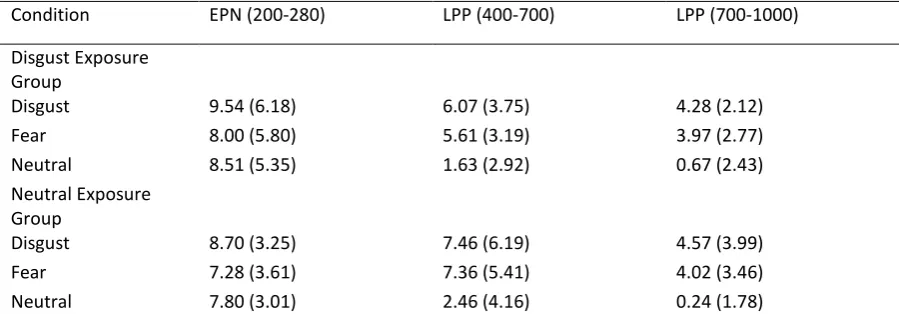
Average scores for the EPN (and centro-parietal LPP) components for each condition are reported in Table 1 (and see Figure 1 for grand average ERPs for the EPN window, and Figure 3 for topographic maps). There were no significant effects or interaction (all Fs < 1.14, all ps > .33).
3.2. Centro-Parietal LPP (400-700 ms)
There was a main effect of emotion (F(1, 38) = 15.77, p < .001). Figure 2 reveals that the LPP for disgust and threat trials was enhanced over neutral (and see Table 1 for centro-parietal LPP means). There was no exposure group effect or interaction (Fs < .99, ps > .46). With disgust propensity entered into the analysis, there were no significant effects (Fs < .72, ps >.49). There were also no effects associated with disgust sensitivity (all Fs < 1.24, ps > .27) or attentional focus (Fs < 1.55, ps > .22). With attentional shifting entered into the model, there was a significant emotion x exposure x attentional shifting interaction (F(1, 38) = 4.94, p = .010).
To explore the shifting effect in more detail, the LPP for both disgusting and threatening images was compared with the neutral LPP individually in two separate models (both of which included
11
For the comparison between threatening and neutral (with attentional shifting as a continuous variable), there was a borderline non-significant interaction between emotion, exposure group and attentional shifting (F(1, 38) = 4.02, p = .052). Similarly to the disgust and neutral comparison, this appeared to be driven by a correlation (though the effect was substantially weaker) between the index representing the difference between threatening and neutral LPP (threatening minus neutral) and attentional shifting in the neutral exposure group (r(18) = -.44, p = .051), but not in the disgust exposure group (p = .81).
3.3. Centro-Parietal LPP (700-1000 ms)
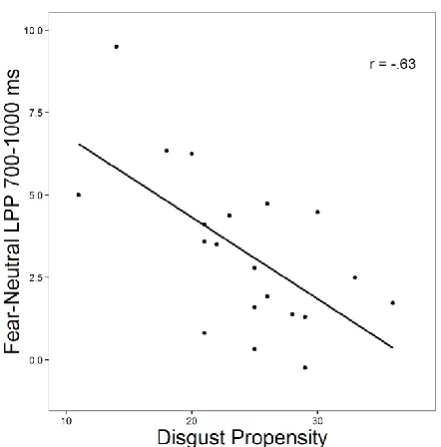
As with the earlier window, there was a significant main effect of emotion (F(1, 38) = 9.98, p < .001) but no exposure effect or interaction (Fs < .45, ps > .64). There was a borderline non-significant interaction between exposure group, emotion and disgust propensity (F(1, 38) = 3.02, p = .055). The contribution of disgust propensity to the LPP augmentation of both disgust and threat over neutral was examined by comparing both emotions against a neutral contrast separately. For the
comparison between disgust and neutral (with disgust propensity entered as a continuous variable), there were no significant effects (all Fs < 1.30, ps > .26). For the model contrasting threatening and neutral, there was an interaction between exposure group, emotion and disgust propensity (F(1, 38) = 5.67, p = .023). A difference index was created by subtracting the neutral LPP from the threatening LPP and this value was significantly negatively correlated with disgust propensity in the disgust exposure group (r(18) = -.63, p = .003; see Figure 5) but there was no significant correlation in the neutral exposure group (p = .55). Rather than representing a reduction in LPP for threatening stimuli, this correlation appeared to predominantly represent an increase in LPP to neutral stimuli with increasing disgust propensity – a finding supported by a significant positive correlation with disgust propensity and neutral LPP (r(18) = .46, p = .040), but no correlation with threat LPP (p = .57).
There were no effects associated with disgust sensitivity (all Fs < .27, ps > .76) or attentional focus (all Fs < 1.37, ps > .26). As with the previous window, there was an interaction between emotion, exposure group and attentional shifting (F(1, 38) = 4.08, p = .021). As with the previous window, this was explored in more detail by comparing disgust and neutral LPP individually in two separate analyses (both including attentional shifting as a continuous variable). For the disgust and neutral comparison, there was a significant interaction between emotion, exposure group and attentional shifting (F(1, 38) = 8.67, p = .006). As with the earlier window, this was driven by a significant
negative correlation between the index representing the LPP difference between disgust and neutral (disgust minus neutral) and attentional shifting in the neutral exposure group (r(18) = -.54, p = .015), but not in the disgust exposure group (p = .44). For the threatening and neutral comparison, there were no significant effects (the 3-way interaction was no longer significant: F = 2.78, p = .10; all other
Fs < 3.68, all other ps > .063).
3.4. Occipital LPP
12
research, this occipital positivity was analyzed post-hoc (subject to the same 3 x 2 basic mixed ANOVA, with participants as a random effect, for three time periods (200-400 ms, 400-700 ms, and 700-1000 ms). These latter two windows represented the ones used in the main analysis, but the initial 200-400 period was also examined as it was the first point at which this positivity appeared to emerge, and because this period overlapped with the window used for the EPN analysis. Following significant emotion effects, paired t tests were used to test the differences between the three stimuli categories.
For the early 200-400 ms window, there was a significant main effect of emotion (F(1, 38) = 5.73, p = .005) but no exposure effect or interaction (Fs < .64, ps > .53). In order to examine the differences between emotions, individual t tests were performed comparing each of the three emotions; given the lack of exposure effects, this comparison was performed collapsed across exposure groups. Threat was enhanced over neutral (t(39) = 4.95, p < .001) and disgust was enhanced over both neutral (t(39) = 10.30, p < .001) and threatening (t(39) = 5.58, p < .001).
As with the previous window, there was a significant main effect of emotion in the 400-700 ms window (F(1, 38) = 14.39, p < .001) but no exposure effect or interaction (Fs < .26, ps > .77). As with the previous window, this was investigated further using paired t tests (collapsed across exposure group). Mirroring the previous window, threatening trials were enhanced over neutral (t(39) = 6.82,
p < .001) and disgust was enhanced over both neutral (t(39) = 17.11, p < .001) and threatening (t(39) = 10.48, p < .001).
There remained a significant main effect of emotion in the 700-1000 ms window (F(1, 38) = 10.52, p
< .001) but no exposure effect of interaction (Fs < .21, ps > .81). The subsequent t tests revealed that disgust was enhanced over both neutral (t(39) = 12.29, p < .001) and threatening images (t(39) = 9.32, p < .001), but there was no significant difference between fear and neutral in this window (p = .11).
3.5. Post-hoc trait disgust rating analysis
As there was a significant modulation of the LPP for the threatening and neutral comparison in the disgust exposure group, further analysis was conducted in order to explore whether disgust propensity influenced explicit appraisal of either stimuli or sentences. Disgust propensity was significantly positively correlated with disgust ratings for disgusting (r(18) = .58, p = .007) and
13
4. Discussion
This study examined the extent to which emotion processing (measured by ERPs) was impacted by prior exposure to disgusting stimuli across different levels of trait disgust and attentional control. Using a standard measure of the EPN (consistent with previous research), there was no significant emotional deflection in this task – there was a period of increased negativity for threatening stimuli, but this was not significant. Consistent with prior research, the LPP was enhanced across both windows for both disgusting and threatening stimuli regardless of exposure group. Disgust
propensity modulated the contrast between threatening and neutral stimuli (in the disgust exposure group) and appeared to be driven by an increased LPP for neutral stimuli as propensity increased. Attentional shifting was a suppressive influence on the LPP for both disgusting and threatening stimuli (in the neutral exposure group), but this effect was much stronger for disgust and persisted to the later LPP window for disgusting stimuli exclusively. A post-hoc analysis revealed that there was also a significantly increased positivity for disgust over both threatening and neutral stimuli (irrespective of condition) in what is typically referred to as the occipital LPP that persisted from 200-1000 ms.
Disgust propensity appeared to modulate the LPP for the neutral stimuli within the disgust exposure condition. Although when all three emotions were entered into the same ANOVA, this effect was borderline significant, there appeared to be a modulation of neutral (relative to threatening) when the emotions were analysed separately against a neutral stimuli control. This finding is concordant with the description of disgust propensity (as it is represented by van Overveld et al., 2006) as a variable that increases the likelihood of individuals being disgusted. There were no effects related to disgust sensitivity, which is a variable that would arguably be more likely to be associated with reaction to stimuli that specifically evoked disgust (as it reflects an increased affective experience when in the presence of disgust). Within this experiment, disgust propensity was also the only disgust measure that correlated with the assessment of stimuli and sentences (and only did so for participants in the disgust exposure condition). Disgust propensity is speculated to be an influence on the affective reaction to stimuli that evoke substantial fear as well as disgust (as evidenced by the link between disgust propensity and spider phobia in van Overveld et al., 2006), thus it is not
14
clear whether these effects are contingent on the prior exposure being of a disgusting nature, and it is possible that manipulations that evoke other negative emotions may also be partially modulated by disgust propensity.
The ability to shift attention was associated with a lower LPP for negative stimuli in the early window but only among participants who were not previously exposed to disgusting sentences. Despite the very low difficulty of the memory component of the experiment, the image task (where participants were encouraged to cognitively appraise the emotional aspects of the stimuli) may have resulted in a task that would benefit from increased attentional shifting (as participants were also attempting to remember sentences). However, the modulation of the LPP for emotional stimuli only in the neutral exposure groups may be indicative of an attentional effect that is washed out with prior disgust exposure. Prior research on mood congruent cognitions suggests that emotional stimuli that match the content of an individual's current mood is subject to enhanced attention (Bower & Mayer, 1989; Siemer, 2005; Smallwood et al., 2009). In light of this, it is possible that attentional effects were only present in the neutral exposure group as the disgusting images did not match the working memory content of the manipulation (and were not representative of a task-relevant emotional category as a result) – thus enabling individuals with increased attentional control to exert a greater influence over the attentional resources allocated to these stimuli. Alternatively, as there is evidence
suggesting that the LPP is influenced by working memory load (MacNamara et al., 2011a, van Dillen & Derks, 2012), it is possible that the emotional nature of the disgust sentences consumed more cognitive resources such that individual differences in attentional shifting were not able to exert a moderating role following such exposure. Under this interpretation, those higher in attentional control are able to suppress the affective LPP response (and the allocation of attentional resources it represents), but the ability to do so is limited when the scenarios in working memory (that are matched on other criteria – thus consuming similar working memory resources) necessitate increased emotional processing. Attentional shifting did not play a moderating role in the comparison between threatening and neutral after 700 ms (and only did so weakly for the early window), but continued to do so for disgusting stimuli until the end of the window. It is possible that due to the increased unpleasantness with which participants regarded the disgusting stimuli,
attentional shifting continued to play a moderating role (after the emotional images were further down the processing stream) at the point in processing where top-down evaluations come to exert a greater influence (i.e. the late portion of the LPP).
15
enhanced positivity could have been partially responsible for the lack of EPN. This positive drift was enhanced for disgusting and threatening images over neutral in the first two windows
(encompassing the 200-700 ms period), but disgust was enhanced over both threat and neutral for the duration of the window. The occipital LPP has been mostly studied in the context of
development, where it has been speculated that the more maximally central LPP present in adults shifts over time from a more occipital distribution (Hajcak & Dennis, 2009; Kujawa et al., 2013) – a finding worth noting in light of the topographic maps in this experiment revealing an occipital shifted distribution for disgust, but a more central one for fear (see Figure 3). The occipital LPP has also been studied with adult participants (Bublatzky & Schupp, 2012), and the PCA analysis conducted by Foti et al. (2009) revealed this occipital positivity that was modulated by both emotion and valence. From the data in this experiment, this modulation seemingly reflected an emotional effect that was more pronounced for disgusting stimuli (we have also found this same pattern of results in the occipital LPP in a subsequent ERP experiment from our lab). It is not clear whether this modulation reflects an enhancement that is sensitive to the specific elements of disgusting scene images, the enhanced attentional resources required to process disgusting images, or whether it simply reflects the increased negativity generated by the disgust responses; however, it is clear that this modulation was independent of prior disgust exposure and should be investigated further.
This study demonstrated that disgust propensity was able to modulate the LPP amongst individuals who had been previously exposed to disgust, whereas attentional shifting exerted an influence only for individuals who had not experienced such prior emotional exposure. For individuals exposed to disgust, increasing disgust propensity resulted in an increased LPP neutral baseline, whereas high attentional shifting was associated with a reduced LPP for disgust stimuli only for those
remembering sentences that were not disgusting (possibly as a result of attention not being directed to stimuli that matched working memory content). These results show that disgust exposure can influence subsequent emotion processing, but does so discrepantly between individuals with different trait characteristics. The clear and substantial modulation for disgusting over both threatening and neutral images in the occipital LPP has implications for the extent to which emotional sub-categories of aversive scene images can diverge electrophysiologically as well as in explicit classification. With regard to disgust exposure, these results add more evidence to the notion that as well as influencing higher cognitive processes, disgust can also have a considerable influence on emotional perception.
Acknowledgments
This research was supported by an Economic and Social Sciences Research Council (ESRC)
16
References
Argo, J. J., Dahl, D. W., & Morales, A. C. (2006). Consumer contamination: How consumers react to products touched by others. Journal of Marketing, 70(2), 81-84.
Armstrong, T., McClenahan, L., Kittle, J., & Olatunji, B. O. (2014). Don’t look now! Oculomotor avoidance as a conditioned disgust response. Emotion, 14(1), 95-104.
Blair, R. J. R. (2003). Facial expressions, their communicatory functions and neuro–cognitive substrates. Philosophical Transactions of the Royal Society of London B: Biological
Sciences, 358(1431), 561-572.
Bower, G. H., & Mayer, J. D. (1989). In search of mood-dependent retrieval. Journal of Social Behavior and Personality, 4(2), 121-156.
Brenner, C. J., & Inbar, Y. (2015). Disgust sensitivity predicts political ideology and policy attitudes in the Netherlands. European Journal of Social Psychology, 45(1), 27-38.
Brown, S. B. R. E., van Steenbergen, H., Band, G. P. H., de Rover, M., & Nieuwenhuis, S. (2012). Functional significance of the emotion-related late positive potential. Frontiers in Human Neuroscience, 6, 33.
Bublatzky, F., & Schupp, H. T. (2012). Pictures cueing threat: brain dynamics in viewing explicitly instructed danger cues. Social Cognitive and Affective Neuroscience, 7(6), 611-22.
Carretié, L., Hinojosa, J. A., Martín-Loeches, M., Mercado, F., & Tapia, M. (2004). Automatic attention to emotional stimuli: Neural correlates. Human Brain Mapping, 22(4), 290-299.
Carretié, L., Mercado, F., Tapia, M., & Hinojosa, J. A. (2001). Emotion, attention, and the ‘negativity bias’, studied through event-related potentials. International Journal of Psychophysiology 41(1), 75-85.
Cisler, J. M., Olatunji, B. O., Lohr, J. M., & Williams, N. L. (2009). Attentional bias differences between fear and disgust: Implications for the role of disgust in disgust-related anxiety disorders. Cognition and Emotion, 23(4), 675-687.
Crawford, J. T., Inbar, Y., & Maloney, V. (2014). Disgust sensitivity selectively predicts attitudes toward groups that threaten (or uphold) traditional sexual morality. Personality and Individual Differences, 70, 218-223.
Curtis, V., Aunger, R., & Rabie, T. (2004). Evidence that disgust evolved to protect from risk of disease. Proceedings of the Royal Society of London B: Biological Sciences, 271(Suppl 4), S131-S133.
Cuthbert, B. N., Schupp, H. T., Bradley, M. M., Birbaumer, N., & Lang, P. J. (2000). Brain potentials in affective picture processing: Covariation with autonomic arousal and affective report. Biological Psychology, 52(2), 95-111.
17
Delplanque, S., Silvert, L., Hot, P., & Sequeira, H. (2005). Event-related P3a and P3b in response to unpredictable emotional stimuli. Biological Psychology, 68(2), 107-120.
Derryberry, D., & Reed, M. A. (2002). Anxiety-related attentional biases and their regulation by attentional control. Journal of Abnormal Psychology, 111(2), 225-236.
Ferrari, V., Codispoti, M., Cardinale, R., & Bradley, M. M. (2008). Directed and motivated attention during processing of natural scenes. Journal of Cognitive Neuroscience, 20(10), 1753-1761.
Fessler, D., & Haley, K. (2006). Guarding the perimeter: The outside-inside dichotomy in disgust and bodily experience. Cognition & Emotion, 20(1), 3-19.
Forgas J. P., Koch A. (2013). Mood effects on cognition. In M. D. Robinson, E. R. Watkins, & E. Harmon-Jones (Eds.), Handbook of Cognition and Emotion (pp. 231-252). New York: Guilford Press.
Forgas, J. P. (1998a). Asking nicely? The effects of mood on responding to more or less polite requests. Personality and Social Psychology Bulletin, 24(2), 173-185.
Forgas, J. P. (1998b). On feeling good and getting your way: Mood effects on negotiator cognition and bargaining strategies. Journal of Personality and Social Psychology, 74(3), 565-577.
Foti, D., & Hajcak, G. (2008). Deconstructing reappraisal: descriptions preceding arousing pictures modulate the subsequent neural response. Journal of Cognitive Neuroscience, 20(6), 977-988.
Foti, D., Hajcak, G., & Dien, J. (2009). Differentiating neural responses to emotional pictures: evidence from temporal-spatial PCA. Psychophysiology, 46(3), 521-530.
Hajcak, G., & Dennis, T. A. (2009). Brain potentials during affective picture processing in children.
Biological Psychology, 80(3), 333-338.
Hajcak, G., & Olvet, D. M. (2008). The persistence of attention to emotion: brain potentials during and after picture presentation. Emotion, 8(2), 250-255.
Hartigan, A., & Richards, A. (2016). Disgust exposure and explicit emotional appraisal enhance the LPP in response to disgusted facial expressions. Social Neuroscience, 12(4), 458-467.
Hauswald, A., Schulz, H., Iordanov, T., & Kissler, J. (2011). ERP dynamics underlying successful directed forgetting of neutral but not negative pictures. Social Cognitive and Affective Neuroscience, 6(4), 450-459.
Herbert, B. M., Pollatos, O., & Schandry, R. (2007). Interoceptive sensitivity and emotion processing: an EEG study. International Journal of Psychophysiology, 65(3), 214-227.
Herzog, H. A., & Golden, L. L. (2009). Moral Emotions and Social Activism: The Case of Animal Rights.
Journal of Social Issues, 65(3), 485-498.
Hilgard, J., Weinberg, A., Hajcak Proudfit, G., & Bartholow, B. D. (2014). The negativity bias in affective picture processing depends on top-down and bottom-up motivational significance.
18
Holmes, A., Nielsen, M. K., & Green, S. (2008). Effects of anxiety on the processing of fearful and happy faces: an event-related potential study. Biological Psychology, 77(2), 159-173.
Horberg, E. J., Oveis, C., Keltner, D., & Cohen, A. B. (2009). Disgust and the Moralization of Purity.
Journal of Personality and Social Psychology, 97(6), 963-976.
Huang, Y. X., & Luo, Y. J. (2006). Temporal course of emotional negativity bias: an ERP study.
Neuroscience Letters, 398(1), 91-96.
Inbar, Y., Pizarro, D. A., & Bloom, P. (2009). Conservatives are more easily disgusted than liberals.
Cognition and Emotion, 23(4), 714-725.
Inbar, Y., Pizarro, D., Iyer, R., & Haidt, J. (2012). Disgust sensitivity, political conservatism, and voting.
Social Psychological and Personality Science, 3(5), 537-544.
Ito, T. A., Larsen, J. T., Smith, N. K., & Cacioppo, J. T. (1998). Negative information weighs more heavily on the brain: the negativity bias in evaluative categorizations. Journal of Personality and Social Psychology, 75(4), 887-900.
Iyer, R., Koleva, S., Graham, J., Ditto, P., & Haidt, J. (2012). Understanding libertarian morality: The psychological dispositions of self-identified libertarians. PloS One, 7(8), e42366.
Junghöfer, M., Bradley, M. M., Elbert, T. R., & Lang, P. J. (2001). Fleeting images: a new look at early emotion discrimination. Psychophysiology, 38(2), 175-178.
Keil, A., Bradley, M. M., Hauk, O., Rockstroh, B., Elbert, T., & Lang, P. J. (2002). Large-scale neural correlates of affective picture processing. Psychophysiology, 39(5), 641-649.
Kisley, M. A., Campbell, A. M., Larson, J. M., Naftz, A. E., Regnier, J. T., & Davalos, D. B. (2011). The impact of verbal framing on brain activity evoked by emotional images. Journal of Integrative Neuroscience, 10(4), 513-524.
Kiss, M., & Eimer, M. (2008). ERPs reveal subliminal processing of fearful faces. Psychophysiology, 45(2), 318-326.
Kujawa, A., Klein, D. N., & Proudfit, G. H. (2013). Two-year stability of the late positive potential across middle childhood and adolescence. Biological Psychology, 94(2), 290-296.
Lang, P. J., Bradley, M. M., & Cuthbert, B. N. (2008). International affective picture system (IAPS): Affective ratings of pictures and instruction manual. Technical Report A-8.
Langeslag, S. J., & van Strien, J. W. (2009). Aging and emotional memory: the co-occurrence of neurophysiological and behavioral positivity effects. Emotion, 9(3), 369-377.
Leutgeb, V., Schäfer, A., Köchel, A., & Schienle, A. (2012). Exposure therapy leads to enhanced late frontal positivity in 8-to 13-year-old spider phobic girls. Biological Psychology, 90(1), 97-104.
19
MacNamara, A., & Hajcak, G. (2010). Distinct electrocortical and behavioural evidence for increased attention to threat in generalized anxiety disorder. Depression and Anxiety, 27(3), 234-243.
MacNamara, A., Ferri, J., & Hajcak, G. (2011a). Working memory load reduces the late positive potential and this effect is attenuated with increasing anxiety. Cognitive Affective and Behavioral Neuroscience, 11(3), 321-331.
MacNamara, A., Foti, D., & Hajcak, G. (2009). Tell me about it: neural activity elicited by emotional pictures and preceding descriptions. Emotion, 9(4), 531-543.
MacNamara, A., Ochsner, K. N., & Hajcak, G. (2011b). Previously reappraised: The lasting effect of description type on picture-elicited electrocortical activity. Social Cognitive and Affective
Neuroscience, 6(3), 348-358.
Mocaiber, I., Pereira, M. G., Erthal, F. S., Figueira, I., Machado-Pinheiro, W., Cagy, M., Volchan, E., & de Oliveira, L. (2009). Regulation of negative emotions in high trait anxiety individuals: an ERP study.
Psychology and Neuroscience, 2(2), 211-217.
Morales, A. C., & Fitzsimons, G. J. (2007). Product contagion: Changing consumer evaluations through physical contact with “disgusting” products. Journal of Marketing Research, 44(2), 272-283.
Moretti, L., & di Pellegrino, G. (2010). Disgust selectively modulates reciprocal fairness in economic interactions. Emotion, 10(2), 169-180.
Moser, J. S., Hajcak, G., Bukay, E., & Simons, R. F. (2006). Intentional modulation of emotional responding to unpleasant pictures: an ERP study. Psychophysiology, 43(3), 292-296.
Moser, J. S., Huppert, J. D., Duval, E., & Simons, R. F. (2008). Face processing biases in social anxiety: an electrophysiological study. Biological Psychology, 78(1), 93-103.
Moser, J. S., Krompinger, J. W., Dietz, J., & Simons, R. F. (2009). Electrophysiological correlates of decreasing and increasing emotional responses to unpleasant pictures. Psychophysiology, 46(1), 17-27.
Moser, J. S., Most, S. B., & Simons, R. F. (2010). Increasing negative emotions by reappraisal enhances subsequent cognitive control: a combined behavioral and electrophysiological study.
Cognitive Affective and Behavioral Neuroscience, 10(2), 195-207.
Mühlberger, A., Wieser, M. J., Herrmann, M. J., Weyers, P., Tröger, C., & Pauli, P. (2009). Early cortical processing of natural and artificial emotional faces differs between lower and higher socially anxious persons. Journal of Neural Transmission, 116(6), 735-746.
Murphy, S. T., & Zajonc, R. B. (1993). Affect, cognition, and awareness: affective priming with optimal and suboptimal stimulus exposures. Journal of Personality and Social Psychology, 64(5), 723-739.
20
Olatunji, B. O., Tomarken, A., & Puncochar, B. D. (2013). Disgust propensity potentiates evaluative learning of aversion. Emotion, 13(5), 881-890.
Olatunji, B. O., Williams, N. L., Tolin, D. F., Abramowitz, J. S., Sawchuk, C. N., Lohr, J. M., & Elwood, L. S. (2007). The Disgust Scale: item analysis, factor structure, and suggestions for refinement.
Psychological Assessment, 19(3), 281-296.
Olofsson, J. K., Nordin, S., Sequeira, H., & Polich, J. (2008). Affective picture processing: an integrative review of ERP findings. Biological Psychology, 77(3), 247-265.
Pastor, M. C., Bradley, M. M., Löw, A., Versace, F., Moltó, J., & Lang, P. J. (2008). Affective picture perception: emotion, context, and the late positive potential. Brain Research, 1189, 145-151.
Pochedly, J. T., Widen, S. C., & Russell, J. A. (2012). What emotion does the “facial expression of disgust” express? Emotion, 12(6), 1315-1319.
Pollatos, O., Kirsch, W., & Schandry, R. (2005). On the relationship between interoceptive awareness, emotional experience, and brain processes. Cognitive Brain Research, 25(3), 948-962.
Richards, A., Holmes, A., Pell, P. J., & Bethell, E. J. (2013). Adapting effects of emotional expression in anxiety: evidence for an enhanced Late Positive Potential. Social Neuroscience, 8(6), 650-664.
Roelofs, K., Putman, P., Schouten, S., Lange, W. G., Volman, I., & Rinck, M. (2010). Gaze direction differentially affects avoidance tendencies to happy and angry faces in socially anxious
individuals. Behaviour Research and Therapy, 48(4), 290-294.
Rohr, M., Degner, J., & Wentura, D. (2012). Masked emotional priming beyond global valence activations. Cognition & Emotion, 26(2), 224-244.
Rohr, M., & Wentura, D. (2014). Spatial frequency filtered images reveal differences between masked and unmasked processing of emotional information. Consciousness and Cognition, 29, 141-158.
Rohrmann, S., & Hopp, H. (2008). Cardiovascular indicators of disgust. International Journal of Psychophysiology, 68(3), 201-208.
Rozin, P., Nemeroff, C., Horowitz, M., Gordon, B., & Voet, W. (1995). The borders of the self: Contamination sensitivity and potency of the body apertures and other body parts. Journal of Research in Personality, 29(3), 318-340.
Sabatinelli, D., Fortune, E. E., Li, Q., Siddiqui, A., Krafft, C., Oliver, W. T., ... & Jeffries, J. (2011). Emotional perception: meta-analyses of face and natural scene processing. NeuroImage, 54(3), 2524-2533.
Schnall, S., Haidt, J., Clore, G. L., & Jordan, A. H. (2008). Disgust as embodied moral judgement.
Personal and Social Psychology Bulletin, 34(8), 1096-1109.
Schneiderman, N., & McCabe, P.M. (1989). Psychophysiologic strategies in laboratory research. In N. Schneiderman, S. M. Weiss, & P. G. Kaufman (Eds.), Handbook of Research Methods in
21
Schupp, H. T., Cuthbert, B. N., Bradley, M. M., Cacioppo, J. T., Ito, T., & Lang, P. J. (2000). Affective picture processing: the late positive potential is modulated by motivational relevance.
Psychophysiology, 37(2), 257-261.
Schupp, H. T., Flaisch, T., Stockburger, J., & Junghöfer, M. (2006). Emotion and attention: event-related brain potential studies. Progress in Brain Research, 156, 31-51.
Schupp, H. T., Junghöfer, M., Weike, A. I., & Hamm, A. O. (2003). Emotional facilitation of sensory processing in the visual cortex. Psychological Science, 14(1), 7-13.
Schupp, H. T., Junghöfer, M., Weike, A. I., & Hamm, A. O. (2004a). The selective processing of briefly presented affective pictures: An ERP analysis. Psychophysiology, 41(3), 441-449.
Schupp, H. T., Öhman, A., Junghöfer, M., Weike, A. I., Stockburger, J., & Hamm, A. O. (2004b). The facilitated processing of threatening faces: an ERP analysis. Emotion, 4(2), 189-200.
Sherman, G. D., Haidt, J., & Clore, G. L. (2012). The Faintest Speck of Dirt: Disgust Enhances the Detection of Impurity Psychological. Psychological Science, 23(12), 1506-1514.
Siemer, M. (2005). Mood-congruent cognitions constitute mood experience. Emotion, 5(3), 296-308.
Singmann, H., & Kellen, D. (in press). An Introduction to Mixed Models for Experimental Psychology. In D. H. Spieler & E. Schumacher (Eds.), New Methods in Neuroscience and Cognitive Psychology. Hove: Psychology Press.
Sinha, R., Lovallo, W. R., & Parsons, O. A. (1992). Cardiovascular differentiation of emotions.
Psychosomatic Medicine, 54(4), 422-435.
Smallwood, J., Fitzgerald, A., Miles, L. K., & Phillips, L. H. (2009). Shifting moods, wandering minds: negative moods lead the mind to wander. Emotion, 9(2), 271-276.
Susskind, J. M., Lee, D. H., Cusi, A., Feiman, R., Grabski, W., & Anderson, A. K. (2008). Expressing fear enhances sensory acquisition. Nature Neuroscience, 11(7), 843-850.
Terrizzi, J. A., Shook, N. J., & McDaniel, M. A. (2013). The behavioral immune system and social conservatism: A meta-analysis. Evolution and Human Behavior, 34(2), 99-108.
Terrizzi, J. A., Shook, N. J., & Ventis, W. L. (2010). Disgust: A predictor of social conservatism and prejudicial attitudes toward homosexuals. Personality and Individual Differences, 49(6), 587-592.
Tybur, J. M., Lieberman, D., Kurzban, R., & DeScioli, P. (2013). Disgust: Evolved function and structure. Psychological Review, 120(1), 65-84.
van Dillen, L. F., & Derks, B. (2012). Working memory load reduces facilitated processing of threatening faces: An ERP study. Emotion, 12(6), 1340-1349.
22
van Dillen, L. F., van der Wal, R. C., & van den Bos, K. (2012). On the role of attention and emotion in morality: Attentional control modulates unrelated disgust in moral judgments. Personality and Social Psychology Bulletin, 38(9), 1222-1231.
van Hooff, J. C., Devue, C., Vieweg, P. E., & Theeuwes, J. (2013). Disgust-and not fear-evoking images hold our attention. Acta Psychologica, 143(1), 1-6.
van Hooff, J. C., van Buuringen, M., El M'rabet, I., de Gier, M., & van Zalingen, L. (2014). Disgust-specific modulation of early attention processes. Acta Psychologica, 152, 149-157.
van Overveld, W. J. M., de Jong, P. J., Peters, M. L., Cavanagh, K., & Davey, G. C. L. (2006). Disgust propensity and disgust sensitivity: separate constructs that are differentially related to specific fears.
Personality and Individual Differences, 41(7), 1241-1252.
Weinberg, A., & Hajcak, G. (2010). Beyond good and evil: the time-course of neural activity elicited by specific picture content. Emotion, 10(6), 767-782.
Weinberg, A., & Hajcak, G. (2011). The late positive potential predicts subsequent interference with target processing. Journal of Cognitive Neuroscience, 23(10), 2994-3007.
Weinberg, A., Hilgard, J., Bartholow, B. D., & Hajcak, G. (2012). Emotional targets: Evaluative
categorisation as a function of context and content. International Journal of Psychophysiology, 84(2), 149-154.
Wiens, S., Sand, A., & Olofsson, J. K. (2011). Nonemotional features suppress early and enhance late emotional electrocortical responses to negative pictures. Biological Psychology, 86(1), 83-89.
23
Appendix
Disgust sentences
"As you start to fall asleep, you feel something tickling your lip and realise, too late, that a cockroach has crawled into your mouth."
"As you come home and walk through your front door, you notice a crackling noise as you step, you turn on the light and realise that the floor is covered with cockroaches."
"As you open your bin you notice that there are maggots crawling around inside."
"As you sit down on a bench in the park you notice a dead pigeon with maggots infesting the corpse."
"As you walk across your bathroom floor in bare feet you step on something, looking down you notice you have squashed a slug."
"As you are at a family birthday party, a relative's young child walks over to you with a squashed slug clenched in his fist."
"As you walk down an alley, you notice that you have stepped in a puddle of urine."
"As you are sitting beside a small child, they lose control of their bladder and urine spreads across the seat and into your clothes."
"As you are watching TV you notice something brushing against your ankle, you look down to see a rat running away."
"As you search in your loft for some tools, you disturb a nest of rats and they run away into a hole in the wall."
"As you sit across from someone on a train you notice that they have a spot on their face that has begun to leak."
"As a colleague goes to shake your hand you notice that they have a cluster of infected spots on two of their fingers."
"As you brush your hair the day after you help out on a school trip, you realise that it is full of head lice."
"As you sit down to have a haircut, you hear the hairdresser inform another customer that they are infested with head lice."
"As you finish mopping up a spill on your kitchen floor, you accidentally knock the bucket of dirty water over your feet and it soaks into your trousers."
"As you walk outside you accidentally drop your keys into a puddle of muddy stagnant water and have to reach in to get them."
24
"As you are standing at a bus stop, a stranger loudly clears the mucus from his throat and spits it onto the floor."
"As you go into your living room one morning, you find that the sofa is covered with small ants."
"As you put your foot in your shoe, you notice that ants are crawling all over it."
"As you walk barefoot along a sandy beach, you accidentally step on a used condom."
"As you pick up some coins you dropped in the street, you accidentally pick up a used condom."
"As you wrap yourself in a towel after getting out of the shower, you realise that the towel has patches of mould all over it."
"As you look in the mirror whilst washing yourself, you notice that the flannel you are using is mouldy."
Neutral sentences
"As you start to fall asleep, you feel something tickling your mouth and realise, too late, that feathers have escaped from your pillow."
"As you come home and walk through your front door, you notice a crackling noise as you step, you turn on the light and realise that you have stepped on some new post."
"As you open your bin you notice that the lid has a large crack and needs replaced."
"As you sit down on a bench in the park you notice a white pigeon flap its wings fast and fly away."
"As you walk across your bathroom floor in bare feet you step on something, looking down you notice a hand towel underfoot."
"As you are at a family birthday party, a relative's young child walks over to you with a small toy clenched in his fist."
"As you walk down an alley, you notice that you have stepped on a sunken paving stone."
"As you are sitting beside a small child, they knock over their drink and water spreads across the seat and onto the floor below."
"As you are watching TV you notice something brushing against your ankle, you look down to see your cat running away."
"As you search in your loft for some tools, you disturb a pile of books and they fall and scatter to the floor by the wall."
"As you sit across from someone on a train you notice that they have blue ink on their face from a pen that has leaked."
25
"As you brush your hair the day after you help out on a school trip, you realise that the sun has lightened it."
"As you sit down to have a haircut, you hear the hairdresser inform another customer that an offer is available."
"As you finish mopping up a spill on your kitchen floor, you accidentally drop a package of new cleaning cloths onto your feet and a few fall out and unfold."
"As you walk outside you accidentally drop your keys onto some grass that is scattered with autumn leaves and have to reach down to get them."
"As you are talking to a friend they unexpectedly start laughing as you speak."
“As you are standing at a bus stop, a stranger loudly starts humming and tapping one of his feet against the ground."
"As you go into your living room one morning, you find that the sofa is covered with cushions."
"As you put your foot in your shoe, you notice that the laces need to be replaced."
"As you walk barefoot along a sandy beach, you accidentally step on a small pebble."
"As you pick up some coins you dropped in the street, you accidentally pick up a used receipt."
"As you wrap yourself in a towel after getting out of the shower, you realise that the towel has some small loose threads all over it."
26
Condition EPN (200-280) LPP (400-700) LPP (700-1000)
Disgust Exposure Group
Disgust 9.54 (6.18) 6.07 (3.75) 4.28 (2.12)
Fear 8.00 (5.80) 5.61 (3.19) 3.97 (2.77)
Neutral 8.51 (5.35) 1.63 (2.92) 0.67 (2.43) Neutral Exposure
Group
Disgust 8.70 (3.25) 7.46 (6.19) 4.57 (3.99)
Fear 7.28 (3.61) 7.36 (5.41) 4.02 (3.46)
[image:27.595.72.522.97.254.2]Neutral 7.80 (3.01) 2.46 (4.16) 0.24 (1.78)
Table 1. Means (and SD) for EPN and centro-parietal LPPs for each set of stimuli set in each condition at each time window.
Condition Occipital LPP (200-400) Occipital LPP (400-700) Occipital LPP (700-1000)
Disgust Exposure Group
Disgust 10.35 (5.47) 9.29 (3.62) 4.20 (2.72)
Fear 8.81 (5.02) 6.19 (3.37) 1.62 (2.28)
Neutral 7.82 (4.34) 4.66 (2.96) 1.23 (2.11) Neutral Exposure
Group
Disgust 9.70 (2.82) 9.64 (3.70) 4.49 (2.61)
Fear 8.65 (3.07) 6.90 (2.83) 1.65 (2.04)
[image:27.595.74.521.303.469.2]27
Figure 1. EPN and Occipital LPP (Electrodes P7, P8, 01 and 02) for disgusting, threatening and neutral images collapsed across conditions.
[image:28.595.77.519.376.614.2]28
Figure 3. Topographic maps showing the mean amplitude (in µV) enhancement for disgust (top) and fear (bottom) over neutral at each LPP time window (collapsed across condition).
[image:29.595.77.521.366.589.2]29