N A N O E X P R E S S
Open Access
Investigating the Effect of Line Dipole
Magnetic Field on Hydrothermal
Characteristics of a Temperature-Sensitive
Magnetic Nanofluid Using Two-Phase
Simulation
Mehdi Bahiraei
1*and Morteza Hangi
2Abstract
Hydrothermal characteristics of a temperature-sensitive magnetic nanofluid between two parallel plates are investigated in the presence of magnetic field produced by one or multiple line dipole(s) using the two-phase mixture model. As the nanofluid reaches the region where the magnetic field is applied, a rotation is developed due to the dependency of magnetization on temperature. This can lead to mixing in the flow and more uniform distribution of temperature due to the disturbance caused in the boundary layer, and consequently, enhancement in convective heat transfer. The results indicate that the disturbance in boundary layer adjacent to the lower wall is more significant than the upper wall. By application of the magnetic field, the convective heat transfer increases locally for both walls. Due to the intensified mixing, a sudden pressure drop occurs when the fluid reaches the region where the magnetic field is applied. For greater magnetic field strengths and lower Reynolds numbers, the improvement in convective heat transfer is more significant. For small magnetic field strengths, the effect of applying magnetic field on the upper wall is much smaller than that on the lower wall; however, this effect becomes almost the same for both walls at great magnetic field strengths.
Keywords:Magnetic nanofluid, Two-phase simulation, Line dipole, Heat transfer, Parallel plates, Magnetic field
Background
Numerous attempts have been made during the recent years in order to apply different methods to improve heat transfer in various thermal systems. Besides saving a considerable amount of energy, achieving greater rates of heat transfer can lead to the development of more compact heat transfer systems with higher thermal effi-ciencies. Among different methods, creating secondary flows, flow mixing, flow rotation, and causing disturb-ance in the boundary layer have been especially taken into account for increasing heat transfer rate in chan-nels. Regarding the fact that further mixing in the flow and, thus, more uniform profiles of temperature and
velocity lead to greater heat transfer rate between the flow and the channel walls, application of these methods can be efficient to achieve higher rates of heat transfer. The researchers have utilized various techniques thus far such as different types of baffles [1, 2], vortex generators [3, 4], chaotic geometries [5, 6], and so forth to create mixing in the flow and improve heat transfer.
In addition to the type of the applied geometry, the thermal properties of working fluid are also important in heat transfer processes. Advances in nanotechnology during the recent years have led to the introduction of a new class of suspensions called nanofluids which are obtained from suspension of nanoparticles having proper thermal properties in a base fluid. A great number of studies have examined the effect of using different nano-fluids for the improvement of heat transfer rate in vari-ous geometries [7–9].
* Correspondence:[email protected]
1Mechanical Engineering Department, School of Energy, Kermanshah University of Technology, Kermanshah, Iran
Full list of author information is available at the end of the article
A group of nanofluids, known as magnetic nanofluid or ferrofluid, is a suspension of a base fluid and mag-netic nanoparticles covered with a layer of surfactants like oleic acid [10, 11]. Magnetic nanofluids not only demonstrate fluidity like the other fluids but also exhibit magnetic properties similar to magnetic materials. This unique feature makes it possible to control the fluid flow, heat transfer, and the movement of particles by ap-plication of an external magnetic field. Thus, magnetic nanofluids can find numerous applications in various fields including bioengineering, electronic packing, and thermal engineering [12–14].
A limited number of studies have been carried out on the flow and heat transfer characteristics of magnetic nanofluids under magnetic fields. Ghofrani et al. [15] performed an experimental investigation to study lam-inar forced convection of aqueous Fe3O4 magnetic nanofluid flowing through a circular tube in the pres-ence of an alternating magnetic field. They found that increasing the magnetic field frequency and the nano-fluid volume fraction leads to better heat transfer enhancement and the effect of the magnetic field is higher at low Reynolds numbers.
Bahiraei et al. [16] applied the two-phase Euler-Lagrange method to evaluate natural convection of the water-based magnetic nanofluid in a square cavity under nonuniform magnetic field. The applied magnetic field was such that upward magnetic force was applied to the nanoparticles near the hot wall and vice versa near the cold wall. The results indicated that applying the mag-netic field can improve the convection of the nanofluid in the cavity and enhance the heat transfer rate.
Aminfar et al. [17] applied a two-phase model to in-vestigate the mixed convection of the water-Fe3O4 ferro-fluid in a vertical rectangular duct under a nonuniform magnetic field generated by an electric current going through a parallel wire located under the duct. They demonstrated that the magnetic field creates a pair of vortices which can improve the heat transfer rate.
Among various magnetic nanofluids, temperature-sen-sitive magnetic nanofluids show numerous applications in the thermal systems due to their temperature-dependent
magnetization. The temperature dependency of
magnetization causes the appearance of a nonuniform body force in differentially heated volume of temperature-sensitive magnetic nanofluid, subjected to magnetic field gradients [18]. Therefore, the fluid can be moved under such field-induced thermomagnetic force, and it can be fascinating and promising to employ such an energy con-version process in a range of areas, for instance, thermal management system for some specialized purposes, which is really important for the development of energy systems.
Few studies have been performed on the hydrother-mal characteristics of temperature-sensitive magnetic
nanofluids. Zablotsky et al. [19] experimentally and nu-merically investigated thermomagnetic convection of a temperature-sensitive ferrofluid in a rectangular cell in the presence of nonuniform magnetic field provided by per-manent magnets attached to the cell walls. They observed that in the presence of magnetic field, enhancement in heat transfer is significantly higher than that in the case of simple thermogravitational convection.
Jin et al. [20] developed a lattice Boltzmann method to simulate the laminar convection of a temperature-sensitive ferrofluid in a porous square cavity under the effect of uniform magnetic field. It was demonstrated that the magnetic force is the main driving force which enhances the average Nusselt number.
For nanofluids, there are two approaches in numerical simulation: phase and two-phase. The single-phase approach in which the effective properties are employed assumes that base fluid and particles are in thermal equilibrium and move with same velocity. How-ever, in two-phase methods, the interaction between the fluid and particles, heat transfer between them and slip velocity are considered. Most numerical studies have ap-plied the single-phase approach, while a limited number of studies have been carried out based on two-phase methods. Some researchers [24, 25] have shown that the two-phase methods give more accurate results in com-parison with the single-phase method.
A comprehensive understanding of the relationship be-tween imposed magnetic fields and hydrothermal charac-teristics of temperature-sensitive magnetic nanofluids is essential for the accurate design and employment of appli-cations involving thermomagnetic convection. The two-phase mixture model is utilized in the current study to numerically analyze effects of the magnetic field produced by one or multiple line dipole(s) on the flow and heat transfer of a temperature-sensitive magnetic nanofluid be-tween two parallel plates. In fact, the magnetic field is ap-plied in order to cause disturbance in the boundary layer and, consequently, enhance the heat transfer rate. The ef-fects of parameters like the magnetic field strength and Reynolds number on temperature, velocity, convective heat transfer, and pressure of the magnetic nanofluid are studied. To our knowledge, this survey is the first study that employs a two-phase simulation to examine the hydrothermal characteristics of a temperature-sensitive ferrofluid under the influence of a line dipole.
Methods
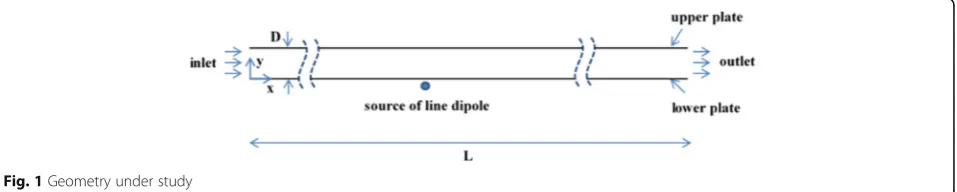
Definition of Geometry and Applied Magnetic Field The magnetic nanofluid flows between two parallel flat plates. The length of the plates isL, and the distance be-tween them is D. The origin of the Cartesian coordin-ate is loccoordin-ated at the leading edge of the lower plcoordin-ate (see Fig. 1). As can be seen in Fig. 1, a line dipole which provides the external magnetic field is located under the lower plate at x/D= 50 and y/D=−0.1. The resulting field is two-dimensional which can be expressed in polar coordinate as below [26]:
Hðr;θÞ ¼m sinθ r2 ^er−
cosθ
r2 ^eθ
ð1Þ
where His the vector of the magnetic field strength, m
denotes the magnetic dipole moment which determines the strength of the dipole, and r andθ are respectively the radial and peripheral directions of polar coordinate in which êr and êθ are unit vectors. It should be noted that this correlation is for the case that the origin of the polar coordinate is placed at the source of the dipole. Therefore, in order to use the above magnetic field cor-relation, it is converted into the Cartesian coordinate with its origin being mentioned above.
The working fluid is a temperature-sensitive magnetic nanofluid; the properties of which are summarized in Table 1. It consists of Mn-Zn ferrite nanoparticles sus-pended in tetradecane.
Mathematical Formulation
The two-phase mixture model is employed to simulate the hydrothermal characteristics of the temperature-sensitive ferrofluid flowing between two parallel plates under the effect of magnetic field produced by one or multiple line-source dipole(s). In this method, it is sup-posed that the coupling between the phases is strong. Also, the phases have their own velocity fields, and the relative velocity between the phases is taken into ac-count. Considering these assumptions, the conservation equations are written as below [27–29]:
Continuity equation:
∇: ρmvm¼0 ð2Þ
Momentum equation:
∇: ρmvmvm
¼−∇Pþ∇:ðμm∇vmÞ þ∇: φpρpvdr;pvdr;p
þμ0M∇Hþμ0H ∂M ∂T∇T
ð3Þ
Energy equation:
∇: φpρpcp;pvpþ 1−φp
ρfcp;fvf
T
¼∇:ðkm∇TÞ ð4Þ
Volume fraction:
[image:3.595.61.540.632.728.2]∇: φpρpvm
¼−∇: φpρpvdr;p
ð5Þ
where
vm¼
φpρpvpþ 1−φp
ρfvf
ρm ð6Þ
In Eqs. 2, 3, 4, 5, and 6, subscriptsm,p, andfrefer to mixture, particle, and base fluid, respectively. Further-more,ρ,v,μ,φ,cp,k,P, andTrepresent density, velocity, dynamic viscosity, volume concentration, specific heat, thermal conductivity, pressure, and temperature, re-spectively. In addition,μ0andMdenote the permeability of vacuum and magnetization of the ferrofluid, respectively.
The last two terms on the right side of Eq. 3 describe the magnetic forces applied to the ferrofluid which are respectively induced by the nonuniform magnetic field and the temperature gradient [30]. For the temperature-sensitive ferrofluid exposed to a nonuniform magnetic field, both of these two terms are effective on the fluid flow. In the mentioned terms, the magnetization of the ferrofluid which is dependent on temperature is evalu-ated as below [19]:
M Tð Þ ¼Mref 1−βmðT−TrefÞ
ð7Þ
whereβmrepresents the pyromagnetic coefficient of the ferrofluid which indicates the dependency of the magnetization on temperature. Additionally, Mref which is the magnetization at reference temperature (Tref) can be obtained according to the single-parameter Langevin approximation as below:
Mref ¼φMsLð Þζ ð8Þ
whereMsdenotes the saturation magnetization of mag-netic particles and ζ is the argument of Langevin func-tion (L) as below:
ζ¼μ0mpH
kBT ð
9Þ
wherekBrepresents Boltzmann constant andmpis mag-netic moment of nanoparticle.
The Langevin function is defined as follows:
Lð Þ ¼ζ cothζ−1
ζ ð10Þ
In Eq. 3, vdr,p is the drift velocity for the secondary phase (i.e., nanoparticles) and is defined as below:
vdr;p¼vp−vm ð11Þ
The slip velocity (i.e., relative velocity) is the velocity of the secondary phase (p) relative to the velocity of the primary phase (f):
vpf ¼vp−vf ð12Þ
The relation between the drift velocity and the relative velocity is as below:
vdr;p¼vpf− φpρp
ρm vf−vp
ð13Þ
Considering the forces acting on a single magnetic particle, the slip velocity is obtained similar to Jafari et al. [31] as follows:
vpf ¼Ccμ0mpLð Þζ 3πμfdp ∇Hþ
ρpd2pCc 18μf
ρp−ρf ρp
g ð14Þ
It should be noted that in the above equation, a form of Stokes’ drag law for sub-micron particles [32] has been employed, where dp represents the nanoparticle diameter and g is gravitational acceleration. Further-more,Ccis the Cunningham correction factor to Stokes’ drag law which can be evaluated from:
Cc¼1þ 2λ
dp
1:257þ0:4e−ð1:1dp=2λÞ
ð15Þ
where λ denotes molecular mean free path for the base fluid.
Boundary Conditions
Uniform velocity is considered at the entrance, and therefore, the hydrodynamic boundary layer is develop-ing. Moreover, the problem is steady, and no-slip condi-tion at the walls and zero relative pressure at the outlet are employed. Uniform temperature is utilized at the channel inlet, and equal and constant heat fluxes are ap-plied at upper and lower plates from the inlet of the channel. Hence, the problem is developing thermally.
Numerical Method and Validation
[image:4.595.55.291.103.236.2]The equations were discretized applying control volume technique. QUICK method was used to solve the con-vection term, while SIMPLE method was adopted for
Table 1Properties of the magnetic nanofluid [19]
Property Value
Density 976 kgm−3
Dynamic viscosity 0.006 Pas
Specific heat 2190 Jkg−1K−1
Thermal conductivity 0.14 Wm−1K−1
Particle diameter ~10 nm
Volumetric concentration 6 %
velocity-pressure coupling. Grids with different meshes were examined to ensure the grid independency, and finer meshing was implemented near the walls due to the pres-ence of severe temperature and velocity gradients.
To validate the numerical method, Nusselt number obtained from the present simulations was compared with the one presented by Shah and London [33] for pure water flowing between two parallel plates. As seen in Fig. 2, there is a good agreement between the results. In addition, the convective heat transfer coefficient obtained from the current simulation method was com-pared with the one obtained from the experimental study of Wen and Ding [34] for water-Al2O3nanofluid flow inside a horizontal tube at φ= 1 % and Re = 1600. The results are presented in Table 2, and as can be ob-served, there is a proper consistency between the results showing the validity of the numerical method.
Results and Discussion
Hydrothermal characteristics of the magnetic nanofluid flow between the two parallel plates under the magnetic field produced by one or multiple line dipole(s) are stud-ied using the two-phase mixture method. First, the effect of applying the magnetic field of one line dipole on temperature, velocity, convective heat transfer, and pres-sure changes of the ferrofluid is assessed at various Reynolds numbers and magnetic field strengths. Then, the magnetic fields are applied in different regions with their effects being evaluated.
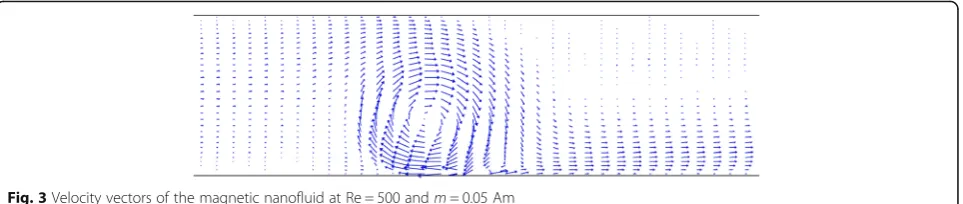
Figure 3 depicts velocity vectors of the magnetic nano-fluid close to the region where the magnetic field is ap-plied form= 0.05 Am and Re = 500. As can be observed, when the fluid approaches this region, a rotation is
developed in the flow. This observation can be attributed to the fact that the magnetization is dependent on the temperature in the temperature-sensitive ferrofluid, such that it decreases at higher temperatures. This depend-ency causes the fluid flowing upstream the region of the applied magnetic field, and the fluid flowing in central regions, which are colder than the fluid adjacent to the lower plate, to be attracted more towards the magnetic field source, and causes the hot fluid to be repelled from the lower plate. In other words, the colder magnetic fluid experiences a greater magnetic force as compared to the hot one. Therefore, the application of such mag-netic field causes mixing in the flow, and as seen in Fig. 4, in which the temperature contour is depicted, the colder fluid comes closer to the lower hot plate, which can lead to increasing the heat transfer rate.
Another point which can be noticed in Fig. 4 is that before the fluid reaches the region where the magnetic field is applied, the thermal boundary layer is growing. However, once the fluid reaches this region and by de-velopment of rotation in the flow, as discussed above, a sudden disturbance is created at the boundary layer and its growth is stopped. When the fluid passes by this re-gion, the thermal boundary layer begins to grow again. Moreover, it is observed that the disturbance in the ther-mal boundary layer is more intensive adjacent to the lower wall in comparison with the upper wall, since according to Fig. 1, the source of the magnetic field is lo-cated below the lower plate, and consequently, the mag-netic field gradient is more significant there.
In Fig. 5, the convective heat transfer coefficients at the upper and lower walls in the presence of the mag-netic field for Re = 500 and m= 0.05 Am are compared with those for the case without magnetic field. As seen from this figure, without the magnetic field, the convect-ive heat transfer coefficients are exactly the same at the upper and lower walls, since there is no mixing in flow and also similar heat flux is applied to them. It is also observed that where the magnetic field is applied, the convective heat transfer coefficients at both walls in-crease locally. The reason is that, as shown in Fig. 4, in
[image:5.595.304.540.124.228.2]Fig. 2Nusselt number obtained from present simulations compared to the one presented by Shah and London [33]
Table 2Results obtained from current study in comparison with
the experimental results [34] for water-Al2O3nanofluid atφ= 1 % and Re = 1600
h(W/m2K) Dimensionless axial distance
Wen and Ding [34] Present study Error (%)
26.2 2611.5 2697.7 3.3
62.8 1741.6 1692.4 2.8
115.7 1201.1 1221.1 1.7
146.1 1015.2 993.5 2.1
[image:5.595.58.291.501.703.2]the region of applying the magnetic field, the temperature is distributed more uniformly in the cross section due to the mixing developed, especially near the lower wall. According to the equation of the convective heat transfer coefficient (i.e., h=q"/(Ts−Tb)), the more uniform the temperature distribution, the lower the dif-ference between the wall temperature (Ts) and the bulk temperature of the fluid (Tb), and therefore, the higher the convective heat transfer coefficient. It is additionally noticed that with application of the magnetic field, the convective heat transfer increment is more significant in the lower wall. Meanwhile, as the magnetic field and its gradient decrease quickly once the fluid passes by the di-pole, the effect of the magnetic field on the flow is strictly local, and the convective heat transfer coefficient de-creases again along thex-axis once the fluid passes by this region, due to the growth of the thermal boundary layer.
Variations of the relative pressure of the nanofluid along the channel length are shown in Fig. 6 for cases with and without the magnetic field atm= 0.05 Am and Re = 500. When the fluid reaches the region where the magnetic field is applied, there is a sudden pressure drop which is attributed to the mixing developed within the flow and the disturbance of the hydrodynamic boundary layer. Once the fluid passes by this region, the hydro-dynamic boundary layer begins to grow again such that the trend of the pressure change in the regions after the dipole source is similar to its trend before the fluid reaches this region.
Streamlines are illustrated in Fig. 7 in the regions of the applied magnetic field at Re = 1000 for the magnetic dipole moment of 0.01, 0.05, and 0.1 Am. As can be ob-served, the stronger the magnetic field, the greater the flow rotation. The reason is that at higher values of m,
larger area of the channel will be affected by the mag-netic field and also the magmag-netic field gradient becomes more significant. Consequently, the fluid flow will ex-perience a greater magnetic force, and the flow mixing will increase.
The average convective heat transfer coefficients at the upper and lower walls are depicted in Fig. 8 in terms of the magnetic dipole moment at Re = 1000. It can be seen that the average convective heat transfer coefficient in-creases by increasing m. The other point which can be observed is that at smaller values of m, the effect of the magnetic field on the upper wall is much smaller than that on the lower wall; however, this effect becomes almost the same for both walls at greater values of m. The reason is that, as seen in Fig. 7, increasing the mag-netic dipole moment intensifies the rotation developed in the flow, and thus, effectiveness of the magnetic field increases on the upper wall. Moreover, it is clear from Fig. 8 that the change ofhavein terms ofmfor the upper wall is almost linear and for the lower wall is parabolic. By curve fitting, the relations betweenhaveandmfor the upper and lower walls are obtained as below:
Upper wall:
have¼631:96mþ160:12 ð16Þ
Lower wall:
have¼−3767:1m2þ978:56mþ165:22 ð17Þ
In Fig. 9, the velocity vectors are shown at different Reynolds numbers for m= 0.01 Am. It is noteworthy that the Reynolds number is defined by Eq. 18. As can be noticed in this equation, the mixture properties have been employed for definition of the Reynolds number.
Fig. 3Velocity vectors of the magnetic nanofluid at Re = 500 andm= 0.05 Am
[image:6.595.59.541.88.190.2] [image:6.595.55.543.635.716.2]It means that the Reynolds number is dependent on the nanofluid properties; however, only one value for the nanofluid concentration (i.e., φ= 6 %) has been considered in the present study.
Re¼ρmvD
μm ð18Þ
At higher Reynolds numbers, the effect of the mag-netic field on the flow reduces due to greater inertia of the flow, and as can be observed, the rotation developed in the flow becomes smaller. As a result, by applying the
magnetic field at higher Reynolds numbers, smaller growth will be noticed in the convective heat transfer, such that for Re = 1000, the enhancement in the con-vective heat transfer coefficient of the lower wall under the magnetic field will be approximately 6.6 % in com-parison with the case without magnetic field, while this value is 17.9 % for Re = 500.
As was observed, using such a magnetic field in a sec-tion of the channel will lead to disturbance of the boundary layer, development of mixing in the flow, and local improvement of the heat transfer rate. The effect of using four line dipoles (two below the channel and
Fig. 5Convective heat transfer coefficients at the upper and lower walls in the presence of the magnetic field for Re = 500 andm= 0.05 Am compared to those for the case without magnetic field
Fig. 6Variations of the relative pressure of the nanofluid along the channel length for cases with and without magnetic field atm= 0.05 Am and Re = 500
Fig. 7Streamlines in the regions of the applied magnetic field at Re = 1000 for the magnetic dipole moment of (a) 0.01 Am,b0.05 Am, andc0.1 Am
[image:7.595.305.539.85.311.2] [image:7.595.57.291.86.275.2] [image:7.595.58.291.488.694.2] [image:7.595.304.539.517.704.2]two above the channel) is now studied. For this case, the convective heat transfer coefficients at both walls are illustrated in Fig. 10 for Re = 1000 andm= 0.05 Am. The positions of the dipoles with respect to the origin of the Cartesian coordinate, depicted in Fig. 1, are presented below:
Dipole 1:x/D= 30 andy/D=−0.1 Dipole 2:x/D= 60 andy/D= 1.1 Dipole 3:x/D= 90 andy/D=−0.1 Dipole 4:x/D= 120 andy/D= 1.1
As can be observed, where the magnetic field is ap-plied, the amount of convective heat transfer increases
at both walls, such that for the sections where dipoles are close to the lower wall (i.e., dipoles 1 and 3), the in-tensity of this enhancement in the lower wall is more significant than that in the upper wall. However, for the sections where dipoles are close to the upper wall (i.e., dipoles 2 and 4), the increase in the convective heat transfer is greater at the upper wall. Generally speaking, application of these magnetic fields has caused the aver-age heat transfer coefficient to be increased by about 50 % at both walls.
It can be noted that induction of such mixing in the flow can not only increase the heat transfer but also avoid sedi-mentation of the nanoparticles. Assessing different ar-rangements of the line dipoles is important since a realistic magnetic field formed by a permanent magnet or an electromagnet having different sizes can be produced by a number of properly placed line dipoles.
Magnetic nanofluids have promising potential for ther-mal applications, because their convection can be easily controlled by applying an external magnetic field. How-ever, unlike conventional forced and free convections, this type of convection is not yet properly characterized. Although the hydrothermal characteristics of a magnetic nanofluid under the effect of the magnetic field pro-duced by line dipoles were evaluated in the current study, much more investigations are necessary both experimentally and numerically in order to better identify the characteristics of this class of nanofluids. In future studies, it is suggested to pay more atten-tion to the two-phase methods in order to gain better understanding of the ferrofluid behavior in the pres-ence of magnetic fields.
Conclusions
In this numerical study, the flow of a temperature-sensitive magnetic nanofluid between two parallel plates was assessed under the effect of the magnetic field pro-duced by one or multiple line dipole(s). Applying the magnetic field led to greater local values of the convect-ive heat transfer at both upper and lower walls. Since the magnetic field source is located adjacent to the lower wall, the disturbance of the boundary layer adjacent to this wall was more significant, and thus, the heat trans-fer augmented more in this region. For greater magnetic field strengths and lower Reynolds numbers, the fluid rotation was stronger and the enhancement in the convective heat transfer was greater. For example at Re = 1000, the amount of enhancement in the con-vective heat transfer coefficient of the lower wall was about 6.6 % in comparison with the case without magnetic field. However, this amount was reported to be 17.9 % for Re = 500. For small magnetic field strengths, the effect of the magnetic field on the upper wall was much smaller than that on the lower
Fig. 9Velocity vectors of the nanofluid form= 0.01 Am at (a) Re = 500,
[image:8.595.56.292.87.326.2]bRe = 1000, andcRe = 1500
[image:8.595.57.291.519.703.2]wall, though this effect on the upper wall became more significant by increasing the magnetic field strength due to greater rotation caused in the flow. Furthermore, disturbance of the hydrodynamic bound-ary layer due to application of the magnetic field led to greater pressure drop in the nanofluid flow. Finally, since various arrangements of line dipoles can simu-late practical magnetic fields, the effect of using four line dipoles on the convective heat transfer was evalu-ated, and this arrangement caused about 50 % im-provement in the average convective heat transfer coefficients at both walls.
Nomenclature
CcCunningham correction factor Cpspecific heat, J/kgK
dpdiameter of nanoparticle, m ggravitational acceleration Hmagnetic field strength
hconvective heat transfer coefficient, W/m2K kthermal conductivity,W/mK
kBBoltzman constant, J/K Mmagnetization
Mssaturation magnetization mmagnetic dipole moment LLangevin function Ppressure, Pa
Ttemperature, K V velocity, m/s
vdr,pdrift velocity, m/s
vpfrelative velocity, m/s Greek symbols
βpyromagnetic coefficient ζargument of Langevin function λmean free path, m
μdynamic viscosity, Pa.s μ0permeability of vacuum ρdensity, Kg/m3
φvolume concentration Subscripts
fbase fluid mmixture pparticle
Authors’Contributions
MB carried out the analyses and wrote the manuscript. MH performed the numerical simulations and computer runs. Both authors read and approved the final manuscript.
Competing Interests
The authors declare that they have no competing interests.
Author details
1Mechanical Engineering Department, School of Energy, Kermanshah University of Technology, Kermanshah, Iran.2Research School of Engineering, The Australian National University, Canberra, ACT 2601, Australia.
Received: 21 July 2016 Accepted: 26 September 2016
References
1. Elias MM, Shahrul IM, Mahbubul IM, Saidur R, Rahim NA (2014) Effect of different nanoparticle shapes on shell and tube heat exchanger using different baffle angles and operated with nanofluid. Int J Heat Mass Transf 70:289–97 2. Bahiraei M, Hangi M, Saeedan M (2015) A novel application for energy
efficiency improvement using nanofluid in shell and tube heat exchanger equipped with helical baffles. Energy 93:2229–40
3. Xia HH, Tang GH, Shi Y, Tao WQ (2014) Simulation of heat transfer enhancement by longitudinal vortex generators in dimple heat exchangers. Energy 74:27–36 4. Khoshvaght-Aliabadi M (2016) Thermal performance of plate-fin heat
exchanger using passive techniques: vortex-generator and nanofluids. Heat Mass Transf 52:819–28
5. Zheng Z, Fletcher DF, Haynes BS (2013) Chaotic advection in steady laminar heat transfer simulations: periodic zigzag channels with square cross-sections. Int J Heat Mass Transf 57:274–84
6. Bahiraei M, Hangi M (2016) Numerical investigation and optimization of flow and thermal characteristics of nanofluid within a chaotic geometry. Adv Powder Technol 27:184–92
7. Lotfi R, Rashidi AM, Amrollahi A (2012) Experimental study on the heat transfer enhancement of MWNT-water nanofluid in a shell and tube heat exchanger. Int Communic Heat Mass Transf 39:108–11
8. Kannadasan N, Ramanathan K, Suresh S (2012) Comparison of heat transfer and pressure drop in horizontal and vertical helically coiled heat exchanger with CuO/water based nanofluids. Exp Therm Fluid Sci 42:64–70 9. Bahiraei M (2016) Particle migration in nanofluids: a critical review. Int J
Therm Sci 109:90–113
10. Odenbach S (2002) Ferrofluids. Springer, Berlin
11. Rosensweig RE (1985) Ferrohydrodynamics. Cambridge University Press, Cambridge
12. Miaskowski A, Sawicki B (2013) Magnetic fluid hyperthermia modeling based on phantom measurements and realistic breast model. IEEE Transac Biomedical Eng 60:1806–13
13. Lee YW, Chang TL (2013) Novel perturbations between magnetic nanofluid and the thermal fluidic system at heat dissipation. Microelectronic Eng 111:58–63 14. Bahiraei M, Hangi M (2015) Flow and heat transfer characteristics of
magnetic nanofluids: a review. J Magn Magn Mater 374:125–38 15. Ghofrani A, Dibaei MH, Hakim Sima A, Shafii MB (2013) Experimental
investigation on laminar forced convection heat transfer of ferrofluids under an alternating magnetic field. Exp Therm Fluid Sci 49:193–200
16. Bahiraei M, Hangi M (2014) Natural convection of magnetic nanofluid in a cavity under non-uniform magnetic field: a novel application. J Supercond Nov Magn 27:587–94
17. Aminfar H, Mohammadpourfard M, Ahangar Zonouzi S (2013) Numerical study of the ferrofluid flow and heat transfer through a rectangular duct in the presence of a non-uniform transverse magnetic field. J Mag Mag Mater 327:31–42
18. Blums E, Cebers A, Maiorov MM (1997) Magnetic fluids. Walter de Gryuter, Berlin 19. Zablotsky D, Mezulis A, Blums E (2009) Surface cooling based on the
thermomagnetic convection: numerical simulation and experiment. Int J Heat Mass Transf 52:5302–08
20. Jin L, Zhang XR (2013) Analysis of temperature-sensitive magnetic fluids in a porous square cavity depending on different porosity and Darcy number. Appl Therm Eng 50:1–11
21. Malvandi A, Ganji DD (2014) Magnetic field effect on nanoparticles migration and heat transfer of water/alumina nanofluid in a channel. J Magn Magn Mater 362:172–9
22. Ganguly R, Sen S, Puri IK (2004) Heat transfer augmentation using a magnetic fluid under the influence of a line dipole. J Magn Magn Mater 271:63–73
23. Malvandi A, Ganji DD (2015) Effects of nanoparticle migration on hydromagnetic mixed convection of alumina/water nanofluid in vertical channels with asymmetric heating. Phys E 66:181–96
24. Haghshenas Fard M, Esfahany MN, Talaie MR (2010) Numerical study of convective heat transfer of nanofluids in a circular tube two-phase model versus single-phase model. Int Communic Heat Mass Transf 37:91–7 25. Bahremand H, Abbassi A, Saffar-Avval M (2015) Experimental and numerical
constant wall heat flux using Eulerian–Lagrangian approach. Powder Technol 269:93–100
26. Ganguly R, Sen S, Puri IK (2004) Thermomagnetic convection in a square enclosure using a line dipole. Phys Fluids 16:2228
27. Mirmasoumi S, Behzadmehr A (2012) Effects of nanoparticles mean diameter on the particle migration and thermo-hydraulic behavior of laminar mixed convection of a nanofluid in an inclined tube. Heat Mass Transf 48:1297–308 28. Aminfar H, Mohammadpourfard M, Narmani Kahnamouei Y (2011) A 3D
numerical simulation of mixed convection of a magnetic nanofluids in the presence of non-uniform magnetic field in a vertical tube using two phase mixture model. J Magn Magn Mater 323:1963–72
29. Bahiraei M, Hangi M (2016) Automatic cooling by means of
thermomagnetic phenomenon of magnetic nanofluid in a toroidal loop. Appl Therm Eng 107:700–8
30. Lian W, Xuan Y, Li Q (2009) Characterization of miniature automatic energy transport devices based on the thermomagnetic effect. Energ Convers Manage 50:35–42
31. Jafari A, Tynjala T, Mousavi SM, Sarkomaa P (2008) Simulation of heat transfer in a ferrofluid using computational fluid dynamics technique. Int J Heat Fluid Flow 29:1197–202
32. Ounis H, Ahmadi G, McLaughlin JB (1991) Brownian diffusion of submicrometer particles in the viscous sublayer. J Colloid Interface Sci 143:266–77
33. Shah RK, London AL (1978) Laminar flow forced convection in ducts. Academic, New York
34. Wen D, Ding Y (2004) Experimental investigation into convective heat transfer of nanofluids at the entrance region under laminar flow conditions. Int J Heat Mass Transf 47:5181–8
Submit your manuscript to a
journal and benefi t from:
7Convenient online submission 7Rigorous peer review
7Immediate publication on acceptance 7Open access: articles freely available online 7High visibility within the fi eld
7Retaining the copyright to your article
![Table 1 Properties of the magnetic nanofluid [19]](https://thumb-us.123doks.com/thumbv2/123dok_us/8852693.935557/4.595.55.291.103.236/table-properties-of-the-magnetic-nanofluid.webp)
![Fig. 2 Nusselt number obtained from present simulations comparedto the one presented by Shah and London [33]](https://thumb-us.123doks.com/thumbv2/123dok_us/8852693.935557/5.595.58.291.501.703/nusselt-number-obtained-present-simulations-comparedto-presented-london.webp)