Open Access
Vol 10 No 3
Research article
Identification of novel monosodium urate crystal regulated
mRNAs by transcript profiling of dissected murine air pouch
membranes
Frank Pessler
1,2, Christian T Mayer
3,4, Sung Mun Jung
4,5, Ed M Behrens
1, Lie Dai
4,6,
Joseph P Menetski
7and H Ralph Schumacher
4,81Klinik und Poliklinik für Kinder und Jugendmedizin, Technische Universität Dresden, Fetscherstraße, 01307 Dresden, Germany 2Division of Rheumatology, The Children's Hospital of Philadelphia, Civic Center Blvd, Philadelphia, Pennsylvania 19104, USA
3Institut für Medizinische Mikrobiologie, Immunologie und Hygiene, Technische Universität München, Trogerstraße, 81675 München, Germany 4Division of Rheumatology, University of Pennsylvania, Spruce St, Philadelphia, Pennsylvania 19104, USA
5Faculty of Oriental Medicine, Department of Herbal Pharmacology, Kyung Hee University College of Oriental Medicine, Hoekidong,
Dongdaemoonku, Seoul 130-701, Korea
6Division of Rheumatology, Second Affiliated Hospital, Sun Yat-sen University, Yan Jiang West Road, Guangzhou 510120, PR China 7Merck Research Laboratories, E. Lincoln Avenue, PO Box 2000, Rahway, New Jersey 07065, USA
8Division of Rheumatology, Veteran Affairs Medical Center, University and Woodland Avenues, Philadelphia, Pennsylvania 19104, USA
Corresponding author: Frank Pessler, [email protected]
Received: 9 Dec 2007 Revisions requested: 23 Jan 2008 Revisions received: 2 Mar 2008 Accepted: 3 Jun 2008 Published: 3 Jun 2008
Arthritis Research & Therapy 2008, 10:R64 (doi:10.1186/ar2435) This article is online at: http://arthritis-research.com/content/10/3/R64 © 2008 Pessler et al.; licensee BioMed Central Ltd.
This is an open access article distributed under the terms of the Creative Commons Attribution License (http://creativecommons.org/licenses/by/2.0), which permits unrestricted use, distribution, and reproduction in any medium, provided the original work is properly cited.
Abstract
Introduction The murine air pouch is a bursa-like space that resembles the human synovial membrane. Injection of monosodium urate (MSU) crystals into the pouch elicits an acute inflammatory response similar to human gout. We conducted the present study to identify mRNAs that were highly regulated by MSU crystals in the pouch membrane.
Methods Air pouch membranes were meticulously dissected away from the overlying skin. Gene expression differences between MSU crystal stimulated and control membranes were determined by oligonucleotide microarray analysis 9 hours after injection of MSU crystals or buffer only. Differential regulation of selected targets was validated by relative quantitative PCR in time course experiments with dissected air pouch membranes and murine peritoneal macrophages.
Results Eleven of the 12 most highly upregulated mRNAs were related to innate immunity and inflammation. They included mRNAs encoding histidine decarboxylase (the enzyme that synthesizes histamine), IL-6, the cell surface receptors PUMA-g and TREM-1, and the polypeptides Irg1 and PROK-2. IL-6 mRNA rose 108-fold 1 hour after crystal injection, coinciding
with a surge in mRNAs encoding IL-1β, tumour necrosis
factor-α and the immediate early transcription factor Egr-1. The other mRNAs rose up to 200-fold within the subsequent 3 to 8 hours. MSU crystals induced these mRNAs in a dose-dependent manner in cultured macrophages, with similar kinetics but lower fold changes. Among the downregulated mRNAs, quantitative PCR confirmed significant decreases in mRNAs encoding TREM-2 (an inhibitor of macrophage activation) and granzyme D (a constituent of natural killer and cytotoxic T cells) within 50 hours after crystal injection.
Conclusion This analysis identified several genes that were previously not implicated in MSU crystal inflammation. The marked rise of the upregulated mRNAs after the early surge in cytokine and Egr-1 mRNAs suggests that they may be part of a 'second wave' of factors that amplify or perpetuate inflammation. Transcript profiling of the isolated air pouch membrane promises to be a powerful tool for identifying genes that act at different stages of inflammation.
Introduction
The murine air pouch is an easily accessible bursa-like space that can be produced de novo in the dorsal subcutaneous tis-sue [1]. Within several days of injecting a small volume of air (2 to 3 ml), a membrane of several layers of cells, which con-sist mostly of fibroblasts, mononuclear cells and small blood vessels, grows around this air-filled space [1]. This membrane resembles the synovial membrane histologically and has important properties of the synovial lining, such as hyaluronic acid synthesis [2] and expression of the Ia antigen [1]. Inflam-matory substances or micro-organisms can be injected easily into the pouch, leading to different forms of inflammation depending on the agent used. For instance, inflammation caused by monosodium urate (MSU) [3] and calcium pyro-phosphate crystals [4], carrageenan [4], joint prosthesis debris [5] and bacterial cell wall components [6] has been studied in this model.
Gene profiling of intact tissues is potentially hampered by the presence of adjacent noninflamed tissue, which increases the complexity of the tissue and introduces background 'noise'. Upon incision of the overlying dorsal skin, the air pouch mem-brane appears relatively loosely attached to the overlying sub-cutaneous tissue. We thus reasoned that it should be possible to dissect the membrane away from the overlying tissues and use this isolated membrane to study tissue-wide gene expres-sion changes in an inflamed tissue of minimal complexity. Here, we report a dissection method leading to the isolation of the pouch membrane from the surrounding tissue. Microarray analysis of dissected inflamed and control membranes, cou-pled with validation of differential expression by relative quan-titative polymerase chain reaction (qPCR), revealed a high yield of genes involved in innate immune responses and iden-tified highly inducible mRNAs that were previously not impli-cated in crystal-induced inflammation.
Materials and methods
Air pouches
Figure 1a outlines the sequence of events of the air pouch experiments. Air pouches were raised on the backs of 6- to 8-week-old female BALB/c mice (Taconic, Tarrytown, NY, USA) by subcutaneous injection of 3 ml filtered air [1,7]. Pouches were re-inflated on day 3 with an additional 2 ml filtered air. MSU crystals were prepared in accordance with the method proposed by McCarty and Faires [8] and were determined to be free from endotoxin using the Gelclot LAL reagent (Charles River Labs, Wilmington, MA, USA). Aliquots from the same batch were used for all experiments. A suspension of 2 mg MSU crystals in 1 ml sterile endotoxin-free phosphate-buff-ered saline (PBS) was injected into the pouch on day 6. To verify the time points of peak and natural resolution of inflam-mation in the pouch, a 50-hour time course experiment was performed during which pouch exudate leukocyte counts were determined at several time points after injection of MSU crys-tals. In agreement with our previous findings [9], the leukocyte
count rose 56-fold from 0 to 9 hours and then subsided, returning close to baseline by 50 hours (Figure 1b). Negative control pouches (n = 5) were injected with 1 ml PBS and har-vested at 9 hours. Their mean leukocyte count was similar to that of the pouches at t = 0 hours (0.32 ± 0.18 × 10⁶ cells/
pouch at 9 hours versus 0.18 ± 0.09 at 0 hours; p = 0.31, one-tailed t-test). All animal experiments followed internationally recognized guidelines and were approved by the Institutional Animal Care and Research Committee of the Philadelphia VA Medical Center.
Dissection of the air pouch membrane
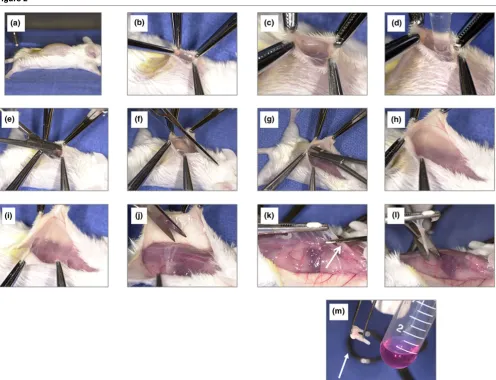
Figure 2 shows key steps in the membrane dissection. After killing the animals by carbon dioxide asphyxiation, the apex of the pouch membrane was exposed with a small skin incision (panel b). The membrane was then punctured with a scalpel (panel c). Typically, little free exudate accumulates within the pouch. Leukocytes were therefore lavaged out of the pouch
Figure 1
Outline of the air pouch experiments
lumen with 2 ml PBS (panel d) and the leukocyte count in the resulting lavage fluid determined with a hemocytometer [10]. The pouch membrane was then separated meticulously from adjacent subcutaneous and paraspinal tissues by blunt dis-section (panels e to j). Finally, the membrane was grasped with forceps, elevated and cut at the base (panels k and l). Great care was taken to avoid the paraspinal and nuchal tissues, to which the base of the membrane is typically attached. Using a rotatory homogenizer (Omni International, Warrenton, VA, USA), the isolated membranes were homogenized in Trizol medium (Invitrogen, Carlsbad, CA, USA), flash frozen in liquid nitrogen and stored at -70°C until further use.
RNA extraction and gene expression analysis
RNA was extracted over RNeasy spin columns (Qiagen, Valencia, CA, USA) and tested for integrity and quantity on an Agilent 2100 Bioanalyzer (Agilent Technologies, Palo Alto, CA, USA). For unknown reasons, significant RNA degradation ensued when MSU-stimulated membranes, but not control membranes, were frozen and thawed before homogenization (data not shown). All membranes were therefore homogenized in Trizol medium immediately after dissection. Typically, 70 to 90 μg RNA was obtained per pouch.
[image:3.612.60.556.90.470.2]For Affymetrix microarray analysis, RNA was processed and fluorescently labeled according to standard Affymetrix proto-cols [11]. To control for differences in dissection, RNA from
Figure 2
Key steps in the separation of the membrane from the overlying soft tissues
three control or three MSU-stimulated pouch membranes was pooled, processed, labeled and then hybridized to Affymetrix Mo430_2 oligonucleotide microarrays (Affymetrix Inc., Santa Clara, CA). Microarray signals were scanned and analyzed using Affymetrix GCOS software and then imported into the software program GeneSpring version 7.2 (Silicon Genetics, Redwood City, CA, USA) for visualization and filtering. RNA aliquots were also reverse transcribed into cDNA according to standard protocols and analyzed further by qPCR using the TaqMan system and ABI Prism 7000 or 7900 HT sequence detectors (Applied Biosystems, Foster City, CA, USA). Com-mercially available primer-probe sets (Applied Biosystems) were used.
IL-6 protein concentration in the pouch exudate was deter-mined by enzyme-linked immunosorbent assay (eBioscience, San Diego, CA, USA), after removal of cells and debris by centrifugation.
Macrophages
Mouse peritoneal macrophages were harvested by peritoneal lavage 4 days after intraperitoneal injection of 2 ml aged 3% Brewer's thyoglycollate (Invitrogen Corporation, Carlsbad, CA, USA). Macrophages were allowed to rest in 3 ml tissue culture wells for 1 hour at 37°C (1 × 10⁶ cells/well). After
removal of nonadherent cells, cells were grown in medium with or without MSU crystals for the time periods indicated in the figure legends. Previously frozen cells were used for the dose response experiment. Macrophage cultures were more than 95% pure, as verified by flow cytometry for CD11b, major his-tocompatibility complex class II, and F4/80.
Histology and immunohistochemistry
Tissues were obtained 9 hours after injecting MSU crystals into the pouch, fixed in formalin for 24 to 48 hours, and embed-ded in paraffin blocks. Blocks were cut into 5 μm thin sections on a rotatory microtome. Immunoperoxidase staining for IL-6 was performed using a semi-automated immunostaining sys-tem (DAKO, Carpinteria, CA, USA) and commercially available polyclonal goat anti-mouse IL-6 IgG (Santa Cruz Biotechnol-ogy Inc., Santa Cruz, CA, USA) at 1:100 dilution. Nonspecific goat IgG was used as negative control.
Results
Dissection of the pouch membrane
Crucial steps in the dissection procedure are shown in Figure 2 and are also described in the Materials and methods section (see above). Dissected pouch membranes had a gelatinous but also somewhat fibrous consistency and usually weighed 70 to 110 mg. Membranes from MSU-stimulated pouches tended to be firmer and to rupture somewhat less easily during the dissection, probably because of a mild increase in thick-ness from inflammation [12]. Figure 3a illustrates the plane of dissection between the membrane and the overlying subcuta-neous tissue. According to our observations, the air pouch
membrane originates from longitudinal soft tissue ridges that overlie the paraspinal musculature and from a cape-like, thicker membrane in the nuchal area. Because pieces of these tissues might contaminate the membrane during the dissec-tion and confound a gene expression analysis, we evaluated them histologically (Figure 3b). The nuchal structure was iden-tified as adipose tissue (Figure 3b, left image) and thus origi-nates from the nuchal fat pad. The paraspinal ridge tissue (shown macroscopically in Fig. 2, panel k) turned out to be rich in blood vessels, striated muscle and fascia (Figure 3b, centre) and thus probably was contiguous with the paraspinal mus-cles. To test the histologic purity of the dissected membranes, haematoxylin and eosin stains were prepared from several membranes. Adipocytes, skeletal muscle and fascia were not observed, confirming that the membranes had been dissected relatively free from surrounding tissue (Figure 3b, right).
Expression of selected targets in isolated membranes versus the overlying soft tissues
As expected, levels of mRNAs encoding resistin (a marker for adipocytes) and dystrophin (skeletal muscle) were by far high-est in RNA extracted from the soft tissues overlying the mem-branes (Figure 3c). In contrast, mRNAs of several mRNAs identified by the microarray analysis of dissected membranes as inducible by MSU crystals (see below) were highest in membrane RNA. Consistent with the observations that IL-6 is also expressed in striated muscle (for instance, Figure 4b) and PUMA-g (protein upregulated on macrophages activated with interferon-γ) in adipocytes [13], the relative soft tissue frac-tions of these two mRNAs were larger than those of TREM (triggering receptor expressed on myeloid cells)-1 and TREM-2, both of which are predominantly expressed on inflammatory cells.
Identification of differentially expressed genes by microarray analysis
MSU crystals. These were filtered on the Affymetrix change P
values below 2 × 10⁻⁵ for upregulated and 1 for the
downreg-ulated probe sets.
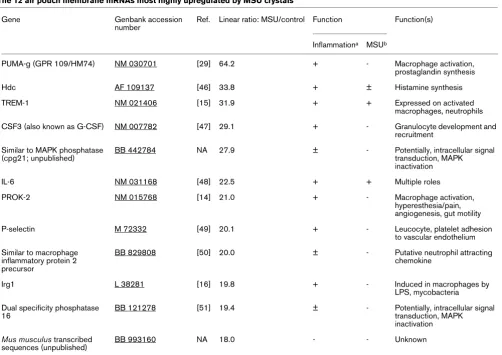
Of these, the 12 most highly over-expressed (linear ratio MSU/ control >17) targets are listed in Table 1. Eight (75%) were genes with known proinflammatory functions: histidine decar-boxylase (Hdc, the enzyme that catalyzes the conversion of histidine to histamine); the surface receptors PUMA-g (also known as GPR109 or HM74) [14] and TREM-1 [15], which
are induced on activated macrophages and neutrophils; immu-noresponsive gene (Irg)1, a protein that is rapidly induced dur-ing monocyte activation with endotoxin [16]; prokineticin (PROK)-2, which is a small polypeptide that is involved in mac-rophage activation, hyperesthesia and other processes [14]; IL-6; colony-stimulating factor (CSF)3 (also known as granulo-cyte colony-stimulating factor); and the adhesion molecule P-selectin. Three genes (25%) encoded less well characterized factors but had potential functions in inflammation. One gene was uncharacterized. Of note, all of the over-expressed genes
Figure 3
Histologic and molecular characterization of dissected membranes and adjacent tissues (a) Histologic cross-sections illustrating the plane of dissection
Figure 4
Validating differential regulation of mRNAs during MSU crystal inflammation in dissected air pouch membranes
with proven proinflammatory functions related to innate immu-nity. Of the 12 most downregulated genes, three (25%) were related to connective tissue constituents, one (granzyme D) to innate immunity, and the others to various processes. The raw microarray data have been deposited in the Gene Express Omnibus microarray repository and are publically available under accession number GSE11498.
Validation of IL-6 expression
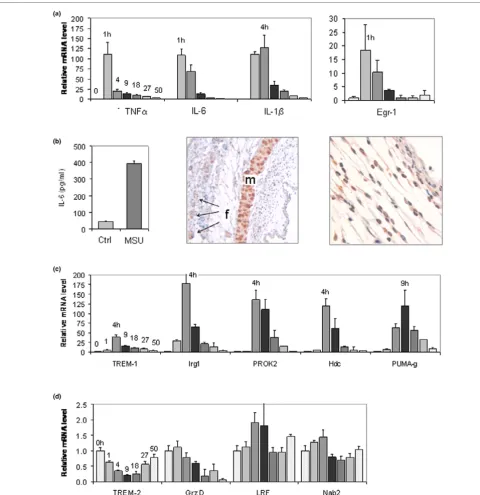
IL-6 is known to be raised in gout [17], but it had not been studied in the MSU-stimulated murine air pouch. qPCR validation of its expression in the 50-hour time course experi-ment summarized in Figure 1 was therefore chosen to estab-lish proof of principle of the microrray approach. Confirming the upregulation at 9 hours that had been detected with the microarrays (Table 1), IL-6 mRNA was 12.9-fold higher at this time point than at t = 0 hours (Figure 4a). However, peak induction occurred much earlier (1 hour) and was much higher (108-fold). In agreement with the observation that the pouch
leukocyte count had returned close to its original level at the end of the 50-hour time course (Figure 1b), IL-6 mRNA also returned to near baseline by 50 hours. The mRNAs encoding IL-1β, tumour necrosis factor (TNF)-α, and the immediate early transcription factor early growth response (Egr)-1 [18] fol-lowed similar kinetics (Figure 4a). These findings confirmed induction of IL-6 mRNA in the membrane and identified the 1-hour time point as the peak of a rapid, early surge in proinflam-matory cytokine and immediate early gene transcription.
In agreement with the induction of IL-6 mRNA in the mem-brane, analysis by enzyme-linked immunosorbent assay revealed that IL-6 protein levels at 9 hours were 8.7-fold higher in exudates from MSU-stimulated pouches than in exudates from control pouches (Figure 4b). The spatial expression of IL-6 in the inflamed air pouch was then determined immunohistochemically, using sections containing the pouch membrane adhering to the overlying skin. Consistent with pre-vious reports of IL-6 expression in striated muscle [19],
spe-Table 1
The 12 air pouch membrane mRNAs most highly upregulated by MSU crystals
Gene Genbank accession
number
Ref. Linear ratio: MSU/control Function Function(s)
Inflammationa MSUb
PUMA-g (GPR 109/HM74) NM 030701 [29] 64.2 + - Macrophage activation, prostaglandin synthesis
Hdc AF 109137 [46] 33.8 + ± Histamine synthesis
TREM-1 NM 021406 [15] 31.9 + + Expressed on activated
macrophages, neutrophils
CSF3 (also known as G-CSF) NM 007782 [47] 29.1 + - Granulocyte development and recruitment
Similar to MAPK phosphatase (cpg21; unpublished)
BB 442784 NA 27.9 ± - Potentially, intracellular signal transduction, MAPK inactivation
IL-6 NM 031168 [48] 22.5 + + Multiple roles
PROK-2 NM 015768 [14] 21.0 + - Macrophage activation,
hyperesthesia/pain, angiogenesis, gut motility
P-selectin M 72332 [49] 20.1 + - Leucocyte, platelet adhesion
to vascular endothelium
Similar to macrophage inflammatory protein 2 precursor
BB 829808 [50] 20.0 ± - Putative neutrophil attracting chemokine
Irg1 L 38281 [16] 19.8 + - Induced in macrophages by
LPS, mycobacteria
Dual specificity phosphatase 16
BB 121278 [51] 19.4 ± - Potentially, intracellular signal transduction, MAPK inactivation
Mus musculus transcribed sequences (unpublished)
BB 993160 NA 18.0 - - Unknown
aRole of target gene in inflammation in general. bRole of target gene in MSU crystal inflammation. +, known to play a role; ±, potentially involved; -,
[image:7.612.59.561.107.462.2]cific staining was seen in muscle fibres of the lamina muscularis of the subcutaneous tissue (Figure 4b, centre; marked 'm'), whereas the signal in hair follicles was not spe-cific (marked 'f', arrows). In the inflamed membrane, spespe-cific IL-6 staining was seen in a multitude of cells, including mono-nuclear and polymorphomono-nuclear cells and fibroblasts (Figure 4b, right).
Validating induction of Hdc, TREM-1, PUMA-g, Irg1 and PROK-2 mRNAs by MSU crystals in the air pouch membrane
qPCR demonstrated dramatic induction of these mRNAs throughout the air pouch time course (Figure 4c). Confirming the microarray results, all of these mRNAs were elevated at 9 hours. Interestingly, the extent and kinetics of their induction differed; whereas maximal induction of Irg1 (177-fold), PROK-2 (136-fold), TREM-1 (39-fold) and Hdc (1PROK-20-fold) occurred at 4 hours, PUMA-g mRNA was upregulated 120-fold and peaked at 9 hours.
To validate the results of the microarray analysis further, we determined kinetics of two mRNAs that were downregulated by MSU crystals, according to the array analysis (Figure 4d). TREM-2 is a homologue of TREM-1 that is downregulated dur-ing macrophage activation [20], and the microarray analysis had revealed an 81% decrease of its mRNA 9 hours after MSU crystal injection. Indeed, the time course demonstrated a 79% decrease in TREM-2 mRNA, with a nadir between 9 and 18 hours and subsequent recovery to near baseline level at 50 hours. In contrast, mRNA encoding granzyme D mRNA, which was 96% downregulated at 9 hours according to the microarrays, decreased steadily and reached 6% of its original level at 50 hours. As negative controls, we measured expres-sion of two mRNAs that were not among the differentially reg-ulated genes on the arrays (Figure 4d). First, leukaemia/ lymphoma-related factor (LRF; also known as FBI-1 and OCZF), a transcription factor important in cellular transforma-tion [21], osteoclastogenesis [22] and regulatransforma-tion of the HIV-1 promoter [23,24]. Levels of its mRNA demonstrated a statisti-cally insignificant twofold increase at 4 hours. Second, mRNA encoding Nab2, a co-regulator of Egr-1 [25], exhibited only minor fluctuations. To exclude their origin from remnant adi-pose or muscle tissue, qPCR results for all of the above mRNAs at 9 hours were also correlated with resistin and dys-trophin mRNA expression, but no significant associations were found.
IL-6, Irg1, PROK-2, Hdc and PUMA-g mRNA upregulation in MSU-stimulated mouse peritoneal macrophages
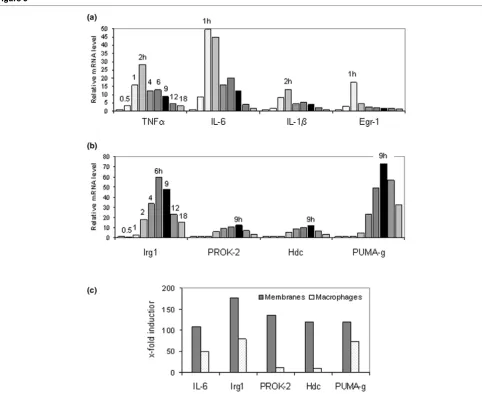
The induction of TREM-1 in macrophages by MSU crystals has been reported [26]. To test whether macrophages were also potential sources of Irg1, PROK-2, Hdc and PUMA-g, kinetics of these mRNAs were determined during 18 hours after the addition of MSU crystals to cultured mouse peritoneal macrophages (Figure 5). As in the tissue, MSU crystals
induced sharp, early peaks in TNF-α, IL-6, IL-1β, and Egr-1 mRNAs (Figure 5a). MSU crystals also upregulated Irg1, PROK-2, Hdc, and PUMA-gmRNAs (Figure 5b). However, with the exception of PUMA-g, their levels peaked somewhat later than in the membranes. As illustrated in Figure 5c, these mRNAs were, to various extents, induced more highly in the membranes than in the macrophages. As in the membranes, MSU crystals caused a decrease in TREM-2 mRNA in the macrophages and no significant changes in Nab2 and LRF mRNAs (data not shown).
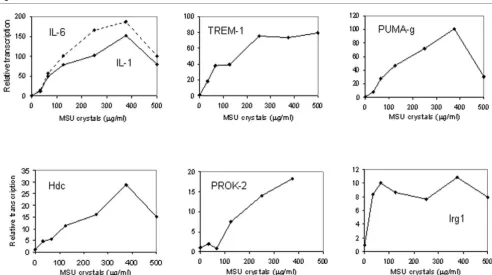
The induction of IL-1β, IL-6, TREM-1, PUMA-g, Hdc, PROK-2 and Irg1 by MSU crystals was also quantified in a dose response experiment (Figure 6). IL-1β and IL-6 mRNAs were induced maximally at a crystal concentration of 375 μg/ml medium, as were PUMA-g, Hdc and PROK-2 mRNAs. Induc-tion of TREM-1 mRNA peaked at a slightly lower, and that of Irg1 mRNA at the lowest crystal concentration.
Discussion
Using microarray analysis of meticulously dissected air pouch membranes, we identified several genes relating to innate immunity that were induced strongly by MSU crystals. Four of the six factors whose upregulation by MSU crystals was con-firmed by qPCR (PUMA-g, Irg1, Hdc and PROK-2) had not previously been associated with crystal-induced inflammation or inflammatory arthropathies. Since the initial presentation of our microarray results [27], the involvement of TREM-1 in MSU crystal-induced inflammation was reported independently [28], thus serving as an additional positive control and validat-ing our approach.
Potential roles of PUMA-g, TREM-1, Irg1, PROK-2 and Hdc in the pathogenesis of crystal inflammation
We validated the induction of six of the most highly over-expressed genes by qPCR. How might these function in the pathogenesis of crystal-induced inflammation? PUMA-g is a G-protein-coupled transmembrane receptor that was initially identified in a microarray screen of macrophages activated with TNF-α and interferon-γ [29]. In addition to activated mac-rophages, it is also expressed on neutrophilic granulocytes and adipocytes. On the latter, it is a major receptor for the cho-lesterol-lowering agent nicotinic acid [13]. Binding of this
lig-and to PUMA-g is also responsible for the cutaneous flushing response that is frequently observed in patients taking nico-tinic acid [30], and it has been proposed that cutaneously expressed PUMA-g leads to the release of prostaglandins D2
and E2, which in turn cause local vasodilatation [30]. These
results suggest that in MSU crystal inflammation PUMA-g transmits signals in macrophages, and perhaps also granulo-cytes, which potentiate release of prostaglandins and thus enhance the inflammatory process. Further studies with cultured cells or PUMA-g-/- mice will now be important in
elu-Figure 5
Validating differential regulation of mRNAs during MSU crystal inflammation in mouse peritoneal macrophages
[image:9.612.60.542.90.484.2]cidating the function of PUMA-g in crystal-induced inflammation.
TREM-1, too, is induced on the surface of activated macro-phages and neutrophils, and has been shown to play impor-tant roles in the systemic manifestations of sepsis [26]. Interestingly, Murakami and coworkers [28] showed that TREM-1 mRNA in the pouch exudate peaked before the max-imum accumulation of leukocytes, thus indicating activation of TREM-1 transcription early on. It has been proposed that one function of TREM-1 is to amplify Toll-like receptor (TLR) sign-aling [26]. Considering that TREM-1 mRNA reached maximum levels after the initial cytokine mRNA surge (Figure 4a) and that recognition of MSU crystals via TLR signaling is believed to be among the earliest events in crystal inflammation [31], one may postulate that the role of TREM-1 in crystal inflamma-tion also relates to potentiainflamma-tion of signals transmitted by TLRs.
Irg1 was isolated originally from a cDNA library made from endotoxin-stimulated macrophages [16], and was later found to be expressed in macrophages infected with mycobacteria [32,33]. Its induction by MSU crystals in peritoneal macro-phages (Figures 5 and 6) suggests that it may play general roles in macrophage activation.
Prokineticins are evolutionary highly conserved small secreted polypeptides that play roles in various tissues, including the
central nervous system, the gastrointestinal tract, the haemat-opoietic system and the vasculature [14,34,35]. PROK-2 was recently shown to augment macrophage chemotaxis and proinflammatory cytokine synthesis [36]. Interestingly, it also causes hyperesthesia, including by local injection into rodent paws, and mice lacking the PROK receptor PKR1 have dimin-ished pain responses [37]. It is therefore intriguing to specu-late that PROK-2 contributes to the symptoms of MSU crystal inflammation by enhancing both inflammation and pain in affected joints.
[image:10.612.59.551.92.367.2]The enzyme Hdc converts histidine to histamine. Histamine is elevated in the joint fluid of patients with gout [38] and in the MSU crystal stimulated rat air pouch, where it is believed to be the result of mast cell degranulation [12]. Our results, how-ever, suggest that histamine may also arise from increased Hdc levels during MSU crystal inflammation. Consistent with our observation that MSU crystals induced Hdc mRNA synthe-sis in macrophage culture, with reports of Hdc mRNA expres-sion in neutrophils [39], and with the well documented presence of mast cells in the air pouch membrane [12], all of these three cell types are probably highly inducible sources of Hdc in the pouch membrane. Thus, Hdc and histamine may contribute significantly to the evolution of MSU crystal inflam-mation in this model, but also in gouty synovitis in humans.
Figure 6
MSU crystal dose response
Significance of the downregulated genes
TREM-2 is a cell surface receptor similar to TREM-1. It pro-motes differentiation of macrophages into osteoclasts [40] but inhibits macrophage activation and is downregulated during this process [20]. The decrease in TREM-2 mRNA in both membranes and cultured macrophages suggests that macro-phage activation by MSU crystals leads to an increase in TREM-1 but to a decrease in TREM-2 mRNA levels. Granzyme D has been detected in murine cytotoxic T cells [41] and endometrial natural killer (NK) cells [42]. The roles of these cell types in urate crystal inflammation have not been studied. However, it is known that uric acid can activate CD8+ T cells
under some circumstances [43], and in preliminary studies we have detected mRNA encoding the NK cell lectin-like receptor A2 in the air pouch membrane (Mayer CT, Schumacher HR, Pessler F, unpublished data). Thus, the persistent downregu-lation of granzyme D throughout the time course suggests that MSU crystals may modulate cytotoxic T cell or NK cell activity in the membrane. Alternatively, one must consider that dilution of the membrane RNA pool by mRNAs contained in immigrat-ing inflammatory cells or by otherwise highly upregulated mRNAs might also cause – at least in part – artifactual decreases in mRNAs expressed by resident membrane cells.
Kinetics of MSU crystal inflammation in the air pouch membrane
The results of the present study also shed new light on the kinetics of transcriptional regulation in the air pouch mem-brane. We observed an early, steep rise in proinflammatory cytokine mRNA synthesis that essentially paralleled the syn-thesis of mRNA encoding the immediate early transcription factor Egr-1. Similarly rapid kinetics were observed in cultured macrophages (Figure 5). Indeed, inclusion of the 30-minute time point revealed that increasing levels of mRNAs encoding Egr-1 and all three cytokines could be detected this early. It is currently believed that TLR-mediated activation of the Nalp3 containing inflammasome, leading to proteolytic cleavage of pre-existing pro-IL-1β to IL-1β, is among the first steps in MSU crystal inflammation [31,44]. Our findings suggest that activa-tion of the proinflammatory cytokine genes encoding IL-1β, IL-6 and TNF-α, as well as Egr-1 and probably other immediate early transcription factors, is among the next, early events in reprogramming the transcriptional machinery in MSU crystal inflammation, both in an intact tissue and in cultured cells. TREM-1, Irg1, PROK-2, Hdc and PUMA-g mRNA levels all peaked after this dramatic burst in early cytokine transcription. These factors may therefore play roles in perpetuating or amplifying this early inflammation. We had performed the microarray analysis 9 hours after MSU crystal injection, the peak of leukocyte accumulation in the pouch lumen. However, results of the time course analysis demonstrate that major tran-scriptional reprogramming in the air pouch membrane occurs several hours earlier. Future RNA-based studies into events leading to the peak phase of inflammation in the membrane
should therefore focus on relatively early time points up to 4 hours.
Caveats of the present study
Gene expression results obtained from the dissected mem-branes do not allow one to determine whether a given overex-pressed gene was induced in the resident membrane cells or imported by infiltrating cells. It is therefore important to validate differential expression of a given gene in a purified cell popu-lation, as was done here with cultured macrophages. Even though we validated the induction of all six targets in cultured macrophages, their fold induction was lower in these cells than in the membranes (Figure 5). This suggests that events in the membranes due to cell flux, expression in cells other than macrophages (for example, neutrophils), or more efficient gene regulation due to cell-cell interactions contribute significantly to regulation of these genes in the intact mem-branes. Another caveat is that the microarray analysis was not replicated, which precluded an extended statistical analysis. However, the unusually high degrees of over-expression and under-expression apparently compensated for this lack of rep-lication; they allowed us to choose a small number of genes for qPCR validation strictly by the high magnitudes of their expres-sion changes.
It is also important to remember that inflammation extends beyond the membrane into the loose, fibroblast-rich tissue between the membrane and the striated muscle layer (Figure 3a and Schiltz and coworkers [12]). The air pouch membrane therefore does not contain the entire inflammation that devel-ops in the air pouch, and inflammatory cells may remain in the air pouch wall if the membrane is removed with the blunt dis-section method described here. Furthermore, MSU crystals cause swelling of the air pouch membrane [45]. This is most likely due to the influx of inflammatory cells and associated interstitial edema and must be considered when evaluating the membrane histologically.
Potential uses of the isolated air pouch membrane in gene discovery
Our findings suggest that a more extensive, replicated micro-array analysis involving higher numbers of air pouch mem-branes may be a powerful tool to identify genes that are differentially active in various aspects of inflammation and innate immunity. In particular, it should lend itself well to the identification of genes that act at different time points in the evolution or resolution of inflammation, genes that are regu-lated in response to treatment with anti-inflammatory agents, or genes that reflect changes in the resident connective tissue cells in response to inflammation.
Conclusion
identified several mRNAs relating to innate immune responses that were previously not implicated in MSU crystal inflamma-tion. The appearance of these mRNAs after an initial surge in proinflammatory and immediate early gene transcription sug-gests that they may form part of a 'second wave' of factors that amplify or perpetuate acute inflammation.
Competing interests
The authors declare that they have no competing interests.
Authors' contributions
FP designed the study, performed the experiments and wrote the manuscript. CTM, SMJ and LD participated in the experiments. EMB provided the macrophages and discussion. JPM provided laboratory equipment, reagents and discussion. HRS oversaw the study, provided the MSU crystals and initial instruction in the use of the air pouch model, and edited the manuscript. All authors read and approved the final manuscript.
Acknowledgements
We thank G Clayburne, Nicole Chartrain and Marlin Camps-Ramirez for technical support; Grace Strazewski and Don Baldwin (University of Pennsylvania Microarray Core) for microarray hybridization; and John Tobias (University of Pennsylvania Bioinformatics Core) for help with analyzing the microarray data; Dan Martinez and the staff of the histopa-thology core of The Children's Hospital of Philadelphia for histology sup-port; and Peri DeRitis and the staff of the VA Medical Center Animal Facility for expert animal care. F Pessler was supported by National Insti-tutes of Health Training Grants T32-AR 007442 and T32-CA 09140 and a 2007-8 American College of Rheumatology Education and Research Foundation Amgen Pediatric Rheumatology Research Award, and CT Mayer by a 2006 American College of Rheumatology Health Professional Graduate Student Preceptorship Award.
References
1. Edwards JC, Sedgwick AD, Willoughby DA: The formation of a structure with the features of synovial lining by subcutaneous injection of air: an in vivo tissue culture system. J Pathol 1981, 134:147-156.
2. Generini S, Matucci-Cerinic M, Partsch G, Stancikova M, Pignone A, Konttinen YT, Rovensky J, Baker DJ, Schumacher HR Jr: Evi-dence for hyaluronan production in the air pouch model in rats. Clin Exp Rheumatol 2001, 19:271-276.
3. Gordon TP, Kowanko IC, James M, Roberts-Thomson PJ: Mono-sodium urate crystal-induced prostaglandin synthesis in the rat subcutaneous air pouch. Clin Exp Rheumatol 1985, 3:291-296.
4. Sedgwick AD, Sin YM, Edwards JC, Willoughby DA: Increased inflammatory reactivity in newly formed lining tissue. J Pathol 1983, 141:483-495.
5. Nagase M, Baker DG, Schumacher HR Jr: Prolonged inflamma-tory reactions induced by artificial ceramics in the rat air pouch model. J Rheumatol 1988, 15:1334-1338.
6. Yoshino S, Cromartie WJ, Schwab JH: Inflammation induced by bacterial cell wall fragments in the rat air pouch. Comparison of rat strains and measurement of arachidonic acid metabolites. Am J Pathol 1985, 121:327-336.
7. Nalbant S, Chen LX, Sieck MS, Clayburne G, Schumacher HR: Prophylactic effect of highly selective COX-2 inhibition in acute monosodium urate crystal induced inflammation in the rat subcutaneous air pouch. J Rheumatol 2005, 32:1762-1764. 8. McCarty DJ Jr, Faires JS: A comparison of the duration of local anti-inflammatory effect of several adrenocorticosteroid
esters – a bioassay technique. Curr Ther Res Clin Exp 1963, 5:284-290.
9. Jung SM, Schumacher HR, Kim H, Kim M, Lee SH, Pessler F: Reduction of urate crystal-induced inflammation by root extracts from traditional oriental medicinal plants: elevation of prostaglandin D2 levels. Arthritis Res Ther 2007, 9:R64. 10. Schumacher HR, Reginato AJ: Atlas of Synovial Fluid Analysis
and Crystal Identification 1st edition. Philadelphia, PA: Lea and Fiebiger; 1991.
11. Affymetrix [http://www.affymetrix.com/support/technical/man ual/expression-manual.affx]
12. Schiltz C, Lioté F, Prudhommeaux F, Meunier A, Champy R, Calle-bert J, Bardin T: Monosodium urate monohydrate crystal-induced inflammation in vivo: quantitative histomorphometric analysis of cellular events. Arthritis Rheum 2002, 46:1643-1650.
13. Tunaru S, Kero J, Schaub A, Wufka C, Blaukat A, Pfeffer K, Offer-manns S: PUMA-G and HM74 are receptors for nicotinic acid and mediate its anti-lipolytic effect. Nat Med 2003, 9:352-355. 14. Li M, Bullock CM, Knauer DJ, Ehlert FJ, Zhou QY: Identification of two prokineticin cDNAs: recombinant proteins potently con-tract gastrointestinal smooth muscle. Mol Pharmacol 2001, 59:692-698.
15. Bouchon A, Dietrich J, Colonna M: Cutting edge: inflammatory responses can be triggered by TREM-1, a novel receptor expressed on neutrophils and monocytes. J Immunol 2000, 164:4991-4995.
16. Lee CG, Jenkins NA, Gilbert DJ, Copeland NG, O'Brien WE: Clon-ing and analysis of gene regulation of a novel LPS-inducible cDNA. Immunogenetics 1995, 41:263-270.
17. Brozik M, Rosztoczy I, Meretey K, Balint G, Gaal M, Balogh Z, Bart M, Mituszova M, Velics V, Falus A: Interleukin 6 levels in synovial fluids of patients with different arthritides: correlation with local IgM rheumatoid factor and systemic acute phase protein production. J Rheumatol 1992, 19:63-68.
18. Sukhatme VP, Cao XM, Chang LC, Tsai-Morris CH, Stamenkovich D, Ferreira PC, Cohen DR, Edwards SA, Shows TB, Curran T, et al.: A zinc finger-encoding gene coregulated with c-fos during growth and differentiation, and after cellular depolarization. Cell 1988, 53:37-43.
19. Febbraio MA, Pedersen BK: Contraction-induced myokine pro-duction and release: is skeletal muscle an endocrine organ? Exerc Sport Sci Rev 2005, 33:114-119.
20. Turnbull IR, Gilfillan S, Cella M, Aoshi T, Miller M, Piccio L, Hernan-dez M, Colonna M: Cutting edge: TREM-2 attenuates macro-phage activation. J Immunol 2006, 177:3520-3524.
21. Maeda T, Hobbs RM, Merghoub T, Guernah I, Zelent A, Cordon-Cardo C, Teruya-Feldstein J, Pandolfi PP: Role of the proto-onco-gene Pokemon in cellular transformation and ARF repression. Nature 2005, 433:278-285.
22. Kukita A, Kukita T, Ouchida M, Maeda H, Yatsuki H, Kohashi O: Osteoclast-derived zinc finger (OCZF) protein with POZ domain, a possible transcriptional repressor, is involved in osteoclastogenesis. Blood 1999, 94:1987-1997.
23. Pessler F, Hernandez N: Flexible DNA binding of the BTB/POZ-domain protein FBI-1. J Biol Chem 2003, 278:29327-29335. 24. Pessler F, Pendergrast PS, Hernandez N: Purification and
char-acterization of FBI-1, a cellular factor that binds to the human immunodeficiency virus type 1 inducer of short transcripts. Mol Cell Biol 1997, 17:3786-3798.
25. Svaren J, Sevetson BR, Apel ED, Zimonjic DB, Popescu NC, Mil-brandt J: NAB2, a corepressor of NGFI-A (Egr-1) and Krox20, is induced by proliferative and differentiative stimuli. Mol Cell Biol 1996, 16:3545-3553.
26. Bouchon A, Facchetti F, Weigand MA, Colonna M: TREM-1 amplifies inflammation and is a crucial mediator of septic shock. Nature 2001, 410:1103-1107.
27. Jung S, Schumacher H, Dai L, Pessler F: Identification of pro-inflammatory genes by genomic analysis of the isolated monosodium urate-stimulated murine air pouch membrane (abstract). Arthritis Rheum 2005, 52:4074.
29. Schaub A, Futterer A, Pfeffer K: PUMA-G, an IFN-gamma-induc-ible gene in macrophages is a novel member of the seven transmembrane spanning receptor superfamily. Eur J Immunol 2001, 31:3714-3725.
30. Benyo Z, Gille A, Kero J, Csiky M, Suchankova MC, Nusing RM, Moers A, Pfeffer K, Offermanns S: GPR109A (PUMA-G/HM74A) mediates nicotinic acid-induced flushing. J Clin Invest 2005, 115:3634-3640.
31. Akahoshi T, Murakami Y, Kitasato H: Recent advances in crystal-induced acute inflammation. Curr Opin Rheumatol 2007, 19:146-150.
32. Basler T, Jeckstadt S, Valentin-Weigand P, Goethe R: Mycobac-terium paratuberculosis, MycobacMycobac-terium smegmatis, and lipopolysaccharide induce different transcriptional and post-transcriptional regulation of the IRG1 gene in murine macrophages. J Leukoc Biol 2006, 79:628-638.
33. Shi S, Blumenthal A, Hickey CM, Gandotra S, Levy D, Ehrt S: Expression of many immunologically important genes in Mycobacterium tuberculosis-infected macrophages is inde-pendent of both TLR2 and TLR4 but deinde-pendent on IFN-alpha-beta receptor and STAT1. J Immunol 2005, 175:3318-3328. 34. Mollay C, Wechselberger C, Mignogna G, Negri L, Melchiorri P,
Barra D, Kreil G: Bv8, a small protein from frog skin and its homologue from snake venom induce hyperalgesia in rats. Eur J Pharmacol 1999, 374:189-196.
35. LeCouter J, Zlot C, Tejada M, Peale F, Ferrara F: Bv8 and endo-crine gland-derived vascular endothelial growth factor stimulate hematopoiesis and hematopoietic cell mobilization. Proc Natl Acad Sci USA 2004, 101:16813-16818.
36. Martucci C, Franchi S, Giannini E, Tian H, Melchiorri P, Negri L, Sacerdote P: Bv8, the amphibian homologue of the mamma-lian prokineticins, induces a proinflammatory phenotype of mouse macrophages. Br J Pharmacol 2006, 147:225-234. 37. Negri L, Lattanzi R, Giannini E, Colucci M, Margheriti F, Melchiorri
P, Vellani V, Tian H, De Felice M, Porreca F: Impaired nociception and inflammatory pain sensation in mice lacking the proki-neticin receptor PKR1: focus on interaction between PKR1 and the capsaicin receptor TRPV1 in pain behavior. J Neurosci 2006, 26:6716-6727.
38. Dalbeth N, Haskard D: Pathophysiology of crystal-induced arthritis. In Crystal-Induced Arthropathies Edited by: Wortmann R, Schumacher H, Becker M, Ryan L. New York, NY: Taylor & Francis; 2007:239-354.
39. Shiraishi M, Hirasawa N, Oikawa S, Kobayashi Y, Ohuchi K: Anal-ysis of histamine-producing cells at the late phase of allergic inflammation in rats. Immunology 2000, 99:600-606.
40. Cella M, Buonsanti C, Strader C, Kondo T, Salmaggi A, Colonna M: Impaired differentiation of osteoclasts in TREM-2-deficient individuals. J Exp Med 2003, 198:645-651.
41. Masson D, Tschopp J: A family of serine esterases in lytic gran-ules of cytolytic T lymphocytes. Cell 1987, 161:679-685. 42. Allen MP, Nilsen-Hamilton M: Granzymes D, E, F, and G are
reg-ulated through pregnancy and by IL-2 and IL-15 in granreg-ulated metrial gland cells. J Immunol 1998, 161:2772-2779. 43. Shi Y, Galusha SA, Rock L: Cutting edge: elimination of an
endogenous adjuvant reduces the activation of CD8 T lym-phocytes to transplanted cells and in an autoimmune diabetes model. J Immunol 2006, 176:3905-3908.
44. Martinon F, Petrilli V, Mayor A, Tardivel A, Tschopp J: Gout-asso-ciated uric acid crystals activate the NALP3 inflammasome. Nature 2006, 440:237-241.
45. Lioté F, Prudhommeaux F, Schiltz C, Champy R, Herbelin A, Ortiz-Bravo E, Bardin T: Inhibition and prevention of monosodium urate monohydrate crystal-induced acute inflammation in vivo by transforming growth factor beta1. Arthritis Rheum 1996, 39:1192-1198.
46. Joseph DR, Sullivan PM, Wang YM, Kozak C, Fenstermacher DA, Behrendsen ME, Zahnow CA: Characterization and expression of the complementary DNA encoding rat histidine decarboxylase. Proc Natl Acad Sci USA 1990, 87:733-737. 47. Demetri GD, Griffin JD: Granulocyte colony-stimulating factor
and its receptor. Blood 1991, 78:2791-2808.
48. Chiu CP, Moulds C, Coffman RL, Rennick D, Lee F: Multiple bio-logical activities are expressed by a mouse interleukin 6 cDNA clone isolated from bone marrow stromal cells. Proc Natl Acad Sci USA 1988, 85:7099-7103.
49. Johnston GI, Cook RG, McEver RP: Cloning of GMP-140, a gran-ule membrane protein of platelets and endothelium: sequence similarity to proteins involved in cell adhesion and inflammation. Cell 1989, 56:1033-1044.
50. Carninci P, Kasukawa T, Katayama S, Gough J, Frith MC, Maeda N, Oyama R, Ravasi T, Lenhard B, Wells C, Kodzius R, Shimokawa K, Bajic VB, Brenner SE, Batalov S, Forrest AR, Zavolan M, Davis MJ, Wilming LG, Aidinis V, Allen JE, Ambesi-Impiombato A, Apweiler R, Aturaliya RN, Bailey TL, Bansal M, Baxter L, Beisel KW, Bersano T, Bono H, et al.: The transcriptional landscape of the mammalian genome. Science 2005, 309:1559-1563. 51. Ko MS, Kitchen JR, Wang X, Threat TA, Wang X, Hasegawa A,