CQfdTRfBUTZONS TO TENSOR ANALYSIS
Thesis by
Willtam
Thorns Guy, Jr,In
Partial Fulfillnient o f t h e Requiremenfs f o r t h e Degreeof
Doctor of Philosophy
California X n s t i t u t e of Technology Pasadena, California
It
is a pleasure t o acknowledge and t o express my ap- preciation f o r the asai stance and encouragement given meby Professor
A. D.
fichd.. His patience and ever-nillingwsa t o talk over t h e vartous p o i n t s and p o s s i b i l i t i e s connected with such an undertaking d e s p i t e other demands on his time and strength are deeply appreciated.This t h e s i s treats t w o separate problems. The first concerns t h e transverse vibrations o f a beam and of a thin rectangular f l a t
plate. These vibrations are associated with a function space
which has the progertiee of a generalized "Riemannian* function epace. The geodesics of this space are shown t o play a role analogous t o that played by the g e o d e s i c s of the configuration
space i n the classical treatment o f the Finite dfraens5.ona.I case. Part
I
is introductory and treats a few aspects o f t h e vibrations of beams with varfous end conditions under a change o f partzr~a&er, Part I1 develops the integro-differential equation f o r t h e t h i nrectangular flat plate. The associated functi~n space and i t s
geodesics are then studied i n some d e t a i l , The spaee i s found
t o be not one o f constant Riemannian curvature. An example is worked out t o illustrate t h e ideas, and an extension i s suggested. The second problem (part 111) considers the equations 0 4 lnotian
of h y d r o d y n d c s o f v i r e o u s f l o w with aooving axes. Use is made
o f t h e space o f a kinetic metric fntreduced by McVittie, rho considered non-viscous
flow
only. The Nevtonian equations are obtained by taking certain approximations. The equations of notion in terms o f the v o r t i e i t y tensor are developed.Two
examples ars discussed i l l u s t r a t i n g t h e theory, one concerninn instabilityPAGE
I
VIBRATION OF B l w d s1, Notations and conventions
2. Introduction
3, Transverse vibrations o f straight beams
11 A FUNCTION SPACE ASSOCIATED WITH A FLaT
PLATE
124, Vibrations o f a t h i n rectangular f l a t plate 12 5. An infinite dimensional generalized Riemannian space 20
6 . Curvature of the generalized Rkemannian space
7. An axample
8. Remarks and suggested problem
111 WVfMG AXES
IN HYI3RODYNAkflCS
OF VISCOUS FtULDS 9. Introduction10. Space of t h e kinetic metric
PART f
VIBRATION
OF BEAMS1. Notations conventions. To avoid any misunderstand-
ing we shall explain t h e notations and conventions used through-
out t h i s thesis. Theorems, lemma, and definitions are numbered
consecutively in each paragraph, The integer represents the number
of t h e paragraph, and t h e number t o t h e r i g h t o f the decimal point represents t h e order o f the theore@, lemma, or definition,
For
example, Theorem 4.1 is the first theorem of paragraph 4, w h i l eL8- 5.3 is the third le~gna o f paragraph 5, e t c , The ordered pair of numbers such as (13,417) l i s t e d in t h e t e x t means page 417
o f reference number 13 i n t h e list o f references given after
PART
111, The usual Eiastein summation convention is used, i , e . , re- peated lower case i n d i c e s @reek o r at in) generate sulas. The range o f such sums will be given explicitly. Capital indices will
be used t o forestall sumntation. As is customary,
we
let notation indicate some o f t h e restrictions or hypotheses, especially in aseries o f lemmas. For example, t h e equation stating L e m 3.2
certainly presupposes that Definitions 3.3, 3.2, etc., are k e p t in aind. This should cause no confusion since t h e required support- i n g d e f i n i t i o n s are usually on t h e same page or on the preceding
from being t o o bulky. On t h e other hand, t h e hypotheses for theorems are l i s t e d in the theorem,
A
function u is said t o be of class C- ( b r i e f l y , u 6c?'
if a l l of i t s first n derivativesare continuous.
2. Tntroductioa, The role played by the geodesics o f t h e oonfiguration space
of
classical mechanics ( o f generalized coordi- nates) i s well know (ef.( I ) ,
(15,417), ( 1 This con-figuration space i s usually a f i n i t e dimensional Riemannian space with a fundamental spsrmetric tensor g The element of arc length
2
is
given by dr=
g.. d i d q $ (=
2 ) where the qi are" L
the generalized coordinates, gig= g . ,
,
and the eummationP
aanventi on i s used,
Tllfe consider here the generalization required f o r , say, t h e
geodesics of t h e ' c o n f i ~ u r a t i o n spacew o f a vibrating string, beam, f l a t plate, stc. Clearly a f h i t e nuaber of independent generalized coordinates i s no longer adequate. An fntroduction o f a generalized "Riemannianw function space circumvents this d i f f i c u l t y (9,551),
(n,38). This generalization requires the use of arbitrary (except for certain r e s t r i c t i o n s listed where required) P u n d i o n s i n lieu o f coordinates, ~ r g c h e t differentials, ~ C t e a u x limits, a gener- alized tensor analysis, and other a s p e c t s o f modern d i f f erentiat
3. Tranmerse vibrations
of
straight beams. The p a r t i a l differential equation f o r t h e "smallw transverse vibrations o f astraight beam o f constant cross s e c t i o n and constructed o f material o f constant density f and constant modulus o f e l a s t i c i t y
E
where u~ u(x,t) i s the displacement o f the axis o f the beam from its unstrained p o s i t i o n as a function of distance x along t h e length o f t h e be- and of time t.
We
9
a s m e u belongs t o class
C
.
E
2 Young's modulus of e l a s t i c i t y 3I
moment of inertia o f the beam cross section about a l i n e through its centroid perpendicular t o t h e planeof t h e displacement ui
,
O = m a s s per u n i t length;
1
-=
,
/
Z
a
(;
:r]
,
which gives theR
a x
13--
curvature o f the axis of t h e beam.
For ease of reference we tabulate son8 of t h e end conditions usually considered in beam probleas, The conditions are arranged in columns from which a t y p i c a l case can be read o f f by taking one
and only one condition from eaeh column, The subscript notation is used for partial derivatives, s.g., u (0,t) 2 a 2 U ( X , t )
TABLE f
(or
TABLE
i
i ft-r
B, u(x,t ( 8 ) )-z(x, 8 ) )A
-
-
B
-
C .IID
Ic( 4
uxg(o,t)=
o
qs(x,t)=
o
uxu(Q,t) = 0 uZM(R9t)= 0 (b) u Z ( 0 , t ) = O u $ ( l , t ) = O u(O,t)= 0 u(!, t ) =
0Well known end conditions are
( 3 ) Aa,
Ba,
Cb, Db 3=t hinged support ( simply ed) ends( 4 ) A b , B b , Cb,Db 1- b u f l t - i n ends (5) Ab, Da, Cb, Da --Js.
bu l t - i n , free
f
canti% ever)( 6 ) Ab,
%,
Cb) Db =t built-in,
hingedThe k i n e t i c e n e r g ~ ( t ) and the potential energy
~ ( t )
aregiven by (14,334) n
w h e r e g is the
2 length o f
the
T h e o r e m u . If
i)
u ( x , t ) € c Y and satisfies eguation'(l)li) the k i n e t i c and p o t e n t i a l energies are given by equations ( 7 ) and (8),
respectively
iii) u(x,t) s a t i s f i e s t h e end condition ( 2 ) (free ends)
[image:8.542.61.465.65.707.2]Proof.
-
P
B
d ( ~ + V)
dt 2 d t ~o ( ~ ~ d
J(&jdx
o x + ~Corollarr
3.1.
If u ( x , t ) s a t i s f i e s any o f t h e end conditions( 3 ) , ( 4 ) , (5), o r ( 6 ) as w e l l as hypotheses i ) and ii) o f Theorem 3.1, then T ( t ) f ~ ( t )
=
C, a constant.Proof. An analysis of t h e "u v" terms o f t h e integration
-
by parts in Theorem 3.1 ahows that t h e y likewise vanish under any o f t h e end conditions ( 3 ) , ( 4 ) , (5), or ( 6 ) . It i s a l s o t o be noted t h a t t h i s result a l s o obtains i f any set o f four conditions
are taken from Table I with one and only one Prom each column.
It i s f r u i t f u l t o introduce another parameter i n lieu of
t.
D e f i n i t i o n
3.1.
A ( X )
2[
C - -[
(
~
~
~
x
dx]'
h
~
4
Proof. Clear. Use Definition 3.1 and equation ( 8 ) .
-
-
~
A
(
)ah
A
Definition
3.2.
s=
-
--..Definition
3.3.
A(s) Z A[%(*)),
U(X,S) u(x,t(a))Lemma
Proof.
-
d~ dt(s)
a
-
r
-
=
A(+) j
-
-
-
-
---
-
from Definitions 3.2 and 3.3. d t d s ~ ( t ( s ) ) A ( s )~ ( t )
=
2T(t)=
f dx frolaequation ( 7 ) andL e m 3.1.
Theorem 3.1 on t h e consewation of energy c a ~ a l s o be written
in
terns of t h e parameter 8.L 9
u(x,s) u(x,t(s)), and
U E C
,
ii) ~ ( t ) and ~ ( t ) are given by equations
iii) s is given by D e f i n i t i o n 3.2,
iv) x(s) is given by Definitions 3.1 and 3.3,
then
&)J(.
7,Sy
:.
r(dy19s)~
(11) d x +
-
d x = C2
0 0
dx
=
0 uaing D e f i n i t i o n 3.1 2EI
0 0
9
~emn~i
3.3.
~f i) u(x,t) s a t i s f i e s equation(I.),
E C,
ii) u(x,t) satisfies t h e end conditions (2)
iii) x ( s ) i s given by D e f i n i t i o n s 3.1, 3.2,
and 3.3, dji( 8 )
t h e n
--
-
-2EI dxd s
a
X.Proof. A ( t )
=
2 C--
Corollary
3.3.
Hypothesis ii) of Lemma 3.3mav
be extended t oencompass any of the end conditions ( 3 ) , (4), ( 5 ) , o r ( 6 ) .
Proof. The *u v" terms o f t h e integration by parts vanish for conditions ( 3 ) , ( 4 ) , ( 5 ) , or (6) as well as f o r condition (2).
Theorem=.
If
i) u(x,t) s a t i s f i e s equation (1) with any of the end conditions (2)-(6),ii) T ( t )
+
~ ( t )=
C, a constantiii)
x(s) is given by Definitions 3.1, 3.2, and 3.3iv) t(x,s) z3 u(x,t(s))
then G(x, s) satisfies the i n t e g r r d i f f e r e n t i a l equation
a s
Proof. - = ~ ( t )
a u ( ~ , t )
a $
Hence
=
-
~ ( t )
a t
a
sand
-
Substituting these equations into equation
(I),
we haveEI
d Y u ( x , t )3 . - L O which,
9
upon using Lemma 3.2 and C o r o l l a r y 3.3, becomes
R
a2
ii
I
a i i
[ a z
aVii
This proves t h e theorem upon d i v i s i o n by
P
We now assume that Table
I
has been rewritten aa Table in whicht
is replaced by t ( s ) and u(x,t)= u(x,t(s))=
3(x,s)*Jc
Theorem
3.4.
If
i) G ( x , a ) E C and s a t i s f i e s equations (lo),(XI),
and (12)ii) i ( r )
>
0 satisfiesDefinition
3.1 w i t h s as a parameteriii) C is a p o s i t i v e constant
i v ) z ( x , s ) s a t i s f i e s the end conditions ( 2 ) o f Table
vi) u ( x , t ) 3 % ( x , s ( t
1)
b) u ( x , t ) satisfies t h e and conditions ( 2 ) of T a b l e
I
c ) u ( x , t ) has t h e c o n s t a n t t o t a l energy l e v e l C.Proof. t 5
iA
-&
by hypothesis.-
S u b s t i t u t i n ~ these i n t o equation (ll), w e have
Since
a f t e r t w o integrations by parts like those f o r the proof of Lemma 3 . 3 . S u b s t i t u t i n a this i n t o equation (12) we have
--
+ - -
dx-
d s
-
-
1Since
-
=
~ ( s ) and A ( $ ) dx=-dt
f '
equation (14) becomes
-
-
+- - -
0. Hence conclusion a) follows. Conclusiona t 2
p a x u
b) f o l l o w s immediately from the relation o f Table
I
and7.
Conclu- sion c ) f o l l o w s from equation (11) o f Theorem 3.2 upon n o t i c i n g that the l e f t side of t h i s equation is j u s t t h e sum o f ~ ( t ) and~ ( t )
as given by equations ( 7 ) and (8).Corollary
3.4.
Hypothesis i v ) may be changed t o read any one o f t h e end conditions ( 3 ) , ( 4 ) , ( 5 ) , o r ( 6 ) o f TableZ
and then t h e conclusion b ) w i l l read t h e respective one of ( 3 ) , (4), ( 5 ) , o r( 6 ) of Table
I.
A FUNCTION SPACE ASSOCIATED
WITH
A FLATPLATE
Before proceeding with t h e geometric ideas and t h e role o f t h e generalized Rienannian function space, we shall consider t h e
small vgbrations o f a thin rectangular flat plate,
4. Vibrations
of
5
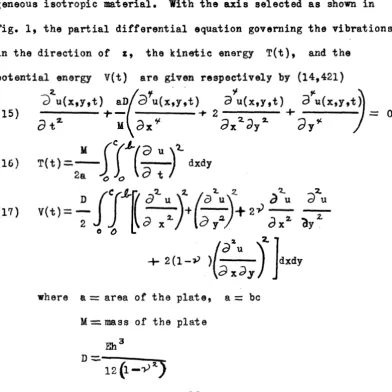
thin rectangular f l a t plate. We con- sider a t h i n rectangular f l a t plate o f p e r f e c t l y e l a s t i c , homo- geneous i s o t r o p i c mterial. With the axis selected as shown inFig. 1, t h e partial differential equation governing t h e vibrations
in the d i r e c t i o n o f
r ,
t h e k i n e t i c energy ~ ( t ) , and thep o t e n t i a l energy V(t) are given respectively by (14,421)
[image:16.550.80.473.296.689.2]E
=
Youngf s modulus o f e l a s t i c i t y o f the material h=
thickness of the p l a t e9
=
Poisson's r a t i o for t h e materialu ( x , y , t )
=
d e f l e c t i o n of t h e plate at time t.We shall be concerned w i t h t h e vibrations u(x,y,t), assumed be- longing t o C
,
f o r which %&
j
boundaq u(x,y,t) s a t i s f i e s(18) u(x,y,t)
=
0,
u (x,y,t)=
0 and ~ ~ $ x , y , t )=
0. d ,Def i n i t
iog
4.1.
Ya'U
SU
du
a u
9 u ( n , y , t )
r
v Z ( v = ( x , , , t ) ) = - + 2+-
a
x Yaxf
J y *JrY
9
Theorem
4.1.
If
i) u(x,y,t) satisfies equation (15) and c Cii) u(x,y,t) s a t i s f i e s t h e boundary condi-
t i o n s of equation (18)
iii) the k i n e t i c and p o t e n t i a l energies are given by equations ( 1 6 ) and (17), respectf v e l y ,
+ 2 ( 1 - ) U , ~ U ~ * ]dxdy and using equation (15)
-
=
&
.I,-
-
L/[
Y,
y
V'U dxdy+
a
+
2 0 - 9 ) u d p & y cI
dxdy.
In
order t o simplify the last i n t e g r a l , we integrate it by parts. We do t h i s a term at a time.= " J
Similarly0 0
The "u vm term o f the integration bv parts vanf shed each tilne by v i r t u e o f t h e boundary conditions. Using t h e results of equations
(20)- (24), equation (19) becomes
Lemma
--
4.1. A ( % ) = 2 T ( t )Proof. Clear. Apply Theorem 4.1 and equation (17).
-
Definition
4.3.
s=
-
f i ( h )d)l.
0
-
-
D e f i n i t i o n
-
4.4.A(*)
~ ( t ( s ) ) , u(x,y,s) u(x,y,t(s))Proof. Pram Definition 4.2
-
Comparing t h i s with t h e second integral o f equation (19) and using equations (20)- (24), we have
-
R o o f . A ( t ) = 2T(t)=- a('(tt
ddry ffro. Le- 4.1 0 0d s
-
-
=
A(%(())=
~ ( s ) by D e f i n i t i o n s 4.3 and 4.4. Q.E.D.aid <(x,*,s) 3 u(x,y,t(s))
ii) T ( t ) and ~ ( t ) a r e given t e s p e d i v e l y by equations (16) and (17)
iii) t h e parameter s i s defined by Definition 4.3 i v ) 'ji(s) is given by Definitions 4.2 and 4.4
,
then
-
~ ( s ) - ~ i ~ ( s ) l l
Proof.
--
2 2er
J
7::
dx3y from Lamma 4.3.D
us dxdy
=
C-
-
- 2+
2 9 i iii
t2a %% ;ILy
+
2(1 -9)G2
j
dxdy from Definition 4.2. Q.E.O.$?
Theorem
4.3.
I1 5 ) u(x,y,t) s a t i s f i e s equations (15) and (18) and a C Yii) ~ ( t ) + ~ ( t )
=
C, a constant; where ~ ( t ) and ~ ( t ) are given by equations (16)and (17)
iii) x((s) is girea by Definitions 4.2, 4.3,
and 4.4
then z(x,y,s) s a t i s f i e s t h e equation
(26)
s s
vY
d x d y + ~ 17% ~ { k $ % r d r ] = t ~.
-'h
I-'%
1%.
d 0 d sProof.
-
=
~ ( t ),
from Definition 4.3 'Substituting these relations as required in equation (15), we have
-
- 2 dii+-
u A
+ < s x -
+-
V
u
=
0 which, upon using Lemmas 4.25s drs
Bb
and 4.3, becomes
Theorem
$.4.
Ifi)
F(x,y ,s) satisfies equations (26) and (25)i i )
A(*)
>
0 and satisflss Definition 4.2~ 5 t h is a general parameter
i i i ) C i s a positive constant
--..
v) u(x,g,s) s a t i s f i e s t h e boundary candi-
t i o n s o f equation (18) with t and u
m
replaced by a and u, respectively,
then u(x,y,t) s a t i s f i e s t h e partial differential equation
aD 9
"be+
y
Q u=
0 w i t h boundary conditions o f equation (18)Proof. t
-
-
byhypothesis.-=-
r C
-
9ds ~ ( s )
-
1 1u.
(x,y,a)=
~ ~ ( x , y , s ( t ) ) '2-=
U- Similarly~ ( s )
A
S u b s t i t u t i n g these i n t o equation (26), we have
1 1
-
Y ,u
V
u dxdy+
-
Y,(28) = - 2 D
/TAt
uv
u dxdy,
where we have repeated the0 0
i n t e g r a t i o n by parts o f equations (20)-(24) using t h e given boundary
conditions on
<
rather than u. Substituting equation (28) i n t oequation (27), we have
2D
-
u 9 9 - u dxdy- 7 2h*('(:*
vVii
dxdy+
A
A
0 0
aD 9
equation (29) becomes u
+
-
V
u=
9,
Q.E.D.*
M5.
&
infinite dimensional g e n e r a l i z e d Riemannian space. We now c o n s i d e r a function space t h a t can be a s s o c i a t e d w i t h t h e v i b r a t i o n s o f t h e beam considered in PartI
o r t h e flat plate o f paragraph 4. We shall d e v e l o p it using the results of paragraph 4, The corresponding development for beams can be considered aa aspecial case where u
*
% 0 and t h e a p p r o p r i a t e boundary conditionsare used.
F i r s t , we need an expression for arc length i n the proposed space.
M
-I=-
A( 8 )/7kZ
dxdy from Ls- 4.3,a 0 o
D e f i n i t i o n 5.1. v(x,y,
h )
u(x,p,s(h)).
Proof. C l e a r from e q u a t i o n (30).
7
D e f i n i t i o n
-
5.2. I fi)
v(x,y), $ v ( x , y ) are a r b i t r a r y f u n c t i o n s € C Y(
6
v b t
a l l v a n i s h a t t h e b o u n d a r i e s ,t h e n t h e d i f f e r e n t i a l of a r c length o f t h e i n f i n i t e dimensional
generalized Riemannian s p a c e i s g i v e n by t h e p o s i t i v e d e f i n i t e f u n c t i o n a l d i f f e r e n t i a l form
z
( 3 2 ) d s
=
w i t h f u n c t i o n c o o r d i n a t e s v(x,y).
We c o n s i d e r t h e g e o d e s i c s of this space. They a r e d e f i n e d i n
t h e u s u a l way, i.e., t h e y a r e t h e c u r v e s f o r which s o f e q u a t i o n ( 3 1 ) have a s t a t i o n a r y value. To f a c i l i t a t e t h e r a t h e r l o n g computa- t i o n s t h e f o l l o w i n g n o t a t i o n i s used.
c
L
D e f i n i t i o n 5.1. v2]
(/
v,(x,Y)
\
( x , Y ) ~ x ~ Y ( 3 3 )-- -
Proof. Compare D e f i n i t i o n s 5.2, 5.3, and equation (32).
-
The geodesics o f t h i s space ( 9 , 5 5 2 - 5 5 9 ) are given by the
generalized c a l c u l u s o f v a r i a t i o n s problem
(35)
if
[z
,
g6c)]
jk
dti=
..imt
4 3
and s a t i s f y t h e g e n e r a l i z ed Euler-Lagrange equation
Z
d v dv dv
( 36)
-
d s 2 + T ( V , ~ , z).)=O. HereD e f i n i t i o n
5.5.
sD e f i n i t i o n
5.6,
~ ( v , ? ) 3 expression f o r7
when~ ( v , )
=
7
is solved forr
.
where ( v , ; ) 5 s t h e ~ r 6 c h n t d i f f e r e n t i a l o f g(v, )
I L I
with increment
.
L
t
D e f i n i t i o n
5.9.
*
( v , r ; Z ) is t h e a d j o i n t of g ( v , r ;2
)53) 2 I
where
Proof.
We
compute g(v,y ;2
) as a~ 2 . t
eaux limit.-
-
-
A , , 9 %, I
)
j
7
( x x )1 ?Jm
-
-
""
h j - 6 ( [ Z h v * ~
'&,$I
+ [2hv%)/'
Xf,*]
+Upon checking D e f i n i t i o n 5.3 and t h e boundary c o n d i t i o n s o f Definition 5.2, we n o t e that the portion between the braces o f
equation ( 3 7 ) i s i d e n t i c a l w i t h the second integral o f equation ( 1 9 ) i f t h e i d e n t i f i c a t i o n s u+v,
u&-?
are made. Also theboundary conditions used f o r u i n equations (20)- (24) are the same as the present ones on v, hence we can use t h e s e computa- tions t o rewrite equation ( 3 7 ) a3
'1C - 2 M f
Lemma
5,4.
g(v,T
;2
)=(3) 2 a
Proof*
g ( v , r ; ),[
I*
%
]
=
[t
9g9a (v,r
;t
a11
from Definition 5.9.
*
-
2mTherefore g ( v , y ;
7
)=-(3) t h
pen
Lemma
5.5.
1
-
2M D D e f i n i t i o n 5.10.4 v l
=
-[c-,
a(
[.,
* v v J+
,%?/I+
\L e m 5.6. If A(s) is d e f i n e d by D e f i n i t i o n 4.2 w i t h u replaced by v, t h e n
a 1
-
- - =
~ ( s )hI p
bl
Proof. Clear, upon checking D e f i n i t i o n 4.2.
-
Lemma 5.7.
-
MD
2. 8
Using D e f i n i t i o n 5.4 w e set
From D e f i n i t i o n 5 . 6 and D e f i n i t i o n 5.10, we have (x,) = G ( v 9 t
=
2
P[v]f 9 9 7
=
G ( Y 9 ~ ( h5
9-j-
))
I * ;
=
P[V]r
(v,, y
) o r , from ~ e - 5.5f 2.
Theorem
5.1.
The s o l u t i o n s o f t h e g e n e r a l i z e d g e o d e s i c equation$ v ( s ) dv dv
=
0 satisfy t h e i n t e g r o - d i f f e r e n t i a lds'
e q u a t i o n
1 9
(38) v 5 S + - [ - 2 0 [ ~ ~ ( s ) V , ~ ] V ~ + D V * V
[I,v']
{
=
0 9 where A ( a ) i s g i v e n by D e f i n i t i o n 4.2 with u r e p l a c e d by v andt
r e p l a c e d by s (cf. Theorem 4.3)./
BBD
Proof. O = V ~ ~ + ~ ( ~ , ~ ~ , V ~ ) = vSS
-
afrom L e m 5.7. But using Lemma 5.6, t h i s becomes
We note t h a t e q u a t i o n (38) i s i d e n t i c a l w i t h e q u a t i o n ( 2 6 ) o f Theorem 4.3 if
t
i s r e p l a c e d by v. Hence we see t h a t thegeodesics v of this g e n e r a l i z e d "Riemannian" s p a c e s a t i s f y t h e
6. Curvature
of
the
generalized Riemannian space. We now d e s i r e t o compute the generalized Riemannian curvature of ourfunction space, F i r s t we compute the generalie ed Riemann- Chrf s t o f f e l curvature form (9,554) given by
Definition 6.2. g ; ; ) i s t h e ~ r 6 c h e t d i f f e r e n t i a l
_ I -
-
z r 3
o f g ( v , ~ ; ) with increment J
* I 3
*
D e f i n i t i o n % . T h e a d j o i n t g ( v , J ; r ; 6 ) i s d e f i n e d ( 3 )
i m p l i c i t l y by
*
D e f i n i t i o n G . The adjoint
r
( v , G , ~ ) o ff
( v , $ , Y )(2) a (4 L
i s defined i m p l i c i t l y by
where
PP]
i s defined by Definition 5.10.Proof. Using Definitions 5.4 and 5.10, we have
We
know that a necessary and sufficient c o n d i t i o n t h a t the apace i s one of constant Riemannian curvature (9,557) is t h a twhere
K is
the Riemannian curvature and i s a constant,n(v+
A &,T
;t
)-g(b'r;?
)Proof. g(*,r ;
1
;6
)=
lim 97
A - 0 h
or, using Lemma 5.3,
Y
[v,)Lv.t]+
A
[qY
6
,
t ]
-
-7
v,=
limfrom Definition 6.3.
Lemma 6.4.
a
by Definition 6.4, Hence on using Lemma 5.5 we have
-
DME.r(v.5,~
[
=:
2I]
[yVv,rL]
[.,I]+
k ' ~ , ~ ]
[wZJ
Hence,
--
DMa
Proof. Using Lemma 6.4, Definition 5.7, and Lemma 5.7, we have
Similarly
,
2Adding equations (41) and ( 4 2 ) we get t h e required result.
Proof. F i r a t we consider t h e f i r s t four terns of
( v ,
,
,
) a s given by Definition 6.1. Using L e m a s 6.2I
and 6.3, they become
Since the r i g h t hand s i d e of equation (40) i s the last two terms of ~ ( v r
7
97%
91
as given by D e f i n i t i o n 6 . 1 , w e get t h e required/
Theorem
G.1.
The i n f i n i t e dimen sf onal f u n d ion spacedetermined by d s 2 of Lemma 5.2 (or equation ( 3 2 ) ) i s not one of constant Riemannian curvature.
Proof, Comparing Lemma 6.1 and 6.6 we see t h a t
-
where
K
i s a constant, as required by equation ( 3 9 ) f o r a apace o f constant Riemannian curvature. Q.E.D.7.
&
example. For an examplewe consider the geodesics for the function space o f t h e flat rectangular plate of paragraph 4 w i t h u(x,y,t) assumed i n the form ( f o r fixed m,n)mvx
n-rr Y(45)
-
Bmm sin- s i n - s i n p t . This f o r m o fb c
u clearly s a t i s f i e s t h e boundary conditions o f equation (18). Equation (15 ) becomes
2 m v x
nn
Y=
- B
p sin- sin-MnL sin p t
+
b c
AD
m r x
n m-t-.
-
sin- sin-
s i n p t BmmM
b cTherefore o r
We d e s i r e t o compute t h e constant C = Cmm= ~ ~ t ~
V!'At)
( t )which r e p r e s e n t s the t o t a l energy level f o r a f i x e d m and n.
From equation (16),
2
2 m r x
-
n n Y-
p cos pt sin'- s i n z-
dxdyb
C
From equation
(IT),
2
2
v.-
a (t)=
-
2(c(b+
u?r
+
29
u jd u4Lr
+
,(I-9
)u]
dxdyO 0
*r
nKY
sin
-
C
nY 7TT m r x n r Y
+ -
sin'-
sin-
s i n z p t+
c Y b c
m2v2
n2TTL+
2 9 --
sir?- s i n z.n-
s i n pt 2.b2 c * b c
n Z y
2 m2n2
.
sinZ-
dxdy+
B - ~ T D-
s i n L p t2 n / 7 y
C O S
-
CO 3-
d%dyb c
Proof. Adding equations (47) and (48), and after substituting
--
f o r pa from equation ( 4 6 ) , we have
3 2.
z
D T
bc 2+~,n,
8(
+
sin p twhich i s a constant for fixed m and n.
9.S.D.
2
We n o t e t h a t if Bm,. is chosen as we have t h e
-
-
=
C , which i s independent o f m and n and hencec*,,
Qthe energy l e v e l i s t h e same f o r a l l modes of vibration.
P r o o f . Using Lemma 4.1, D e f i n i t i o n 4.3, and e q u a t i o n (47),
-
2
c o s pt, dt,
2
Bm, IApZ bc 1
-
-
(t+
;
s i n Zpt8a
Theorem
-
7.1. If i) C = (where D, b, c a r e de-8
fined a f t e r equation (17)) 2 - 1 1
i i ) Bmn
=
($+5)
2
2
iii) p
=
-
M
t h e n
sin
-
n r y s i n p tv ma-
-
%4= Ci s a geodesic of t h e infinite dimensiona.1 "Riernznnian" space
d e f i n e d by equation ( 3 2 ) of D e f i n i t i o n 5.2 with t o t a l energy l e v e l C f o r each harmonic,
P r o o f . The d s of D e f i n i t i o n 5.2 i s t h e d i f f e r e n t i a l of
-
a r c l e n g t h as given by Lomma 5.1, which i n turn i s oquivalsnt t o s a s given i n D e f i n i t i o n 4.3. D e f i n i t i o n 4.3 g i v e s t h e form o f s a c t u a l l y used i n t h e c o m p u t a t i o n o f s of Lemma. 7.2, That each harmonic h a s R t o t a l energy level C follows from t h e remark
( x , y , t ) f o r a f i x e d value
Lemma 7.3.
If
v,,,(x,y)=
urn&(x,y) are c l o s e d geodesics. of
t ,
t h e n t h e g e o d e s i c s vmm.Proof. From e q u a t i o n (45) we o b s e r v e that we r e t u r n t o t h e
same f u n c t i o n v,,, i f t i s i n c r e a s e d by 2 TT.
Theorem 7.2. The f u n c t i o n a l elements v,,
,
q ,
,
vi,,
;J
,
vZz,V
3/
'
...
of t h e double i n f i n i t y f a m i l y of geodesics a r e o r t h o g o n a la t t h e o r i g i n ,
Proof. The o r i g i n is given by v
=
0, i. e., by t=
0-
i n umm(x,y,t). The t a n g e n t v e c t o r t o ,,v a t t h e o r i g i n is
g i v e n by
'mtm (x,y,t) m7Tx n TfY
I
-
-
BmNp sin-sin-
,
a
t b Cx = o
By o r t h o g o n a l i t y of two f u n c t i o n s
T
andJz
we mean t h a tD e f i n i t i o n s 5.3 and 5.4, From D e f i n i t i o n s 5.4 and 5.10 we have
Hence
r n f i
i r x
pmmp
i n-
s i n,
g(
v, B~ . p s i n - s i n=)I
b c
,I'
b c-
1- -
lr m n i r x n q j r y B_,B+p21
isin
-sin-
sin-
s i n-
dxdyPIv]
b b c cwhere t h e r e p e a t e d i n d i c e s d o &n g e n e r a t e sums and i$ t h e
well known Kronecker delta symbol. Hence ,,v i s o r t h o g o n a l t o
8. Remarks
--
and-
suggested problem.Tho
f u n c t i o n space a s s o c i a t e d w i t h t h e t h i n r e c t a n g u l a r f l a t p l a t e of paragraph 4 was developed i n d e t a i l i n paragraphs 5 through 7. The f u n c t i o napace f o r t h e v i b r a t i n g beam of Part I w i t h various end c o n d i t i o n s
can be o b t a i n e d similarly.
In
t h i s l a t t e r case, however, a d i f f e r e n t f u n c t i o n space i s obtained f o r d i f f e r e n t end c o n d i t i o n s i n s p i t e oft h e fact t h a t many o f t h e leading e q u a t i o n s involved are not
a f f e c t e d by t h e end conditions. That t h i s i s t r u e can be r e a d i l y
seen by rewriting D e f i n i t i o n 5.2 f o r the c a s e of the v i b r a t i n g beam.
The new h y p o t h e s i s ii) c e r t a i n l y varies w i t h t h e end c o n d i t i o n s ,
t h u s changing t h e elements of the f u n c t i o n space.
An e s s e n t i a l p a r t of t h e development was t h e f a c t t h a t t h e sum of t h e k i n e t i c and p o t e n t i a l energy was a constant. This was
o b t a i n e d by assuming t h a t t h e modulus of e l a s t i c i t y
E,
t h ed e n s i t y
P
,
t h e moment of inertia I, etc. were constants. Thisc o n d i t i o n can be r e l a x e d so that these q u a n t i t i e s vary w i t h p f s i t i o n /
d ( ~ ( t ) + ~ ( t ) ) and time. I n this event, t h e requirement t h a t
=
0 means t h a t an i n t e g r a l i n v o l v i n gE
,
I ! ,
g
,
etc. must be;t
0. T h i s p l a c e s an a d d i t i o n a l r e s t r i c t i o n on the f u n c t i o n s v o f
t h e a s s o c i a t e d f u n c t i o n space. The study of' such a space has
i n t e r e s t i n g p o s s i b i l i t i e s , one of them b e i n g t h e p o s s i b i l i t y o f
PART
I11MOVING AXES
IN HYDRODYNA?dICS
OF VISCOUS FLUIDS9, I n t r o d u c t i o n , I f t h e s q u a t i o n a o f hydrodynamics a r e
d e s i r e d i n t e r m s o f a c u r v i l i n e a r system of c o o r d i n a t e s , t h e y
can be d e r i v e d from t h e known e q u a t i o n s expressed i n a " f i x e d n r e c t a n g u l a r c o o r d i n a t e system. Then u s i n g a t r a n s f o r m a t i o n f o r
t h e s p a c e v a r i a b l e s o n l y , we can a r r i v e a t the d e s i r e d e q u a t i o n s
v i a t h e methods of t e n s o r a n a l y s i s . On t h e o t h e r hand, t h e s e o p
s r a t i o n s f a i l i f t h e d e s i r e d c u r v i l i n e a r system i s i n motion w i t h r e s p e c t t o t h e f i x e d r e c t a n g u l a r c o o r d i n a t e system,
We shall now show how t h e r e q u i r e d e q u a t i o n s f o r v i s c o u s
*
f l o w may be o b t a i n e d by t h e i n t r o d u c t i o n of a " k i n e t i c m & r i c b W From t h i s , u s i n g some o f t h e t e c h n i q u e s o f t h e t h e o r y of s p e c i a l
r e l a t i v i t y , we can o b t a i n t h e Newtonian e q u a t i o n s by s u c c e s s i v e
a p p r o x i m a t i o n s i n t e r m s o f 1
,
where c i s t h e v e l o c i t y o fl i g h t
,
10. Space of t h e k i n e t i c m e t r i c .
-
--
-7 We first r e q u i r e t h e s q u a r e o f t h e d i f f e r e n t i a l element of a r c l e n g t h f o r t h e proposedspace. This i s o b t a i n e d by c o n s i d e r i n g a f i x e d c o o r d i n a t e system
w i t h a n assumed a b s o l u t e t i m e and t r a n s f o r m i n g t o a moving c o o r d i n a t e
3
a y s t em. We l e t
A'
,
x2,
X b e t h e apace c o o r d i n a t e s i n t h e f i x e d-
#
The non-viscous c a s e was d i s c u s s e d by G. C. M c V i t t i e (6,285).
f
c o o r d i n a t e system and X be t h e assumed a b s o l u t e t i m e co- o r d i n a t e . Also l e t x ' , x', x3 and x' be t h e space and t i m e c o o r d i n a t e s i n t h e moving c o o r d i n a t e system. Let t h e t r a n s f o r m - t i o n from f i x e d t o moving c o o r d i n a t e s be given by
D e f i n i t i o n
-
10.1.x*=
hN(x', x Z ,2 ,
x'),
r = 1,2,3IC Y
X = x
2
where hN €
C
.
C l e a r l y t h e k i n e t i c energy T o f a u n i t mass o f t h e f l u i d i n t h e
X-
system i s g i v e n bywhere
h5
i s t h e w e l l known 2-index Kronecker d e l t a symbol.--
I-6
dxAdxJ D e f i n i t i o n 10.2. ds' E ( d ~ * f - ,+s
We now i n t r o d u c e the convention t h a t Latin lower c a s e i n d i c e s have
t h e r a n g e 1 t o 3, and Greek lower case i n d i c e s have t h e range 1 t o
4, u n l e s s o t h e r w i s e s t a t e d .
a
hX a h SDefinition 10.3.
r = & - -
--
-
+ F
-
Definition 10.4. 8
=
3u'
3Rgp
fie-
ca& d h
uc
PProof. From Definition 10.1, dX
=
-
dx" and dX=
dx.
a
X=S u b s t i t u t i n g t h e s e i n t o D e f i n i t i o n 10.2, we have
Upon using Definitions 10.3 and 10.4, this becomes
-.
-
g'fz dxddxe Q.E.D.This d s is the desired differential of arc length of the
space associated with t h e u n i t mass k i n e t i c energy
T.
Definition 10.5. g gb,
,
r
z
cr
,
A =%&
*
g'Z6s
(cofactor of gc, in g ) g 'y9'=
-
( c o f a c t o r o fP
in^)^'
.
Here t h e v e r t i c a l b a r s are a short n o t a t i o n f o r t h e d e t e r m i n a n t
o f t h e elements enclosed between them,
6
Lemma 10e2. g
=
- c - A + c - 8 y r,
P r o o f , Observe
=
-
by D e f i n i t i o n 10.4, Rewrite g as t h e sum o f two d e t e r m i n a n t s
by s p l i t t i n g t h e summands o f t h e fourth column and apply D e f i n i t i o n 10,5,
1 Lemma 10.3. ( - g f = A
6-
ot)&- t e r m s of. o r d e r ? ,c 3 C
P r o o f , Clear,
-
Lemma 10.4. For t h e f i x e d r e c t a n g u l a r c a r t e s i a n c o o r d i n a t e system X
6 Z
with remaining g and ,R e q u a l 0, Proof,
11. Equations
of
motionof
c o n t i n u i t y . For purposes ofr e f e r e n c e and completeness we shall g i v e a b r i e f s k e t c h of the
s t e p s r e q u i r e d t o w r i t e t h e e q u a t i o n s o f motion and of c o n t i n u i t y ( N a v i e r - s t o k e s d i f f e r e n t i a l e q u a t i o n s ) of a f l u i d i n t h e form used
i n t h e s p e c i a l t h e o r y of r e l a t i v i t y .
D e f i n i t i o n
--
11.1.p
d e n s i t y o f t h e f l u i d p p r e s s u r e of t h e f l u i dr
c o e f f i c i e n t o f v i s c o s i t y of t h e f l u i d(X,Y
,z)
e x t e r n a l f o r c e s p e r u n i t volume i nt h e
x',
x',
x3
( f i x e d system) d i r e c t i o n s , r e s p e c t i v e l y .t h e
the v e l o c i t y components i n
2 3 F
I C f , X
,
X,
X d i r e c t i o n s ,r e s p e c t i v e l y
.
-
a
U'a
u2
a
u3
0 f o r i n c o m p r e s s i b l e f l u i d s@ = -
+ -
0 f o r compressible f l u i d s
The w e l l known Navier- S t o k e s d i f f e r e n t i a l e q u a t i o n s (3,577) are
a u l
aul
p
(a;
+ u 8 -
+ ~ * - ~ tUsing t h e equation o f c o n t i n u i t y
(Z),
equation ( 1 ) may ber e w r i t t e n as
a ( p u f )
+ z (3
P ~ ~ l ~p ) + h (f U'U a ) + -
a
( p ~ J ~ 3 )a
X +ax2
3
x3
D e f i n i t i o n 11.2.
T
6TLemma 11.1. If terms o f order
-%
are n e g l e c t e d , t h e na
T = ~i s t h e left s i d e of e q u a t i o n (3) f o r 6
=
1, 2, o r 3a
X =
proof. Using Lemma 10.4, we have
which i s clearly t h e l e f t s i d e of equation ( 3 ) .
which i s t h e l e f t side of equation ( 2 ) . QaEoDo
r 2 3 v
D e f i n i t i o n 1 1 3 . (f
,
f,
f,
f )f
(X,
Y, Z,O)1
Lema 11.2. I f terms of order
7
are n e g l e c t e d , t h e n- -
-UIwhere t h e comma d e n o t e s p a r t i a l d i f f e r e n t i c t i o n .
-9 d U
proof. Since U ,$
=
=
@
9 We have--
i f we neglect terms o f order
4
.
C1 g C c
auS,,,
1 ,=%a
Q,Therefore
-
- p
-
-
= - r
-
Q.S.D.3 C =
axL
33
X*
Lemma 11.3. I f terms of o r d e r
4
are n e g l e c t e d . t h e n C1 a r 9
-
r
6;
v 2
uUIl
wherev 2
i s t h e three-
-
p
g U , r , r-
c Zd i m e n s i o n a l L a p l a c i a n o p e r a t o r .
Proof.
-
+?
ghF%
=
v
U,
n e g l e c t i n g, Z
t e r m s of o r d e r c
.
T h e r e f o r e ,-
2 9- C
p
g6'u : ~ , ~ =
~
b
.
~
Q.E.D.a
~
~
---
-
1Theorem 11.1. I f t eras of o r d e r
-
a r e neglected, thenc 2
e q u a t i o n s ( 3 ) and ( 2 ) become
a
T='Proof. By Lemma 11.1, a X r
--
g i v e s t h e left side o fequations ( 3 ) and ( 2 ) . Comparing Lemmas 11.2 and 11.3 w i t h t h e r i g h t side o f equations ( 3 ) a n d ( 2 ) and remembering D e f i n i t i o n 11.3, t h e d e s i r e d results f o l l o w .
0-
D e f i n i t i o n 11.4. I f x and s are t h e c o o r d i n a t e s and
a r c Length, r e s p e c t i v e l y , o f Lemma 10.1, t h e n we d e f i n e
D e f i n i t i o n 11.5. Regarding f a n d p a s i n v a r i a n t s , we
----
-
d e f i n e T
6z
i n t h e x - c o o r d i n a t e system by ( c f . D e f i n i t i o n 1 1 . 2 )Proof. In changing from rectangular c o o r d i n a t e s X t o t h e g e n e r a l c o o r d i n a t e s x o f t h e s p a c e o f Lemma 10.1, we r e p l a c e
at
t h e p a r t i a l d e r i v a t i v e o f T by i t s c o v a r i a n t d e r i v a t i v e . Hence r e w r i t i n g e q u a t i o n ( 4 ) of Theorem 11.1, we g e t t h e desired r e s u l t .
The e q u a t i o n s o f motion and c o n t i n u i t y o f Lemma 11.4 may a l s o b e written i n terms of t h e v o r t i c i t v t e n s o r .
D e f i n i t i o n 11.6. I f v b s t
-
-
-
v,
t h e n t h e v o r t i c i t y t e n s o r ,,
i s d e f i n e d by expression f o r v o r t e x vector o fa-z ,I
-
- 1 2-
c-
( v , , - v1
r,
=
x r
-
-
2s i n c e we are n e g l e c t i n g t e r m s o f o r d e r c
.
Using Lemma 10.4,auZ
a ?
we have
=
---
+-
ax3
a x ' '
The o t h e r r e l a t i o n s f o l l o w2 3
s i m i l a r l y .
Lemma 11.6, The equations o f motion can be written
--
P r o o f . Taking the covariant derivative of T
6 r
as given-
by Definition 11.5, W e have
Now substituting f o r
Y,T
from Def;-nition 11.6, we g e tNMultiplying" by gC6 and summing on s we have
7:
a
(63
Hence i f we observe that v v,,~
=
3
,
and i f we writea
x 6f o r
s
and C f o r 't,
we gert the d e s i r e d result.1
Lemma 11.7. I f terms of o r d e r 7 a r e n e g l e c t e d , then f o r
C
7:
=
4, e q u a t i o n (5) becoaes( p v 6 ) , , = 0
Proof. Since v = gr
-
7: v 6 , then"
= Rq6 vQ= ,R, t- grg VF
.
f
dx"
O r by using D e f i n i t i o n 10.4 and v+=
-
= 1,
we haved s
-1
-
% P
CVk
.
By D e f i n i t i o n 10.4Using Lemma 10.3,
v
+
(9) c~
7
I: a=
c~~
(1- I)<=
.
S i n c e f=
O,S u b s t i t u t i n g t h e s e r e s u l t s into equation ( 5 ) , we have for t h e
Y
c a s e 7: = 4(v
=
1),
, ;L
N e g l e c t i n g terms o f order c this becomes
d 2
Theorem 11.2. If terms o f order c are n e g l e c t e d , t h e n f o r
1
=
q = 1 , 2 , o r 3, t h e equations o f motion ( 5 ) becomeProof.
-
Sett ing 't
-
-
-
gcg- gyg+
v'gkg-
- - s , F c-
0 - f '
# -2,
:
r * * ~ , ~ , ~
n e g l e c t i n g terms o f order c.
bs-
2 - L
M u l t i p l y i n g by c and n e g l e c t i n g t e r m s o f o r d e r c
,
we haveC o r o l l a
11.1.
I f t h e c o o r d i n a t e svstem x i s a t r e s tP
r e l a t i v e t o t h e "fixed" c o o r d i n a t e system X, t h e n equation (12) becomes
Proof. From Definition 10.4 we see t h a t
=
0 = $9 if-
& 4
t h e t r a n s f o r m a t i o n function h i s independent o f x , and hence
e q u a t i o n ( 1 2 ) s i m p l i f i e s t o e q u a t i o n (13).
C o r o l l a ~ x
1
1
2
.
I f t h e c o o r d i n a t e s y s t ern x i s a t restr e l a t i v s t o t h e c o o r d i n a t e svstern X and i s such t h a t
fbF=
0
2 3