University of Huddersfield Repository
Abonawara, Samira
The Development of Auditing and the Possible Existence of an Expectation Gap in Libya
Original Citation
Abonawara, Samira (2013) The Development of Auditing and the Possible Existence of an Expectation Gap in Libya. Doctoral thesis, University of Huddersfield.
This version is available at http://eprints.hud.ac.uk/id/eprint/19038/
The University Repository is a digital collection of the research output of the University, available on Open Access. Copyright and Moral Rights for the items on this site are retained by the individual author and/or other copyright owners. Users may access full items free of charge; copies of full text items generally can be reproduced, displayed or performed and given to third parties in any format or medium for personal research or study, educational or notforprofit purposes without prior permission or charge, provided:
• The authors, title and full bibliographic details is credited in any copy; • A hyperlink and/or URL is included for the original metadata page; and • The content is not changed in any way.
For more information, including our policy and submission procedure, please contact the Repository Team at: [email protected].
The Development of Auditing and the
Possible Existence of an Expectation Gap in
Libya
Samira Abonawara
A Thesis Submitted to the University of Huddersfield in
Partial Fulfilment of the Requirements for the Degree of
Doctor of Philosophy
The University of Huddersfield
University of Huddersfield Business School
Department of Accountancy
2
Abstract
Auditing has grown considerably recently but this growth has not been impeded by steady criticism, misgivings and discussions concerning the worth of the auditing function and audit report communication. A great deal of such criticism and discussion typically emerge following major financial scandals and company collapses such as the crash of Enron, Arthur Andersen, not only in countries that suffered from such corporate collapses, but also in countries that have never experienced such crises. This criticism is attributed to the fact that this serious problem is referred to as the “Audit Expectation Gap”. Consequently, the “expectation gap”, has been investigated by various scholars in order to examine its occurrence in numerous countries such as the USA and the UK; nevertheless, the scope of such gap has not been explored in many emerging economies such as that of Libya.
The main aim of carrying out this research study is to explore and examine the development and current state of auditing in Libya, and the possible existence of an expectation gap in auditing in economic transition conditions in one of the less developed countries, namely Libya.
To realise the research objectives and to respond to the research questions, mixed research methods were applied. A questionnaire was conducted with the general auditing bureau, private auditors, financial statement preparers, lenders and private investors, aimed at investigating the existence of an audit expectation gap and the effectiveness of audit report communication in Libya. 270 questionnaires were gathered. The questionnaires were followed by 15 semi-structured interviewsto gain an understanding of the gap the reasons behind the existence of an audit expectation gap.
3
Table of Contents
Abstract ... 2
List of Tables ... 8
List of Figures ... 11
Acknowledgments ... 12
Chapter 1 : Introduction and Background 1.1 Introduction ... 13
1.2 Background of the Study ... 13
1.2.1 The Existence of the Audit Expectation Gap ... 13
1.2.2 The Development of the Audit Report ... 19
1.3 Motivation for Undertaking the Research Topic ... 21
1.4 Research Aims and Questions ... 24
1.5 Research Methodology and Method ... 25
1.6 Chapter Development ... 29
1.7 Summary ... 31
Chapter 2 : The Development of Auditing in the Libyan Context 2.1 Introduction ... 32
2.2 Historical, Political and Economic Background ... 32
2.3 Aspects of Libyan Culture ... 35
2.4 The Libyan Privatisation Programmes ... 36
2.5 The Legal and Regulatory Framework of Financial Reporting and Auditing in Libya ... 39
2.5.1 The Development of Financial Reporting and Auditing in Libya Context ... 39
2.5.2 The Influence of the Libyan Commercial Code (LCC) ... 41
2.5.3 The Influence of Income Tax Law ... 42
2.6 The Libyan Stock Market ... 43
2.7 Accounting and Auditing Profession in Libya ... 44
2.7.1 The Audit Report ... 47
2.8 History of Accounting Education in Libya ... 48
2.9 Summary ... 51
4
3.2 Definition of Audit ... 53
3.3 The Role and Purpose of Audit ... 56
3.3.1 Theories of Expectation Gap ... 58
3.4 The Historical Background of Development of the Audit Expectations Gap ... 66
3.4.1 Expectation Gap in the 1970s ... 69
3.4.2 The Expectations Gap in the 1980s and 1990s ... 72
3.4.3 The Definition of the Audit Expectation Gap ... 74
3.5 The Structure of the Audit Expectation Gap ... 77
3.6 Factors Contributing to the Existence of an Expectation gap ... 82
3.6.1 Auditor Independence ... 83
3.6.2 Fraud Detection ... 85
3.6.3 Auditors Giving Early Warning of Company Failure ... 87
3.6.4 Audit Report ... 89
3.7 Empirical Studies on the Audit Expectation Gap ... 91
3.8 Brief History of the Development of the Audit Report ... 98
3.8.1 The Development of the Audit Report in the 1980s and 1990s of the Twentieth Century. .. 98
3.8.2 The Development of the Audit Report in the Twentieth First Century. ... 102
3.9 Summary and Conclusions ... 111
Chapter 4 : The Research Methodology and Approach 4.1 Introduction ... 113
4.2 Research Objectives ... 113
4.3 Overview of the Philosophical Assumption ... 114
4.3.1 Ontology: ... 116
4.3.2 Epistemology ... 117
4.3.3 Human Nature ... 118
4.4 The Regulation–Radical Change Dimension ... 118
4.4.1 The Burrell and Morgan Paradigms ... 119
4.5 The Research Methodology ... 123
4.6 The Research Type ... 125
4.7 The Data Collection Methods ... 127
4.7.1 The Questionnaire ... 128
5
4.8.1 Questionnaire Wording ... 130
4.8.2 Measurement Scales ... 132
4.8.3 The Questionnaire Layout ... 133
4.8.4 Pre-Testing and Correction of Problems ... 134
4.8.5 The Translation of the Questionnaire ... 135
4.8.6 The Content of the Questionnaire ... 137
4.8.7 Semi-Structured Interviews ... 139
4.8.8 The Population and Sample of the Present Study ... 142
4.9 Reliability and validity evaluation ... 147
4.9.1 Reliability ... 147
4.9.2 Validity of the Data Collection Method ... 148
4.10 Summary of Fieldwork Process ... 149
4.11 Methods Applied in Data Analysis Statistics ... 152
4.11.1 Kruskal-Wallis H Test ... 153
4.11.2 Mann-Whitney U Test ... 154
4.11.3 The Chi-square Test ... 154
4.12 Difficulties in Conducting the Fieldwork ... 155
4.13 The Study Framework ... 156
4.14 Summary... 161
Chapter 5 : Questionnaire Survey Results 5.1 Introduction ... 162
5.2 Response Rate ... 162
5.2.1 General Profile of the Private Auditors and General Auditing Bureau ... 164
5.2.2 The Financial Statement Preparers ... 170
5.2.3 The Financial Statement User Group ... 172
5.3 The Role and the Nature of Audit practice ... 174
5.3.1 The Libyan target groups’ perceptions concerning Auditors and the Auditing Process .... 174
5.3.2 The Libyan target groups’ perceptions toward the Auditor’s role with respect to Audited Financial Statements and Audit Clients ... 183
5.3.3 : The Libyan target groups’ perceptions toward Current and Possible Prohibitions and other Regulations in the Audit Environment. ... 192
6
5.3.5 Section C: The Effectiveness of Unqualified Audit Report Communication ... 202
5.4 Summary ... 228
Chapter 6 : Analysis of the Interviews 6.1 Introduction ... 231
6.2 The Audit Objectives ... 233
6.3 The Roles and Responsibilities of the External Auditors ... 234
6.4 The Level of Guidance Given to the Auditors by the Libyan Law to Assist them in Implementing their Roles and Responsibilities ... 237
6.5 Audit Report ... 238
6.6 Challenges Facing the Libyan Auditing Profession ... 242
6.7 The Development of Auditing since the Stock Market was set up ... 245
6.8 A Summary ... 248
Chapter 7 : Discussion of the Main Findings of the Questionnaire, Interviews and Conclusion 7.1 Introduction ... 251
7.2 Participants’ perceptions of the Role and Nature of Auditing ... 251
7.2.1 Objective One: Auditors and the Auditing Process ... 252
7.2.2 The Auditor’s Role with respect to the Audited Financial Statements of Companies ... 260
7.2.3 The Auditor’s Role with respect to the Company Audited ... 261
7.2.4 Prohibitions and Regulations in the Libyan Audit Environment ... 266
7.3 The Research Objective Two: the Effectiveness of Unqualified Audit Report Communication use in Libya. ... 272
7.3.1 Audit Purpose ... 273
7.3.2 Perception about Auditors’ Responsibility ... 275
7.3.3 Perception about Assurance of Future Viability ... 278
7.3.4 Reliability of the Financial Statements ... 279
7.3.5 Usefulness for Decision Making ... 281
7.4 Conclusions ... 284
7.4.1 The Questionnaire Survey Findings ... 285
7.5 Research Implications ... 291
7.6 Expected Contribution to Knowledge ... 294
7.7 Limitations and Future Research ... 298
7
Registration with LAAA and Qualification Requirements ... 355
7.8 Responsibility to Clients and to Third Parties ... 358
8
List of Tables
Table 2:1 The characteristics of LAAA and IPCFU ... 41
Table 3:1 Current Studies Review of Audit Expectations Gap Literature in Developed Economy ... 93
Table 3:2 Current Study’s Review of Audit Expectations Gap Literature in Emerging Economy 94 Table 3:3 Continued: Current Study’s Review of Audit Expectations Gap Literature in Emerging Economy ... 95
Table 3:4 Continued: Current Study’s Review of Audit Expectations Gap Literature in Emerging Economy ... 96
Table 3:5 Continued: Current Study’s Review of Audit Expectations Gap Literature in Emerging Economy ... 97
Table 3:6 Current Studies’ Review of Development of Audit Report Literature in Developed Economy ... 104
Table 3:7 Continued: Current Studies’ Review of Development of Audit Report Literature in Developed Economy ... 105
Table 3:8 Continued: Current Studies’ Review of Development of Audit Report Literature in Developed Economy ... 106
Table 3:9: Continued: Current Studies’ Review of Development of Audit Report Literature in Developed Economy ... 107
Table 3:10 Continued: Current Studies’ Review of Development of Audit Report Literature in Developed Economy ... 108
Table 3:11 Current Studies’ Review of Development of Audit report Literature in Emergence Economy ... 109
Table 3:12 Continued: Current Studies’ Review of Development of Audit Report Literature in Emergence Economy ... 110
Table 4:1 Merits and demerits of open-ended and closed-ended questions ... 131
Table 4:2 Public and Private Banks in Libya ... 146
Table 4:3 Reliability Test Results ... 148
Table 5:1 The questionnaire distribution and response rate ... 163
Table 5:2 Respondents’ Profiles (PA and GAB ) ... 166
Table 5:3 Professional Training by firms, LAAA and the number of the companies audited every year ... 168
Table 5:4 General Profile of the financial statement preparers ... 170
Table 5:5 Demographic data about financial statement user groups ... 172
9
Table 5:7 Views regarding the auditor’s role with respect to the audited financial statements of
companies ... 184
Table 5:8 Views regarding the auditor’s role with respect to the company audited ... 188
Table 5:9 Views regarding the prohibitions and regulations in the audit environment ... 194
Table 5:10 Views regarding the auditors’ legal responsibility. ... 200
Table 5:11 Perception of stakeholder groups toward the purpose of the audit is clear in the audit report ... 203
Table 5:12 Chi-square test: Perception of stakeholder groups toward the financial statements are presented fairly ... 204
Table 5:13 Perception of stakeholder groups toward the extent of audit work performed is clear ... 205
Table 5:14 Perception of stakeholder groups toward the audit report is understandable ... 207
Table 5:15 Chi-square test: perception of stakeholder groups toward the audit report enhances the credibility of the financial statements ... 208
Table 5:16 Chi-square test: perception of stakeholder groups toward Users of the audit report would understand better if the audit report was standard for all companies ... 209
Table 5:17 Perception of stakeholder groups toward the internal control structure of the entity is sound ... 210
Table 5:18 Chi-square test: Perception of stakeholder groups toward the auditor has prepared the financial statements ... 211
Table 5:19 Chi-square test: Perception of stakeholder groups toward the auditor has assessed the good character of management ... 212
Table 5:20 Chi-square test: Perception of stakeholder groups toward the accounting records of the entity are correct... 213
Table 5:21 Chi-square test: Perception of stakeholder groups toward the financial statements are free from bias ... 213
Table 5:22 Perception of stakeholder groups toward the auditor has agreed with the accounting policies used in the financial statements ... 214
Table 5:23 Perception of stakeholder groups toward the entity is run efficiently ... 216
Table 5:24 Chi-square test: Perception of stakeholder groups toward the entity is well managed ... 217
Table 5:25 Chi-square test: Perception of stakeholder groups toward the entity is free from illegal acts ... 217
Table 5:26 Chi-square test: Perception of stakeholder groups toward the entity is a going concern ... 218
10
Table 5:28 Chi-square test: Perception of the participants on the financial statements are free from fraud ... 219
Table 5:29 Chi-square test: Perception of the participants on the auditor has verified the data in the financial statements ... 220
Table 5:30 Chi-square test: perception of stakeholder groups toward the auditor is satisfied with the financial statements ... 221
Table 5:31 Chi-square test: Perception of stakeholder groups toward users can have absolute assurance that the financial statements are free from material misstatements... 222
Table 5:32 Perception of stakeholder groups toward the audited financial statements are useful for making decisions ... 223
Table 5:33 Perception of stakeholder groups toward the audited financial statements are useful in monitoring the performance of the entity ... 224
Table 5:34 Perception of stakeholder groups toward the entity is a good investment * Group Cross tabulation ... 226
11
List of Figures
Figure 3:1 Diagram illustration of Agency theory ... 63
Figure 3:2 Components of Audit expectations gap ... 79
Figure 3:3 Framework of the Audit expectations Gap ... 80
Figure 3:4 the audit expectations gap empirical studies ... 92
Figure 4:1 Assumptions about the nature of social science... 116
Figure 4:2 the four paradigms as applied to the analysis of a social theory (Burrell and Morgan) ... 120
Figure 4:3 Study Sample Groups ... 143
Figure 4:4 Research Method Conceptual Framework ... 152
Figure 4:5 Framework of the Study ... 159
Figure 5:1 The questionnaire distribution and response rate ... 163
Figure 5:2 Perceptions toward auditors are too concerned with keeping company management satisfied ... 177
Figure 5:3 Providing credible data through better auditing would increase foreign investment in Libya. ... 178
Figure 5:4 Too much expected of auditors by the investing community. ... 179
Figure5:5 Auditors are more interested in collecting fees than in doing a rigorous professional job ... 180
Figure 5:6 The quality of company audits has increased in recent years ... 181
Figure 5:7 Audits generally take too long to complete ... 182
Figure 5:8 Auditors should ensure that audited financial statements comply with the tax law. .. 185
Figure 5:9 Auditors should ensure that audited financial statements comply with the LAAA rule. ... 186
Figure 5:10 Auditor should ensure that financial statement contain no deliberate distortions .... 187
Figure 5:11 Auditors should inform the regulatory authorities of any significant malpractice ... 189
Figure 5:12 Auditors should ensure that the company is being run efficiently ... 190
Figure 5:13 Auditors should ensure that the balance sheet provides a fair valuation of the company ... 191
Figure 5:14 Auditors are appointed and removed by the shareholders at the annual general meeting ... 195
Figure 5:15 Audit firms should have their appointments and fees determined by an independent ... 196
Figure 5:16 Auditors should not provide internal audit services to their audit clients ... 197
12
Acknowledgments
I first and foremost extend my thanks to Almighty Allah for his direction and blessings that inaugurated this study by granting me the knowledge, power, time and health to achieve my objectives.
Accomplishing this doctoral thesis cannot be realized without the inspiration and encouragement of numerous dedicated people and agencies, who have contributed, each in his own mode, to its completion. I would like to express my deepest thanks and gratitude to my supervisors, who have dedicated their precious time and efforts to help me achieve what I feel proud of today. They are generous with their guidance, support, advice, and valuable, critical and insightful comments and suggestions especially those on the initial drafts of each chapter of this thesis. My thanks go to Miss Julie Drake, ProfessorChris CowtonandDr Messaoud Mehafdi.
I would also like to thank all the teaching staff members of the Business School at Huddersfield University for their assistance, kindness, productive discussions and cherished advice. I also highly appreciate the companionship, care and support of my doctoral colleagues. My appreciation also goes to Tripoli University for granting me a scholarship to pursue my PhD research. I would also like to record my thankfulness to the participants in the questionnaires and interviews for their insightful contributions to the research including the external auditors, the auditors from the inspection and control Department, the Libyan private companies, the bank loan officers and the private investors.
13
Chapter 1: Introduction and Background
1.1Introduction
The aim of this chapter is to provide a general introduction to the thesis: the study of the development of auditing and the audit expectation gap in the private sector in Libya. The first section introduces the background for undertaking the study. The research motivation is outlined in section 1.3. The research aims and objectives are highlighted in section 1.4. The methodology of study is discussed in section 1.5. Section 1.6 highlights the chapter development. Finally, section 1.7 outlines the chapter summary and conclusion.
1.2Background of the Study
1.2.1The Existence of the Audit Expectation Gap
An audit is defined by the American Accounting Association (AAA, 1973), as "a
systematic process of objectively obtaining and evaluating evidence regarding assertions
about economic actions and events to ascertain the degree of correspondence between
those assertions and established criteria and communicating the results to interested
users”. There are many writers who agree with the definition given by American Accounting Association (AAA), such as (Mautz & Sharaf, 1986; Carmichael, Willingham, & Schaller, 1996).
Also auditing can be defined as “an investigation or a search for evidence to enable an opinion to be formed on the truth and fairness of financial and other information by
person or persons independent of the preparer and persons likely to gain directly from
the use of the information, and the issue of a report on that information with the intention
of increasing its credibility and therefore its usefulness” Gray & Manson (2008, p. 21).
14
ensuring that all serious elements are tackled. The AAA’s and Gray and Manson’s definitions incorporate that the external auditor must be competent to comprehend the criteria employed and capable of identifying the sorts and amounts of evidence that accrue for examination purposes, in order to reach appropriate deductions on the one hand. On the other hand, he must retain an autonomous attitude of objectively, and attain and assess results without bias, or prejudice. The recognised criteria are standards on the basis of which the value of assertions within management presentations is decided.
Auditing is a process that notifies readers about the degree of correspondence between the well-known criteria and the quantifiable information. According to the Gray and Manson (2008) definition, the final stage in the audit process is the audit report which is the way that it communicates the final results to the user group, whereas in AAA’s definition, it is “communicating the results to interested users”. This implies that the findings with the audit opinion should be made accessible to all those who use the auditors’ report, including shareholders, the management team, creditors, government agencies and the public. Finally, both definitions emphasise the audit viewpoint from the standpoint of “quantifiable information” and “economic actions and events to ascertain the degree of correspondence between those assertions and established criteria”. That is to say, the second definition focuses on the actual utility of audit, on the fact that it is a form of communication to its users, and therein resides a problem when encountering auditing and financial reports with respect to a developing economy such as that of Libya, whereby audit regulation and corporate reporting are still in the process of development.
15
expectations then his signature together with his brief opinion will no longer be useful to decision makers, and are likely to lead to multiple misinterpretations of the financial reports (Liggio, 1974).
Misunderstandings and multiple misinterpretations of financial reports or audit statements are made worse by the use of accounting terminologies and symbols often included in such reports. Different interpretations of the audit function and the exact responsibilities of external auditors, and the audit concepts, with which they operate, have contributed to creating an expectation gap not only in interpreting the auditors’ report, but also in the expectations of the users of these reports. In the 1970s, the expression “expectation gap” with reference to auditing first emerged in developed economies as a broad expectation gap and did not consider the elements within, and this expression was first defined by Liggio (1974), who defined it as the difference in the levels of expect performance as understood by the auditor and as perceived by users of the financial statements. Furthermore, the American Institute of Certified Public Accountants (AICPA) defined the audit expectation gap, as “the difference between what the public and financial statement users believe auditors are responsible for and what
auditors themselves believe their responsibilities are” (American Institute of Certified Public Accountants AICPA, 1993, p. iii). Therefore, the expectation gap can be viewed from two different perspectives, which are those of the auditors and the users of the financial reports.
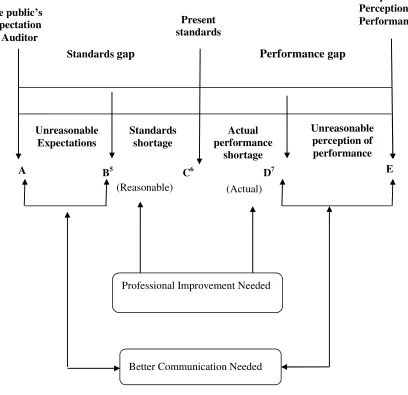
A few years later, the Canadian Institute of Chartered Accountants (CICA, 1988) and Porter (1993) described deficient performance, deficient standards and unreasonable expectations as components of the audit expectation gap. However, a recent empirical study conducted by Porter & Gowthorpe (2004) has exposed that these elements have changed over time depending on the interaction between the audit profession and the public,
16
Humphrey (1991) explains that the gap is a representation of the feeling that the auditors’ performance varies in accordance with the beliefs and wishes of the beneficiaries concerned with the audit, emphasising that this was very much in the context of developed countries.
Thus, for many years, there has been some concern about the company audit functioning resulting from numerous accounting and corporate scandals like the downfall of Enron, Arthur Andersen in the USA, WorldCom, and Parmalat in Italy, all of which have revealed the crumbliness of professional reputations, together with the fact that financial crises may diminish the reputation of and the public’s confidence in auditing. This, in turn, upsets profitability and the capability of auditing to offer the best service, and contributes to the continuance and the probable broadening of an “audit expectation gap”. Concerning this point, Aljaaidi (2009) illustrated that the audit expectation gap by itself is a concern whereby the auditors and the public have diverse perceptions regarding the auditors’ obligations and tasks and the texts they deliver by the audit reports.
The available literature on the audit expectation gap demonstrates that the gap is harmful to both the auditing profession and the groups that use the financial statements audit. Hence, if the auditors did not succeed in identifying society’s expectations, or in recognising the degree to which they meet (or more appropriately, fail to meet) those expectations, then they will be criticised and sued; moreover, in case the failure persists, society’s confidence in the audit profession will be undermined, and the audit functioning and profession will be rendered valueless (Porter & Gowthorpe, 1999). Thus, it becomes vital to explore the perceptions of the five stakeholders who are involved in the financial reporting in one of the emerging economies, specifically Libya.
17
performance and auditing standards. However, most recently an empirical study conducted by Humphrey (1997), classified issues about the AEG in four key areas: ensuring audit and audit reports, audit independence and audit regulation.
To solve the problem, due attention has been paid to the issue of the expectation gap by both the auditing professional societies and researchers all over the world. Several commissions have been established such as the following:
In 1974, the AICPA in the United States established the Cohen Commission to examine whether a there is a gap between what the public anticipate or need and what the auditors can and should rationally be anticipated to achieve. In 1978, the Commission accomplished the research, which in fact emphasized the presence of an expectation gap (Humphrey, Moizer, & Turley, 1992).
In October 1987, the USA National Commission on Fraudulent Financial Reporting (Treadway Commission) issued a report that it is considered a central duty for the auditors to sense and prevent fraudulent financial reporting, though the auditor’s role with respect to deception and other misbehaviour is inferior to that of management and the board of directors (AICPA, 1987).
In 1988, the Canadian Institute of Chartered Accountants (CICA) subsidised an extra study on what the public expect of auditing, “the MacDonald Report”. The Commission prepared a detailed model concerning the audit expectation gap which scrutinised the constituent components of the expectation gap as irrational expectations, inadequate standards and deficient performance. According to the study, the communication and the educational backgrounds of the users (Almer & Brody, 2002), the extension of the auditor’s tasks, together with the auditor’s own education and discipline, were the efficient correctional measures required to reduce the gap (Porter, Simon, & Hatherly, 2009).
18
the UK. This report suggested legislation for the expansion of constitutional protection t o all auditors who provide warning of suspicion of fraud to authorities in charge of investigation, in order to reduce the expectation gap (performance gap and reasonableness gap); different approaches were investigated and several suggestions were made by accounting authorities, auditing researchers and associated professional bodies.
The major approaches suggested by the earlier studies can be summarised as follows:
(1) Extending the audit report.
(2) Promoting the education, training and development of auditors and users.
(3) Pinpointing the responsibilities of the directors and auditors with respect to detecting fraud and defining the limits of the role of auditors and their expansion.
(4) Setting up an autonomous regulatory agency that takes into account the appointment, determination and practices of auditors of the listed companies.
In recent decades, numerous empirical studies have been conducted on the issue of the audit expectation gap, and the effectiveness of audit report communications in the developed economies including the USA (American Institute of Certified Public Accountants AICPA, 1978; Schelluch, 1996; Frank, Lowe, & Smith, 2001; Almer & Brody, 2002), the UK (Holt & Moizer, 1990; Hatherly, Innes, & Brown, 1991; Humphrey, 1991; Institute of Chartered Accountants in Ireland ICAI, 1992; Sikka, Puxty, Willmott, & Cooper, 1992; Innes, Brown, & Hatherly, 1997); Canada (Canadian Institute of Chartered Accountant CICA, 1978); Australia (Gay & Schelluch, 1993; Schelluch & Gay, 2006), and New Zealand (Porter & Gowthorpe, 2004).
19
Egypt (Dixon, Woodhead, & Sohliman, 2006), Lebanon (Sidani & Olayan, 2007), Iran (Salehi, 2011) and Nigeria (Adeyemi & Uadiale, 2011). These research studies have confirmed that there is a gap between what the user groups expect from an auditor or the auditing process and what the auditor realises as the objectives of auditing. This is perhaps because auditing is not viewed as an exact science whereby the aim is to produce 100% precise results concerning the extent of the accuracy of information including the financial data, as some believe (for more details on the previous studies, see Chapter Three). In actual fact, while the auditing process is carried out according to the auditing standards, in many cases, it relies on the subjective judgement of the auditor. The aim of the auditing process, however, is to produce reasonable statements about the extent of the reality and fairness of the financial data involved, but not the absolute truth; that is, the statements provided are reasonably true and fair rather than absolute (Humphrey, 1991).
1.2.2The Development of the Audit Report
The audit report was defined as the primary means of communication that is at the disposal of the auditor. It enables him/her to communicate the outcomes of the audit to groups outside the company management. In the audit report, the auditor can communicate his opinion; s/he can state the type of assurance to be given, and call attention to further information s/he feels significant concerning those documents or areas of organisational performance falling within the range of his/her audit. If the meaning expressed in the auditor’s report is not comprehensible, then the value of the audit could be uncertain (Higson, 2003).
20
objective of extending the audit report in the UK; it was to “set out in more details the work of auditors, as well as the auditors and directors’ responsibilities, and thus help to tackle the audit expectation gap”; nonetheless, in 2001, this report was revised.
On the other hand, the nature of the expectation gap and the efforts exerted to tackle the liability and credibility issues in one country may not be applicable to another country, since the auditing function is influenced by environmental factors whereby the audits function. Suggestions to bridge the gap without comprehending the interaction of factors in the business environment that impact the nature, objective, potentials and restraints of auditing are doomed to failure (Zaid, 1993; Sucher & Bychkova, 2001; Lin & Chen, 2004; Haniffa & Hudaib, 2007). Such suggestions are also unsuccessful in developing countries with diverse cultural values, such as Libya. Thus, the findings, prescriptions and different courses of treatment proposed for one society, may not be applicable or practical for another (Haniffa & Hudaib, 2007).
21
Developments in Libya in recent times have created a demand for audit as an open door policy following a prolonged period of sanctions (see Chapter Two, the Libyan background). The implementation of such a policy, the encouragement of the private sector to work in line with the public sector, and the establishment of the Libyan stock market have drawn foreign and domestic investors; thus, while the speed of economic growth and the demand for professional accounting services have increased, including providing auditors with more job opportunities, it has nonetheless encouraged auditors to carry out their tasks and responsibilities professionally.
This thesis sets out to examine the audit expectation gap in the context of Libya as one of the emergent economies, by adopting a mixed method approach. This study attempts to reduce the literature gap that exists on the audit expectation gap in emerging economies. It attempts to identify the extent, to which the audit expectation gap (the elements of the audit expectation gap) may exist between auditors and users of the financial statements in the Libyan context, to highlight possible causes, and to make suggestions and recommendations.
1.3Motivation for Undertaking the Research Topic
22
First, the significant increase in the number of private and joint venture corporations operating in Libya over recent years, partly due to the government’s policy which involves enhancing free-market capitalism and promoting foreign investment into the country. As a result, it is particularly important for foreign partners and shareholders to understand fully the audit profession and the meaning of the audit report that is presently in use in order to guarantee their sustained self-confidence in the national auditing profession and in the reports that are audited by its members to assist foreign business partners in the investment decisions they make. Therefore, much is expected of the auditor in giving credibility to the market economy.
Second, the conversion from a planned to a market economy in the Libyan situation, which started a decade ago, has produced certain changes in the Libyan milieu. For example, several reforms have been implemented: the country has witnessed a key economic and regulatory reform in incorporating the introduction and observance of International Accounting Standards (IASs) and International Standards on Auditing (ISAs) within both the banking sector and the Libyan stock market (Faraj & Akbar, 2010). It is expected that such a step could sustain confidence in auditing (Central Bank of Libya CBL, 2005). Moreover, such initiatives soon followed the enacting of a new foreign investment law whereby the audited financial statements play an important role in securing both local and foreign investors. The new Libyan stock market is also established to take other aspects into consideration.
23
laws rather than driven by the need to supply helpful information to the potential users (Bait-El-Mal, Smith, & Taylor, 1973; Kilani, 1988; Buzied, 1998; Khorwatt, 2006). Thus, the emergence of the Big Four suggest demand for auditing is more prevalent in Libya which means users of financial statement are going to increase in number and type.
Fourth, the rationale for the audit expectation gap that has been selected for this research is multiple. Such as, though several research studies have been conducted lately on the existence of the audit expectation gap and the effectiveness of audit report communication, no empirical study has explored the audit functions and the efficiency of audit report communication in the Libyan setting. Furthermore, most of the studies undertaken on the audit expectation gap have been carried out by applying the quantitative approach. This research study aims at bridging this gap by implementing the qualitative approach to support the quantitative approach and to cultivate confidence, thus enriching and corroborating one another (Creswell & Plano Clark, 2007). In addition, the qualitative approach will deepen understanding of the expectation gap in an emerging economy.
24 1.4Research Aims and Questions
The main aim of carrying out this research study is to explore and examine the development and current state of auditing in Libya, and the possible existence of an audit expectation gap, in economic transition conditions in one of the emergent economies, namely Libya. To achieve this aim, the following objectives were set for this research study.
1. To investigate the role and the purpose of auditing from the perspective of external auditors’ and financial statement preparers, together with the prospective users, comprising investors and lenders, by investigating the following aspects:
The auditor’s role with respect to audited financial statements and audit clients;
Recent and potential prohibitions and other regulations in the audit environment and
The groups to whom auditors should be responsible.
2. To investigate the perception of the external auditors and that of the stakeholders of the information communicated by the Libyan audit report.
The objectives of the study are to answer the following research questions:
RQ1- What are the external auditors, financial statement preparers, and user groups’ perceptions of the role and the nature of auditing in Libya, which contribute to the components of audit expectation gap?
This question covers a number of questions in the following order:
RQ1-1 What should be the auditor’s and the auditing process?
25
RQ1-3-What prohibitions and regulations should be placed on audit firms?
RQ1-4-Who are the third parties to whom auditors should be responsible?
RQ2-What are the differences in perceptions of the message(s) that is/are (or is/are not) communicated in the current unqualified audit report used in Libya between the external auditors, financial statement preparers, and users’ groups in Libya?
1.5Research Methodology and Method
As will be discussed in more detail in chapters four, this research lies within the functionalist and interpretive paradigms. Certain features are shared by both paradigms, but the interpretive paradigm is more appropriate for exploratory research. Money and Samouel (2003), observed that exploratory research is helpful in case the researcher’s experience or knowledge as related to the research issue is limited. The functionalist paradigm is associated with empirical or quantitative research (Creswell, 1998), as well as, most of the research conducted within the interpretive paradigm is termed as qualitative research.
26
private companies the Big Four accounting firms began to see a developing market in Libya and set up offices. Finally, international Accounting Standards were being adapted in the banking sector and Libyan stock market. Thus, similar to other emerging economics, the demand for audit was increasing. Therefore, the increasing demand presents the possibility of an expectations gap. Since there is no evidence of differences in perspective between auditors and users in Libya about the duties and responsibilities assumed by auditors and the messages conveyed by unqualified audit reports. As a result, this thesis seeks to reduce this gap in the literature.
The main purpose of this study is to explore and offer a more inclusive analysis of the perceptions of the relevant groups (the private auditors, the general auditing bureau, financial statement preparers, credit managers and private investors) on several pertinent auditing issues in the context of Libya. Patton (1990), recommended that studies which only adopt one method are more exposed to errors related to that particular method than studies which use multiple methods in which different types of data provide cross validity checks. Therefore, due to the nature of the required data and the research objectives, and to overcome the weaknesses of using either one of the methods alone and to obtain the most useful results, questionnaires, and semi-structured interviews are used in this study. Thus, this research advocates the use of diverse data collecting methods especially those that involve conducting questionnaire surveys and interviews. Whereas most studies in both developed economies (Hatherly, Innes, & Brown, 1992; Humphrey et al., 1992; Monroe & Woodliff, 1994; Gramling, Schatzberg, Wallace, & Walsh, 2000) and emerging economies (Schelluch, 1996; Saleh, 2002; Fadzly & Ahmad, 2004; Dixon et al., 2006; Haniffa & Hudaib, 2007; Adeyemi & Uadiale, 2011), have relied on the questionnaire method, that approach is supplemented here with interviews.
27
research aims, concerning the developed of audit and the audit expectation gap in new environment in Libya.
The most well-known method utilised by most of the previous studies, as mentioned earlier, was the questionnaire; it was primarily used for exploring the individuals’ views as related to the expectation gap issues (see chapter three). The questionnaire is planned to draw out the viewpoints of the diverse groups of stakeholders concerning the role and purpose of auditing generally and the efficiency of unqualified audit report communications in the Libyan context; the data are used to answer most the research questions, namely research question 2 and research question 3.
The questionnaire survey is regarded as an efficient method for examining the presence of the audit expectation gap, in order to inspect the individuals’ views (Hatherly & Skuse, 1991; Humphrey et al., 1993; Schelluch, 1996; Innes et al., 1997; Hussain, 2003). The questionnaire used the five-point Likert scale. The questionnaire was divided into three sections; the division is based on areas specified in the literature. The sections were as follows: the first section covers the common information about participants; the second one concerns itself with the respondents’ viewpoints as related to the role and purpose of auditing; it is divided into four parts: the first one emphasises the auditors and the auditing process in general, the second part examines audited financial statements and audited corporations in particular; the third is dedicated to prohibitions and regulations in the Libyan audit milieu, and the fourth includes the auditors’ legal tasks and responsibilities. The third section explored the attitude of the Libyan stakeholder towards the efficiency of the audit report as the main tool to communicate the results of audit work in Libya.
28
The second stage was the administration of a questionnaire survey to five groups. The groups were:
The Auditors Group: the external auditors (private and government) were surveyed to find out the belief of those who are in charge of validating the financial statements of Libyan private companies, including the Big Four auditors’ partners and correspondents.
The Preparers: are represented by the financial directors of a sample of Libyan private corporations both listed and non-listed in the stock market. The general managers are legally and theoretically in charge of preparing the Libyan companies’ annual reports. The reasons for choosing this sample are based on the fact that these corporations should conform to the tax law and the monetary directors; their nominees may have the practical accountability for the preparation of the company fiscal statements.
The Individual Investors (Shareholders): shareholders were chosen as one of the main groups that will benefit from the audited financial statements. A large part of the literature on the subject is related to individual investors presenting their views about different aspects of the auditors’ function regarding audit reporting.
Credit Managers: the current credit directors of the twelve Libyan commercial banks comprise another user group of the audited fiscal statements. The audited statements help them evaluate the capability of the borrowers to pay back their loans along with servicing their interest charges. Thus, they have to rely on auditors extensively to supply them with plausible and dependable data that will help them in their lending decisions.
The participants in the interview were split into five groups as mentioned earlier: private auditors1 (4 auditors), GAB members (3 members), financial statement prepares (3 people) and ‘other users’ consisting of private investors (2 investors) and lenders (3
1 In Libya, most practitioners practice the auditing profession through accounting and
29
managers). All the interviews were conducted in Libya by the researcher; it was decided to restrict the location of those being interviewed to Benghazi and Tripoli, the capital of the country, this location being relatively accessible to the researcher. Further, the biggest auditors’ offices that have long experience and audit the accounts of most companies and economic enterprises which including the Big Four auditors are located in Tripoli.
The interviewees were free to respond to the questions, and to choose the place and time of the interview. The interview questions were inspired by the literature review, discussed with the supervisors and reinforced by the questionnaire responses. Great care was exercised in preparing and conducting the interviews to reduce the impact of probable problems. To realise that objective, the interviews were normally arranged in advance. Before conducting the interviews, the following steps were taken: the interviewees were supplied with suitable information related to the research and to the general content of the interview; cautious thought and careful consideration were accorded to the opening section of the interview and the phrasing of the questions; permission was obtained in advance for recording of the interviews confidentially. During the study, the moral considerations mainly focused on safeguarding the confidentiality of the respondents which was secured via anonymity.
1.6Chapter Development
Chapter 1: Introduction to the Thesis: this chapter serves as an introduction to the thesis which offers an overview to the research, it also introduces the research aims and objectives and the research methodology. Chapter one also provides an overview of the remaining chapters and the chapter development.
30
nature of accounting education in Libya, examining the law of the Libyan Accountants and Auditors Association (LAAA) and focusing on the significant features of auditing. Furthermore, this chapter incorporates information on the Libyan stock market.
Chapter 3: Audit Expectations Gap Literature Review: this chapter establishes the literature on the auditing expectation gap. The first part of this chapter presents a discussion of the concept of the audit function; the second part discusses the theory of the auditing role; the third part includes the other studies that examined the existence of the auditing expectation gap in developed countries as compared to those applied in developing countries. The fourth part of this chapter present a discussion of the factors contributing to audit expectations gap. The fifth part of this chapter incorporates the development of the audit report, and evidence obtained from the empirical studies that are conducted in this field
Chapter 4: Research Methodology and Method: this chapter outlines the research methodology adopted in this study. It considers the various kinds of research methods. It concludes that the survey method (the mail-questionnaire technique) and the interview are the most appropriate methodology taking into consideration the Libyan auditing and auditing environment. The design and planning of the study, including the research administration, are introduced. The questionnaire structure, format, content, translation, and pilot study are among the aspects discussed. The semi-structured interviews are presented. The procedures whereby the data were gathered are also highlighted. Finally, the reliability and validity of the research findings are elucidated.
31
Chapter 6: Interview Analysis: this chapter analyses the data collected via the semi-structured interviews. The primary objective of the interview is to obtain more detailed information related to the present status of the Libyan accounting and auditing profession, the reasons that lie behind the presence of the audit expectation gap and the future perspective on auditing practices. These interviews help develop a more comprehensive representation of the accounting and auditing profession in the Libyan milieu.
Chapter 7: Discussion and Conclusion: the final chapter summarises the major results of this study and provides related discussion, provides the conclusions drawn, and considers possible explanations and the implications for interpretation of the audit expectation gap in Libya. It presents numerous recommendations and makes suggestions for future studies.
1.7Summary
32
Chapter 2: The Development of Auditing in the Libyan Context
2.1Introduction
In order to gain a comprehensive understanding of the accounting and audit development in Libya, this chapter aims to explore and examine the Libyan historical, political, economic, legal, and cultural background. To start with, it is essential to comprehend and examine the role of the external auditors and the communication of the audit report in Libya. In the beginning, a brief historical perspective will be introduced. It presents the political system. The major resources of the economic and business regulations and activities will then be identified. The social and cultural attributes will then be highlighted. A historical account of the auditing profession will then be provided: it comprises an introduction to the history of accounting in Libya, followed by an examination of the law that organises the auditing profession, touching upon the type and nature of accounting education in the Libyan universities.
2.2Historical, Political and Economic Background
33
(Vandewalle, 1998). At that time, there was no source of power or any mineral resources. The expansion in agriculture was strictly limited by the harsh climatic conditions. The capital configuration was zero or less, and there was no skilled labour available or native private enterprise (Kilani, 1988).
However, in spite of the steady economic development Libya enjoyed in the 1950s and early 1960s, this growth was not speedy enough to convert Libya from being a deprived and underdeveloped nation, highly dependent on foreign aid, to a well-off nation. The breakthrough for Libya was in 1959 when enormous quantities of petroleum deposits were discovered in the country by explorers from Esso (Mahmud, 1997). Concessions were awarded to many commercial project owners soon after the discovery of petrol. The discovery of oil in 1959 helped Libya change its investment atmosphere; it became a very encouraging one. It in fact has turned the extensive, less populated, poor nation into a rich one. Additionally, it furnished Libya with enormous opportunities for development, and helped it establish the main turning point in its modern history (Wright, 1981; Vandewalle, 1998).
A new epoch in the history of Libya started on September 1, 1969, when Al Gaddafi and his fellow army officers brought down the previous royal government and founded a republic known as the Libyan Arab Republic. The Libyan political and economic system has seen several dramatic changes. The most significant of these changes are:
34
The public sector then grew speedily after the revolution, because of the policies adopted by the government which aimed at restricting the private sector. The state controls everything: manufacturing, banks, insurance corporations, international trade and the majority of the national trade. Everything became nationalised; industrialisation and community service plans were presented.
The UN imposed a number of sanctions on Libya during 1992 and 1993. The objective was to force down Tripoli to deliver two suspects who were wanted for trial in a special court for matters related to the Lockerbie bombings. The sanctions were later suspended in 1999. The UN sanctions were completely lifted when the Libyan government reached a settlement with the families of the Lockerbie victims concerning compensations in mid-August 2003.
In September 1992, the State allowed the private sector to emerge freely by introducing more liberal standards. The general purpose of such measures was to put an end to the public spending, and finally to encourage the growth of the private sector Vandewalle, (1998, p. 84), and to reform the banking sector (Salama & Flanagan, 2005; Twati & Gammack, 2006; Ellabbar, 2007). The reforms included the establishment of a new stock market (General People Committee GPC, 2006, Decree 134) and encouraging foreign investment (General People's Congress GPCO, 1997, Law Nr. 5, amended by Law Nr. 7, 2003). It also included a new banking regulatory requirement (Central Bank of Libya CBL, 2005), which requires the Central Bank of Libya to comply with the International Accounting Standards and the International Standards on Auditing. These issues will be discussed in following sections.
35
This two-way opening will reduce the barriers to entry and departure for international companies and facilitate business.
2.3Aspects of Libyan Culture
The behaviour and attitude towards accounting and auditing practices like all other human activities, are affected by culture (Douglas, 1989; Wildavsky, 1989; Haniffa & Cooke, 2002). As a result, substantial attention has been paid in the accounting literature to the impact of culture on both accounting and auditing policy and its practices (Hamid, Craig, & Clarke, 1993). A number of researchers such as Adler, (1983); Adler, Doktor, & Redding, (1986); Jaeger, (1986); Hofstede & Bond,(1988); Hofstede, (1990,1991) Hofstede (1991); Belkaoui, (1991); Doupnik & Salter (1995); Belkaoui,(2000); Cravens & Oliver, (2000); Jaggi & Low, (2000); Archambault & Archambault, (2003), have demonstrated that culture is a major factor that affects the structure of business, society and accounting.
Libya is one of a number of Arabic countries included in Hofstede’s (1997) cultural study, along with Egypt, Iraq, Kuwait, Lebanon, Saudi Arabia, and the United Arab Emirates. Though Arab countries share many characteristics in common, they differ in many aspects. Hofstede (1980) says Libya has been described as highly masculine and showing uncertainty-avoidance with a large power distance and collectivistic society. Libya is characterised by the extended family, tribe and village which might be a result of the influence of the religion of Islam. Thus, the external auditors are more likely to be influenced by many members within the society.
36
values such as the reputation of their names, families and tribes. Hence, social reputation is a very important element for societal relationships in Libyan society. Therefore, the strict adherence to the traditions of the Islamic religion by the external auditor in Libya would strengthen deontological norms and codes of audit professional ethics in Libya.
Islam is the main religion of Libyan society which comprises extended family and tribes, where national, culture, values and norms have their influence in all aspects of everyday life, which may also influence the accounting and auditing service. Lewis (2001) maintains that if culture influences the accounting practices, then religion also should have the greatest impact . Similarly, El-Fathaly (1977, p. 12) states that:
“The strong role of religion in a traditional Islamic society like that of Libya has
produced a society with special features. Conservative attitudes have been
predominant in every respect. People’s values and behaviour have been a
function of their religious background and attachment: hence, evaluation and
acceptance of innovation and change have been subject to religious beliefs and
notion”.
Pargeter (2006), highlighted that socio-cultural structure in Libya is integrated into the political system such as popular leaders, which is an informal association, which consists of senior leaders of all the Libyan tribes. These values affect the quality and quantity of information disclosed in the audit process (Haniffa & Hudaib, 2007). Therefore, Libya is still suffering real limitations to a development model based on its current administrative system that aims to impose the rule of law in the country.
2.4The Libyan Privatisation Programmes
37
and Act No. 107 in 2005. These Acts aimed to permit the private ownership of economic activities, fostering and controlling the private sector activities in all aspects of the economy (that is agriculture, tourism, industry, commerce, transport and finance) together with an open door policy for the sake of the privatisation of several public-sector companies (Alsharif, 2002).
The Libyan Foreign Investment Board (LFIB) was formed in accordance with Act 5 in 1997, to attract and encourage foreign investment into Libya within the already designed socialist framework of economic and social growth. This act and the amendments that followed in 2003 had the objective of promoting foreign investment through a joint venture between Libyan and foreign capital suppliers in diverse sectors such as industry, agriculture, health and tourism. The law embraced in this act aims at enabling the transfer of modern technologies to Libya along with technical progress in human resources, the expansion of sources of income, and the encouragement of national products to be able to penetrate international markets. Consequently, some foreign companies had resumed their operations in Libya in the 1990s and early 2000s. In its attempt to solicit foreign investment, the government has already adopted some steps to lower these barriers. In its attempt to free the economy Libya started to execute its privatisation plan. To realise that, a General Board of Ownership of Public Companies and Economical units was founded by Act No. 198 in 2000. This organisation shouldered the responsibility for managing the transfer of public sector possessions and the ownership of economic facilities to the private sector. It was expected that the a General Board of Ownership of Public Companies and Economical units would achieve the privatisation of 361 State-owned enterprises by the end of 2008 according to a three-stage plan starting on 1/1/2004, but by the end 2006, only 69 state owned firms were privatised2. The government took another decision (Act No. 313 for the year 2003) exempting these privatised institutions from
2
38
income and export taxes for five years, the encouragement of foreign investment and the orientation of globalisation.
The aim of a private company is to make profit; therefore the Libyan government at this stage took several steps to reform the financial sectors. The auditors in this time were to play a vital role in the achievement of company objectives (to make profits). Therefore, an urgent need for professional accounting and auditing emerged to control the rights of shareholders. In reality, the latest economic growth has brought about a growing demand for qualified accountants, auditors and dependable accounting and auditing information. However, there were only 1369 qualified and/or partially- qualified auditors in Libya in 2002. The population of Libya is over 5.5 million; evidently, there is a sharp scarcity of qualified auditors, in this regard Shareia (2010, p. 21), stated that
“This change has the potential to affect the practice of accounting, and the
accounting profession, as a greater emphasis is placed on private activity for
profit making, which will necessitate the development of different kinds of
accounting information systems. Accounting practice in Libya is thus controlled
by various laws which specify in great detail the requirements set out by the
Government to achieve its goals, and by the oversight of the accounting
professional bodies, also strongly influenced by the State. When these are added
to Libya’s particular political and social dynamics, the effect on the accounting
profession is that of constraint, i.e. a limitation on the perceived role of
accounting, and consequently on the appreciation of the need for a well-qualified,
39
2.5The Legal and Regulatory Framework of Financial Reporting and Auditing in
Libya
2.5.1The Development of Financial Reporting and Auditing in Libya Context
Libyan financial accounting history is short. The first the profession oversees accounting and auditing in Libya can be traced back to the era of Libyan liberation from the Italian occupation in 1952. That body was referred to as the State Accounting Bureau (SAB). The SAB was established according to Act No. 31 of 1955; it belonged to the Ministry of Treasury. The act was modified to assure the dependence of the SAB; it became directly responsible to the Ministries’ Council of Libya under the Audit Bureau Law of 1966. As a result of Al-Fath of September Revolution, the structure of the government has changed; it now consists of two branches: an executive branch and a legislative branch.
Article No. 1 of the SAB Law 79 of 1975 states that the SAB is an autonomous agency associated with the RCC, and that its purpose is to apply efficient supervision over public funds. Since the Revolutionary Command Council (RCC) transferred its authority to the General People’s Congress (GPC) in 1977, the SAB has directly become in charge of this latest legislative body. In the early 1970’s, the public accountants in Libya enjoyed a golden age owing to the vast expansion of business corporations and new government projects; hence, the economy developed. Kilani (1988), observes that all those factors constantly reinforced the need for the accounting services which subsequently increased the number of working accounting firm. The approval of Act No.116 of 1973 which recognized the accounting profession has also made this growth easy, and caused public accountants to be more accurate and broad in their scrutiny when they deal with bigger government owned corporations.
40
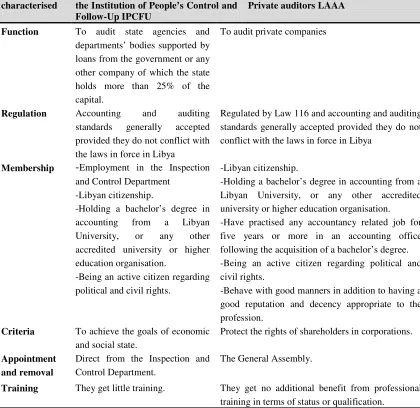
as the Institution of People’s Control and Follow-Up (IPCFU) in 1996 by the General People’s Congress. The major goals of the IPCFU were to supply the auditing services and the administration with the supervision required for all the state agencies and departments’ bodies supported by loans from the government or any other company of which the state holds more than 25% of the capital. The aims of the auditing services were to guarantee that these state agencies and the bodies they belong to operate in accordance with the financial regulations and guidelines established by their pertinent ministries; they thus meet social and economic objectives. The IPCFU’s responsibilities were expanded to incorporate the auditing services of foreign corporations and joint ventures operating in Libya, with the aim of ensuring that they function in accordance with Libyan laws and regulations.
41
Table 2:1 The characteristics of LAAA and IPCFU
characterised the Institution of People’s Control and Follow-Up IPCFU
Private auditors LAAA
Function To audit state agencies and departments’ bodies supported by loans from the government or any other company of which the state holds more than 25% of the capital.
To audit private companies
Regulation Accounting and auditing
standards generally accepted provided they do not conflict with the laws in force in Libya
Regulated by Law 116 and accounting and auditing standards generally accepted provided they do not conflict with the laws in force in Libya
Membership -Employment in the Inspection and Control Department
-Libyan citizenship.
-Holding a bachelor’s degree in accounting from a Libyan University, or any other accredited university or higher education organisation.
-Being an active citizen regarding political and civil rights.
-Libyan citizenship.
-Holding a bachelor’s degree in accounting from a Libyan University, or any other accredited university or higher education organisation. -Have practised any accountancy related job for five years or more in an accounting office following the acquisition of a bachelor’s degree. -Being an active citizen regarding political and civil rights.
-Behave with good manners in addition to having a good reputation and decency appropriate to the profession.
Criteria To achieve the goals of economic and social state.
Protect the rights of shareholders in corporations.
Appointment and removal
Direct from the Inspection and Control Department.
The General Assembly.
Training They get little training. They get no additional benefit from professional training in terms of status or qualification.
2.5.2The Influence of the Libyan Commercial Code (LCC)
42
rules on business enterprise records together with certain aspects of financial reporting and auditing.
The LCC specifies the requirements for the accounting and auditing practices, and the systems and the reporting methods applied by Libyan corporations (Buzied, 1998). For instance, the LCC demands that the corporations prepare a balance sheet and profit and loss account at least once a year. The preparation of the accounts is assigned to the companies’ managers who are also asked to prepare a report concerning the company’s performance. The Commercial Act also emphasised the need for appointing auditors (Article 550), (Libya State, 1970) who control the company’s administration and guarantee sound progress of the company’s activities in compliance with the law. Article 553 of the Commercial Act provides details of the duties concerning the auditing board (Article 553) (Libya State, 1970). The law requires that the auditor hands in a report to the General Assembly covering the results of the financial year’s activities, expressing his view concerning the progress of the company’s work, along with confirming the genuineness of the budget and the accounts (Article 580) (Libya State, 1970). The law neither states what this report should embrace, nor does it tackle the formality that should be encompassed in this report. On the other hand, Libyan companies are not asked by the LCC to supply to the public the information contained in the yearly reports.
2.5.3The Influence of Income Tax Law