University of Huddersfield Repository
Evans, C. K.
Developing the perfect fashion archive
Original Citation
Evans, C. K. (2011) Developing the perfect fashion archive. In: Fashion Forward. InterDisciplinary
Press, Witney. ISBN 9781848880016
This version is available at http://eprints.hud.ac.uk/id/eprint/8346/
The University Repository is a digital collection of the research output of the
University, available on Open Access. Copyright and Moral Rights for the items
on this site are retained by the individual author and/or other copyright owners.
Users may access full items free of charge; copies of full text items generally
can be reproduced, displayed or performed and given to third parties in any
format or medium for personal research or study, educational or notforprofit
purposes without prior permission or charge, provided:
•
The authors, title and full bibliographic details is credited in any copy;
•
A hyperlink and/or URL is included for the original metadata page; and
•
The content is not changed in any way.
For more information, including our policy and submission procedure, please
contact the Repository Team at: [email protected].
Claire Evans
Abstract
It is common practice for designers to draw inspiration from fashion garment archives. Many established companies and fashion houses hold their own private archives, going back to their company’s beginnings. These collections provide invaluable resources that are essential to fashion designers who constantly draw inspiration from them when developing new ranges, they use them to re-examine, reconstruct and re-evaluate the design process, as can be see by the following quote:
Christopher Bailey- always up for a rummage in the archives- has obviously had some great fun. Never too obvious- there’s no reissues here- he instead infuses heritage into modern pieces1
The ability of students to understand the use of archives as primary research material when designing is essential. Archives become key learning resources that provided an understanding of the use of physical garments to create and inspire the design process. Current fashion archives tend to be large; however there is a need for small teaching archives to be established on a more manageable scale. Archives are held with specific aims in mind with their planning and development being essential.
This article discusses what would constitute the perfect fashion archive for a fashion department. Researching the creation of a specialist fashion reference collection that functions as a teaching aid within a department with limited space and finances.
Key Words: Fashion archives, fashion reference collections, teaching aids, garments.
*****
1. Established fashion archives
Developing the perfect fashion archive
_________________________________________________ 2
For fashion companies to establish and dust off otherwise neglected fashion archives is also a vogue that seems to be suddenly re emerging. Phillip Sykas from Manchester Metropolitan University comments:
In this new design and art environment design archives are growing in importance, not just as a source of untapped imagery, but as a memory of technique 3
Fashion archives can comprise of records of a number of varied fashion products ranging from garments to company marketing material. Currently the UK houses a number of extensive fashion archives with permanent public exhibitions. The Victoria and Albert Museum’s Fashion, Jewellery and Accessories collection of ‘fashionable dress from the 17th century to the present day’ being one of the most extensive.4
The often hidden resources of archives held at established fashion design companies/houses and by private collectors are less well recognised. Manuela Morin creative director of Tanner Krolle (bespoke British made luggage supplier formerly to the royal family) explains:
The history is such an attractive element, both in terms of the product’s look and the story behind it. The extensive archives have been inspirational for my designs, and this integrity is what will put Tanner Krolle back on the fashion map 5
These fashion archives are made up of physical collections of garments and samples from company back catalogues and bought in pieces. They provide invaluable primary resources materials from which design inspiration and trends can be gleaned. Elisa Palomino (former head of studio at John Galliano) when asked what her collection of John Galliano and vintage had taught her responded ‘My Galliano wardrobe has helped me create my own universe, playing with colour, mixing prints, textures and vintage. There is no limit!’6
Designers find themselves working from these pieces and often with the pieces to develop garments and ranges, bring the pieces into the studio environment to be examined, sometimes dismantled, sampled and reworked:
________________________________________________
puts them back together again giving rise to highly appealing creations with rich detailing 7
Using fashion archives within design teaching provides a stimulating creative facility that is both hands on and easily accessible. Yet few education establishments are officially supported by such fashion archives and of those that are they usually comprise of extensive reference collections. For example the Museum at FIT (Fashion Institute of Technology) in New York whilst operating as a museum of clothing, accessories and textiles also runs alongside (literally in the same building) FIT’s established fashion courses as a ‘think-tank’ for fashion studies.8 The Yorkshire National Fashion Archive (YNFA) at University of Leeds focuses on the ‘historical and cultural record of Yorkshire life in the 20th century through the prism of fashion’ says David Backhouse, deputy chair of the archive’s executive committee9. The extensive archive is currently used to support the teaching of students and research and is currently looking for a permanent home.
Similarly, other education establishments holding design archives are mainly again on a large scale. Examples include Central St Martins, Museum and Study collection, which holds teaching examples from the original Theatre Costume course; Heriott-Watt University Archive, with its focus on Scottish textile heritage and University of Leeds International Textile Archive (ULITA), which houses a collection of textiles and related design material.
Reference collections and archives are often extensive and specialist with some finding themselves struggling against space and budgets. Many also require special handling which restricts their use in a teaching environment where handing, putting on mannequins, photographing and sometimes even dismantling is to be encouraged.
2. Creating a working fashion archive in a fashion department
Establishing such a learning resource archive within a fashion department does not however have to be costly and with careful selection a small key reference range can be formed that will become invaluable. The challenge of curator/ tutor is to initially identify the overriding nature of the collection and its function.
A. Creating our specialist fashion archive
Developing the perfect fashion archive
_________________________________________________ 4
B. Collection size, storage and preservation
As with most departments our space is limited and, when researching the creation of an archive, the space that it would take up was a major issue. In order for the collection to be manageable, it was decided that its size needed to be controlled and restricted so that it remained static once it reached a certain scale rather than growing and becoming unmanageable. As staff started to take pieces into the studios, the maximum number of garments it soon became apparent. Twelve seemed to work with our class sizes, space (or lack of it) and need, so became the natural maximum for us.
It was decided to store the garments in boxes. Firstly consideration was given to storing the garments on hangers, however it was then realised that this was going to be difficult from both a storage and preservation point of view. It was also established that boxes were less cumbersome and could be moved around with relative ease, extra additional related items could be added and they could be labelled clearly. Archive boxes were sourced at A2 size and 10cm depth, a generous size for holding most pieces. Acid free tissue paper and handling gloves are also used to help preserve the more delicate items.
Figure 1 Garments being accessed by students.
C. Access
________________________________________________
D. Selecting the garments
Thanks to the donations from personal staff archives, we were soon able to bring together around four suitable pieces. This process of donations could have continued; however, it was felt that some truly contemporary and historical pieces needed to be brought in to stop the collection becoming staid. In order to add this contemporary/historical feel to the collection, a university capital funding bid of £1500 was successfully awarded.
Staff from across the department were then asked to complete a survey to establish what other garments they would like to see in the collection to support their teaching. The results showed that the collection needed to encapsulate the new, the old, specific techniques, fabrics, menswear, womenswear, and the list goes on. With this in mind a collection of garments started to come together. After further discussion it was decided that garments from high end markets, couture and ready to wear were more essential that garments from low end markets. This was due to the availability and relative ease with which students could access lower budget garments.
The staff needs within modules were then explored. For example a tailored womenswear garment incorporating hand finishing was needed for demonstrating techniques on one of our manufacture modules. Bias cutting techniques were needed to demonstrate on our module developing moulaging techniques. Promotion staff requested garments that came from established labels so students could ‘share their knowledge on the designers, the garment, fabrics and construction techniques, target customer and a date of when the garment was made’. See figure 2.
Figure 2 Garments being recorded and investigated in the studios
E. Buying the pieces
Developing the perfect fashion archive
_________________________________________________ 6
maybe slightly out of date. This also helped with our budget, as we could source bargains during the end of season sales. Any additional information that came with these garments was also kept in the boxes, their swing tags, packaging etc; anything that we felt added an additional link to the original garment.
To source the historical pieces, antique clothing fairs were attended. These brought up some real gems at very reasonable prices. These garments were often in poor repair, -having been handed down, altered and repaired over their life time, -yet this is the nature of these garments and is wonderful from an historical perspective. Specialist second hand clothing stores were also visited to source design classics and garments with specific manufacturing finishes, textures and prints that fitted between contemporary and historical.
Consideration was also give to sizing and it was resolved that any size between UK 8-14 could be considered; it was the pieces that were more important than the size.
F. The fashion archive online
The music television/video games revolution is cultivating a generation of new learners and consumers who demand a more graphical, integrated, and interactive multi media presentation of information. 10
In order to be used successfully by students the fashion archive had to be distanced from the often perceived feeling of a stuffy specialist collection. It had to provide students with all the facilities to appreciate fully its value and relevance as a working fashion archive, which could support their studies. It also required a platform for the dissemination and integration of additional information and to be accessible to the widest possible audience.
Fashion garments bring with them a whole host of additional material, which goes way beyond the garments. The contemporary pieces have been instigated through an entire chain of events; they are part of a collection that was presented at a fashion show, photographed, reported and advertised in the press. The older pieces hold an historical and cultural significance that can be tracked and recorded.
________________________________________________
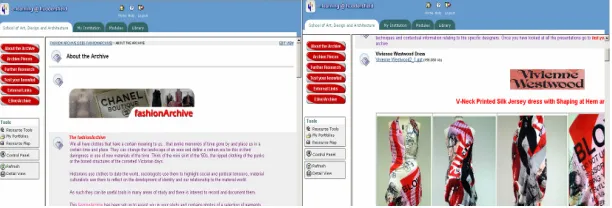
[image:8.595.146.452.274.378.2]been set with students investigating and recording the garments and the findings have been posted online. A Blog was established where contributors are asked to record and talk about pieces they own; that they feel maybe of interest. A quiz testing students’ knowledge was introduced. The online archive has added an extra dimension to the fashion archive and has resulted in a large amount of documentation been continuously put together with relative ease. It has allowed the fashion archive to develop it’s own community of practice supporting the learning and sharing of information.
Figure 3 The online archive
G. The future
The fashion archive has been available for over two years now. It has been successfully integrated into teaching with staff constantly thinking of new and innovative ways of using it.
The area that now needs addressing is change. In order to abide by the original aims, the archive will not grow in size; it will stick to twelve pieces, but needs variation. Some of the older pieces are looking tired and a contemporary piece or two require up dating. Replacing selected pieces on a perennial basis appears to be the ideal solution, adding flavour and variation whilst allowing the archive to remain manageable. This will have cost implication, but these will be minimal and due to the resource now been recognised and established finding funding should be easier. Pieces are still been offered to us regularly by staff and this is also an additional option to consider. There is no reason why, however, the online resource cannot grow, with the information on garments that we replaced still remaining accessible. This would also help to establish further the online resource as a key research platform for students whilst giving it greater diversity.
Developing the perfect fashion archive
_________________________________________________ 8
also make them just as accessible’; ‘Student work from the university would be interesting’. Many students however, felt ‘it is the variety that is important’.
The fashion archive has been a highly successful creation. This has been a simple and relatively straightforward facility to establish. It has become invaluable in teaching and learning and due to its size and accessibility has integrated effectively into the studio situation. Students appreciate having the pieces readily available as reference and staff value the additional in-house resource. Work still needs to be done to encapsulate a fully divers collection of pieces, all of which are in equal demand. Some pieces seem to be accessed less extensively than others and could be replaced. The main recommendation when forming an archive for in-house teaching purposes is ensure you work with your space and budget. Remain mindful of your need and keep the archive focused.
Notes
1
L Cochrane, ‘Burberry icons: inheritance chic’, i-D (UK), Sep 2006, London, vol. 269, p.80.
2
J Hill, ‘Shelved’, Selvedge, London, 2007, vol:16, p.30.
3
ibid, p.32. 4
V& A, Fashion, Jewellery and Accessories, V&A Online, No update, Viewed on: 21st May 2009.
<http://www.vam.ac.uk/collections/fashion/index.html>.
5
T Krolle, ‘Bags of potential’, Drapers, London,Jun 2007, p.20. 6
J Anderson and F Burns, ‘Me, myself and mine’, i-D (UK),London, April 2006, vol.265, p.200.
7
A Capozzi, 2006 ‘Reconstruction: past and present’ Collezioni Donna
Autumn/Winter 2006-2007, vol. 114, p.332. 8
FIT, About the museum, FITNYC, No update, Viewed on :8th Feb 2009 <http://www.fitnyc.edu/aspx/Content.aspx?menu=PresentGlobal:Museum:A boutTheMuseum>
9
University of Leeds, ‘Yorkshire’s story of coal ,cloth and fashion’, Reporter
Vol.539,8th Feb 09,Updated: 08/02/09, Accessed: 16th Feb 09, http://reporter.leeds.ac.uk/539/s5.htm
10
________________________________________________
Bibliography
Andreson, J., Burns, F., ‘Me, myself and mine’. i-D (UK) vol..265, April 2006, pp.194-201.
Capozzi, A., 2006 ‘Reconstruction: past and present’. Collezioni Donnavol. 114, Autumn/Winter 2006-2007, pp.332-335.
Cochrane,L., ‘Burberry icons: inheritance chic’. i-D (UK) vol. 269, Sep 2006, p.80.
FIT, ‘About the museum’, FITNYC, No update, viewed on :8th Feb 2009 <http://www.fitnyc.edu/aspx/Content.aspx?menu=PresentGlobal:Museum:A boutTheMuseum>.
Hill, J., ‘Shelved’. Selvedge vol:16 2007, pp.30-35. Krolle, T., ‘Bags of potential’. DrapersJun 2007 pp.19-20.
Lee, Sul.H., Collection development in a digital environment. Haworth Information Press New York, 1999, p.4.
University of Leeds, ‘Yorkshire’s story of coal, cloth and fashion’, Reporter
Vol.539,8th Feb 09,updated: 08/02/09, viewed on: 16th Feb 09, <http://reporter.leeds.ac.uk/539/s5.htm>.