University of Huddersfield Repository
Culpeper, Jonathan and Demmen, Jane
The development of playtexts: From manuscript to print
Original Citation
Culpeper, Jonathan and Demmen, Jane (2011) The development of playtexts: From manuscript to print. In: Communicating Early English Manuscripts. Studies in English Language . Cambridge University Press, Cambridge, UK, pp. 162177. ISBN 9780521193290
This version is available at http://eprints.hud.ac.uk/id/eprint/21537/
The University Repository is a digital collection of the research output of the University, available on Open Access. Copyright and Moral Rights for the items on this site are retained by the individual author and/or other copyright owners. Users may access full items free of charge; copies of full text items generally can be reproduced, displayed or performed and given to third parties in any format or medium for personal research or study, educational or notforprofit purposes without prior permission or charge, provided:
• The authors, title and full bibliographic details is credited in any copy;
• A hyperlink and/or URL is included for the original metadata page; and
• The content is not changed in any way.
For more information, including our policy and submission procedure, please contact the Repository Team at: [email protected].
The development of play-texts:
From manuscript to print
Jonathan Culpeper and Jane Demmen, Lancaster University
1. Introduction
It is an axiom of historical linguistics, and indeed historical studies generally, that our present-day assumptions are not a reliable basis for the analysis and
interpretation of language data from earlier periods. Assumptions, not just about language but any kind of human experience, help people make sense of the world in a cognitively efficient way. But those very assumptions interact with the phenomena to which they pertain, and together they change over time. Present-day assumptions form the endpoint of diachronic change. The first task for the historian is to describe earlier states of the language and its contexts, including the likely assumptions of contemporaries, and begin to understand why it is as it is. The second task is to explain the processes of change which have led to the current situation today. This paper aims to show how present-day assumptions about early modern play-texts are inappropriate or misleading. It explores how the dialogue of earlier plays was shaped by particular manuscript practices, and compares this with the dialogue of present-day plays that are shaped by the context of printing.
The present-day reader is likely to take some of the conventions of play-texts for granted, including that the play exists from the outset as an entire visible entity, available to all readers. Indeed, plays are now generally written as a whole, rapidly reproduced for people to read as a whole and published as a whole. For example, Henrik Ibsen's play Ghosts was published in 1881 before it had been performed, and this was the case for the remaining plays he produced (Holland 2006:1). Ibsen looked forward to the profits from publication, as he was writing in a period in which the reading public had rapidly expanded and was to expand further (something which in the UK was assisted by the Education Act of 1870, making school compulsory). With regard to historical plays, although there is sometimes an acknowledgement of different manuscript variants and imprints, in present-day works they are also generally discussed as a whole and edited as a whole. However, historically, from the earliest plays through to fairly late in the early modern period, the play-text had a very different existence. It was written in manuscript form for performance, and only printed later, if at all. Moreover, and crucially for the actors who performed it, it did not exist as one complete text. It is more accurate to think of an early play as a bundle of fragments rather than a unitary whole. Only in performance did those fragments unite as a whole. In this paper, we argue that such differences in textual history had a number of
implications for how the play was written − implications that linguists, historians and critics have generally ignored. In particular, we explore implications for turn construction, especially turn length, and the cohesiveness of the dialogue
This paper focuses on five plays written and performed in the time of Shakespeare. For obvious reasons, character-part manuscripts have not generally survived from this period, though ‘foul papers’ are thought to be reconstructions from them and the memories of actors. However, there is no evidence to suggest that manuscript plays written for performance, like the five plays we analyse, were then radically revised before they were subsequently printed, to remove traces of the fact that they were originally written in manuscript form, physically fragmented and then united in performance. In section 2, we will review the early play manuscript practices, the outcome of this review being a set of hypotheses about how those practices are likely to have shaped the language of the play. In the sections 3 to 5, deploying both quantitative and qualitative analyses, we will test some of those hypotheses with respect to specific linguistic features.
2. Plays: Manuscripts and performance
As Stern (2004) argues, the early modern play is a patchwork in a number of ways. For one, it was quite normal for a writer to gather disparate bits of material from various sources, especially the commonplace book, and weave them
together. For another, it is never a unitary whole in the same way as, for example, a poem. Plays were not only formed as patchworks but were written to be so. The audience would in part be listening to plays for turns of phrase or passages that could be recycled in other contexts -- in commonplace books, other literary texts or even just in everyday discourse. Stern (2004:156) writes that plays
were to a certain extent written to be resolved into commonplace books. For a play that was not published, indeed, quotation was the way it would be promulgated amongst the audience − and thus the mark of its success.
Moreover, Stern (2004:156) points out that the
printed layout of surviving text raises the suggestion that some plays were transcribed, kept, learned, revised, and even written, not as wholes, but as a collection of separate units to be patched together in performance.
Stern (2004) observes that songs, and some letters, were often printed in a different typeface, and were kept separately from the rest of the play. The same goes for prologues and epilogues. Did the play ever exist as a whole? The answer to this is yes, most likely as
a loosely tied bundle of papers, consisting of the book of dialogue (or several if the play were submitted piecemeal [...]), some separate sheets containing songs and letters, other separate papers containing prologues and epilogues (unless kept elsewhere as no longer relevant), and finally, perhaps, a separate bill/title page providing the lure that attracted the audience. (Stern 2004:166)
only required that "players" and their "playmakers" "present and recite" their plays to the Master (from the commission cited in Gurr 1992: 73). However, even as early as the 1580s, when the job was less textual in nature, Stern (2000:52) points out that it is unrealistic to suppose that the Master of the Revels had the time to listen to private performances of all plays being produced in London. Instead, manuscripts were brought in for inspection, and this accords with the contemporary accounts of how the Master of the Revels "perused, & neccessarely corrected and amended" plays (Feuillerat 1908: T III 71, a collection of
documents relating the revels, cited in Stern 2000: 52).
If early modern plays were written for performance, what matters, then, is how the text equipped the actors for performance. Once the playwright had completed the manuscript, it was in fact read to the actors, during which casting would take place (Stern 2000: 60-61). Thereafter, actors would receive their individual parts. Having said that, actors could be given parts to learn even before the play was finished, i.e. before it could be read out as a whole (Stern 2000: 62). What actors never received was the whole text, partly because it was expensive to produce multiple manuscript copies and partly because with more full copies in circulation there was an increased risk of the play being stolen by a rival
company or printer (Palfrey and Stern 2007: 1). Thomson (1997: 322) summarises what happened to the Elizabethan play manuscript:
In the best-conducted companies, the scribe (or scribes) had made not one but at least two fair copies of the manuscript. The first would become the property of the company, serving as what we would now call a promptbook: the second, to save further
transcription, could then be cut up into individual “parts” and the scraps of speeches pasted onto a scroll, with short cues added. […] Only when the parts had been assembled on their individual scrolls could the play conveniently be given its first reading by the company.
The actor's "part", then, had the more literal meaning of part of the play-script, and not simply the character in the play, as is more often the case today; also, the word "role" may derive from the "roll" of paper containing the actor’s part.
Thomson does not elaborate on what the “short cues” consisted of, but fortunately Stern, especially in collaboration with Simon Palfrey, has studied this in detail (see Palfrey and Stern 2007).
The cue was a prompt for a speech in an actor's part. It consisted of 1 to 3 words preceding each speech (Palfrey and Stern 2007: 95). However, there was no explicit indication of:
• the speaker of the cue,
• the length of gap between one speech and another (i.e. how long one might have to wait before one heard one's cue), or
• having been cued, to whom one should direct one's speech and in what capacity (Stern 2000: 61; Stern 2004:166).
dashed lines precede the 1-3 word cues which were provided for the speeches that comprise Orlando's part.
(1) −−−−−−−−−−−−−−−−−−−−−−−−−−−−−− Angelica ah. my dear Angelica
syrha fetch me the harping starr from heauen Lyra the pleasant mystrell of see s[h]phears that J may daunce a gayliard wth Angelica r<u> me to Pan, bidd all his waternimphes come wth ther baggpypes, and ther tamberins.
−−−−−−−−−−−−−−−−−−−−−−−−−−−− for a woeman howe fares my sweet Angelica?
−−−−−−−−−−−−−−−−−−−−−−−−−−− for hir honesty Art thou not fayre Angelica
s
<w>hos<e>browes a[re] faire as faire Jlythia that darks Canopus wth her siluer hewe.
−−−−−−−−−−−−−−−−−−−−−−−−−−−− art Angelica Why are not these, those ruddy coulered cheekes wher both the lillye, and the blusshing rose syttes equal suted, wth a natyue redd
(cited in Stern 2004:167)
From the first cue in the part version of Orlando’s dialogue in example 1, we can gather that Orlando is talking to an unknown interlocutor who mentions or introduces a second interlocutor, Angelica, to whom Orlando subsequently addresses himself. It is not clear from the second and third cues whether these lines are spoken by Angelica or the first interlocutor. The fourth cue suggests it is the other interlocutor speaking, unless Angelica is talking about herself in the third person. Also, in the part version, it is not clear whether or not Orlando’s question “Art thou not fayre Angelica” seeks to confirm her identity or her opinion of her own beauty. We compared this to the corresponding extract from the earliest printed version of the whole play on Early English Books Online1, dated 1594, shown below in example 2.
(2) Org: Excellent: come see where my Lord is. My Lord,here is Angelica.
Orl: Mas thou saist true,tis she indeed; How fares the faire Angelica?
Cl: Well, I thanke you hartely.
Orl: Why art thou not that same Angelica, Whose hiew as bright as faire Erythea That darkes Canopus with her siluer hiew? Cl: Yes forsooth.
Orl: Are not these the beauteous cheeks, Wherein the Lillies and the natiue Rose Sits equall suted with a blushing red?
interlocutors. Although the cues in the part version suggest that Orlando is talking to Angelica, we can see from the full version that in fact a Clown is pretending to be Angelica. Furthermore, Orgalio contributes to the deception by identifying the Clown as Angelica to Orlando in the first turn. It is hard to see how the actor playing Orlando would have known that he is talking to the Clown in disguise and not to the real Angelica at this point in the play from the part version alone. It may well become apparent later on in the part version, the full text of which we have not seen, and it would not of course have stopped the actor from learning his own character’s lines. However, limited access to the other characters’ speech must clearly have severely limited the actor’s ability to prepare fully for the role in advance of the play coming together as a whole.
Given the pressures, not least of all financial, of producing a huge repertoire of plays, group preparation and rehearsals were a "luxury" (Stern 2000:64). Actors ended up with little sense of the play as a whole. All this may lead one to suspect that performances, particularly first performances, were a disaster. However, two things helped hold some aspects of the performance together. One was a "plot", a sheet of paper on cardboard hung backstage, containing essential dramatic information, the sequence of scenes, the actors’ entrances, others in the scene, and so on (cf. Palfrey and Stern 2007: 72). Perhaps the present-day parallel would be the film storyboard. The other was a prompter, who had responsibility not just for the words but also for the action, e.g. giving notice of actors' entrances and properties, and also of important events, such as music, dances and songs.
We believe that early modern playwrights were likely to have conceived plays in a more fragmentary way. Furthermore, the production of the manuscript for distribution as parts would also have influenced the language of the plays. Stern (2004:168) comments that the fact that plays were learnt by actors in fragmentary form is likely to have affected the way they were written. Let us consider some specific areas of influence. Firstly, given the fragmentary nature of the text, one would expect less cohesion across the dialogue. In particular, one would expect less of the cohesive repetition that characterises so much
conversation, with one interactant recycling words and phrases from the previous. “Lexical cohesion” is amongst Halliday and Hasan’s (1976: 324) classification of “types of cohesive relations”, a sub-category of which is “reiteration”, e.g.
through lexical repetition; see also Hoey (1991: 3-25). This would lead to the hypothesis that early modern plays have greater lexical richness compared with present-day plays. Secondly, the fact that the manuscript was to be cut up had implications for the way turn-taking was represented. The "new speaker = new line" rule was a practical necessity. Interestingly, early printed plays periodically departed from this for another practical reason, namely to save space and thus reduce printing costs. An example is given below:
(3) Went. We shall honor thee.
Bar. But how Butler. Bu. I am now
going to their place of residence, scituate in the choicest place in the City, and at the sign of the Wolf iust against Gold-smiths-row
Furthermore, rapid turn-taking, involving short turns, would have required much more cutting and pasting. This would lead to the hypothesis that early modern plays have longer turns on average compared with present-day plays. The cut-up manuscript also reduced potential for representing simultaneous talk and
interruptions. Playwrights would use designations such as "omnes" to signal that a group should speak, or would indicate an interruption through an incomplete sentence, a dash or the interrupting character using an item such as "hush", though these do not always signal interruptions, of course. Thirdly, given that an actor would only get to read his2 own character part of the dialogue, hearing the rest of the dialogue at possibly just one rehearsal, there was pressure on the playwright to provide the actor with sufficient evidence in the part he received, particularly in the cues, as to how the dialogue would cohere, both for the actors and for the audience. One way in which this could partly be achieved was through reliance upon terms of address. Terms of address also have the advantage of providing relational information − information about relative social status and other social groupings. This would lead to the hypothesis that early modern plays not only contain a greater number of terms of address compared with present-day plays, but more particularly that those terms of address were available as implicit cues for actors.
In the following three sections, we will put these three hypotheses to the quantitative test. Of course, there may well be other factors that contribute to lexical richness, average turn length and frequency of terms of address, but we will also provide some supporting qualitative evidence of a causal relationship.
3. Data and methodology
3.1 Corpora of present-day and early modern plays
In order to test our hypotheses, we will compare our five early modern plays with a similar sample of present-day plays, using corpus analysis methods. We
matched our corpora as closely as possible in size and structure, and selected plays which were generally successful and popular in their time. Both corpora span as few years as possible, in order to minimise the influence of changing trends and styles of writing over time. Our present-day drama corpus was originally constructed for comparison with early modern drama in A Corpus of English Dialogues, 1560-1760 (hereafter, “CED”). Both corpora were compiled by Merja Kytö (University of Uppsala) and Jonathan Culpeper (Lancaster University); for further details on the CED, see Kytö and Walker (2006). The present-day corpus contains samples from five award-winning comedies spanning a ten year period, 1974 to 1984, and comprises 38,190 words of direct speech. Samples are drawn from the following plays:
Table 1. The present-day drama corpus (word counts from WordSmith Tools)
Date published
Title Author Word count of
1974 Absurd Person Singular: A Comedy Alan Ayckbourn 6563 1981 Educating Rita: A Comedy Willy Russell 9197 1982 The Real Thing: A Comedy in Two Acts Tom Stoppard 8651 1982 Noises off: A Play in Three Acts Michael Frayn 7120 1984 Run for Your Wife: A New Comedy Ray Cooney 6659
38190 (total)
[image:8.612.123.530.72.145.2]For our early modern corpus, we used five plays from the Drama Comedy section of the CED. Samples are drawn from the following plays:
Table 2. The early modern drama corpus (word counts from WordSmith Tools)
Date of first printing
Title Author Word count of
sample 1594 A Knacke to Knowe a Knaue Anonymous 9097
1595 The Old Wiues Tale George Peele 5870
1599 An Humerous Dayes Myrth George Chapman 7258 1602 How a Man May Chuse Thomas Heywood 7778 1607 The Miseries of Inforst Mariage George Wilkins 8002
38005 (total)
Given that our quantity of material is relatively small, we were very careful in our selection of plays. We avoided playwrights whose work was particularly
stylistically distinctive or idiosyncratic and, regarding the early modern plays, those who wrote with a view to publication rather than performance, e.g. Ben Jonson. We included plays for which the dates of the first performance, first printing and our source texts coincided as closely as possible. The plays in the CED are based on the earliest available extant printed versions of the plays. In fact, the source texts for the five early modern plays we use are, as far as we know, the very first imprint. The present-day plays are based on the earliest published versions. As far as scholarship can tell, no play, whether early modern or present-day, was performed more than two years before it was printed, and in most cases it was printed in the same year as it was performed. Indeed, it is quite possible that some plays were printed whilst still being performed, as is suggested by the title page of Wilkins's play: "The Miseries of Inforst Mariage as it is now Playd by his Maiesties Seruants". We trimmed an equal amount from the ends of each of the five early modern play samples from the CED, in order that the overall sizes of both corpora would be approximately the same.
3.2Regularising early modern spelling variation
Variation in spelling is a known problem for corpus linguists using historical texts and investigating results based on the matching of orthographic word forms. We applied the spelling variant detecting software VARD2 (version 2.1.5) to our early modern data. VARD2 was developed at UCREL3 (see Archer et al.,
extended dictionary. The user can choose the level of confidence with which
VARD2 regularises spellings: at higher levels, the programme requires more evidence from the disambiguating rules in order to change the spelling. We used the default threshold of 50%, which requires evidence from the dictionary plus one of two other sources in order to replace a spelling variant.
4. Turn length compared
Table 3 and Table 4 display the average number of words per turn in our present-day and early modern plays.4
Table 3. Present-day plays (word counts from WordSmith Tools; turn counts from Microsoft WordTM 2007)
Title Number of
words
Number of turns
Average number of words per turn Absurd Person Singular: A Comedy 6563 665 9.9
Educating Rita: A Comedy 9197 595 15.5
The Real Thing: A Comedy in Two Acts 8651 725 11.9 Noises off: A Play in Three Acts 7120 853 8.3 Run for Your Wife: A New Comedy 6659 1004 6.6
[image:9.612.122.525.405.503.2]Totals 38190 (total) 3842 (total) 10.4 (overall mean)
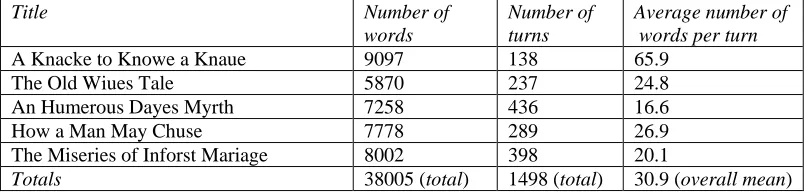
Table 4. Early modern plays (word counts from WordSmith Tools; turn counts from Microsoft WordTM 2007)
Title Number of
words
Number of turns
Average number of words per turn
A Knacke to Knowe a Knaue 9097 138 65.9
The Old Wiues Tale 5870 237 24.8
An Humerous Dayes Myrth 7258 436 16.6
How a Man May Chuse 7778 289 26.9
The Miseries of Inforst Mariage 8002 398 20.1
Totals 38005 (total) 1498 (total) 30.9 (overall mean)
We had hypothesised in section 2 that early modern plays would have longer turns on average compared with present-day plays, on account of the
pieces that might become quoted in other sources. This is not to say early modern drama was completely devoid of rapid taking. However, if such rapid turn-taking appears, it is a temporary deviation from the norm, and often designed for particular rhetorical effects. A good example is the rhetorical technique of stycomythia, in which single lines or half lines are given to two alternating characters, usually in violent dispute. An excellent example can be found in Act I scene ii of Shakespeare's play Richard III, where Richard of Gloucester
encounters robust resistance from Lady Anne.
5. Lexical richness compared
Having confirmed in section 4 that there were fewer, longer turns in early modern plays compared to present-day plays, we now investigate our second hypothesis arising from the labour-intensive production process of cutting and pasting speech turns for the distribution of parts to early modern actors. To investigate our expectation in section 2 that early modern drama would have been less cohesive and featured relatively less repetition and recycling of words than present-day drama, we began by obtaining type-token ratios for the play samples in both corpora. These show the relative lexical richness of the plays by
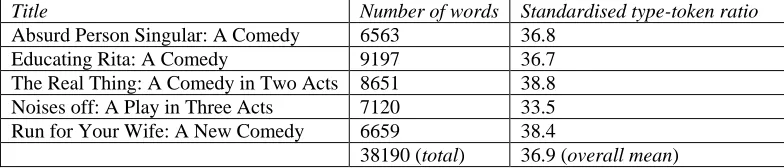
[image:10.612.122.514.457.541.2]calculating the number of unique words (types) in every 1000 running words (tokens) in the texts (see Scott, 1996-2009). Higher type-token ratios indicate greater lexical richness, and therefore lower levels of word repetition. We used standardised type-token ratios because the play-texts in our corpora vary in length, i.e. the figures are calculated per 1000 words. The results are shown below in Tables 5 and 6.
Table 5. Present-day plays (word counts and type-token ratios from WordSmith Tools)
Title Number of words Standardised type-token ratio
Absurd Person Singular: A Comedy 6563 36.8
Educating Rita: A Comedy 9197 36.7
The Real Thing: A Comedy in Two Acts 8651 38.8 Noises off: A Play in Three Acts 7120 33.5 Run for Your Wife: A New Comedy 6659 38.4
38190 (total) 36.9 (overall mean)
Table 6. Early modern plays (word counts and type-token ratios from WordSmith Tools)
Title Number of words Standardised type-token ratio
A Knacke to Knowe a Knaue 9097 40.5
The Old Wiues Tale 5870 42.7
An Humerous Dayes Myrth 7258 37.8
How a Man May Chuse 7778 42.9
The Miseries of Inforst Mariage 8002 43.1
38005 (total) 41.4 (overall mean)
As Tables 5 and 6 show, type-token ratios were generally higher in the early modern plays-texts, although the type-token ratio of An Humerous Dayes Myrth
Though the overall mean type-token ratios of early modern and present-day play-texts do not show a huge numerical difference, a t-test showed that the results were statistically significant (significance probability level 0.011, two-tailed, conducted using SPSS). This confirms that our early modern play-texts show greater lexical richness than the present-day ones. We therefore pursued our hypothesis of less lexical repetition/recycling and lower levels of cohesion further through some qualitative analysis.
All the present-day comedy samples showed evidence of sequences of short turns where characters repeat and echo each other’s words. One of many examples is given below. In the examples in this section, we have added turn numbers to the original play-text, and have outlined the repetitions for clarity and convenience.
(4) 1. HENRY. It's no good.
2. ANNIE. You mean it's not literary.
3. HENRY. It's not literary, and it's no good. He can't write. 4. ANNIE. You're a snob.
5. HENRY. I'm a snob, and he can't write.
6. ANNIE. I know it's raw, but he's got something to say.
7. HENRY. He's got something to say. It happens to be something extremely silly and bigoted. But leaving that aside, there is still the problem that he can't write. He can burn things down, but he can't write.
Tom Stoppard, The Real Thing, 1982, 56-57
In example 4, Henry and Annie, a couple, are in disagreement during this debate, and effectively constructing opposing arguments. However, their strategies for doing so involve picking up and borrowing one another’s words and phrases, rather than introducing new ones. Turns 1 and 3 are linked through “it’s no good”; turns 2 and 3 through “literary”; turns 3, 5 and 7 through “he can’t write”, repeated twice in turn 7; turns 4 and 5 through “a snob” and turns 6 and 7 through “he’s got something to say” (“something” is also repeated in turn 7). These links are, in Halliday and Hasan’s (1976) terms, reiteration which strengthens the cohesiveness of the text.
In contrast, the early modern drama shows fewer of these links, with characters introducing more new words and phrases rather than echoing each other’s words, as in the following example of a male and a female character, Lemot and Florila, again in some dispute:
(5) 1. Flo. Why let vs be gon my kind Lemot, and not be wondered at in the open streets.
2. Le. Ile go with you through fire, through death, through hell, come give me your own hand, my own dear heart, this hand that I adore and reverence, and loath to have it, touch an old man's bosom, O let me sweetly kiss it; [he bites]
3. Flo. Out on thee wretch, he hath bit me to the bone, O barbarous Canibal, now I perceive thou wilt make me a mocking stock to all the world.
mooue me, my father and my mother died both in a day, and I rung me a peal for them, and they were no
sooner brought to the church and laid in their graves, but I fetched me two or three fine capers aloft, and took my leave of them, as men do of their mistresses at the ending of a galliard; Besilos manus
5. Flo. O brutish nature, how accursed was I ever to endure the sound of this damned voice?
6. Le. Well, and you do not like my humour, I can be but sorry for it, I bit you for good will, and if you accept it, so, if no, go.
7. Flo. Vilain, thou didst it in contempt of me.
George Chapman, An Humerous Dayes Myrth, 1599, F2R-F2V
As example 5 shows, within the seven speech turns, the only repeated lexical (content) word linking turns is “bit”, in turns 3 and 6. Otherwise, the two characters make their points using fresh sets of words and phrases, introducing more variety but reducing the cohesiveness of the text. Note that the turns are much longer, too, in the early modern example than in the present-day example, as discussed in section 4.
It may well be that the short turns and lexical repetition we observe in the present-day drama are particularly characteristic of comedy, since it was clear from our data that the serial echoing of words and phrases is often exaggerated so as to be amusing. This is demonstrated in example 6 below.
(6) 1. MRS. CLACKETT. What's he saying? 2. FLAVIA. He's saying... ring the police! 3. ROGER. Ring the police?
4. OMNES. Ring the police!
ROGER picks up the receiver, finds the
body of the phone missing, and hands the receiver to LLOYD. 5. ROGER. It's for you. LLOYD puts the receiver to his ear and tries to dial.
6. FLAVIA. No phone?
7. MRS. CLACKETT. To TIM: Fetch a phone!
8. TIM. Fetch a phone? Exit TIM through the front door. 9. FLAVIA. Here's the phone!
10. ROGER. We've found the phone! LLOYD puts the receiver back o top of the phone. At once it rings.
11. FLAVIA. Pick it up! 12. LLOYD. faintly Pick it up? 13. OMNES. Pick it up!
14. FLAVIA. picks it up It's the police! I'll tell them we're just missing a young woman!
15. ROGER. Yes! We're just missing a young woman!
Michael Frayn, Noises off, 1982, 169-170
repetition as a comic strategy is perhaps one which only became fashionable in drama at a time when it no longer added to the effort involved in producing and distributing the script. In any event, we can see from example 6 how quickly and easily repetitions accumulate in parts of present-day comedy, helping to account for the lower levels of lexical variety seen in the present-day type-token ratios in Table 5.
6. Terms of address compared
We manually inserted a tag of one symbol not otherwise used in the texts, a forward slash /, immediately before each term of address in the plays in both corpora. Using the WordSmith Tools Concord function we could then isolate all the terms of address in our corpora simply by conducting an automated search for anything immediately preceded by /.
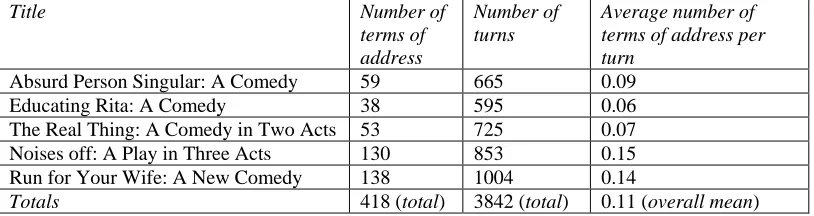
[image:13.612.123.530.328.436.2]Table 7 and Table 8 display the average number of words per turn in our present-day and early modern plays.
Table 7. Present-day plays (word counts from WordSmith Tools; turn counts from Microsoft WordTM 2007)
Title Number of
terms of address
Number of turns
Average number of terms of address per turn
Absurd Person Singular: A Comedy 59 665 0.09
Educating Rita: A Comedy 38 595 0.06
The Real Thing: A Comedy in Two Acts 53 725 0.07 Noises off: A Play in Three Acts 130 853 0.15 Run for Your Wife: A New Comedy 138 1004 0.14
[image:13.612.122.531.485.595.2]Totals 418 (total) 3842 (total) 0.11 (overall mean)
Table 8. Early modern plays (word counts from WordSmith Tools; turn counts from Microsoft WordTM 2007)
Title Number of
terms of address
Number of turns
Average number of terms of address per turn
A Knacke to Knowe a Knaue 224 138 1.62
The Old Wiues Tale 145 237 0.61
An Humerous Dayes Myrth 207 436 0.47
How a Man May Chuse 128 289 0.44
The Miseries of Inforst Mariage 132 398 0.33
Totals 836 (total) 1498 (total) 0.56 (overall mean)
surprising, as the systems of terms of address differ between the two historical periods we are looking at: the early modern period relied on terms of address to express deference much more than is the case today. Nevertheless, for the early modern actor the cohesiveness of both the turn-taking system, e.g. who was talking to who, and the social system, e.g. in what capacities characters speak and receive talk, hangs upon the system of terms of address that was available at the time. In effect, terms of address acted as implicit cues within the speeches of the actors’ parts, giving them information about how to orientate the speeches when the play comes together as a whole in performance. Example 7 shows how this works. Moreover, here we have comparatively short turns and more than two participants in the dialogue; consequently, the need to orientate the actors is greater.
(7) Eum. Thanks my fine eloquent hostess. Iack. But hear you master, one word by the way, are you content I shall be halfes in all you get in your iourney?
Eum. I am Iack, here is my hand. Iack. Enough master, I ask no more. Eum. Come Hostess receive your money, and I thank you for my good entertainment. Host: You are heartily welcome sir. Eum. Come Iack whether go we now? Iack. Mary master to the coniurers presently. Eum. Content Iack: Hostis farewell.
George Peele, The Old Wiues Tale, 1595, E3V
7. Conclusions
In this paper we have argued that the evolution of plays from manuscript to print may have had an impact on the language of the plays. In particular, early modern plays were not the unified wholes that they are now, in the sense that (a)
playwrights were likely to have been more focused on “set pieces” and individual character/actor parts, and (b) plays were literally fragmented into parts for
distribution to the actors, only coming together in performance. We hypothesised three ways in which the impact of this would be manifested in the language of early modern plays compared with those from the present day:
(1) Early modern plays have longer turns on average compared with present-day plays, because longer turns would have minimised the amount of cutting and pasting of speech turns when preparing an actor’s part, and also maintained a visual distinction between the speech itself and the short preceding cue.
(2) Early modern plays have higher levels of lexical richness, since they were more like a stack of speeches working relatively independently towards a particular end than an interlocking, overlapping discourse.
(3) Early modern plays contain a greater number of terms of address
and social relations between characters, which would be needed to unify the play in performance.
In sections 4, 5 and 6 we tested these three hypotheses quantitatively and qualitatively. Quantitatively, we found supporting evidence for all three. However, other factors may well have played a role in shaping the language of plays, and consequently our findings. Nevertheless, our qualitative examples and analyses support the idea that there is a causal link, at least in part, between the different media (manuscript and print) and the different linguistic characteristics we observed.
Our study has merely scratched the surface of what might be an issue of considerable importance. It is surprising that the constraints and practices of early modern play script production are so woefully neglected not only in historical studies, but also in texts on the stylistics of drama (e.g. Herman 1995; Culpeper et al. 1998). As a result, a full understanding of the linguistic characteristics of the plays cannot be achieved.
Needless to say, there are other ways in which the medium of the plays would probably have affected their language, including, as we mentioned, that the cut-up manuscript also reduced the potential for representing simultaneous talk and interruptions; compare the elaborate transcription notation system of the present-day playwright Carol Churchill. These would be worth investigating. Furthermore, we have considered only comedy plays here, and our results could usefully be compared with those from a wider range of genres.
References
Archer, Dawn, Tony McEnery, Paul Rayson and Andrew Hardie (2003) “Developing an automated semantic analysis system for Early Modern English”. In Proceedings of the Corpus Linguistics 2003 conference.
[UCREL technical paper number 16]. UCREL, Lancaster University, U.K., pp. 22-31.
Baron, Alistair and Paul Rayson (2008) “VARD 2: A tool for dealing with the spelling variation in historical corpora”. In Proceedings of the
Postgraduate Conference in Corpus Linguistics, Aston University, Birmingham, U.K., 22 May 2008. See
http://www.comp.lancs.ac.uk/~barona/VARD2/ (accessed 10.08.2009) Culpeper, Jonathan, Mick Short and Peter Verdonk (eds.) (1998) Exploring the
Language of Drama. From Text to Context. London and New York: Routledge.
Feuillerat, Albert (1908) Documents Relating to the Office of the Revels in the Time of Queen Elizabeth. Louvain: A. Uystpruyst.
Gurr, Andrew (1992) (3rd edn.) The Shakespearean Stage 1574-1642. Cambridge: Cambridge University Press.
Halliday, Michael A.K. and Ruqaiya Hasan (1976) Cohesion in English. London and New York: Longman.
Herman, Vimala (1995) Dramatic discourse: Dialogue as interaction in plays.
London: Routledge.
Hoey, Michael (1991) Patterns of Lexis in Text. Oxford: Oxford University Press. Holland, Peter (2006) Introduction: Printing performance. In: Peter Holland and
Stephen Orgel (eds.) From Performance to Print in Shakespeare's England. Houndmills, Basingstoke: Palgrave MacMillan.
Kytö, Merja and Terry Walker (2006) Guide to A Corpus of English Dialogues 1560-1760. Acta Universitatis Upsaliensis. Studia Anglistica Upsaliensia 130. Uppsala: Uppsala Universitet.
Palfrey, Simon and Tiffany Stern (2007) Shakespeare in Parts. Oxford and New York: Oxford University Press.
Rayson, Paul, Dawn Archer and Nick Smith (2005) “VARD versus WORD: A comparison of the UCREL variant detector and modern spellcheckers on English historical corpora”. In Proceedings of Corpus Linguistics 2005, 14-17 July, Birmingham University, U.K.; Proceedings from the Corpus Linguistics Conference Series on-line e-journal, Vol. 1, no. 1, ISSN 1747-9398.
Rayson, Paul, Dawn Archer, Alistair Baron, Jonathan Culpeper and Nick Smith (2007) “Tagging the Bard: Evaluating the accuracy of a modern POS tagger on Early Modern English corpora”. In Proceedings of Corpus Linguistics 2007, July 27-30, University of Birmingham, U.K. See also
http://ucrel.lancs.ac.uk/VariantSpelling/ and
http://www.comp.lancs.ac.uk/~barona/VARD2 (accessed 10.08.2009) Scott, Mike (1996-2009) WordSmith Tools manual version 5. Oxford: Oxford
University Press. See
http://www.lexically.net/downloads/version5/HTML/index.html
(accessed 10.08.2009)
Stern, Tiffany (2000) Rehearsal from Shakespeare to Sheridan. Oxford and New York: Oxford University Press.
Stern, Tiffany (2004) Re-patching the play. In: Peter Holland and Stephen Orgel (eds.) From Script to Stage in Early Modern England. Houndmills, Basingstoke: Palgrave MacMillan.
Thomson, Peter (1997) Rogues and rhetoricians: Acting styles in early English drama. In: John D. Cox and David Scott Kastan (eds.) A New History of Early English Drama. New York: Columbia University Press, 321–35.
1
See http://eebo.chadwyck.com
2
In this period, all actors, of course, would have been male.
3
UCREL: the University Centre for Computer Corpus Research on Language, Lancaster. See
http://www.comp.lancs.ac.uk/ucrel
4
totals were derived by temporarily conducting a "replace all" operation; the number of