2016 International Conference on Artificial Intelligence and Computer Science (AICS 2016) ISBN: 978-1-60595-411-0
Recommender System for
China Braille Library
Zhen ZHANG
1,*, Wei WANG
2and Zhi YU
3123Zhejiang Provincial Key Laboratory of Service Robot, College of Computer Science,
Zhejiang University, Hangzhou 310027, China {zhen_zhang, wangwei_eagle, yuzhirenzhe }@zju.edu.cn
*Corresponding author
Keywords: Recommender system, Visually impaired person.
Abstract. The recommender systems are playing an increasingly important role in people's daily
lives and they are widely used in E-commerce companies, online music websites and online book stores etc. However, none of these existing recommender systems have taken into account that the disabled person may have some special requests in some case. We have designed a recommender system for China Braille Library to aid the disabled person getting personalized recommending books. By this way, the effect of information overload is largely reduced for visually impaired persons.
Introduction
With the significant development of science and technology, the Internet has become an integral part of life. People can get all kinds of information and communicate with each other via the Internet. At the same time, the active participation of people brings in an explosive growth of information in the Internet. We gradually step from the era of information-poor to the information-overload era. In this era, both the information consumers and information producers have encountered great challenges. For information consumers, finding their own interest from a large number of information is a very difficult thing. For information producer, let their own information product stand out, becoming the focus of majority users’ attention, also a very difficult thing. Recommender systems is an important tool to solve this contradiction. The recommender system’s task is to connect users and information, on the one hand, helping users find valuable information for them; one the other hand, information can be displayed in front of the highly interested users, so as to achieve the goal of double win between information consumers and information producers.
However, there exists quite a number of special populations in our society, such as the disabled, the elderly, the children and so on. Due to their inherent physical defects, they have difficulties in accessing information easily to some degree. For example, the visually impaired persons cannot obtain all the information from visual images and hearing impaired people cannot get all the information form the audio channel. It is difficult for them to adapt to the information society and they cannot enjoy the convenience brought by technology which hinders the comprehensive development of society. It is much harder for them to find their own interest in the vast Internet information.
experimental settings and result are discussed in the next. Finally, we provide the conclusion and future work to end this paper.
Related Work
Over the past two decades, many work has been done in recommender systems. In general, recommender systems are divided into two types: one is explicit feedback systems which have numerical ratings; the another is implicit feedback systems which do not cover any explicit ratings, only involving the available operation history etc.
For systems with explicit feedback, Collaborative Filtering (CF) [1,2,3] is the most widely used algorithm due to its accuracy and scalability. Generally speaking, there exits two kinds of CF methods: memory-based and model-based method. The most famous representative memory-based method is K-Nearest Neighbor (KNN) collaborative filtering [4]. There are a lot of methods to compute the similarity of KNN matrix, including Cosine similarity, Pearson correlation coefficient, Euclidean distance etc. Model-based algorithms, in contrast, utilize the collection of training data to learn a parametric model or nonparametric model first and then we can use the learned model to make predictions instead of directly manipulating the original dataset. Although traditional CF models have been successful in many areas, they all have to face several critical problems, such as data sparsity, scalability and cold start. To alleviate the sparsity problem, many matrix factorization (MF) models [5,6] are adopted, such as Singular Value Decomposition (SVD), Non-negative Matrix Factorization (NMF), Maximum Margin Matrix factorization (MMMF) and Probabilistic Matrix Factorization (PMF) [7] etc.
As for recommender systems with implicit feedback, considerable work has also been done to solve the problem of how to use just implicit feedback to generate high quality recommendations for users. In 2007, Das et al presented an online recommendation algorithm for Google News where click history of each user is the only available data for them (hence implicit) [8]. Hu et al in 2008 proposed a novel method to transform implicit feedback into two paired quantities: preference and confidence levels and use both of them to learn a latent factor for model [9]. Since those methods focus on implicit feedback, we simply refer the reader to excellent surveys and monographs for more details.
User Information Acquisition and Modeling
continue to expand, the recommender system for user modeling also put higher requirements in scalability, real-time ability and incremental.
Recommendation Algorithm in Our System
The recommendation algorithm is the core of the recommender systems. Collaborative filtering is the most widely used algorithm in recommender system. In CF, for a target user, we may first find its similar users and then recommend these users' high-score rated items to this user (user based CF) or we may also recommend him those items which are similar to some item rated a high score by this target user (item based CF). In our recommender system, we combine both user based CF and item based CF to improve the accuracy of the recommended results. The details in the algorithm is as follows:
First step, we use four types of action to calculate the user-item rating matrix. Let's denote the rating of user on item i as rui and rating matrix as Rmxn. Second step, we conduct the similarity metrics on rating matrix. There are several ways to calculate the similarity of users and items, including Cosine similarity, Pearson correlation coefficient, Euclidean distance etc. In our recommender system, we choose Pearson correlation to compute the similarity due to its advantage over other several similarity methods. In details, Pearson method takes into account that the users' item scoring standards are not same, some users liking to give full item scores, while some other users never giving full item scores. At the same time, the Pearson correlation coefficient does not take into account the difference in the average value of the item's preference score, which makes the user comparable, that is, even if the absolute score of the two users on the item preference is completely different, but this way can still find the user score value between the fairly obvious linear correlation, and then get two user similar conclusions. The Pearson correlation coefficient is usually defined as:
∈ , ̅ , ̅
∈ , ̅ ∈ , ̅
. (1)
Where Iij is the set of users who rate both item i and item j, and ̅ is the mean rating score on item i. Both the user-user similarity matrix and item-item similarity matrix are needed to be calculated. After the similarity is calculated, the remaining main task is how to rank the items to get topk recommendation. Third step, we rank the user-user similarity matrix and item-item similarity matrix sorted by descending order of similarity. For every user, we extract topk most similar users and the same operation has also been done for every items. After having got topk similar users, we can use this information to predict the unrated items. The procedure is that the rating score of unrated items are calculated through multiplying the similarity scores of users by items' rating scores which have been rated by the topk similar users. Then the scores are divided by the sum of the similarities. For example, u1 did not rate i1, but the topk similar users of u1 like u5 and u10 have rated the i1, then we can regard the predicted rating score of u1 on i1 is the rating score of u5 on i1 times the similarity of u1 and u5, then plus the rating score of u10 on i1 times the similarity of u1 and u10 deducing the rest from this way and finally divided by sum of u1 and u5, u10 similarity score and so on. Then we can take topk highest weighted rating scores items as recommendation results.
Experimental Design
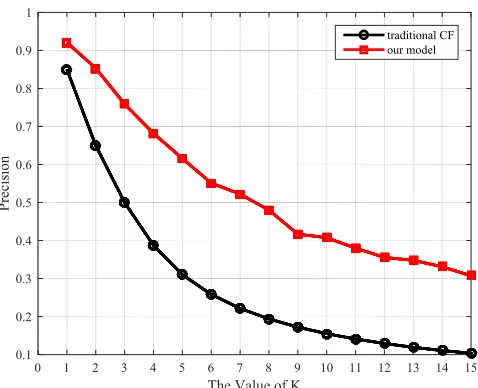
We have conducted several experiments to exmaine the effectiveness of our model. We compare the performance of standard CF model with our mixed recommendation method. We use a real-world dataset which is collected from China Braille Library System. As we have discussed before, we use four types of operation logs in the system to build our rating matrix. It cantains the reading history, collecting history, sharing history and commenting history of 100 user on 100 books. Actually we have done some cleaning on the dataset, the original dataset contains the operation logs of last six months in the China Braille Library System, that is 225 different users and 1355 different books in total. Based on this scarce operation data, the dataset is even more sparse than the widely used standard datasets, such as Netflix dataset, MovieLens dataset et al. To ensure the experiment is simple and effective, we adopt a very simple method, which keeps every user at least read 4 books. In this dataset, we randomly choose 80% of the data for training and leave the remainder for testing.
We use the hitting rate as the metrics to measure the prediction accuracy. This metric quantifies the fraction of items that are in the topk ranking list sorted by their estimated rankings. For each user u we define S(K;u) as the set of already-consumed items in the test set that appear in the topk list and S(u) as the set of all items consumed by this user in the test set. Then we have:
@ | ; |. (2)
Let C(u) be the set of user u's candiate items for ranking in the test set. The average precision for u is:
| |
| | @
. (3)
And the mean average precision will be:
MAP | |Σ ∈ Ap u . (4)
Figure 1. Precision of two versions CF models.
Conclusions
In this work, we explore a new application of recommender system to reduce the information overload. We build an e-book recommendation system for visually impaired people in China Braille Library system. We model the user-user and item-item relations, then we combine this information to get better recommendation results. Our results show that even though we just adopt a simplest method to build a recommendation system, there is still a huge improving traffic in our websites. We expect that our exploration can attract further research on the topic of CF model. Further works are needed in two main aspects: one is to find some kind of effective similarity metrics and the other is to design new methods taking into account item topics. For example, when we recommend books for user, the topics of the book are quite important.
Acknowledgements
This work is supported by National Key Technology R&D Program (Grant No. 2014BAK15B02).
References
[1] Jonathan L. Herlocker, Joseph A. Konstan, Loren G. Terveen, and John T. Riedl. Evaluating collaborative filtering recommender systems. ACM Transactions on Information Systems (TOIS), 22(1): 5–53, 2004.
[2] John S. Breese, David Heckerman, and Carl Kadie. Empirical analysis of predictive algorithms for collaborative filtering. In Proceedings of the Fourteenth conference on Uncertainty in artificial intelligence, pages 43–52. Morgan Kaufmann Publishers Inc. 1998.
[3] Y. Koren. Factorization meets the neighborhood: a multifaceted collaborative filtering model. In KDD, pages 426–434, 2008.
[4] Badrul M. Sarwar, George Karypis, Joseph Konstan, and John Riedl. Recommender systems for largescale e-commerce: Scalable neighborhood formation using clustering. In Proceedings of the Fifth International Conference on Computer and Information Technology, Volume 1, 2002.
[5] Y. Koren et al. Matrix factorization techniques for recommender systems. IEEE Computer, 42(8): 30–37, 2009.
The Value of K
0 1 2 3 4 5 6 7 8 9 10 11 12 13 14 15
Pre
cis
io
n
0.1 0.2 0.3 0.4 0.5 0.6 0.7 0.8 0.9 1
[6] R. Salakhutdinov and A. Mnih. Probabilistic matrix factorization. In NIPS, pages 1257–1264, 2007.
[7] A. Krohn-Grimberghe et al., Multi-relational matrix factorization using bayesian personalized ranking for social network data. In WSDM, pages 173–182. ACM, 2012.
[8] A. Das et al., Google news personalization: Scalable online collaborative filtering. In WWW, pages 271–280, 2007.