2016 International Conference on Artificial Intelligence: Techniques and Applications (AITA 2016) ISBN: 978-1-60595-389-2
Texture Image Optimization Segmentation Based on the SLIC Algorithm
Ji-chun LI, En-cai ZHANG, Kun ZHANG and Guan-nan CHEN
*Key Laboratory of OptoElectonic Science and Technology for Medicine, Ministry of Education, Fujian Normal University, Fuzhou, 350007, China
Department of Network and Communication Engineering, Fujian Normal University, Fuzhou, 350007, China
*Corresponding author
Keywords: Superpixel, Segmentation, Texture image, Optimization.
Abstract. The superpixels gathered by high similar pixels can effectively reduce the redundancy of the image and the complexity of the subsequent image processing. In this paper, a new method combined with SLIC (simple linear inerative clustering) algorithm and the energy optimization function to segment texture image is proposed. SLIC approach is used to obtain the initial superpixels, and optimization function can relocate new center points to creat more homogeneous superpixels. It has been shown that this method performs better adaptability in the complex texture image.
Introduction
Superpixel segmentation is an important method for many computer vision applications such as image segmentation, object localization and depth estimation. This method can reduce texture image redundancy and cluster pixels into homogeneous image regions, called superpixels (SPs) which concept is primordially presented by Ren[1]. Superpixel segmentation provides the spatial support for computing region based features such as similar color and texture characteristics. The main merit of superpixel is to provide a more natural and perceptually meaningful representation of the input image[9]. A superpixel representation greatly reduces the number of image primitives and improves the representative effciency compared to the pixel representation[10].
There are many approaches to generating superpixels. It can be divided into two categories, graph-based and gradient ascent methods. The main idea of graph based approaches is to map the original image for an undirected weighted graph, and each pixel will be seen as a node in a graph. Edge weights represent the characteristic differences or the similarities between neighboring pixels. Superpixels are acquired by minimizing a cost function defined in the figure. On the behalf of the algorithms based on graph are Normalized Cuts, Graph-based and Superpixel Lattice.
On the contrary, gradient ascent methods mainly adopt the basic ideas of aggregate classification, with initial relative dispersion diagram in various parts of the superpixel center of gravity as the center, by means of gradient ascent refine the clusters until all the pixels classification are finished or some convergence conditions are satisfied. The methods based on gradient ascent have Mean Shift[1], the Quick Shift, Watershed and TurboPixel.
Texture, an important attribute of the image and significant visual cues, is widely used in image segmentation[4]. Texture segmentation refers to dividing the image into different parts, and each region has a relatively consistent texture feature. There are two common texture segmentation methods[8], one of them is based on the area and the other one is based on boundary. Texture feature[7] extraction is the key, because it can directly affect the quality of subsequent processing.
Texture Image Optimization Segmentation
SLIC Algorithm
The procedure begins with intialization clustering center. Each seed will be dispersed evenly in
the image,in the process of clustering in order to avoid error resulting from the seeds sitting in the
position which gradient is too large, the original clustering centers are replaced by minimum gradient position in a 3*3 neighborhood. Assuming that the original image containing P pixels cluster together into N superpixels. The size of each superpixel should be S P/N in order to ensure that the generated superpixels are regular and the distribution is compact and homogeneous. Adjacent clustering center distance approximate S.
Next we calculate the color difference, space distance and similarity between pixel i and j.
2
2
2j i j i j
i
lab l l a a b b
d
(1)
2
2j i j
i
xy x x y y
d
(2)
xy lab
s d
S m d
D
(3) Where dlab is the color difference between pixel i and j, dxy is the Euclidean distance between pixel i and j, Ds is Clustering threshold, S is the distance between cluster center, and m is the compact factor, used to control the color difference and space distance proportion in clustering threshold. To improve the efficiency of algorithm, the searching region is defined as 2S2S neighborhood around the clustering center.
Superpixel Optimization
In this paper, we adopt a energy optimization function[6] to make sure that the superpixels boundaries adhere well to object boundaries and contain much texture information. It can increase efficienty and performance of superpixels. The function is expressed as
2
2, ~
l
n l x l
l AreaS W CT c x
S Area E
(4) Where Area
Sl is the area of superpixel and Area
S is the average of superpixels. The label ofsuperpixel is not consistent, so Wx
~
is compensatory function.
~
, 2l
n l xCT c x
W is smooth item to
find out the optimal relocating center positions of superpixels. On th variable cln after the first
order derivative with the above Equation, we can get the minimizing solution of the smooth item. The new center position is defined as:
l ln
n l x
l ln
n l x n
l
c x
x c CT W
x c x
x c CT W c
1 1
1 1
, ~
, ~
(5)
On th variable Area
Sl after the first order derivative with the above Equation, we can get theminimizing solution of the first item as:
which have uneven texture will be partitioned into small superpixels. This will make sure that superpixels be more homogeneous in complex texture areas.
Here we use the local binary pattern(LBP)[5] to calculate texture information. The LBP value of each pixel is defined as:
1 0 2 q t t i t qi s g g LBP
(7)
Where q is the gray level of image, gi denotes the gray value of pixel i, gt denotes the gray value of
pixel t in the pixel i neighborhood.
l S i i l LBP S Area,
NLBP S
Area iSl
i
(8) Where N means the number of superpixels, and we use TH to control the number of iterations in superpixel optimization procedure. When Area
Sl Area
S TH , the large superpixel will besplitted up into two small superpixels. The two new centers depend on whether the formula
xcl
s is equal to zero and s means the corresponding eigenvector with the largest eigenvalue of the covariance matrix. The covariance matrix is defined as:
T l c x S x x l l nl x c x c
c x x c CT l l
, 2 2 , (9) The two new centers are defined as:
0 0 1 , , ~ , ~ s c x l l x s c x l l x new l l l c x x c CT W x c x x c CT W c ,
0 , 0 , 2 , , ~ , ~ s c x S x x l l x s c x S x x l l x new l l l l l c x x c CT W x c x x c CT W c (10) We take the following steps to optimize the superpixels:1. Initial superpixels Sl and an integer N,
2. Apply equation (5) to achieve the new cln
3. Apply equation (10) to get the new cl(new,1) and cl(new,2)
4. Refine Sl by using SLIC algorithm around the new center position
5. Run steps 2 to 4 iteratively until convergence
Results and Discussion
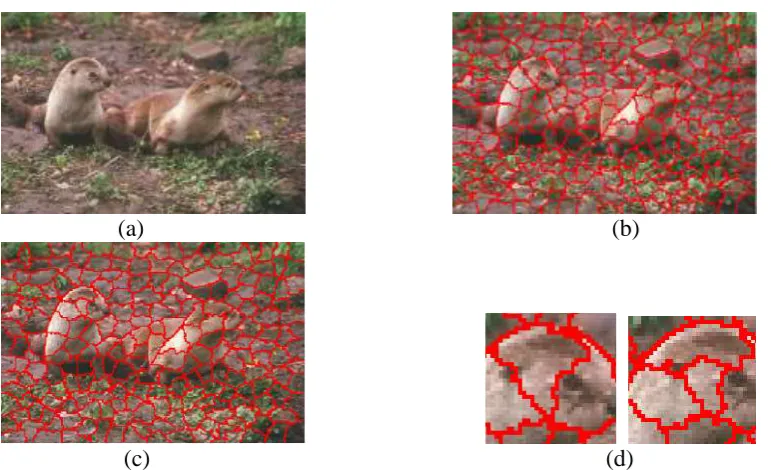
This algorithm is evaluated by using the original image which has much complex texture information. The superpixels produced by the optimization algorithm have very strong adaptability to border. It shows strong ability to adhere well object boundaries. Example images segmented using the optimization algorithm are shown in Fig.1.
(a) (b)
[image:4.595.108.494.65.300.2]
(c) (d)
Figure 1. Texture image segmented using the proposed approach. (a) the original image; (b) superpixels by our algorithm; (c) superpixels generated by using larger Th; (d) local superpixels by setting different Th.
The number of superpixels are controled by parameter N. The larger N is, the better segmentation effect. As we can see in Fig.2, texture details can be fetching. The smaller the generated superpixels are, the better boundary adherence. The complex texture area will be divided into small homogeneous pieces.
(a) (b)
Figure 2. Texture image segmented. (a) the original image; (b) the number of superpixels N is 500.
Conclusion
A novel texture image superpixel method have been proposed in this paper by using the SLIC algorithm and energy optimization function. First the initial superpixels are acquired by utilizing the SLIC algorithm, then the seeds positions are relocated according to the texture information and the seeds information will be put back into SLIC algorithm to generate new superpixels iteratively until convergence. Finally, good segmentation results will be separated from the original image. The superpixels have strong boundary adherence performance, uniform size and regular shape.
In the future, a better way will be found to segment image with complex texture information and show better performance.
[image:4.595.114.486.405.518.2]References
[1] X. Ren and J. Malik, “Learning a classification model for segmentation,” in Proc. 9th IEEE ICCV, Oct. 2003, pp. 10-17.
[2] D. Comaniciu and P. Meer, “Mean Shift: A Robust Approach toward Feature Space Analysis,” IEEE Trans. Pattern Analysis and Machine Intelligence, vol. 24, no. 5, pp. 603-619, May 2002.
[3] Achanta R, Shaji A, Smith K, et al.SLIC superpixels compared to state-of-the-art superpixel
methods[J]. IEEE Transactions on Pattern Analysis and Machine Intelligence,
2012,34(11):2274-2282.
[4] Clausi D A. An analysis of co-occurrence texture statistics as a function of grey level quantization[J]. Canadian Journal of Remote Sensing, 2002, 28(1) : 45- 62.
[5] T. Ojala, M. Pietikäinen, and T. Mäenpää, “Multiresolution gray scale and rotation invariant texture analysis with local binary patterns”, IEEE Trans. Pattern Anal. Mach. Intell, vol. 24, no. 7, pp. 971-987, Jul. 2002.
[6] O.Veksler, Y. Boykov, and P. Mehrani, “Superpixels and supervoxels in an energy optimization framework,” in Proc. ECCV, 2010, pp. 211-224.
[7] J.Shen, Y.Du, W.Wang, X. Li, “Lazy random walks for superpixel segmentation.” IEEE Trans. on Image Processing, 23(4):1451-1462, 2014.
[8] Haralick R M. Statistical and structural approaches to texture[J]. Proceedings of the IEEE, 1979, 67 (5): 786- 804.
[9] Lan J H, Zeng Y L. Multi-threshold image segmentation using maximum fuzzy entropy based on a new 2D histogram[J]. Optik-International Journal for Light and Electron Optics, 2013, 124 ( 18 ) : 3756-3760.