2016 International Conference on Artificial Intelligence: Techniques and Applications (AITA 2016) ISBN: 978-1-60595-389-2
Modeling and Simulation of the Knife Movement for Veneer Lathe
Guang-ming XIONG and Li-jun GUO
College of Aeronautics and Astronautics, University Xiamen, Xiamen, 361005, China
Keywords: Veneer lathe, Peeling, Simulation.
Abstract. The mathematical model of the knife with variable-speed feeding was established, the changing law between the knife feeding speed and the diameter of the log was deduced, the calculation method of the peeling time was also derived, the formula based on pitch angle of the knife is given. The mathematic model among the pitch angle, diameter of log and height position of the knife was established in the paper, there was a simulation with the help of matlab software. The study shows that, in rotary cutting process, in order to achieve the optimization of the rotary cutting, when the knife was fed at variable-speed it must be rotated with pitch angle, the pitch angle is influenced by height position of the knife, the results of study will provide a guide for the control system design.
Introduction
The veneer lathe is a main machine in plywood production, it is used to peel the round wood into veneer, it can be used to be the production of the veneers or the artificial veneer of the surface decoration, in order to raise the utilization ratio of the log, veneer lathe was widely used at present. It is the main problem that the precision of the veneer and the uniformity of the thickness are acquired. In rotary cutting process, the movement of the knife include the feeding-speed, the rotary cutting time, the pitch angle and the height position of the knife. Therefore, establishing the cutting model, studying on the changing law between the serial movement parameters of the cutter and the log can provide the basic theory for design of system.
[image:1.595.207.390.476.600.2]The mathematical model of veneer lathe is shown in Figure 1.
Figure 1. The system sketch of the veneer lathe.
Driving roller 1, 2 and press roll 3 contra rotate. The knife fixed on the press roll 3 is fed at the
speed of v (m/s). When the rotary speed n0 of the driving roller 1, 2 and the press roll 3 keep on constant, the rotary speed of the log is n(r/m) and the rotary speed n of the log will be changed. Supposing that there is no relative sliding among the driving rollers, press roll and the log, then the tangent linear velocity of the log is constant. So in order to peel veneer with the same thickness m, in rotary cutting process, it requires the feeding speed v of the knife must be changed continuously according to the law, which makes the lathe work well.
Model and Simulation of Knife Movement with Variable-Speed
d: the diameter of driving roller 1, 2 and driving roller 3.
0
D: the diameter of the round log; m: peeling thickness. a: the central distance of the driving roller1, 2.
v: feed speed.
Supposing that there is no relative sliding among the driving rollers and the round log, and driving roller 1, 2 are completely fixed, in the veneer lathe peeling process, on one hand the round log rotates around its axis, on the other hand, in the role of driving roller 3, it also does the center horizontal moving to the driving roller 1, 2. The tangent linear velocity of the round log is equal to that of the driving roller, thus equation (1).
0 n d n
D (1)
In the veneer lathe peeling process, when the rotation speed n0(rpm) of the driving roller keeps on constant; the rotation speed of the round log is increasing while the diameter of the round log is decreasing.
When the veneer lathe peels the round log, its peeling knife edge is in the symmetrical center plane of the driving roller 1, 2, the horizontal coordinates of the peeling knife edge is shown in equation (2).
2 22 1
2 D d a
D
x
(2) The first derivative of the equation (2) with respected to the time t; the horizontal moving speed of the veneer lathe will be got, refer with equation (3)
dtdD a D d d D dt dx V 2 2 1 2 1 (3)
Substitute (1) and m n dt
dD
2 into (3), thus equation (4).
Dn d m a d D d D dt dx V 0 2 2
1
(4) A negative sign of equation (4) indicates that the direction of v is in the opposite direction of the coordinate axis.
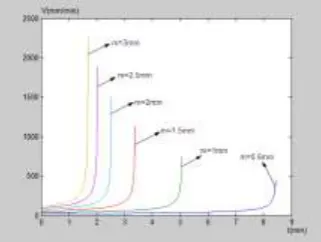
To guarantee the same thickness of the veneer, the cutting variable-speed v should be equation (4). Choose: a 97mm ,m 0.6 3mm ,n0 74rpm,Dmax 380mm,Dmin 25mm,d 96mm
Figure 2. The changing curve of the blades feeding speed v and the diameter of the log D.
From Figure 2 we can see that when d, a, n0, m is fixed, the knife feeding speed v changes with the diameter of the log D. In the veneer lathe peeling process, D became smaller and smaller, while v became bigger and bigger. The bigger m is, the quicker the knife feeding speed is.
The precise calculation of peeling time t. Because: equation(5)
dt d n m dD
D 2 0 (5)
Integral equation (5), thusequation (6),(7),(8).
t D
D
dt d n m dD
D
0
0 2
0 (6)
t d n m D
D
2
2 2
2 0 2
(7)
d n m
D D t
0 2 2 0 4
[image:3.595.217.378.383.504.2](8) Equation (4)、(8), if use the same above numeric value, through the emulation of matlab. The change curve of knife feeding speed change with the time, its diagram is shown in figure 3.
Figure 3. The changing curve of the blades feeding speed and the time.
From Figure 3 we can see that when d、a、n0、m is fixed, the knife feeding speed v became bigger along with time t. In the veneer lathe peeling process, thickness m became bigger, the knife feeding speed is quickly incremented and peeling time decreases.
Calculation and Simulation of the Pitch Angle
[image:3.595.215.387.668.779.2]Because the veneer thickness m is much less than the log radius r, the tangent point A may be regarded as a point on the horizontal beeline through point O. After the knife area of the figure 1 was magnified, the contact between the back of the knife and the log is shown in figure.4.
In rotary cutting process, the curvature was increased with the diameter of the log decreased. In feeding process, if the interface between the back of the knife and the log is constant, the pitch angleof the knife should be changed.
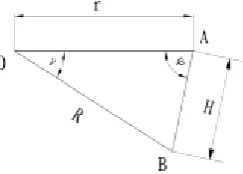
[image:4.595.238.360.165.252.2]It is shown in figure 5. Here, H is the contact height between the knife and the log, r is the radius of the log, O is the rotary center of the log, A is the edge of the cutter, AB is the contact line between the back of the cutter and the log, is the pitch angle.
Figure 5. The triangle among the pitch angle and other parameters.
In rotary cutting process, the length of the log is constant, so the change of the contact area will be reflected by the change of height H. With the radius of the log decreasing, the curvature of point A will be big continuously. In order to keep the height H is constant, the slope of the line AB must be changed continually, that is the pitch angle will be changed. When the chosen height H is perfect, the changing law of the pitch angle will be optimal.
In OAB, according to the Cosine Theorem, the equation (9) will be got:
rH R H r
2 cos
2 2 2
(9)
According to the Sine Theorem again,
sin sin
H
R , Substitute into (9), the unary quadric
equation about cos is solved, equation (10) will be got:
H
r H
r
sin2 1 sin2 2 2 sin2
cos
(10) Because the value of the height H which relative to the value of the radius r is very small, according to the bowstring relationship, we will obtain equation (11), the equation (11) is substituted into (12), the pitch angle will be solved.
D H
arcsin 2
(11)
H
D H D
2
sin 4
sin 1 sin cos
2 2 2 2
2
(12)
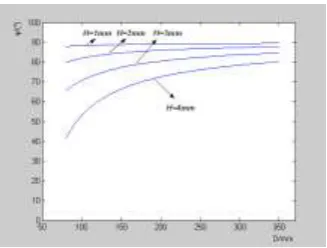
Figure 6. The changing curve between the pitch angle and the diameter of the log.
The Figure 6 shows that when the height H was constant, the pitch angle was related with the diameter D of the log. In rotary cutting process, the pitch angle was decreased with the diameter of the log decreased, which was faster and faster. The bigger the chosen height H was, the faster the speed of the pitch angle changed. In addition, by simulation curve, it was shown that when the diameter of the log was bigger than 200(mm), the change of the pitch angle was a line, when the diameter of log was smaller than 200(mm), the change of the pitch angle was a curve and the decrease of the pitch angle was accelerated with the decrease of the diameter of the log.
Conclusion
The mathematical model of the variable-speed feeding of the knife can be used to guide the control system design for veneer lathe.
In order to achieve the optimization of the rotary cutting system, when the knife was fed at variable speed it must be rotated. The rotation of the knife means the change of the pitch angle. The pitch angle was decreased with the diameter of the log decreased, which was faster and faster according to the curve. The bigger the chosen height H was, the faster the speed of the pitch angle changed. The changing law of the pitch angle of the knife provided the theory method for control knife of the veneer lathe with high precision.
References
[1] W. Wei, P. Y. Xi, The research and design for timber lathe and its mechanism, Machine Design and Research, 2004, 20 (3), 19-20.
[2] T. Pan, S. Chen, X. Y. Chen, J. H. Wang, Variable-speed feeding mechanism and control system designed of log-core veneer lathe, Modular Machine Tool & Automatic Manufacturing Technique, 2003, 2, 13-64.
[3] X. Lu, G. M. Xiong, G. Q. Hu, Design and research on automatic control system for hydraulic log-core veneer lathe, 3rd China-Japan Conference on Mechatronics. FuZhou. 2006, pp, 120-123.
[4] X. Lu, G. M. Xiong, G. Q. Hu, Study on the model both cutting variable-speed of the log-core veneer lathe and moving locus model with constant-speed peeling. Forestry Machinery & Woodworking Equipment, 2006, 34 (1), 12-15.
[5] J. L. Wang, P. X. Cao, Variation of working clearance angle during rotary veneer cutting. China Wood-Based Panels, 2004, 11 (7), 11-13.