2016 International Conference on Computer, Mechatronics and Electronic Engineering (CMEE 2016) ISBN: 978-1-60595-406-6
The Standardization Design and Implementation of Voice
Communication System of Large Enterprise Group
Zhen-gang JIANG and Kuang HAO
Centre of Information Technology, CGN Power Co., Ltd.
Keywords: Experience of operation and maintenance, Standardization, “VCS”, Cost efficiency.
Abstracts. The former design of Voice Communication System (VCS) has many problems, such as backward technology, single-architecture system and detachment between design and operation. In order to solve these problems, this article is going to introduce a solution called standardization design of VCS. This standardization not only absorbs industry advanced communication system technology, but also effectively integrates them and field operation and maintenance experience. Therefore, with this standardization design, system could better adapt to the requirements of technical development and links up with new technology and new application in the future. Besides, it also realizes the designing goal of achieving “Four Capacities” including Strategic Business Supporting Capacity, Integrating Management Capacity of VCS, The Capacity of Rapid Deployment and The Capacity of Innovative Application of Voice Communication. More importantly, this standardization design improves the uniformity of the Group’s multiple-plants voice systems; effectively reduce the cost of design and construction.
Introduction
As we can see, rapid development of national economy brings out many serious problems such as rapid growth of power consumption, the crisis of energy and environment. Therefore, nuclear power as a kind of clean energy got its big advantages. Throughout many years’ technology improvement, the domestic three generations of nuclear power technology like CPR1000 and Hualong ONE has made a breakthrough. The spring of nuclear power has come, many countries has made their blueprint of nuclear power development. Recently, our group put forward the idea of Plate Operation, which means divides the group businesses into four plates: Nuclear Power Plate, Fission Fuel Plate, Non-nuclear Clean Energy Plate, Finance and Integrated Services Plate. This idea helps the group integrate its business and share its resources, and ultimately realize its strategic goal of “Standardization, Professionalization and Intensification.”
Voice Communications System(VCS)plays an irreplaceable role in dairy administrative work, production and emergency of every business plate. In previous stages, because the key technologies of the Units were imported from other countries, so the whole VCS also were coped from other countries. However, while the group’s independent technology (Hualong One Unit) develops rapidly, which requests the technology of VCS to catch up and to meet the changes of application requirements, because the old design of VCS obviously can’t satisfy requirements of the new business and application. The old design got many problems. For example, Unitarian system architecture can’t meet the demands of system reliability. Besides, the mismatches between the design and operation, the disunity of the design and application standard, has caused many modifications of design and increased construction cost.
Overview of Group’s VCS
The Design Goal the Standardization (Achieving Four Capacities)
Strategic Business Supporting Capacity: build up comprehensive voice communication system application; improve informatization’s supporting capacity to the group’s developmental strategy; promote the realization of the group’s strategic goal of “Constructing Benchmarking Project”.
Integrating Management Capacity of VCS: with consideration of the requirements of Units’ key technologies and the principle of “Unifying Design, Unifying Management and Sharing”, to build full life-cycle data management capacity, which centralizes progress, cost, equipment, documentary and safe mass and so on.
The Capacity of Rapid Deployment: based on the group’s mature application and contractor’s mature application of informatization, combining the VCS, perfect system constructing management mechanism, fully organizing and using IT professionals and infrastructure resources, to build the capacity of rapid deployment.
The Capacity of Innovative Application of Voice Communication: promoting technology innovative ability, fully using available information resources, consulting advance experience of peers from all over the world, firmly keeping on the road of technological innovation and mastering intellectual property, gradually becomes the benchmark of voice communication among Large enterprise groups.
System Construction Principles
Based on the requirement of the group business, VCS should be normal operating all the time to make sure the whole system won’t be influenced by single point of failure.
Following design principles should be satisfied:
Reduce single point of failure; improve whole system’s availability.
Scalability. In consider of future development, to establish total interconnection with active voice private network, get manufactures’ authorized compatibility or pass the test given by communication administration to prove its compatibility and stability.
Maintainability. System should be equipped with good monitor mode so that the administration and maintenances could be convenient.
Cost-effective. Under the premise of a highly reliable system, we should choice cost-effective equipment that has lower maintenance cost.
Standardization Design of VCS in Group
VCS is an important part of each business plate’s communication and is important secure information system for dairy production, operation and emergence. Besides, because of the particularity of nuclear power and the special safety demands of nuclear power plant from International Atomic Energy Agency, National Nuclear Safety Administration and Province Emergency Operation, the plant’s VCS also requires to reach the standard and be operating stably before first charging materials.
Architecture Design of Standardization
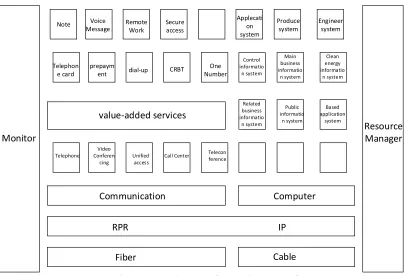
The overall architecture of group VCS is designed from four layers: physical layer, transport layer, system layer and application layer.
Monitor Fiber Cable RPR IP Communication Computer Resource Manager Telephone Video Conferen cing Call Center Note Voice Message Remote Work Secure access value-added services Applecati on system Produce system Engineer system Telephon e card prepaym
ent dial-up CRBT
[image:3.595.93.498.67.343.2]One Number Unified access Telecon ference Control informatio n system Main business informatio n system Clean energy informatio n system Based application system Public informatio n system Related business informatio n system
Figure 1.Architecture of Voice System Platform.
Reliability Design of Standardization
Because of limitation of technology condition and different application requirements, almost all the former VCS architecture design was single machine and the redundancy of key hardware wasn’t enough. Therefore the reliability of system was rather low. Once the system or hardware occurs faults, the whole system would breakdown and the range of influence is big.
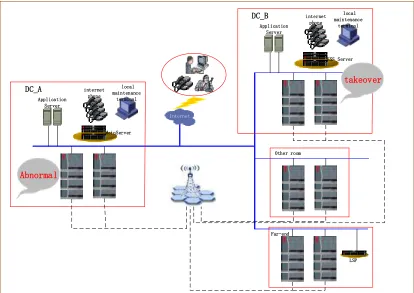
Therefore, when we are doing system-standardization design, we have paid much attention to the reliability of VCS. Besides, we integrate feedbacks of security events at home and abroad and the changes of application and learn from advance voice communication technology, and also overcome many restrictions (such as cost and environment). We use redundant backup and N+1 backup as device configuration model whose product feature is high reliability to attain N+1 backup design effect which could support active main control components, main transmission link and application support components. Ultimately this design could improve system’s reliability and provide a guarantee for reliable safety production and normal office running of group each business plate.
In order to realized main equipment redundancy switchover with high reliability, the components of redundant backup should be design in the active main control system including communication control server, signaling interface unit, power supply modules and voice main transmission interface unit and so on.
MainServer Application
Server
local maintenance
terminal internet
phone
ESS Server Application
Server
local maintenance
terminal internet
phone
LSP Internet
Abnormal
takeover
DC_A
DC_B
Far-end Other room
[image:4.595.91.505.71.364.2]Figure 2. Reliability design of VCS.
The Standardization of Network Organization
Each business plate in the Group constantly develops and expanses, so the system also has to keep on optimizing itself. Nowadays, The Group has constructed a dual-redundancy and high reliable double voice system junction Center based on Data Center A and Data Center B, which covers all nuclear power plants, all member companies and agencies. Our Group has more than 20 sets of systems.
When we need to construct a new system, we should consider its real capacity requirements. If a plant’s position is too far away from Group headquarters (not in the same city or area), or its capacity requirement is lower than 200 and will not expensed up to 200 for a long time, we will choose to t remotely register its Internet phones to the Group’s VCS to decrease the construction cost.
For number companies or affiliated agencies of the Group, if their capacity requirement is between 200-1000 and will not be expensed for a long time. At first we will integrally consider all the following conditions: to decrease construction cost; simplicity, flexibility and easiness of maintenance of the system, real requirements of one specific number company or affiliated agency, and the power system capacity and trunk-group channel of the main system of the Group VCS. Then, we will choose to construct an independent system for them, or, use N+1 redundancy architecture approach (that has the features of Gateway scalable, modularity, stackable and hot-swappable) as a remote module to expanse.
Value Points
Blending in New Technology
The Group’s former VCS basically used analogy technology. However, with the development of communication technology and the increasing new application requirements, the former system couldn’t need new requirements. At the same time, almost all the old system and equipment was eliminated because of quick replacement of hardware equipment. So system’s components and service couldn’t get effective protection, which would seriously impact system’s safe and steady operation.
Under the premise of stability and reliability, this standardization design of VCS blends in many technologies such as digitization, all-IP, virtualization and so on, to ensure it could meet all new emergency requirements, such as voice prompt function, mobile office and so on. Besides, this design will ensure the protection of system’s components and service. Meanwhile it could effectively monitor systems, which mean it could quickly locate and solve faults.
Experience of Operation and Maintenance would be Reflected
The former VCS was designed by Design Institute, built by Engineering Company, operated and maintained by Information Technology Center. However, these three parts didn’t work together effectively. The design of Design Institute was basically a copy pattern. While the construction was total finished by Engineering Company without any intervention of operated and maintain department. Therefore, when problems occurred, the experience of finding and solving faults couldn’t immediately and effectively be reflected back to design and construction phases. This phenomenon would result in a serious problem: the design of system couldn’t fully meet the application requirements. Timewise, this way of finding faults already was delayed. Then the result was increasing design changes, extending the progress of system construction, adding cost and reducing the efficiency of operation and maintenance.
Nowadays, for the Group’s policy has changed and has adjust the information control function, so the Information Technology Center is no longer only responsible for operation and maintenance but becomes an integrated role, which also is responsible for design. The information team becomes a part of system’s design and construction. Therefore, their experience of operation and maintenance would exactly and immediately be reflected on the design, which ensure that the requirement of field application is satisfied. In this way, there will be fewer changes that caused by problems of pervious design and construction and decrease the cost.
Effectively Controls Progress and Cost
Through avoiding or reducing extension caused by design changes, this design could also guarantee the constructing progress and ensure it could correspond to overall construction progress of nuclear power plant. At the same time, this design could effectively control the overall cost of system construction even the overall cost of whole construction of nuclear power plant.
Summary
This standardization design has been optimized and updated the problems that existed in the former one. It absorbs the experiences and good practices occurring in the phase of operation and maintenance to better accommodate safety production and meet users’ real application needs. Meanwhile, this design also imports new technology and new business that ensures it could meet the requirements of technology development and links up to future’s new technology and application.
In the future, this standardization design will become a reference for other domestic and international nuclear power plants (especially for the third generation nuclear power technology such as EPR, AP1000, Hualong One and so on) to design, construct and operate their VCS. Most importantly, this design is the guidance for the Group to design and implement its communication system of its different business plates.
References
[1] McKinley R L. Voice communication research evaluation system[J]. Nasa Sti/recon Technical Report N, 1980, 80.
[2] Emmanuel O R A. Inline power system and method for network communications: US, US8325710[P]. 2012.
[3] Afilalo M, Lang E, Léger R, et al. Impact of a standardized communication system on continuity of care between family physicians and the emergency department.[J] Canadian Journal of Emergency Medicine, 2007, 9(2):79-86.
[4] Coulmas F. Conversational routine: explorations in standardized communication situations and prepatterned speech[M]. Mouton, 1981.
[5] Baumann T, Pacholik A, Salzwedel H. Performance Exploration with MLDesigner using Standardized Communication Interfaces[J]. Proceedings of the Date, 2007.
[6] Drobics M, Dohr A, Leopold H, et al. Standardized Communication in ICT for AAL and eHealth[C]// 5. Deutscher AAL-Kongress. 2012.