2017 2nd International Conference on Software, Multimedia and Communication Engineering (SMCE 2017) ISBN: 978-1-60595-458-5
Application of Target Activity Cost Management in Construction
Enterprise Cost Accounting: Taking 1# Workshop as an Example
Yan ZHANG
Shandong Weifang Dongfeng East Street No. 5147, Weifang University, China
Keywords: Total quality management, Cultural change, Construction business.
Abstract. In recent years, the development of construction enterprises as the pillar industry of our country, the construction quality is the product life, total quality management is considered a necessary factor in all enterprises including construction, sustainable development, the key lies in the enterprise's total quality management from top to bottom at all levels of all staff to participate in quality management and constrained by the. The implementation of total quality management is the basis of culture change, this paper from the process of management, employee participation and analysis the necessity and feasibility of implementing culture change in total quality management in the construction industry to change the management point of view, there is a certain significance for the implementation of total quality management in construction industry.
The Need of Mode Change in Total Quality Management of Construction Enterprises in China
One of the common problems in the construction industry is the cultural habit of inferior quality. In recent years, the construction industry has been greatly improved in terms of quality, but the increase only reflects several aspects in the construction process, the design of the site management and housing may be increased more than ten years ago, but the quality of the final delivery of the construction products is still not good enough. This is because the construction industry is not really customer centric. The construction industry does not regard quality as a general problem to meet the needs of customers, but only as a series of steps to deal with the safety of the design, materials and construction site. Many enterprises have already realized that really good quality is not based on a series of product inspection standards to come, but from the way of overall quality management to the customer as the center, this is the essence of total quality management, total quality management method is to take the customer as the center and related to the organization of the various departments and people.
Competitive bidding is one of the most obvious examples. Contractors who have been forced to cut prices to get a project will try to use the most economical and efficient way to stay out of the budget. When subcontractors can easily enter the industry and do not take into account the quality of their own subcontractors, regardless of the quality of the general contractor's system can not be implemented. In addition, the management of the general contractor and the Subcontractor is complex, the level is different, the lack of skills makes the situation worse.
[image:1.595.55.545.716.794.2]Competitive bidding is one of the most obvious examples. Contractors who have been forced to cut prices to get a project will try to use the most economical and efficient way to stay out of the budget. When subcontractors can easily enter the industry and do not take into account the quality of their own subcontractors, regardless of the quality of the general contractor's system can not be implemented. In addition, the management of the general contractor and the Subcontractor is complex, the level is different, the lack of skills makes the situation worse.
Table 1. The new model of customer centered in construction industry.
theme Old pattern new pattern
quality Meet specific requirements Customer value
measure Internal efficiency measurement Associated with customer value
Location compete Customer link
Key stakeholders Stakeholder customer
A run in the old model of the enterprise will be a follower, and its primary task is to make stakeholders and senior management profitability, and compared with the success of other companies to determine their success. The evaluation of its benefits is also compared with the pre established indicators, but the reasons for these indicators are rarely studied, but through the inspection of quality control. Finally, the quality of the enterprise to meet the specific performance requirements.
Instead of a run in the new mode of enterprise can find out the needs of the customers and then produce goods to meet these needs, quality and inspection of benefits and customer value are connected, market positioning is based on market share as the starting point. Finally, short-term profit is not the purpose, because the people who are regarded as the main stakeholders are customers rather than shareholders.
Total quality management of the three drivers are: enterprise integration, customer focus and continuous improvement. Table 2 mentions only one aspect of the new model, that is customer centric. In addition, the new model also reflects the integration and continuous improvement. In the context of integration, the barriers between the functions of the various departments of the enterprise are disappearing, and human and organizational behavior is becoming more and more important in the organization. From the point of view of continuous improvement, but also from the top-down short-term management model to a more open, long-term focus on the plan, driven by customer driven mode of operation.
The Change of Culture in Total Quality Management of Construction Enterprises
The successful implementation of total quality management in construction enterprises, it is necessary to change its model. Pattern refers to the characteristics of common knowledge of the thinking and behavior, and culture is to support these ideas and behavior of social structure. In order to change the pattern, it is necessary to change the corporate culture of the construction industry.
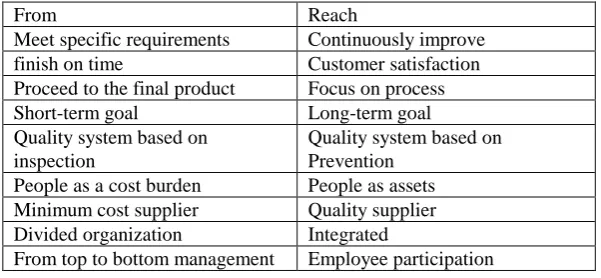
[image:2.595.148.449.459.598.2]The cultural changes that are needed can be summarized as shown in table 2.
Table 2. The cultural transformation of total quality management in construction industry.
From Reach
Meet specific requirements Continuously improve
finish on time Customer satisfaction
Proceed to the final product Focus on process
Short-term goal Long-term goal
Quality system based on inspection
Quality system based on Prevention
People as a cost burden People as assets Minimum cost supplier Quality supplier
Divided organization Integrated
From top to bottom management Employee participation
However, corporate culture is a reflection of social culture, which means that it is difficult to change, because it exists in a society as a whole of the rules. But it is not impossible to introduce a new corporate culture to the working environment. However, aware of the possibility of changing corporate culture, and this is the only way to achieve total quality management, there are several ways to change corporate culture. Change can be achieved through the following methods: the role of management, training and improvement, processes and systems, employee involvement.
A careful look at one of the methods, the traditional management role is: planning, organization, command, coordination, control. Now the role needs to include: nominal leadership, leadership, liaison, supervision, propagandists, speakers, entrepreneurs, dealing with the interference, resource allocation, negotiators.
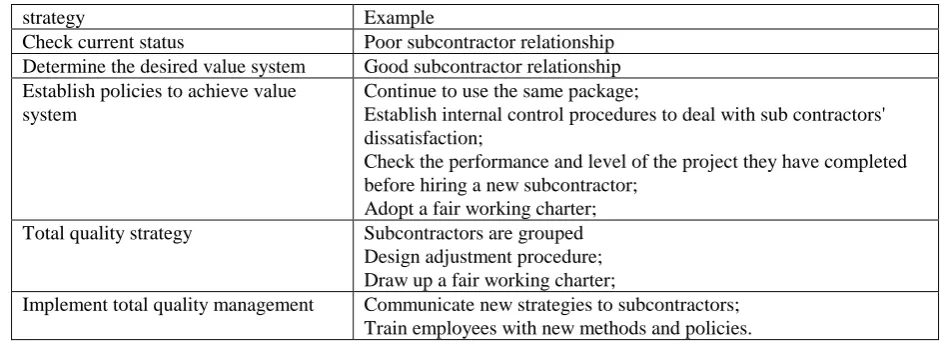
that it is not possible to change the culture. The following table shows how to implement this strategy in the construction industry.
Table 3. The method of cultural transformation in construction industry.
strategy Example
Check current status Poor subcontractor relationship Determine the desired value system Good subcontractor relationship Establish policies to achieve value
system
Continue to use the same package;
Establish internal control procedures to deal with sub contractors' dissatisfaction;
Check the performance and level of the project they have completed before hiring a new subcontractor;
Adopt a fair working charter; Total quality strategy Subcontractors are grouped
Design adjustment procedure; Draw up a fair working charter;
Implement total quality management Communicate new strategies to subcontractors; Train employees with new methods and policies.
The integration of enterprises with a single goal and common culture. Communication increases and values respect for individuals rather than respect for their department. One of the main purposes of total quality management is to eliminate internal differentiation, so that the development of institutions to a more holistic.
(1) Process management
An enterprise has an internal customer, the customer of the business process. The concept of the business process is the core of the overall quality management idea, because it believes that if all the internal customers are satisfied, the products or services provided by the external end users will be improved. For a construction project, which usually involves several companies, which is usually one of the reasons for the management problems. However, the idea of the business process spans these boundaries. Because the idea that all companies are all customers. If the main contractor sees the subcontractor as a customer and vice versa, it can be imagined that the construction process will proceed much more smoothly, and will also give the owner and end user a better project and service. Although the construction industry may hold the opposite view, there is no difference between the construction industry and the manufacturing sector.
From the point of view of total quality management, the customer is defined as the beneficiary of any work or activity. Customers are divided into:
Internal customer: the customer within the organization, such as the sales department;
External customer: that is, the process of the outside of the organization (such as subcontractors); End users: they contribute and have the final product (such as owner);
It is generally assumed that the improvement of the process to meet the needs of both internal and external customers will improve the quality of the final product. The intrinsic idea is that quality control does not depend on the final product, but in the control of each process.
The basis of total quality management is to change the internal culture. Commit to the process helps to achieve this cultural change, because this method will focus from the final product, short-term results and lack of coordination away.
Inverted organization can also be used as a way to integrate the enterprise. The reversed organization treats the people who serve as the top of the organization, not the manager, because they come from the front line.
(2) Employee participation
encourage employees to participate in the process and increase their master spirit. Employee participation can be achieved in the following ways:
①Quality circle
Organize employees to identify, analyze and solve problems related to a process. The quality cycle is important because he encourages the spirit of the owner and thus enhances the process.
Quality circle can be active and passive two. When a specific problem occurs in the process, the use of the passive circle. On the other hand, the active circle is a permanent team. In both cases, the active mass circle is considered to be better, because in the normal state than in the process of learning more problems.
The quality of the elements: people, skills, time, place, resources. The stage of quality circle identification: the process of identifying a problem or being the subject of an active quality circle; evaluating identifying all the problems and potential problems of a process. Distinguish between the question and the company can not control problems can be corrected; find a solution to solve the problem of optimal method; report to senior management report quality circle results and propose an improved system implementation; implementation system is improved.
②Cross functional team
Cross-functional teams, through horizontal operation, do not follow the typical hierarchical structure, promote the integration of enterprises. The basis of these teams is to coordinate the various departments of the enterprise through the process of their operation.
③Training and development
Without training, employees can not be involved. Total quality management training is usually divided into three categories: to enhance the quality of the purpose of the specific job skills training and total quality management principles. Total quality management is the key to solve the problem. Solving problems is a huge area of management, so here are some of the major problem solving techniques.
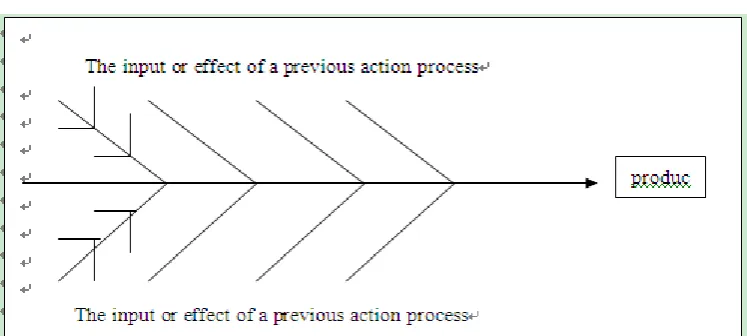
Storm thinking:Before dealing with a completely neutral term, there should be no question about the definition of the problem, and there should be no suggestion on how to solve the problem. It should limit the time to propose solutions to the problem, and all the proposed methods should be recorded, no matter what they seem to be messy. It should be emphasized again that unusual ideas should be encouraged because often these ideas form effective and feasible solutions.
Figure 1. Aisikawa (Ishikawa) diagram (fishbone).
④Performance evaluation
Traditional evaluation methods are not suitable for total quality management. Performance evaluation should focus on the company's goals, rather than the individual's contribution, performance evaluation should establish an effective quality incentive mechanism, take the right incentive strategy, and regularly evaluate the performance of employees.
(3) Change management
Total quality management involves changes at all levels of the company. Change doesn't happen on its own, it needs someone to manage it. Management change is to control the process of change and grasp the direction of change. The management of change includes four stages: the need for change; the acquisition and ongoing commitment; implementation; review.
One of the most important points of effective management change is that all employees of the company must be included. This is contrary to current management. Current management tends to make decisions for senior managers to change, and then to convey, and rarely explain the reasons. There is also a way to choose, that is, the mushroom method, managers simply to convey some ideas to some of their own do not understand the environment, and then wait to see what will happen.
Even if the change has been managed in order, there will be a number of obstacles, including costs, lack of time, the original concept of employees, industry culture and lack of capacity, etc.. Identifying and understanding these barriers to change is important to overcome them.
Construction Stage
The stage of material cost management can be the target activity-based costing concept[3], erials should be specified in the use of parts of the program, to facilitate the use of the target and the amount of pre made contrast. The Department of materials should be established by the end of the month to receive account for each construction team led by material summary report, and inventory quantity, material inventory, set up at the beginning and the end of current material collar number data, real-time tracking of materials and the materials to the actual consumption, for each combination of engineering quantity contract materials limit comparison of actual consumption.
Completion Stage
opportunity to change the cultural transformation of the construction industry will be faster than expected.
Acknowledgement
This research was financially supported by Scientific research project of Weifang University, Item number: 2012S12, Project Name: new technology and Application Research of cost management of construction project -- a case study of the East Chang Da Plaza Project.
References
[1] Lihui Sui, Zhexing Shu. Based on A new model of total quality management in twenty-first Century. Management science development.6 (2003): 13-15.
[2] Weifeng Lv. Total quality management, Beijing, 1997.