DOI 10.3233/ISU-2012-0651 IOS Press
Huddersfield Open Access Publishing
1
Graham Stone
Information Resources Manager, Computing and Library Services, University of Huddersfield, Queensgate, Huddersfield, UK
E-mail: [email protected]
Abstract. This paper presents the findings of the Huddersfield Open Access Publishing Project, a JISC funded project to develop a low cost, sustainable Open Access (OA) journal publishing platform using EPrints Institutional Repository software.
Keywords: Open access, publishing, University Press, e-journals, culture, technology
1. Introduction
The Huddersfield Open Access Publishing (HOAP) Project [11] was a 6 month project funded by JISC and led by Computing and Library Services at the University of Huddersfield, in conjunction with the School of Education and Professional Development and the Research and Enterprise Directorate. The University of Huddersfield is a medium-sized university in the north of England of around 23,000 students. The University has a rapidly expanding research portfolio and is on target to achieve its goal of becoming an internationally recognised research-led institution.
The HOAP platform aimed to develop a low cost, sustainable Open Access (OA) journal publishing platform using EPrints Institutional Repository software. It has been used to migrate the University journal,Teaching in Lifelong Learning, from its existing print subscription model to an OA e-journal. A specific front end has been created for the journal, with content being archived in the University Repository. As part of this work the ‘notes for contributors’ section has been completely revised and a move from copyright transfer to a ‘licence to publish’ model has also been undertaken. Membership of CrossRef and the Committee on Publishing Ethics (COPE) has been investigated and the journal has been be submitted to the Directory of Open Access Journals (DOAJ).
The platform will also be used to launch a new title,Huddersfield Research Review, which will show-case the most significant research at the University of Huddersfield by including interviews with the authors of the most cited and/or most downloaded University articles in the University Repository to-gether with an editorial overview by a senior researcher who will locate Huddersfield research within the broader national and international literature in the relevant fields and disciplines.
An audit of the University’s journals has also been undertaken to assess the suitability of adding these to the platform in the future. This has proved extremely successful resulting in the addition of other titles during the project and also the potential for starting two new OA titles in 2012.
1Paper also published in theProceedings of the 16th International Conference on Electronic Publishing, ISBN
978-1-61499-064-2.
216 G. Stone / Huddersfield Open Access Publishing
Finally, the project has developed a toolkit for other institutions, this includes details of new work-flows, a ‘licence to publish’ template and guidelines for new title proposals, which the project hopes can be adopted by the wider community.
2. Open Access journals
The philosophy of the University-as-publisher in reaction to the ‘serials crisis’ is well established, “As the chief benefactor of research within its walls, universities have long chafed at the notion that this research is given away to commercial entities, then repurchased at a premium” [34].
Indeed in their 2004 study, Rowlands et al. [29] found that in relation to alternative business models for journal publishing many authors’ thought that universities, amongst others, should fund scholarly journals [22]. By 2010 McClanahan et al. [20] reported that academics attitudes to e-journals themselves had shifted and that use of printed journal had been all but eliminated in favour of e-versions, however, Kennan [16] found that there may still be lack of understanding about OA journals and self-archiving, with many authors equating OA with lack of peer review. Initial findings from the SOAP project showed that attitudes to OA publishing are changing with 89% of researchers stating that they were in favour of OA journals, but only 8% of the yearly scholarly output was published in OA journals [6], this was also found at the local level by a survey of research staff at the University of Huddersfield in 2010 [32].
In a recent Research Information Network report, Nicholas [28] observes that there is little reliable information on the number of OA articles, but estimates that 20.6% of ISI-indexed papers were available through either green or gold OA in 2008. However, this is a constantly evolving picture and in 2011 Sherpa reported that 60% of journals allowed for “immediate archiving of peer reviewed content” [21]. Laakso et al. [19] have shown that, since 2000, “the average annual growth rate has been 18% for the number of [OA] journals and 30% for the number of [OA] articles” and that OA journals had represented 7.7% of all peer-reviewed journal articles. Björk [1] concludes that the fact that major publishers are now coming on board with OA journals proves the sustainability of the model.
As the Bloomsbury Qatar Foundation Journals White Paper states in its opening paragraph, “Open access publishing has arrived” [2].
3. The HOAP platform
The HOAP project attempts to bring together the two systems of delivering OA research articles, OA repositories and OA journals [38]. The project has developed a low cost, sustainable OA journal publishing platform using EPrints Institutional Repository software [37]. The project is managed by the University of Huddersfield Press, an initiative led by Computing and Library Services in order to “support the production and dissemination of research in new ways” [36]. The principle aim of the project was to develop the platform to convert the peer reviewed University journal,Teaching in Lifelong Learning[35], from its existing print subscription model to an OA e-journal.
3.1. Specification
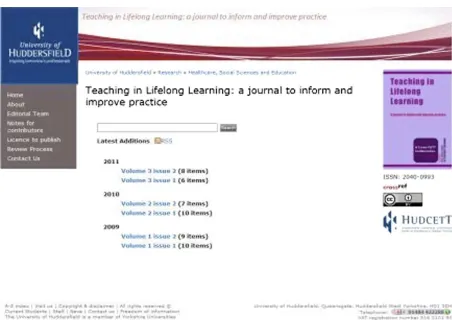
Fig. 1.Teaching in Lifelong Learninglanding page. (Colors are visible in the online version of the article; http://dx.doi.org/ 10.3233/ISU-2012-0651.)
allows each title to have its own branding on the landing pages and contents pages. For new titles, there may be a small charge for completing this work as part of any set up costs of the journal.
The creation of the journal landing pages and the volume/issue pages is fully automated. The articles are uploaded into the Repository in the normal way, with the first article of a new issue automatically creating a new entry on the landing pages (Fig. 1) and a new issue page by referencing the ISSN, year, volume, issue and page numbers in the articles. Each subsequent article deposited in the issue will therefore be listed on the journal pages. The efficient workflow means that an entire issue can be uploaded in around 30 minutes. The articles themselves maintain the standard Repository branding, but each one also links back to the journal’s landing pages on the platform. This simplifies the process and aids discovery, e.g., the article only has one instance in the Repository and can be discovered through the Repository, journal landing pages, via Google (Scholar), and in due course, the DOAJ. Inclusion in DOAJ will mean that the title will be retrieved from web scale discovery systems such as Summon, Primo, etc.
3.2. Adding content to Teaching in Lifelong Learning
218 G. Stone / Huddersfield Open Access Publishing
journal articles they deposit via CrossRef” [5]. In order to fulfil these requirements, the original Word documents had to be requested. Approximately 200 DOIs were added in this way. Although this process resulted in the correct metadata being added to the older articles it did result in the format of the original PDF and the Word/PDF copy being different. This has also led to a discrepancy in page numbering for these articles, an issue which is still to be fully resolved. In order to reduce the workload in future, the notes for contributors section of the journal pages were rewritten to request authors to supply DOIs where possible. The process of checking the DOIs will now become part of the copy editing process, as will the creation of new article level DOIs.
The move from a subscription model to an open access model required a complete review of the notes for contributors. The print version required authors to assign the copyright to the Press, but this goes against the ideals of open access. The journal now has a new ‘notes for contributors’ section. The ‘Licence to Publish’ (LtP) replaces the previous copyright transfer agreement. The LtP allows the author to retain the copyright under a Creative Commons Attribution 3.0 Unported License (cc-by) [4].
Volume 4, Issue 1 became the first truly online only OA version of the journal in June 2012. This volume sees a change of ISSN for the journal as this is required by the British Library in order to reflect the change in format. After a suggestion from one of the project team, it was agreed that the University Press become a member of COPE [3], a forum for editors and publishers of peer-reviewed journals to discuss all aspects of publication ethics.
In addition to submission to the DOAJ, the project received a request for the title to be included by JournalTOCs at Heriot Watt University [15]. JournalTOCs is the largest, free collection of scholarly journal Tables of Contents (TOCs): 17,493 journals (including 2898 selected Open Access journals) from 962 publishers.
3.3. Cost benefits
[image:4.595.206.394.545.684.2]Like many journals,Teaching in Lifelong Learningrelies on voluntary contributions for the editorial role and peer review. Income was derived from subscription, a contribution from Huddersfield Univer-sity’s Distributed Centre for Excellence in Teaching Training (HUDCETT) and the UniverUniver-sity’s Teach-ing and LearnTeach-ing Institute (TALI).
Figure 2 shows 70% of the expenditure of the journal went towards the printing, postage and stationery costs associated with a print only copy. Thus, the move to an OA model, although meaning a loss from
subscription income, actually resulted in a reduction in the amount of contribution from HUDCETT. Given the aims of the journal to disseminate the work of early career researchers from across the UK, this contribution is seen as an investment for future research.
Changes in the workflows from Volume 4 onwards have resulted in considerable time-savings com-pared to the time taken to prepare for the print issue. For example, the layout of PDFs has been simplified from two columns to one in order to make improvements to the online reading experience. There is now more work at the typesetting stage as DOIs have to be added to all references and checked for accuracy, however, publication is almost instantaneous, with an entire journal able to go live within a couple of hours.
3.4. Usage statistics
A major impact of only having one instance of the article in the Repository is that the IRStats package [12] can be used to monitor usage for all articles in the journal. This also allows authors to see their own statistics immediately. In addition the ‘impact’ of a particular volume can be measured over time using the reporting feature on the IRStats administration pages. For example, volume 3(2) has had over 500 downloads from 33 countries around the world within the first 8 months of publication.
3.5. Huddersfield Research Review
Another outcome of the project was to assess the feasibility of a journal to showcase the most signifi-cant research at the University of Huddersfield by including interviews with the authors of the most cited and/or downloaded articles in the Repository together with an editorial overview by a senior researcher who will locate Huddersfield research within the broader national and international literature in the rele-vant fields and disciplines. TheHuddersfield Research Reviewwas endorsed by the University Research Committee in December 2011 and the project will be taken forward during 2012.
3.6. New and additional titles
An audit of the University’s journals revealed a further 5 journals in existence, in addition to a number of annual reviews. As part of the project, 2 of these titles were loaded onto the HOAP platform,Mental Health and Learning Disabilities Research and Practice andRADAR. These titles have now been as-signed DOIs. As a result of the audit a number of new journals, including a proposal for theJournal of Magic Performancewill be considered for publication by the University of Huddersfield Press Editorial Board. The Board will use submission guidelines authored by the project and inspired by a presentation given by Damien Short at the launch event of another JISC funded project, SAS Open Journals [30].
4. Cultural change within Huddersfield
220 G. Stone / Huddersfield Open Access Publishing
In addition,Teaching and Lifelong Learning, was highlighted in the 2012 Ofsted report on the School of Education and Professional Development, “A particular achievement has been the publication of a journal to inform and improve practice which is disseminated nationally across centres for excel-lence” [7].
4.1. Social media
Huddersfield has been experimenting with social media and web 2.0 tools and technologies since 2005 [33], consequently it was decided from the outset of the project to encourage reader comments and ratings and social tagging as part of the publication process. This has been partly achieved through the bookmarks and sharing features of the existing Repository, RSS feeds and automated tweets for new articles. A plug-in to EPrints also allows authors to see if their articles have been cited in Scopus. However, the project wanted to go one step further by encouraging authors and readers to use social media based on the recommendations of the 2010 RIN report, If you build it, will they come? How researchers perceive and use web 2.0[27] and discussions from the 4th ALPSP International conference [18]. The Repository will be implementing the SNEEP (Social Networking Extensions for EPrints) [31] suite of social networking extensions as part of the next release of EPrints. This will allow readers of the journal (as well as all other Repository content) to comment, tag and make notes once they log in. However, this will be dependent on how comfortable readers feel with social media and this leads back to the way this is encouraged and supported by their host institutions [27].
4.2. Advocacy
In order to facilitate the constant flow of papers, the editorial board ofTeaching and Lifelong Learning needs to ensure that the publication has a high profile. This should become easier as the journal develops, as a result of ease of access and evidenced by the increase in usage.
Based on the success and interest generated by the audit of University journals, the project also rec-ommended that the University Research Committee encouraged all Schools and Research Centres at Huddersfield to identify and plan potential research journals that could be launched via the HOAP plat-form. The University Press Editorial Board recently agreed to develop an advocacy model in order to encourage Schools and research centres. These journals could take the form of in-house research journals enabling early career researchers to get a foot on the publishing ladder or collaborative titles with other universities and research centres. In addition there has been interest from some Schools in publishing annual conference papers using the platform.
The project has also recommended that a feasibility study is undertaken to investigate whether the model could be offered to local societies in the region as a means migrate print journals to OA via the HOAP platform.
5. Impact on the wider community
The project hopes that the release of the HOAP Toolkit [10] will inspire other institutions to investi-gate OA journal publishing. The toolkit was launched through the University Repository in December 2011 and features sections on moving to OA; setting up journal landing pages using EPrints; adding content; dissemination and workflows. The toolkit also gives guidance on how to set up a new journal and includes details on the LtP and notes for reviewers and authors that the project used.
6. Comparisons with OJS
The HOAP project team has been in contact with its sister JISC project, SAS Open Journals, which uses the OJS platform, throughout the funding period and there are some interesting comparisons that can be made between the two models. Both models have unique strengths. On observation of the SAS Open Journals project [30] and Huddersfield’sNorth American Journal of Welsh Studies[23], the OJS platform has a very functional back end enabling a smooth workflow for the peer review process; however, the look and feel of the OJS platform is not as configurable as the EPrints platform. The very nature of the Repository platform concept is one of dissemination and usability, journals published in this way could blend into an existing Repository or as a standalone publication or suite of publications as well as benefitting from the discoverability of the EPrints software via Google (Scholar) and web scale discovery platforms. Looking forward, it will be interesting to see how the two platforms, OJS and EPrints compare and this is certainly an area that would benefit from further exploration.
7. Recommendations
The audit of University journals has proved extremely successful in tracing the different outputs from the Schools and also in starting a conversation about possible future projects. One of the recommen-dations from the project is to extend this audit to other UK universities with a view to depositing the metadata in a central repository; this could be something that might be considered in a future phase of the Knowledge Base+[17] project.
The outcomes and findings of the projects in this strand indicate that there is still further development work to do, of particular relevance to the HOAP project is PANFeed (Personal Academic News Feed) at the University of Southampton [24]. The PANFeed project aims to create personalised, adaptive RSS feeds based on the news feeds available at an institution. These RSS feeds could be incorporated into the development of theHuddersfield Research Review.
There is still further work to be done, particularly at the national level, where there is clear potential in scaling up the project to create university OA journals as an alternative to traditional forms of pub-lishing for niche subject areas and markets. The project has recommended that EPrints look to add the functionality developed for the HOAP project to the EPrints Bazaar [9] at the earliest opportunity, in order for other universities to benefit from the outcomes of this project. In addition, it is recommended that the best practice from HOAP and SAS Open Journals project be combined to provide a set of best practice guidelines, and also alternative platform recommendations.
7.1. Usage statistics
222 G. Stone / Huddersfield Open Access Publishing
understanding of usage will assist in the identification of ‘hot topics’, which will help to map out future directions for the journal titles. Analysis of usage will also show potential return on investment for the journals, e.g., a cost per download figure could be established by measuring usage against the on-going production costs of the journal.
Between 2009 and 2011, the University of Huddersfield Repository participated in the PIRUS2 [25] project. This project showed that reliable usage data could be taken from EPrints repositories accord-ing to COUNTER rules. One of the recommendations to JISC was the case for the implementation of ‘IRUS’, the Institutional Repository Usage Statistics service, based on the technical and organisa-tional model proposed in the final report of the PIRUS2 project. In recent months JISC have provided additional funding as part of UK RepositoryNet+to establish IRUS-UK [13], ‘a national aggregation service, containing details of all content downloaded from UK participating IRs’. It is hoped that this service will help to demonstrate the value and impact of Repositories in general and that, ideally, uni-versity publishing initiatives such as HOAP could join IRUS and therefore be in a position to deliver individual articles level usage reports (AR1) for authors and editors. Logically there seems to be a role for the JISC Journals Usage Statistics Portal (JUSP) [14] here, as they are perfectly placed to run custom reports for OA journals published in this way.
7.2. Workflows
Until now, the HOAP project has concentrated on workflows and discoverability of articles through the EPrints platform. However, there is a significant amount of work that could be done in developing a back-end to the platform. This would enable authors to deposit their articles directly into the system, which could then be peer reviewed, copy edited and published via a series of workflows. It is anticipated that the RIOJA toolkit [26] could be used to facilitate this area of development.
Furthermore, it is recommended that EPrints looks to develop the outcomes of the EPICURE project [8], which aimed to develop and make public an XML template for UCL e-publishing. This would allow both HOAP and Institutional Repositories to make output available in PDF and XML versions resulting in wider dissemination through mobile devices.
8. Conclusion
Ultimately, there is potential in JISC supporting the development of additional projects to exploit the potential of the HOAP platform in maximizing the return on investment from publicly-funded research and also further studies on the concepts and findings of the projects within the campus-based publishing strand.
Acknowledgements
References
[1] B.C. Björk, A study of innovative features in scholarly open access journals,J. Med. Internet Res.13(4) (2011), 1–14. [2] Bloomsbury Qatar Foundation Journals, Open Access, BQFJ White Paper, London, 2011, available at: http://www.
qscience.com/userimages/ContentEditor/1322148977938/oa-whitepaper.pdf. [3] Committee On Publishing Ethics (COPE), http://publicationethics.org/. [4] Creative Commons, http://www.creativecommons.org.uk/.
[5] CrossRef, http://www.crossref.org/.
[6] S. Dallmeier-Tiessen, R. Darby, B. Goerner, J. Hyppoelae, P. Igo-Kemenes, D. Kahn et al., Open access journals: what publishers offer, what researchers want,Inform. Services Use31(2011), 85–92.
[7] S. Dillon, University of Huddersfield: initial teacher education inspection report, Ofsted, London, 2012, available at: http://www.ofsted.gov.uk/inspection-reports/find-inspection-report/provider/ELS/70030.
[8] EPICURE (E-Publishing Infrastructure Capitalising on UCL’s Repositories), http://www.ucl.ac.uk/ls/epicure/. [9] EPrints Bazaar, http://bazaar.eprints.org/.
[10] HOAP toolkit, http://eprints.hud.ac.uk/12239/.
[11] Huddersfield Open Access Publishing blog, http://library.hud.ac.uk/blogs/projects/hoap/. [12] IRStats, http://wiki.eprints.org/w/IRStats.
[13] IRUS-UK, http://www.irus.mimas.ac.uk/.
[14] JISC Journals Usage Statistics Portal (JUSP), http://jusp.mimas.ac.uk/. [15] JournalTOCs, http://www.journaltocs.hw.ac.uk/.
[16] K.A. Kennan, Academic authors, scholarly publishing, and open access in Australia,Learn. Publ.20(2) (2007), 138–146. [17] Knowledge Base+, http://www.jisc-collections.ac.uk/knowledgebaseplus/.
[18] A. Küster, After disruptive change, what’s next for scholarly publishers?, in:Proc. 4th ALPSP International Conference on Publishing Perspectives, Association of Learned and Professional Scholarly Publishers (ALPSP), 27 September 2011, available at: http://publishingperspectives.com/2011/09/after-disruptive-change-scholarly-publishers/.
[19] M. Laakso et al., The development of open access journal publishing from 1993 to 2009,PLoS One6(6) (2011), e20961. [20] K. McClanahan, Embracing change: perceptions of e-journals by faculty members,Learn. Publ.23(3) (2010), 209–223. [21] P. Millington, 60% of journals allow immediate archiving of peer-reviewed articles: but it gets much better. . ., SHERPA
Services blog, 2011, available at: http://romeo.jiscinvolve.org/wp/2011/11/24/60-of-journals-allow-immediate-archiving-of-peer-reviewed-articles-but-it-gets-much-much-better/.
[22] D. Nicholas et al., In their own words: authors and scholarly journal publishing,Learn. Publ.18(3) (2005), 212–220. [23] North American Journal of Welsh Studies, http://welshstudiesjournal.org/.
[24] PANfeed, http://panfeed.ecs.soton.ac.uk/.
[25] PIRUS2 project, http://www.cranfieldlibrary.cranfield.ac.uk/pirus2/tiki-index.php. [26] Repository Interface for Overlaid Journal Archives (RIOJA), http://www.ucl.ac.uk/ls/rioja/.
[27] Research Information Network,If You Build It, Will They Come? How Researchers Perceive and Use Web 2.0, Research Information Network, London, 2010.
[28] Research Information Network,Access to Scholarly Content: Gaps and Barriers, Research Information Network, London, 2011, available at: http://www.rin.ac.uk/node/1172.
[29] I. Rowlands et al., Scholarly communications in the digital environment: what do authors want? Findings of an interna-tional survey of author opinion, Project report, Centre for Information Behavior and the Evaluation of Research (CIIBER), Department of Information Science, City University London, London, 2004.
[30] SAS Open Journals, http://sasopenjournals.blogspot.com/.
[31] Social Networking Extensions for EPrints (SNEEP), http://www.jisc.ac.uk/whatwedo/programmes/reppres/sue/sneep. aspx.
[32] G. Stone, Report on the university repository survey, Research report, University of Huddersfield, Huddersfield, October– November 2010, available at: http://eprints.hud.ac.uk/9257/.
[33] G. Stone and D. Pattern, Knowing me. . .Knowing you: the role of technology in enabling collaboration, in:Collaboration in Libraries and Learning Environments, M. Melling and M. Weaver, eds, Facet, London, 2012, to appear.
[34] G. Tananbaum, Of wolves and boys: the scholarly communication crisis,Learn. Publ.16(4) (2003), 285–289. [35] Teaching in Lifelong Learning, http://eprints.hud.ac.uk/journal_till/.
[36] University Leadership Council,Redefining the Library: Managing the Migration to Digital Information Services, The Ad-visory Board Company, Washington, DC, 2011.
[37] University of Huddersfield Repository, http://eprints.hud.ac.uk/.