2016 3rd International Conference on Information and Communication Technology for Education (ICTE 2016) ISBN: 978-1-60595-372-4
1 INTRODUCTION
Asynchronous motor is an important electrical equipment, which can make realization of electrical energy into mechanical energy. Asynchronous motor/It has played a very important role in modernization of industry, agriculture, national defense and science technology. Because of its safety, reliability and stable operation, asynchronous motor has a significant impact on the improvement of the national economy and people's living standards, and even on other equipment and people's life and property safety. If weak fault symptoms can be identified in the early stage of motor failure, it is helpful to take immediate measures to prevent the fault development, and make timely maintenance to resume normal operation as soon as possible. Therefore, by analyzing the characteristics of motor behavior under fault conditions, the fault detection for asynchronous motor is accurate with the use of an effective signal processing method, which can guarantee the safety of production process and personnel. Thus, the accurate fault detection can reduce motor fault rate in a targeted manner, and significantly reduce spare capacity, investment and annual cost savings. Therefore, the fault detection for asynchronous motor is of great significance, which is conducive to prevent, eliminate fault, and reduce the scope of the fault in a timely way (Ren Zhen, 2003).
2 WAVELET ANALYSIS
Depending on the form and content of the wavelet transform, the wavelet transform is divided into
continuous wavelet transform and discrete wavelet transform. Continuous wavelet transform places emphasis on theoretical analysis, while discrete wavelet transform focuses on practical application.
In continuous wavelet transform, the wavelet
function:
1 2
, ( ) ( ), , , 0
a b
t b
t a a b R a a
ψ = − ψ − ∈ > ,and
( )t
ψ satisfies the permissive condition:
( )
∞ < =
∫
∞∞
−
ω
ω
ω
ψ
ψ d
C
2 ˆ
(1)
Because of the redundancy of continuous wavelet transform, it is necessary to find out. In order to reconstruct the signal, discrete scale parameter a
and translation coefficient b to eliminate the redundancy in the transformation. In practice, the following formula is often used:
Z k j a
k
b= j = j; , ∈
2 1 ,
2 ,
( )
t( )
t j(
jt k)
k b
a
j j
− =
= 2 /2 2
2 , 2
1
, ψ ψ
ψ (2)
The formula (2) is often abbreviated as:ψj,k
( )
tConverting the form:
k j j
j
f f
k
WT , ,
2 , 2
1
ψ
=
In order to reconstruct the signal,
{ }
Z k j k j, ,∈
ψ
isrequired to be Riesz basis of L2
( )
R . Definition 1:Application of Wavelet Analysis in Fault Diagnosis for
Asynchronous Motor by Simulation
Zhizhang Hu, Yucheng Zhang, Hongqin Liang*
School of Mechanical Engineering, Southwest Jiaotong University, Chengdu, China *Corresponding author, [email protected]
A function
ψ
∈L2( )
R is called one of R functions, if{ }
Z k j k j, ,∈
ψ
is a Riesz basis followingthe rules below: ψj,k, j,k∈Z , its linear tension is
dense in L2
( )
R , and there are positive constant A, B, 0< A≤B<∞, then{ }
{ }
2, 2
2 , , 2
, 2 2
l k j
j k
k j k j l
k
j c B c
c
A ≤
∑ ∑
≤∞
−∞ =
∞
−∞ =
ψ
Will hold for all
{ }
cj,k , when{ }
=∑ ∑
<∞∞
−∞ =
∞
−∞ =
2
, 2
, 2
j k
k j l
k
j c
c
Suppose
ψ
is one function of R, the only one Riesz basis,{ }
ψj,k j,k∈Z, of L2( )
R exsist and is valid.Z m l k j
m k l j m l k
j , = , , , , , , ∈
,
, ψ δ δ
ψ
It is dual with
{ }
ψj,k . Then every f( )
t ∈L2( )
Rhas the only progression expression like equation 3:
( )
∑ ∑
∞( )
−∞ =
∞
−∞ =
=
j k
k j k
j t
f t
f ,ψ , ψ , (3)
Specially, if
{ }
Z k j k j, ,∈
ψ
could be the orthogonalbasis of L2
( )
R , then ψj,k =ψ j,k. Then the reconstructed function is( )
t f( )
tf
j
k j k
k j
∑ ∑
∞−∞ =
∞
−∞ =
= ,ψ , ψ , (4)
3 SIMULATION IMPLEMENTATION
Wavelet analysis has the characteristics of multi-resolution analysis, with good localization properties in the time domain and frequency domain. For different frequency components, wavelet analysis is capable of using gradually fine sampling step, which is valid to detect high and low frequency signals. Wavelet analysis is especially suitable for the analysis of singular signal, and can distinguish between singular size. In addition, the wavelet analysis can accurately reflect the time when the fault occurred, location and other information. Therefore, wavelet analysis can have real-time, effective condition monitoring and fault diagnosis on the equipment or the entire system. In the fault diagnosis for asynchronous motor, the modulus maximum value of wavelet transform is used to detect the current or voltage mutation point after the
fault, and to analyze internal fault of asynchronous motor. The fault signal can be extracted by using good frequency selection characteristics of wavelet transform multi-scale filter, which can be used for generator sample differential protection, detection of stator and rotor winding faults.
In addition, wavelet transform also shows its advantages in dealing with transient singularity signal as following: decomposition and reconstruction and de-noising of asynchronous motor fault signal, insulation detection for asynchronous motor, extraction of partial discharge signals, friction vibration of unit and other aspects (Bi Da-qiang, 2003).
3.1 Simulation of asynchronous motor
AC asynchronous motor is a multivariable system of higher order, nonlinear, strong coupling. If without certain assumptions, it is difficult to make quantitative analysis on the operation mode.
In the study of mathematical model of three-phase asynchronous motor, it is usually required to make the following assumptions:
(1) Three-phase windings are symmetrical, and along the circle of air gap, the magnetic potential is distributed according to the sine.
(2) Neglect of the influence of magnetic saturation, self and mutual inductances of the windings are linear.
(3) Ignore the core loss.
(4) The influence of temperature and frequency on the resistance of the motor is not considered.
3.2 Simulation of normal operation
Asynchronous motor model is more complex, both electrical parts, with both electrical and mechanical parts. The general model must have a dozen equation, composed of dozens of parameters. Also during the operation of asynchronous motor, the variation of its internal magnetic field distribution and the induced electromotive force is complex. Compared with Basic, C language programming Solving the Numerical Solution, Matlab/simulink has an unparalleled advantage to solve the numerical solution, such as its distinct, simple connection, without programming, debugging convenience.
Run the simulation, and the results in the Scope waveform display are as follows:
0 0.1 0.2 0.3 0.4 0.5 0.6 0.7 0.8 -400
-300 -200 -100 0 100 200 300 400
时 时T/s
三三电电
-200 -100 0 100 200 300
相电相
A
-200 0
200 B相电相
0 0.1 0.2 0.3 0.4 0.5 0.6 0.7 0.8 -200
0 200
时 时T/s
相电相
C
Figure 2. Three-phase current.
3.3 Fault simulation
In this paper, the simulation is conducted on broken circuit of power A phase, broken circuit of stator A phase and three-phase unbalance of asynchronous motor.
3.3.1 Broken circuit of power a phase
0 0.1 0.2 0.3 0.4 0.5 0.6 0.7 0.8 -400
-300 -200 -100 0 100 200 300 400
时时T/s
三三电电
Figure 3. Three-phase unbalanced voltage.
-1000 -500 0 500 1000
相电相
A
-1000 -500 0 500 1000
相电相
B
0 0.1 0.2 0.3 0.4 0.5 0.6 0.7 0.8 -1000
-500 0 500 1000
时 时T/s
相电相
C
Figure 4. Three-phase breaking current.
3.3.2 Short circuit of a phase
0 0.1 0.2 0.3 0.4 0.5 0.6 0.7 0.8 -400
-300 -200 -100 0 100 200 300 400
时 时T/s
三三电电
Figure 5. Three-phase voltage (A phase ground fault).
-1000 -500 0 500 1000
相电相
A
-1000 -500 0 500 1000
相电相
B
0 0.1 0.2 0.3 0.4 0.5 0.6 0.7 0.8 -1000
-500 0 500 1000
时 时T/s
相电相
C
Figure 6. Three-phase short circuit current.
3.4 Fault diagnosis—wavelet analysis (Taking A phase current as an example)
The high frequency signals generated by the fault transient can be used to correctly identify the internal fault of the generator. Wavelet analysis has excellent time-frequency focusing ability, and it can be focused to any details of the object. What’s more, wavelet analysis also has a unique singularity detection capability, which can create the conditions for the analysis of non-stationary transient information. Decompose the high frequency signals
at different scales by wavelet analysis, and it will clearly show the singular variation of voltage and current signals in the fault, so that the fault detection and diagnosis can be effectively carried out.
Wavelet analysis has a great advantage in the extraction of fault signal characteristics. For the fault signal, before and after the fault, the component based on the wavelet transform has a good stability, which can overcome the influence of motor frequency fluctuation. The detection result based on wavelet transform is almost not affected by the system frequency offset , so wavelet analysis has a good ability of frequency tracking. Moreover, due to the relative concentration of the wavelet function energy, the basis function energy of Fourier algorithm is disperse, so that the wavelet transform has a larger advantage in the processing of non - stationary and transient signal. Therefore, the faults of ship synchronous generator should be detected by using wavelet analysis theory, and this detection can be used to diagnose these faults accurately and effectively (Ren Zhen et al, 2001).
3.4.1 Normal signal
2 4 6 8 10 12 14 16
x 104
-0.4 -0.2 0 0.2 0.4
d1 -0.5
0 0.5
d2 -1 0 1
d3 -2 0 2
d4 -5 0 5
d
5 -200
0 200
a5 -200
0 200
s
正正正正
[image:3.612.317.554.312.469.2]Decompos ition at level 5 : s = a5 + d5 + d4 + d3 + d2 + d1 .
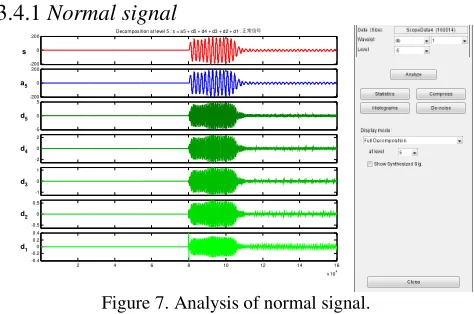
Figure 7. Analysis of normal signal.
Wavelet analysis function should be used to analyze the simulation signal, and the results are shown above (In the figure, s is the original signal, and a5、 d5, d4, d3, d2, d1 are db5 processed wavelet function signals and decomposed 1st ~5th layer signal respectively, s= a5+d5+d4+d3+d2+d1). It can be seen from the waveform analysis of the figure, each detail coefficient of the normal analog signal does not appear abnormal after the five layers decomposition of db5 wavelet.
3.4.2 Short circuit of a phase
obvious, and the real-time detection can not be carried out by traditional Fourier analysis. Due to the characteristics of time-frequency localization, wavelet transform is the best method to solve this kind of non-stationary signal decomposition. Through the detection of singular points and comparison of modulus maxima of high frequency component of fault signal before and after fault, the fault of relatively few short circuited turns can be detected, which is helpful to find the fault as soon as possible (Cui Zhi-Chao, 2010).
2 4 6 8 10 12 14 16
x 104
-2 0 2
d1 -4 -2 0 2 4
d2 -5 0 5
d3 -10
0 10
d4 -20
0 20
d5 -500
0 500
a5 -500
0 500
s
相相相相相
[image:4.612.322.554.153.291.2]Decomposition at level 5 : s = a5 + d5 + d4 + d3 + d2 + d1 . A
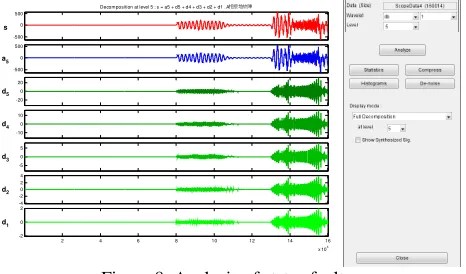
Figure 8. Analysis of stator fault.
From the above figure, when the grounding fault occurs in a phase, the symmetry of the asynchronous motor is destroyed. Wavelet analysis function should be used to analyze the simulation signal, and the results are shown above (In the figure, s is the original signal, and a5, d5, d4, d3, d2, d1 are db5 processed wavelet function signals and decomposed 1st ~5th layer signal respectively, s= a5+d5+d4+d3+d2+d1). It can be seen from the waveform analysis of the figure, there is obviously high frequency oscillation in the grounding fault after the five layers decomposition of db5 wavelet. The time of occurrence of the fault can be determined by using the detected signal, and the fault will be diagnosed in time.
3.4.2.1 Broken circuitof a phase
When the rated symmetrical three-phase voltage is applied to the motor and the motor is in stable operation under constant torque and rated load, A phase of motor stator winding is in suddenly broken circuit. The motor is forced to run in two phases, and the simulation results of the motor is as shown in Figure.
There is one phase disconnection in three-phase power, and the two series phase windings are connected with the other phase winding in parallel. The three-phase induction motor is changed into a single-phase motor, only producing pulsating MMF at startup, and the average starting torque is equal to zero (Cui Zhi-Chao, 2010). The instant disconnection of a phase has a greatly impact on impulse current and impulse torque of the stator, which value is very large. In the torque, there is a
strong component of two harmonic oscillator, which causes the fluctuation of rotating speed or motor vibration. After the broken circuit, the current of a phase winding in the stator is two times the current of the other two phase windings. The asynchronous motor can be in long time operation under 0.3 times of the harmonic load, but the efficiency and overload capacity of motor will be greatly decreased (Deng Jian-guo et al, 2012).
2 4 6 8 10 12 14 16
x 104
-2 0 2
d1 -4 -2 0 2 4
d
2 -5 0 5
d3 -10
0 10
d4 -20
0 20
d5 -500
0 500
a5 -500
0 500
s
相相相
Decompos ition at level 5 : s = a5 + d5 + d4 + d3 + d2 + d1 . A
Figure 9. Analysis of A phase broken fault.
When the broken fault of A phase occurs in the stator winding, the symmetry of the asynchronous motor will be destroyed. There is two harmonic induced electromotive force in the winding, which can generate a lot of impulse current. By detecting the mutation signal and the wavelet analysis of the mutation signal, the wavelet coefficient can be seen from d1, d2 layer of the details figure, and the fault can be diagnosed in a timely and accurate manner.
In view of the variation characteristics of harmonic component in fault, the characteristics of wavelet transform multi-resolution analysis are applied to analyze the fault signal and extract the fault characteristic quantity. It can be seen from the wavelet decomposition of the signal (Figure 7 and figure 8 and Figure 9), the mutation (fault) appears in d4, d5 layer at the moment of simulation signal fault, which indicates that the wavelet analysis can be used to diagnose the fault of asynchronous motor.
4 CONCLUSIONS
[image:4.612.64.297.178.315.2]applications, which is an ideal mathematical tool for section spectrum analysis of the signal.
5. ACKNOWLEDGMENTS
This work was supported by the Fundamental Research Funds for the Central Universities of China (Grant No. 2682015CX035).
REFERENCES
[1] Ren Zhen, 2003. Wavelet Analysis and Application to Power Systems. China Electric Power Press, Beijing, China.
[2] Bi Da-qiang, 2003. Studies on Stator Ground Fault and Its Protection for Large-Sized Hydro-Generators. Tsinghua University, Beijing, China.
[3] Ren Zhen, Huang Qun-gu, Huang Wen-ying, Zhang Yong-jun, et al, 2001. Four New Wavelet Transforms And Their Application To Fault Signal Analysis In Generators Of Power Systems. Automation of Electric Power Systems, 01:50-54.
[4] Cui Zhi-Chao, 2010. Application of Wavelet Analysis in Fault Diagnosis for Ship Generator by Simulation. Jimei University, Xiamen, China.