2016 International Conference on Electronic Information Technology and Intellectualization (ICEITI 2016) ISBN: 978-1-60595-364-9
Study on Algorithm of Fire Detection Based on
Fusion of Multiple Features
Hongmei Yan
ABSTRACT
The paper introduces the algorithm of fire detection based on fusion of multiple features for the early warning of fire. Firstly, on the basis of the color characters of fire image, the color segmentation is achieved under the Ohta color space by the Otsu method. Then, many features in flame area are extracted, which include number of corner points, circularity, area change percentage and height variation. Finally, the features can be fused using the BP network. The results show that the algorithm has characterized by its simplicity and good applicability. Therefore, the fire detection can be done effectively.
INTRODUCTION
With the development of the techniques of information, the fire detection and pre-warning are moving forward to visualization and intelligence. In a word, the flame can be discriminated by its features, which can be extracted by the technique of digital image process combined by pattern recognition[1]-[3]. These methods not only can realize the early-warning of fire, but also have the advantages including intelligence, anti-interference and high security, which provide new way for fire detection as well as overcoming the shortcoming of the traditional ways. The paper introduces the algorithm of fire detection based on fusion of multiple features in video surveillance system. Firstly, the videos from the surveillance system would be converted into the frame sequence and the color features of flame image can be analyzed. Thus, a new method of color segmentation is proposed by Ohta color
________________________
space combined by Otsu method. Then, four features in flame area are extracted, which include circularity, number of corner points, area change percentage and height variation. Finally, the features which can be fused as input of BP neural network would be used to detect fire by learning and training. Because of the combination of image process and BP neural network, the algorithm have the advantages such as high recognition rate and strong adaptability. In process of practical application, the algorithm can be planted to the existing system without additional equipment, being low cost and widely use.
COLOR SEGMENTATION
The colors of burning flame include red, yellow and white and the brightness around fire flame is high to distinguish from background. The color features of flame of many detection algorithms can be used to recognize the fire area. The RGB model, widely used, is one of the standard modes in industry. The whole color of flame image appears in shades of red because the proportion of R is the largest. If R component may be considered to cut apart the fire area, it is difficult to distinguish flame area from sky and other objects whose brightness of R are high too.
Ohta proposed the Ohta color model expressed by the orthogonal color features set
I1,I2,I3
in 1980 [4]. The conversion formula from RGB to Ohta is representedby Equation 1
4 / ) 2 ( 2 / ) ( 3 / ) ( 3 2 1 B R G I B R I B G R I (1)
where the conversion from RGB space to that of Ohta is linear. Moreover, the calculation process of
I1,I2,I3
in Ohta color space is simple and each componentis independent from each other. Therefore, the segmentation of color image by Ohta space model will receive very good results.
By many experiments, the histogram of flame image I2 has the features of single peak or two peaks in Ohta color space, so it is suitable for flame segmentation [5]. Considering the proportion of R is greatest whereas G and B smaller, the I2new
component would be restructured in terms of Equation 2.
) ( ) (
2 R B R G
In Figure 1, I2new has higher brightness than I2 in flame area, so the threshold of
new
I2 is used to carry on binarization processing for I2 in order to cut apart the fire
area more accurately. The color segmentation procedure is as follows:
(1)The RGB color image may be transformed to gray image in Ohta color space by using Equation 1 and 2, and I1,I2,I3, I2new would be get. Then, the adaptive
threshold T of I2new can be received by Otsu[6];
(2)I2 is binarily processed by T ;
(3)The empty is filled by mathematical morphology, noise removed.
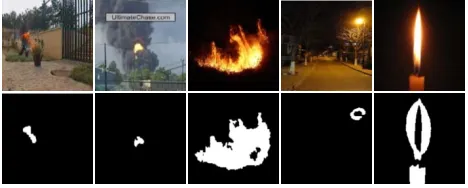
The segmentation of feature regions which have suspected flame color is realized by the procedure above. The treatment results for different images are shown in Figure 2, the original images are shown in line 1, color segmentation in line2. Form Figure 2, the new method of color segmentation has better segmentation results for interfering flame by pedestrian, smoke of fire in the distance and fire at night. At the same time, street lamps and candle fire, whose colors are similar to fire, are distinguished. Therefore, the fire flame can be detected accurately combined by other features of fire.
EXTRACTION OF FLAME FEATURES
The flame features mainly include static and dynamical features. The static one is the visual feature in single frame image of flame video, including two aspects such as space structure and spectral information. On the other hand, the dynamical features are the change of area, shape and radiation intensity of fire in the process of burning. Complexity of algorithm and recognition rate considered, four representative features of flame are exacted in this paper, which include circularity, number of angular point, area change percentage and height variation.
[image:3.612.194.411.509.569.2](a) Original image (b) I2 component(c) I2new component
Circularity
The circularity is a quantity which can be used to measure the degree of approximation compared by a circle, represented by Equation 3 [7].
2
4
P A
C (3)
[image:4.612.185.419.285.379.2]where P is the perimeter and A is the area. C is the circularity whose value ranges from 0 to 1. For example, the circularities of street lamp, car light and flashlight are close to 1. Because of marginal changes and irregularity in the process of fire burning, the circularity of fire area will be less than 1. Thus, the circularity can be used as an important judge criteria.
Figure 2. Color segmentation results.
Corner Points
The corner points is the corner which protrudes or indented in sight, such as the corner of triangle and polygon. The circular object has no corners. The distinct characteristic of unstable fire edge trembling is the irregular change of the number of fire corners, while most of the objects of regular shape have relatively fixed corners. Therefore, the corner feature of fire is an important judge reason. In the paper, the algorithm of Harris corner detection is used to detect the corners, which can meet the demand for real-time of video detection.
Area Change
The fire area is irregular affected by the magnitude of combustion products. With the increasement of flame in early stage of fire, the area of fire will extend gradually. Thus, the enlargement of fire area can be used as a criteria for early fire.
The area change percentage is calculated by Equation 4.
A
A
where Ai1 is the suspected fire area of No. i1 frame and Ai is that of No. i
frame. R is the calculation result. The area can be represented by the number of
pixels in suspected fire area in image processing.
Height
[image:5.612.93.497.316.380.2]In the process of burning, the height of fire will change due to flicker phenomenon and its variation rule is directly related to the flicker frequency of fire. The spectral component of height variation is rich, whereas that of car light and street lamp is poor. So the height variation can be used as an vital detection basis for fire recognition. In this paper, the fire height is replaced by the mean of longitudinal coordinate in suspected fire area.
TABLE I. FEATURE DATA ( CIRCULARITY AND CONER POINTS).
TABLE III. FEATURE DATA (AREA CHANGE PERCENTAGE AND HEIGHT CHANGE).
From the videos of fire flame, candle fire and streetlights, 300 frames are selected respectively to extract the above features. Among these the data of futures above-mentioned of 5 frames are shown in Table I and Table II.
As shown in Table I and Table II, the results are good when the fire was detected by circularity, algorithm being simple. However, the detection effect will become poor while the fire is far from the camera. The feature of corner points, not limited by the distance between fire and the camera, would result in loss of geometric information when there is opaque objects. Thus, combining the area change percentage of fire with height change, the detection rate will be increased by fusion of multiple features.
Feature data Circularity Corner points
Flame 0.1491 0.1091 0.2479 0.2137 0.1875 193 137 280 164 281
Candle fire 0.0249 0.0358 0.0332 0.0457 0.0438 45 46 45 44 45
Street lamp 0.8375 0.8980 0.9132 0.8873 0.9154 3 5 2 4 3
[image:5.612.92.497.432.494.2]FIRE DETECTION
The features would be fused after extracted in order to judge whether there is a fire or not. BP neural network has unique advantages on classification recognition owing to its self-organization and self-study. Here the three-layer model of BP neural network is selected, which make it easy to implement. The function of the input layer in BP network is equivalent to the buffer memory to receive external data, so its number of nodes depends on the dimension of the input vectors. In the paper four features in suspected flame area are used as the reasons to judge fire flame. Thus, there are four nodes on the input layer. In addition, in order to prevent output saturation due to excessive absolute value of net put the values of input and output would be dealed with normalization, the data limited in[-1,1] interval. While the fire flame can be recognized by BP network, if the output value is 1, fire occurs and 0 means no fire, so one node is selected on the output layer. The node number of the hidden layer are related to the amount of information of input and output. The simplicity of network and effect of experiment considered, there are three nodes on the hidden layer. Some videos used in the experiment comes from the fire video databasehttp://signal.ee.bilkent.edu.tr/VisiFire/index.html), others from the internet and the author’s database. 240 frames are selected as the training samples, which comes from fire frame, candle fire and street lamp respectively. Besides the training set, 60 frames are chose as the detection samples. The recognition rate is 93%, corresponding to the recognition rates of other similar algorithms.
CONLUSION
The algorithm of fire detection based on fusion of multiple features is proposed, which combines the features of fire image with BP neural network. The results show that the algorithm can distinguish fire from other similar distractors. Meanwhile, it has the advantages including low complexity, high detection rate, fitting for outside and high space, so the fire can be detected timely and accurately and the warning will be done. In addition, this algorithm can be planted to the existing video monitoring system, being low lost and widely use. Moreover, in order to increase the detection rate more features of fire would be exacted. In a word, the new path to reduce the complexity of algorithm is to research other features which can reflect the whole feature of fire more accurately.
REFERENCES
1. Jing Shao, Guanxiang Wang and Wei Guo. Jun 2013. “Fire detection based on video dynamic texture” (In Chinese). Journal of Image and Graphics, 18(6), pp. 647-653.
3. Han Bao, Quansheng Kang and Ming Zhou. Jun 2011. “A Flame Recognition Algorithm Based on LVQ Neural Network and Image Processing” (In Chinese). China Safety Science Journal, 21(6) , pp. 60-64.
4. Ohta Yu Ichi, Kanade Takeo. 1980. “Color information for region segmentation”. Computer Graphics and Image Processing, 13(3), pp. 222~241.
5. Jiansheng Wu, Yao Gao, Bin Zhang. Jan2014.”A video-based flame detection method. Computer Applications and Software” (In Chinese). Computer Applications and Software, 31(1), pp. 173-175, 190.
6. N. Otsu. 1979. “A Threshold Selection Method from Gray-Level Histograms”. IEEE Transactions on Systems, Man, and Cybernetics, 9(1), pp. 62-66.