The London School of Economics and Political Science
Why do countries implement Basel II?
An analysis of the global diffusion of Basel II implementation
Young Bong Cho
January 2013
A thesis submitted to the Department of International Relations of
the London School of Economics and Political Science for the
Declaration
I certify that the thesis I have presented for examination for the MPhil/PhD degree of the London School of Economics and Political Science is solely my own work.
The copyright of this thesis rests with the author. Quotation from it is permitted, provided that full acknowledgement is made. This thesis may not be reproduced without my prior written consent.
I warrant that this authorisation does not, to the best of my belief, infringe the rights of any third party.
Abstract
Acknowledgements
I would like to express my deepest gratitude to my supervisor, Professor Andrew Walter. I owe a large part of this thesis to Professor Walter, as it was his pioneering work on international financial standards that opened my eyes to this topic in the first place and motivated me to pursue a PhD on the implementation of Basel II. Professor Walter has been a fantastic role model and I feel extremely lucky to have been his supervisee. I am grateful for his critical, insightful, constructive, detailed and timely comments on all aspects of this thesis from start to finish.
I would like to thank my parents and brother in Korea for their unconditional support. I am particularly indebted to my sisters and their family for their endless support, especially Sora, Do and Joo. I am especially thankful to Suyoun for always being there for me. Having spent over eight years at the LSE, I have many people to thank, but in particular, I would like to express my sincere gratitude to the Department of International Relations, Department of Economics and my colleagues at the LSE, especially Rajeev Sibal, Daniel Capparelli, Natali Bulamacioglu, Silvia Pepino, Kevin Young and fellow inhabitants of Q1. I would also like to thank Steve Crosby and Richard Jordan at Standard Chartered Bank.
Table of Contents
List of Figures and Tables ... 1
List of Acronyms and Abbreviations... 2
Chapter One Introduction 1.1 Why do countries implement Basel II? ... 3
1.2 Research question and central explanatory framework ... 7
1.3 Overall research design ... 10
1.3.1 A global dataset of Basel II implementation ... 11
1.3.2 Quantitative study: Testing the effects of policy diffusion on Basel II implementation across the world ... 12
1.3.3 Six country case studies: Unpacking the process of policy diffusion ... 16
1.4 Chapter plans and summary of main arguments ... 20
Chapter Two Literature Review 2.1 Introduction ... 27
2.2 The Basel Committee, Basel I and Basel II ... 28
2.2.1 The Basel Committee ... 28
2.2.2 Basel I ... 31
2.2.3 Basel II ... 32
2.3 The empirical literature on the Basel Accords ... 37
2.3.1 The empirical literature on Basel I ... 38
2.3.2 The empirical literature on Basel II ... 47
2.4 The theoretical literature: Explaining compliance with international norms ... 49
2.4.1 The state-based enforcement approach ... 49
2.4.2 The market-based approach ... 50
2.4.3 The managerial approach ... 51
2.4.4 Functional institutionalism ... 53
2.4.5 Role of ideas ... 54
2.4.6 Domestic-level explanations ... 55
2.5 The policy diffusion literature ... 58
2.5.1 Policy diffusion: definitions and features ... 58
2.5.2 Four policy diffusion mechanisms: How do policies diffuse? ... 59
2.5.3 Strengths and weaknesses of the policy diffusion literature ... 66
Chapter Three
Basel II implementation at the global level: A quantitative analysis of Basel II implementation and its diffusion across 150 countries
3.1 Introduction ... 73
3.2 A global overview of Basel II implementation ... 74
3.2.1 Measuring Basel II implementation across 150 countries ... 74
3.2.2 The state of Basel II implementation across the world ... 79
3.3 Testing the effects of policy diffusion on Basel II implementation ... 86
3.3.1 The Model ... 86
3.3.2 The dependent variable ... 88
3.3.3 Policy diffusion variables ... 89
3.3.4 Control variables ... 94
3.4 Findings ... 102
3.4.1 The effects of policy diffusion ... 104
3.4.2 The effects of control variables ... 107
3.5 Limitations of the quantitative analysis ... 110
3.6 Conclusion ... 113
Chapter Four Case study design and case selection 4.1 Introduction ... 115
4.2 Case study design and methods ... 116
4.2.1 The within-case method of process tracing ... 117
4.2.2 The cross-case method of controlled comparison ... 120
4.2.3 Case selection procedure ... 121
4.3 Case selection ... 123
4.3.1 Construction of the truth table ... 123
4.3.2 Application of the case selection steps ... 127
4.3.3 Case selection for the controlled comparisons ... 130
4.4 Conclusion ... 133
Chapter Five The diffusion of Basel II across inter-supervisory authority networks: A comparative analysis of Malaysia and Chile 5.1 Introduction ... 134
5.2 Policy diffusion and Basel II implementation in Malaysia ... 136
5.2.2 Policy diffusion at the strategic level and BNM‟s implementation
policy ... 142
5.2.3 Policy diffusion at the tactical level as implementation progressed ... 147
5.3 Policy diffusion and Basel II implementation in Chile ... 152
5.3.1 American inter-supervisory authority networks and their response to Basel II ... 152
5.3.2 Policy diffusion at the strategic level and SBIF‟s implementation policy ... 156
5.3.3 Chile‟s gradualism that stalled ... 163
5.4 Comparative analysis... 166
5.5 Conclusion ... 171
Appendix 1 ... 173
Chapter Six The diffusion of Basel II across the cross-border structure of international banks: A comparative analysis of Malaysia and South Korea 6.1 Introduction ... 174
6.2 Policy diffusion and Basel II implementation in Korea ... 176
6.2.1 The cross-border structure of international banks in Korea ... 176
6.2.2 Post-crisis Korea and the diffusion of Basel II ... 180
6.2.3 International banks and the diffusion of Basel II in Korea ... 187
6.3 Policy diffusion and Basel II implementation in Malaysia ... 200
6.3.1 The cross-border structure of international banks in Malaysia ... 200
6.3.2 Post-crisis Malaysia and the diffusion of Basel II ... 202
6.3.3 International banks and the diffusion of Basel II in Malaysia ... 206
6.4 Comparative Analysis ... 211
6.5 Conclusion ... 217
Chapter Seven The diffusion of Basel II across financial sectors that compete for capital: A comparative analysis of Hong Kong and Korea 7.1 Introduction ... 219
7.2 Competing for capital and the implementation of Basel II in Hong Kong ... 223
7.2.1 Tracing the paths of policy diffusion to Hong Kong ... 223
7.2.2 The diffusion of policies that converged with Basel II ... 230
7.2.3 The diffusion of policies that diverged from Basel II ... 239
7.3 Competing for capital and the implementation of Basel II in Korea .. 246
7.3.2 The diffusion of policies that converged with Basel II ... 250
7.3.3 The diffusion of policies that diverged from Basel II ... 257
7.4 Comparative analysis... 262
7.5 Conclusions ... 266
Chapter Eight Conclusion 8.1 Introduction ... 267
8.2 Summary of the main empirical findings ... 269
8.2.1 A highly uneven and clustered global regulatory landscape ... 269
8.2.2 Explaining the implementation of Basel II at the global level ... 271
8.2.3 The diffusion of Basel II across inter-supervisory authority networks274 8.2.4 The diffusion of Basel II across the cross-border structure of international banks ... 277
8.2.5 The diffusion of Basel II across financial sectors that compete for capital ... 279
8.3 Contributions to the IPE literature ... 281
8.3.1 Contributions to the literature on the political economy of international financial regulation ... 281
8.3.2 Contributions to the policy diffusion literature ... 285
8.3.3 Contributions to the debate on power in the world economy ... 289
8.4 Three key policy implications ... 294
8.4.1 Shifting risks: From the risk of premature implementation to the risk of a globally uneven regulatory landscape ... 295
8.4.2 Exploiting the dynamics of policy diffusion for policy ... 298
8.4.3 Alternative modes of promoting convergence: From voluntary standards towards hard law and the role of multilateral economic institutions ... 306
8.5 Conclusion ... 308
1
List of Figures and Tables
Figure 1: The three main building blocks of this thesis ... 11
Figure 2: Examining policy diffusion at different levels of analysis ... 15
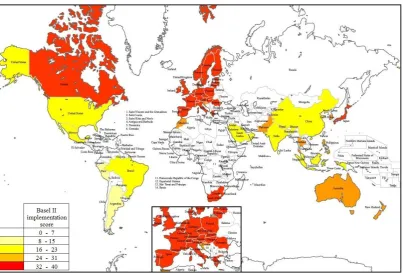
Figure 3: World map of Basel II implementation ... 79
Figure 4: Sharing notes on implementation amongst supervisors ... 146
Figure 5: Timeline of Basel II implementation and the cross-border structure of international banks in Korea ... 180
Figure 6: A stylized map of the cross-border structure of international banks and channels of policy diffusion ... 213
Table 1: Pillar 2 principles ... 35
Table 2: Sample of Basel II implementation dataset ... 75
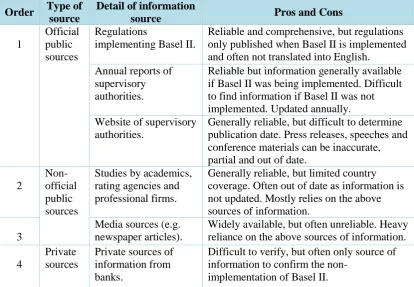
Table 3: Pecking order of information sources ... 76
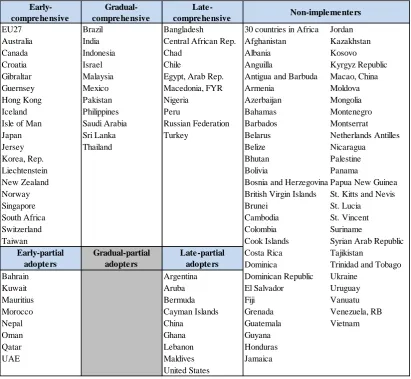
Table 4: A classification from early-comprehensive to late-partial adopters ... 81
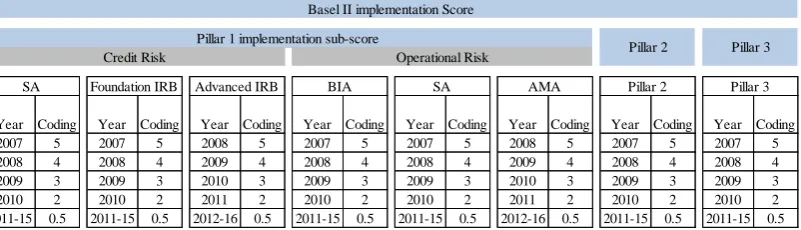
Table 5: Basel II implementation score coding scheme ... 89
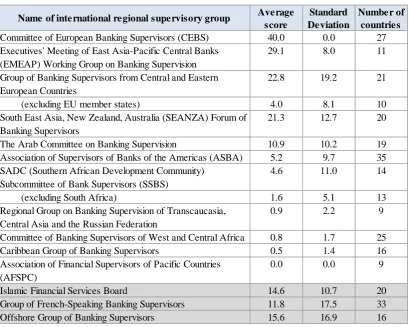
Table 6: Basel II implementation by supervisory networks ... 91
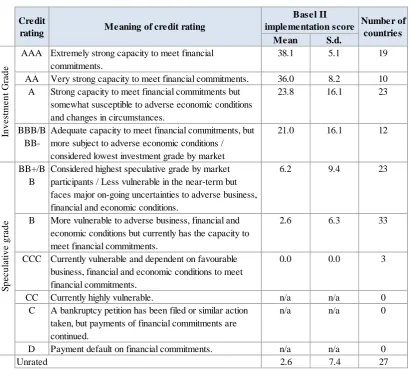
Table 7: Basel II implementation scores by credit ratings ... 93
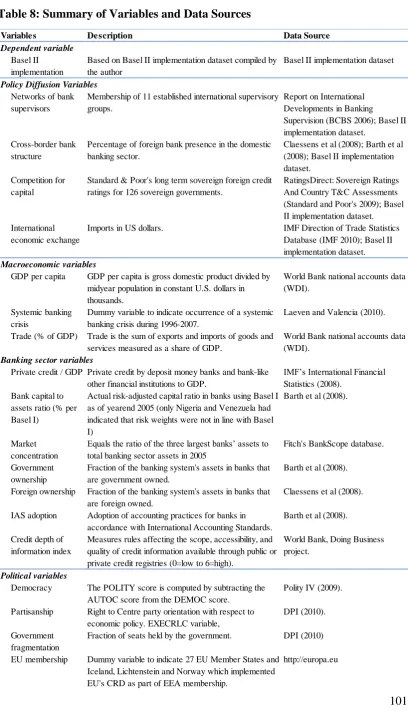
Table 8: Summary of variables and data sources ... 100
Table 9: Results of Regression Analysis ... 103
Table 10: Correlation between spatial lag variables ... 106
Table 11: General framework for within-case analysis ... 119
Table 12: Distribution of countries based causal paths ... 126
Table 13: Case selection of comparative case studies across three channels of policy diffusion ... 131
Table 14: Foreign and government ownership of banks ... 179
Table 15: Consolidated foreign claims to Hong Kong ... 225
Table 16: Global Financial Centres Index rankings and Hong Kong‟s rank ... 227
Table 17: Countries with similar credit ratings as Hong Kong ... 228
Table 18: Consolidated foreign claims to Korea ... 247
Table 19: Global Financial Centres Index rankings and Seoul‟s rank ... 249
2
List of Acronyms and Abbreviations
ASBA Association of Supervisors of Banks of the Americas
BCPs Core Principles for Effective Banking Supervision
BNM Bank Negara Malaysia
BIS Bank for International Settlements
CEBS Committee of European Banking Supervisors
CEMLA Centre for Latin American Monetary Studies
CP1 The New Basel Capital Accord: First consultative paper
CP2 The New Basel Capital Accord: Second consultative paper
CP3 The New Basel Capital Accord: Third consultative paper
CRD Capital Requirements Directive
EC European Commission
ECAI External credit assessment institution
EMEAP Executive Meeting of East Asia Pacific
EMEAP WBGS Executive Meeting of East Asia Pacific Working Group on Banking Supervision
EU European Union
FELABAN Latin American Federation of Banks
FSAP Financial Sector Assessment Program
FSA Financial Services Authority (UK)
FSI Financial Stability Institute
FSS Financial Supervisory Service (Korea)
FSSA Financial System Stability Assessment
G10 Group of Ten
G20 Group of Twenty
GFCI Global Financial Centres Index
HKMA Hong Kong Monetary Authority
ICAAP Internal Capital Adequacy Assessment Process
ICBS International Conference of Banking Supervisors
IDB Inter-American Development Bank
IMF International Monetary Fund
IRB approach Internal Ratings-Based approach
MAS Monetary Authority of Singapore
RWA Risk Weighted Assets
SBIF Superintendency of Banks and Financial Institutions (Chile) SEACEN South East Asian Central Banks Research and Training Centre
SMEs Small and Medium-sized Enterprises
3
Chapter One
Introduction
1.1 Why do countries implement Basel II?
The global financial crisis of 2007-8 triggered a string of financial regulatory reforms. In particular, the Basel Committee on Banking Supervision (“Basel Committee”) developed a comprehensive set of reform measures at the behest of the G20 to strengthen global regulatory standards for bank capital, liquidity and macroprudential regulation. These new standards, called Basel III, constituted the centrepiece of the G20‟s agenda on global financial reform and were regarded as a “decisive breakthrough” that would strengthen the resilience of banking systems
around the world (Hannoun 2010:1). In the G20 Seoul Summit in November 2010, the G20 Leaders “endorsed the landmark agreement reached by the BCBS [Basel Committee] on the new bank capital and liquidity framework” and committed “to take action at the national and international level to raise standards, and ensure that… national authorities implement global standards developed to date, consistently, in a way that ensures a level playing field, a race to the top and avoids fragmentation of markets, protectionism and regulatory arbitrage” (G20 2010:2).
4 the full, timely and consistent implementation of Basel II/III.1 As the Chairman of the Basel Committee warned, implementation can be challenging because “memories fade quickly. Regardless of how tough the new standards are and how
we expect them to increase the resilience of bank and banking systems, they must be effectively implemented and enforced” (Wellink 2010:5). The global financial regulatory framework risks being undermined if regulatory reforms at the international level are not followed up with robust voluntary implementation at the national level, but instead partial, inconsistent or non-implementation. According to the Basel Committee, the stakes are very high since the “[f]ull, timely and consistent implementation of Basel III [which builds on the implementation of Basel II] is fundamental to raising the resilience of the global banking system, in maintaining market confidence in regulatory ratios and in providing a level playing field. The benefits of the recent round of regulatory reforms will not be realised without implementation.” (BCBS 2012:1)
Thus, from a policy point of view, understanding the degree of global regulatory convergence with Basel II and the factors that explain why countries implement Basel II has become even more critical as countries embark on the implementation of Basel III.2 This is more so the case due to the following reasons. Firstly, the new global financial regulatory framework that emerged following the global financial crisis of 2007-8 builds on the implementation of Basel II. While Basel II was intended to replace the Basel Accord of 1988 (“Basel I”), Basel II constitutes a core component of Basel III, which is additive to Basel II. However, there is evidence of considerable variations in the implementation of Basel II across countries, providing a key motivation for this thesis. Secondly, Basel II is a voluntary standard that was never intended to have legal force and the Basel Committee does not possess any formal supranational supervisory authority. Given
1 Basel II is formally called the “International Convergence of Capital Measurement and Capital
Standards: A revised Framework” (BCBS 2004)
5 the lack of formal international coordination concerning the national implementation of Basel II, it is important to understand why countries implement Basel II.
In addition to being a question very pertinent to policymakers and banks around the world in the post-global financial crisis regulatory environment, understanding how and why countries implement Basel II is important as a topic for academic research. This is because the Basel Capital Accords have profoundly shaped bank capital adequacy regimes across the world over the past two decades. According to the Basel Committee, “during the 1990s the Accord [Basel I] became an accepted world standard, with well over 100 countries applying the Basel framework to their banking system” (BCBS 2001:11). Similarly, when Basel II was published in 2004, more than one-hundred countries indicated their intentions to implement it, creating expectations that Basel II would also become the next global standard for bank capital regulation like its predecessor (FSI 2004). The Basel Committee, IMF and World Bank were alarmed by the overly keen response of non-Basel Committee countries‟ intent to implement non-Basel II, prompting them to warn
countries against the risks of premature implementation (BCBS 2004a; IMF 2005a).3 Although the delayed and partial implementation of Basel II turned out to be a greater problem several years later, supervisors in the G10 at that time were particularly concerned that there was “a serious risk that many countries will begin to adopt the advanced IRB approach, because they think this is the global standard to which they must aspire, when it may not be appropriate for their banks at their current stage of development” (Davies 2005:249; GRR 2004; Le Pan 2008:20).
3 References to the membership of the Basel Committee throughout this thesis refer to the G10,
6 Despite being an important topic for academic research in light of the profound impact the Basel Accords have had on governing bank capital across developed and developing countries, there are two significant gaps in the International Political Economy (IPE) literature on the political economy of international finance and financial regulation with respect to Basel II.4 Firstly, empirical research on the actual state of Basel II implementation is scarce and patchy and the state of implementation in developing countries is particularly under-researched. A preliminary data gathering exercise of Basel II implementation conducted in the beginning of this research project indicated considerable cross-national variations in implementation contrary to expectations that prevailed when Basel II was agreed amongst the G10 and published in 2004, undermining the extent to which Basel II had become globally accepted standards for regulating bank capital like its predecessor. Given the substantial differences between Basel I and Basel II, extrapolating how countries will implement Basel II based on their implementation of Basel I is likely to be invalid and unreliable. This is more so considering that even in the case of Basel I, the adoption of “domestic regulatory standards elaborated in a non-legally binding international arrangement among a dozen countries… by more than 100 countries that did not participate in the formulation of the standards” was a “development that [was] unusual if not unprecedented” (Tarullo 2008:65-6).
The second major gap in the literature is the lack of understanding of the factors that promote or hinder the national implementation of Basel II across developed and developing countries. Why did countries that were not members of the Basel Committee voluntarily implement Basel II, an arrangement they were not party to and took no part in formulating? Moreover, why have countries implemented Basel II in different ways? As discussed in the literature review in Chapter Two, the literature is far from offering a convincing answer to why
7 countries around the world implemented Basel I, let alone Basel II. The untested theory which has become to be accepted as conventional wisdom is that Basel I was reputationally binding for non-members of the Basel Committee (see Simmons 2001:602; Tarullo 2008:65; Goodhart 2011:186). Some have anecdotally argued that “[t]he same perceptions seem to surround adoption of the revised Basel II framework” (Simmons 2006:11), although none have empirically tested the factors
that promote or hinder the national implementation of Basel II in the literature.
1.2 Research question and central explanatory framework
8 Policy diffusion was adopted as the main explanatory framework for the following four empirical and theoretical reasons. First, empirical research on policy diffusion is often motivated by the observation that countries adopt similar policies or institutions within a fairly circumscribed period of time, resulting in temporal and spatial clusters of policy change (Elkins and Simmons 2005:34). In a preliminary data gathering exercise, clusters of cross-national variations in the implementation of Basel II were also observed across countries in East Asia, South Asia and Latin America. There seemed to be a high degree of regulatory convergence amongst certain groups of countries that adopted similar implementation strategies. However, different groups of countries exhibited different levels of convergence with Basel II, producing a highly uneven and clustered state of Basel II implementation at the global level. These preliminary observations were complemented by findings in the Financial Stability Institute (FSI) surveys on countries‟ plans to implement Basel II,
which showed variations in regional trends (FSI 2004; 2006; 2008).5 Although the identity of the countries that responded to the FSI surveys were not disclosed on confidentiality grounds, and countries‟ plans to implement Basel II in some regions
turned out to be considerably different to how Basel II was actually implemented, combined with the observations from the preliminary data gathering exercise, the clustering of Basel II implementation policies across countries that had or were planning to implement Basel II provided sufficient prima facie evidence to merit the adoption of policy diffusion as a possible causal explanation. However, policy diffusion provides one possible explanation of why policies may have converged across countries and is by no means the only plausible explanation. Independent yet similar policy responses of countries that face similar economic or political conditions or cases of explicit policy coordination amongst countries also provide
5
9 plausible competing explanations to policy diffusion. Hence, in testing the effects of policy diffusion, it is necessary to control for these competing explanations.
Secondly, upon examining the policy making process to identify how countries implemented Basel II in the preliminary data gathering exercise, it was evident that in domestic policy debates, supervisors often referred to supervisory policies adopted by their regional peers or by leading global financial centres. This indicated that national policy decisions were not made in isolation from that of their foreign counterparts. However, there is a difference between learning and diffusion, and whether learning about policies in other countries had any systematic casual effects on national policy decisions is unknown and has to be tested. If policy decisions are indeed interdependent on the policy decisions of other countries, attempting to explain Basel II implementation with only the independent effects of domestic economic and political factors or international factors alone will fail to capture the uncoordinated yet interdependent process of policy making amongst supervisory authorities around the world. In this respect, the policy diffusion theory offers a conceptually different explanation to those that assume that countries make policy decisions independently of each other. The simple yet compelling theory of policy diffusion, namely, countries‟ policy choices are shaped by those of other countries with which they are closely interconnected to economically, politically and socially when making their own policy decisions, provides a convincing theory to explain how and why countries implemented Basel II.
10 implementation across countries may be limited because policy diffusion by definition is characterised as a process of interdependent yet uncoordinated policy adoption. The lack of formal international coordination concerning the national implementation of Basel II provides a highly relevant context to investigate policy diffusion on theoretical grounds.
Fourthly, the investigation of Basel II implementation addresses significant gaps in the policy diffusion literature in addition to the literature on the political economy of international financial regulation. As discussed in the literature review chapter, policy diffusion is a burgeoning area of research in IPE. However, whilst policy diffusion has been applied to explain the diffusion of various financial policies such as capital account and interest rate policies, it has not been applied to explain bank capital policies. Furthermore, although the diffusion of various standards, such as environmental and labour standards has been studied, financial regulatory standards have not. Hence, the investigation of the diffusion of bank capital standards, namely Basel II, makes an original contribution to the portfolio of policies investigated in the policy diffusion literature.6
In this thesis, a mixed-method research design is adopted to investigate both the effects of policy diffusion at the global level as well as the underlying process of policy diffusion in specific country cases. The policy diffusion hypotheses tested in the quantitative study and case studies are discussed in the next section, which outlines the overall research design of this thesis.
1.3 Overall research design
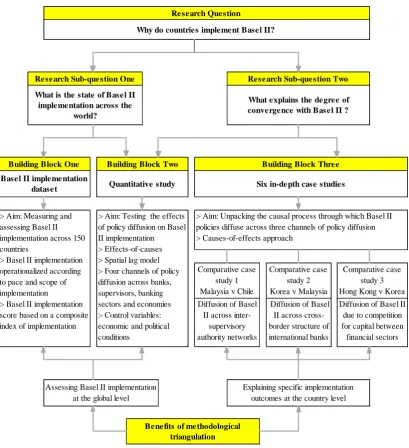
This thesis consists of three main building blocks. The first is a global dataset of Basel II implementation across 150 countries, the second is a quantitative study that tests the effects of policy diffusion on Basel II implementation across the world, and the third consists of six in-depth case studies that aim to unpack the causal process
11 through which policy diffusion shaped the national implementation of Basel II. This is summarized in Figure 1.
Figure 1: The three main building blocks of this thesis
This section explains how the above three building blocks each contribute to answering the research question posed in this thesis.
1.3.1 A global dataset of Basel II implementation
To answer the first of the two sub-questions, a global dataset of Basel II implementation across 150 countries is compiled by the author in order to measure
Research Question
Explaining specific implementation outcomes at the country level Assessing Basel II implementation
at the global level
> Aim: Testing the effects of policy diffusion on Basel II implementation > Effects-of-causes > Spatial lag model > Four channels of policy diffusion across banks, supervisors, banking sectors and economies > Control variables: economic and political conditions
Building Block Three
Six in-depth case studies
> Aim: Unpacking the causal process through which Basel II policies diffuse across three channels of policy diffusion > Causes-of-effects approach
Basel II implementation dataset
What explains the degree of convergence with Basel II ? Research Sub-question Two
Building Block One
> Aim: Measuring and assessing Basel II implementation across 150 countries
> Basel II implementation operationalized according to pace and scope of implementation
> Basel II implementation score based on a composite index of implementation
Quantitative study Building Block Two Research Sub-question One
Comparative case study 2 Korea v Malaysia
Comparative case study 3 Hong Kong v Korea Diffusion of Basel
II across cross-border structure of international banks
Diffusion of Basel II due to competition for capital between financial sectors
Why do countries implement Basel II?
Benefits of methodological triangulation What is the state of Basel II
implementation across the world?
Diffusion of Basel II across
inter-supervisory authority networks Comparative case
12 and evaluate the state of Basel II implementation at the global level. The implementation of Basel II is operationalized according to the scope and pace of implementation. To capture the scope of implementation, the dataset measures whether key components of Basel II, namely the six approaches of Pillar 1 for calculating regulatory capital for credit and operational risk, Pillar 2 and Pillar 3 had been implemented across 150 countries. The dataset then records the year in which the above components of Basel II were implemented to capture the timing of implementation. Measures of the scope and pace of convergence with Basel II for each country are then coded and weighted to construct a composite Basel II implementation score. Doing so provides a single pragmatic measure that reflects the core structure of Basel II while summarizing how countries implemented Basel II in a comparable way across 150 countries. In addition to enabling the assessment of the state of Basel II implementation at the global level, the Basel II implementation dataset provides vital building blocks to answer the second component of the research question, that is, what explains the degree of convergence with Basel II? The dataset not only provides the underlying data to construct the dependent variable for the quantitative study, but also aids the selection of case studies by providing information on the population of candidate cases.
1.3.2 Quantitative study: Testing the effects of policy diffusion on Basel II implementation across the world
13 firmly grounded on the causes-of-effects approach aimed at explaining specific implementation outcomes at the country-level (Mahoney and Goertz 2006:230). The benefits of methodological triangulation may be particularly high precisely because statistical analysis and case studies embody distinct and often contrasting methodological orientations that can produce unique synergies if combined effectively into the overall research design.
The objective of the quantitative study is to test whether on average policy diffusion systematically affects the degree of Basel II implementation across the world. Variables representing four distinct channels of diffusion are constructed to model how policies diffuse across channels formed by inter-supervisory authority networks, the cross-border structure of international banks, competition to attract international capital and the nexus of international economic exchange. Each policy diffusion variable consists of a unique connectivity matrix that describes how and to what extent each and every country are interconnected to all other countries across each channel of diffusion to test the following four policy diffusion hypotheses. First, inter-supervisory authority networks are hypothesized to reinforce the state of regulatory convergence amongst countries that are interconnected to one another, but at different levels of convergence with Basel II across different supervisory networks. There are more than a dozen established networks of banking supervisors, some dating back more than fifty years. Most supervisory networks organize regular meetings, conferences and training sessions, while some engage in achieving more ambitious goals such as formulating regional financial standards. Supervisory networks are expected to foster the diffusion of policies by serving as important channels of communication for supervisors to share experiences and policy ideas and learn about Basel II as well as each other‟s implementation policies.
14 convergence with Basel II in the host country they operate in if the international bank had implemented Basel II in its home country, or otherwise hinder implementation if the home country of the international bank had not implemented Basel II. This is because Basel II implementation decisions by the parent bank at the banking group level, which is a function of implementation decisions made by the home supervisor, may have implications on the way Basel II is implemented across its subsidiaries in host jurisdictions.
Thirdly, competition between financial sectors to attract international capital and banking business are hypothesized to translate into competitive pressures amongst policymakers to implement Basel II, leading to its diffusion amongst rivals. When a country‟s foreign competitors implement Basel II, investors may be drawn to that location since implementation may enhance financial stability, incentivize advancements in risk management or reduce compliance costs for international banks that want to adopt their preferred approaches of Basel II globally. Anticipating this outcome, countries may come under competitive pressures to match their rivals‟ Basel II policy, and they too may implement Basel II in response. As a result, Basel II policies are expected to diffuse amongst financial sectors that compete for capital.
15 competition, whereby countries decide to match the policies of those countries with which they trade relatively more with (Simmons and Elkins 2004:178-179). Both motivations are likely to be inter-related in practice.
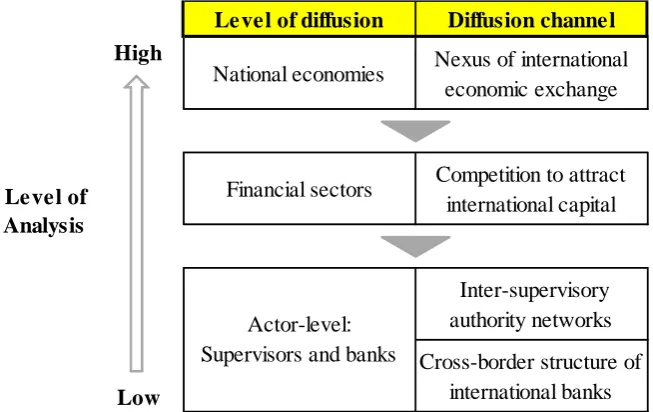
[image:23.595.141.468.322.528.2]These four channels of diffusion were devised based on the following considerations. First, they are intended to complement one another by contributing to distinct dimensions of analyses in terms of how policies diffuse not only due to interdependencies formed between countries at the level of national economies and financial sectors, but also at the level of supervisors and banks, both of which are key actors in the process of implementation. This is illustrated in Figure 2.
Figure 2: Examining policy diffusion at different levels of analysis
With this distinction, it may be possible to discern whether policy diffusion is most effective due to interdependencies formed across countries via the nexus of bank supervisors, banks, financial sectors or economies. Secondly, the channels of policy diffusion formed by the way banks and supervisors are interconnected to one another respond to a major weakness in the policy diffusion literature. Increased interest in policy diffusion has developed alongside growing criticisms of the weak empirical basis and theoretical underpinnings of the diffusion process, especially in relation to the channels through which policies diffuse and the role of key agents involved in the process of diffusion. The imprecise specification of the channels of
Level of diffusion Diffusion channel High
National economies Nexus of international economic exchange
Financial sectors Competition to attract international capital
Inter-supervisory authority networks
Low
Cross-border structure of international banks Actor-level:
Supervisors and banks Level of
16 diffusion, which are often only vaguely related to the specific policies that are hypothesized to diffuse, produce very generic channels of diffusion that make the tests of policy diffusion less convincing and not very relevant to the policy under investigation. The analysis of policy diffusion across the cross-border structure of international banks and inter-supervisory authority networks are innovative channels of policy diffusion that are tailored to highlight the role of key actors in implementing Basel II, namely, banks and supervisors and their interdependent relationships with their foreign counterparts in forming the paths through which policies diffuse across countries. These novel channels of diffusion mark original contributions to the policy diffusion literature as they have not been studied elsewhere. To provide a stronger empirical test of policy diffusion, the quantitative study systematically controls for several economic and political variables. These variables control for two competing explanations to policy diffusion, that is, independent responses to similar economic or political conditions and explicit policy coordination amongst countries.
17 that lump together dissimilar cases to obtain a larger sample (George and Bennett 2005:19).
The case studies in this thesis combine within-case analysis and cross-case comparisons within a single study to exploit the strongest means of drawing causal inferences from case studies (ibid. p18). Detailed within-case analysis employing a variant of the process tracing method is conducted to unpack the casual process of policy diffusion in six case studies, which consist of three pairs of cases from Chile, Korea, Malaysia and Hong Kong. Each pair of cases investigate the process of policy diffusion and Basel II implementation across each of the three channels of diffusion formed by inter-supervisory authority networks, the cross-border structure of international banks and competition for capital.7 Then, the cross-case comparative method of controlled comparison is undertaken for each pair of case studies to investigate how policy diffusion reinforces the degree of regulatory convergence with Basel II in some countries while reinforcing lower levels of convergence with Basel II in others. To ensure that the most theoretically, empirically, and methodologically relevant cases are selected, a rigorous case selection procedure involving three selection steps are applied to the population of candidate cases. These selection steps take into account binding scope conditions that may apply to the theory of policy diffusion, cases of explicit policy coordination and methodological considerations that aim to maximize variations in the policy diffusion variable under investigation, while controlling for the effects of other diffusion channels and statistically significant explanatory variables from the quantitative study.
The first pair of case studies examines the diffusion of Basel II across inter-supervisory authority networks in Malaysia and Chile. The inter-supervisory authorities implementing Basel II, Bank Negara Malaysia (BNM) in Malaysia and the
7 The fourth diffusion channel modelled by the structure of international economic exchange in the
18 Superintendence of Banks and Financial Institutions (SBIF) in Chile, belong to different supervisory networks in East Asia and the Americas respectively. The policy choices of BNM and SBIF regarding when and how to implement Basel II in Malaysia and Chile are hypothesized to be systematically conditioned by, and thus interdependent on the policy choices of other supervisors with which BNM and SBIF are closely interconnected to via inter-supervisory authority networks. Stated generally, countries that are interconnected to other countries that have attained a high level of convergence with Basel II across channels of diffusion formed by inter-supervisory authority networks are also expected to adopt implementation policies that attain a high level of convergence with Basel II, and vice versa. In order to uncover the process through which policy diffusion led to convergent Basel II policies amongst supervisory authorities within the same supervisory network, but at divergent levels of convergence with Basel II across different supervisory networks, the case studies first examine the initial formative years of BNM and SBIF‟s implementation strategy and their participation in supervisory networks. This is followed by an examination of how supervisory networks function as channels through which policies diffuse.
The second pair of case studies investigates the diffusion of Basel II across channels of diffusion formed by the cross-border structure of international banks in Korea and Malaysia.8 Whilst Malaysia‟s banking sector was more protected and foreign players maintained a non-negligible yet stable share of the banking sector, Korea experienced an abrupt surge in the number of foreign players to levels unprecedented in the domestic banking sector, producing a contrasting configuration in the way Malaysia and Korea were interconnected to the rest of the world when Basel II was implemented. The cross-border structure of international banks are expected to form powerful channels of diffusion by creating very specific and direct
8
19 linkages between the host and home countries of global banks. These linkages are expected to not only provide information to host supervisors regarding who their competitors are, but also facilitate the cross-border transfer of implementation capabilities. Furthermore, aided by the international supervisory architecture that defines the rules of the game between home and host supervisors, the influence of global banks and home supervisors are expected to be even more compelling in host countries. Countries that are interconnected to the home countries of international banks that have attained a high level of convergence with Basel II are hypothesized to adopt implementation policies that also attain a high level of convergence with Basel II, and vice versa. To uncover the process of policy diffusion, the case studies first investigate the diffusion paths formed by the network of international banks that link Basel II policies in Korea and Malaysia to those of other countries. Then, the way international banks shaped various steps in the implementation process, from the initial policy consideration of whether to implement Basel II to the supervisory approval process of allowing banks to adopt the advanced approaches, are examined.
The third pair of cases studies examines how implementation policies in Hong Kong and Korea were shaped by the Basel II policies of financial sectors they competed with to attract international capital and banking business.9 Countries may come under competitive pressures to match their rival‟s financial regulatory policies,
leading to the cross-border diffusion of Basel II. However, because Hong Kong and Korea compete with different financial sectors around the world, different Basel II policies are expected to diffuse in these countries. Put generally, financial sectors that compete for capital with other financial sectors that have attained a high level of convergence with Basel II are hypothesized to adopt domestic implementation policies that also attain a high level of convergence with Basel II, and vice versa. To uncover the process of policy diffusion, the case studies first trace the paths through
9 Two countries that are in the same supervisory network and where the level of foreign bank
20 which policies diffused across financial sectors that competed for capital, before investigating how policy choices in Hong Kong and Korea were shaped by the policy choices of these financial sectors.
For each pair of case studies, comparative analyses with respect to what, how and why policies diffused is undertaken to understand how and why policy diffusion reinforces convergence with Basel II in some cases, whilst reinforcing partial, gradual or delayed implementation in others. The next section explains how the above three building blocks are presented in the subsequent chapters of this thesis.
1.4 Chapter plans and summary of main arguments
21 empirical literature on policy diffusion are also discussed in this chapter in order to formulate a research design that maximizes the strengths and addresses the weaknesses of this literature. The subsequent five chapters constitute the empirical chapters of this thesis devoted to investigating the state of Basel II implementation across the world and answering the question of why countries implemented Basel II.
22 II/III implementation, a systematic study of how and why countries implemented Basel II across developed and developing countries has not been undertaken yet.
To investigate the cause of the highly uneven and clustered global regulatory landscape, regression analysis is undertaken to test whether Basel II policy decisions in countries are interdependent on the policy decisions of other countries with which those countries are closely interconnected while controlling for the effects country-specific economic and political conditions may independently have on national decisions to implement Basel II. The results provide strong and consistent evidence to support the policy diffusion hypothesis tested in the analysis. There is a positive and statistically significant relationship between the level of Basel II implementation in one country, and the average implementation score of those countries with which that country is closely interconnected to across channels of diffusion formed by inter-supervisory authority networks, the cross-border structure of international banks, competition for capital, and the structure of international economic exchange. Furthermore, countries that are not developing countries, have a sizeable and developed banking sector, maintain lower levels of regulatory capital in the banking system, experienced a systemic banking crisis and have adopted international accounting standards are on average associated with higher levels of Basel II implementation than those that are not.
23 way.10 Three pairs of cases from Chile, Korea, Malaysia and Hong Kong are selected to investigate the process of policy diffusion and Basel II implementation across three channels of diffusion formed by inter-supervisory authority networks, the cross-border structure of international banks and financial sectors that compete for capital. The case studies highlight considerable variations in implementation, from late-partial adopter Chile, to gradual comprehensive adopter Malaysia and early comprehensive adopters Korea and Hong Kong.
Chapter Five examines how the implementation of Basel II in Malaysia and
Chile was shaped by the diffusion of Basel II across inter-supervisory authority networks. Supervisory networks emerged as powerful channels of diffusion that promoted convergence in implementation policies amongst countries by shaping the formation of implementation norms amongst supervisors from very early in the implementation process, thus, changing the trajectory of how countries implemented Basel II. Both BNM and SBIF extensively shared experiences and ideas on various aspects of Basel II with their foreign counterparts when formulating their own national implementation policy. However, divergent implementation policies diffused across supervisory networks in East Asia and the Americas. In Malaysia, policies diffused not only at the strategic level in terms of deciding on the speedy pace and comprehensive scope of implementation, but also at the more detailed tactical level. In contrast, whether supervisors should implement Basel II at all was an open question amongst policymakers in ASBA, which decided to adopt a more gradual and layered approach. Although divergent implementation policies diffused, the implementation of Basel II in Malaysia and Chile were strongly shaped by considerations of how their supervisory peers were implementing Basel II as there were pros and cons for not moving ahead with the rest of one‟s peers in the case of Malaysia, and moving ahead without the rest of one‟s peers in the case of Chile.
10 The truth table sorts the data into different combinations of the independent variables and their
24
Chapter Six investigates how the implementation of Basel II in Korea and Malaysia was shaped by the diffusion of Basel II across the cross-border structure of international banks. The case studies found two channels of diffusion within the cross-border structure of international banks to be particularly important. Firstly, the way one country was interconnected to another at the level of banks had significant implications on the degree of convergence with Basel II attained in the host countries. In some cases, convergence with Basel II was facilitated as foreign banks that benefited from their Basel II-knowledgeable parent banks were the first to adopt the advanced yet operationally onerous approaches of Basel II in Korea and Malaysia. In other cases, foreign banks hindered the full and timely implementation of Basel II due to delays and uncertainty in implementation in the home country. Secondly, international banks also created a channel of diffusion between home and host supervisors, which tended to promote convergence in line with the home supervisors‟ Basel II policies, except for some areas where host country-specific divergences were reinforced.
25 competitors in the first place. This highlighted that both divergences from and convergences with international financial standards were inseparable consequences of policy diffusion.
In addition to finding compelling evidence in support of policy diffusion, the findings also underscored the importance of the level of development. The quantitative study suggested that on average, developing countries were constrained by their level of development when implementing Basel II. In the case studies, even relatively developed countries such as Hong Kong and Korea faced capacity constraints of various sorts. A closer examination of implementation across countries suggested that the capacity to implement Basel II was a necessary but insufficient condition for Basel II policies to diffuse. No matter how strong the effects of policy diffusion in encouraging high levels of implementation, policy diffusion mechanisms were unable to overcome low capacity constraints. Moreover, less developed countries were rarely exposed to strong policy diffusion effects that encouraged convergence with Basel II across the channels of diffusion in the first place. Thus, when the level of development was low, the prospects for converging with Basel II were even poorer as policy diffusion tended to reinforce low levels of Basel II implementation.
In Chapter Eight, the main empirical findings of this thesis and their contributions to the IPE literature on the political economy of international financial regulation and policy diffusion are discussed. Three key policy implications that follow from the findings are also presented, followed by a discussion on how this thesis informs the wider debate on power in the world economy. In the world of global standard setting, it is widely accepted that the “great powers”, namely the US and EU, “remain the primary actors writing the rules that regulate the global
26 regarding whose policies diffuse and how. Although Basel II was not formally enforced and remained a voluntary standard outside the G10, implementation in the EU and US had repercussions on how other countries implemented Basel II around the world because both the EU‟s full and timely implementation and the US‟s delayed and partial implementation diffused. Moreover, it is argued that the influence of the EU and US permeates through the process of diffusion at a deeper level by shaping the channels of diffusion, and in doing so, have indirectly, but profoundly shaped the global regulatory landscape for bank capital regulation. In sum, not only are the EU and US “great powers” in setting international standards, they are also leading powers in shaping the implementation of Basel II around the world.
27
Chapter Two
Literature Review
2.1 Introduction
28 reviewed with a particular focus on the methodology utilized to operationalize policy diffusion. The strengths and weaknesses of the theoretical and empirical literature are also discussed in order to formulate a research design that builds on the existing literature and maximizes its contribution to the policy diffusion literature.
This chapter proceeds in the following order. An overview of the Basel Committee, Basel I and Basel II is presented in section 2.2. This is followed by a review of the empirical literature on the Basel standards in section 2.3. Then the six general theories of compliance are discussed in section 2.4, followed by a comprehensive review of the policy diffusion literature in section 2.5.
2.2 The Basel Committee, Basel I and Basel II 2.2.1 The Basel Committee
The Basel Committee was established in 1974 by the central bank governors of the Group of Ten (G10) countries in the aftermath of severe disturbances in international currency and banking markets following the failure of Bankhaus Herstatt in West Germany.1 Until 2009, the membership of the Basel Committee consisted of the G10, namely, Belgium, Canada, France, Germany, Italy, Japan, the Netherlands, Spain, Sweden, Switzerland, United Kingdom, United States and Luxembourg.2 The Basel Committee provided a forum for regular cooperation
1
This section primarily draws on the „History of the Basel Committee and its Membership‟ by the Basel Committee (2009).
2 Spain was invited to join the Basel Committee in 2001. References to the membership of the Basel
29 between member countries on banking supervisory matters and initially focused on modalities to close gaps in the international supervisory net for internationally active banks. The Basel Concordat of 1975, which aimed to ensure that no international bank escaped adequate supervision, marked one of the most important earlier achievements of the Basel Committee.3 The Basel Committee‟s “wider objective has been to improve supervisory understanding and the quality of banking supervision worldwide” by exchanging information on national supervisory arrangements, improving the effectiveness of techniques for supervising international banks, and most importantly, by setting minimum supervisory standards (BCBS 2009:1). To this end, the Basel Committee has produced more than one-hundred documents providing supervisory standards and guidance on a wide range of supervisory topics.
Of the supervisory standards formulated by the Basel Committee, the Basel Committee “is best known for its regulations on capital adequacy requirements,
CARs. The 1988 Accord, or Basel I, as it became more widely known, put the BCBS on the map for banks and policy-makers” (Goodhart 2011:194). According to the Basel Committee, “[t]he merits of the Accord [Basel I] were widely recognised
and during the 1990s the Accord became an accepted world standard, with well over 100 countries applying the Basel framework to their banking system” (BCBS 2001:11). By the time Basel II was agreed, over 140 countries claimed to have implemented Basel I (Barth et al 2008). The Basel Committee decided to undertake a thorough revision of Basel I in 1998, and after six years of intense negotiations, Basel II was published in June 2004. There were strong expectations that Basel II would succeed its predecessor and become the next global standard for capital regulation when more than 100 countries indicated their intentions to implement Basel II in 2004 (FSI 2004). However, as countries were transitioning onto Basel II,
3
30 the Basel Committee was yet again at the centre of reforming global financial regulatory standards, but this time at the behest of the G20 following the global financial crisis of 2007-8. The Basel Committee formulated a set of new global regulatory standards for bank capital, liquidity and macroprudential regulations, collectively called Basel III.
In addition to developing standards for regulating bank capital, the Basel Committee also produced standards in other areas, such as the Core Principles for Effective Banking Supervision (BCPs), which also received almost universal acceptance. The BCPs were “conceived as a voluntary framework of minimum standards for sound supervisory practices” and consisted of twenty-five “principles that are needed for a supervisory system to be effective” (BCBS 2006b:2).4
Since its publication in 1997, the BCPs have become “the de facto minimum standard for sound prudential regulation and supervision of banks and banking systems” around
the world (BCBS 2012b:1). Moreover, according to Goodhart, the BCPs represented “a radical change in the Committee‟s relationships with the rest of the World” as the Basel Committee “emerged upon the world stage as the institution responsible for establishing norms for the regulation of banking systems… right around the world” (2011:299).
The emergence of the Basel Committee as the pinnacle of authorities for establishing standards for regulating banking systems around the world has occurred under quite unique circumstances.
“The Committee does not possess any formal supranational supervisory authority. Its conclusions do not have, and were never intended to have, legal force. Rather, it formulates broad supervisory standards and guidelines and recommends statements of best practice in the expectation that individual
4 The BCPs “have been used by countries as a benchmark for assessing the quality of their
31 authorities will take steps to implement them through detailed arrangements – statutory or otherwise – which are best suited to their own national systems. In this way, the Committee encourages convergence towards common approaches and common standards without attempting detailed harmonisation of member countries‟ supervisory techniques.” (BCBS 2009:1)
Despite the lack of formal supranational supervisory authority over its members and non-member countries, the Basel Committee‟s voluntary standards have had profound effects in shaping national regulatory regimes across the world. In particular, the Basel Capital Accords, which are explained next, have had far reaching implications for national and international banks and supervisors across developed and developing countries.
2.2.2 Basel I
In the early 1980s, the Basel Committee became concerned that the capital ratios of the main international banks were deteriorating at a time when international risks, notably those vis-à-vis heavily-indebted Latin American countries, were growing. The two principal aims of Basel I were “to ensure an adequate level of capital in the international banking system and to create a “more level playing field” in competitive terms so that banks could no longer build business volume without adequate capital backing” (BCBS 2001:11). Members of the Basel Committee
resolved to halt the erosion of capital standards in their banking systems by working towards greater convergence in the measurement of capital adequacy. This resulted in the emergence of a broad consensus on a weighted approach for measuring risks both on and off the balance sheet. Following comments on a consultative paper published in December 1987, Basel I was approved by the G10 Governors and released to banks in July 1988.
32 depending of their ability to absorb losses. Tier 1 included shareholders‟ equity and retained earnings and Tier 2, supplementary internal and external capital resources such as general provisions and subordinated debt. To measure risk-weighted assets, assets were classified into four buckets, 0%, 20%, 50% and 100%, according to their riskiness, which in the case of Basel I varied by who the debtor was. Capital was not required against government assets such as Treasury Bills and bonds whist claims on banks attracted a 20% weight, which translated into a capital charge of 1.6% of the value of the claim. Claims on the non-bank private sector generally received the standard 8% capital requirement.5 Basel I was supplemented a number of times mostly to deal with the treatment of off-balance-sheet activities, although the most significant amendment was made in 1996 with the Market Risk Amendment. This required the removal of trading positions in bonds, equities, foreign exchange and commodities from the credit risk framework in place for explicit capital charges related to the bank‟s open position in each instrument. Basel I is generally seen to have succeeded, “brilliantly” according to Goodhart, in achieving its goals of raising capital levels and moving towards a level playing field, and “has largely, though
recently less so, stood the test of time” (Goodhart 2011:195).
2.2.3 Basel II
Due to rapid developments in financial markets, the simple and ad hoc bucket approach in Basel I created incentives for banks to move high quality assets off the balance sheet, thus reducing the average quality of banks, and became increasingly outdated as regulatory capital requirements conflicted with sophisticated internal measures of economic capital. The rationale of Basel II was to reduce the scope for regulatory arbitrage and make regulatory capital requirements more risk-sensitive by incorporating advances made in banks‟ internal risk management practices in
5 Off-balance sheet exposures through guarantees, commitments and forwards were converted into a
33 calculating regulatory capital requirements. The „International Convergence of Capital Measurement and Capital Standards: A revised Framework‟, known as Basel II, was agreed in 2004 and consisted of three pillars corresponding to minimum regulatory capital requirements in Pillar 1, the supervisory review process in Pillar 2 and market discipline in Pillar 3 (BCBS 2004).
The first Pillar sets out a menu of approaches to determine minimum capital requirements for credit, operational and market risk. For credit risk, there are three options that allow banks and supervisors to choose from depending on the sophistication of banks‟ activities and internal controls. The standardized approach (“SA”) draws a distinction between the type and riskiness of an exposure in an effort to improve the risk sensitivity of capital requirements. Fixed risk weights are established for different types and riskiness of exposures. To assess the credit quality of borrowers, banks can use external credit assessments by rating agencies. Where an external rating is not applied to an exposure, the SA mandates a risk weighting of 100%, equivalent to a capital requirement of 8%. Compared to Basel I, an expanded range of credit risk mitigants, such as collateral, guarantees and credit derivatives are recognised based upon which capital requirements could be reduced. Furthermore, the SA provides special treatment for retail exposures, whereby the risk weights for residential mortgage exposures and other retail exposures were reduced relative to Basel I. Also, loans to small- and medium-sized enterprises (SMEs) received retail treatment, enabling them to receive lower risk weights.
34 a given time horizon, loss given default (LGD) measures the proportion of an exposure that will be lost if a default occurs, exposure at default (EAD) measures the amount of a facility that is likely to be drawn if a default occurs, and maturity (M) measures the remaining economic maturity of an exposure. The IRB approaches consist of the Foundation IRB (“FIRB”) and Advanced IRB (“AIRB”) approaches. The FIRB approach utilizes banks‟ own estimates of PDs whilst using supervisory values set by the Basel Committee for LGD, EAD and M. In contrast, the AIRB approach utilizes banks‟ own estimates of PD, LGD, EAD and M as quantitative inputs in calculating the risk weight of assets. The latter is generally considered “the fundamental innovation of Basel II that breaks with the Basel I method” (Tarullo 2008:139). For the treatment of credit mitigants, different types of collateral are reflected in the supervisory values for LGD for FIRB banks, whilst greater flexibility is accorded to AIRB banks to assess the value of collateral. For retail exposures, there is only a single AIRB approach and no FIRB alternative. The key inputs in the IRB retail formulas are PD, LGD and EAD, all of which are based on banks‟ internal estimates for pools of similar retail exposures rather than for
individual exposures.
35 gross income of each business line by a factor ranging from 12% to 18%.6 In the AMA, banks are allowed to use their own internal method for assessing their exposure to operational risks, as long as it is sufficiently comprehensive, systematic and meets the quantitative and qualitative criteria set out in Basel II.
The supervisory review process of Pillar 2 requires banks to develop an internal capital adequacy assessment process (ICAAP) and set capital targets to ensure that banks have adequate capital to support their risks beyond the core minimum requirements. Supervisors are expected to evaluate how well banks are assessing their capital needs relative to their risks and to intervene where appropriate. Pillar 2 consists of the following four key principles.
Table 1: Pillar 2 principles
Principle 1 requires bank to undertake a comprehensive assessment of risks, including those not explicitly captured in Pillar 1, such as interest rate risk in the banking book, credit concentration risk and liquidity risk. Principles 2 and 3 empower supervisors to review and intervene when necessary and require banks to hold capital above the minimum requirement per Pillar 1. Pillar 3 sets out market disclosure requirements in relation to the scope of application, capital structure and adequacy, risk exposures, risk assessment processes, and the overall capital adequacy of banks. The intention is “to encourage market discipline by developing a
6 The eight business lines and betas (in parentheses) are corporate finance (18%), trading and sales
(18%), payment and settlement (18%), commercial banking (15%), agency services (15%), retail banking (12%), asset management (12%) and retail brokerage (12%).
Pillar2: Four key principles of supervisory review
Principle 1: Banks should have a process for assessing their overall capital adequacy in relation to their risk profile and a strategy for maintaining their capital levels.
Principle 2: Supervisors should review and evaluate banks‟ internal capital adequacy assessments and strategies, as well as their ability to monitor and ensure their compliance with regulatory capital ratios. Supervisors should take appropriate supervisory action if they are not satisfied with the result of this process.
Principle 3: Supervisors should expect banks to operate above the minimum regulatory capital ratios and should have the ability to require banks to hold capital in excess of the minimum.