2017 International Conference on Computer Science and Application Engineering (CSAE 2017) ISBN: 978-1-60595-505-6
Design and Realization of Tourism Software based on IOS Platform
Yuexia Zhang*, Yixuan Feng and Tingwei Song
School of Information and Communication Engineering, Beijing Information Science & Technology University, 100101 Beijing, China
ABSTRACT
With the continuous improvement of national consumption level, people's demand for tourist travel is growing. Tourism software cannot meet the current market demand because their function is too single. So the exploit of a tourism software is of great significance. This article designs a tourism software based on iOS Platform. This software has two modules, one is the scenic server and the other is the tourist client. Scenic spot administrators can introduce scenic spots, push attractions feature, update the price of attractions tickets and the conditions of surrounding traffic through the scenic server. Visitors can use the tourist client to browse travel strategy, search information, and share travel notes. The test results show that the software has many characteristics, such as less resource occupation, high efficiency, extensibility, simple operation and so on.
INTRODUCTION
With the rapid development of information and network technology, people's income level continues to grow, and the concept of consumption continues to improve. Tourism industry in the world has been rapid development. Before traveling, the tourists need to know the characteristics of attractions, the environment around the site, the evaluation from people who have been to the scenic spots. It is not enough to meet needs of tourists depended on the introduction of a single travel company. People are used to inquire about attractions by phone, but the amount of information on the Internet
is not enough to meet people's needs [1]. Therefore, the design of a tourism service
software is very meaningful.
At present, the two most popular foreign tourism software are Pocket and
Gogobot[2].The advantage of Pocket is that users can assemble all travel articles and
videos to a platform, which can be viewed, shared, or commented on a variety of
devices anytime and anywhere[3]. Gogobot, a travel app, lets users to comment on each
other, to get advice from friends, and then to choose hotels, bars, coffee shops, hotels
and so on[4-6]. Some others tourism software, such as: Tuniu, Qunar, Ctrip, their main
functions are hotel reservations. There is no emphasis on the design of the travel notes and the functions of the tourist raiders. Specialized tourism software such as ant free travel software is aimed at niche groups and has not been popular with the
public[7-8]. Although the development of foreign tourism applications is more perfect,
they cannot be large-scale popularization in the domestic market because of lacking
of localization [9]. The domestic popular travel notes software cannot meet the current
market demand [10]. Thus, it is a major trend in the market to design a multi-functional
In this paper, it designs a tourism software based on iOS Platform. It has two modules, one is the scenic server and the other is the tourist client. Scenic spot administrators can introduce scenic spots, push attractions feature, update the attractions tickets and the surrounding traffic conditions through scenic server.
Visitors can use the tourist client to browse travel strategy, search information, and share travel notes. The test results show that the software has many characteristics, such as less resource occupation, high efficiency, extensibility, simple operation and so on.
NEEDS ANALYSIS
In this paper, it analyses the basic needs of users according to market demand. The scenic spot administrator's requirements analysis is shown in Figure 1. The scenic spot administrators are responsible for uploading photos of scenic spots, tickets, maps and other information to attract tourists. They can also upload information about
the weather and parking lot near the scenic spots[11], and classify the travel notes which
uploaded by tourists according to the photos, time and other information. The
administrators push features about the city in the main interface, such as specialty snacks, discounted hotels, etc. They should also analyze uploaded travel notes and travel strategies to improve the inadequacies of the service so that they can attract more tourists.
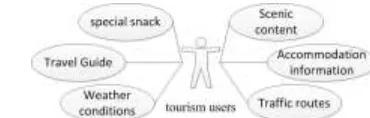
The tourism user's requirements analysis is shown in Figure 2. Tourism users are most concerned about the characteristics of the attractions, the scenery, and how to better visit the attractions and the city of the attractions. In addition, the tourism users most concerned about the traffic near the attractions, the number of visitors at different time periods, the location information of the parking lot, the hotel accommodation
around scenic spots, the recent weather conditions, the local special snack and so on.[14].
The tourists who have been to scenic spots can share their travel strategies through the tourism software which can provide a great convenience for other tourists. The tourists can upload their travel diaries and travel photos, video on the Internet, which can be used as travel memories, and easy for others to reference.
Therefore, it is necessary to design software with travel guide, information search, destination information push, travel notes sharing and commenting.
[image:2.612.297.482.539.598.2]
Figure 1. Scenic spot administrator needs analysis. Figure 2. Tourism users needs analysis.
DESIGN
Overall Scheme
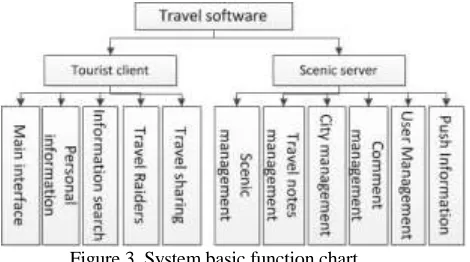
comment management, user management and push information management. The tourist clients chiefly services for tourists, providing tourists with travel tips, travel notes and information search functions. The specific functional structure of the system is shown in Figure 3.
Figure 3. System basic function chart.
Attractions Service Side Program
There are six modules in the scenic server, including the scenic spot management module, the travel notes management module, the city management module, the comment management module, the user management module and the push information module.
The scenic management module can be used by the scenic spots administrators to upload the map of the attractions, ticket prices, service time and various precautions. The travel notes management module is convenient for the administrator to save and classify the travel notes uploaded by tourists. For example, it can classify the travel notes according whether it has photos, per capita prices, time plan and other information. The city management module can provide the weather information of the city and the food and lodging information nearby according to the location information. The review management module facilitates the management of visitors' comments, such as high praise and bad reviews. The administrator uses the user management module to make statistics on the user's preferences through the background information,
so as to facilitate better management of the scenic spots.The push information module
can push the city's famous sights and specialty snacks on the APP home page.
Travel Client Program
The travel client has five modules, including the main interface module, the personal information module, the travel notes module, the search module and the travel notes module.
The main interface module is the contract point of all modules, using interactive pages to show popular travel notes and latest travel stories by scrolling pictures. The personal information module includes login, registration, contents and password
changes.The travel notes module can add or delete personal travel notes, browse other
traffic conditions, you can also check the location information of the parking lot near the scenic spot.
System Data Flow
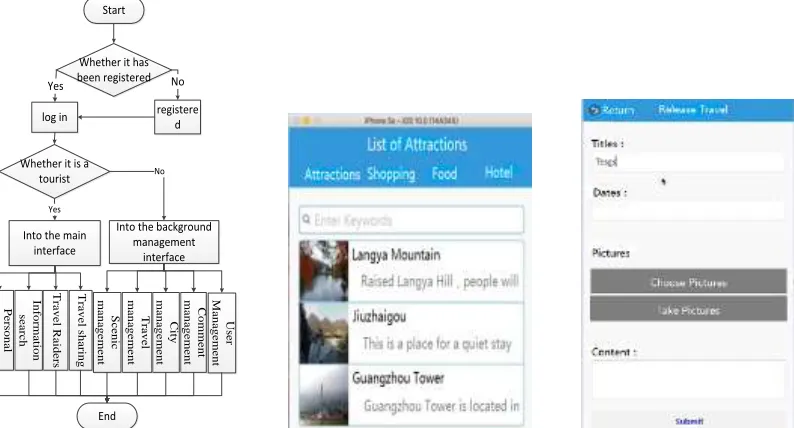
In this paper, the software flow chart is shown in Figure 4. When you open the software, it will firstly confirm whether you have registered. If you don't register, you'll register with your cell phone number, your mailbox, micro-blog or QQ. Users can login
after registration. The software determines the user's type based on the login account.If
you are the scenic spot administrator, you will directly enter the corresponding background management interface of scenic spots. The administrator can update the information of attractions, classify the travel notes and comments through the backstage management. The administrator can provide tourists with information about the city's
weather and nearby snacks.If you are the tourism user, you will enter the main interface.
The main interface can be used for password modification, content collection, etc. Through the information search module, the tourism user can search the surrounding attractions and can browse other tourists recommend raiders through the itinerary. Travel sharing module can not only upload our own travel notes, but also comment
besideother people's travel notes.
Start
Whether it has been registered log in Yes registere d No
Into the main interface T ra v e l s h a ri n g T ra v e l R a id e rs In fo rm a ti o n se a rc h P e rs o n a l in fo rm a ti o n
Whether it is a tourist
Yes
[image:4.612.102.499.332.546.2]Into the background management interface No C o m m e n t m a n a g e m e n t C it y m a n a g e m e n t T ra v e l m a n a g e m e n t S c e n ic m a n a g e m e n t U se r M a n a g e m e n t End
Figure 4. System flow chart. Figure 5. Software home page interface. Figure 6. Release Travel Interface.
SYSTEM IMPLEMENTATION AND TESTING System Home Page Display
Release Travel Show
Users can use the software to upload their own travel notes, including dates, photos and their sentiment. Users can choose from the album photo upload, they can also click "take pictures". They can record their own feelings, it can be a word or an article, the number of words is not limited. The specific operating interface is shown in Figure 6.
Background Management Home Page Display
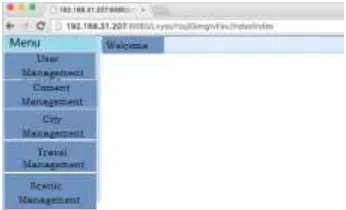
After the administrator logs in the software, they can enter the background for information management and data processing. The administrator uses the user management module to make statistics on the user's preferences through the background information, so as to facilitate better management of the scenic spots. As shown in Figure 7.
[image:5.612.108.281.263.368.2]
Figure 7. Background management interface. Figure 8. User management interface.
User Management Display
After the administrator enters, they can manage the user’s information of the
system. The specific display interface is shown in Figure 8.
Travel Information Display
[image:5.612.152.444.546.698.2]Administrators can manage travel notes, including add, modify, delete the travel notes. It can realize the overall management of the system data. The specific display interface is shown in Figure 9.
CONCLUSIONS
The tourism software based on iOS platform can be used to search scenic spots, browse the surrounding environment, and share travel notes. Tourism users only need to enter short key words, then they can obtain the required travel notes. They can also comment the travel notes of others. Scenic spot administrators can update scenic spots information and manage uploaded travel notes or travel guides. This software provides a comprehensive platform for users. The current market needs a software which can not only share their travel experiences by recording travel notes, but also obtain the knowledge and strategies provided by other users. This article designed the software just in line with this demand.
ACKNOWLEDGMENT
This work was supported by the National Natural Science Foundation of China (No.51334003, No.61473039), the Introduction and Training Program of high level talents in Beijing municipal colleges and Universities (No.CIT&TCD201504058), and the Beijing Information Science and Technology University Graduate Education Quality Engineering Project (No.5121724107).
REFERENCES
1. Liu, Li, and Y. Jing. 2012. “Android city tour guide system based on Web service,” presented at the International Conference on Consumer Electronics, April 21-23, 2012.
2. Li, S., Duan X. and Bai Y. 2015. “Development and Application of Intelligent Tour Guide System in Mobile Terminal,” presented at the 7th International Conference on Measuring Technology and Mechatronics Automation, May 11-13, 2015.
3. Guo X., Duan X. and Gao H. 2013. “An ECG Monitoring and Alarming System Based On Android Smart Phone,” J. Communications & Network, 5(3):584-589.
4. Rusu S. and Cureteanu R. 2009. “International Tourism Evolution and Smartphone Impact on Tourism,” J. Annals of Tourism Research, 37(3):466-469.
5. Reddy BSN and Sam DRP. 2013. “Mobile Location-Based Tour guide System,” J. International Journal of Computer Trends & Technology, 4(5)183-192.
6. Guo Y., Cao L. 2012. “Study of Location and Navigation Services in Complex Indoor Scenes Based on the Android Mobile Computing Platform,” J. Engineering & Science, 57(3):91-93.
7. Ongtang M., Mclaughlin S. and Enck W. 2012. “Semantically Rich Application-Centric Security in Android,” J. Security & Communication Networks, 5(6):658-673.
8. Gan Q. and Wu H. 2013. “The Research of Android Broadcast Intercept Technology Based on Priority,” presented at the 5th International Conference on Multimedia Information NETWORKING & Security, November 1-3, 2013
9. Lin K. C., Chang L. S. and Tseng C. M. 2014. “A Smartphone APP for Health and Tourism Promotion,” J. Mathematical Problems in Engineering, 21(1):1-10.
10. Wang D., Sangwon P. and Fesenmaier D. R. 2012. “The role of smartphones in mediating the touristic experience,” J. Journal of Travel Research, 51(4):371-387.
11. Okazaki S., Campo S. and Andreu L. 2014. “A latent class analysis of Spanish travelers' mobile internet usage in travel planning and execution,” J. Cornell Hospitality Quarterly, 56(2):163-170. 12. Jara A. J., Lopez P. and Fernandez D. 2014. “Mobile discovery: discovering and interacting with the
world through the Internet of things,” J. Personal & Ubiquitous Computing, 18(2):323-338. 13. Zhang W. R. 2014. “Design of Online Teaching Management Platform Based on Android Internet
APP Technology,” J. Applied Mechanics & Materials, 23(7):651-653.