2017 International Conference on Computer Science and Application Engineering (CSAE 2017) ISBN: 978-1-60595-505-6
The Polarization Modulation Based Self-Interference
Cancellation for Full Duplex
Chao Ma*, Fangfang Liu and Zhimin Zeng
Beijing Key Laboratory of Network System Architecture and Convergence, School of Information and Communication Engineering, Beijing University of Posts and
Telecommunications, 100876 Beijing, China
ABSTRACT
In full duplex systems, self-interference (SI) cancellation amounts is limited by the power amplifier (PA) nonlinear distortion. In this paper, to cancel the nonlinear SI induced by the PA, a SI cancellation scheme based on polarization modulation is proposed. The proposed scheme uses polarization state as the information-bearing parameter and can let the PA work in its nonlinear region without suffering distortion. The simulation results and analysis show that the proposed SI cancellation scheme can improve the bit error rate (BER) performance significantly when the PA nonlinear distortion exists in the system.
INTRODUCTION
Full duplex (FD) technology can transmit and receive signals simultaneously by using the same frequency band, which can improve the spectrum efficiency compared with the time division duplex (TDD) or frequency division duplex (FDD) technologies. To implement FD communication, the self-interference (SI) needs to be canceled to the noise floor to ensure that the interested signal can be detected from the mixed signals, because in the received mixed signals the SI is generally in the order of 60dB~100dB stronger than the interested signal. Hence it is a challenge to cancel the SI, and various SI cancelation methods have been put forward to realize FD communication [1]-[4].
In the FD system, power amplifier nonlinear distortion limits the SI cancellation performance seriously, and several SI cancelation methods have been proposed to address this problem[5]-[7]. These methods firstly need to model the PA nonlinearity, and PA nonlinearity coefficients of the models are then estimated through some estimation methods. Finally, constructed SI signal can be obtained by combining the estimated nonlinearity coefficients of the PA and the SI channel state information, and is subtracted from the received signal. The cancellation performance of these methods heavily depends on the accuracy of the PA nonlinearity coefficients estimation, and the estimation error for the nonlinearity coefficients deteriorates the performance seriously, especially when the transmit signal power is strong.
polarization modulation is immune to the PA non-linear distortion, and can allow the PA to work in its non-linear region. Numerical results manifest that the cancelation performance of the proposed method in terms of the BER is not affected by the PA nonlinearity compared to the system which needs to estimate the PA nonlinearity coefficients.
The rest of this paper is organized as follows. In Section II, the polarization modulation based FD system model equipped with orthogonally dual polarized antennas is presented. The proposed polarization modulation based SI cancellation method is described in detail in Section III. In section IV, simulations and analysis about the performance of the proposed method are given. Finally, the conclusions are drawn in Section V.
SYSTEM MODEL
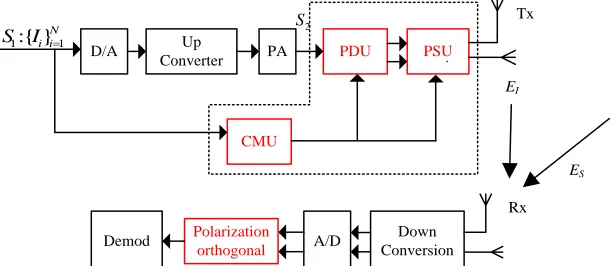
In this section, we illustrate the proposed polarization modulation based full duplex system which is given in Figure 1.
In the system, we denote the encoded transmitting sequence S1 as 1
N i i
I
, where N
represents the amount of the symbols and Ii is ith symbol, and we process the encoded transmitting sequence S1 with two branches. In the upper branch, S1 is processed by
the Digital to Analog converter (D/A), the Up Converter and then is input into the
nonlinear PA. Due to the PA nonlinearity, the output signal S2 of PA can be denoted by
a polynomial function of S1 as follows
2 1
1
L l l l
S a S
(1)where L is nonlinearity order of PA, and a is nonlinearity coefficient.
The lower branch establishes the mapping between S1 and the PS of
1M i i=
P
through the Constellation Mapping Unit (CMU), so S1 is transformed into a group of
constellation points
1
1
N M
l l= l i i=
P P P
. After that, we use Power Division Unit (PDU) and Phase Shifting Unit (PSU) to generate the PS sets. Finally, the two signal
components output from PSU, denoted as EH and EV are transmitted by the Horizontal and Vertical polarization antenna respectively. The PDU and PSU can be described by their transfer functions F and G as follows respectively
cos
sin
l l
F , 1 0
0 ejl
G (2)
Through polarization modulation, all of the components in S2 will be transmitted
with the same polarization state (PS), and such PS corresponds to the transmitted
2 2 2
cos
sin l
l
I j l
l
E S S PS
e
GF (3)
where Pl is the polarization state of transmit signal S2 described by the phase
descriptor ( l, l). l(l
0, / 2
) denotes the amplitude relationship between the twocomponents of the transmit signal EH and EV , which is l= arctan
EV / EH
, and l (l
0, 2
) denotes the phase difference between them, which is l= EV EH . It
can be seen that once the parameters of the PDU and PSU are fixed which refer to ( l, l), the PS of the transmit signal including the distortion signal can be determined correspondingly. It indicates that the PS of the transmit signal is immune to the PA nonlinearity.
Up
Converter PA PDU PSU
Demod Down
Conversion D/A
A/D
Tx
Rx
EI
CMU
Polarization orthogonal 1:{ }1
N i i
S I
ES
[image:3.612.153.460.242.375.2]2 S
Figure 1. The full duplex system model with the proposed PMSIC scheme.
At the receiver, the interested signal ES comes from other transmitter is received,
and meanwhile the signal EI is received as the SI which is much more stronger than ES.
Hence the received signal can be described as
0
S S I I
YH E H E N (4)
Where HS denotes the interested channel and HI denotes the SI channel. N0
represents a two-dimensional independent and identically distributed additive white
Gaussian noise (AWGN) with { } 2 2 2
H
N E NN
R I , where I2 is a two-order unit
array.
For the received signal as described in (4), the second term HIEI is the received SI,
which needs to be canceled as much as possible, and for the interested signal ES, which
needs to be detected at the receiver.
THE SI CANCELLATION SCHEME BASED ON POLARIZATION MODULATION (PMSIC)
First, the SI is transmitted through the orthogonally dual polarized antennas (ODPAs), and the encoded signals are mapped with the PSs generated by the PDU and PSU through the CMU. In the same transceiver, the receiver can obtain the PS of its transmitter. Hence we can set the PS of the ODPAs at the receiver orthogonal to the PS
of the SI. It is that if the PS of the SI is
1
1 1
cos sin j T
SI
P e
, then the PS of
receive ODPAs PR should satisfy
PR HPSI 0 (5)where
H denotes the conjugate transposition. PR can be calculated easily according to (5). Then the received signal at the receiver can be denoted as
0
2 0
0
H H H H
R R SI R S R
H H H
R SI R S R
H H
R S R
P Y P E P E P N
P P S P E P N
P E P N
(6)
From (6) it shows that the nonlinear SI ESI can be canceled efficiently. And there is only interested signal ES left, hence it can be demodulated without the SI interfering.
NUMERICAL RESULTS
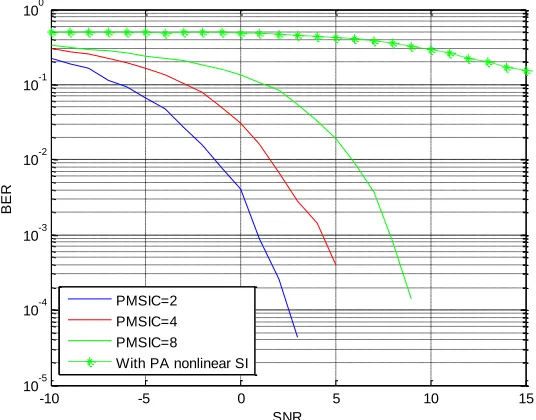
Some BER simulation results for the proposed PMSIC scheme are given in this section. And it is compared to the method which needs to estimate the PA nonlinearity coefficient and reconstruct a copy signal of the nonlinear SI. We choose the PSK signal as the signal source. For the simulation, we compare 2, 4, 8 order polarization modulation. For example, for the 2 order polarization modulation, we use the PSs
0 1Tand
1 0 Tto map with the BPSK signal 0 and 1 respectively. And for the n order polarization modulation, there are n given polarization states to map with the nPSK signal. For the compared nonlinearity estimation cancellation (NEC) method and the proposed scheme, it is assumed that the channel state information (CSI) are all perfect known at the receiver, since we just investigate how the PA nonlinearity impacts the SI cancellation. For the PA, only a limited number of odd orders of polynomial contribute to the PA nonlinearity distortion and the higher orders could be neglected, hence the nonlinear PA can be modeled as
3 5
0 3 5
ya xa x a x (7)
where x is the input signal of PA, and y is the output signal of PA. for the PA model, it only estimates the third-order nonlinearity of PA according to the NEC
method in [6], hence the estimation error is unavoidable because the third term
5 5
a x
is neglected.
demodulate the interested signal correctly. On the contrary, the proposed PMSIC method performs well in each case, which indicates that the proposed scheme is not impacted by the PA nonlinearity.
-10 -5 0 5 10 15
10-5 10-4 10-3 10-2 10-1 100
SNR
BER
PMSIC=2 PMSIC=4 PMSIC=8
[image:5.612.158.426.108.318.2]With PA nonlinear SI
Figure 2. BER performance comparison between the proposed scheme and the system with PA nonlinear SI.
Then we compare the performance between the proposed PMSIC scheme and the conventional NEC scheme. As Figure 3 shows that the PMSIC scheme performs obviously better than the NEC scheme in each modulation order. The NEC scheme applies the conventional Quadrature Amplitude Modulation (QAM), NEC=4 means that it applies the 4 order QAM. Hence the proposed PMSIC scheme is more effective than the NEC scheme.
-10 -5 0 5 10 15
10-5 10-4 10-3 10-2 10-1 100
SNR
BER
PMSIC=2 PMSIC=4 PMSIC=8 NEC=2 NEC=4 NEC=8
[image:5.612.160.424.470.675.2]CONCLUSIONS
In this paper, we take advantage of the feature that the polarization state of the signal is not affected by the PA nonlinearity, and propose a self-interference cancellation scheme based on polarization modulation for the FD systems. The proposed scheme needs not to model the PA nonlinearity, and can avoid the PA nonlinearity coefficient estimation error. Simulation results and analysis show that the BER performance of the proposed scheme is better than the conventional scheme which needs to estimate PA nonlinearity coefficient, which indicates that the proposed scheme can cancel the nonlinear SI induced by the PA effectively.
ACKNOWLEDGEMENT
This work is supported by the National Natural Science Foundations of China under Grant No. 61501050 and the Fundamental Research Funds for the Central Universities under Grant No.2014ZD03-01.
REFERENCES
1. S. K. Hong, J. Brand, and J. Choi, et al. 2014. “Applications of self-interference cancellation in 5G and beyond,” IEEE Communications Magazine, 52(2): 114-121.
2. M. Duarte, A. Sabharwal, and V. Aggarwal, et al. 2013. “Design and Characterization of a Full-duplex Multi-antenna System for WiFi networks,” IEEE Trans. Veh. Tech., 63(3): 1160-1177. 3. E. Everett, A. Sahai, and A. Sabharwal. 2014. “Passive Self-interference Suppression for Full-duplex
Infrastructure Nodes,” IEEE Trans. Wireless Commun., 13(2): 680-694.
4. S. Huberman and T. Le-Ngoc. 2015. “MIMO Full-duplex Precoding: a Joint Beamforming and Self-interference Cancellation Structure,” IEEE Trans.Wireless Commun., 14(4): 2205-2217. 5. D. Bharadia, E. McMilin, and S. Katti. 2013. “Full duplex radios,” in ACM SIGCOMM, pp. 369-373. 6. E. Ahmed, A. Eltawil, and A. Sabharwal. 2013. “Self-interference cancellation with nonlinear distortion suppression for full-duplex systems,” in Asilomar Conference on Signals, Systems and Computers, pp. 1199-1203.
7. L. Anttila, D. Korpi, V. and Syrj¨ al¨ a, and M. Valkama. 2013. “Cancellation of power amplifier induced nonlinear self-interference in full-duplex transceivers,” in Asilomar Conference on Signals, Systems and Computers, pp. 1193-1198.
8. Benedetto S., and Poggiolini P T. 1994. “Multilevel polarization shift keying: optimum receiver structure and performance evaluation,” IEEE Trans. Commun., 42(10):1174-1186.
9. Benedetto S., and Poggiolini P. T. 1992. “Theory of polarization shift keying modulation,” IEEE Trans. Commun., 40(10):708-721.