2017 3rd International Conference on Computer Science and Mechanical Automation (CSMA 2017) ISBN: 978-1-60595-506-3
Linear Programming Algorithm for Assembly Line
Balancing in Crane Production
Si-Qi ZHANG
1,a,*, Qi GE
1,b, Nan-Nan YANG
1,c, Yu ZHANG
1,d,
Ying-Qiao ZHU
1,eand Ying-Wen XING
1,f1
Traffic Engineering School, Shenyang Jianzhu University, Shenyang, Liaoning Province, China
Email: [email protected], [email protected], [email protected], d
[email protected], [email protected], [email protected]
Keywords: Assembly line balancing, Linear programming, Crane production.
Abstract. Crane has the characteristics of complex structure, large volume and weight. Crane production is widely used in fixed-point assembly. But in the fixed-point assembly process, there will be assembly inefficient, complex distribution, to be more products and other issues arise. Therefore, the assembly line balance is one of the important issues in planning efficient assembly lines. On the basis of fully understanding the crane production line, the linear programming method was used to establish the mathematical model which can fully reflect the relationship between the production elements of the production line in this paper. And then using Lingo software to optimize the production line balance solution, the assembly line achieve a smooth production and improve the production efficiency.
Introduction
Crane is a large construction machinery and equipment. Cranes are mainly used for hoisting and construction of large projects. Due to the larger overall shape of the crane, the heavier weight, the current crane assembly is the use of fixed-point assembly in the form of assembly. That is, in the same position to complete all the assembly work. Because the same a total station also need to correspond to all processes, resulting in production logistics chaos, cross obvious, long lines of transportation, production without the concept of rhythm, low production efficiency, management difficulties. With the increasingly fierce market competition, raw material costs increase, more and more cheap products, increased labor costs, profit margins have become smaller and smaller. The current production plan cannot meet the company's production capacity [1,2]. In the whole production process from raw material to finished product shipments, most of the time is consumed in the movement of raw materials, tools and parts, and the time spent in production is very small. Good logistics system is very important for compressing inventory, shortening handling time and optimizing production.
Assembly Line Balancing (ALB) is conducive to shortening the assembly time of the product, increasing the output per unit time, reducing the preparation time between the processes and improving the efficiency of the production line [3,4]. Through the study of the crane assembly process, this paper changes the current production mode of fixed-point assembly, to the assembly line to the production mode. The linear programming method proposed in the paper is helpful to improve the efficiency of crane assembly and production capacity.
Linear Programming Model
assembly line balance problem, and the optimal solution of the problem is obtained by optimizing the assembly line by solving the linear mathematical model.
For the production line balance, the establishment of mathematical models are mainly the following constraints:
Restrictions 1: In order to ensure product assembly process and the integrity of the final product, all the contents of the work must be assigned to the various assembly workstations.
Restrictions 2: The standard operating time for each workstation cannot be greater than the established production cycle time.
Restrictions 3: Assembly precedence constraint. For example, a job i must be completed before job j, that is, job j must be on station A, then job i is only allowed to allocate from station 1 to station A, and cannot be assigned To station A behind.
According to the first constraint, the following mathematical expressions are available:
Set i, j variable as the serial number (index) of the job element, representing the job element i, j = 1, 2 ... n.
Set k as the workstation serial number (index), on behalf of the k station, k = 1, 2 ... ... K.
X+ X+ ⋯ X= 1
X+ X+ ⋯ X = 1
⋯
X+ X+ ⋯ X= 1
Can be simplified as:
∑X = 1(i = 1,2 … n) (1)
According to the second constraint, the operating time of each workstation cannot be greater than the established production cycle time. We can get the following mathematical expression. Where the variable Ti represents the time of the i-th job element,( = 1,2, … )
XT+ XT+ ⋯ XT≤ CT
XT+ XT+ ⋯ XT≤ CT
⋯
XT+ XT+ ⋯ XT≤ CT
Can be simplified as:
∑ X T≤ CT(k = 1,2 … k) (2)
According to the third assembly precedence constraint: For example, a job i must be completed before job j, that is, job j must be on station A, then job i is only allowed to allocate from station 1 to station A, and cannot be assigned To station A behind. This way ensures that the assembly of the job elements between the priority relationship. The following mathematical expressions are available:
Set Pred as the sequence of work units. Pred = {(i, j) | The job unit i is the immediate job of the job unit j}.
∑ (KX − KX)≥ 0((i, j) ∈ pred) (3)
In order for the LINGO software program to be operational, the value of this workstation is 1 when a work station has a job element assigned. In this case, '( is used as the instruction variable for station K. Specific mathematical expressions are as follows:
∑(()*( ≤ '((+ = 1,2 … +) (4)
, -.
-/ Min = ∑A
∑AX = 1(i = 1,2 … n)
∑ X T≤ CT(k = 1,2 … k)
∑ 2KX − KX3≥ 02(i, j) ∈ pred3
∑X≤ nA(k = 1,2 … k)
Solution Procedure of the Crane ALB
The definition of assembly line balance is defined as the assembly of a product or part of a product consists of a series of processes in which there is a sequence of time constraints between certain processes. Given the production cycle time CT, in terms of satisfying the order of product assembly and assembly fixture constraints , it consider how to allocate each job process, so that the number of workstations required minimum, and the maximum operating time of the workstation does not exceed the takt time. At the same time, the total time allocated to each workstation's work is as equal as possible.
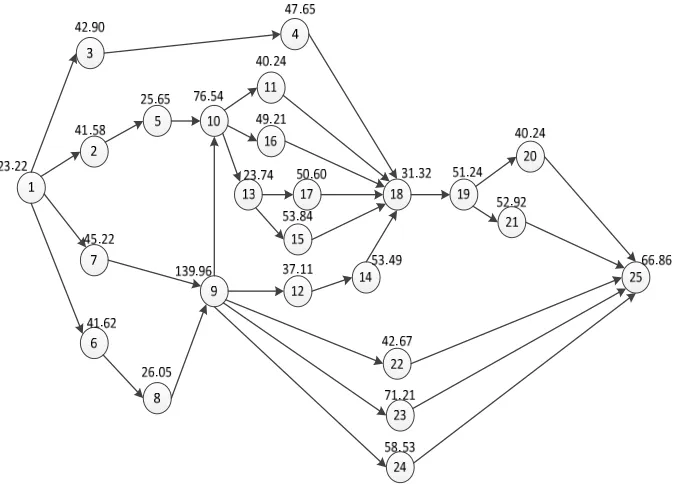
[image:3.612.138.478.345.587.2]The crane assembly line consists of a series of stations. The product passes through each station and completes the corresponding work. From the original, the crane is assembled and finally forms the final form of the product. According to the practical production problems, this paper first collects the basic data of the current assembly line balance and the operating time of minimum operating unit. And then it draws the assembly priority diagram (Figure 1).Secondly, this paper establishes the relevant mathematical model, that is, the method of mathematical modelling to establish the mathematical model of assembly line balance.
Figure 1. Main station line priority sequence diagram.
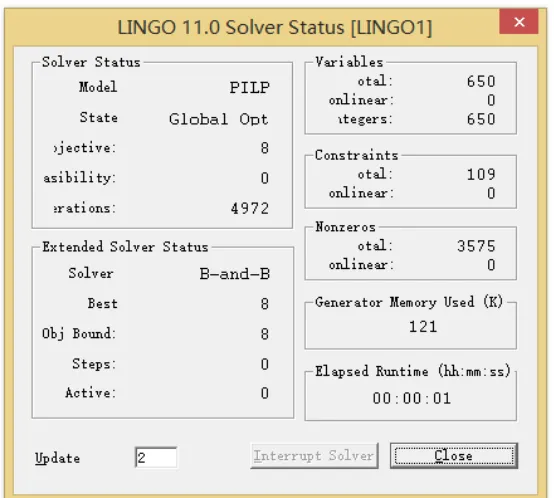
Figure 2. LINGO software operation diagram.
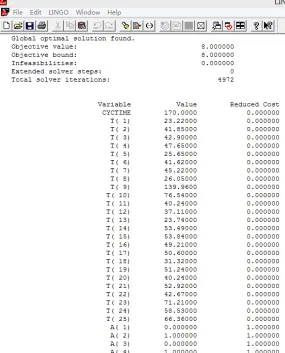
Figure 3. LINGO software running part of the results diagram.
According to the above procedures, Lingo software get the following variable results (Where the operation = 0.000000 represents the i-th job and is not placed on the jth workstation; When the operation value = 1.000000 on behalf of the i-th job is placed on the jth workstation). Table 1 shows the results of the workstation assignment.
Table 1. Lingo post-workstation assignment results.
workstation distribution process total operating time (min)
1 1,2,5,6,8 158.99
2 3,4,7 135.77
3 4 5 6 7 8
9 10,11,17 12,13,14,15 16,18,24 19,20,23 21,22,25
139.96 167.38 168.18 139.06 162.69 162.45
[image:5.612.160.445.38.391.2]Conclusion
In this paper, the crane assembly line as the background, the production line balance was studied. In this paper, the linear programming method is used to allocate the contents of each work to the corresponding station. The assembly line has been improved. After the balance is optimized, to achieve smooth production, the crane is produced in a pipelined manner, changing the original no-bit, no rhythm of the fixed-point assembly production. In this way, it improves the production efficiency. This article sets up a reasonable logistics planning method and process for the crane assembly production, in order to carry on the reasonable plan when carries on the equipment adjustment in the later stage and for the expansion of the plant logistics planning to provide a reference.
Acknowledgment
This work is partially supported by Ministry of Housing and Urban-Rural Development (No. 2017-R2-039) and Student Innovation & Entrepreneurship Training Program.
References
[1]Thibaut V, Teodor G C, Michel G, et al. A unified solution framework for multi-attribute vehicle routing problem. European Journal of Operational Research, 234(3):658~673, 2014.
[2]Faidal Aqlan. An integrated simulation-optimization study for consolidating production lines in a configure-to-order production environment. Int. J. Production Economics, 148:51~61, 2014.
[3]Nooshin Rahmani. Designing the retouch line in an automobile factory using a simulation-based optimization technique a real case study. Procedisa-Social and Behavioral Sciences, 62:995~1000, 2012.
[4]Oncu Haazir. Assembly line balancing under uncertainty: Robust optimization models and exact solution method. Computers & Industrial Engineering, 65:261~267, 2013.
[5]Anna Corinna Cagliano, Alberto DeMarco, Carlo Rafele and Sergio Volpe, Using system dynamics in warehouse management: a fast-fashion case study, Manufacturing Technology Management, Vol. 22 (2): 171~ 188, 2012.