Jilani, Aisha
Parallel corpus multi stream question answering with applications to the Qu'ran
Original Citation
Jilani, Aisha (2013) Parallel corpus multi stream question answering with applications to the Qu'ran.
Doctoral thesis, University of Huddersfield.
This version is available at http://eprints.hud.ac.uk/id/eprint/23852/
The University Repository is a digital collection of the research output of the
University, available on Open Access. Copyright and Moral Rights for the items
on this site are retained by the individual author and/or other copyright owners.
Users may access full items free of charge; copies of full text items generally
can be reproduced, displayed or performed and given to third parties in any
format or medium for personal research or study, educational or notforprofit
purposes without prior permission or charge, provided:
•
The authors, title and full bibliographic details is credited in any copy;
•
A hyperlink and/or URL is included for the original metadata page; and
•
The content is not changed in any way.
For more information, including our policy and submission procedure, please
contact the Repository Team at: [email protected].
QU’RAN
AISHA JILANI
A thesis submitted to the University of Huddersfield in partial fulfilment of the requirements for the degree of Doctor of Philosophy
The University of Huddersfield
i thesis) owns any copyright in it (the “Copyright”) and s/he has given The
University of Huddersfield the right to use such copyright for any administrative, promotional, educational and/or teaching purposes.
ii. Copies of this thesis, either in full or in extracts, may be made only in accordance with the regulations of the University Library. Details of these regulations may be obtained from the Librarian. This page must form part of any such copies made. iii. The ownership of any patents, designs, trademarks and any and all other
intellectual property rights except for the Copyright (the “Intellectual Property Rights”) and any reproductions of copyright works, for example graphs and tables (“Reproductions”), which may be described in this thesis, may not be owned by the author and may be owned by third parties. Such Intellectual Property Rights and Reproductions cannot and must not be made available for use without the prior written permission of the owner(s) of the relevant
The knowledge from which no benefit is derived is like a treasure
from which no charity is bestowed...
Prophet Muhammad
iii Question-Answering (QA) is an important research area, which is concerned with developing an automated process that answers questions posed by humans in a natural language. QA is a shared task for the Information Retrieval (IR), Information Extraction (IE), and Natural Language Processing communities (NLP). A technical review of different QA system models and methodologies reveals that a typical QA system consists of different components to accept a natural language question from a user and deliver its answer(s) back to the user. Existing systems have been usually aimed at structured/ unstructured data collected from everyday English text, i.e. text collected from television programmes, news wires, conversations, novels and other similar genres. Despite all up-to-date research in the subject area, a notable fact is that none of the existing QA Systems has been tested on a Parallel Corpus of religious text with the aim of question answering. Religious text has peculiar characteristics and features which make it more challenging for traditional QA methods than other kinds of text.
This thesis proposes PARMS (Parallel Corpus Multi Stream) Methodology; a novel method applying existing advanced IR (Information Retrieval) techniques, and combining them with NLP (Natural Language Processing) methods and additional semantic knowledge to implement QA (Question Answering) for a parallel corpus. A parallel Corpus involves use of multiple forms of the same corpus where each form differs from others in a certain aspect, e.g. translations of a scripture from one language to another by different translators. Additional semantic knowledge can be referred as a stream of information related to a corpus. PARMS uses Multiple Streams of semantic knowledge including a general ontology (WordNet) and domain-specific ontologies (QurTerms, QurAna, QurSim). This additional knowledge has been used in embedded form for Query Expansion, Corpus Enrichment and
Answer Ranking.
Table of Contents
Abstract ... iii
Table of Contents ... iv
List of Figures ... xi
List of Tables ... xiv
Acknowledgements ... xvi
Disclaimer ... xviii
Chapter 1 – Introduction ... 1
Rationale ... 2
Motivation ... 3
Novel contributions of thesis ... 3
Thesis structure and highlights ... 6
Summary ... 8
Chapter 2 – Background Studies ... 9
2.1 Theoretical Underpinnings ... 9
I – Natural Language ... 9
Natural Language – Challenging... 10
English Language – Ambiguity ... 11
Dealing with Ambiguity in Natural Language ... 13
II – Question Answering Systems... 14
Evolution of QA ... 15
QA Evaluation Campaigns ... 16
General QA Architecture ... 18
Recent Question-Answering Systems ... 21
I – QA Model Applied to Document Retrieval System: 2009 ... 21
II – AquaLog: 2005 ... 22
III – The NSIR System: (2000 - 2005) ... 23
IV – ASU QA: 2002 ... 24
V – Falcon: TREC9 (2000) ... 25
VI – QA-LaSIE: TREC9 (2000) ... 26
VII – AskMSR ... 27
VIII – START: 1993 ... 28
Multi-Stream Question Answering ... 28
I – Skimming Approach ... 29
v
III – Dark-Horse Approach ... 30
IV – Web Chorus Approach ... 30
V – Answer Validation Approach ... 30
Critical Analysis of QA Systems ... 32
Section Summary ... 33
2.2 The Quran Corpus ... 34
I – The Quran ... 35
(i) History of the Quran ... 35
(ii) Structure of the Quran ... 37
(iii) Language of the Quran ... 38
(iv) Prominent Topics of Interest in the Quran ... 38
Rituals & Faith ... 39
(i) Shahada ... 39
(ii) Salat ... 39
(iii) Saum ... 40
(iv) Zakat ... 40
(v) Hajj ... 40
Natural Science ... 41
History ... 41
Code of Conduct ... 42
Islamic Rulings ... 43
(v) Essential Books for Understanding the Quran ... 44
Hadith & Sunnah ... 44
Tafsir ... 45
II – Peculiar Characteristics of the Quranic Text ... 45
(i) Figurative Meanings of Words ... 46
(ii) Information Distribution in the Quran ... 46
(iii) Figurative use of Language ... 47
Metonymy ... 47
Personification ... 48
Hyperbole ... 48
Metaphors and Similes ... 49
(iv) Grammatical Nature of the Quranic Text ... 50
(v) Mental Schema and the Quran ... 50
(vi) The Quran’s Appellation to Human Senses ... 51
V - Computing Research using Other Religious Texts ... 53
Section Summary ... 54
2.3 – Computational Research on the Quran ... 55
I – Cluster Analysis for Automated Classification of Quranic Chapters ... 56
II – Visualisation System for the Quran ... 57
III – Quranic Ontologies... 59
IV – Islamic Question-Answering Systems ... 60
2.3.1 Islam Q&A Website ... 61
2.3.2 Study the Quran Website ... 61
2.3.3 IslamiCity ... 62
2.3.4 Islam Web ... 63
2.3.5 On Islam... 64
2.3.6 Qibla Answers ... 64
2.3.7 Understanding Islam ... 65
2.3.8 Alim ... 66
2.3.9 Quran Al-Islam ... 67
2.3.10 Studying Islam ... 67
V – Quranic Verse Retrieval Problem ... 68
VI – Quranic Corpus ... 70
VII – Linguistic Work on the Quran... 71
VIII – QurAna ... 71
IX – QurSim ... 73
X – QurTerms ... 74
Section Summary ... 76
Chapter 3 – PARMS ... 77
3.1 Theoretical Underpinnings ... 79
3.1.1 Control Vocabulary – The Metadata ... 80
3.1.2 Weighting Functions ... 80
(i) Term Frequency – (tf) ... 80
(ii) Inverse Document Frequency - idf ... 81
(iii) Term Frequency – Inverse Document Frequency ... 81
(iv) OKAPI Model ... 81
3.1.3 Stop words ... 82
3.1.4 Stemming ... 82
3.1.5 Term Expansion... 83
vii
Cosine Similarity ... 84
LESK ... 84
3.2 Methodology ... 84
3.2.1 Phase I – Creation of Control Vocabulary ... 85
Step - 1 ... 85
Step - 2 ... 86
Step - 3 ... 87
3.2.2 Phase II – Selection of Candidate Answers ... 88
3.2.3 Phase III – Document Weighting & Similarity Measure ... 89
Step – 1 ... 89
Step - 2 ... 89
3.2.4 Phase IV – Answer Ranking & Re-Ranking ... 90
3.2.5 Phase V – Generation of Results ... 91
3.3 Implementation ... 92
3.3.1 System Design & Development ... 93
Data Layer ... 93
Processing Logic Layer ... 93
Presentation Layer ... 93
3.3.2 PARMS Question Answering Application ... 94
3.3.3 PARMS Evaluation Framework ... 95
3.4 Testing ... 97
Summary ... 99
Chapter 4 – PARMS Evaluation System ... 100
4.1 PARMS Model Question Set ... 101
4.1.1 Rationale ... 101
4.1.2 Collection Resources ... 102
4.1.3 Question Answer Pair Classification ... 103
Questions ... 103
(i) Frequently Asked Questions ... 103
(ii) Online User Queries ... 104
(iii) Offline User Queries ... 104
(iv) Derived User Queries ... 105
Answers ... 105
(i) Expert Answers ... 106
(ii) Derived Answers ... 108
4.1.5 Representation ... 111
4.2 Evaluation Parameters ... 112
(i) Translated By ... 112
A – Single Author Translation Mode ... 113
B – All (Parallel) Mode ... 113
C – Parallel-Corpus Mode ... 113
(ii) Remove Stop Words ... 114
(iii) Use Stemming ... 114
(iv) Stemmers ... 114
(v) Weight Functions ... 115
(vi) Results Cut-off Point ... 115
(vii) WordNet Term Expansion ... 115
A – Questions Only ... 115
B – Documents Only ... 115
C – Both (Questions and Documents) ... 115
D – None ... 115
(viii) Ignore Duplicate Terms ... 116
(ix) Resolve Pronouns ... 116
(x) Translate Terms ... 116
(xi) Similarity Measure ... 116
(xii) Re-Rank Results ... 116
4.3 Parameter Settings ... 117
Simple Parameters Setting (SPS) ... 117
Basic Parameters Setting (BPS) ... 117
Enhanced Parameters Setting (EPS) ... 118
4.4 Evaluation Metrics ... 118
I – Accuracy ... 119
II – Precision ... 119
(i) Precision at 1st rank – P@1 ... 119
(ii) Precision at top 5 ranks – P@5 ... 119
(iii) Precision at top 10 ranks – P@10 ... 120
III – Recall ... 120
IV – Mean Average Precision ... 120
V – Mean Reciprocal Rank ... 120
4.5 Results: Visual Representations ... 121
ix
Chapter 5 – PARMS Evaluation Results ... 125
5.1 Preliminary Experiments ... 125
5.1.1 Effect of Basic NLP Techniques ... 126
5.1.2 Effect of Term Weighting Functions ... 127
5.1.3 Effect of WordNet Ontology ... 127
5.1.4 Effect of Cosine Similarity Method ... 128
5.2 Significant Experimental Results ... 129
5.2.1 SPS Experiment Results ... 129
(i) Precision at 1 – P@1 ... 129
(ii) Precision at 5 – P@5 ... 131
(iii) Precision at 10 – P@10 ... 132
5.2.2 BPS Experiment Results ... 133
(i) Precision at 1 – P@1 ... 133
(ii) Precision at 5 – P@5 ... 135
(iii) Precision at 10 – P@10 ... 136
(iv) Overall Success Trends for BPS ... 137
5.2.3 EPS Experiment Results ... 138
(i) Precision at 1 – P@1 ... 138
(iii) Precision at 5 –P@5 ... 139
(iii) Precision at 10 –P@10 ... 140
(iv) Performance Trend for Parallel-Corpus Mode ... 141
(v) Recall by Rank ... 141
5.3 Evaluation Results Analysis... 142
5.3.1 Role of Parallel-Corpus ... 142
5.3.2 Role of Multi-Stream Semantic Knowledge ... 143
I – Experiment One ... 143
II – Experiment Two ... 145
III – Experiment Three ... 148
Summary ... 150
Chapter 6 - Conclusion & Future Work ... 151
Potential Application areas of this research ... 154
Methodology ... 154
Corpus... 155
QurTerms ... 155
Application ... 156
Appendices ... 159
Appendix 1 – Copyright Permissions ... 159
Alim.org... 159
StudytheQuran.com ... 160
IslamQA.info ... 161
Appendix 2 – XML Schemas ... 162
Question Set ... 162
QurTerms Ontology ... 163
Appendix 3 – PARMS Input ... 164
QurTerms ... 164
PARMS Model Q&A Set ... 170
Appendix 4 – PARMS Output ... 195
Answer Analysis Report ... 195
Results Summary Report ... 196
Result Statistical Report ... 197
Control Vocabulary ... 198
CV 2 ... 198
CV 3 ... 204
Appendix 5 – PARMS Supporting Tools ... 211
Question Helper Tool ... 211
Appendix 6 – PARMS Testing Evidence ... 212
Bibliography ... 220
xi
List of Figures
Figure 2.1: Grammar for the sentence ‘Fruit flies like a banana’ ... 11
Figure 2.2: First Possible Parse Tree ... 12
Figure 2.3: Second Possible Parse Tree ... 12
Figure 2.4: Components of a typical Question Answering System (Jilani 2012) ... 18
Figure 2.5: Block Diagram of a Typical Question Answering System (Jilani 2012) ... 19
Figure 2.6: General Architecture of a Question Answering System (Keller 2013) ... 21
Figure 2.7: Overview of the System Architecture (Kaplan 2001) ... 22
Figure 2.8: Overview of the AquaLog QA System (Jilani 2012) ... 23
Figure 2.9: Overview of the NSIR Question Answering System (Jilani 2012) ... 24
Figure 2.10: Overview of the ASU-QA System (Jilani 2012) ... 25
Figure 2.11: Overview of the Falcon Question Answering System (Jilani 2012) ... 26
Figure 2.12: Overview of the AskMSR Question Answering System (Jilani 2012) ... 27
Figure 2.13: Methods and Techniques used to achieve effective Question Answering (Jilani 2012) ... 33
Figure 2.14: Block Diagram showing Architecture of AQILAH Visualisation System (Mustapha 2009) ... 58
Figure 2.15: Different Levels of Solat Taxonomy (Saad, Salim et al. 2011) ... 59
Figure 2.16: Islam Question Answering (1997)... 61
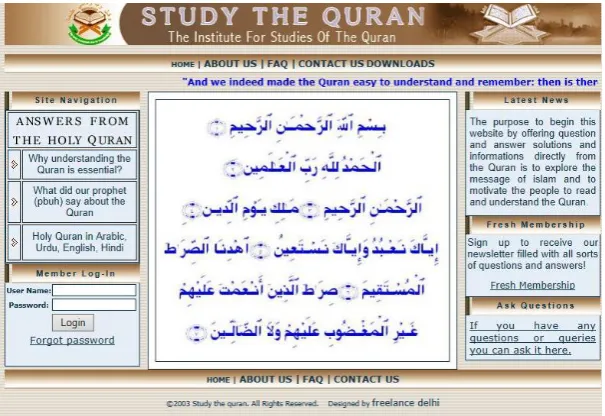
Figure 2.17: Study the Quran Website (2003) ... 62
Figure 2.18: IslamiCity Website (1995) ... 62
Figure 2.19: Islam Web Website (1998) ... 63
Figure 2.20: OnIslam Website (2010) ... 64
Figure 2.21: Qibla Answer Website group of questions (2010) ... 65
Figure 2.22: Understanding Islam Website (2001) ... 65
Figure 2.23: Understanding Islam Website (2010) ... 66
Figure 2.24: QA Categories by Quran Al-Islam.com Website (Salhey 2013) ... 67
Figure 2.25: Studying Islam (2007) Website ... 67
Figure 2.26: Hierarchical Structure of Islamic sources ... 68
Figure 2.27 Sample from Eight-Parallel Quran ... 70
Figure 2.28 Example of QurTerm ... 76
Figure 3.1 Block Diagram depicting Parallel Corpus Multi Stream (PARMS) Methodology (Jilani 2013) ... 79
Figure 3.4: Block Diagram depicting Control Vocabulary Generation (Jilani 2013) ... 88
Figure 3.5: Pseudo-code for PARMS Re-Ranking Method (Jilani 2013) ... 91
Figure 3.6: Block Diagram depicting PARMS QA Application Architecture (Jilani 2013) ... 94
Figure 3.7: Screenshot of PARMS Question Answering Application (Jilani 2013) ... 95
Figure 3.8: Screenshot of PARMS Question Answering Evaluation Framework (Jilani 2013) 96 Figure 3.9: Screenshot of Evaluation Results using PARMS Model Questions Set (Jilani 2013) ... 97
Figure 4.1: FAQ Type PARMS Model Question QID#45... 103
Figure 4.2: Online User Query Type PARMS Model Question QID#18 ... 104
Figure 4.3: Offline User Query Type PARMS Model Question QID#69 ... 105
Figure 4.4: Derived User Query Type PARMS Model Question QID#24 ... 105
Figure 4.5: Question Answer sample from IslamQA.com ... 106
Figure 4.6: Question Answer sample from IslamQA.com – (a) ... 107
Figure 4.7: Question Answer sample from IslamQA.com – (b) ... 107
Figure 4.8: Question Answer sample from IslamQA.com – (c) ... 108
Figure 4.9: PARMS Model Question QID#69 ... 108
Figure 4.10: Quran Subjects feature of Quran Al-Islam website ... 109
Figure 4.11: Al-Quran Subject Index of Alim.org website ... 109
Figure 4.12 PARMS Model Question Sample ... 111
Figure 4.13 PARMS Evaluation System Parameters ... 112
Figure 4.14: Sample Model Question - QID#09 ... 121
Figure 4.15: Sample Model Question - QID#50 ... 122
Figure 4.16: Screen Shot of Unsuccessful Results shown ... 122
Figure 4.17: Sample EPS Bitmap Image for P@10 ... 123
Figure 4.18: Change Chart Depicting Change of Results ... 124
Figure 5.1: SPS Bitmap Image for P@1 ... 130
Figure 5.2: Model Question and Answer Pair ID# 27 ... 130
Figure 5.3: SPS Bitmap Image for P@5 ... 132
Figure 5.4: SPS Bitmap Image for P@10 ... 133
Figure 5.5: Model Question QID#87 ... 134
Figure 5.6: Question Terms for QID#87 using SPS ... 134
Figure 5.7: Location of Correct Answer for QID#87 using SPS ... 134
Figure 5.8: BPS Bitmap Image for P@1 ... 135
Figure 5.9: BPS Bitmap Image for P@5 ... 135
Figure 5.10: BPS Bitmap Image for P@10 ... 136
xiii
Figure 5.14: EPS Bitmap Table for P@10 ... 140
Figure 5.15: Graph of Performance Trends for Parallel-Corpus Mode ... 141
Figure 5.16: Graph of Recall by Rank ... 141
Figure 5.17: Graph of Performance Trend for Parallel-Corpus Mode for EPS Experiments . 142 Figure 5.18: Screen Shot of PARMS Results showing incorrect results for QID#38 ... 144
Figure 5.19: Screen Shot of PARMS Results showing correct results for QID#38 ... 144
Figure 5.20: Screen Shot of PARMS Evaluation System Result for Experiment Two Stage 1 ... 145
Figure 5.21: PARMS Evaluation System Result for Experiment Two Stage 2 ... 146
Figure 5.22: Change Chart for Experiment Two Stage 1 & 2 ... 146
Figure 5.23: PARMS Model Question QID#82 ... 146
Figure 5.24: Correct Answer 007:169 for PARMS Model Question QID#82 ... 147
Figure 5.25: PARMS Evaluation System Result for Experiment Two Stage 3 ... 147
Figure 5.26: Change Chart for Experiment Two Stage 1 & 3 ... 148
Figure 5.27: Change Chart Diagram for PARMS Results with and without Re-ranking ... 149
List of Tables
Table 2.1: The Quranic Chapters with more than 1,000 words used for Cluster Analysis
(Mustapha 2009) ... 57
Table 4.1: Statistics for Question Types in PARMS Model Question Set ... 110
Table 4.2: Statistics for Question Topics in PARMS Model Question Set ... 111
Table 4.3: Simple Parameter Settings ... 117
Table 4.4: Basic Parameter Settings ... 118
Table 4.5: Enhanced Parameter Settings ... 118
Table 4.6: Sample BPS Experiment Result for P@10 ... 121
Table 5.1: SPS Experiment Result for P@1 ... 129
Table 5.2: SPS Experiment Result for P@5 ... 131
Table 5.3: SPS Experiment Result for P@10 ... 132
Table 5.4: BPS Experiment Result for P@1 ... 134
Table 5.5: BPS Experiment Result for P@5 ... 135
Table 5.6: BPS Experiment Result for P@10 ... 136
Table 5.7: EPS Experiment Result for P@1 ... 138
Table 5.8: EPS Experiment Result for P@5 ... 139
xv
Dedicated to my husband, Shakeel Ahmed
“Do not consider even the smallest good deed as insignificant; even meeting your brother with a
cheerful face (is a good deed)."
Prophet Mohammed
This piece of text might read more like a story instead of formal words. This is the best way I can express my gratitude to those whom I owe great respect and appreciation. This is because I see my PhD as a long journey not only a degree. I also want to share my personal experience with those who are held back thinking that a PhD has no end. I have to acknowledge many people; as I met so many ‘lovely’ personalities on my PhD journey who have contributed in my success one way or the other.
I see this research work as produced by a first time mother (myself) who knew nothing BUT had the will to achieve a PhD besides having a lovely & lively family. Honestly, every time I felt low my considerate supervisor restored my moral by sharing his personal experiences. He kept me reminded how much he trusted my skills. He made me realise that a PhD is not about earning a degree; it’s about learning to remain determined and be productive despite how low-flight the journey is or how high your research target is. I was given more hopes
by a kind-hearted lady. She gave me the directions which led me to a point where I was free to think and pave my way to the end. But there still was something important missing – the test data. Here another sympathetic and intellectually generous personality allowed access to his expertise. He encouraged me to identify and fit in the missing pieces of the jigsaw. His dedicated support and encouragement did wonders and I achieved the amount of work in minimum time which I’m sure must have been very difficult otherwise. Finally, following are the names of the respective personalities:
Prof Lee McCluskey: Thank you Lee for having faith in my abilities and helping me make my
dream come true. My sincere respect to you for being my supportive supervisor 2
ndtime.
Dr Di Cai: Thanks a lot for showing me the direction where the solution to my problems laid.
Dr Eric Atwell: Words are not enough to say what I got from you when and where I needed it.
Thanks a lot for being around.
xvii
It is important to name my friendly colleagues who made our office environment ‘less freaky’. Rabia Jilani (my sister) thanks for being there and everywhere in my final year and yes! also for decorating my desk every now and then to cheer me up. I won’t let you miss me...!!! Dr (to be soon) Shahin Shah I will miss our tea coffee and nibbling together. Falilat Jimoh, I’m grateful for the handy advice you always had for me. Asma Kilani, thanks for absorbing my free advice. Dr Fariha Chaudhary, thanks a lot dear for listening to my research issues and sharing your wisdom; you always gave me a different perspective for my work. Last thing – my dear office desk: I will miss you a lot too...!
Overall, my PhD journey was tough but all pains turned into gains as my child, Shaheer Ahmed, grew besides this research work. My husband, Shakeel Ahmed, ensured to suppress my guilt as being a working mother. Doing so, he took stress out of my life. He did everything and anything to give me the best opportunity to gain this success. Thank you so much Ahmed – for being ‘true’. I must have never achieved this without your support.
Now to mention contributions of my parents and family... Nothing in this world can be achieved unless you have your parents behind your back to trust on, to rely on, to lean on and to reflect on. I would like to express my deep gratitude to my parents, my father Prof. Ghulam Jilani and mother Shahida Jilani. Ammi and Puppa I am ME because of YOU. The more I am learning, the more I understand your unbeatable value in my life. Not to forget, Abba Gee, Maan Gee Juzak Allah Khair for your prayers and moral support. I also owe special thanks to my uncle Saeed Anjum for his critical thoughts on my work. I would also like to acknowledge his family for the on-going support they have been providing me throughout my life in UK. Last but not least, thanks a lot to my dear brothers Ali Asghar Jilani for lending me an ear whenever I needed one and Awais Jilani for the good laughs you always shared. This provided me a safe zone to relax at times. My sincere thanks to Anila Bashir for all the practical support I got from her.
An aspect of my work was to apply my research methods to the Quran. In this regard, I got several volunteer offers from several knowledgeable and motivated people across the globe. I have availed myself of a few of these and will surely get in touch whenever the need arises in future. I thank you all for your contributions in this regard!
Applying my research to the Quran as a case study helped me better understand the topics and
the Verses of this book. This is one of the best things I have achieved during my PhD. I have
tried hard to accomplish this task in the best possible way. But I would also like to state that
research presented in this thesis is a part of computer science studies, not religious studies. The
method proposed in this work tries to compute answers from the Quranic translations using
different question answering methods reputable in the subject area. Authors are by no means
trying to supplant or override any human experts in this context. The answers provided by the
proposed method should NOT be seen or used independently of the advice from domain
scholars. Also the choice of English translations of the Quran was purely based on firstly,
availability and then suitability for the task. We are not claiming any translation to be more
virtuous than any other. May Allah SWT accept my limited effort – Ameen.
"He who makes peace between people by inventing good information or saying good things, is not a liar."
Prophet Muhammad
1 Advances in information technology and the volume of information available in electronic form led to the development of advanced search engines and document retrieval systems, e.g. Google and AltaVista. Although these systems provide links to relevant documents very efficiently, the user is required to take the trouble to search through them to identify the most suitable document which satisfies his information need. This is what triggered research into developing Question Answering (QA) Systems which were capable of mapping a user’s knowledge requirement presented in a natural manner (i.e. by asking questions), to a piece of information that satisfies the user’s needs (i.e. answer to asked question). Here the challenges are to determine the knowledge requirement precisely, identify where the required knowledge is available, and finally extract present knowledge to a level of user understanding and satisfaction. Development of a system capable of meeting these challenges has been a long-standing research goal.
Research on QA Systems has a history since the 1960’s, resulting in multiple techniques, methods, procedures and several attempts to design successful systems. Question Answering (QA) is recognised as an inter-disciplinary research task that requires input from Artificial Intelligence (AI), Information Retrieval (IR), Information Extraction (IE), and Natural Language Processing communities (NLP). Evaluation campaigns like Text REtrieval Conference (TREC 1999-2007), Cross Lingual Evaluation Forum (CLEF), Question Answering track at Initiative for the Evaluation of XML retrieval (QA@INEX) and REsPubliQA 2010 have encouraged more research on QA systems design and development. Today several open-domain and closed-open-domain QA systems intended for a variety of purposes exist but their level of accuracy, efficiency and feasibility are still a matter of debate and require further research.
A major area of interest that needs the attention of Question-Answering community is the Religious Domain. Religious texts include the faith-defining religious canon, authoritative interpretations and commentaries, sermons, liturgy, prayers, religious poetry, and lyrics. There is computational research involving Religious Text e.g. Automated Classification, Cluster Analysis, Machine Learning, Named Entity Recognition, Collocation Extraction, Information Retrieval and Linguistic Analysis. But no prominent attempt to apply Question-Answering techniques to any religious texts was found by the author of this thesis.
involving Religious texts is bound to have a direct and positive impact on society by making the religious sources more accessible for the general public and further research. This is because there are billions of readers of the holy books. It is also known that followers of religion ought to refer to religious text very frequently for religious, personal and motivational reasons. At present human domain experts are mainly queried for information comprehension and question-answering. These scholars are available in person but since the evolution of the Internet they are now available through website forums also. But it is important to note that these services are closer to the definition of Information Dissemination systems. This is because they are partly automated and involve the human brain at the core level for answering user questions. Religious texts can prove not only an interesting but also challenging domain for the QA research community. This is because they inherit the traditional issues of natural language processing and also pose more peculiar challenges specific to the domain.
Rationale
We rationalize that Religious Question-Answering is recognisably different from factoid Question-Answering on generic text documents. It is generally believed that involved techniques are required to be adapted to the data characteristics (Pérez-Iglesias, Garrido et al. 2010). Hence a question arises whether methods and techniques that have proved effective in developing QA Systems to deal with traditional text sources are equally effective for Question-Answering with religious texts. If not, what techniques and tools need to be adopted? As per our knowledge, no QA system has previously been developed with the aim to attempt Question-Answering on religious texts. Hence this is a research question that needs examination.
A key aspect of research presented in this thesis is to investigate how to adapt generic Question Answering tools and techniques to the specialised needs of Religious Questions for finding answers in a parallel corpus of English translations of a religious text. The following are a few attributes that make the source text corpus ideal for the task:
The text corpus should have no privacy constraints and costs involved. It should be available
free for research purposes.
A large community of experts for that corpus exists, which has developed ‘linguistic tagging
schemes’ or ontologies for the domain.
A large group of users exist, that can assist in evaluating the system and its results.
3 this research. The Classical Arabic Quran meets the above listed criteria in their fullness as there are over a thousand of years of documented work on the linguistics of the Classical Arabic text of Quran. Besides most features and resources mentioned above are valid for the English translations of the Quran also. In today’s global population Muslim readers of the Quran comprise “the largest user-group ever for a single text corpus” (Eric Atwell 2013). Out of this huge population, the audience user group for research on English translations of the Quran is still a huge group - the billions of Muslims worldwide who communicate using the English language. Quranic Arabic corpus linguistic research has produced ontological resources and tools such as the named – entity ontology (Dukes 2011), semantic concept “tags” (Abbas 2009), QurAna (Sharaf and Atwell 2012) and QurSim (Sharaf and Atwell 2012). Although these resources were developed for the Arabic Quran they remain equally useful for research on English translations of the Quran as the verse references are the same regardless of the language of the Quran. So they can prove useful resources for Question-Answering System design.
Motivation
Observing the Online Question Answering services generally used by the Muslim community, we have deduced that there is a big demand for being able to answer questions that need references from the Quran. Most Islamic websites providing QA service, e.g. Islam Question Answering (Al-Munajjid 2013), Study the Quran (Ali 2013), Islam City (Imam 2013), Quran Al-Islam (Salhey 2013), Islam Web (Mufti 2013), Qibla Answers (Keller 2013), On Islam (Scholars 2013), Understanding Islam (Amjad 2001), Alim (Shah 2010), Studying Islam (Rahim 2007), and Renaissance Journal (Sheikh 2006) rely on human scholars for answering user questions. Our interest is to investigate and evaluate to what extent Artificial Intelligence Computational methods can emulate or assist these experts. The QA System proposed in this thesis is potentially a decision support system not a system aiming at replacing the domain experts. Another aspect of the motivation is our personal interest in the Islamic domain in general and the Quran in specific.
Novel contributions of thesis
to be adapted for the purpose leading to new contributions within the domain. This work also puts forward the hypothesis that additional semantic knowledge adds value and helps in identifying correct answers. The novel contributions of this thesis to the subject area are as follows:
I – Question Answering System tailored to Religious Text II – PARMS Methodology
III – Resource specific to QA of Religious Text – QurTerms IV – Model Question Answer Set – PARMS Model QA Set V – PARMS Evaluation tool
The work presented in this thesis is inspired by on-going recent research in this area that has been mentioned in the rationale. It is expected that contributions of this novel research will attract more researchers towards the subject. We intend to further extend this work and make the products of this research freely available for reuse under General Public Licence (GPL). A summary of the contributions of this thesis is given below.
I – Question Answering System tailored to Religious Text: QA research community experts indicate that Question Answering has benefited from collaborative work across related fields. They inform us that Question Answering depends mainly on two complementary fields; Information Retrieval (IR) and Natural Language Processing (NLP). Research in this thesis applies a combination of IR and NLP techniques for Question Answering and tailors this to suit the needs of a novel religious domain.
II – PARMS Methodology: This thesis proposes PARMS (Parallel Corpus Multi Stream) Methodology; a novel method applying existing advanced IR (techniques combining them with NLP methods and additional semantic knowledge enrichment to implement QA (Question Answering) for a parallel corpus. Details of the method are provided in chapter 3.
5
Secondly, QurTerms provides
meanings
for those Islamic terms which do not belong to
contemporary English; hence their meanings are not available in glossaries and dictionaries.
Lastly, QurTerms provides us
thesaurus
for the Islamic terms that are commonly used and take
different shapes and forms depending on the context of their use. A thesaurus of these words is
usually not available in the WordNet ontology.
QurTerms is an initial step contributing towards a solution to problems described later in this chapter, section 2.3.
IV – Model Question Answer Set – PARMS Model QA Set: The PARMS approach has been evaluated using a corpus of 100 Question Answer pairs called PARMS Model QA Set. This evaluation resource has been collected from different original resources. This work also attempts to analyse what kind of questions people are expected to ask a QA system in the Quranic domain. These model QA pairs use Natural Language, English in this case. These sample questions exemplify ‘real questions’ as they had been asked by ‘real people’ and answers are based on discussions and commentaries provided by ‘real domain experts’. These have been designed for multiple purposes and have been gathered from multiple sources such as:
Extracted from Authentic online scholarly sources
Acquired from Educational Quranic QA websites
Collected from Potential End users i.e. Domain Users
Derived from all the above – Questions designed to meet specific experiments
Chapter 3 provides further details on the rationale, sources used and methodology adopted for gathering these sample questions and finally the design and representation of the PARMS Model QA Set.
different parameters on PARMS methodology. The PARMS Methodology aims to evaluate the range of semantic knowledge streams separately and in combination; and also to evaluate alternative subsets of the DATA source: QA from one stream vs. parallel corpus. Details of parameters used for evaluation and available options have been provided in Chapter 4 section 4.1.
Thesis structure and highlights
This section is a discussion how the remainder of the thesis is structured. Chapter 2, Literature Review, presents general subject areas around this thesis including following:
2.1 Theoretical Underpinnings
Natural Language (NL)
Question Answering (QA)
2.2 The Quran Corpus
2.3 Computational Research on the Quran
Chapter 2, section 2.1 reflects on how natural language is challenging and ambiguous and what problems an automated Natural Language Processing (NLP) would be expected to deal with. Moving on, chapter 2 reports on evolution, evaluation campaigns and general architecture of Question Answering (QA) systems. It introduces a few traditional QA systems and multi-stream QA systems that provide the baseline for this thesis. A critical analysis of QA systems is presented towards the end.
7 area including Cluster Analysis, Automated Classification, Visualisation Systems, Ontologies, Information Dissemination Systems, Verse Retrieval Problem, Corpus Development and Linguistics. The chapter also lists the research work i.e. development of QurAna and
QurSim, which have had a strong impact in convincing me to go ahead with the research that has culminated in this thesis. Besides published research some in-progress research (which has been happening in parallel to this thesis) is also included in this section. Hence these projects are either incomplete to present or have limited publications but they have been included for the sake of completeness. Another motive behind compiling this section is to provide a one-stop source of up-to-date research involving the Quran which is not readily available otherwise. Lastly the chapter also introduces QurTerms Ontology, which is a contribution of the present research work as listed under contributions of this thesis in the previous section.
The fundamental research behind this thesis is detailed in Chapter 3, PARMS. The chapter introduces the core methodology in much detail supported by diagrams and other visual aids to support readers’ understanding. The chapter briefly describes the theoretical underpinnings that lay the foundations of the proposed methodology. The methodology comprises Phases I – V which are elaborated in simple words for maximum readability. Next the chapter describes the implementation details of the application developed as proof of the concept of this research. Finally the chapter also provides a visual walkthrough of the system designed for evaluating the proposed methodology. The evaluation methods adopted are discussed in the next chapter.
results presented in the next chapter.
Chapter 5, PARMS Evaluation Results, reports the evaluation of the results for the proposed methods, techniques and choice of resources. Experiments have been grouped on certain parameters for effective comparisons. Trends identified for each group of results have been presented using visual aids for better understanding. Initially some preliminary experimental results have been discussed which led to the detailed experimentation reported later in the this chapter. Finally analysis of the results has been presented using random examples of experiments to highlight the performance of the proposed method. Generally experiments are described in a walkthrough manner where visual elements like screen shots, graphs and tables are used to facilitate understanding. Analysis and discussion on each of the result set has been provided along each example and experiment.
Finally the thesis closes describing the conclusion of this research in Chapter 6 – Conclusion & Future Work. The same chapter proposes some future work directions. This includes our comments on how the PARMS QA System can benefit from further research in certain dimensions and what other techniques can be explored to address the same research problem. It also informs the reader about what impact this research can have on the subject area and how certain contributions of this thesis can be reused for similar domains.
Summary
Chapter 2 – Background Studies
2.1 Theoretical Underpinnings
This research is an inter-disciplinary project and proposes a methodology of Question Answering benefiting from existing advanced Information Retrieval techniques coupled with sophisticated Natural Language Processing (NLP) techniques using domain-specific resources.
Natural Language Processing (NLP) as a field of computer science is classed as a sub-field of Artificial Intelligence (AI) due to the nature of the problems (complexity and ambiguity) it poses. Mufti (2013) cites H.G.Wells’ book, The Time Machine (published 1895, reissued 1995) as an example and states that “the interaction in natural language form has been a dream of artificial intelligence since the invention of computers and even foreseen earlier by creative imagination”. NLP includes the core technical methods and theories that surround manipulation of human natural language using a computer machine. Roger Schank and Alex Kass suggest that in order to make progress in NLP and design intelligent machines that understand natural language as human beings do, researchers must address such questions as how we (human beings) understand and represent the concepts that language can communicate, how we learn new concepts, and how we organize this knowledge in memory.
This chapter is organised as a literature review of subject areas that have interplay in this research. The chapter starts with describing issues around Natural Language Engineering (NLE) and Natural Language Processing (NLP). Question Answering (QA) Systems are discussed in much more detail. The discussion provides a quick walkthrough of the evolution of the early and recent QA systems. Then a critical review of QA systems in connection to their application to religious datasets is presented. Discussion follows on describing the idea behind multi-stream QA and the final section informs readers about NLP techniques involved in this research work.
I – Natural Language
we be more aware of linguistic research that can improve our (researchers in NL) engineering work, we (researchers in NL) should also be directly involved in such research” (Wintner, 2009) that can inform design of systems that deal with natural language in a more formal way.
Natural Language – Challenging
Formal computer programming languages such as C++ or Java are strictly guided by the grammar rules and violation of the simplest rule can generate an error. Spoken language also has set rules to be followed yet minor syntactic errors do not deteriorate the semantics of the communication. NIST (1992) argues that this flexibility of natural language is what is difficult to achieve with language understanding computer systems because “What is communicated by natural language is not explicitly stated” (Scholars 2013). Natural Language researchers agree that at an ultimate level of natural language understanding, actually we need to understand the syntax, the semantics and pragmatics of the sentence. Syntax is defined by the grammar of the language. If a sentence is syntactically well formed it helps in understanding the meaning of the sentence. But it is also important to note that sentences that are syntactically correct are not essentially correct in their meaning. For example the sentence “Colourless green ideas sleep furiously” is grammatically correct but it is still meaningless.
Edward Sapir, the famous 20th-century anthropological linguist, presents juxtaposition for his celebrated sentence “The farmer kills the duckling” as “The man takes the chick”. He claims that the new (latter) sentence is totally different from the first sentence in what it conveys, not in how it conveys it (Ali 2003); even when apparently both the sentences appear to fit the same syntactic pattern. Elaborating on Sapir’s work the Russian linguist Roman Jakobson argues that if the above sentence is conversed and codified in some purely relational and non-material regard, and (for instance) changing the word order A kills B by the inverse sequence B kills A, we do not vary the material concepts involved but (only change) uniquely their mutual relationship (Jakobson, 1980). Although this change of relationship does not affect the syntax of the sentence, the sentence now does not ‘make sense’. As agreed both semantics and pragmatics play a vital role in understanding the sentence uttered in natural language.
whether they are derived through the senses or through events within ourselves, within some larger picture where they make sense...” (Marican 2013).
English Language – Ambiguity
Edward Sapir declares that “It would be impossible for any language to express every concrete idea by an independent word or radical element. The concreteness of experience is infinite; the resources of the richest language are strictly limited” (Ali 2003). The inherent ambiguity in English language poses several problems for Natural Language Processing (NLP) systems. Some words in the language do not have a single meaning. To make sense
of the meaning, the context, the word lies in needs to be understood e.g.
We gave the monkeys the bananas because they were hungry We gave the monkeys the bananas because they were over-ripe
In the above sentence the referent of the use of word ‘they’ is ambiguous. The true meaning can be identified only if the properties of the objects – monkeys and bananas are known.
English does not also distinguish the relationships between parts of speech (e.g. which noun a particular adjective refers to) in some sentences. For example in the phrase ‘Pretty little
girls’ school’ it is hard to tell which word the adjective little applies to. This could apply to either the girls’ or the school. It could be taken as to be connected to the word pretty as well.
Information also adds meaning to the overall sentence. For example in the sentence ‘I never said she stole my money’ different emphasis on each word changes the entire meaning of the sentence.
Technically there could be multiple parse trees for a single sentence which again needs deciding on which one to use. For instance for the sentence ‘Fruit flies like a banana’, two possible parse trees shown in figure 2.2 and figure 2.3, can be derived from the grammar in Figure 2.1.
The first possible parse tree can be derived as follows:
Figure 2.2: First Possible Parse Tree
Another possible parse tree for the same sentence and from the same grammar can be as:
Figure 2.3: Second Possible Parse Tree
The sentence above also has a problem that it can be considered to have multiple meanings at the same time. For example there can be several interpretations for the sentences given below:
Time
flies
like an arrow
Fruit f
lies
like a banana
He is my
old
friend
My brother Sunny grew
another foot
It is also important to understand that the appearance and structure of the word changes in different situations. For example in the plural form child becomes children whereas book
Dealing with Ambiguity in Natural Language
Natural language processing (NLP) has long been confronted with the problem of dealing with challenges arising due to the ambiguous nature of natural language. Church et al. (Amjad 2001) believe that natural language sentences can be far more ambiguous than one might think. They indicate that sentences written in a natural language can sometimes produce thousands of syntactic parse trees resulting from the ambiguity in interpretation of the meaning of certain clauses in the sentence. Church makes an observation that a sentence with only two prepositional phrases (PP) such as, Put the block in the box on the table - has two interpretations as follows:
Put the block [in the box on the table]
Put [the block in the box] on the table
But in fact, this number of interpretations ‘combinatorially’ grows. The above sentence bears five interpretations with an additional prepositional phrase, as in:
Put the block in the box on the table in the kitchen
The reader can verify for himself that there would be fourteen interpretations with four PPs. Each of these interpretations bears a different binary tree. Church suggests analysing this structural ambiguity as the product of its components or as a series of connections.
Schelenker (2006) argues that sentences are sometimes assumed to be mere strings of words put together, which actually is not the case. They are actually made of word(s) that
form constituents structured in a tree-like fashion. Hence sentences are represented as
syntactic trees in linguistics. The author justifies this argument with a constituency test that makes use of the juxtaposition of words. The author notes that ambiguity in a sentence can be lexical ambiguity caused by the presence of an ambiguous word e.g.
He was sitting beside the
bank
II – Question Answering Systems
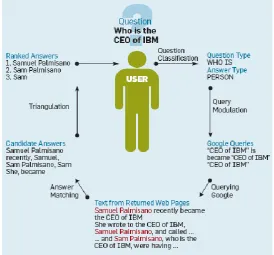
Today’s search engines like Yahoo, Google and MSN have made information access a lot easier. These perform keyword search using techniques such as link analysis and counting number of words in the query and this has enhanced their capability to search information from most popular and lexically related pages. However, search engines are not designed to deal with natural-language questions (Keller 2013). An emerging alternative to keyword-based web searching is automated question answering (Mufti 2013). A simple experiment conducted by Roussinov et al (2008) proves that the QA ability claimed by Google and Microsoft search engines is as yet limited to certain areas (Google - questions related to geographical data, MSN – questions based on Encyclopaedia Encarta) as they can sometimes produce useless and even false results for questions on dynamic topics (“Who is the CEO of ...”). They both lack the ability to answer semantically complex and challenging questions (“How long can a British Prime Minister serve in office?”). These shortcomings highlight need for a more efficient way to deal with information requests placed in natural language. This has led to focused research on Question Answering Systems within Natural Language processing research.
Question Answering (QA) systems can be defined as automated systems capable of processing a question asked in natural language, e.g. English or Arabic and returning the
“Answer” providing the required information. In-depth analysis informs us that an Ideal QA system should be able to understand the required information through simple natural language, locate this required information, extract this information from its source and return it in the form of an answer.
Although there has been decades of research aimed to achieve this ideal QA system, the state of the art is still far away from achieving these goals. To achieve this vision, the QA research community has divided the overall QA task into specialised sub-tasks, e.g. Information Retrieval (IR) to feed the information requirement and Natural Language Interfacing using Databases to support information retrieval from structured information sources. This has helped concentrate efforts on more manageable problems which can also inform other problems in parallel such as Question Answering.
Evolution of QA
At the early stage of NLP, understanding the meaning of a sentence, dealing with ambiguity, translating into formal languages and searching large tree structures were seen as the key problems in NLP. These were also seen to propagate within application of NLP e.g. QA. From the very early stage of QA systems, they were seen from two perspectives: Artificial Intelligence (AI) and Information Retrieval (IR).
Simmons (Aznan Zuhid Saidin 2005) indicates that one of the early written programmes, Belnap logically analyse a question in an attempt to provide an answer. The classification breaks the questions into two parts, i.e. one part that delineates a set of alternatives and another part that makes the request. These answers were classified as direct answers, partial answers, eliminative answers, corrective answers and relevant answers. Other approaches classified questions into complete or incomplete depending on the kind of information they are expecting.
The history of programs written to answer questions goes back to the early 1960’s in the form of the Natural Language Database QA (NLD-QA). There was a motivation to find an alternative to formal query languages. This motivation was derived from the AI influence on QA Systems, where knowledge was encoded using structured databases. NLD-QA approach was to translate the question into a formal database query, find the answer and translate the results back into the question language. The advantage of this approach was that as the conceptual schema of the application domain was known, it was possible to apply deep reasoning and other modern techniques. Initial attempts in the area were programs like,
The Conversation Machine. This was designed with the intention to gain experience with the meaning of Turing’s idea. It did not attempt to tackle the core NLP problem, i.e. syntactic analysis. Instead it dealt with it using the principle of an attribute-value pair. Hence this program was limited to dealing with simple English sentences alone.
This trend shifted to Question Answering over free text in the mid-1990’s. Dalamas (Mohd Yunus 2008) indicates that there was more work on Reading Comprehension (RC) and open domain QA during this period. Both made use of Boolean query and/or regular expressions to approach the problem of QA. This involved use of an Information Retrieval (IR) module that extracts the candidate answer(s) from the relevant text or document. Each answer was ranked for its occurrence and the final answer calculated. This change in approach led to certain challenges such as ambiguity recognition and resolution. In RC and open domain QA is delayed until after the data retrieval stage whereas this is dealt with before database access in NLD-QA. This is due to the tight coupling of question and answer in the latter as compared to the former.
Researchers from the early period of question answer systems convincingly identified that “generalizing from current small–scale experiments to language-processing systems based on dictionaries with thousands of entries – with correspondingly large grammars and semantic systems – may entail a new order of complexity and require the invention and development of entirely different approaches to semantic analysis and question answering” (Shah 2010).
QA Evaluation Campaigns
Although current QA evaluation forums TREC, CLEF and NTCIR are termed competitions they are more correctly thought of as Evaluation Campaigns. They are focused on lab-to-product transfer of text retrieval technology. Each conference culminates with a workshop where the participating systems share their learning and understanding of the domain.
to 50 bytes. The TREC website notes that these questions were taken from MSNSearch logs and AskJeeves logs. TREC-2002 QA participants were required to give a single answer for each question and answer ranking was used (Mohammed 2005). Factoid and definition questions were introduced in the TREC-2003 QA track. These questions were taken from the logs of Microsoft and AOL. TREC-2004 QA focused on more complex questions and attempted to answer questions like ‘How’ and ‘Why’ returning only a phrase not a document.
General research has been going on in this area for a long time but Text REtrieval Conference (TREC) competitions have led to more specific research being carried out for the past decade or so. TREC has had a track dedicated to QA since 1999 (Anon, 2005) and has received a great deal of attention from the Computational Linguistics and Information Retrieval research communities in the last few years (e.g. TREC 2001–2003, cited by Svenonius (1972)). The definition of the task, however, is generally restricted to answering factoid questions (Svenonius 1972) with a focus on open-domain systems.
In contrast QA systems aimed at handling questions within a closed-domain can benefit from understanding the ‘true’ meaning of the word in the question stated using natural language (Schlaefer 2007). For instance the word ‘Heavy Metals’ can be a difficult term to understand in a general context. This makes more sense when observed in a closed-domain such as entertainment i.e. Heavy Metals is a musical group in the entertainment domain.
A new task - complex interactive QA (ciQA) was brought forward in the TREC-2006 QA. The objective of this task was to investigate the suitability of the participants to meet the complex information needs of interactive systems. TREC-2007 made use of the same dataset as provided in TREC-2006 but with addition that the questions could be asked about blogs as well as newswires. The participants were expected to be capable of handling poorly formed language – frequently in blogs, as compared to well-formed language as in newswires. TREC-2007 QA led to a new campaign called Text Analysis Conference (TAC).
The Cross Lingual Evaluation Forum (CLEF) was an equivalent campaign set up for European languages as an initiative for research and development in monolingual and cross-language information access domains. Since 1998 the NTCIR campaign has provided cross-language evaluation for Asian languages working on Information Access (IA) technologies including information retrieval, question answering, text summarization, extraction, etc. Technolangue-EQUER is a similar campaign dealing with QA in French.
be used for NLP tasks. QA@INEX mainly deals with factoid and definition questions over resources like Wikipedia (in English), and a passage is expected as the extracted answer. Moreover there is research that focuses on Paragraph Retrieval and present paragraphs as the answer to the question (Rodrigo, Perez-Iglesias et al. 2010, Xu and Klakow 2010). Also REsPubliQA 2010 proposed two tasks related to QA for evaluating QA Systems (Peñas, Forner et al. 2010). One of these tasks was to retrieve a Paragraph as an Answer. The main focus of the QA@INEX track is to combine different types of questions in a single task (Aisa Mustapha 2012).
Kuhn (1962) has persuasively argued that science progresses by means of its models of the general nature of a research area (cited by Shah 2010) — hence the motivation of TREC (QA) was also to design systems that can potentially produce fact-based short-answers (50 bytes long) to more generic questions. It also reflects the information access paradigm shifting from keyword-based search to natural language driven navigation (Mufti 2013).
General QA Architecture
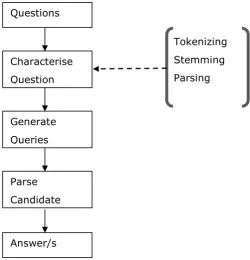
A typical QA system performs question analysis, document/passage retrieval and answer selection in a sequential manner. These together constitute a single processing stream (e.g. Saad, Salim et al. 2011). This general pipeline architecture can be shown as in the block diagram shown in figure 2.4 (produced by myself):
Questions
Characterise Question
Generate Queries
Parse Candidate
Answer/s
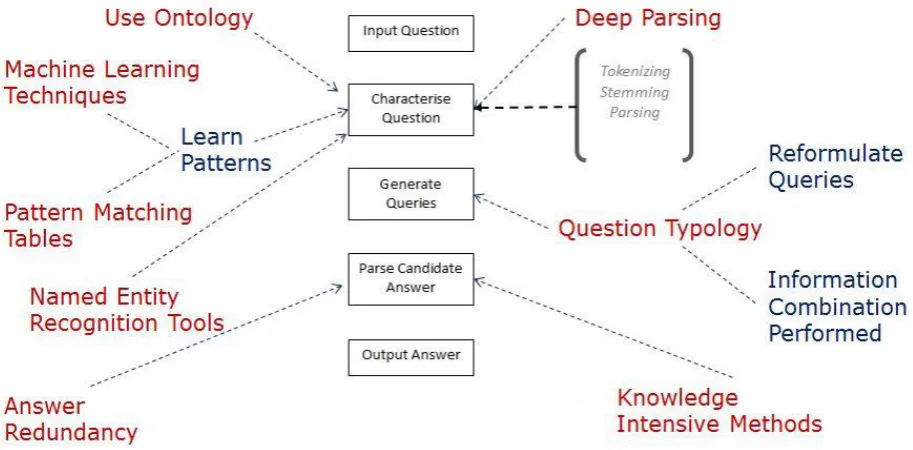
[image:38.595.235.486.489.750.2]Some QA systems perform deep parsing while characterising a question. Others make use of ontologies to understand the context of the question better. Machine Learning techniques are used to learn the existing question patterns – pattern matching tables and named entity recognition tools are used for question annotation. Scholbash et al. (Meenachi and Sai Baba 2012) informs us that many open-domain QA systems start by harvesting a huge number of candidate answers by generating queries. Some approaches reformulate these queries in an attempt to target more information.
Another method is Question typology that involves determining expected answer type and/or deciding whether the candidate answer is of the semantic type expected by the question. In such approaches information combination is performed at this stage. Valero et al (Jilani 2013) indicate that common methods used for answer selection are based on lexical overlaps and answer redundancies (e.g. Anon 2002) and methods based on knowledge intensive methods (e.g. Mohd Yunus 2008). Finally parse trees of the question and candidate answer are compared to extract the potentially final answer. Another experimental approach used performs a form of reverse engineering. This is done by formulating potential questions for the free-text. This part of the process is done offline and stored for later use. These questions are later compared with the user query to provide an answer.
A block representation of components used by a typical Question Answering system has been presented in figure 2.5. This figure is based on the personal understanding of the author in order to provide nutshell view of a general QA system. This model has also been used later in this section when studying existing QA systems to aid quick understanding.
All components presented in this figure may or may not be named and separated explicitly within each implementation of the QA System. The above block diagram has been reused to describe existing variants of the QA system. A brief outline of the sub-components presented in figure 2.5 has been included to enable further understanding:
NLP Processor – An NLP Processor is used to parse an input NL question/sentence. It can be further seen to have sub-components like:
Sub-component to
tokenize
the sentences into smaller logical sentences
Sub-component to
tag
the parts of speech for each sentence
Sub-component to identify occurrence of
known
objects in the domain
Sub-component to understand the
morphology
of the words
Multiple tools and techniques are available to implement this component but, again, the choice depends on the nature of the project under development.
Formal Rep. of Question – Based on the output of the NLP Processor user question, this is
represented formally in machine-understandable format.
Formal Rep. of Knowledge – This component produces the formal representation of the candidate answer(s) for the question.
Mapping – This component is responsible to map a user question to an answer. Mapping is done by applying different comparison techniques. A successful mapping produces answer(s) to the question.
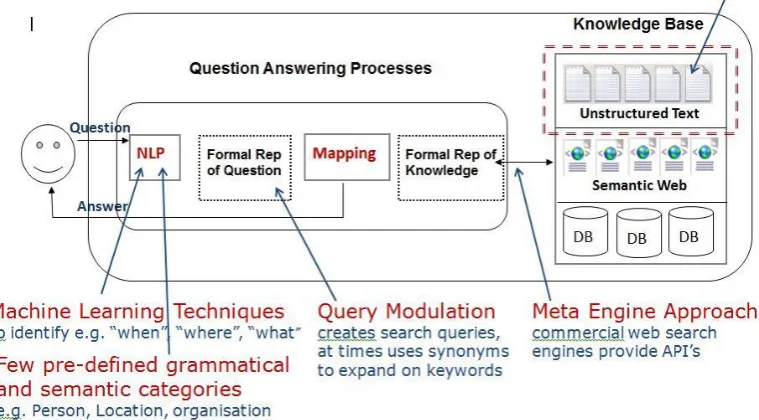
Following figure 2.6 presents architecture of a typical QA System suggested by (Keller 2013):
Figure 2.6: General Architecture of a Question Answering System (Keller 2013)
Recent Question-Answering Systems
The QA goal (of a typical NLP system) is to locate, extract, and provide specific answers to user questions expressed in natural language (Keller 2013). The following is a brief introduction to a few systems designed in an attempt to achieve this identified goal.
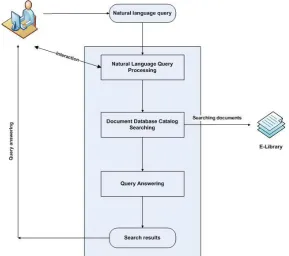
I – QA Model Applied to Document Retrieval System: 2009
Figure 2.7: Overview of the System Architecture (Kaplan 2001)
Results of the pre-processing steps are used by the core component of the system to understand the user query. The user query is parsed, tagged and matched to the learned vocabulary. Unmatched tokens are ignored. Once the words are recognised, they are mapped to syntactic structures and transformed into semantic structures. Once semantic structure is determined, the rest of the process appears to be relatively trivial and deterministic. It involves generation of SQL queries to be executed against a database. The Database query result is then used to prepare the answer.
II – AquaLog: 2005
Figure 2.8: Overview of the AquaLog QA System (Jilani 2012)
The result of the linguistic component is translated into ontology-compatible triples using relation similarity. These ontology-compatible triples are ultimately mapped to semantic mark-up. Different mechanisms are applied to resolve any ambiguity including using WordNet or, as a last resort, asking the user to select the appropriate answer among different choices. User interaction could be a good option here but may not be suitable in some QA systems due to the nature of communication, e.g. mobile text messaging.
III – The NSIR System: (2000 - 2005)
Figure 2.9: Overview of the NSIR Question Answering System (Jilani 2012)
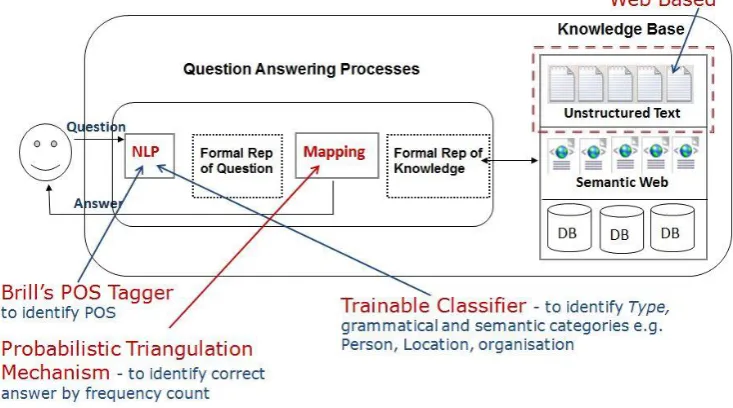
Research experiments have shown NSIR capable of returning exact answers or snippets of text containing the answer (Keller 2013). The above figure shows a nutshell view of the NSIR QA System.
IV – ASU QA: 2002
An article in an online magazine Information Week, dated 28th March 2005, mentioned the
Figure 2.10: Overview of the ASU-QA System (Jilani 2012)
Figure 2.10 gives a nutshell view of the ASU-QA System. ASU QA was demonstrated in 2005 to help locate potentially malevolent online content, potentially helping law-enforcement (Keller 2013). Alongside other research tools ASU QA has been used for several years for research purposes in a $2 million project supported by NASA.
V – Falcon: TREC9 (2000)
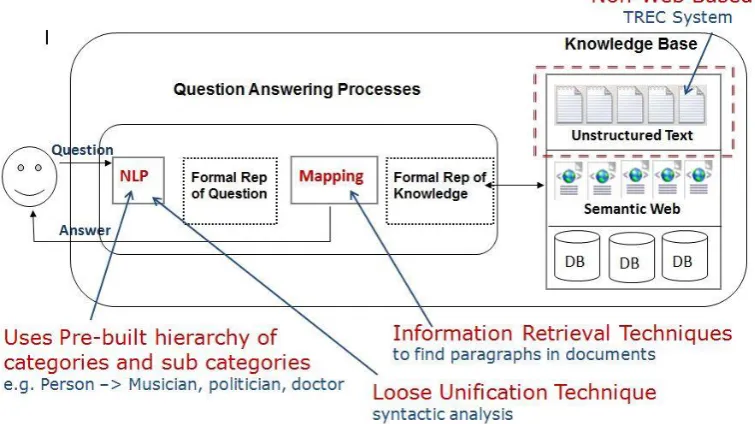
Falcon has been identified as one of the most successful systems presented in the TREC9 (2000) track (Mufti 2013)that makes use of open domain linguistic resource WordNet. NSIR and ASU QA only use grammatical and semantic types whereas Falcon goes an extra step; it classifies the identified words in the question in pre-built semantic types (like person, place, profession, date, etc.) and sub-types (such as musician, writer, politician etc.) in an attempt to understand the semantics of the user question which in return helps in identifying the potential correct answer to the question.
Figure 2.11: Overview of the Falcon Question Answering System (Jilani 2012)
VI – QA-LaSIE: TREC9 (2000)
QA LaSIE is an IE system designed for research purpose by Sheffield University. It is an extension of the LaSIE (Large Scale Information Extraction) system that was originally designed for participating in message understanding conferences (MUC6 & MUC7). As LaSIE did not have grammar rules to handle sentence-posing questions this feature was added on; hence the name QA LaSIE. This capability was achieved by introducing a special semantic predicate module to identify entity under question.
The user question is passed to the Information Retrieval (IR) system. IR compares this question against a repository of (unstructured) text documents to find candidate passages. IR takes a number of documents to return and the number of paragraphs in the passage as parameters. The question with the passages identified by IR is sent to the QA-LaSIE. These are parsed by LaSIE, which internally uses GATE for tokenizing,