Structural, spectroscopic and theoretical studies of diosmium(III,III)
tetracarboxylates
Raquel Gracia and Nathan J. Patmore
Department of Chemistry, University of Sheffield, Sheffield S3 7HF
Abstract
The preparation of Os2(TiPB)4Cl2 (1; TiPB = 2,4,6-triisopropylbenzoate) and Os2(TiPB)2(OAc)2Cl2 (2) by carboxylate exchange reactions with Os2(OAc)4Cl2 is reported. The structure of 1 has been determined by single-crystal X-ray studies, and
shows a paddlewheel arrangement of the ligands about the triply bonded diosmium core. Both compounds have magnetic moments at room temperature that are
consistent with the presence of two unpaired electrons, and their cyclic
voltammograms show a single redox process corresponding to the Os25+/6+redox couple. The electronic absorption spectra of 1 and 2 display an absorption at ~395 nm,
corresponding to the π(Cl) → π*(Os2) LMCT transition, as well as numerous weaker
absorptions at lower energy. Density functional theory (DFT) calculations on Os2(OAc)4Cl2 at different levels of theory (B3LYP and PBE0) have been used to probe the electronic structure of diosmium tetracarboxylates. The calculations show
TOC Entry
The structural, redox and optoelectronic properties of two disomium tetracarboxylate
Introduction
Dimetal paddlewheel complexes contain dimetal cores supported by four bridging
ligands such as carboxylates or formamidinates.1 The unique electronic structure of these species results in complexes with a formal MM bond order of up to 4 and a dimetal core that can exhibit interesting photophysical properties or rich
electrochemical behaviour. Diruthenium complexes have been of particular interest in recent years because of their application as catalysts in C-H amination2 and aerobic oxidation,3 and as materials with interesting magnetic properties.4 They have also been shown to be remarkably effective at facilitating electron transfer between redox active centres,5 making them good candidates for incorporation into molecular wires.6 By contrast, the chemistry of diosmium paddlewheel complexes, which have a close periodic relationship, has remained somewhat less developed. However the isolation
and first structural characterisation of a M27+ core in [Os2(hpp)4Cl2]+ (hpp =
1,3,4,6,7,8-hexahydro-2H-pyrimido[1,2-a]pyrimidine),7 which was characterised by
EPR spectroscopy and shown to have a σ2π4δ2δ* electronic configuration,8 demonstrates the important contribution that these complexes can make in our
understanding of the electronic structure of metal complexes. Diosmium paddlewheel complexes are typically synthesised by ligand metathesis reactions of Os2(OAc)4Cl2 and a bidentate ligand such as a carboxylate,9 amidate,10 or formamidinate.11 The axial chloride ligands in [Os2(O2CR)4Cl2] complexes can be substituted by reaction with HBr.12 The alkynyl and azido substituted complexes [Os
2(ap)4(C2Y)2] (Hap = 2-anilinopyridine; Y = Ph, Fc, SiMe3) and [Os2(DPhF)4(N3)2] (HDPhF = N,N’
-diphenylformamidine) have also been isolated.13
studies of [Os2(O2CnPr)4Cl2] showed a magnetic moment that varied with
temperature; decreasing from 1.15 B.M per Os at 300 K to 1.02 B.M. per Os at 188
K.9,14 This indicated that there were two unpaired electrons in either a σ2π4δ2π*2 or
σ2π4δ2δ*1π*1 electronic configuration. A later magnetic susceptibility study of [Os2(O2CC6H4-2-C6H5)4Cl2] between 5 - 300 K gave data that could not be modeled
based on a σ2π4δ2π*2configuration, ruling this out as a possible ground-state electronic configuration.15 A model for the temperature dependence of the magnetic
susceptibility of diosmium tetracarboxylates was eventually developed by analysis of the magnetic properties of [Os2(O2CCH3)4Cl2]. The model was based on a
σ2π4δ2δ*1π*1 ground-state configuration incorporating a large zero-field splitting (D = 331 cm-1) that successfully fitted the data between 30 and 350 K.16 In addition to the complicated magnetic behaviour, the electronic absorption spectra of
[Os2(O2CR)4Cl2] compounds exhibit a number of weak transitions in the visible and NIR region. A detailed solution and solid-state study of the absorption spectra of [Os2(O2CR)4X2] (R = Me, nPr, tBu; X = Cl, Br) was used to assign some of these transitions, although a number of visible region transition remain unassigned. The first aim of this study is to synthesis and characterise diosmium compounds containing the bulky carboxylate ligand 2,4,6-triisopropylbenzoate (TiPB; Scheme 1).
We have previously shown that this ligand can significantly distort the diruthenium core in complexes of form [Ru2(TiPB)4]0/+, resulting in an unusual decrease in Ru-Ru bond length despite increase in bond order.17 We were intrigued to see if similar effects would be observed in the chemistry of diosmium compounds. The second aim of this study is to probe whether density functional theory calculations can be used to
Scheme 1.
Results and Discussion
Synthesis and characterisation
The diosmium tetra-substituted complex [Os2(TiPB)4Cl2], 1, and the bis-bis complex [Os2(O2CCH3)2(TiPB)2Cl2], 2, were synthesised by carboxylate exchange reactions between [Os2(O2CCH3)4Cl2] and HTiPB in refluxing 1,2-Cl2-C6H4 solutions. Both complexes were isolated as brown powders and are soluble in most organic solvents,
including hexane. The infrared spectrum for 1 shows two intense bands at 1404 and 1457 cm-1 corresponding to the symmetric and asymmetric stretching modes of the bridging carboxylate ligands. More than four stretches are observed in the carboxylate
region of the IR spectrum of 2 indicating that ligand stretches are overlapping with the TiPB and OAc ligands. Despite repeated attempts we were unable to grow crystals of
2 in order to determine whether the TiPB ligands are located trans or cis with respect
to one another in the solid state. However, related compounds of form
M2(TiPB)2(O2CR)2 (M = Ru,17b Mo)18 exclusively adopt the trans arrangement to minimize steric interactions and it is reasonable to assume that same will be the case for 2.The MALDI-TOF mass spectra show a single peak for both 1 and 2, with the
expected isotope distribution pattern for a diosmium complex. Compounds 1 and 2
are both paramagnetic, with magnetic moments of 2.1 B.M. and 1.9 B.M. at room temperature.
OH O
Attempts were also made to isolate the Os(II,III) analogue of 1, by reaction of 1 with cobaltocene in CH2Cl2. This results in the formation of a dark green solution
containing [1][Co(η5-C5H5)2], but crystals of the compound could not be obtained as
it forms an unstable green oil upon removal of solvent. Due to the instablility of
[1][Co(η5-C
5H5)2], we were unable to isolate and fully characterise this complex. The infrared spectrum of freshly prepared sample of shows a shift of the νsym(CO2) and
νasym(CO2) stretching frequencies from 1404 cm
-1 and 1457 cm-1 in 1 to 1391 cm-1and 1458 cm-1 for [1][Co(η5-C5H5)2].
X-ray Crystallography
Crystals of 1 suitable for X-ray diffraction were obtained by slow evaporation of a
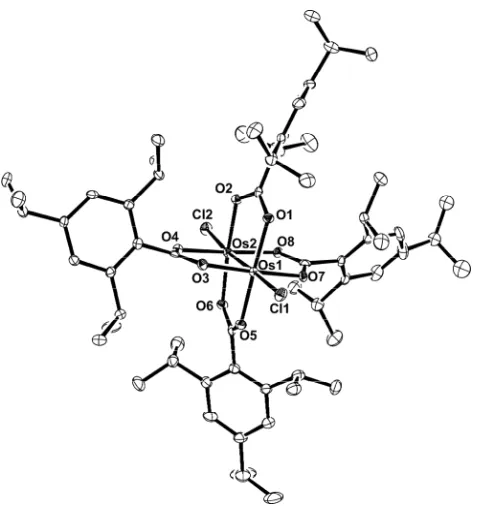
hexane solution. The structure is displayed in Figure 1, and selected bond lengths and angles are given in Table 1. The structure shows the expected paddlewheel
arrangement of the TiPB ligands, and there is a small distortion of the diosmium core
Figure 1. Solid state structure of complex [Os2(TiPB)4Cl2], 1. Hydrogen and
disordered atoms have been omitted for clarity, with thermal ellipsoids drawn at 50% probability level.
Table 1. Selected bond lengths (Å), angles (º) and torsion angles (º) for 1.
Os1-Os2 2.3276(4) Os1-Cl2 2.412(2)
Os1-O1 2.030(5) Os2-Cl1 2.422(2)
Os1-O3 2.013(4) Os1-Os2-Cl1 174.97(5) Os1-O5 2.025(5) Os2-Os1-Cl2 178.64(5) Os1-O7 2.032(4) O1-Os1-Os2-O2 5.8(2) Os2-O2 2.024(5) O3-Os1-Os2-O4 7.5(2) Os2-O4 2.038(4) O5-Os1-Os2-O6 4.6(2) Os2-O6 2.020(5) O7-Os1-Os2-O8 7.3(2) Os2-O8 2.028(5)
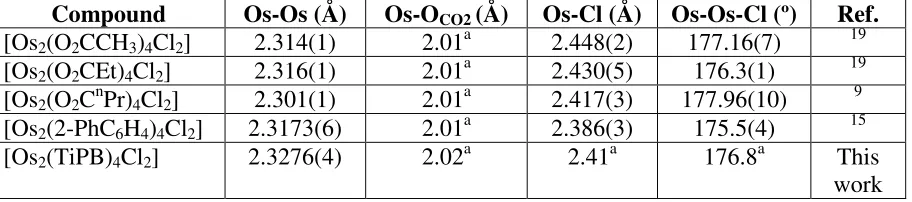
[image:7.595.139.460.498.631.2]comparable to those found in other [Os2(O2CR)4Cl2] complexes. The Os-Os bond distance in 1, 2.3276(4) Å, is the longest found to date, although only by ~0.01 Å. In
all of the complexes the Os-Os-Cl bond angle is slightly distorted from linear. Unlike the diruthenium counterparts of 1, it would appear that the structure of the diosmium core is not significantly perturbed by the bulky TiPB ligand, perhaps because it is
[image:8.595.73.529.321.422.2]slightly larger.
Table 2. Selected bond lengths (Å) and angles (º) obtained for diosmium
tetracarboxylates complexes.
Compound Os-Os (Å) Os-OCO2 (Å) Os-Cl (Å) Os-Os-Cl (º) Ref.
[Os2(O2CCH3)4Cl2] 2.314(1) 2.01a 2.448(2) 177.16(7) 19 [Os2(O2CEt)4Cl2] 2.316(1) 2.01a 2.430(5) 176.3(1) 19 [Os2(O2CnPr)4Cl2] 2.301(1) 2.01a 2.417(3) 177.96(10) 9 [Os2(2-PhC6H4)4Cl2] 2.3173(6) 2.01a 2.386(3) 175.5(4) 15 [Os2(TiPB)4Cl2] 2.3276(4) 2.02a 2.41a 176.8a This
work a) Average value
Cyclic Voltammetry
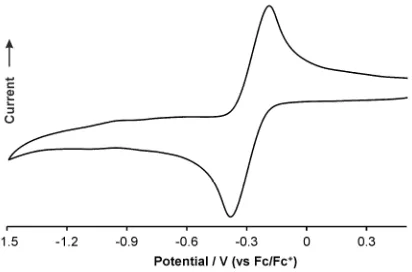
The cyclic voltammograms of 1 (shown in Figure 2) and 2 were recorded in 0.1 M Bu4nPF6 CH2Cl2 solutions. As expected, they display a single reversible redox process at -0.19 and -0.11 V (vs. Fc/Fc+) respectively, assigned to the Os
Figure 2. Cyclic voltammogram of 1 in a 0.1 M NnBu
4PF6 / CH2Cl2 solution.
Electronic absorption spectroscopy
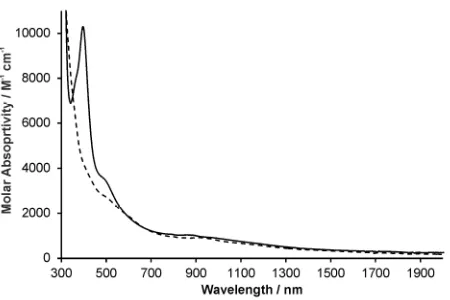
The UV/vis spectra of 1 and 2 contain similar features, so we will focus on discussion for 1. The spectrum of 1 in CH2Cl2 is shown in Figure 3 and displays an intense peak at 397 nm. A detailed spectroscopic study on Os2(O2CCMe3)4X2 (X = Cl, Br)
compounds by Miskowski and Gray has assigned this transition to a π(Cl) → π*(Os2)
LMCT transition. This study also used single crystal polarized absorption
spectroscopy to assign weak absorbances at 850 and 1200 nm as the spin-allowed δ
→ δ* and spin-forbidden δ*→π* transitions respectively. The low-energy region for
1 displays a weak absorbance at 875 nm, which we tentatively assign as the δ → δ*
transition, where as the expected δ*→π* transition is too weak and broad to be
assigned with any confidence. We also note the appearance of a relatively weak band at 510 nm. This could be due to an impurity in the sample, but it does not disappear
after repeated sample recrystallization. We
Whilst the reduced forms of 1 and 2 could not be isolated, we could study the electronic absorption spectrum of [Os2(TiPB)4Cl2]– (1–) spectroelectrochemically at reduced (-20°) temperature (Figure 3). The prominent changes upon reduction is a
proposed δ → δ* transition to 944 nm. Similar changes were observed in the
spectroelectrochemical study of [Os2(O2CC2H5)4Cl2]0/–,20 and the loss of intensity for the LMCT transition is consistent with reduction of Os26+ to Os25+. Switching back to a positive potential at the end of the experiment regenerated 1, although some
bleaching of the π(Cl) → π*(Os2) transition indicated a small amount of
[image:10.595.184.409.268.418.2]decomposition (~20%) even at low temperature.
Figure 3. Electronic absorption spectra of 1 (solid) and 1– (dashed) in a 0.1 M NBu4PF6 / CH2Cl2 solution, obtained in a spectroelectrochemical cell at -20ºC.
Computational results
Methodology
Whilst density functional theory (DFT) calculations are now routinely used in the study of dimetal paddlewheel compounds, to the best of our knowledge the only
computational studies on diosmium compounds have used SCF-Xα calculations.15,21
tetracarboxylates, employing a number of different functional and basis set combinations.17b,22 A more detailed recent computational study by Roitberg and Cukiernik has used different levels of theory to evaluate electron transfer through coordination polymers containing diruthenium tetracarboxylates.23
A recent DFT/TDDFT study on [Os(N^N)2(P^P)] (N^N = 5-(1-isoquinolyl)-1,2,4-triazoles, P^P = bidentate phosphine) compounds using mixed LANL2DZ/6-31G(d) basis sets found that calculations employing the Perdew–Burke–Ernzerhof exchange
correlation functional (PBE0) better matched the experimental geometries and absorptions than the B3LYP functional.24In order to determine the best functional / basis set combination for diosmium tetracarboxylates we have performed geometry
optimisations using BPE0 and B3LYP functionals with the relativistic basis sets SDD or LanL2DZ for osmium, and 6-31G* for the remaining atoms. Calculations on
[Os2(TiPB)4Cl2]0/- complexes are too computationally expensive, hence we performed calculations using [Os2(O2CCH3)4Cl2] as a model for Os2(III,III) tetracarboxylates. Full geometry optimization for the triplet state was performed both in vacuum and in
dichloromethane solutions using the polarizable continuum model (PCM), with
optical transitions calculated using time-dependent DFT. The resulting geometries and
calculated energy of the π(Cl) → π*(Os2) transition is presented in Table 3, where
they are compared with experimental data.
The calculations employing the B3LYP functional model do a reasonable job of modeling the structural parameters, with the calculated Os-Os bond lengths (ranging
as good a job of modeling the spectroscopic properties; the calculated energy of the
π(Cl) → π*(Os2) transition is consistently ~0.5 eV too low in energy. By contrast, the PBE0 functional does a much better job of modeling the spectroscopic properties,
with the calculated energy of this transition within ~0.2 eV of the experimentally observed values. There is also good agreement between the optimized and
experimental structural parameters for this functional. The best correlation between
calculated and experimental data is seen for the BPE0 functional with SDD/6-31G* basis sets, and the results from these calculations will be used in the following
Table 3. Comparison of calculated and experimental bond lengths (Å), angles (º) and torsion angles (º) for [Os2(O2CCH3)4Cl2] in vacuum and
solution (CH2Cl2).
B3LYP PBE0
SDD/6-31G* LANL2DZ/6-31G* SDD/6-31G* LANL2DZ/6-31G*
Vacuum Solution Vacuum Solution Vacuum Solution Vacuum Solution Experimentala
Os-Os 2.375 2.356 2.378 2.361 2.350 2.332 2.355 2.332 2.314(1)
Os-OCO2b 2.07 2.06 2.06 2.05 2.05 2.04 2.01 2.04 2.01
Os-Cl 2.401 2.445 2.418 2.464 2.368 2.408 2.386 2.406 2.448(2)
Os-Os-Cl 162.6 164.8 163.4 165.7 162.0 164.1 162.8 163.4 177.16(7)
OCO2-Os-Os-OCO2b 1.7 1.0 1.5 0.8 1.9 1.1 1.6 1.2 1.5
λ λ λ
λmax LMCT (nm) 462 (2.69) 463 (2.68) 470 (2.64) 470 (2.64) 428 (2.90) 425 (2.92) 434 (2.86) 431 (2.88) 392 (3.17)c
a) Values obtained from reference 19. b) Average values. c) Value for [Os
Calculated Electronic Structure
There are three possible electronic configurations for [Os2(O2CCH3)4Cl2]; a singlet
(σ2π4δ2δ*2) and two triplets (σ2π4δ2δ*1π*1 or σ2π4δ2π*2). The triplet state for
[Os2(O2CCH3)4Cl2] was calculated to be 13.4 (vacuum) and 23.7 (solution) kJ mol-1 more stable than the singlet state. Whilst these values need to be treated with caution as hybrid
functionals such as PBE0 tend to stabilise higher spin states,26 the results are in agreement with magnetic studies on related Os26+ species which can be successfully modeled based upon
a σ2π4δ2δ*1π*1 configuration.16,20,27
Calculated open-shell frontier MO energy level diagrams for [Os2(O2CCH3)4Cl2] are
displayed in Figure 4. In both instances the LUMO is the Os2 π*, whilst the SOMOs are the
Os2 δ* and π* orbitals, giving a σ2π4δ2δ*1π*1 electronic configuration.16 Diagrams of these
orbitals shown in Figure 5 show strong mixing with π(Cl) and σ(Cl) combinations. Figure 4
shows that the ordering of the MOs is broadly similar in both vacuum and solution, but
orbitals are shifted to lower energy in solution. A number of doubly occupied axial chloride π
and σ orbitals are found close in energy to the Os2 δ* and π* orbitals. In vacuum, the Os2 δ
orbital is lower in energy than some of the π(Cl) and σ(Cl) combinations, however in solution
the Os2 δ orbital appears at a slightly higher energy than the axial ligand orbitals in the β
Figure 4. Calculated open-shell frontier MO diagrams for [Os2(O2CCH3)4Cl2] in vacuum (left) and CH2Cl2 solution (right).
Figure 5. Plots of selected α-MOs for calculated for [Os2(O2CCH3)4Cl2] in vacuum (0.04
[image:15.595.189.404.439.708.2]TDDFT calculations
The optical transitions for [Os2(O2CCH3)4Cl2] were calculated in vacuum and solution, and the results are summarized in Table 4. The calculated features of the electronic absorption spectrum [Os2(O2CCH3)4Cl2] in both vacuum and solution are similar, although they do differ slightly in the calculated transition energies. Given that most experimental data for this type of species is reported in solution we will discuss the solution calculations.
The two lowest energy transitions calculated for [Os2(O2CCH3)4Cl2] occur at 1572 nm (0.789
eV) and 1350 nm (0.919 eV) , and can be assigned as δ*→π* and δ → δ* transitions
respectively. These assignments are consistent with those from the previous experimental study on [Os2(O2CCH3)4Cl2], in which the two lowest transitions were observed at 1100 nm (1.13 eV) and 850 nm (1.46 eV).16 The intense transition calculated at 425 nm (2.915 eV; f =
0.1439) is a π(Cl) →π* LMCT transition, which corresponds well to the intense transition
observed at ~395 nm for [Os2(O2CR)4Cl2] species. The calculations indicate that the weak transitions observed experimentally in the 400 to 700 nm region, but previously unassigned,
[image:16.595.66.495.571.757.2]are likely to correspond to a mixture of π(Cl) → π* and σ(Cl) → δ* LMCT transitions.
Table 4. Calculated transitions (with f > 0) for [Os2(O2CCH3)4Cl2] in vacuum and in
solution. Transitions are assigned based on their most significant character.
Vacuum Solution
λ, nm λ, eV f assign. λ, nm λ, eV f assignment
Conclusions
Diosmium compounds containing the bulky carboxylate ligand 2,4,6-triisopropylbenzoic acid have been synthesized, and the solid-state structure of 1 was has been determined by single-crystal X-ray diffraction. The UV/vis spectroscopy and electrochemical studies show that the
use of a sterically hindered ligand does not significantly perturb the geometry or electronic structure of the Os26+ core, although compound 1 does show improved solubility in most organic solvents.
The electronic structure of these diosmium paddlewheel compounds has been rationalized for the first time with the aid of DFT calculations that employ basis sets with a relativistic
effective core potential for Osmium. The PBE0 / SDD / 6-31G* combination of functional and basis sets was found to most closely match the structural and optoelectronic properties of
diosmium tetracarboxylates. These calculations also support a σ2π4δ2δ*1π*1 electron
configuration for the diosmium core, proposed by Miskowski and Gray on the basis of magnetic studies in 1997.16
Experimental
General considerations
Matrix assisted laser desorption/ionization time-of-flight (MALDI-TOF) mass spectrometry was performed using [1,8-dihydroxy-9,10-dihydroanthracen-9-one] (dithranol) as the matrix, prepared as a saturated solution in toluene. Allotments of matrix and sample were thoroughly
mixed together; 0.5 mL of this was spotted on the target plate and allowed to dry. IR spectra were recorded as solid samples with a Perkin Elmer Spectrum RX I FT-IR spectrometer equipped with a DuraSamplIR II diamond ATR probe and universal press. Magnetic moments
susceptibility data on the basis of Pascal’s constants.28 Electronic absorption spectra were recorded using a Varian Cary 5000 UV-Vis-NIR spectrophotometer. Elemental analyses were carried out by the Microanalytical Service of the Department of Chemistry at Sheffield with a Perkin-Elmer 2400 analyzer. Electrochemical studies were carried out in N2-purged methanol solutions with 0.1 M [nBu4N][PF6] as supporting electrolyte. A standard three-electrode system was used with a Pt microdisc and a large surface area Pt wire as the working and
counter electrodes, respectively. Potentials were measured in reference to a Ag/AgCl reference, with all potentials quoted for a scan rate of 100 mV s-1. At the end of every experiment, ferrocene was added as an internal standard, with the Fc/Fc+ couple consistently observed at +0.43 V vs. Ag/AgCl. The UV/vis spectroelectrochemical studies were performed in an optically transparent thin layer electrode cell, in 0.1 M [nBu
4N][PF6] CH2Cl2 solutions. Ward and coworkers have previously described the cell setup and temperature control procedures.29
All experimental manipulations were performed under an inert atmosphere using standard
Schlenk line techniques. Solvents were distilled over an appropriate drying agent prior to use. [Os2(O2CCH3)4Cl2] was prepared according to literature procedures,9 and all other chemicals were acquired from commercial sources.
Synthesis of [Os2(TiPB)4Cl2],1
A solution of [Os2(O2CCH3)4Cl2] (0.100 g, 0.14 mmol) and HTiPB (0.360 g, 1.45 mmol) in 1,2-Cl2-C6H4 (50 mL) was refluxed under an argon atmosphere for 16 h. The brown solution was cooled to room temperature, and filtered to remove a dark precipitate. The filtrate was
dried in vacuo, and the product further purified by redissolving in hexane and filtering again
before removing the solvent in vacuo. Excess HTiPB was recovered by sublimation at 130 ºC,
Crystals suitable for X-ray diffraction were grown by slow evaporation of a hexane solution.
MALDI-TOF-MS: calcd. monoisotopic MW for Os2C64O8H92Cl2 1441.54, found m/z 1441.81
(M+ 100%). IR (cm-1): 2961s, 2929w, 2869w, 1755w, 1695s, 1605s, 1575w, 1457m, 1404s,
1363m, 1260s, 1110m, 1021s, 876m, 791s, 750m. Magnetic moment (solid); µeff = 2.1 B.M..
λmax(CH2Cl2) / nm (ε / M-1 cm-1): 397 (10,300), 505sh (3340) 875 (1030). Found: C, 52.81; H, 6.24. Os2C64O8H92Cl2 requires C, 53.37; H, 6.44%.
Synthesis of [Os2(OAc)2(TiPB)2Cl2],2
A solution of [Os2(O2CCH3)4Cl2] (0.100 g, 0.14 mmol) and HTiPB (0.072 g, 0.28 mmol) in 1,2-Cl2-C6H4 was refluxed for 14 h. The solvent was removed in vacuo, and the product purified by redissolving in dichloromethane and filtering the solution before removing the solvent in vacuo to afford [Os2(O2CCH3)2(TiPB)2Cl2] as a brown powder. Yield = 0.110 g (74%). MALDI-TOF-MS: calcd. monoisotopic MW for Os2C36O8H52Cl2 1064.16, found m/z 993.29 (M-2Cl+ 100%). IR (cm-1): 2963s, 2922m, 2866w, 1712s, 1688s, 1620w, 1604m, 1534m, 1460s, 1440s, 1428w, 1412s, 1396s, 1372w, 1334w, 1197w, 1173m, 1156m, 1111s,
1063s, 1021w, 949w, 902w, 877w, 852w, 831s, 800s. λmax(THF) / nm (ε / M-1 cm-1): 380
(3900), 407 (3500), 875 (576). Magnetic moment (solid); µeff = 1.9 B.M.. Found: C, 41.02; H,
4.97. Os2C36O8H52Cl2 requires C, 40.63; H, 4.93%.
Synthesis of [(
η
5-C5H5)2Co][Os2(TiPB)4Cl2], 3
A solution of [Os2(TiPB)4Cl2] (50 mg, 0.035 mmol) in CH2Cl2 was treated with cobaltocene (6.5 mg, 0.035 mmol). The reaction mixture was then stirred at room temperature for 30 minutes, during this time the clear brown solution becomes dark green. The solution was then
air. IR (cm-1): 2952s, 2916w, 2863w, 1604s, 1569w, 1504w, 1458m, 1391s, 1361m, 1349w, 1319w, 1295w, 1255s, 1156m, 1087s, 1012s, 940m, 875m, 861m, 794s.
X-ray crystallography
Data were measured on a Bruker Smart CCD area detector with Oxford Cryosystems low temperature system. After integration of the raw data and merging of equivalent reflections,
an empirical absorption correction was applied (SADABS) based on comparison of multiple symmetry-equivalent measurements.30 The structures were solved by direct methods (SHELXS-97) and refined by full-matrix least squares on weighted F2 values for all
reflections using the SHELX suite programs.31 All hydrogens were included in the models at calculated positions using a riding model with U(H) = 1.5 x Ueq (bonded carbon atom) for methyl hydrogens and U(H) = 1.2 x Ueq (bonded carbon atom) for methine and aromatic
hydrogens.
One of the TiPB groups in 1 was disordered over two positions (0.49/0.51 site occupancy),
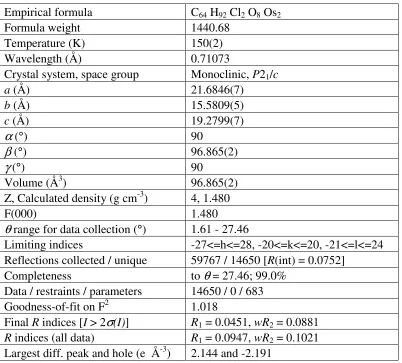
Table 5. Crystal data for 1.
Empirical formula C64 H92 Cl2 O8 Os2
Formula weight 1440.68
Temperature (K) 150(2)
Wavelength (Å) 0.71073
Crystal system, space group Monoclinic, P21/c
a (Å) 21.6846(7)
b (Å) 15.5809(5)
c (Å) 19.2799(7)
α (°)
90β (°)
96.865(2)γ (°)
90Volume (Å3) 96.865(2)
Z, Calculated density (g cm-3) 4, 1.480
F(000) 1.480
θ range for data collection (°)
1.61 - 27.46Limiting indices -27<=h<=28, -20<=k<=20, -21<=l<=24 Reflections collected / unique 59767 / 14650 [R(int) = 0.0752]
Completeness to θ = 27.46; 99.0%
Data / restraints / parameters 14650 / 0 / 683 Goodness-of-fit on F2 1.018
Final R indices [I > 2σ(I)] R1 = 0.0451, wR2 = 0.0881
R indices (all data) R1 = 0.0947, wR2 = 0.1021 Largest diff. peak and hole (e Å-3) 2.144 and -2.191
DFT calculations
Molecular structure calculations on Os2(O2CCH3)2Cl2 were performed using density functional theory as implemented in the Gaussian03 suite programs.32 Calculations were performed using either the B3LYP functional33 or Perdew–Burke–Ernzerhof exchange correlation functional (PBE0),34 in combination with the effective core potential basis sets LANL2DZ35 or SDD36 for Os, and 6-31G* basis set37 for all other atoms. Unrestricted open-shell calculations were performed in every case. Electrons of alpha and beta spins are independently described which results in a set of orbital energies and molecular orbitals for
both vacuum and in a CH2Cl2 solvent cavity using the polarizable continuum model, as implemented in Gaussian 09. The results from the PBE0 / SDD / 6-31G* combination most
closely matched the experimental data, and the structures in vacuum and solution were confirmed to be the minimum on the potential energy surface by frequency analysis.
Electronic absorption spectra were calculated using the time-dependent DFT (TD-DFT) method.
Supporting Information
Calculated atomic coordinates for Os2(O2CCH3)2Cl2 (both vacuum and PCM solvent model) at the PBE0 / SDD / 6-31G* level of theory.
Acknowledgements
The Royal Society is thanked for the award of a University Research Fellowship (NJP). Dr Anthony Meijer is thanked for computational assistance and Mr Harry Adams is thanked for
crystallographic help.
References
1. F. A. Cotton, C. A. Murillo and R. A. Walton, For a detailed review of this field see.
2. A. K. M. Long, R. P. Yu, G. H. Timmer and J. F. Berry, J. Am. Chem. Soc., 2010, 132, 12228.
3. a) N. Komiya, T. Nakae, H. Sato and T. Naota, Chem. Commun., 2006, 4829; b) H. B.
Lee and T. Ren, Inorg. Chim. Acta, 2009, 362, 1467; c) C. N. Kato, M. Ono, T. Hino,
T. Ohmura and W. Mori, Cat. Commun., 2006, 7, 673.
4. a) M. Mikuriya, D. Yoshioka and M. Handa, Coord. Chem. Rev., 2006, 250, 2194; b)
T. E. Vos, Y. Liao, W. W. Shum, J.-H. Her, P. W. Stephens, W. M. Reiff and J. S. Miller, J. Am. Chem. Soc., 2004, 126, 11630; c) B. S. Kennon, J.-H. Her, P. W.
Stephens and J. S. Miller, Inorg. Chem., 2009, 48, 6117; d) M. C. Barral, T. Gallo, S.
Herrero, R. Jiménez-Aparicio, M. R. Torres and F. A. Urbanos, Inorg. Chem., 2006, 45, 3639; e) M. C. Barral, D. Casanova, S. Herrero, R. Jiménez-Aparicio, M. R. Torres and F. A. Urbanos, Chem. Eur. J., 2010, 16, 6203.
5. a) J.-W. Ying, I. P.-C. Liu, B. Xi, Y. Song, C. Campana, J.-L. Zuo and T. Ren, Angew. Chem. Int. Ed., 2010, 49, 954; b) G.-L. Xu, R. J. Crutchley, M. C. DeRosa, Q.-J. Pan,
6. a) D. Olea, R. González-Prieto, J. L. Priego, M. C. Barral, P. J. de Pablo, M. R. Torres, J. Gómez-Herrero, R. Jiménez-Aparicio and F. Zamora, Chem. Commun.,
2007, 1591; b) A. S. Blum, T. Ren, D. A. Parish, S. A. Trammell, M. H. Moore, J. G. Kushmerick, G.-L. Xu, J. R. Deschamps, S. K. Pollack and R. Shashidhar, J. Am. Chem. Soc., 2005, 127, 10010; c) S. P. Cummings, J. Savchenko, P. E. Fanwick, A.
Kharlamova and T. Ren, Organometallics, 2013, 32, 1129; d) J.-L. Zuo, E. Herdtweck
and F. E. Kühn, J. Chem. Soc., Dalton Trans., 2002, 1244.
7. F. A. Cotton, N. S. Dalal, P. Huang, C. A. Murillo, A. C. Stowe and X. Wang, Inorg. Chem., 2003, 42, 670.
8. F. A. Cotton, G. M. Chiarella, N. S. Dalal, C. A. Murillo, Z. Wang and M. D. Young,
Inorg. Chem., 2010, 49, 319.
9. T. Behling, G. Wilkinson, T. A. Stephenson, D. A. Tocher and M. D. Walkinshaw, J. Chem. Soc., Dalton Trans., 1983, 2109.
10. A. R. Chakravarty, F. A. Cotton and D. A. Tocher, Inorg. Chim. Acta, 1984, 89, L15.
11. F. A. Cotton, T. Ren and J. L. Eglin, Inorg. Chem., 1991, 30, 2559.
12. T. W. Johnson, S. M. Tetrick and R. A. Walton, Inorg. Chim. Acta, 1990, 167, 133.
13. a) Y.-H. Shi, W.-Z. Chen, K. D. John, R. E. Da Re, J. L. Cohn, G.-L. Xu, J. L. Eglin, A. P. Sattelberger, C. R. Hare and T. Ren, Inorg. Chem., 2005, 44, 5719; b) P. M. B.
Piccoli and J. F. Berry, J. Clust. Sci., 2010, 21, 351.
14. T. A. Stephenson, D. A. Tocher and M. D. Walkinshaw, J. Organomet. Chem., 1982, 232, C51.
15. F. A. Cotton, T. Ren and M. J. Wangner, Inorg. Chem., 1993, 32, 965.
16. V. M. Miskowski and H. B. Gray, Top. Curr. Chem., 1997, 191, 41.
17. a) R. Gracia, H. Adams and N. J. Patmore, Dalton Trans., 2009, 259; b) R. Gracia, H.
Adams and N. J. Patmore, Inorg. Chim. Acta, 2010, 363, 3856.
18. M. V. Barybin, M. H. Chisholm, N. J. Patmore, R. E. Robinson and N. Singh, Chem. Commun., 2007, 3652.
19. F. A. Cotton, A. R. Chakravarty, D. A. Tocher and T. A. Stephenson, Inorg. Chim. Acta, 1984, 87, 115.
20. S. M. Tetrick, V. T. Coombe, G. A. Heath, T. A. Stephenson and R. A. Walton, Inorg. Chem., 1984, 23, 4567.
21. P. A. Agaskar, F. A. Cotton, K. R. Dunbar, L. R. Falvello, S. M. Tetrick and R. A. Walton, J. Am. Chem. Soc., 1986, 108, 4850.
22. a) B. E. Bursten, M. H. Chisholm and J. S. D'Acchioli, Inorg. Chem., 2005, 44, 5571;
b) M. A. Castro, A. E. Roitberg and F. D. Cukiernik, Inorg. Chem., 2008, 47, 4682; c)
O. V. Sizova, L. V. Skripnikov, A. Y. Sokolov and O. O. Lyubimova, J. Struct. Chem., 2007, 48, 28.
23. M. A. Castro, A. E. Roitberg and F. D. Cukiernik, J. Chem. Theory Comput., DOI:
10.1021 / ct400179t.
24. J. Su, L. Shi, X. Sun, W. Guan and Z. Wu, Dalton Trans., 2011, 40, 11131.
25. F. A. Cotton and X. Feng, J. Am. Chem. Soc., 1997, 119, 7514.
26. M. Reiher, O. Salomon and B. A. Hess, Theor. Chem. Acc., 2001, 107, 48.
27. F. A. Cotton, K. R. Dunbar and M. Matusz, Inorg. Chem., 1986, 25, 1585.
28. G. A. Bain and J. F. Berry, J. Chem. Educ., 2008, 85, 532.
29. S.-M. Lee, R. Kowallick, M. Marcaccio, J. A. McLeverty and M. D. Ward, J. Chem. Soc., Dalton Trans., 1998, 3443.
30. G. M. Sheldrick, University of Gottingen, Germany, 1996. 31. , Bruker Analytical X-ray Instruments Inc., Madison, WI, 1998.
Millam, S. S. Iyengar, J. Tomasi, V. Barone, B. Mennucci, M. Cossi, G. Scalmani, N. Rega, G. A. Petersson, H. Nakatsuji, M. Hada, M. Ehara, K. Toyota, R. Fukuda, J. Hasegawa, M. Ishida, T. Nakajima, Y. Honda, O. Kitao, H. Nakai, M. Klene, X. Li, J. E. Knox, H. P. Hratchian, J. B. Cross, C. Adamo, J. Jaramillo, R. Gomperts, R. E. Stratmann, O. Yazyev, A. J. Austin, R. Cammi, C. Pomelli, J. W. Ochterski, P. Y. Ayala, K. Morokuma, G. A. Voth, P. Salvador, J. J. Dannenberg, V. G. Zakrzewski, S. Dapprich, A. D. Daniels, M. C. Strain, O. Farkas, D. K. Malick, A. D. Rabuck, K. Raghavachari, J. B. Foresman, J. V. Ortiz, Q. Cui, A. G. Baboul, S. Clifford, J. Cioslowski, B. B. Stefanov, G. Liu, A. Liashenko, P. Piskorz, I. Komaromi, R. L. Martin, D. J. Fox, T. Keith, M. A. Al-Laham, C. Y. Peng, A. Nanayakkara, M. Challacombe, P. M. W. Gill, B. Johnson, W. Chen, M. W. Wong, C. Gonzalez and J. A. Pople, Gaussian, Inc.
, Wallingford CT, 2004.
33. a) A. D. Becke, Phys. Rev. A, 1988, 38, 3098; b) A. D. Becke, J. Chem. Phys., 1993, 98, 5648.
34. a) J. P. Perdew, K. Burke and M. Ernzerhof, Phys. Rev. Lett., 1996, 77, 3865; b) J. P.
Perdew, K. Burke and M. Ernzerhof, Phys. Rev. Lett., 1997, 78, 1396.
35. P. J. Hay and W. R. Wadt, J. Chem. Phys., 1985, 82, 299.
36. D. Andrae, U. Haeussermann, M. Dolg and H. Preuss, Theor. Chim. Acta, 1990, 77,
123.
37. W. J. Hehre, L. Radom, P. v. R. Schleyer and J. A. Pople, Molecular Orbital Theory,
![Table 3. Comparison of calculated and experimental bond lengths (Å), angles (º) and torsion angles (º) for [Os2(O2CCH3)4Cl2] in vacuum and](https://thumb-us.123doks.com/thumbv2/123dok_us/340938.1035079/13.595.66.725.143.277/table-comparison-calculated-experimental-lengths-torsion-angles-vacuum.webp)
![Figure 4. Calculated open-shell frontier MO diagrams for [Os2(O2CCH3)4Cl2] in vacuum](https://thumb-us.123doks.com/thumbv2/123dok_us/340938.1035079/15.595.189.404.439.708/figure-calculated-open-shell-frontier-diagrams-cch-vacuum.webp)
![Table 4. Calculated transitions (with f > 0) for [Os2(O2CCH3)4Cl2] in vacuum and in](https://thumb-us.123doks.com/thumbv2/123dok_us/340938.1035079/16.595.66.495.571.757/table-calculated-transitions-os-o-cch-cl-vacuum.webp)