The Future of Enterprise Security with Regards to
Mobile Technology and Applications
F. T. Tagoe
1and M. S. Sharif
2,31Department of Digital Innovation and Creative Enterprise
GSM London, London, UK
2School of Architecture, Computing and Engineering
University of East London, University Way, London, UK
3Department of Electronic and Computer Engineering
Brunel University London, Uxbridge, UK {[email protected]}
Abstract
The utilisation of work assigned mobile technology by enterprise staff to chat and upload contents to the social media applications for personal use has become a key issue for a significant number of enterprises. This work aims to understand the trends amongst the users of work assigned phones when unknowingly downloading and using applications which could breach the security of the enterprise. In this paper; we assess current trends amongst employees and organisations' use and trust of hybrid and web based social media applications used on a daily basis to communicate. This information is then evaluated alongside human related cyber security risks presented by such applications to provide instructions and advice on the management of social media application use within organisations in the Healthcare, Education and Energy sectors. The findings may be employed to develop a more robust cyber security strategy which focuses at reducing the user related risks.
Keywords: Social Media, Security, Mobile Technology.
1. Introduction
web… consider how easily sensitive personal information can be accessed through these channels,” said Amichai Shulman, chief technology officer at Imperva [2].
54% of companies had a 100% block on social network use in 2009 but by 2011, this number was reduced to just 31% [3]. With such a fast growing presence online of both individuals and organisations, the benefits of being online and having staff who understand how to use social media effectively is clearly beneficial. The difficulty for cyber security and information security departments is in designing and building effective management systems that can identify legal and strategic risks. Each company will need to make appropriate considerations regarding their consistent voice to suit their objectives and values [4].
1.1
The Internet - Human Right or Utility?
The United Nations Special Rapporteur on the Promotion and Protection of the Right to Freedom of Opinion and Expression ruled that removing access to the internet is a human rights violation of article 19, paragraph 3, of the International Covenant on Civil and Political Rights [5]. Aside from providing individuals with the security of knowing their rights are protected, this also went a long way towards encouraging people globally to see the internet as a space to speak freely and share their thoughts [6]. For companies, this has increased the ability of customers to provide feedback and praise on dedicated digital platforms as well as social media sites.
2
Enterprise & Mobile Technology
2.1
Native Social Media mobile applications
Native applications are developed to work on specific devices and operating systems and as a result are installed directly to the device. Such applications are readily available on all well-known app stores such as the Apple App Store and Google Play and are required to conform to the security requirements of the Marketplace or App Store they will be downloaded from in order to gain approval [11].
As a result, such applications are unable to function across operating systems and must be developed individually to fulfill security requirements of the App store and the Operating System meaning a larger amount of time and money is involved in the development of such tools. This however does provide increased reliability for developers as the SDK and development tools increase the ease of creation.
The benefit of such applications is that they can be used both offline and online and provide a smoother experience through increased speed of use and ubiquitous access [12]. This is possible through a combination of local storage of information and sychronisation when connected to the cloud. Users are also more attracted to such applications as they provide familiar device-specific functionality such as the cameras and accelerometer increasing User Experience fulfilling user expectations.
The disadvantages of such applications are in the time and resources required to develop multiple applications which are able to function on the wide range of devices available on the market today. Alongside this are the in-creased customer support, maintenance costs and extensive approval processes across the various app stores .[13] Many users are unwilling to download such applications onto their devices as company regulations may discourage such activity. These disadvantages present as barriers for developers who strive for popularity amongst users in order to gain a positive return on investment.
2.2
Web Applications
The benefit of the Web application is the removal of the requirement to submit the application for safety and security approval through App Stores and Marketplaces [15]. This means that the applications can be released at will by developers based on their preferences without consideration for security restrictions imposed by any individual Company and users do not need to go to such Marketplaces to access applications developed in this way.
The disadvantages of mobile web applications however lie mainly in the limited access to device features for functionality of elements such as hand gestures and recognition of sensors and cameras [16]. Furthermore, although there is a reduced requirement to develop different versions of the application for marketplaces, there is a need to consider the various web browsers, versions and the relationships that they have with individual devices thereby making it difficult to develop stable applications which function across devices with minimal issues. With the applications not been advertised in marketplaces and app stores, users are less likely to discover whether applications and when they do quality control, safety and more importantly security are not guaranteed.
Although Web Based applications appear to be safer to use, many include the common PHP script (present in over 75% of websites) which can allow extremely sensitive data to be sourced directly from the phone through file inclusion attacks, once the user uploads content, grants permissions at the point of download or is led to believe they are in the application when they may in fact be using a cloned User interface.
2.3 What are the main sources of risk to enterprise?
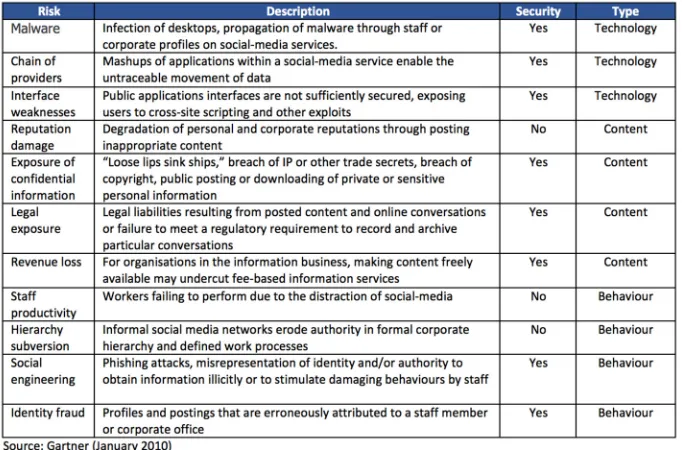
Figure 1: The top 11 risks as listed by Gartner in relation to social media.
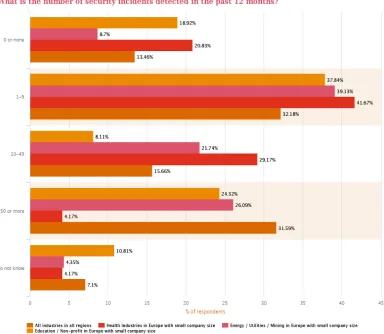
Figure 2: The global State of Information Security Survey 2016, which includes health industres, energy and education.
A recent study into cyber security threats conducted by PWC asked over 100 companies around the world a range of questions about the state of cyber security within their organisations and future plans to increase security.
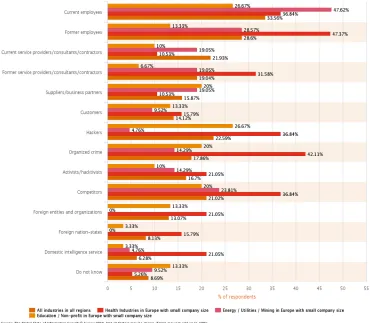
Figure 3: The global State of Information Security Survey 2016, including health industres, energy and education.
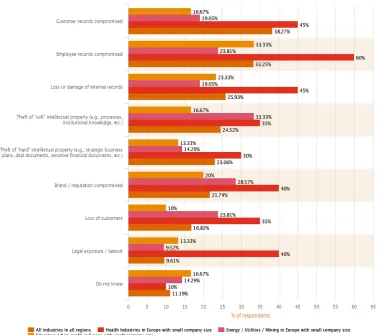
Figure 4: The global State of Information Security Survey 2016, including health industres, energy and education
2.4 The Methodology
The Global State of Information Security Survey in 2016 is a worldwide study by PWC, CIO, and CSO. It was conducted online from the 7th of May 2015 to 12th of June 2015. Readers of CIO and CSO and clients of PWC from around the globe were invited via email to take the survey. The results discussed in this report are based on responses of more than 10,000 CEOs, CFOs, CIOs, CISOs, CSOs, VPs, and directors of IT and security practices from 127 countries. Thirty-seven percent (37%) of respondents are from North America, 30% from Europe, 16% from Asia Pacific, 14% from South America, and 3% from the Middle East and Africa. The margin of error is less than 1%.
3 Recommendations for governance and use of Social Media within
Enterprise
3.1 Understand the risks through regular bespoke risk assessments
The environment is constantly changing and Hackers are in a position to know more about the device than the manufacturers, distributing companies and staff. Companies have reduced the security restrictions on mobile devices and in some cases remove them in favour of increasing the user experience for staff members.
Two steps verification combined with Single-Sign-On means that once a user is logged into a device which is then stolen or goes missing, not only is there an issue that the data on the device can be accessed; it is possible that someone could access other areas of the company system/database/information using the single sign on feature. Risk assessments and audits should be bespoke to the needs of the specific company and staff requirements.
3.2 Effective management of identified risks
Google play recently changed the rules on how permissions are granted when downloading applications by removing the requirement to grant permissions before users have begun utilising the applications and Whatsapp have recently launched end-to-end encryption protecting user messages from being decrypted.
3.3 Follow and share examples of best practice
made a great foundation within the area of risk management, and therefore learning from best practice and developing new methods upon this layout information is fundamental.
3.4 Ensure engagement from the organisation's leadership team
Many cases of Governments and law enforcement operatives obtaining encryption keys from companies and website owners and so ensuring that the leadership team across all levels of the organisation are actively engaged in the process of regularly assessing the situation. Social media is clearly a requirement in the business world today as the marketing methods and dynamics have grown to involve and require the use of social media marketing tools and applications on a day-to-day basis for both private and corporate use. As a result, the changing landscape of business is further complicated by the addition of social media. It is vital that companies adhere to or develop policies around the encryption and decryption of content on work assigned devices.
3.5 Train the Employees, including those without work assigned technology
Staff who are provided mobile devices are in the most part extremely responsible. It is vital that staff is trained and able to understand security threats and best practise regarding the form of information which can/should be stored on mobile devices. Users frequently visit websites via links which could pose a security risk and as a result put employer’s data at risk. Poor password selection can be combatted through the use of 2-step verification in conjunction with single sign on services (SSO) such as Security as Service (SAAS) combinations. However, an employee misplacing an unlocked mobile device and another that conducts a malicious information leak presents the same amount of risk. Disgruntled employees with an in-depth knowledge of technology and mobile security can be a serious source of risk.
4 Conclusion and Future Work
It is vital that the future of business includes the commitment of all employees to maintaining and preserving security both of themselves as individuals and as of the organisation itself. The education, energy and health sectors have a lot to lose through cybercrime that fracture employee and customer data. As a result, managers and leaders must be forward thinking and work towards developing strategies and infrastructure that prevents and mitigates the most common risks at a minimum level.
The while it is clear that social media as with all elements of the Internet are advancing at a faster pace than most are able to grasp from a security perspective, the rewards of engaging these platforms in ways that allow businesses to engage their audience is safely while will provide untold benefits to all involved. A fundamental factor required for this to take place, is honesty and transparency across industry sectors about incidents which have occurred so that (E lessons can be learned and up-to-date training and information can be distributed as often as necessary.
The work presented in this paper establishes the basis for further research activities and findings in the near future. Our future work will involve gathering effective statistics about the most ten popular apps being downloaded by staff onto mobiles (e.g tinder) via the technical department of 100 companies. Then we are planning to analyse the ranking of all apps into order from most to least secure apps. Afterwards these apps will be rated accordingly based on different factors such as threats raised, hack attempts etc. Moreover, a technical based solutions and recommendations will be developed to help and support enterprise. This will lead to develop a global system that provides updated training materials and alerts about the recent breaches to all work based phones. This system will be able to provide advice on the need for increased training and governance for all the employees involved in such work.
References
[1] “Accenture Comprehensive Approach Managing Social Media Risk Compliance. [2] “Research shows dangers of user-generated content,” ComputerWeekly. [Online]. Available: http://www.computerweekly.com/news/2240150785/Research-shows-dangers-of-user-generated-content. [Accessed: 28-Jul-2016].
[3] R. Shullic, “Risk Assessment of Social Media,” The SANS Institute, 2012.
[4] D. Jayaram, A. K. Manrai, and L. A. Manrai, “Effective use of marketing technology in Eastern Europe: Web analytics, social media, customer analytics, digital campaigns and mo-bile applications.,” Uso Eficaz Tecnol. Mark. En Eur. Este Analíticas Web Medios Soc. Analítica Clientes Campañas Digit. Apl. Móviles, vol. 20, no. 39, pp. 118–132, Dec. 2015.
[5] “U.N. Report Declares Internet Access a Human Right | WIRED.” [Online]. Available: https://www.wired.com/2011/06/internet-a-human-right/. [Accessed: 28-Jul-2016].
[6] S. PREIBUSCH, “Privacy Behaviors After Snowden.,” Commun. ACM, vol. 58, no. 5, p. 48, May 2015.
[8] “No, the Internet Is Not a Utility,” Conservative Review. [Online]. Available: https://www.conservativereview.com/commentary/2016/06/no-the-internet-is-not-a-utility. [Ac-cessed: 28-Jul-2016].
[9] K. Jenab and S. Moslehpour, “Cyber Security Management: A Review.,” Bus. Manag. Dyn., vol. 5, no. 11, pp. 16–39, May 2016.
[10] L. Gardner, “Welcome to the Web World.,” J. Aust. N. Z. Inst. Insur. Finance, vol. 38, no. 3, pp. 1–6, Sep. 2015.
[11] A. CHARLAND and B. LEROUX, “Mobile Application Development: Web vs. Na-tive.,” Commun. ACM, vol. 54, no. 5, pp. 49–53, May 2011.
[12] R. S. Dikhit, “Using Android for the Enterprise.,” Open Source You, vol. 4, no. 5, p. 49, Feb. 2016.
[13] “HTML5 vs Native Whats a Mobile Developer to Do 648997,” eWeek, 2012. [14] I. de M. Barroca Filho and G. S. Aquino Júnior, “Development of mobile applications from existing Web-based enterprise systems.,” Int. J. Web Inf. Syst., vol. 11, no. 2, p. 162, Apr. 2015.
[15] “The Enterprise Guide to Developing Secure Mobile Apps.,” Comput. Wkly., pp. 1–19, Jun. 2016.
[16] D. BREWER, “Native apps vs. Web apps.,” N. H. Bus. Rev., vol. 33, no. 22, p. 30, Oct. 2011.
[17] A. Gatlin, “Social Media Privacy Settings Get Few Likes From Millennials Show High Level Of Distrust But survey finds gen Yers still need to improve their cybersecurity awareness,”
Investor’s Business Daily, 2015.