R
a t i o n a l i t y
a n d
T
im e
A M ultiple-Self Model of Personal Id en tity over Tim e for Decision and G am e T heory
C onrad H eilm ann
A thesis submitted to the Department of Philosophy, Logic and Scientific Method of the London School of Economics and Political Science for the degree of Doctor of
UMI Number: U61B442
All rights reserved
INFORMATION TO ALL USERS
The quality of this reproduction is dependent upon the quality of the copy submitted.
In the unlikely event that the author did not send a complete manuscript and there are missing pages, these will be noted. Also, if material had to be removed,
a note will indicate the deletion.
Dissertation Publishing
UMI U613442
Published by ProQuest LLC 2014. Copyright in the Dissertation held by the Author. Microform Edition © ProQuest LLC.
All rights reserved. This work is protected against unauthorized copying under Title 17, United States Code.
ProQuest LLC
rases
F
D ec la ra tio n
I certify th a t the thesis I have presented for examination for the PhD degree of the London School of Economics and Political Science is solely my own work other
the extent of any work carried out jointly by me and any other person is clearly identified in it). The copyright of this thesis rests with the author. Quotation from it is permitted, provided th at full acknowledgement is made. This thesis may not be reproduced without the prior w ritten consent of the author. I warrant th a t this authorization does not, to the best of my belief, infringe the rights of any third party.
than where I have clearly indicated th at it is the work of others (in which case
A b str a ct
This thesis presents extensions to formal theories of rationality in order to analyse intertemporal decisions. It offers multiple-self models of the decision-maker’s per sonal identity over time. These models complement decision and game theory and axe used to develop the new accounts of time discounting, backward induction, and preference change th at are presented in this thesis.
The first part of the thesis develops multiple-self models of personal identity over time. These models depict a rational decision-maker as a series of different but interconnected temporal selves. The models allow one to relax the assumption that a rational decision-maker is a diachronically stable entity. Moreover, they structurally cohere with key problems and distinctions in theories of personal identity over time.
In the second part of the thesis, three problems of time in decision and game theory axe analysed. Firstly, the problem of time discounting is considered. Gen eral foundations of time discounting axe given in a measurement-theoretic frame work. In the multiple-self interpretation of a decision-maker, the discounting factor represents the degree of connectedness between temporal selves in a per son. Secondly, the reasoning method of backward induction in interactions over time is considered. Sufficient conditions for backward induction are given by formulating a belief revision policy on the basis of intrapersonal connectedness of players. Thirdly, preference change is considered. A new characterisation of diachronic inconsistency in terms of conflicts in intrapersonal connectedness is given.
O verview
Acknowledgements 13
1 Introduction 14
1 M u ltip le-S elf M od els o f P erson al Id en tity over T im e 27
2 M ultiple-Self M odels 28
3 Personal Identity over Time 52
II T h ree P rob lem s o f T im e in D ecisio n s and G am es 79
4 Time Discounting 80
5 Backward Induction 153
6 Preference Change 189
7 Conclusions 223
C on ten ts
Acknowledgements 13
1 Introduction 14
1.1 Intertemporal D e c is io n s ... 14
1.2 Three Problems of Time in Decisions and G a m e s ... 15
1.2.1 Temporal Distance and Time D isco u n tin g ... 16
1.2.2 Interaction over Time and Backward In d u c tio n ... 17
1.2.3 Temporal Dynamics and Preference C h a n g e ... 18
1.3 Time in Decision and Game T h e o r y ... 19
1.3.1 Extensions for Decision T h e o r y ... 20
1.3.2 Multiple-Self Models of Personal Identity over Time . . . . 22
1.4 Thesis Overview ... 23
1.4.1 P a r t i ... 23
1.4.2 P art I I ... 24
1.4.3 O u tlo o k ... 26
1 M u ltip le-S elf M od els o f Person al Id e n tity over T im e 27 2 M ultiple-Self M odels 28 2.1 Introduction... 28
2.2 Time and Decision T h e o ry ... 30
2.2.1 Standard Decision-Theoretic R ep resen tatio n s... 30
2.2.2 Intertemporal Decisions and G a m e s ... 32
2.2.3 Extending Decision T h e o r y ... 37
2.3 Multiple-Self A cco u n ts... 38
C O N TEN TS
2.3.2 Towards Multiple-Self M o d els... 42
2.4 Multiple-Self Models for Decision T h e o r y ... 42
2.4.1 Selves, Connectedness, and their In te rp re ta tio n ...43
2.4.2 Reductive and Non-Reductive In te rp re ta tio n s...45
2.4.3 Dual Multiple-Self M o d els... 47
2.4.4 Multiple-Self Models and Decision-Theoretic Representations 48 2.5 C onclusions... 51
3 Personal Identity over Time 52 3.1 In troduction...52
3.2 A Stylised History of Theories of Personal Identity over Time . . . 54
3.2.1 Plato and Descartes versus Locke and Hume ... 54
3.2.2 Contemporary Debates: Dualisms and C r i t e r i a ... 57
3.3 Three Problems of Personal Identity over T i m e ...59
3.3.1 Instances, Persistence and C r it e r ia ... 60
3.3.2 Instances and P e rs is te n c e ...62
3.3.3 C r i t e r i a ... 65
3.3.4 Personal Identity Thought E x p e rim e n ts ...67
3.4 Criteria of Personal Identity over T im e ... 69
3.4.1 Memory C r i t e r i a ... 69
3.4.2 Psychological C r i t e r i a ...72
3.5 Multiple-Self Models of Personal Identity over T i m e ... 76
3.6 C onclusions... 77
II T hree P rob lem s o f T im e in D ecisio n s and G am es 79 4 Time Discounting 80 4.1 Introduction... 80
4.2 Time D iscounting...84
4.2.1 Time Discounting F unctions...85
4.2.2 Exponential and Hyperbolic Discounting T h e o r i e s ... 87
4.2.3 Conceptual Motivations for Time D iscounting...92
4.2.4 Four Problems of Time D is c o u n tin g ... 96
4.3 Representation Theorems for Time D iscounting...100
4.3.1 Representation Theorems and Measurement Theory . . . . 101
C O N TEN TS
4.3.3 Problems of Time Discounting R ep resen tatio n s... I l l
4.4 General Foundations of Time D isco u n tin g ... 115
4.4.1 Introduction ... 116
4.4.2 Representing Time D istan ce... 118
4.4.3 Interpreting Time D is ta n c e ... 123
4.4.4 Time Distance D is c o u n tin g ... 126
4.4.5 Exponential and Hyperbolic Time Discounting Functions . 129 4.4.6 Discounted V alu e ... 131
4.4.7 S u m m a ry ...132
4.5 Time Discounting Theories Reconsidered...133
4.5.1 Four Problems of Time D is c o u n tin g ... 134
4.5.2 Time P references... 138
4.6 Time Discounting in the M u ltip le-S elf... 139
4.6.1 Parfit’s Discounting for Intrapersonal Connectedness . . . . 140
4.6.2 Exponential Discounting for Taste C h ange... 145
4.7 C onclusions... 147
4.8 Appendix: P ro o fs... 148
5 Backward Induction 153 5.1 Introduction... 153
5.2 Modelling Dynamic Games ...157
5.3 Extending Type-based Interactive Epistemology... 161
5.4 Sufficient Conditions for Backward I n d u c ti o n ... 168
5.5 D iscussion... 174
5.5.1 D y n a m ic s...174
5.5.2 M u ltip le-S elf...175
5.5.3 Epistemic Indep end en ce...178
5.5.4 Backward Induction P a ra d o x e s ... 180
5.5.5 Trembling Hand . ... 183
5.6 Conclusion ... 185
5.7 Appendix: P ro o fs... 186
6 Preference Change 189 6.1 Introduction... 189
6.2 Preference Change and Dynamic In c o n siste n c y ...192
CO NTENTS
6.3.1 Hyperbolic D is c o u n tin g ...196
6.3.2 ‘Multi-Selves’ A p p ro ach es...199
6.4 Dynamic Inconsistency in Multiple-Self Models of Personal Iden tity over Time 207
6.4.1 Present Bias in a Simple Multiple-Self M o d e l... 208
6.4.2 A Dual Multiple-Self M o d e l... 210
6.4.3 Theories of Dynamic Inconsistency R e v is ite d ... 219
6.5 C onclusions... 221
7 Conclusions 223 7.1 Time in Decisions and G a m e s ...223
7.2 The Multiple-Self in Decisions and G a m e s ...225
7.3 Future Work ... 227
List o f Figures
4.1 Discounting F u n c tio n s ...
List o f Tables
2.1 Temporal Selves in a Simple Multiple-Self Model ... 43
4.1 Two Questions of Time Discounting and Two Modes of their Discussion . 96 6.1 Dual Selves in a Two-Row Model ... 210
6.2 A Utility E va lu a tion ... 211
6.3 Connectedness of Planner- and D o e r -S e lv e s ...212
6.4 Utility Evaluation of the P la n n e r-S elf... 214
6.5 Utility Evaluation of the D oer-Self... 214
6.6 Connectedness Weighting of the Doer’s Evaluation I ...215
6.7 Connectedness Weighting of the Doer’s Evaluation I I ... 215
6.8 Aggregation over A c t s ...216
A ck n o w led g em en ts
First and foremost, I would like to thank my supervisors, in particular Richard Bradley. I have benefited enormously from his patience, intellectual empathy, sharp (and quick) feedback as well as many astute suggestions. I am grateful for his outstanding support which went such a long way in helping me to develop and improve on this project. It was also a real pleasure to work with him on a practical and day-to-day basis. I would like to thank Katie Steele and Franz Dietrich for their co-supervision, generously offering their invaluable help and advice. I feel privileged to have worked with such a committed, encouraging, and kind team of supervisors.
I would like to thank my collaborators Christian W. Bach and Philip Cook for many hours of enjoyable, stimulating, and fruitful work. I am also indebted to Luc Bovens, Christian List, Mauro Rossi, and Olivier Roy, who offered so much help, advice, and encouragement all along.
Thanks to all members and seminar participants of the LSE Choice Group for creating a unique environment which has educated me a great deal. Most key ideas in this thesis have been aired in front of this most helpful, engaging, and critical of audiences and greatly improved as a result. The same holds for the Decisions, Games & Logic (DGL) workshops and the LSE PhD Seminar in Philosophy. I also want to thank organisers and participants of seminars and conferences for many helpful discussions at Amsterdam, Canberra, Eindhoven, Groningen, Norwich, Osnabriick, Paris, Prague, St. Andrews, and Sydney, where I have presented material contained in this thesis.
Thanks to everyone at the LSE Department of Philosophy, Logic and Scientific Method, the Centre for the Philosophy of N atural and Social Science (CPNSS), and the Philosophy Programme at the ANU in Canberra. I am also grateful for financial assistance from the German Academic Exchange Service (DAAD), the Academic Merit Foundation of German Businesses (sdw), and the LSE Research Studentship Scheme.
Obrecht, Eric Pacuit, M att Parker, Andres Perea, Jan-Willem Romeijn, Kai Spiekermann, Chris Thompson, Johan van Benthem, M artin van Hees, Alex Voorhoeve, Jon Williamson, and Stuart Yasgur.
Special thanks to Alice and Marilena for their congenial companionship in the PhD programme, and to Foad. Finally, sincere thanks to my parents, my sister and my brother, and so many friends and family th a t it is impossible to list them all. You know who you are!
Chapter 1
In trod u ction
1.1
In tertem p o ra l D e c isio n s
Time plays an im portant role in many decisions. Indeed, intertemporality is prominent when deciding between small gains in the short-term and large gains in the long-term, and when deciding whether to do something earlier or later. Such intertemporal decisions play a highly significant role in the everyday fife of individuals as well as in collective decision-making. For individuals, decisions about education, career path, migration, or investment in housing come to mind. For collectives, such intertemporal decisions include investments in education, pension systems and infrastructure, as well as dealing with environmental prob lems like climate change or biodiversity. Intertemporal decisions are important because they have a profound influence on the lives of the individuals and col lectives concerned with them.
C H A P T E R 1. INTRO D U CTIO N
specify in what sense future costs and benefits of decisions are significant today. Do future benefits count less than present benefits, or are they to be evaluated on equal terms? How are we to factor in the possibility th a t what we think beneficial or costly today might not be considered so in the future?
Similar questions arise in intertemporal decisions of individuals. Consider an undergraduate student who decides whether to pursue further study or get a job instead. The consequences associated with each of these prospects will occur at different times. Moreover, it is likely th at the two prospects have quite different consequences in the short-term and in the long-term: when pursuing further study, the student might have less money in the near future, and possibly a loan to pay after her studies. But in the long-term, the student might be able to earn more money because of her higher qualifications and she might lead a more satisfied fife because of that. By getting a job instead of further study, she will earn more money in the short-term, but she might not be able to earn so much in the long-term. Even if the student is clear about how she values the kinds of jobs and studies available to her, the intertemporal aspect of the decision might still puzzle her. Should she think of the consequences in the far future as less valuable? How should she account for the fact th a t she might change her mind later about one of the possible courses of action? When individuals make decisions with a long-term impact, such aspects will m atter a great deal.
The above examples suggest th a t intertemporal decisions are im portant and give rise to complex theoretical and practical questions. Not all of the questions th a t can be raised about such decisions will be treated in this thesis - indeed, I limit its scope to discussing three particularly interesting problems of intertem porality in decisions and games, and more generally to suggesting extensions to standard decision theories to better deal with such problems of intertemporal ity. Before discussing the latter, we tu rn to introducing the three particularly poignant problems of intertemporality in decisions and games.
1.2
T h ree P ro b lem s o f T im e in D e c isio n s and G am es
C H APTER 1. INTRO D U CTIO N
consequences occur at different times, which raises the question of how this fact impacts evaluations of decision-makers. More specifically, we can ask the follow ing three questions.
(i) W hat is the significance of the fact th a t one dinner takes place later than the other one?
(ii) In what sense can decision-makers anticipate and deal with the fact th at other decision-makers might surprise them over time?
(iii) How are decision-makers to deal with the fact th a t they might change their minds about possible courses of action?
These axe the kinds of questions raised by intertemporality in decisions and games th at this thesis addresses. In the following, we look at these three problems in more detail, and explain each of them by using a variant of the dinner example just introduced.
1.2.1 T em poral D ista n ce and T im e D isco u n tin g
The first problem of intertemporality is called the problem of temporal distance. Consider the dinner example. Suppose th a t the comparative quality of the dinners is not at issue; the two dinners are the same, except in when they will actually take place. W hat can we say about this temporal distance between the two dinners? Intuitively, there is an obvious difference between the two prospects of having dinner at different times. Hence, it is possible th a t the friends react in a different way. For instance, one of the friends could dislike waiting for social occasions and hence be rather impatient about the dinner taking place. In contrast, another one of the friends might get a lot of pleasure out of knowing th at the dinner will be taking place, enjoying the anticipation of the occasion. Furthermore, some of the friends could foresee a lot of work-related commitments in the next week and think it unlikely th at they will be able to join for the later dinner. Others amongst the friends could fear th at not everyone will make it to tomorrow’s dinner due to the short notice, and so on. T hat is to say, the mere fact th at alternatives axe different as to when they materialise can have a strong impact on their evaluation.
CH APTER 1. INTRO DU CTION
modelled by standard decision-theoretic frameworks. Yet, once all such features are taken into account, it remains an open question as to whether temporal dis tance as such can change our goodness evaluations.
Here, the heavily contested concept of time discounting has been proposed to deal with temporal distance, by postulating weights on future outcomes to reduce their value (Frederick et a l, 2002). One question of this thesis is to develop foundations of time discounting, giving an exact description of how the notion of time discounting can be described and specifying on what kinds of assumptions it rests. In economics, time discounting is frequently employed to deal with temporal distance, such th at goods occurring later in time are weighted less than those occurring earlier. In this context, the question arises in what way should goodness be weighted according to temporal distance. This has led to debates about the correct interpretation and method of time discounting. On the other hand, in philosophy, the position is by and large th a t temporal distance should not have an impact on the evaluation of an outcome (Sidgwick, 1907; Rawls, 1971; Broome, 1991, 1999), with Parfit (1984) being the most famous exception to this view. This thesis asks what kinds of evaluation of temporal distance can be represented by time discounting functions. In order to answer this question, we develop a general representational framework for time discounting th a t allows us to clarify existing theories, making transparent the requirements for the construction of well-founded time discounting functions.
1.2.2 In teraction over T im e and B ackw ard In d u ctio n
The second problem of intertemporality is called the problem of interaction over time. Suppose there is an element of strategic interaction between the friends who
C H APTER 1. INTRO D U CTIO N
considering one’s own decisions. Furthermore, whether other decision-makers will be consistent over time and whether they will commit to decisions once made is also highly relevant to forming one’s own evaluations. T h at is to say, hypothetical reasoning as described above requires one to entertain situations in which one is surprised by other decision-makers, such as when they do not stick to their plans.
The question of how to characterise decision-makers’ interactive beliefs and possible changes in belief when facing surprises has been a key problem in models of hypothetical reasoning, in particular in discussions about the key reasoning method of backward induction. Epistemic game theory models dynamic interac tions and provides a rich framework for its description with a focus on the role of knowledge (Brandenburger, 2007). Indeed, epistemic game theory character ises the epistemic assumptions of solution concepts in dynamic games, making transparent the hypothetical reasoning of the decision-makers. In this context, the reasoning method of backward induction is central, in which a decision-maker firstly entertains what she would choose at the last possible decision in a dynamic game and then works her way backwards to the beginning of the game (Perea, 2007). When determining possible courses of action in such a way, the decision maker has to entertain situations which could only arise if another decision-maker is irrational (Stalnaker, 1998). How to keep the belief in the other decision makers’ rationality when entertaining such situations has been a pressing problem in the foundations of game theory (Binmore, 1987). This thesis shows how an enhanced representation of the temporal stability of decision-makers can improve the characterisation of backward inductive reasoning.
1.2.3 T em poral D yn am ics and P referen ce C han ge
C H APTER 1. IN TRO D U C TIO N
in a conflict as to which of the dinners she would prefer. In general, we can thus say th a t there are interesting temporal dynamics when decision-makers are given the chance to re-assess their decisions, revise their preferences, or remain in conflict about the decision. Some of those dynamics can be quite easily modelled within standard decision theory. In particular, decision theories allow for decision makers to update their beliefs in light of new information. Yet, some of the dynamics mentioned before are not so easily analysable in terms of information, such as when decision-makers change their tastes. Such problems of changing and conflicting preferences remain contested in both philosophy and economics (Stigler and Becker (1977), Bradley (2009b)) .
A particular kind of preference change, commonly referred to as dynamic inconsistency, occurs when a decision-maker has contradictory preferences over time. One of the concerns of the thesis is to analyse preference change by an account th a t improves on the explanation of dynamically inconsistent preferences of decision-makers over time. In this context, Schelling (1980, 1984) and Ainslie (1992, 2001) have proposed to draw on the metaphor of persons as ‘multiple- selves’ in order to analyse dynamic inconsistency, such th a t different selves have opposing preferences. In the more recent behavioural economics literature, such approaches have been combined with hyperbolic discounting functions, modelling dynamic inconsistency as being produced by the interaction of short-sighted and far-sighted selves, for instance in Thaler and Shefrin (1981) and Fudenberg and Levine (2006). This thesis presents a modelling approach th a t is simpler yet achieves the same aims as the aforementioned ones, and makes transparent in what way the description of dynamically inconsistent decision-makers requires us to depart from normative decision-theoretic accounts.
1.3
T im e in D ec isio n and G am e T h eo r y
C H APTER 1. IN TRO D U C TIO N
1.3.1 E x ten sio n s for D ecisio n T h eory
Standard decision-theoretic accounts take a subjectivist approach to analysing decisions. They embark from a sparse and idealised representation of an indi vidual’s mental state by way of a pair of probability and value functions. The probability function represents the individual’s beliefs and the value function represents the individual’s desires. Decisions can then be analysed on the basis of such two-factor models. More specifically, the expected goodness of possible courses of actions can be evaluated by combining the beliefs of the decision-maker with the desirability she assigns to the different options. Formulating rational ity conditions on the structure of beliefs and desires yields accounts of rational decision-making. Moreover, decision theories not only present powerful tools to analyse decisions, they also give subjectivist foundations for economics and social sciences. Indeed, the latter can be based on a decision-theoretic analysis of their choices, interactions, and collective actions.
Yet, standard decision-theoretic representations of individuals do not offer tools to explicitly consider separate attitudes towards the future, such as those implied by time discounting functions, and possible changes in tastes. Hence, it is natural to investigate how standard decision-theoretic frameworks can be enriched in order to widen their scope and applicability. Let us now recall the three problems of intertemporality and their discussion in the literature. It seems that all three problems have in common th a t a direct application of a standard decision-theoretic framework does not give conclusive answers to them.
CH APTER 1. INTRO D U CTIO N
Now consider the problem of backward induction in interactions over time. Standardly, game theory assumes the sequential stability of the preferences as well as plans of action of individuals. Yet, precisely such stability assumptions need to be locally relaxed in order to account for surprise information in hypothetical reasoning: if someone faces another individual who deviates from her plan of action, then this new information needs to be accommodated within the existing beliefs of the individual. Here, epistemic game theory provides tools to model hypothetical reasoning of decision-makers about each other’s actions. However, the modelling devices of epistemic game theory require us to specify in what way individuals revise their beliefs about each other. This raises the question of how epistemic models of dynamic games can be amended such as to accommodate surprise information th a t is key to backward inductive reasoning.
Finally, consider the problem of preference change in temporal dynamics. Many applications of decision-theoretic frameworks embark from the assumption th at an agent’s preferences are stable over time. An im portant tool to deal with some types of changes is the so-called ‘updating’ of beliefs in light of new inform ation or evidence. T hat is, by learning new propositions, an individual can revise her beliefs so as to correctly represent her knowledge about the world. However, changes of preference can also occur in less laudable circumstances, for instance, when individuals change their tastes without apparent motivation and when they contradict themselves over time. From a decision-theoretic point of view, such changes in preference are irrational. Yet, real-world decision-makers change their tastes and contradict themselves quite persistently, such as when failing to adhere to a healthy diet. This raises the question of how such preference changes can be described in order to better understand how individuals persistently violate the assumption of dynamic consistency.
C H A P T E R 1. INTRO DU CTION
1.3.2 M u ltip le-S elf M od els o f P erson al Id e n tity over T im e
This thesis proposes the modelling device of ‘multiple-self models of personal identity over time’ to suitably extend decision theory in order to analyse the three problems of intertemporality from a decision-theoretic point of view.
Multiple-self models introduced in this thesis depict a decision-maker as a col lection of temporal selves, and characterise their degree of connectedness. More precisely, temporal selves capture the idea th a t a decision-maker exists at dif ferent points in time, with possibly changing characteristics. The notion of con nectedness describes the degree of stability between temporal selves, i.e. the degree to which temporal selves have similar characteristics. In a general sense, these multiple-self models will allow us to capture decision-makers as temporally extended persons, offering precise descriptions of their stability over time. This provides a structure to express what to take as relevant about the changing nature of decision-makers.
From a decision-theoretic point of view, the concepts of temporal selves and connectedness can be interpreted reductively. On such an interpretation, at each point in time, the temporal self is depicted as a rational decision-maker th a t is constrained by standard decision-theoretic consistency assumptions. The degree of connectedness describes in what sense the different temporal selves axe similar to each other. In Chapter 2, we will discuss in detail how such a reductive multiple-self model relates to standard decision-theoretic representations, and we will give different variants of multiple-self models th a t can complement decision- theoretic representations of decision-makers.
CH APTER 1. INTRO D U CTIO N
of decision-makers with insights from theories of personal identity over time. More generally, the multiple-self models introduced in this thesis can be in terpreted as relaxing the assumption of temporal stability th at is often made in applications of decision theories. This suggests th a t while the multiple-self models depict insights into decision-makers’ personal identity over time, we axe not re quired to endorse them as metaphysical views of the ontology of decision-makers. Rather, the models can be viewed as structures th a t offer a more permissive representation of the decision-maker’s deliberations about time. That is to say, in order to apply the aforementioned models as extensions to formal theories of rationality, no additional assumption is made other than to accept them as a method of relaxing stability assumptions th a t axe often made in their application. Applying such a description of temporally extended decision-makers to intertem poral decisions allows much richer interpretations of the new accounts of time discounting, backward induction, and preference change presented in this thesis.
1.4
T h esis O verview
The thesis is divided into two paxts. Paxt I develops the multiple-self approach, showing how multiple-self models can enrich decision theory (Chapter 2), and how they structurally cohere with philosophical theories of personal identity over time (Chapter 3). Paxt II provides three accounts of temporal problems in decisions and games: foundations of time discounting (Chapter 4), sufficient conditions for backward induction (Chapter 5), and dynamically inconsistent preference change (Chapter 6). Chapter 7 offers conclusions.
1.4.1 P art I
Paxt I develops multiple-self models of personal identity over time. It is ar gued that such modelling devices both present extensions to decision theories and structurally cohere with key distinctions in theories of personal identity over time.
C H APTER 1. INTRO DU CTION
a reductive interpretation, temporal selves are sets of preferences and their connectedness is determined by similarity of preferences. In a non-reductive interpretation, temporal selves are seats of a broader range of psychological features, such as preferences, memory, emotions, etc. We show how such an extended representation of decision-makers can capture the influence of time on decision-making and how it relates to existing proposals of under standing individuals as ‘multiple-selves’.
C h a p te r 3. P e rs o n a l Id e n tity over T im e. Chapter 3 shows how multiple- self models structurally cohere with key questions and distinctions in the ories of personal identity over time. We suggest th a t those theories can be viewed as competing answers to three questions: (i) instances, the question of what is significant for a person to exist at a given point in time - this can be captured by the notion of temporal selves in a multiple-self model, (ii) persistence, the question of what is significant for a person to exist over time - this can be captured by the notion of connectedness in a multiple- self model, and (iii) criteria, the question of what establishes instances and persistence of persons - this can be captured by an interpretation of tem poral selves and connectedness in a multiple-self model. T hat is, given a sufficiently rich specification of a multiple-self model, it can be motivated and constrained by specific theories of personal identity over time.
Multiple-self models of personal identity over time will be used in the second part of the thesis to improve our understanding of three problems of time in decision and game theory. While many of those discussions do not directly hinge on endorsing multiple-self models as a premise, we will show how for each of those problems, they offer valuable modelling devices th a t give additional insights into how intertemporality can be analysed by decision and game theory.
1.4.2 P art II
P art II discusses three problems of intertemporality in decision and game theory.
C H A P T E R 1. INTRO D U CTIO N
accurate underlying conceptual motivation. We proceed by presenting a general representation framework for time discounting which outlines the requirements th a t well-founded time discounting functions have to fulfil. This general framework is used to analyse both existing accounts of time discounting, as well as Parfit’s dictum of time discounting because of a weak connectedness to future selves. More generally, the requirements for time discounting theories developed here demonstrate th a t time discounting factors are restricted in the kinds of conceptions they can express.
C h a p te r 5. B ack w ard In d u c tio n . Chapter 5 analyses the problem of inter action over time; in particular, the sequential structure of dynamic games with perfect information. A three-stage account is proposed, th a t specifies set-up, reasoning and play stages of dynamic games. Accordingly, we define a player as a set of agents corresponding to these three stages. Moreover, the notion of agent connectedness is introduced which measures the extent to which agents’ choices are sequentially stable. A type-based epistemic model is augmented with agent connectedness and used to provide suffi cient conditions for backward induction. Moreover, an existence result is obtained ensuring th at these conditions are indeed possible. Our epistemic foundation for backward induction makes explicit th a t the epistemic inde pendence assumption involved in backward induction reasoning is stronger than usually presumed. Furthermore, in the three stage-account, players can explicitly be understood as multiple-selves, which permits one to in terpret low agent connectedness as stemming from imperfect connectedness between selves.1
C h a p te r 6. P re fe re n c e C h an g e. Chapter 6 analyses temporal dynamics and gives an account of dynamic inconsistency. Two families of approaches to dynamic inconsistency are identified: firstly, those th a t use hyperbolic dis counting functions to describe dynamically inconsistent decision-makers as myopic, and secondly, those that postulate multi-selves models th a t capture different motivations and time horizons which can lead a decision-maker to (fail to) control himself in the face of tem ptation. In order to achieve a simpler characterisation of dynamic inconsistency, we reconsider both hy perbolic discounting and multi-selves models in the more general model
CH APTER 1. INTRO D U CTIO N
of connectedness in the multiple-self. A simple specification of this model can motivate hyperbolic discounting, and an extended version of it can be used to reformulate the multi-selves models, using a less complex structure th at can be better motivated. Moreover, the latter allows us to distinguish between conflicts in connectedness and conflicts in goodness evaluation.
1.4.3 O u tlook
This thesis is divided into two parts, with the latter part focusing on three specific problems in intertemporal decisions and games, and the former part developing modelling devices th at facilitate the analysis. However, this does not entail th at all the accounts, arguments, and formal results in those three accounts necessarily depend in any way on accepting the modelling devices as premises. Naturally, the three accounts differ in how fax they draw on the multiple-self models in their analysis.
In light of this, there are two modes of reading this thesis. Firstly, there is a ‘th in ’ reading which focuses on the three accounts of intertemporality in decisions and games and understands them as isolated solutions to specific intertemporal problems. On this reading, Chapter 4 provides general foundations of time dis counting, Chapter 5 proposes new sufficient conditions for backward induction, and Chapter 6 analyses dynamic inconsistency. Indeed, the individual chapters in P art II are intended as, by and large, self-contained treatments of received problems in their respective areas of enquiry.
Part I
M u ltip le-S elf M od els o f
Chapter 2
M u ltip le-S elf M od els
S u m m ary . This chapter discusses how decision theories usually represent decision makers and how such representations can be enriched in order to capture changes in decision-makers over time. We introduce the device of multiple-self models th a t allows us to conceive of a decision-maker as a collection of temporal selves and their connectedness. In a reductive interpretation, temporal selves are sets of preferences and their connectedness is determined by similarity of preferences. In a non-reductive interpretation, temporal selves axe seats of a broader range of psychological features, such as preferences, memory, emotions, etc. We show how such an enriched representation can capture the influence of time on decision making and how it relates to existing proposals of understanding individuals as ‘multiple-selves’.
2.1
In tr o d u ctio n
Decision-theoretic accounts provide representations of decision-makers’ states of mind. Indeed, their models combine a formal characterisation of beliefs and desires to analyse the decision-making of individuals. Such two-factor models are widely applied, and also used to provide foundations in economics and so cial science, for instance by motivating utility functions in economics, and by providing foundations for methodological individualism. The widespread use of decision-theoretic accounts is due to their sparse and therefore highly flexible rep resentation of decision-makers: only some assumptions on the structure of beliefs and desires axe needed to formulate models of rational decision-making.
CH APTER 2. MULTIPLE-SELF MODELS
Yet, as briefly alluded to in the introduction of this thesis, the sparse structure of standard decision-theoretic representations does not enable us to discuss how to conclusively evaluate all aspects of the problems of (i) temporal distance, (ii) interaction over time and (iii) temporal dynamics in greater detail. This chapter briefly introduces the main features of decision-theoretic representations of decision-makers and proposes an answer to the following question: how can decision-theoretic representations be enriched so as to be applicable to the three problems of time decisions and games?
We begin the chapter by reviewing the basic elements of standard decision- theoretic representations of decision-makers, focusing on the capacity of such accounts to analyse intertemporal decisions. Extensions to decision theory are introduced th a t have been proposed in the literature to deal with some aspects of such decisions. Yet, further extensions of decision-theoretic frameworks are required in order to answer the kinds of questions about intertemporal decisions posed in this thesis.
In a second step, we introduce accounts from a th at rather diverse literature th a t have attem pted to provide more enriched models of individuals by drawing on the metaphor of the ‘multiple-self’ (Elster, 1986). Such accounts view indi viduals as consisting of several different selves in order to analyse their conflicts of motivation. However, as pointed out by Frederick et al. (2002) when discussing the role of multiple-self accounts in the analysis of intertemporal decisions, ‘most of these multiple-self models have not been formalized’.
This chapter introduces ‘multiple-self models’ th a t enrich standard decision- theoretic representations of decision-makers to improve on this deficiency. They represent the temporal dimension of prospects by a model of the decision-maker as a collection of interconnected temporal selves. Such models are used to de scribe the decision-maker’s attitudes to the temporal aspect of prospects. T hat is, multiple-self models provide tools to widen the scope of decision theory to analyse intertemporal decisions in greater detail.
CH APTER 2. MULTIPLE-SELF MODELS
are connected to each other, and proposes different kinds of interpretation of connectedness. Section 2.5 briefly concludes.
2.2
T im e an d D ec isio n T h eo ry
This section reviews standard accounts of the representation of decision-makers and some proposed extensions, focusing on the capabilities of such accounts to analyse intertemporal decisions. In particular the problems of temporal distance, interaction over time, and temporal dynamics are considered. This sets the scene for presenting the device of multiple-self models later in this chapter.
2.2.1 Stan dard D ecisio n -T h eo retic R ep resen ta tio n s
Decision theories offer tools for characterising how decision-makers evaluate pro spects. In general, prospects are assumed to be rich descriptions of ‘complete world histories’, i.e. sets of possible worlds. For example, take the prospect of going to the beach. A maximally rich description of this prospect encompasses all events th a t can possibly be associated with it, such as going s w im m in g , finding a space on an overcrowded beach, eating ice-cream, seeking shelter from the rain, and so on. Decision theories formulate two-factor models th a t combine beliefs and desires in an attem pt to characterise the attitudes of decision-makers to such prospects. Indeed, such two-factor models of decision-makers’ states of minds are employed to give a quantified characterisation of an individual’s beliefs and desires.
Imagine a decision-maker who evaluates the prospect of going to the beach. In a decision-theoretic analysis, her attitudes to these prospects are characterised by her beliefs and desires. T hat is, her beliefs, such as how likely it is th at the beach will be overcrowded, are combined with her desires, such as how much the individual enjoys swimming. For instance, her desire to go swimming might be combined with a high degree of belief th at the beach will be overcrowded. If other prospects are available to the individual, such as staying home, then those might be evaluated as better overall by her than going to the beach because of her high degree of belief th a t the beach will be overcrowded.
CH APTER 2. M ULTIPLE-SELF MODELS
the decision maker’s beliefs by a probability function p, and her desires by a value function v. These functions are defined over a set of prospects, such that (p, v)-models give a quantified representation of beliefs and desires with regards to prospects (Bradley, 2009a,b). The above ingredients of a decision-model can be understood as the core idea th a t underlies decision-theoretic frameworks. This core idea has been specified in greater detail in different decision theories.
In order to obtain such a representation, many decision theories embark from the notion of a preference ordering over a set of prospects. T hat is, decision makers are assumed to rank different prospects in terms of their desirability. If such preference orderings satisfy some structural assumptions, such as weak or dering and independence conditions, they can be represented by a utility function. If the latter is weighted with the decision-maker’s probability function, we obtain an expected utility representation of the decision-maker’s preferences. T hat is, a decision-maker prefers prospect A over prospect B iff a larger expected utility is associated with prospect A than with prospect B . To obtain expected utility, von Neumann and Morgenstern (1944) employ an objective notion of probability, whereas more recent frameworks, such as Savage (1972), Jeffrey (1983), Joyce (1999), and Bradley (2007b), interpret the probability function as a represent ation of subjective degrees of belief. In the following, all those aforementioned decision theories will be referred to as (p, v)-representations of a decision-maker’s mental states. Such representations of belief and desire are, in their most basic forms, reductive and sparse as they only require a few structural assumptions. They offer a highly idealised and flexible representation of the states of minds of individual decision-makers.
CH APTER 2. M ULTIPLE-SELF MODELS
ample of the individual evaluating the prospects of going to the beach and staying home. Imagine she learns th a t her neighbours will be throwing a big party, or that she listens to the weather report. Conditionalising her beliefs on such new information will arguably be a better representation of her attitudes, if she is rational.
We will call the elements of decision-theoretic representations as introduced so far a ‘standard’ account. T hat is, a standard account combines an evaluation of prospects by beliefs and desires, given by the maximisation of a preference ordering over prospects represented by an expected utility function, with Bayesian conditionalisation to model the acquisition of new beliefs. We will now discuss whether such a standard account can be applied directly to analyse intertemporal decisions, and what kinds of extensions have been proposed in order to do so.
2.2.2 In tertem p o ra l D ecisio n s and G am es
This section shows th a t a direct application of standard decision-theoretic ap proaches is not sufficient to provide full answers to the three problems of inter- temporality in decisions and games raised in the introduction of this thesis. We discuss some extensions to decision theory that have been offered in the literature and suggest th a t while they answer some variants of the three questions posed here, further extensions to decision theory are needed.
Time Distance
The problem of time distance in intertemporal decisions arises when events asso ciated with prospects are distributed over time. Indeed, there are intertemporal decisions, such as the decisions between the two dinners at different days, in which time distance plays a very important role.
C H APTER 2. MULTIPLE-SELF MODELS
only one decision to make in his whole life. He must, namely, decide how to live, and this he might in principle do once and for all’ (Savage, 1972, 83). To avoid such problems, decision theories usually make assumptions th a t permit them to characterise more isolated decision situations. Savage (1972), for instance, goes on to describe how decision theories based on such a ‘lifetime-decision’ assump tion would not be applicable to practical decision-making, and indeed attem pts to define ‘small worlds’ in which practical decisions can be analysed. This discus sion of prospects illustrates th a t standard decision theories start from a rather general characterisation of decision-makers and prospects, without prescribing much structure.
How can time distance aspects of prospects be evaluated in decision-theoretic frameworks? In the standard accounts, intertemporal aspects are not modelled explicitly. T hat is, prospects can extend through time, and the decision-maker can adopt any attitudes to those, as long as those are within the confines of the structural assumptions th at axe needed to obtain expected utility representations. In particular, the decision-maker can take any attitude to time distance. T hat is to say, it is a m atter of desirability attitude, or personal taste, how a decision maker is influenced by distance in time. Therefore, decision theory does not assume th a t the present is inherently more, equally or less valuable than the future, or vice versa. If an agent is very patient, then the beliefs and desires that reflect this are just as admissible as the beliefs and desires of an agent who dislikes waiting.
In other words, decision theory does not offer structure for considering time distance separately. The beliefs and desires represent the agent’s attitudes, and assuming specific attitudes to time th at are separate from those is not part of standard decision-theoretic frameworks. However, there axe many decisions in which the time aspect is of overwhelming importance, for instance those about handling climate change for collectives, or choosing a career path. A direct ap plication of standard decision-theoretic frameworks as introduced above will not yield a detailed analysis of the intertemporal aspects of such decisions.
CH APTER 2. MULTIPLE-SELF MODELS
in Chapter 4. Other proposed extensions to decision theory, such as the concept of discounted utility in economics, will also be considered in detail in Chapter 4, and discussed in the context of the multiple-self model.
Interaction over Time
The problem of interaction arises when there is an interdependence between sev eral decision-makers, such th a t the consequences of their decisions depend on each other. Rational interaction of decision-makers is analysed in game theory, which builds on standard decision-theoretic frameworks and furnishes additional structure and assumptions to consider the interdependence of players’ choices. Interactions over time are analysed as dynamic games in the so-called extensive form, which will be introduced formally in Chapter 5.
The extensive form makes use of standard decision-theoretic accounts in order to model interaction over time; in particular, it is assumed th a t each player in the game is endowed with a utility function. Furthermore, the concept of belief updating is highly relevant, as dynamic games are marked by the fact th at new information can become available at different stages in the game. More specifically, consider that interactions over time require extensions to standard frameworks of belief updading in two key respects.
Firstly, the beliefs involved in the characterisation of rational interactions are complex, as higher-order beliefs are needed to characterise a player’s beliefs. T hat is, we are not only interested in the player’s beliefs as such, but also in what she believes about her opponents, what she believes her opponents believe about her, what she believes her opponents believe what she believes about them, and so on. Here, the research programme of epistemic game theory offers us modelling devices th at can characterise such higher-order beliefs (Brandenburger (2007), Perea (2011, forthcoming)). In Chapter 5, this approach will be will introduced formally.
CH APTER 2. MULTIPLE-SELF MODELS
belief in the opponent’s rationality has been a pressing problem in game theory. Binmore (1987)). In Chapter 5, we will give a characterisation of a new belief revision policy th at deals with this problem.
More generally, considering belief hierarchies and surprise information are two problems of interaction over time th at have led to extensions to standard frameworks. The multiple-self models th a t will be introduced in the next sections will help to further motivate such extensions, and will be used to interpret the sufficient conditions for backward induction developed in Chapter 5.
Temporal Dynamics
Temporal dynamics is perhaps the problem of intertemporal decisions th a t has re ceived the most attention in terms of extensions to decision theory. Two families of extensions axe particularly important: firstly, those extensions that analyse the problem of changing desires, by generalising standard decision-theoretic frame works. Secondly, those extensions th at deal with sequential decisions over time. We discuss each of those in turn and suggest th a t while they can treat a variety of problems associated to temporal dynamics, the description and explanation of dynamic inconsistency still requires further extensions.
Firstly, recall th a t Bayesian conditionalisation can model learning processes of decision-makers. Consider the example of choosing between the earlier or later dinner. For instance, in between the two possible dinners, a decision-maker could leaxn th at the restaurant has received a damning review by an important critic, which could influence the attitudes of the diners. Temporal dynamics th at are associated with the decision-maker receiving new information can hence be analysed with such tools. Applying such standard decision-theoretic tools in game theory and microeconomics more generally often comes with the assumption th at the decision-maker’s tastes are not supposed to change over time, and are not influenced by time in an explicit way. As Stigler and Becker (1977, 76) put it: ‘...o n e does not argue over tastes for the same reason one does not argue over the Rocky Mountains - both axe there, will be there next year, too . .. ’. Embarking from this methodological proposition, Stigler and Becker (1977) then develop models of taste changes in which they axe explained by belief changes. More generally, the application of decision-theoretic frameworks in economics is almost exclusively based on stable tastes.
CH APTER 2. MULTIPLE-SELF MODELS
new beliefs. It could also be the case th a t an agent changes her tastes or desires, rather than her beliefs. (We will henceforth use the terms taste and desire in terchangeably) . Recent generalisations of the concept of Bayesian updating also investigate an application of this method to desires, i.e. the value function (Brad ley, 2007a, 2009a,b). In such applications of Bayesian updating, more complex and realistic cases of changes of decision-makers’ minds can be accommodated for, such as changes of taste, for instance due to habituation, training and exper ience (Bradley, 2009b, 222f., for a list of examples). This account thus extends the standard decision-theoretic and Bayesian conditionalisation approaches and can deal with more complex temporal dynamics th a t are marked by taste change.
A related extension to standard frameworks in order to explain taste changes consists in introducing more structure in the model th a t yields the probability and value evaluation. Consider the recent model by Dietrich and List (2009), who introduce the idea th at consequences can have different features, which can but need not become salient for the decision-maker. Hence, while there is only ever one (p, i>)-pair activated, a whole collection of those objects is possible, as and when different features of the world become salient, for instance when an individual grows up and develops different tastes to those he or she had as a child. In similar spirit, one can also make such an assumption directly about the decision-maker, such th at it consists of a collection of those different (p, v)-items in the background, as, for instance, the idea of avatars suggested by Bradley (2009b). Hence, if one assumes th at each point in time is associated with more than one probability and value evaluation, considering collections of such evaluations - possibly indexed by points in time - makes it possible to extend on the analysis of temporal dynamics by standard representations.
CH APTER 2. MULTIPLE-SELF MODELS
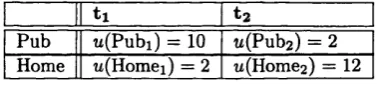
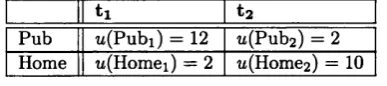
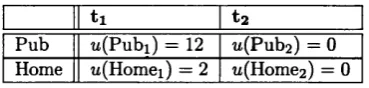
the deliberations, recommending to go home. On this account, going to the pub (and regretting it afterwards) is brandished as naive or myopic (Hammond (1976), Steele (2007)). On the other hand, proponents of so-called ‘resolute’ choice recom mend to find ways to prevent the momentary preference change from happening (such as McClennen (1990)). For a comprehensive overview and assessment of sequential decision theory, see Steele (2007).
Apart from the normative assessment, there is also the descriptive and ex planatory question as to why real-world decision-makers often reveal dynamic inconsistency. T hat is, how can we describe and explain dynamically incon sistent preferences of decision-makers over time? Here, Schelling (1980, 1984) and Ainslie (1992, 2001) have proposed to draw on the metaphor of persons as ‘multiple-selves’ in order to analyse dynamic inconsistency, such th a t different selves have opposing preferences. The next sections presents a modelling approach to multiple-selves th a t is simpler yet achieves the same aims as the aforementioned ones, and makes transparent in what way the description of dynamically incon sistent decision-makers requires us to depart from normative decision-theoretic accounts, which will be discussed in detail in Chapter 6.
2 .2 .3 E x ten d in g D ecisio n T h eory
The above review has shown th a t standard decision-theoretic representations ‘stay silent’ on many aspects of intertemporality. This feature is by no means problematic in itself - indeed, part of the appeal of decision theory is the fact th a t its structure is simple and general. However, when analysing intertemporal de cisions, extensions of decision theory th a t pay particular attention to the temporal dimension could widen its scope. If we were to take only a standard decision- theoretic approach to intertemporal decisions, then it would not be possible to discuss in greater detail in what sense discounting for temporal distance can be rational and how exactly it can be employed, how relaxing stability requirements in game-theoretic frameworks can be interpreted, and how to model dynamically inconsistent decision-makers. Yet, as the initial review of these problems in the introduction suggested, such topics are subject to considerable debate, and also of practical importance.
CH APTER 2. M ULTIPLE-SELF MODELS
time. In this context, it is interesting th at Savage (1972) called his derivation of Bayesian decision theory ‘personalistic’ decision theory, and subjective Bayesian- ism as a whole was known as ‘personalism’ before terms like individualistic and subjectivist became more common (Teller, 1975; Zellner, 1982). This suggests th at Bayesian decision theory is linked to the assumption of a decision-maker as a single individual. In fact, this feature of the theory is of great importance for its foundational role in economic theory and other social sciences that rest on methodological individualism. It is therefore natural to account for time in the context of normative decision theory in a subjectivist manner, developing an account of the internal temporal structure of the decision-making individual.
The multiple-self models introduced in this chapter axe proposed to offer such a structure, which is intended as a minimal addition to decision-theoretic frame works. Before introducing the multiple-self models, we review the rather diverse literature th a t has used the metaphor of the ‘multiple-self’ in various ways.
2.3
M u ltip le -S e lf A cc o u n ts
This section reviews accounts th at employ the notion of multiple-self. Charac terising persons as a collection of distinct and interconnected entities has been considered in many different philosophical traditions as well as in psychology, literature and economics. The main motivation of those accounts is to provide a more complex understanding of individuals. However, as ubiquitous as the presence of the multiple-self notion is, as elusive it has proven to be in terms of theoretical characterisation. This motivates the development of multiple-self models in the next section.
2.3.1 E lster ’s R e v iew o f M u ltip le-S elf T h eories
In a general sense, the idea of a multiple-self is th a t of a person consisting of several distinct yet interconnected entities. Elster (1986) provides a review of philosophical, psychological and economic theories of the multiple-self, whose ac counts differ on a number of dimensions. We consider the comprehensive overview of such theories offered by Elster (1986), before discussing how the multiple-self model relates to the accounts in the literature.
CH APTER 2. MULTIPLE-SELF M ODELS
ration’, such as an individual with beliefs and motivations th at contradict each other, or beliefs and motivations th at differ with regards to which realm of life they are applicable to. Indeed, once individuals realise such contradictions, they could resort to standard techniques such as revising their beliefs to resolve them. Hence, a ‘loosely integrated self’ might not have any more significance than a local or momentary departure from the idealised decision-maker as usually presumed in applications of Bayesian decision theories.
S elf-d ecep tio n a n d w eak ness o f w ill. In the philosophical literature, multiple-selves are mostly associated with cases of self-deception and weakness of will. T hat is, the concept of several selves within one person is evoked in cases in which decision-makers act irrationally, act against their best interest, or hold conflicting attitudes (Elster, 1986, 6). There axe two fundamentally differ ent modes of inquiry regarding these problems: one concerns the possibility of its existence (Davidson, 1980, most prominently) and another one concerns its resolution (such as Ainslie (1992, 2001)).
F a u s tia n selves. The famous ‘two souls’ within the Faust-chaiacter give the label for a type of multiple-self in which one p art of the person has higher- order intentions whereas the other part has desires th a t clash with those. Such conflicts between the two Faustian selves can be superficial (i.e. potentially be resolved by deliberation) or very deeply seated, such as in prolonged inner con flicts. Schelling (1980, 1984) has proposed to view individuals in conflicts as two such opposing selves and has proposed to apply game-theoretic tools to model potential resolution of their conflict.
CH APTER 2. M ULTIPLE-SELF M ODELS
agent would like to view the betterness of alternatives.
T h e F re u d ia n legacy. Freud’s theory provides the famous labels of the ‘id’, ‘ego’, and ‘superego’. Elster (1986, 20) characterises these three concepts as ‘agents’ th at are assigned different tasks in the person. He explains how these three agents map onto the tasks - or ‘territories’, in his terminology - of the ‘con scious’, ‘preconscious’, and ‘unconscious’. Those concepts exemplify tripartite ontologies of persons and provide a metaphorical vocabulary for inner processes and dynamics, such as deeply rooted conflicts and their resolutions.
S p lit b r a in - sp lit m in d ? The finding th at the two hemispheres of the human brain can operate independently has, in theories of personal identity over time, given rise to many thought experiments th a t involve a split brain, which will be briefly discussed in the next chapter. Elster (1986, 23ff.) takes this as starting point to discuss whether ‘cognitive compartmentalisation’ of different degrees really does imply a divided self: he maintains th a t goals and motivations need not differ in a person who has abnormal communication between the two hemispheres of her brain (although this is possible). Cases in which cognitive compartmentalisation has such drastic effects seem to fall outside the scope of what a reasonably general theory of persons would want to cover.
P a ra lle l selves. Elster (1986, 17f.) labels cases in which a person seems to enter a different state of mind with the notion of ‘parallel selves’. T hat is, in cases of vivid imagination, such as daydreaming or in cases of concentrated cognitive effort, such as reading, the self of a person seems to be divided between two profoundly different worlds. Such consideration are im portant because they can help to characterise how person’s imagine future situations and devise strategies accordingly, for instance against anticipated regret.
H o m o o econ om icu s a n d ho m o sociologicus. Elster (1986, 25f.) main tains th a t we can have different selves in private and in public, such th a t private utility-maximisation (according to an inner homo oeconomicus) can conflict with social norms and desired altruistic behaviour (according to an inner homo soci ologicus). The divide between such motivations has been widely debated in a number of disciplines. For instance, in a series of papers, Akerlof and Kranton (2000) have explored the role of social identities for economics behaviour, at tempting to bridge the gap between the traditional homo oeconomicus and homo sociologicus accounts.
CH APTER 2. MULTIPLE-SELF MODELS
or temporal selves which is the focus of the multiple-self models introduced later, and discussed in greater detail in the next chapter.
T h e ‘n o -se lf’ th e o ry . Finally, Elster (1986, 28ff.) describes approaches th at axe extremely reductionist as those that deny th a t there is such a thing as a self, labelling those theories ‘Neo-Buddhist’. In this category, he includes Hume (1739) and Parfit (1984) who endorsed ‘disintegrating’ views of individuals as vast collections of selves. In so doing, Elster concludes th a t they effectively deny th at there is such a thing as the self.
In yet a further step to generalise the idea of a multiple-self, dropping even the assumption th a t there is a common person in the background of the multiple-self has been considered:
‘A man is said to be the same person from childhood until he is advanced in years: yet though he is called the same he does not at any time possess the same properties; he is continually becoming a new person ... not only in his body but in his soul besides we find none of his manners or habits, his opinions, desires, pleasures, pains or fears, ever abiding the same in his particular self; some things grow in him, while others perish.’ (Plato, Symposium)
Indeed, this first step to consider one person at different times really as a new person can be further developed into one where introspective processes of persons are compared to groups of distinct individuals. This idea already plays a prominent role in P lato’s Republic, when he compares the inner structure of the Republic and th at of the Soul (Pettit, 2003). Indeed, in the Republic, Plato regards the individual as state-like and the state as a super-individual. - While this view has im portant consequences for moral philosophy and political theory, it has remained metaphorical in the context of rational agency.
Now consider the following two dimensions of comparison