2017 2nd International Conference on Software, Multimedia and Communication Engineering (SMCE 2017) ISBN: 978-1-60595-458-5
A Comparison of Internal Feature Measures in
Statistical-based New Words Extraction
Wu-yang WU, Yu-song TAN, Qing-bo WU and Jie LIN
School of Computer, National University of Defense Technology, Changsha, China
Keywords: New words extraction, Text mining, Internal feature measures, NMED.
Abstract. New words extraction is an essential prerequisite in Chinese-oriented natural language processing and text mining. The statistical-based method is the most widely used new words extraction methods. There are mainly two kinds of statistical feature for new words extraction: the internal feature and the contextual feature. This paper compares eight internal feature measures for Chinese new words extraction on the individual basis. They are seven widely used internal feature measures and normalized multiword expression distance, which is from the non-compositionality measures of English multiword expressions, introduced for the first time. As a consequence, the experimental results indicate that the performance of normalized multiword expression distance is superior to the others.
Introduction
New words extraction is an indispensable task in Chinese-oriented natural language processing and text mining. Birth of new words is a universal phenomenon in human language and closely related to the social development. With the rapid development of modern society and the coming of information explosion age, the generation velocity of new words is faster, the structure and type of new words are more and more complicated. Whether the new words are extracted correctly influences the improvement in the related tasks such as word segmentation, sentiment analysis, machine translation, information retrieval and question answering system. Research suggests that more than 60% of Chinese word segmentation errors were caused by new words [1]. Recent studies have shown that new words extraction is of great significance for improving the accuracy of sentiment analysis [2]. In the academic field, there are two interpretations of new words, of which one can be called “pure new words” and another called “unknown words”. Pure new words mean the words that generate strictly with the passing of time; however, unknown words mean the words that do not occur in the dictionary used for related tasks. It is obvious that pure new words are a subset of unknown words. Actual new words extraction does not make the distinction between pure new words and unknown words, neither do in this study.
statistical feature measures selected have important effect on overall performance, so it is of great significance to compare different statistical feature measures.
In general, there are two kinds of statistical features in statistical-based methods [6]. One is the internal feature, which represents the cohesion and soundness of different components in a word, such as the Frequency. Another kind is the contextual feature, which represents the liberalization and popularity of a word on its context, such as the left/right entropy. This paper aims to analyze different internal feature measures mentioned below, experiments and compares their new words extraction performance on the individual basis. The main contributions of this paper are summarized as follows:
Based on the similarity between Chinese word and English multiword expression, this paper firstly study the performance of using the normalized multiword expression distance (NMED) [7] as internal feature measures in statistical-based new words extraction. NMED is one of the most effective measures to reflect the non-compositionality of English multiword expression which has not been used into Chinese new words extraction yet.
We compare the new words extraction performance of NMED and seven frequently-used internal feature measures on the individual basis by experiment, then analysis their merit and shortcoming based on the experiment results. Experiments show that NMED achieves the best practical effect.
The rest of the paper is structured as follows: we introduce related work in Section 2. In Section 3, we describe the compare method. We then present the experiments and discussions in Section 4. Finally, the whole researches are summed up in Section 5.
Related Work
There are extensive works on the study of internal feature measure of statistical-based new words extraction. The first measure is Pointwise Mutual Information (PMI) [8]. Since then, a lot of internal feature measures have been proposed such as Symmetrical Conditional Probability (SCP) [9] and Log-likelihood [10].
English multiword expression is a sequence of neighboring words “whose exact and unambiguous meaning or connotation cannot be derived from the meaning or connotation of its component” [11]. As the similarity between Chinese words and English multiword expressions, some researchers try to use the non-compositionality measure of English multiword expressions as the internal feature measure of Chinese words [12], such as Enhanced Mutual Information (EMI) [13], and obtain the remarkable results. Over the past few years, some new non-compositionality measures of English multiword expression are proposed, such as multiword expression distance (MED) and the normalized version NMED [7], which is based on the information distance theory and claimed superior performance to SCP, EMI and other measures. However, MED and NMED have not been used as internal feature measures in the statistical-based new words extraction, it is necessary to study its Chinese new words extraction performance considering its outstanding performance in English multiword expressions extraction.
Methodology
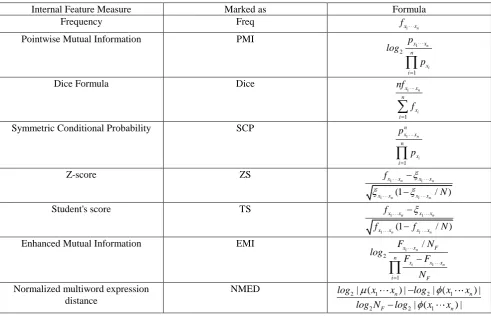
NMED and seven frequently-used internal feature measures, including Frequency (Freq), PMI, Dice Formula (Dice), SCP, Z-score (ZS), Student's t-score (TS), EMI are discussed and compared in this paper.
Table 1 lists formulas of internal feature measures mentioned above. In the table: x1 xn represents
any n-gram, N is the size of corpus, NF is the number of all texts in the corpus, fxi and pxi are frequency and probability of xi respectively, fx1 xn and px1 xn are frequency and probability of x1 xn respectively,
i
x
F is the number of texts in which xi appears, Fx1 xn is the number of texts in which
1 n
x x appears, (x1 xn) is the set of texts in which all individual grams in x1 xn co-occur,
1
(x xn)
is the set of texts in whichx1 xn appears, (x1 xn) is the frequency expectation of x1 xn
suppose x ii( 0, , )n are independent. It is obvious that
1
1
( )
n
n x x
x x p p N
.
[image:3.595.52.544.390.706.2]To compare the new words extraction performance of different internal feature measures on the individual basis, we need to get the new words extraction results under different internal feature measures. For corpus which needs treatment, we carry out the word segmentation and then mining n-grams as candidate new words. We prune the candidate new words by contextual feature, that is, if the contextual feature measure value of a candidate new words is less than a certain threshold, we prune it. In this paper, the contextual feature measure used is fixed to left/right entropy. After being pruned, candidate new words that extract from the corpus are obtained, then sort it by different internal feature measures, and calculate the corresponding evaluation value finally.
Table 1. Eight internal feature measures.
Internal Feature Measure Marked as Formula Frequency Freq
1 n
x x
f
Pointwise Mutual Information PMI
1 2 1 n i x x n x i p log p
Dice Formula Dice
1 1 n i x x n x i nf f
Symmetric Conditional Probability SCP
1 1 n i n x x n x i p p
Z-score ZS
1 1
1 (1 1 / )
n n
n n
x x x x
x x x x
f N
Student's score TS
1 1
1 (1 1 / )
n n
n n
x x x x
x x x x
f
f f N
Enhanced Mutual Information EMI
1 1 2 1 / n i n
x x F
n
x x x
i F F N log F F N
Normalized multiword expression distance
NMED
2 1 2 1
2 2 1
| ( ) | | ( ) |
| ( ) |
n n
F n
log x x log x x log N log x x
internal associative between the different grams of an n-gram, and thus the more possibility of an n-gram being a new word.
Experiment
In this section, we conduct extensive experiments on large-scale real text and obtain a large number of results. Then we compare the new words extract performance of eight internal feature measures and discuss the advantages and disadvantages of these measures.
Data Preparation
We download 5,000,000 Sina Weibo posts as the corpus, the size of it is 687 M and the Chinese character number of it is 194,813,692. Sina Weibo is not only one of the most influential online social platforms, but also the platform for creating and spreading of new words. This Weibo text is suitable as the corpus in research about the new words. These posts were then segmented by ICTCLAS2016, which is widely used and reported as the best Chinese word segmentation tool in the entire world. Evaluation Metric
As there is the demand for evaluating internal feature measure based on a list of words that sorted by this measure, and the size of the corpus is too big to obtain all new words of it manually. We select precision (P), Improved precision (IP) as metrics. The metric is computed as follows:
1
( ) ( )
K
k
real k P K
K
1
1
( ) * ( )
( )
( )
K
k K
k
P k real k IP K
real k
Where K is the number of words in the list that sorted by internal feature measure. If the word at position k in sorted list is a real new word, the real(k) will be 1, otherwise 0. The P value and IP value of a perfect sorted list (all top K words are real new words) both equal to 1.0.
Comparison of Different Measures
For each internal feature measure, we label the top 2,000 words that were sorted by value of this measure. Figure 1 illustrates the variation trend of P value and IP value of these eight internal feature measures with increasing K. As it can be seen from Figure 1, the NMED obtains the best new words extraction performance over all eight measures. From linguistic perspectives, there is a lot of similarity between the Chinese words and English multiword expressions. Effective feature measures for English multiword expressions should also be valid for Chinese new words. From Figure 1, we can also see that the relative order of some measures will be changed with increasing K, such as PMI and Freq, the P value of PMI is higher than that of Freq when K is small, but when K is 2000, the P value of PMI is smaller than that of Freq. This does not mean that Freq is better than PMI, because the IP value of PMI is always more than that of Freq with increasing K. When the K is constant, the higher the P value is, the more new words extracted, the higher the IP value is, the higher ranking of new words.
Figure 1. Trend charts of P and IP vary with K.
Figure 2. Length distribution of new words extracted.
Conclusion and Future Work
[image:5.595.92.500.293.619.2]generally not impacted by this word length, which makes the Chinese new words of different length extraction performance of NMED is more balanced than other measures.
With the increasing number of Chinese new words, new words structure is becoming much more complex. Future work will combine the NMED with other measures by machine learning methods such as decision tree to enhance the overall performance.
Acknowledgement
This work was supported by National Core Electronic Devices, High-end Generic Chips and Basic Software (CHBS) Project “xx Mobile Terminal Operating System” under Grant No. 2016ZX01040101.
References
[1] Chen, and Aitao. "Chinese word segmentation using minimal linguistic knowledge." (2003). [2] Huang, Minlie, et al. "New Word Detection for Sentiment Analysis." Meeting of the Association for Computational Linguistics 2014:531-541.
[3] Dias, G., S. Guilloré, and J. Lopes. "Mining Textual Associations in Text Corpora." 2000. [4] Mei, Lili, et al. FCL: A New Network Words Extraction Approach Based on Statistical Language Knowledge. Social Media Processing. Springer Singapore, 2015.
[5] Chen, Keh Jiann, and W. Y. Ma. "Unknown Word Extraction for Chinese Documents." International Conference DBLP, 2002.
[6] Luo, Shengfen, and M. Sun. "Two-character Chinese word extraction based on hybrid of internal and contextual measures." Sighan Workshop on Chinese Language Processing Association for Computational Linguistics, 2003:24-30.
[7] Bu, Fan, X. Zhu, and M. Li. "Measuring the Non-compositionality of Multiword Expressions." International Conference on Computational Linguistics Association for Computational Linguistics, 2010:116-124.
[8] Bu, Fan, X. Zhu, and M. Li. "Measuring the Non-compositionality of Multiword Expressions." International Conference on Computational Linguistics Association for Computational Linguistics, 2010:116-124.
[9] Silva, J. F., and G. P. Lopes. "A Local Maxima Method and a Fair Dispersion Normalization for Extracting Multiword Units." (1999).
[10] Dunning, Ted. "Accurate methods for the statistics of surprise and coincidence." Computational Linguistics 19.1(1993):61-74.
[11] Choueka, Yaacov. "Looking for Needles in a Haystack or Locating Interesting Collocational Expressions in Large Textual Databases." Computer-Assisted Information Retrieval DBLP, 1988:609-624.
[12] Mei, Lili, et al. "A novel unsupervised method for new word extraction." Science China Information Sciences 59.9(2016).