2017 2nd International Conference on Manufacturing Science and Information Engineering (ICMSIE 2017) ISBN: 978-1-60595-516-2
Material Selection Analysis for Certain
Absorption and Diffraction Camouflage Screen
Based on the Lossy Medium Plate Model
Yan Li
ABSTRACT
Absorption and diffraction camouflage screen performance to some extent depends on the screen material for electromagnetic diffraction of radar wave behavior, by establishing a lossy medium plate model, on the basis of electric and magnetic field distribution and boundary conditions, calculating the relationship between the material of radar reflectivity, transmittance, absorption rate and its electric conductivity, theoretically analysis the optimal range of the electric conductivity of screen materials, to provide theoretical support for follow-up experiments and research.1
INTRODUCTION
With the rapid development of radar technology, the radar detection camouflage screen based on diffraction and reflection is not equipped with the fusion effect of radar stealth and background. How to realize the radar stealth on the ground military target is always an important research subject in the field of camouflage technology. Professor Xuliang Lv and professor Zhaoyang Zeng as the core of camouflage materials research group, have put forward a kind of camouflage screen of both absorption and diffraction principle, and from the theoretical analysis of the feasibility of radar reconnaissance [1]. From the principle, the absorption and diffraction camouflage screen performance of radar reconnaissance depends on the screen material absorption, transmission and reflection characteristics of radar wave, to make the screen own a wide range of camouflage performance, which must be analysis and optimization of material physical properties. In this paper, through the
1Yan Li, Automobile NCO Academy of Military Transportation University of PLA, Anhui,
establishment of the lossy medium plate model, on the basis of electric and magnetic field distribution and the boundary conditions, calculate the relationship between material absorptivity, transmissivity, reflectivity and its conductivity, theoretically analyze the optimal range of the conductivity of screen materials, to provide theoretical support for follow-up study and simulation calculation.
LOSSY MEDIUM PLATE MODEL
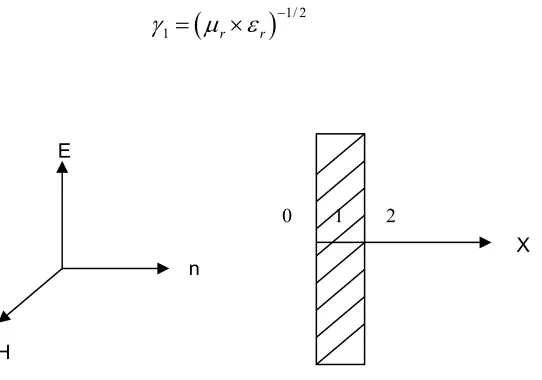
On the analysis of the selection screen material must fully consider different materials with different frequencies of the radar wave electromagnetic diffraction behavior, in order to intuitively analyze camouflage screen materials for radar wave reflection, transmission and absorption performance, through the establishment of the lossy medium plate model [2] (shown in figure 1), using the electromagnetic diffraction characteristics analysis model of radar wave actions. With the model considering the electromagnetic wave vertical incidence on the net surface (screen), the screen cloth is thickness for d of the continuous uniform lossy medium plate,
r
for its relative permittivity, r for relative permeability, for conductivity. The space of microwave spread is divided into three parts: the presence of microwave and reflection microwave area 0, area 1 of the screen model, and area 2 of transmission microwave.
According to the electric, magnetic field distribution and boundary conditions, the transmission coefficient (as ) and reflection coefficient (as ) of the screen material is
2 1
( )
2 1 2
0 1 0 1 2 1 2 1 0
4 ( )( ) ( )( ) d E e E
(1)
1 2 0 2 1 2 2
0 1 1 1
(1 )(1 ) d (1 )
E
e E
(2)In the three areas, E0, E1 , E2 for the electric field intensity, H0, H1, H2 for
magnetic field intensity, 0, 1, 2 for the characteristics impedance, 0, 1, 2
for the propagation constant. Since zone 0 and zone 2 are areas of air, the characteristic impedance is about 377, and propagation constant is 3 10 8m s/ [3]. In the area of zone 1 is screen model, the characteristic impedance and propagation constant are related to the relative permittivity and relative permeability of the material, and the formula is
1
r r
1/ 2 (4)Figure 1. The vertical incidence of the lossy medium plate.
ELECTROMAGNETIC DIFFRACTION BEHAVIOR
To facilitate the analysis of electromagnetic diffraction behavior of screen materials, defined the screen material absorptivity isT1 , transmissivity isT2 ,
reflectivity isT3, and respectively express absorption, transmission and diffraction characteristic of screen material of electromagnetic wave. Definition
2 1
2
( )
2 1 2
2
1 0 1 2 1 2 1 0
4
( )( ) ( )( )
d e T
(5)
1
2 2
2 2 0 2 2
3
1 1 1
(1 )(1 ) d (1 )
T e
(6)According to the law of conservation of energy
T1 T2 T3 1 (7)
According to the data and experimental measurements, the relative permittivity of the conventional screen material is generally between 1.6 and 9, and the relative permeability is between 0.5 and 1.6. Considering the tactical and technical requirements of camouflage screen, the weight of the screen cloth is strictly limited, and the corresponding thickness is generally less than 1mm. Under the thickness, the value of material permeability for electromagnetic wave transmission behavior is very low, and the impact of negligible, the conductivity of material is crucial to the
E
n
H
0 1 2
electromagnetic wave transmission behavior. Therefore, a lossy medium plate model is established to calculate the electromagnetic diffraction behavior mainly around the range of the conductivity of the screen material.
[image:4.612.127.457.162.314.2]
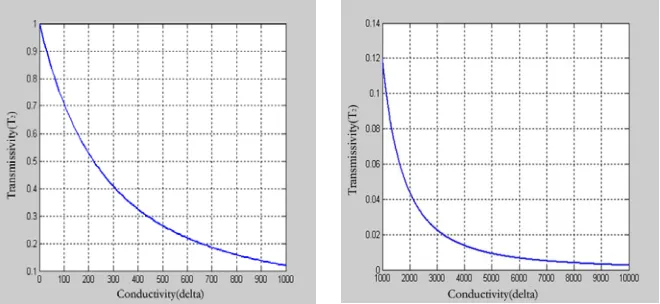
Figure 2. The relationship between transmissivity and its conductivity of screen cloth.
According to the formula (12) of the calculation results, the Matlab software programming is used to calculate the relationship between transmissivity and its conductivity of screen cloth (shown in figure 2). The thickness of the screen cloth is set as 0.5mm at time of calculation, and the incident microwave frequency is set as 10GHz.
The data in Fig. 2 shows that the transmissivity decreases with the increase of conductivity, while the transmissivity is about 70% when the conductivity is greater than 100S/m; the transmissivity is about 26% when the conductivity is greater than 500S/m; the transmissivity is only about 12% when the conductivity is greater than 1000S/m; the transmissivity is much less than 0.1 when the conductivity is greater than 2000S/m. It can be determined that the electromagnetic wave can hardly pass the camouflage screen, which is consistent with the conclusion that the good conductor has strong back scattering on the electromagnetic wave.
screen material (consider secondary echo of radar wave after target reflection) absorption, reflection and transmission performance of radar wave, choice the reasonable range will be considered, to satisfy the inosculation and defilade of camouflage screen. Using the above formula and software, the detailed calculation results are shown in figure 3.
Figure 3. The relationship between absorptivity, transmissivity, reflectivity and its conductivity of screen cloth.
CONCLUSIONS
Through the calculation results of the lossy medium plate model, the range of conductivity of the screen material can be clearly defined. But the structure of camouflage screen has important influence on absorption, transmission, and reflection. Such as a hole is opened in the screen plane to form a grid or reticular structure; the small flat plates are assembled into large plates, and while the small plates have different material parameters; the small scattering unit is used to form a random diffraction structure [5]. Therefore, to realize the absorption and diffraction camouflage screen performance of radar reconnaissance, the retrofit design of the structure was carried out on the screen, which should as far as possible ensure no damage to the screen of the absorption, transmission and reflection performance, to achieve the double effect of screen materials and structures of radar wave, to improve the ability of radar reconnaissance.
REFERENCES
1. Zhaoyang Zeng, Yan Li, Xuliang Lv, and Yongjie Lan. 2009, “Theoretical Analysis of a New Model of Absorption and Diffraction Camouflage Screen,” Protective Engineering, 01: 20-21. 2. Yun Yi and Bing Cheng. 2010, “Research on the Microwave Scattering Characteristic of the
Camouflage Screen,” Journal of Microwaves, 03: 35-37.
3. Zihong Mi and Zaixin Xu. 1988, the Electromagnetic Branch of Physical Dictionary. Science Press, pp. 127-128.
4. Yongyuan Huang, Jun Liu, and Bing Cheng. 2005, “Quantitative Analysis of Interaction between Microwave and Screen,” Journal of PLA University of Science and Technology, pp. 49-50. 5. Wei Xie, Zhaoyang Zeng, Xiaoyong Wang, and Xuliang Lv. “Radar Diffraction Features of