© 2017, IRJET | Impact Factor value: 5.181 | ISO 9001:2008 Certified Journal
| Page
1687
Implementation Using Chaotic Encryption Over Biometric Image For
Remote Authentication
Miss. Pooja Chandgude
1, Prof. N G Pardeshi
21
Miss. Pooja Chandgude, Dept. of Computer Engg. SRES College of Engg. Kopargaon
2 Prof. N G Pardeshi, Dept. of Computer Engg. SRES College of Engg. Kopargaon---***---Abstract - In today’s world security is the very important issue while doing any transaction. As we are like to use online
applications like snapdeal.com for shopping. The payment transaction should be secure so that in this system we are using biometric threats for identification that identity is unique. No one can steal that identity. When message will get transferred. When there is remote authentication so verification is most important while communication. QSWT is used for embedding and locating object into an image. In this system biometric signal is encrypted with chaotic encryption and then through video object steganographic image is hidden in a video which is captured runtime after that it will send it to server then after decryption extracted biometric sample is compared with already stored sample then identity is verified.Key Words: Steganography, Encryption, Biometric, Password, Smart card
1. INTRODUCTION
1.1 Overview
Security is mainly important issue in today’s life. Applications having security is in the form of password. But this cannot be a strong security. As mentioned in paper [2] there is details of identity fraud detection is increasing day to day.so there is need of fulfil the three main security goals:
Confidentiality
Integrity
Availability
Confidentiality
Confidential means only authorized person can have access to that data. The confidentiality discusses to limiting the disclosure and access of information to the users those are authorized and avoiding those not authorized from accessing it. With this technique, a company or society is able to avoid extremely delicate and vital information from getting into the hand of the wrong people while still making it accessible to the right people.
Integrity
Data is not altered by unauthorized person. It consist set of rules which is limit for access information. e. g. access control. Integrity is another security concept that involves maintaining data in a constant, accurate and trustworthy manner over the period in which it will be existent. In this case, one has to ensure that data is not changed in the course of a certain period. In addition, the right procedures have to be taken to ensure that unauthorized people do not alter the data.
Availability
Make data available whenever user need he/she can access his/her data. The concept of availability refers to the up time maintenance of all resources and hardware. This means that all the hardware and resources one have are functional all the time. It can also involve carrying out of regular hardware repairs.
1.2 Structure of Biometric System
© 2017, IRJET | Impact Factor value: 5.181 | ISO 9001:2008 Certified Journal
| Page
1688
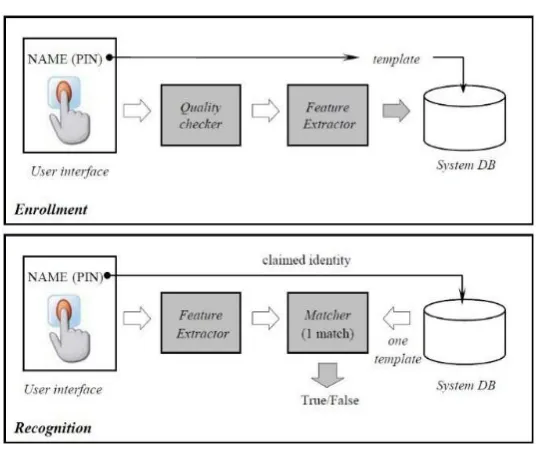
Fig 1: Working of Biometric System
1. In this module users are get registered into this systems database. During this phase, reader of biometric will scan and
capture biometric characteristic and represent it in the form of digital format.
2. Feature Extraction Unit: This element processes the input sample and it generates a compressed representation called
as template. This is stored in main database.
3. Matching Unit: In this unit it will compare current input to the template. If the system performs identity cerification,
this compares new feature with stored template and produce match value.
4. Decision Maker: In this section works on threshold which catches the score.
2. Implementation
2.1 Existing System
As explanation in fig.1client server communication using smart card. This is the multiuser environment where user i.e. client is communicating with server. Internet is the media through which client is communicating with server .But there is disadvantage of smart card which is having some bottlenecks.
1. User have to carry smart card every time
2. Several days required for reissuing, if lost.
3. They should support read- write actions limitations.
4. Due to low power not able to perform larger computation
© 2017, IRJET | Impact Factor value: 5.181 | ISO 9001:2008 Certified Journal
| Page
1689
Fig 2: Remote Server-client communication with smart card
2.2 Proposed System
In this system there is restriction that each and every time user have to carry smart card always for identification purpose. If identity is verified then only user is allowed to perform transaction.so this drawback is overcome in proposed system. For identification biometric threat is considered again for verification.so this identification is so much secure than any other security measure like password. Advantage of using biometric as an identity is it requires physical presence of that particular person then and then only identity will get verified.
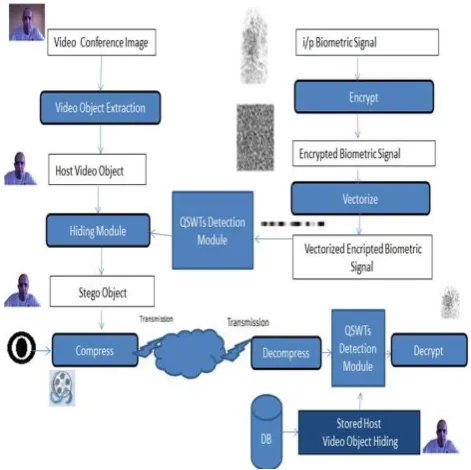
Fig 3: System Architecture
© 2017, IRJET | Impact Factor value: 5.181 | ISO 9001:2008 Certified Journal
| Page
1690
at server side it is already having storage of authenticated biometric samples. Which is verified after extraction of signa from video. For this extraction process also QSWT is used to separate biometric sample and image. If match found then only allow.
2.3 Chaotic Encryption
Fig 4: Chaotic Encryption
In this encryption method there are two main parts confusion and diffusion. First input image as a plain text is given. In first part confusion there is pixel permutation in this the pixels position is twisted over entire image and they do not disturb other pixel values so the image is distorted. As shown in fig 4.chaotic encryption there in initial condition and control parameter both are considered to generate secrete key. But this can be broken so to provide again security Second part is there that is diffusion in this part pixel values are changed sequentially. This confusion and diffusion rounds are repeated till suitable security level is reached.
3. Algorithm
1. Procedure QSWTEST (I,S,L)
2. Define input frame I = input frame
3. Selection of subband S = subband selection (e.g. LH)
4. Selection of level of subband L = subband level (e.g. 3)
5. Define threshold values T1 & T2
6. According to level apply DWT and point out particular location in image
7. Check subband is in node and greater than T1.
© 2017, IRJET | Impact Factor value: 5.181 | ISO 9001:2008 Certified Journal
| Page
1691
4. CONCLUSIONS
Biometric is mainly important in all type of applications in day todays life that we all using. Biometric signals enter more and more into our everyday. Firstly passwords are used mostly for security in applications. With the help of password anyone who know password can have access to that application. But whenever biometric is used with password then more security is provided. Important is that person’s physical characteristic is required so that no one can replace. This identity cannot be theft. In this system biometric signal is encrypted so security is provided twice. Again this is hidden in video which is captured by runtime so it seems no fake information’s will get passed. With the help of QSWT this image is hidden in video as well as extracted the location of that video. Finally at server side already authenticated biometric is stored. After matching is performed and result is returned whether person is authorized or not.
ACKNOWLEDGEMENT
It is my proud privilege and duty to acknowledge the thing of help and guidance received from several people in preparation of this paper. It would not have been possible to prepare this paper in this form without their valuable help, cooperation and guidance.I dedicate my work to esteemed guide, Prof. N. G. Pardeshi whose interest and guidance helped me complete the work successfully. This experience will always steer me to my work perfectly and professionally. Last but not the least, I thank all others, and especially my friends who in one way or another helped me in the successful completion of this paper.
REFERENCES
[1] Klimis Ntalianis, Member IEEE, Nicolas Tsapatsoulis, Member. IEEE Remote Authentication via Biometrics: A Robust Video-Object Steganographic Mechanism Over Wireless Networks in, Ieee Transactions On Emerging Topics In Computing, 2015.
[2] Identity fraud report: Data breaches becoming a treasure trove for fraudsters, Javelin Strategy and Research, Tech. Rep., 2013
[3] Chuang MC, Chen MC. An anonymous multi-server authenticated key agreement scheme based on trust computing using smart card sand biometrics, Expert Systems with Applications, 2014; 41(4):1411-1418.
[4] Lamport L. Password authentication with insecure communication, Communications of the ACM, 1981; 24(11):770-772.
[5] Kundur D, Zhao Y, Campisi P. A steganographic framework for dual authentication and compression of high resolution imagery, in Proceedings of the IEEE International Symposium on Circuits and Systems, 2004; 2(IEEE):14.
[6] Liao IE, Lee CC, Hwang MS. A password authentication scheme over insecure networks, Journal of Computer and System Sciences, 2006; 72:727-740,
[7] Weir M, Aggarwal S, Collins M, Stern H. Testing metrics for password creation policies by attacking large sets of revealed passwords, in Proceedings of the 17th ACM Conference on Computer and Communications Security. ACM, 2010, 162-175.
[8] Wang Yy, Liu Jy, Xiao Fx, Dan J. A more efficient and secure dynamic id-based remote user authentication scheme in Computer Communications, 2009; 32(4):583- 585.
[9] Hemalatha S, Dinesh Acharya U, Renuka A, Kamath P R. A securecolor image steganography “in transform domain International Journalon Cryptography and Information Security, 2013; 3(1).
[10] Rao NN, Thrimurthy P, Babu BR, A novel scheme for digital rights management of images using biometrics in nternational Journal of Computer Science and Network ecurity. 2009; 9(3):157-167, as AK. Analysis and improvement on an efficientbiometric based remote user authentication scheme using smart cards in IET Information Security, 2011; 5(3):145- 151.