© 2018, IRJET | Impact Factor value: 6.171 | ISO 9001:2008 Certified Journal | Page 1577
Techno – Economic Study of Different Type of Slab
A.V. Pawar
1, A. C. Patil
2, K. B. Ghutukade
3, S. S. Sherkar
4, Mr. M. M. Gidd
51,2,3,4
Department of Civil Engineering, Vishveshwarya Technology Campus, Patgaon, India.
5Professor, Department of Civil Engineering, Vishveshwarya Technical Campus, Patgaon, India.
---***---Abstract
:
This paper describes the analysis of commercialbuilding with different types of slab design. The behavior of building was investigated using ETABS software. For modeling and analysis of old Traditional slab & flat slab structural, ETABS 2016 software is used. The dead load, live load & wind load or consider as per Indian codes IS 456 : 2000 & IS 875 : 1987. The investigation shows that, the weight of flat slab structure is more compared to old traditional slab structure. The cost of flat slab structure is more by 0.82 % as compared to old traditional slab.
Keywords: Old Traditional Slab, Flat Slab, Multi Storey Building, ETABS, Cost Comparison.
INTRODUCTION
The current work is focused on the Comparative Study of flat slab and Old Traditional slab. The configuration involves the conventional frame structures which acting on different loading circumstances. The Old Traditional R.C. and flat slab having different conditions in framework so, they are performing different way on different loading circumstances.
With rapid growth in population along with development of industrial and commercial activities rapid urbanization has taken place which has resulted into continues influx of rural people to metro cities. So obviously the horizontal space constraint is reaching an alarming situation for metros. To cope with the situation maximum utilization of space vertically calls for the construction of multi-storey buildings in large numbers but the question of affordability of the target customers mainly the middle income group of our country necessitates efficient and cost effect design of such buildings.
A. Old Traditional:
[image:1.612.331.556.493.642.2]Slabs supported on walls or on beams are classified as conventional slab. Old Traditional slab are generally rectangle in shape, but it can be of any shape such as triangular, circular, trapezoidal, etc. Loads are transferred by the slab by flexural; shear and torsion to the supports such slabs supported on two parallel sides carry loads by bending in the direction perpendicular to the supports. Slabs supported on four sides also behave as one way slab if the length is very large as compared to the width of the slab.
Fig. 01
B. Flat Slab :
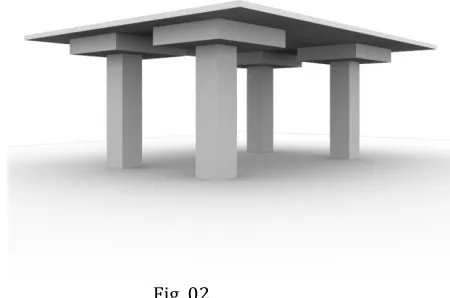
Common practice of design and construction is to support the slabs by beams and support the beams by columns. This may be called as beam-slab construction. These types of construction are aesthetically appealing also. Flat slabs which are directly supported by columns.
Fig. 02
METHODOLGY
© 2018, IRJET | Impact Factor value: 6.171 | ISO 9001:2008 Certified Journal | Page 1578
MATERIAL PROPERTY
[image:2.612.48.279.167.457.2]The properties of material used given in Table 1.
Table No. 01 : Material Properties
Grade Of Concrete M - 25 Density Of Concrete 25 KN/M3 Modulus of Elasticity of
Concrete 2 x 10
5 N/MM2
Grade Of Steel Fe – 500 ( HYSD)
[image:2.612.46.281.496.679.2]MODEL DISCRIPATION
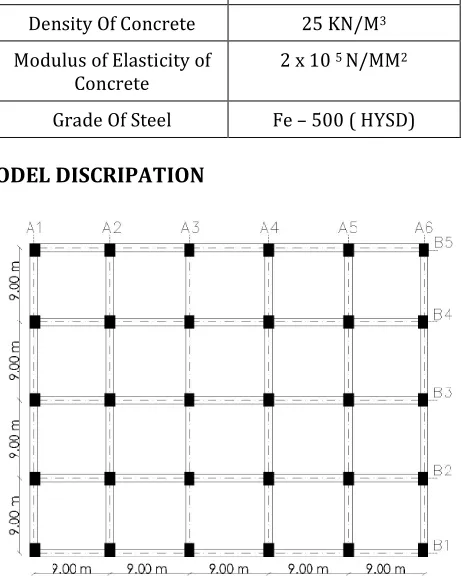
Fig. 03 : Floor plan Of ( G + 1 ) Building
Fig. 04 : Floor plan Of ( G + 1 ) Building
Table No. 02: Structure Plan Details
Number of stories G +1 Height of each storey 3.65 m Total height of building 7.3 m Number of bay’s along X 5 Nos. Number of bay’s along Y 4 Nos.
Table No. 03: Structure Element Details
Columns 300 x 380, 300 x 600 mm Beams 230 x 457 mm Flat slab 150 mm Flat Drop 300 mm Conventional Slab 150 mm
LOAD CALCULATION
The Load considered for the following study is mentioned below which are in accordance with IS 456-2000.
1. Dead load
The self weight of the structural members is calculated according to the wt. Of slab and taken care in the software
Dead oad on floor finishing : 1 KN / m2
2. Live load : 3 KN / m2
STEP IN ETAB SOFTWARE FOR DESIGNING OF
FLAT OR OLD TRADITIONAL SLAB
© 2018, IRJET | Impact Factor value: 6.171 | ISO 9001:2008 Certified Journal | Page 1579 Fig. 05: steps for design
[image:3.612.316.561.81.277.2]RESULT AND DISCUSSION
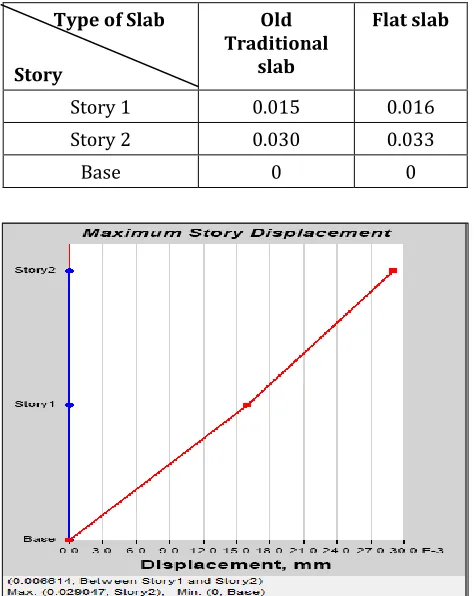
Table No. 04: Result of Displacement of Building in mm
Type of Slab
Story
Old Traditional
slab
Flat slab
Story 1 0.015 0.016 Story 2 0.030 0.033
Base 0 0
Fig. 06 Old Traditional Slab
Fig. 07 Flat Slab
[image:3.612.29.266.373.671.2]The result shows that the Old Traditional slab is get 6.25 % less displacement than Flat slab at story 1 & 9.09 % less displacement at story.
Table No. 05: Result of story Drift of building in mm
Type of Slab
Story
Old Traditional
slab
Flat slab
Story 1 4 x 10⁻⁵ 4 x 10⁻⁵ Story 2 4 x 10⁻⁵ 4 x 10⁻⁵ Base 4 x 10⁻⁵ 4 x 10⁻⁵
Fig. 08 Old Traditional Slab
Defining dimensions of the plan
Defining the members and material properties
Assigning loads & load Combinations
Run Check model to find errors Run analysis Extract result &
[image:3.612.166.552.380.680.2]© 2018, IRJET | Impact Factor value: 6.171 | ISO 9001:2008 Certified Journal | Page 1580 The result shows that the Old Traditional slab & Flat slab
get same result at both stories.
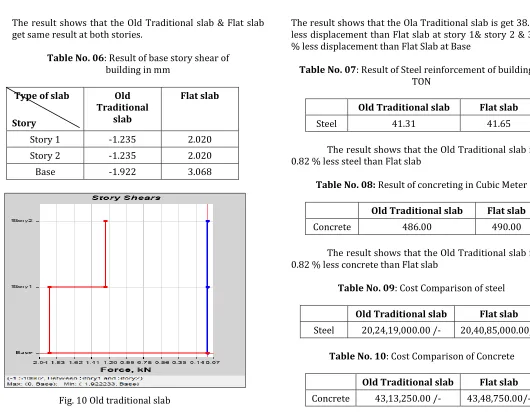
Table No. 06: Result of base story shear of building in mm
Type of slab
Story
Old Traditional
slab
Flat slab
Story 1 -1.235 2.020 Story 2 -1.235 2.020
Base -1.922 3.068
Fig. 10 Old traditional slab
[image:4.612.37.286.82.277.2]The result shows that the Ola Traditional slab is get 38.86 % less displacement than Flat slab at story 1& story 2 & 37.37 % less displacement than Flat Slab at Base
Table No. 07: Result of Steel reinforcement of building in TON
Old Traditional slab Flat slab
Steel 41.31 41.65
[image:4.612.323.565.84.277.2]The result shows that the Old Traditional slab is get 0.82 % less steel than Flat slab
Table No. 08: Result of concreting in Cubic Meter
Old Traditional slab Flat slab Concrete 486.00 490.00
The result shows that the Old Traditional slab is get 0.82 % less concrete than Flat slab
Table No. 09: Cost Comparison of steel
Old Traditional slab Flat slab Steel 20,24,19,000.00 /- 20,40,85,000.00/-
Table No. 10: Cost Comparison of Concrete
Old Traditional slab Flat slab Concrete 43,13,250.00 /- 43,48,750.00/-
[image:4.612.24.554.309.723.2] [image:4.612.326.565.407.442.2]© 2018, IRJET | Impact Factor value: 6.171 | ISO 9001:2008 Certified Journal | Page 1581
CONCLUSIONS
Following are the conclusion of project work:
The displacement result shows that the Old Traditional slab is get 6.25 % less displacement than Flat slab at story one & 9.09 % less displacement at story two Therefore old Traditional slab is safer than Flat slab.
The story drift result shows that the Old Traditional slab & Flat slab get same result at both story for. because of same story drift of both slab, old Traditional slab &Flat slab are react same
The result shows that the Old Traditional slab is get 38.86 % less shear displacement than Flat slab at story one & story two & 37.37 % less shear displacement than Flat Slab at Base. therefore old Traditional slab is safer than Flat slab
The result shows that the Old Traditional slab is get 0.82 % less steel than Flat slab. therefore old Traditional slab is more economical than Flat slab
The result shows that the Old Traditional slab is get 0.82 % less concrete than Flat slab. therefore old Traditional slab is more economical than Flat slab
REFERENCES
[1] Makode, K.R., Akhtar, S., Batham, G.,“Dynamic analysis of multistory rcc building frame With flat slab and grid slab”, al Int. Journal of Engineering Research and Applications, Vol. 4, Issue 2(Version 1), February 2014, pp.416-420
[2] Patil, K.S.,Gore, N.G., Salunke, P.J., “Minimum cost design of reinforced concrete flat Slab”, International Journal of Recent Technology and Engineering, Vol.-2, Issue-6,January 2014.
[3] Patil, K. S ,Gore, N. G, Salunke , P.J., “Optimum design of reinforced concrete flat slab with Drop Panel”, International Journal of Recent Technology and Engineering, Vol. 2,September 2013
[4] Sable,K.S., Ghodechor, V.A., B., Kandekar, S.B., “Comparative Study of Seismic Behavior of multistory flat slab and conventional reinforced concrete framed structures”, International Journal of Computer Technology and Electronics Engineering, Volume 2, Issue 3, June 2012
[5] Gupta,U., Ratnaparkhe ,S., Gome,P.,“Seismic behavior of building having flat slabs with Drops”, International
Journal of Emerging Technology and Advanced Engineering Volume 2, Issue 10, October 2012.
[6] Bothara, D. S .,Varghese, V.,“Dynamic analysis of special moment resisting frame Building With flat slab and grid slab”, International Journal of Engineering Research and Applications Vol. 2, Issue 4, July-August 2012, pp.275-280.
[7] Climent ,A.B., Sánchez,D.Z., Gil-Villaverde, J.F., “Experimental study on the effective Width of flat slab structures under dynamic seismic loading ”,2012.
[8] Finzel, E.S., Jeffrey, T.M., Kenneth, R.D., Enkelmann, E.,“Upper plate proxies for flat-slab subduction processes in southern Alaska”, Earth and Planetary Science Letters, 2011.
[9]Tilva, k.V.,Vyas,A.B., Thaker, P., “Cost comparison between flat slabs with drop and Without drop in four storey lateral load resisting building”, National Conference on Recent Trends in Engineering & Technology, 13-14 May 2011 B.V.M. Engineering College, V.V.Nagar, Gujarat,India
[10] Humphreys, E., “Relation of flat subduction to magmatism and deformation in the Western USA”.
[11] Han, W. S., Park, Mi. Y., Kee, H.S.,“Stiffness reduction factor for flat slab structures Under lateral loads - A literature review on
experimental study”, Journal of structural Engineering © ASCE / JUNE 2009 / 743.
[12] Erberik, M. A., Elnashai, S. A. “Loss estimation analysis of flat-slabs structures”, 26 / NATURAL HAZARDS REVIEW © ASCE / FEBRUARY 2006.
[13] Erberik, M. A., Elnashai, S. A., “Fragility analysis of flat-slab structures”, ELSEVIER, 23 February2004.
[14] Erberik, M. A., Elnashai, S. A. “Vulnerability analysis of flat slab structures”, 13th World Conference on Earthquake Engineering, Vancouver, B.C., Canada, August 1-6, 2004, Paper No.31.
[15]Srikanth, T., “Nonlinear push-over analysis of flat slab buildings with and without Seismic retrofitting” 1999/MT/IITK/42.
© 2018, IRJET | Impact Factor value: 6.171 | ISO 9001:2008 Certified Journal | Page 1582
BIOGRAPHIES
Mr. Patil Akshay, pursuing B.E. in civil Engineering at Vishveshwarya Technical Campus, Patgaon, Miraj.
Mr. Pawar Akash, pursuing B.E. in civil Engineering at Vishveshwarya Technical Campus, Patgaon, Miraj.
Mr. Ghutukade Kiran, pursuing B.E. in civil Engineering at Vishveshwarya Technical Campus, Patgaon, Miraj.
Mr. Sherkar Sohel, pursuing B.E. in civil Engineering at Vishveshwarya Technical Campus, Patgaon, Miraj.