© 2018, IRJET | Impact Factor value: 6.171 | ISO 9001:2008 Certified Journal | Page 673
Comparative Study of Different Strength for Different Mixer by using fly
ash, quarry Dust and 6mm Coarse Aggregate
M. Praveena
Assistant professor, V.S.B Engineering College, karur, Tamilnadu, India.
---***---Abstract- The utilization of fly ash, quarry dust and 6mm
one chips concrete can enhance the fresh properties of concrete through reduced water demand for a given slump, improved pump ability, improved cohesion, reduced segregation, reduces bleeding. Experimental investigations were conducted on seven different samples. The properties investigated are compressive strength, split tensile modulus of rupture at 21 and 28 days. The result various samples were compared with OPC concrete. From the result we know it can be clearly seen that fly ash concrete containing 30% replacement of OPC with fly ash, 30% replacement of fine aggregate with quarry dust and 30% replacement of coarse aggregate with 6mm chips attained 90% compressive strength compared with ordinary Portland cement. In this project we are going to deal study and compare these mechanical properties of conventional concrete with different mixer by using fly ash, quarry dust and 6mm stone chips as coarse aggregate. Common fly ash, quarry dust, 6mm chips are waste material from structural point of view. In this projects structural waste material could be converted into use fill building material.
Keywords: Fly ash, quarry dust, 6mm chips, Portland cement, compressive strength, split tensile modulus of rupture
1. INTRODUTION
Every year 87 to 100 million tonne of fly ash is generated from coal based thermal power stations in India and power is the key to the prosperity and development of a nation and the power generation in India consumes 70% of country’s coal production and generates 100 million tones ash per tear. The ash generation is projected to increase at least to 175 million tonne per year by 2012. Now, having seen that fly ash is such a wonderful and useful material that it can be used for large number of gainful applications like in building components, cement, construction of embankments, raising, dykes, agriculture and mine fill material, it is successfully accepted for large scale utilization instead of disposing at high handling costs. This article deals with the management of fly ash in utilization based on its quality and value, dry ash collection, handling, densification and managing ash dykes and ponds in an economical. Cementations materials have in existence for a long time and that their use in construction
activity dates back to Babylonians, Romans and Egyptian is a well-known fact. These materials have undergone several changes over ages and during the past four decades, the changes in both process and prediction have established cement and concrete composites to be the most economical and high performance of the construction materials today. The different forms of reinforcing these materials to compensate for their inadequate tensile strength and other properties made it an effective and viable alternative material to structural steel in the construction industry. The rapid deterioration of concrete structures, which are forced to perform in the most severe natural environment like the oceans and the other more severe environmental condition brought about by the industrialization, necessitated the construction industry to look for effective methods of achieving a better performance.
1.1 Fly ash in concrete:
Fly ashes are finely divided residue resulting from the combustion of ground or powdered coal. They are generally finer than cement and consist mainly of glassy-spherical particles as well as residues of hematite and magnetite, char, and some crystalline phases formed during cooling. Use of fly ash in concrete started in the United States in the early 1930's. The first comprehensive study was that described in 1937, by R. E. Davis at the University of California (Kobubu, 1968; Davis et al., 1937). The major breakthrough in using fly ash in concrete was the construction of Hungry Horse Dam in 1948, utilizing 120,000 metric tons of fly ash. This decision by the U.S. Bureau of Reclamation paved the way for using fly ash in concrete constructions.
1.2 Quality of fly ash used in Portland cement
Fly ash to be used in Portland cement concrete (PCC) must meet the requirements of ASTM C618.(5) Two classes of fly
© 2018, IRJET | Impact Factor value: 6.171 | ISO 9001:2008 Certified Journal | Page 674 1.3 Scheme of Work
In order to establish empirical relationship between compressive strength of HPC with its other properties like tensile strength, modulus of rupture study is carried out.
The properties investigated are
1. Compressive strength at 21 and 28 days.
2. Tensile strength by split cylinder test at 21 and 28 days. 3. Modulus of rupture test at 21 and 28 days.
Totally seven we are used in this project. No. of samples = 70.
Table 1: Different Mixer Of Concrete
S.
No Properties investigated No. Of specimens M20 grade
1 Compressive strength (cube size
150mm x 150mm x 150mm) 6
2. Tensile strength (spilt cylinder test) (cylinder size 150mm dia and
300mm height
2
3. Modulus of rupture test( beam
100mm x 100mm x 500mm) 2
Total 10
2. EXPERIMENTAL WORK
2.1 Introduction:
Concrete is a widely used material in the world. Based on global usage, it is placed at second position after water. Fine aggregate is an essential component of concrete. The most commonly used fine aggregate is Natural River or pit sand. Experimental investigation to find various properties such as plain concrete and blended concrete are taken up in this work. The details of equipment, materials used test procedure are described in this chapter.
2.2 Experimental Programme
(i) In this work concrete sample were made 20% partial replacement of ordinary Portland cement (OPC) with fly ash.
(ii) Another sample was made with 20% partial replacement for OPC, with fly ash 20%partial replacement of fine aggregate with quarry dust.
(iii) Another sample was also 20% partial replacement for OPC, with fly ash and 20% partial replacement of fine aggregate with quarry dust and %20 partial replacements of 6mm stone aggregate.
(iv) Second sample were also made from different matrix such as 30%fly ash, 30% quarry dust and 30% 6mm stone aggregate.
(v) The compressive strength, tensile strength and modulus of rupture of the concrete were determined at the end of 21, 28 days to study the influence of age on strength of the concrete.
2.3 Materials Utilized
2.3.1 Cement
[image:2.612.323.568.295.391.2]Ordinary Portland cement 53 grade was used for this study. The properties of the cement are investigated as per IS (7) and presented in Table 2
Table 2: Test on cement
S.
No Property Experimental values. Limiting values (as per code)
1. Specific gravity 3.15
2. Normal
consistency 33%
3. Initial setting time 40 minutes ≤ 30 min.(ok)
4. Final setting time 460 minutes ≥ 600 min.(ok)
2.3.2 Coarse aggregate
Coarse aggregate of maximum size of 12mm and which are clean, strong, durable and free from any deleterious substance is used. The results of test on coarse aggregate conducts according to IS: 383-1970 are given table 3
Table 3: Properties of Coarse Aggregate
S.no Property Experimental values
1. Fineness modulus 4.16
2. Specific gravity 2.8
2.3.3 Fine aggregate
Clean sand which is locally available is used as fine aggregate. Test are conducted as per IS 383-1970 and results are tabulated in Table 4
Table 4: Properties of Coarse Aggregate
S.no Property Experimental values
1. Fineness modulus 2.96
© 2018, IRJET | Impact Factor value: 6.171 | ISO 9001:2008 Certified Journal | Page 675 2.4 Fly ash
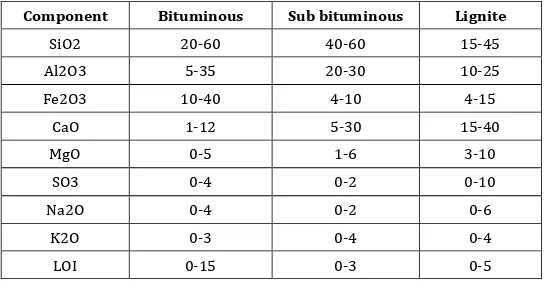
[image:3.612.30.302.187.328.2]Fly ash consists of fine, powdery particles that are predominantly spherical in shape, either solid or hollow, and mostly glassy (amorphous) in nature. The carbonaceous material in fly ash is composed of angular particles.
Table 4: Chemical Composition For Fly Ash
Component Bituminous Sub bituminous Lignite
SiO2 20-60 40-60 15-45
Al2O3 5-35 20-30 10-25
Fe2O3 10-40 4-10 4-15
CaO 1-12 5-30 15-40
MgO 0-5 1-6 3-10
SO3 0-4 0-2 0-10
Na2O 0-4 0-2 0-6
K2O 0-3 0-4 0-4
LOI 0-15 0-3 0-5
3. DESIGN CONSIDERATIONS
3.1. Mix Design
Concrete mixes are designed by selecting the proportions of the mix components that will develop the required strength, produce a workable consistency concrete that can be handled and placed easily, attain sufficient durability under exposure to in-service environmental conditions, and be economical. Procedures for proportioning fly ash concrete mixes differ slightly from those for conventional concrete mixes. One mix design approach commonly used in proportioning fly ash concrete mixes is to use a mix design with all Portland cement, remove some of the Portland cement, and then add fly ash to compensate for the cement that is removed .“mix design can be defined as the process of selecting suitable ingredients of concrete and determining their relative proportions with the object of producing concrete of certain minimum strength as economically as possible. Mix design for the M20 grade using IS is
done besed on Erntroy and shacklock’s method. Mix proportions 1: 1.71: 2.98 w/c = 0.45
3.2 Construction Procedures
3.2.1 Material Handling and Storage
When fly ash is used as a mineral admixture, the ready-mix producer typically handles fly ash in the same manner as Portland cement, except that fly ash must be stored in a separate silo from the Portland cement.
3.2.2 Mixing, Placing, and Compacting
Placement and handling of fly ash concrete is in most respects similar to that of normal concrete. Fly ash concrete using Class F fly ash has a slower setting time than normal concrete hours, depending on the temperature. Placement and finishing, although properly proportioned concrete mixes containing fly ash should benefit workability and finishing.
3.2.3 Curing
The proper application of a curing compound should retain moisture in the concrete for a sufficient period of time to permit strength development.
3.3 Test Procedures
3.3.1 Preparation of Test Specimens
The specimens were cast in steel moulds and compacted on a table vibrator by placing the concrete in the moulds in three equal layers and compacting with the table vibrator after placing each layer. The specimens were cured in water on demoulding after 24 hours.
3.3.2 Mechanical Properties
Compressive strength tests were done on 150 mm cube concrete specimens at different ages as per the procedure specified in IS: 516-1959 [28]. Cylindrical concrete specimens were tested at 21, 28 days. The flexural tests were carried out on beam specimens of size 500 x 100 x100 mm under standard two-point loading, while the split tensile strength was determined by subjecting 150 mm diameter x 300 mm long cylinders to diametric compression.
3.3.3 Compressive test
The compressive strength of concrete cubes of the different mixer are found out at the end of 21 and 28 56 days. The concrete cubes are tested for their compressive strength in the compression testing machine as per IS 516-1959 specifications. The rate of loading is applied 140 kg/sq.cm/min until the failure takes places. The ultimate loads of the concrete cubes are recorded.
3.3.4 Splitting tensile strength
© 2018, IRJET | Impact Factor value: 6.171 | ISO 9001:2008 Certified Journal | Page 676 to 21 kg/cm2/min until specimen failure be recorded. The
splitting tensile strength τ of the specimen shall be calculated from the following formula.
τ = 2P ; kg/cm2
πdl`
P = maximum load in kg applied to the specimen. D = measured diameter in cm of the specimen. L = measured length in cm of the specimen.
3.3.5 Modulus of rapture
The modulus of rapture of the beam (100mm x 100mm x 500mm) is tested in UTM as per IS : 516-1959 specifications. The rate of loading applied 180 kg/sq.cm/min. the shall be increased until the specimens fails, and the maximum load applied (P) to the specimen during the test shall be recorded.
Modulus of rapture σ = M = σ ; I = bd3/12; Y=
D/2 I Y Where,
M = Moment
D = measured depth in cm of the specimen at the point of failure.
I = Moment Of Inertia.
P = maximum load in kg applied to the specimen.
3.4 Calculation for Different Mixer
3.4.1 Sample no.1 :( OPC)
Compressive stress :( Dim. 150mm x 150mm x 150mm) Cube 1 = load/area = 540 x 103/ 22500 = 24 N/mm2
Cube2 = load/area = 520 x 103/ 22500 =23.11 N/mm2
Cube 3 = load/area = 535 x 103/ 22500 = 23.78 N/mm2
Tensile strength: (Dim. D= 150mm, L = 300mm)C1
τ= 2P = 2 x 230 x 103 = 3.26 N/mm2
πdL π x 150 x 300
Flexural strength :( Dim.50cm x 10cm x 10cm) R1
M = σ ; I = bd3/12; Y= D/2
I Y
I = 10 x 103/12 = 833.33cm4; Y = 10/2 = 5cm
M= w.a = 600 x 10 = 6000kg.cm
σ = M x y = 6000 x 5 = 36kg/cm2
I 833.33
3.4.2 Sample no.2 :( OPC+fly ash20%)
Compressive stress :( Dim. 150mm x 150mm x 150mm) Cube 1 = load/area =510 x 103/ 22500 =22.67 N/mm2
Cube 2 = load/area = 500 x 103/ 22500 =22.22 N/mm2
Cube 3 = load/area = 490 x 103/ 22500 = 21.78 N/mm2
Tensile strength: (Dim. D= 150mm, L = 300mm) C1
τ= 2P = 2 x 215 x 103 = 3 N/mm2
πdL π x 150 x 300
Flexural strength :( Dim.50cm x 10cm x 10cm) R1
M = σ ; I = bd3/12; Y= D/2
I Y
I = 10 x 103/12 = 833.33cm4; Y = 10/2 = 5cm
M= w.a = 700 x 10 =7000kg.cm σ = M x y = 7000 x 5 = 42kg/cm2
I 833.33
3.4.3 Sample no.3: (OPC+flyash20%+quarry dust20%)
Compressive stress :( Dim. 150mm x 150mm x 150mm) Cube 1 = load/area = 490 x 103/ 22500 =21.78N/mm2
Cube2 = load/area = 470x 103/ 22500 = 20.89 N/mm2
Cube 3= load/area =480 x 103/ 22500 =21.33 N/mm2
Tensile strength: (Dim. D= 150mm, L = 300mm) C1
τ= 2P = 2 x 220 x 103 = 3.11 N/mm2
πdL π x 150 x 300
Flexural strength :( Dim.50cm x 10cm x 10cm) R1
M = σ ; I = bd3/12; Y= D/2
I Y
I = 10 x 103/12 = 833.33cm4; Y = 10/2 = 5cm
M= w.a = 500 x 10 = 5000kg.cm σ = M x y = 5000 x 5 = 30kg/cm2
© 2018, IRJET | Impact Factor value: 6.171 | ISO 9001:2008 Certified Journal | Page 677 3.5 Tabulation for Different Mixer
3.5.1 Compressive strength
[image:5.612.308.595.95.443.2]The compressive strength of concrete using standard cubes and obtained as per IS 516(1959)(5) ,compressive strength values at 21 and 28 days are presented in table for different mixers.
Table 5: Compressive strength
S.No Grade Sample Detail of specimen
Compressive strength N/mm2 21 days 28 days
1. M25 Plain cement
concrete 1 2 3 24.00 23.11 23.78 27.57 26.22 25.78
Average 23.63 26.52
2. M25 OPC + fly ash
20% 1 2
3 22.67 22.22 21.78 25.78 23.78 22.67
Average 22.22 24.08
3. M25 OPC + fly ash
20%+quarry dust 20% 1 2 3 21.78 20.89 21.33 21.33 22.67 23.58
Average 21.33 23.53
4. M25 OPC + fly ash
20%+quarry dust 20%+6mm C.A 20% 1 2 3 21.33 22.67 22.22 24.89 25.78 23.78
Average 22.67 24.81
5. M25 OPC + fly ash
30% 1 2
3 20.44 21.33 20.00 24.89 25.78 25.78
Average 20.59 25.48
6. M25 OPC + fly ash
30%+quarry dust 30% 1 2 3 20.00 19.11 21.33 21.33 22.67 23.58
Average 20.15 23.53
7. M25 OPC + fly ash
30%+quarry dust 30%+6mm C.A 30% 1 2 3 19.55 19.55 20.89 24.00 23.11 23.78
Average 20.00 23.63
3.5.2 Split Tensile Strength
The tensile strength of concrete using standard cylinders and obtained as per IS5816-1970 and presented in table for different mixer.
Table 6: Split Tensile Strength
S.No Grade Sample Detail of specimen
Tensile strength(split) N/mm2 21 days 28 days
1. M25 Plain cement
concrete 1 3.26 3.75
2. M25 OPC + fly ash 20% 2 3.00 3.40
3. M25 OPC + fly ash
20%+quarry dust 20%
3 3.11 3.60
4. M25 OPC + fly ash
20%+quarry dust 20%+6mm C.A 20%
4 3.40 3.96
5. M25 OPC + fly ash 30% 5 2.83 3.11
6. M25 OPC + fly ash
30%+quarry dust 30%
6 3.26 3.53
7. M25 OPC + fly ash
30%+quarry dust 30%+6mm C.A 30%
7 3.40 3.68
Table 7 : Opc For 1 M3
Qty. Item Rate Per Amount
0.32 Cement 7372.80 M3 2359.29
0.55 Fine aggregate 811.67 M3 446.42
0.95 20mm C.A 917.54 M3 871.63
L.S Mixing charges 88.23 M3 88.23
Total 3765.57
[image:5.612.24.299.210.604.2]
Net amount = Rs.3766/=
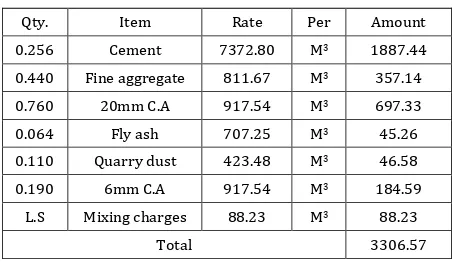
Table 7 :OPC + FLY ASH 20% + QUARRY DUST 20% +6MM CHIPS20% FOR 1 M3
Qty. Item Rate Per Amount
0.256 Cement 7372.80 M3 1887.44
0.440 Fine aggregate 811.67 M3 357.14
0.760 20mm C.A 917.54 M3 697.33
0.064 Fly ash 707.25 M3 45.26
0.110 Quarry dust 423.48 M3 46.58
0.190 6mm C.A 917.54 M3 184.59
L.S Mixing charges 88.23 M3 88.23
Total 3306.57
Net amount = Rs.3307/= Percentages save
For 20% = 3766 – 3307 x100 = 12% 3766
[image:5.612.333.559.493.626.2]© 2018, IRJET | Impact Factor value: 6.171 | ISO 9001:2008 Certified Journal | Page 678
4. FINAL RESULTS AND CONCLUSION
Fly ash concrete mixer contains 20% fly ash, 20% quarry dust and 20% 6mm coarse aggregate or stone chips with OPC concrete having cube compressive strength is 4% less with OPC at the age of 21 days At the same time 7% more with OPC @age of 28 days. Fly ash concrete mixer contains 30% fly ash, 30% quarry dust and 30% 6mm coarse aggregate or stone chips with OPC concrete having cube compressive strength is 15% less with OPC at the age of 21 days. At the same time 5% more than OPC @age of 28 days. Cost of fly ash concrete mixer (20:20:20) is 12% less with OPC concrete. Cost of fly ash concrete mixer (30:30:30) is 19% less with OPC concrete.
Conclusion
From the above results it is well known by using fly ash concrete mixer(30:30:30) will bring down 19% cost reduction with OPC concrete and cube compressive strength is also increased by 5%. And also it is good environment protector and reduces the impact of global warming. Hence the Government should implement the above project to all the cement industries, Ready mix concrete (RMC) manufacturers and local construction industries and the growth of the National economic will be increased. Environmental protection and global warming which were threatening the very existence of society. By using fly ash in the manufacture of concrete industry is a best mechanism to arrest environmental pollution and thereby reduce the impact of global warming.
5. SUGGESTION FOR FURTHER WORK
1. The study and comparison of the compressive strength of fly ash concrete mixer having matrixes such as 40: 40:30 & 50:50:30 and.50:100:30.
2. Study the property of concrete containing gypsum with fly ash concrete mixer to get higher strength.
3. Study and properties of concrete with ground granulated blast furnace slag (GGBS) in fly ash concrete mixer.
4. Study and properties of concrete at the age of 30days, 56days and 91days for various engineering property like compressive strength, split tensile strength, modulus of rupture , modulus of elasticity,shinkage and permeability characteristics.
6. REFERENCES:
[1] Akindahunsi, A. and Ojo, O., “Recycling Billet Scales as Fine Aggregate in Concrete Production”, Civil Engineering Dimension, Vol. 10, No. 2, September 2012, 59-62.
[2] Faiz Abdullah M. Mirza., “Effect of Sand Replacement and Silica Fume Addition on Chloride Ion Permeability of Lightweight Concrete”, JKAU: Eng. Sci., Vol. 20 No.1, pp: 61-73 (2009 A.D. / 1430 A.H.).
[3] R. Ilangovana, N. Mahendrana and K. Nagamanib, “Strength and Durability Properties of Concrete Containing Quarry Rock Dust as Fine Aggregate”, ARPN Journal of Engineering and Applied Sciences, VOL. 3, NO. 5, October 2008.
[4] Nisnevich M. Sirotin G. and Eshel Y. 2003. “Lighweight concrete containing thermal power station and stone quarry waste”. Magazine of Concrete Research pp. 313-320.