© 2017, IRJET | Impact Factor value: 5.181 | ISO 9001:2008 Certified Journal
| Page 1218
Effect of Effective Porosity and Saturated Water Absorption on Rice
Husk Ash-Filtered Sand Self-Compacting Concrete
Manjunath N K
1, Lohith Kumar B C
2, Annapurna B P
3, Pavan Kumar Jogi
41,2
Assistant Professor, Dept. of Civil Engg, Madda Walabu University, Bale Robe, Ethiopia
3
Assistant Professor, Faculty of Engineering-Civil, U.V.C.E, Bangalore-560056
4
Assistant Professor, Dept. of Civil Engg, AASTU, Addis Ababa, Ethiopia
---Abstract- Experiments were conducted to study the effect of rice husk ash and filtered sand on the durability properties such as effective porosity and saturated water absorption. In this study M70 grade concrete with rice husk
ash, filtered sand and superplasticizer were used. Cement and sand was replaced at the levels of 5%, 10%, 15%, 20% and 25%, 50%, 75%, 100% respectively. From the test results, it was observed that rice husk ash SCC and rice husk ash filtered sand SCC has shown better performance than conventional concrete.
Keywords:
Durability,Self-Compacting Concrete (SCC), Rice Husk Ash (RHA), Filtered Sand (FS)
1.0 INTRODUCTION
Concrete is a widely used construction material for various types of structures due to structural stability and strength. All the materials required producing such huge quantities of concrete come from the earth’s crust. Thus, it deflects its resources every year creating ecological strains. On the other hand, human activities on earth produce solid wastes in considerable quantities of over 2500/MT per year, including industrial wastes, agricultural wastes and wastes from rural and urban societies. Recent technological development has shown that these materials are valuable as inorganic and organic resources and can produce various useful products. Amongst the solid wastes, the most prominent ones are fly ash, blast furnace slag, rice husk ash, silica fume and demolished construction materials.
From the middle of 20th century, there had been an increase in the consumption of mineral admixtures by the cement and concrete industries. This increasing demand for cement and concrete is met by partial cement replacement. Substantial energy and cost savings can result when industrial by-products are used as a partial replacement for the energy intense Portland cement. The use of by-products is an environmental– friendly method of disposal of large quantities of materials that would otherwise pollute land, water and air. The current cement production rate of the world, which is approximately 1.2 billion tones/year, is expected to grow exponentially to about 2 billion tones/year by 2015. Most of the increase in demand will be met by the use of supplementary cementing materials.
© 2017, IRJET | Impact Factor value: 5.181 | ISO 9001:2008 Certified Journal
| Page 1219
The main components of concrete are cement, sand & coarse aggregate. The production of cement adds pollution to the environment is a well-known fact to civil engineers. River sand which is used as fine aggregate is becoming very scarce, sand mining is discouraged to save the rivers of our country. Because of these environmental and economic reasons it requires thinking about the use of industrial wastes as alternative materials in concrete production, which not only reduce the cost of production of concrete but also controls the pollution relatively.
Rice plant is one of the plants that absorbs silica from the soil and assimilates it into its structure during the growth (Smith et al., 1986). Rice husk is the outer covering of the grain of rice plant with a high concentration of silica, generally more than 80-85%.
Surface soils from tank beds, agricultural fields and village common lands have been excavated and washed to produce a kind of artificial sand in order to meet the enormous demand known as filtered sand. Only source materials with suitable strength, durability and shape characteristics should be considered. Production generally involves screening and possible washing. Separating into discrete fractions, recombining and blending may be necessary.
Therefore the utilization of Rice Husk Ash (RHA) & Filtered Sand (FS) in concrete for the replacement of cement & sand, environmentally and economically advantageous. In the present study Portland cement and sand was replaced by RHA and FS at various percentages to study strength and durability properties like saturated water absorption, effective porosity.
2.0 EXPERIMENTAL PROGRAMME
2.1 Materials used
Cement: ordinary Portland cement of 53 grade confirming to IS: 12269-1987 was used for the present experimental investigation. The cement was tested as per the Indian standards IS: 4031-1988. The test results are given in Table 1.
Fine Aggregates: Natural river sand as per IS: 383-1987 was used. The physical properties and sieve analysis of fine aggregate are presented in Table 2.
© 2017, IRJET | Impact Factor value: 5.181 | ISO 9001:2008 Certified Journal
| Page 1220
Coarse Aggregates: Crushed Granite jelly of size 12.5mm down confirming to IS: 383-1987 was used (Table 5).
Rice Husk Ash: The rice husk ash obtained from Maddur (Mandya dist.). RHA used for investigation have tested in the Civil Aid and the chemical characteristics are given in Table 6.
Superplasticizer: Polycarboxylic ether based super plasticizer Glenium 6100 has been used in present research work.
2.2 Mix Proportioning
For the present investigation, High strength self-compacting concrete of grade M70 was aimed. To achieve this grade of concrete, OKAMURA (JAPANESE) METHOD of mix design was used.
NOTE: [C.SCC - Convention Self Compacting Concrete with only Cement & Natural Sand without RHA & FS]. The mix proportions obtained for C.SCC of M70 grade is 1:1.12:1.17 is been replaced by RHA & FS in place of cement & natural sand by different percentages, which is tabulated in Table 7.
Note: C.SCC-Conventional Concrete (0%RHA, 0%FS); A Series-5% RHA; B Series-10% RHA; C Series-15% RHA; D Series-20% RHA;
Ao A1 A2 A3 A4 – 5% RHA, (100%NS+0%FS,
75%NS+25%FS, 50%NS+50%FS, 25%NS+75%FS,
0%NS+100%FS);
Bo B1 B2 B3 B4 – 10% RHA, (100%NS+0%FS,
75%NS+25%FS, 50%NS+50%FS, 25%NS+75%FS,
0%NS+100%FS);
Co C1 C2 C3 C4 – 15% RHA, (100%NS+0%FS,
75%NS+25%FS, 50%NS+50%FS, 25%NS+75%FS,
0%NS+100%FS);
Do D1 D2 D3 D4 – 20% RHA, (100%NS+0%FS,
75%NS+25%FS, 50%NS+50%FS, 25%NS+75%FS,
© 2017, IRJET | Impact Factor value: 5.181 | ISO 9001:2008 Certified Journal
| Page 1221
3.0 TESTING OF SCC
It is important to mention that none of the test methods for SCC have yet been standardized and included in Indian Standard Code for the present. The following are some of the features of SCC mentioned in Indian standard code IS: 456-2000.
1. Slump flow: Minimum 600mm.
2. Sufficient amount of fines (<12.5mm) preferably in the range of 400kg/m3 to 600kg/m3.This can be achieved by having sand content more than 38% and using mineral admixture to the order of 25% to 50% by mass of cementitious materials.
3. Use of high range water reducing (HRWR) admixture and viscosity modifying agent (VMA) in appropriate dosages are permitted.
European guidelines for testing, covers number of parameters ranging from material selection, mixture design and testing methods like slump flow test, L-box test and V-funnel test as recommended by EFNARC for determining properties of SCC in fresh state. Most of Indian researchers are following these guidelines to determine the rheological properties of SCC mixes.
4.0 TESTING METHODS OF SCC
Different methods have been developed to characterize the rheological properties of SCC. No single method has been found until date, which characterizes all the
relevant workability aspects. Each mix has been tested by more than one test method for the different workability parameters. Following are the tests recommended by European guidelines.
A. Slump flow test- The slump flow test is used to assess the horizontal flow of SCC in the absence of obstructions. The test also indicates resistance to segregation. On lifting the slump cone, filled with concrete the average diameter of spread of the concrete is measured. It indicates the filling ability of the concrete.
B. V-funnel test- The flowability test of the fresh concrete can be tested with the V-funnel test, where by the flow time is measured. The funnel is filled with about 22kgs of concrete and the time taken for it to flow through the apparatus is measured. Shorter flow time indicate greater flowability.
C. L-Box test- This is a widely used test, suitable for laboratory and site use. It accesses filling and passing ability of SCC and serious lack of suitability can be detected visually. The vertical section of the L-box is filled with concrete, and then the gate is lifted to let the concrete flow into the horizontal section. Blocking ratio, it indicates passing ability of concrete or the dosage to which the passage of concrete through the bars is restricted.
5.0 TESTS CONDUCTED:
5.1 Saturated Water Absorption and Effective
Porosity:
© 2017, IRJET | Impact Factor value: 5.181 | ISO 9001:2008 Certified Journal
| Page 1222
Saturated water absorption,SWA = [(Ws±Wd)/Wd] x 100
Where; Ws = Weight of the specimen at fully saturated condition in kg
Wd = Weight of oven dried specimen in kg The porosity obtained from absorption test is designated as Effective porosity. It is determined by using the formula,
Effective porosity = (Volume of voids/Bulk volume of specimen) x 100
The volume of voids was obtained from the volume of water absorbed by an oven dry specimen or the volume of water lost on oven drying of a water saturated specimen at 105°C to constant mass. The volume of specimen is given by the difference in mass of the specimen in air and it’s mass under submerged condition in water.
6.0 RESULTS AND DISCUSSIONS
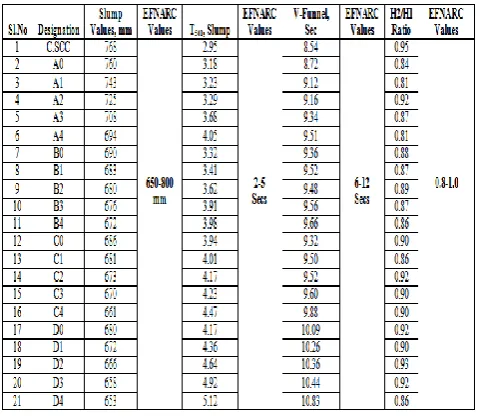
The slump flow characteristics, V-funnel & L-box of the mixtures satisfies the EFNARC requirement. Slump flow decreases with increase in RHA content along with FS. The RHA indicates the increase in the viscosity of concrete. The blocking ratio in L-box test were as per requirement of SCC mixes as laid down by EFNARC guidelines. The results are presented in Table 8.
The fresh concrete properties compared to EFNARC specifications, the slump obtained from RHA-FS SCC is between 768 mm to 653mm. The V-Funnel time obtained from RHA-FS SCC is between 2.95 sec to 5.12 sec. The H2/H1 ratio obtained from RHA–FS SCC is between 0.945 to 0.862.The fresh concrete properties of RHA-FS SCC obtained are within the EFNARC specifications.
6.1 Saturated Water Absorption and Effective
[image:5.595.327.574.287.451.2]Porosity
Table 9: SWA of Conventional SCC mixes (C.SCC) & RHA-FS SCC with different replacement levels of RHA and FS for curing
periods of 28 and 56 days
[image:5.595.44.285.519.728.2]
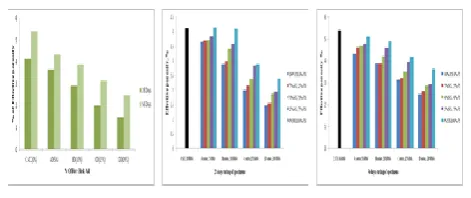
Fig 1: Comparison of SWA of conventional SCC (C.SCC) & RHA-FS SCC with different replacement levels of RHA and 0% of FS and with different replacement levels of FS for curing periods of 28
© 2017, IRJET | Impact Factor value: 5.181 | ISO 9001:2008 Certified Journal
| Page 1223
Table 10: Effective porosity of Conventional SCC mixes (C.SCC) & RHA-FS SCC with different replacement levels of RHA and FS for
curing periods of 28 and 56 days
Fig 2: Comparison of EP of conventional SCC (C.SCC) & RHA-FS SCC with different replacement levels of RHA and 0% of FS and with different replacement levels of FS for curing periods of 28 and 56
days
Saturated water absorption (SWA) of C.SCC and RHA-FS SCC specimens.
In SCC with or without RHA the percentage of saturated water absorption (SWA) is quiet higher at 56 days of curing period when compared to 28 days of curing period.
The percentage of SWA in RHA-FS SCC decreases with the increase in RHA content when compared to C.SCC.
The replacement of sand by FS in RHA-FS SCC influences in increase of the SWA.
The SWA of RHA-FS SCC for different replacement level of FS from 0% to 100% with 5%, 10%, 15% and 20% of RHA varies between 3.8-4.1%, 3.2-3.8%, 2.4-3.0% and 1.96-2.5% respectively.
Hence the partial replacement of cement by RHA decreases the SWA in RHA-FS SCC, as small RHA particles improved the particle packing density of the concrete mix leading to a reduced volume of larger pores.
But the partial replacement of NS by FS increases the SWA may be due to the presence of silt content in FS increases the SWA.
Effective Porosity (EP) of C.SCC and RHA-FS SCC specimens.
In SCC with or without RHA the percentage of effective porosity is quiet higher at 56 days of curing period when compared to 28 days of curing period.
The percentage of effective porosity in RHA-FS SCC decreases with the increase in RHA content when compared to C.SCC.
The replacement of sand by FS in RHA-FS SCC influences in increase of the effective porosity due to the presence of silt content in it.
The effective porosity of RHA-FS SCC for different replacement level of FS from 0% to 100% with 5%, 10%, 15% and 20% of RHA varies between 4.3-5.1%, 3.89-4.9%, 3.148-4.2% and 2.4-3.6% respectively.
Hence the partial replacement of cement by RHA in RHA-FS SCC decreases the effective porosity, as small RHA particles improved the particle packing density of the concrete mix leading to a reduced volume of larger pores.
But the partial replacement of NS by FS increases the EP may be due to the presence of silt content in FS increases the EP.
7.0 CONCLUSIONS
RHA contributes in the reduction of agricultural waste that is the main cause of environmental problems in agricultural countries. On the other hand, it is an approach to improve the quality of concrete without using costly additives such as silica fume, GGBFS etc.
[image:6.595.42.278.338.437.2]© 2017, IRJET | Impact Factor value: 5.181 | ISO 9001:2008 Certified Journal
| Page 1224
normal concrete which attains the strength at 28days.
The presence of RHA reduces the slump, with the increase in quantity of RHA in SCCs the reduction in slump also increases. The addition of FS along with RHA further reduces the slump. For D4-Mix (20% RHA+100% FS) the slump reduced frrom768 mm (Conventional SCC mix) to 653 mm.
The T500 time increases with the increase in percentage of RHA. The presence of FS further increases the T500 time i.e., 2.95 sec to 5.12 sec.
The increase of RHA affects the consistency of flow of SCC. The presence of FS along with RHA, add to the increase in reduction of consistency of flow.
The V Funnel time increases with the increase in percentage of RHA. The presence of FS further increases the V Funnel time.
The partial replacement of cement by RHA decreases the SWA and EP in RHA-FS SCC, as small RHA particles improved the particle packing density of the concrete mix leading to a reduced volume of larger pores. But the partial replacement of natural sand by FS increases the SWA and EP may be due to the presence of silt content in FS increases the SWA.
The RHA-FS SCC with only replacement of cement by RHA (upto 20%) and without the replacement of natural sand by filter sand decreases the saturated water absorption and effective porosity.
Hence the RHA-FS SCC with replacement of cement by RHA is more durable than the RHA-FS SCC with replacement of natural sand by filter sand.
8.0 REFERENCES
1. V.Ramasamy* Dr.S.Biswas, “Durability Properties of Rice Husk Ash Concrete” ICI Journal, October-December 2009.
2. Salas*, 1, M. A. Ospina1, S. Delvasto2 and R. Mejía de Gutierrez2, “Study on the Pozzolanic Properties of Silica Obtained from Rice Husk by Chemical and Thermal Process” 1 Materials Engineer, Ph.D Student, Composites Materials Group, CENM, Universidad del Valle, Cali, Colombia, 2 Titular Professor, Composites Materials Group, CENM, Universidad del Valle, Cali, Colombia, Received zzz, revised zzz, accepted zzz, Published online zzz.
3. Alireza Naji Givi 1, Suraya Abdul Rashid 2, Farah Nora A. Aziz 3, Mohamad Amran Mohd Salleh 2, “Contribution of Rice Husk Ash to the Properties of Mortar and Concrete: A Review” Journal of American Science, 2010;6(3).
4. S.H. Adnan1*, I. Abdul Rahman2, Y.L. Lee3 and H. Yusof4, 1, 2, 3,4 Faculty of Civil and Environmental Engineering, Universiti Tun Hussein Onn Malaysia, Malaysia, “Compressive Strength and Water Permeability Performance of Micronized Biomass Silica Concrete” International Journal of Integrated Engineering (Issue on Civil and Environmental Engineering).
5. G. Sivakumar (Corresponding Author), R. Ravibaskar, “Investigation on the Hydration Properties of the Rice Husk Ash Cement Using Ftir and Sem” Vol.1, No.2, November 2009.
6. P. Chindaprasirt a, C. Jaturapitakkul b, U. Rattanasak c,*, “Influence of fineness of rice husk ash and additives on the properties of lightweight aggregate” Fuel 88 (2009) 158– 162.
7. Paratibha Aggarwal*, Yogesh Aggarwal, S M Gupta, R Siddique, “Properties of Self-Compacting Concrete – An Overview” 30th Conference on Our World in Concrete & Structures: 23 – 24 August 2005, Singapore.
8. S. D. Nagrale1, Dr. Hemant Hajare2, Pankaj R. Modak3, “Utilization Of Rice Husk Ash” International Journal of Engineering Research and Applications (IJERA) ISSN: 2248-9622, Vol. 2, Issue 4, July-August 2012, pp.001-005.
© 2017, IRJET | Impact Factor value: 5.181 | ISO 9001:2008 Certified Journal
| Page 1225
10. Sumrerng Rukzon1, Prinya Chindaprasirt2, and Rattana Mahachai3, “Effect of grinding on chemical and physical properties of rice husk ash” International Journal of Minerals, Metallurgy and Materials Volume 16, Number 2, April 2009, Page 242.
11. A. Ramezanianpour1,*, M. Mahdi khani2, Gh. Ahmadibeni3, “The Effect of Rice Husk Ash on Mechanical Properties and Durability of Sustainable Concretes” International Journal of Civil Engineerng. Vol. 7, No. 2, June 2009.
12. V. Kannan1, K.Ganesan2, “Strength and water absorption properties of ternary blended cement mortar using rice husk ash and Metakaolin” Scholarly Journal of Engineering Research Vol. 1(4), pp. 51-59, August 2012.
13. M.F. Nuruddin, N. Shafiq, N.L.M. Kamal, “The Effects of Types of Rice Husk Ash on the Porosity of Concrete”.
14. B. Chatveera a,*, P. Lertwattanaruk b, “Evaluation of sulfate resistance of cement mortars containing black rice husk ash” Journal of Environmental Management 90 (2009) 1435–1441.
15. Md. Harunur Rashid, Md. Keramat Ali Molla, Tarif Uddin Ahmed, “Durability of Mortar in Presence of Rice Husk Ash” World Academy of Science, Engineering and Technology 43 2010.
16. Dr. Hemant Sood1, “Incorporating European Standards for Testing Self Compacting Concrete in Indian Conditions” International Journal of Recent Trends in Engineering, Vol. 1, No. 6, (May 2009).
17. Akindehinde Ayotunde Akindahunsi1) and Oluwotosin Alade, “Exploiting the Potentials of Rice Husk Ash as Supplement in Cement for Construction in Nigeria” International Journal of Concrete Structures and Materials, Vol.4, No.1, pp. 3~8, (June 2010).
18. Mixture proportioning procedure for Self-compacting concrete, The Indian concrete journal, Aug 2004.
19. OKAMURA,H., Ozawa, Kand Ouchi, M. self-compacting concrete, structural concrete, March 2001, No.1, pp.5.17.
20. OKAMURA,H., Ozawa, K. Mix design for self-compacting concrete, concrete library of JSCE, june 1995, No.25, pp.107-120.
BIBLIOGRAPHY
Manjunath N K B.E.,M.E
Assistant Professor
Department of Civil Engineering Madda Walabu University
Bale Robe, Ethiopia
Having 5 Years of Teaching Experience
Lohith Kumar B C B.E.,M.Tech
Assistant Professor
Department of Civil Engineering Madda Walabu University Bale Robe, Ethiopia
Having 6 Years of Teaching Experience
Pavan Kumar Jogi B.Tech.,M.E
Assistant Professor
Department of Civil Engineering AAS & T University
Addis Ababa, Ethiopia
Having 5 Years of Teaching Experience
Dr. Annapurna B P B.E.,M.E.,Ph.D Assistant Professor
Faculty of Engineering - Civil UVCE, Bangalore University Bangalore, India