© 2017, IRJET | Impact Factor value: 5.181 | ISO 9001:2008 Certified Journal | Page 1914
POWER EFFICIENT RING AND TREE BASED ROUTING PROTOCOL
Gurpreet Kaur
1, Er. Jasdeep Singh
2M.Tech Student ,CSE, Bhai Maha Singh Engineering College, Shri Mukatsar Sahib,Punjab,India1
Assistant Professor, CSE,Bhai Maha Singh Engineering College, Shri Mukatsar Sahib,Punjab,India2
---***---Abstract
-
Wireless sensor networks (WSNs) comprise of littlehubs with detecting, calculation and wireless network capacities. WSNs comprise of countless cost, low-control and savvy sensor hubs and at least one sinks or base stations (BSs)]. Those hubs are little in size and can perform numerous vital capacities, including occasion detecting, data handling, and information correspondence. The sensor sends such gathered information, more often than not by means of radio transmitter, to a war room (sink) either straightforwardly or through information focus (a door). In this exploration paper, a diagram of sensible topologies and dynamic coordinating is given. More especially, Atypical Routing for WSNs is isolated into five orders, including group based, chain-based, tree-based, lattice tree-based, and run based topologies. Furthermore, differing true blue topologies for different levelled WSNs have been researched by reasonable topologies, including their qualities, central focuses additionally, shortcomings. At last we have re-enacted the ring steering and the tree based ring directing instruments and thought about them on the bases of Delay, Energy and Load on the framework. The conclusion from the outcomes is that Power effective ring and tree based steering performs superior to anything the cross breed directing.
Keyword-Ring Routing, Wireless Sensor Networks (WSN), Chain Routing, Tree Routing
1.INTRODUCTION
A wireless sensor network is a gathering of specific transducers with a communications infrastructure for observing and recording conditions at different areas. Regularly checked parameters are temperature, moistness, pressure, wind course and speed, brightening intensity, vibration power, sound power, power-line voltage, chemical concentrations, toxin levels and indispensable body capacities. A sensor organize comprises of numerous discovery stations called sensor hubs, each of which is little, lightweight and convenient. Each sensor hub is furnished with a transducer, microcomputer, handset and power source. Be that as it may, organize lifetime can't portray arrange adequately, there exist inadequacy in as of now evaluative standard. To tackle the issue, two new records (arrange scope rate and viable system lifetime) are presented for assessing wsns.The transducer produces electrical signs in light of detected physical
impacts and marvels. The microcomputer procedures and stores the sensor yields. The handset gets charges from a focal PC and transmits information to that PC. The power for every sensor hub is gotten from a battery.
The WSN is worked of "hubs" – from a couple to a few hundreds or even thousands, where every hub is associated with one (or in some cases a few) sensors. Each such sensor organize hub has normally a few sections: a radio handset with an inner reception apparatus or association with an outer receiving wire, a microcontroller, an electronic circuit for interfacing with the sensors and a vitality source, more often than not a battery or an implanted type of vitality reaping. A sensor hub may differ in size from that of a shoebox down to the span of a grain of tidy, albeit working "bits" of certified minuscule measurements presently can't seem to be made. The cost of sensor hubs is correspondingly factor, going from a couple to several dollars, contingent upon the multifaceted nature of the individual sensor hubs. Size and cost imperatives on sensor hubs bring about comparing requirements on assets, for example, vitality, memory, computational speed and interchanges transfer speed. Subsequent to doing reenactment test, it is discovered the versatility and extensibility of bcrp altogether enhanced [2].The topology of the WSNs can shift from a basic star system to a progressed multi-bounce remote work arrange. The engendering strategy between the bounces of the system can defeat or flooding.
1.1 Tree Based Hierarchal
© 2017, IRJET | Impact Factor value: 5.181 | ISO 9001:2008 Certified Journal | Page 1915
impediments. By considering vitality proficiency introduced a survey on bunching calculations for WSNs from the point of view of information steering. Some critical grouping calculations were inspected in which a couple of measurements, for example, leftover vitality, and consistency of CH circulation were investigated. Every hub just speaks with the closest hubs in its upper and lower layer, that is to state, father-hub and child hubs, and transmits a coordinated information to its dad hub subsequent to intertwining its own with every detected data from its child hubs [8].In the renowned bunching calculation LEACH and its relative were talked about in regards to the favorable circumstances and hindrances. In the favorable circumstances and goals of bunching for WSNs were sketched out, and an exhaustive scientific classification of grouping techniques for WSNs were introduced. Specifically, some conspicuous bunching directing conventions for WSNs were depicted and broke down as indicated by the convention usage stages.
1.2 Basic Architecture of WSN
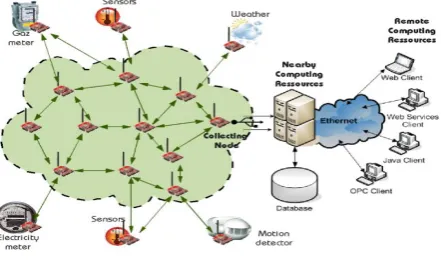
[image:2.595.39.260.549.680.2]A WSN is a system comprising of various sensor hubs with detecting, remote interchanges and processing abilities. These sensor hubs are scattered in an unattended domain (i.e. detecting field) to detect the physical world. The detected information can be gathered by a couple sink hubs which have gets to systems like the Internet. At long last, an end client can remotely bring the detected information by getting to systems. One of the numerous wsn capacities is to give detecting administrations in an unattended cruel condition.
Fig 1 - Architecture of WSN
1.3 Applications of WSN
1. Environmental Monitoring:- Environmental checking can be utilized for creature following,
woods observation, surge discovery, and climate estimating.
2. Health Monitoring:- WSNs can be implanted into a doctor's facility working to track and screen patients and every single restorative asset. At last, as per the estimations of element weights in the neighboring rundown, the sensor hub chooses the following jump sending way .
3. Traffic Control:- Sensor systems have been utilized for vehicle movement observing and control for quite a while. At numerous intersection, there are either overhead or covered sensors to distinguish vehicles and to control the activity lights. Besides, camcorders are likewise as often as possible used to screen street portions with overwhelming movement.
4. Industrial Sensing:- As plant framework ages, hardware disappointments cause increasingly spontaneous downtime. The ARC Advisory Group evaluates that 5% of generation in North America is lost to impromptu downtime.
1.4 Atypical Hierarchical Routing
Hierarchical routing is a procedure of directing in systems this depends on various leveled tending to. Various leveled directing is the methodology of organizing switches progressively. A decent case could be to consider a corporate intranet. Most extreme organization intranets envelop a high speed spine arrange. Connected to this spine are switches which may be thus identified with a chose workgroup. Those workgroups possess a totally one of a kind LAN. The thought process this is an eminent course of action is on account of despite the fact that there is presumably many different workgroups, the traverse (most bounce recall to get from one host to whatever other host at the system) is two. Notwithstanding assuming the workgroups separated their LAN people group into littler dividers, the traverse ought to best development to four on this specific illustration.
© 2017, IRJET | Impact Factor value: 5.181 | ISO 9001:2008 Certified Journal | Page 1916
characterized advertisements. With progressive steering, best center switches associated with the spine are conscious of all courses. Switches that lie inside a LAN best perceive around courses in the LAN. Unrecognized areas are surpassed to the default course.
2 Literature Review
Lin et.al in [1] proposed with inspirations driving improving framework scope rate and feasible framework lifetime in wsns. It upgrades sort out extension rate through gathering patch, and it has different leveled multi-way tree coordinating property. Moreover, the center points are allocated into three classes: assemble center, sense center and non-sense center, which improves the essentialness protection. Amusement comes to fruition exhibit that the cphrp can guarantee more than 90% framework scope rate inside most of framework lifetime with relationship with notice when the amount of inward gathering sense centers is more than 6. With the various advancements of framework center points, the practical framework lifetime of the cphrp rises by more than 60%. Exactly when the amount of internal bundle center points augments in various of 6, the improvement of its framework lifecycle is over half alternately of the under 7% of respect.
Zhu et.al in [2] depicted the qualities of wsn directing conventions; furthermore examines in subtle elements the aodv which is the commonplace on-request steering convention in specially appointed, transplants it into wsn and proposes the move technique for versatile grouping steering and directing move; lastly conspire out another versatile various leveled steering move convention bcrp of high effectiveness and respectability. In the wake of doing recreation test, it is discovered the versatility and extensibility of bcrp essentially moved forward.
Huruiala et.al in [3] proposes and examines the proficiency of a various leveled directing convention intended to expand the life of the system by limiting vitality utilization and inertness by picking the best hubs to end up bunch heads. Minimization is acknowledged with a multi-objective hereditary calculation executed on a focal BS and the outcomes send to the system hubs. Reproduction is done in ns-2 where there is as of now an execution of filter convention with whose outcomes they look at.
Aziz et.al in [4] proposed a concentrated various leveled based directing convention, which conveys vitality stack among sensor hubs in view of their remaining vitality. The execution of the proposed convention is assessed by means of serious reproduction. Reproduction comes about demonstrate that the proposed convention outflanks the outstanding base-station controlled element bunching convention (bcdcp) as far as system lifetime and vitality investment funds.
Latif et.al in [5] tended to vitality confinement requirements as for expanding system life time utilizing straight programming plan procedure. To check the productivity of various bunching plan against displayed requirements, they chose four group based steering conventions, low vitality versatile bunching order (filter), edge delicate vitality effective sensor organize (high schooler), stable decision protocol (sep), and distributed energy efficient clustering (deec). To approve our scientific system, they perform investigative reenactments in matlab by picking number of alive hubs, number of dead hubs, number of parcels and number of CHs, as execution measurements.
Liliana M.C. Arboleda et.al in [6] concentrated one of the systems used to expand the life of Wi-Fi sensor systems (WSN) and to give more noteworthy effective working procedures is bunching. By methods for accepting parts inside a group progressive system, the hubs in a WSN can control the games they executed and along these lines, reduce their quality utilization. In any case, the decision of while to carry on as a realities organization (sparing vitality) and when to act as a passage (bunch head) among the hubs and the base station isn't a basic mission. To make this determination it's miles essential to consider elements like power level flag, transmission plans and systems administration working (proactive or receptive). In this paper they investigate a couple of key standards identified with the grouping framework in WSN and providing a difference study between exceptional bunching conventions
© 2017, IRJET | Impact Factor value: 5.181 | ISO 9001:2008 Certified Journal | Page 1917
advantages and drawbacks of various anomalous progressive directing conventions are broke down with appreciate to their broad exhibitions and application inevitabilities. At some point or another, they suggest some open issues concerning the design of various leveled WSNs. These study aspirations to offer useful steerage for machine creators on an approach to assess and pick suitable intelligent topologies and progressive directing conventions for exact bundles.
3. Existing Method
In basic algorithm, the Hybrid Routing Protocol is proposed in which the idea of CHIRON (Chain Based Routing Protocol) and Ring Routing (Area Based Routing Protocol) is consolidated. Cross breed Routing Protocol is proposed to expel the restrictions of these both existing conventions. While Area-based frameworks are exceptionally adaptable, they have substantial deferrals. To take care of this issue, execute an idea of least jump with vitality proficient advancement for zone based directing. In this idea, execute the range based steering where will process the base number of bounces required to transmit the information from source to sink. At that point will process the base vitality that is required to transmit the parcel from source to sink. At that point discover the crossing point where the vitality and bounce have ideal esteem and afterward transmit the bundle .Also will make the great load adjusting in system and make the more versatile system
4. Problem Formulation
Over the most recent couple of years, wireless sensor networks (WSN) have turned into a dynamic range for analysts because of its expansive and developing application. In any case, steering is a basic issue that needs thought as it specifically impacts the execution of WSN. A few conventions have been proposed to address this issue and in addition decreasing vitality utilization and drag out a lifetime of the sensor hubs in WSN. The chain-based is one approach from Hierarchical steering conventions which decreases the vitality utilization in WSN. In any case, an issue emerges when the chain has long-interface (LL) from the base station (BS). Consequently need of such steering convention is felt which can diminish the vitality utilization and stacking. We propose to configuration tree based steering convention to enhance vitality utilization and stacking.
5. Proposed Methodology
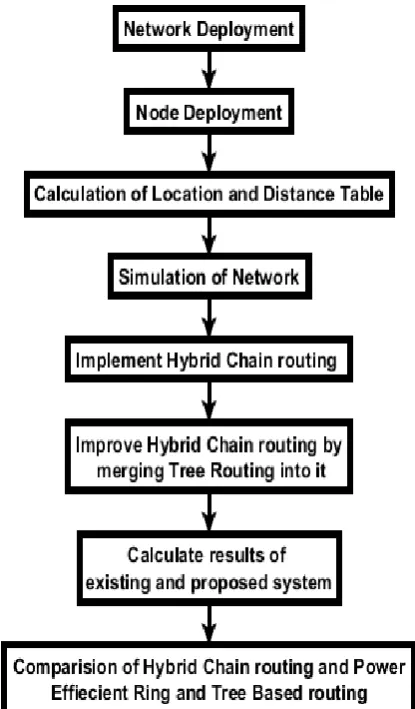
[image:4.595.316.524.315.670.2]In this proposed work, the Power efficient ring and tree based routing protocol is proposed in which the concept of tree based routing protocol and Ring Routing (Area Based Routing Protocol) is merged. In proposed work, implement a concept of minimum path with energy efficient optimization for area based routing. In this concept, implement the area-based routing and improve it by merging tree based routing protocol into area based routing. Where it will compute the minimum number of paths required to transmit the data from source to sink. Then will compute the minimum energy that is required to transmit the packet from source to sink .Also will make the good load balancing in network.
© 2017, IRJET | Impact Factor value: 5.181 | ISO 9001:2008 Certified Journal | Page 1918 6. Experimental Results
The result generated of the comparison between the Hybrid Chain Routing and the current scenarios i.e. the power efficient ring and tree based Routing Protocol show that the power efficient ring and tree based Routing performs better than the Hybrid chain routing mechanism in terms of System load, delay and energy.
Algorithm of Power Efficient Ring and Tree based Routing Protocol
INPUT VARIABLES
X = {length of region}
Y= {Breadth of region}
Nodes={Number of nodes}
Store =Deploy Nodes (Nodes, X, Y)
[cX,cY]=Computer center(X,Y) OUTPUT
Draw circles ([cX,cY],{number of circles})
Usage=calculation(nodes)Find path=nod e(2,X,Y,Usage)
PROCESS
Start rounds
Select source node
path =find path(source node to first ring node, First ring to second ring node, Second ring to sink);
Distance calculation.
Energy calculation.
Delay calculation.
Load calculation.
Results. OUTPUT
Plot metrics (global metric)
Parameters used:
In this research different scenarios are taken into consideration with varying number of nodes against constant simulation time.
Energy: Energy used by packet in transmission over the calculated distance. Energy of the network specified as how much packets are consumed during the transmission from one node to another node. . It is expressed as milijoules.
Formulas for calculate the Energy: The formula with the use of energy is calculated is given below:
The energy consumed in the network is dependent on two factors. First is the constant activation energy (Eelec) for transmission given by:
Eelec = (23/√𝐴𝑟𝑒𝑎)*PS for nodes up to 200 and
Eelec = (25/√𝐴𝑟𝑒𝑎)*PS for nodes above 200
Area = 400
Packet Size (PS) = 10
So the energy equation becomes:
E = Eelec + RF * d * 10-9
d = (X1-X2)(X1-X2)+(Y1-Y2)(Y1-Y2)*0.5
Where,
Reducing Factor (RF) is division of maximum number of observations further divided by number of paths. For nodes below 300 the number of paths is one in general.
Reducing Factor = ((1/Max no. of Observations) *NoO)/NoP
NoO = No. of Observations
NoP = No. of Paths
Delay: Delay caused in the packet transmission over the selected path. Delay of the network specified how long it takes for milliseconds of data to travel across the network from one node to another.
Formulas for calculate the delay: The formula with the use of delay is calculated is given below:
Going by the same theory, Similarly Delay D is given by:
D = Delec + RF * d * 10-9
Where,
Delec = (0.14/√𝐴𝑟𝑒𝑎)*PS for nodes upto 200 and
Delec = (0.04/√𝐴𝑟𝑒𝑎)*PS for nodes above 200
Load: The number of packets transmitted cause the network to experience consumption of availability of paths. It refers to the amount of data that is carried by a network. It is expressed as computational cycles.
Formulas for calculate the Load: The formula with the use of load is calculated is given below:
Load L is given by
© 2017, IRJET | Impact Factor value: 5.181 | ISO 9001:2008 Certified Journal | Page 1919
Where,
Lelec = (1.2/√𝐴𝑟𝑒𝑎)* PS for nodes up to 200 and
Lelec = (0.4/√𝐴𝑟𝑒𝑎)*PS for nodes above 200
Any further improvement as in the number of paths will differ the calculations by a new reducing factor making it observation multiplies by reducing factor.
[image:6.595.30.267.251.489.2]Energy/Delay/Load * Reducing factor
Table 1 - Simulation Parameters Simulator
Parameters
Value
Simulator MATLAB
No. of nodes 200, 250
Network area 400*400
Routing Protocols Ring Routing, Tree Routing
Initial Energy 100mj
[image:6.595.308.548.280.485.2]Range Type Fixed
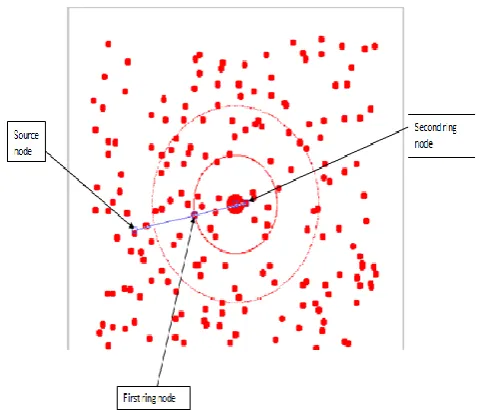
Fig 7 – Deployment of Network and Nodes
Radius of first ring=100m
Radius of second ring=50m
Radius of sink=10m
Radius of node=3m
In figure 7, deployments of network and nodes are shown, 200 nodes are deployed in the area of 400*400 and two concentric rings are formed. We proposed ring routing with hybrid tree routing protocol.
Fig 8 – 1st communication node selected and communication path decided
In figure 8, 1st communication source node selected and communication path decided. In communication path second node should be in first ring and third node should be in second ring. There are three paths created between source nodes to sink. Distance of each path is calculated and then there is sum of all paths.
[image:6.595.42.277.499.710.2]© 2017, IRJET | Impact Factor value: 5.181 | ISO 9001:2008 Certified Journal | Page 1920
[image:7.595.288.552.51.304.2]Fig 9 – Five different nodes selected for communication
Fig 10 – Energy consumed in Milijoules (200 Nodes Deployed)
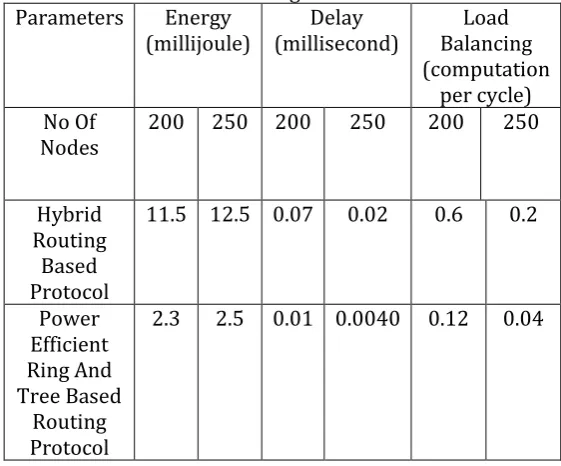
In figure 10, Energy consumed (in Milijoules) by network for communication is shown when 200 nodes are deployed. Energy consumed for previous method is 11.5 Millijoules and for proposed method is 2.3 Millijoules.
[image:7.595.46.278.342.553.2]In figure 11, Energy consumed (in Millijoules) by network for communication is shown when 250 nodes are deployed. . Energy consumed for previous method is 12.5 Millijoules and for proposed method is 2.5 Millijoules.
[image:7.595.315.549.368.569.2]Fig 11 – Energy consumed in Milijoule (250 Nodes Deployed)
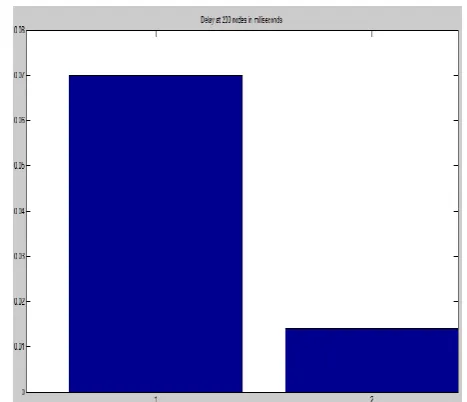
Fig 12 – Delay in Millisecond (200 Nodes Deployed)
In figure 12, Delay (in Millisecond) for communication is shown when 200 nodes are deployed. Delay for previous method is 0.07 Millisecond and for proposed method is 0.01 Millisecond.
© 2017, IRJET | Impact Factor value: 5.181 | ISO 9001:2008 Certified Journal | Page 1921
[image:8.595.36.269.78.301.2]Fig 13 – Delay in Millisecond (250 Nodes Deployed)
Fig 14 – Load at 200 nodes in computation per cycle
In figure 14, Load at 200 nodes in computation per cycle for communication network is shown. Load for previous method is 0.6 and for proposed method is 0.12.
[image:8.595.47.278.356.554.2]In figure 15, Load at 250 nodes in computation per cycle for communication network is shown. Load for previous method is 0.2 and for proposed method is 0.04.
Fig 15 – Load at 250 nodes in computation per cycle
Comparison of Ring Routing and Hybrid Routing Protocols on the basis of delay, energy and load.
Ring Routing and Hybrid Routing Protocols are compared on the basis of delay, energy and delay into the below given table.
Table 2 - Comparisons of ring routing and hybrid routing
Parameters Energy
(millijoule) (millisecond) Delay Balancing Load (computation
per cycle) No Of
Nodes 200 250 200 250 200 250
Hybrid Routing
Based Protocol
11.5 12.5 0.07 0.02 0.6 0.2
Power Efficient Ring And Tree Based
Routing Protocol
[image:8.595.301.582.444.677.2]© 2017, IRJET | Impact Factor value: 5.181 | ISO 9001:2008 Certified Journal | Page 1922 7. CONCLUSION
WSNs have pulled in extending thought starting late for their expansive applications. In view of the compelled resources, steering is stacked with challenges in WSNs and shrewd topology accept an earnest part in coordinating framework of advantage impediment frameworks. Already, much anxiety has been made in delineating conceivable dynamic guiding traditions for WSNs considering particular sensible topologies. In this examination paper, an outline of sensible topologies and dynamic coordinating is given. More especially, Atypical Routing for WSNs is isolated into five groupings, including bunch based, chain-based, tree-based, lattice based, and run based topologies. Moreover, assorted genuine topologies for different leveled WSNs have been researched by cognizant topologies, including their qualities, central focuses additionally, shortcomings. At last we have reproduced the ring steering and the tree based ring directing instruments and looked at them on the bases of Delay, Energy and Load on the framework. The conclusion from the outcomes is that Power effective ring and tree based steering performs superior to anything the mixture directing.
8. Future work
In the future that can be done on this work; the researcher can merge different protocols for hybrid mechanism like Grid based routing and will try to enhance this mechanism by making multiple grids in the network.
References
[1] Lin, Jianhua, And Minghong Liao. "A Clustering Patch Hierarchical Routing Protocol For Wireless Sensor Networks." Computer Science And Education (Iccse), 2010 5th International Conference On. Ieee, 2010.
[2] Zhu, Dongjie, Et Al. "A New Adaptive Hierarchical Routing Protocol In Wireless Sensor Network." Information Science And Engineering (Icise), 2010 2nd International Conference On. Ieee, 2010.
[3] Huruiala, Petre-Cosmin, Andreea Urzica, And Laura Gheorghe. "Hierarchical Routing Protocol Based On Evolutionary Algorithms For Wireless Sensor Networks." Roedunet International Conference (Roedunet), 2010 9th. Ieee, 2010.
[4] Aziz, El. "An Energy-Efficient Hierarchical Routing Protocol For Wireless Sensor Networks." 2010 The 7th International Conference On Informatics And Systems (Infos). 2010.
[5] Latif, Khalid, Et Al. "Performance Analysis Of Hierarchical Routing Protocols In Wireless Sensor Networks." Broadband, Wireless Computing, Communication And Applications (Bwcca), 2012 Seventh International Conference On. Ieee, 2012.
[6] Arboleda, L.M. and Nasser, N., 2006, May. Comparison of clustering algorithms and protocols for wireless sensor networks. In Electrical and Computer Engineering, 2006. CCECE'06. Canadian Conference on (pp. 1787-1792). IEEE.
[7] Liu, X., 2015. Atypical hierarchical routing protocols for wireless sensor networks: A review. IEEE Sensors Journal, 15(10), pp.5372-5383.
[8] Xiao, Wei, Yaqing Tu, And Hua Xu. "A Hierarchical Routing Protocol To Handle Topological Variation For Wireless Sensor Network." Intelligent Control And Automation, 2008. Wcica 2008. 7th World Congress On. Ieee, 2008.
[9] Al-Fares, Mohammad S., Zhili Sun, And Haitham Cruickshank. "A Reliable Multi-Hop Hierarchical Routing Protocol In Wireless Sensor Network (Wsn)." Information Technology: New Generations, 2009. Itng'09. Sixth International Conference On. Ieee, 2009.
[10]Li, Hui, Tiancheng Hou, And Weigang Hou. "Dynamic Weight Based Hierarchical Routing Protocol In Wireless Sensor Networks." Electrical And Control Engineering (Icece), 2011 International Conference On. Ieee, 2011.
[11]Wikipedia. 2017. Hierarchical routing - Wikipedia.
[ONLINE] Available at:
https://en.wikipedia.org/wiki/Hierarchical_routi ng. [Accessed 06 February 2017].
[12]Siny Daniel. 2015. A Review of Atypical Hierarchical Routing Protocols for Wireless Sensor Networks. [ONLINE] Available at: