© 2017, IRJET | Impact Factor value: 5.181 | ISO 9001:2008 Certified Journal | Page 1620
Performance evaluation of compressed images by using Gradient based
optimization and Edge restoration method
Er.Sachindeep Kaur
1, Er.Navneet Bawa
21 M. Tech Scholar Department of CSE Amritsar College of Engineering and Technology
,
Amritsar, India
2Associate Professor,Department of CSE Amritsar College of Engineering and Technology ,Amritsar, India
---***---Abstract-
The image compression can be applied to severalfield associated with image processing. The main goal of image compression is to decrease the area to get storage space and reduce transmission charges and also retain the visual quantity of images. The following paper describe the strategies that can be used for image compression and also explain the different artifacts along with their reduction methods. This paper present a edge based restoration technique to eliminate artifacts coming from compressed image. The most recent technique combined SVD-WDR compression as well as edge restoration technique for removing ringing artifacts from the compressed images.
Keywords—Image Compression, Gradient Optimization, Edge restoration method
I
.
INTRODUCTION
Image compression can be used for data compression
on various digital images. The main goal associated
with image compression is usually to decrease the
actual redundancy from the image data for storing
and transmitting data within an effective way
.
Multimedia data that is uncompressedneeds more
transmission bandwidth and also more storage
capacity. With the rapid growth in processor speeds
and mass-storage density requires more storage
capacity and data transmission bandwidth.The
newprogessof web data demanding multimedia-based
web programsrequires not onlybest way to encode
information
and
images
but
also
require
communication
tools
andmore
storage
for
compression of such signals. Image compression is
classified as:
a) Lossy compression
b) Lossless compression
a) Lossy compression: To compressed multimedia
data that is audio and video. Lossy compression is
most commonly used. In Lossy compression data is
reduced to such an extent where the original data
cannot be achieved when the video is decompressed.
b) Lossless compression: As the name signifies, in
lossless compression there is no data loss.
Both original data as well as compressed data is same
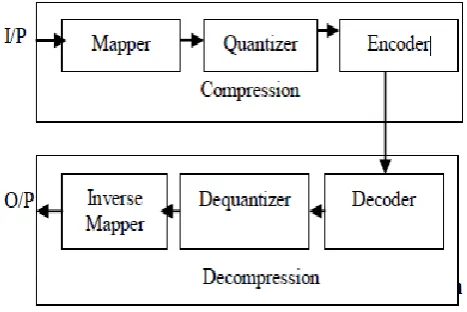
[image:1.595.306.540.300.456.2]in lossless compression. The motive of this
compression is to eliminate the redundant data in the
compression and also add them in the
decompression.GIF is an example of lossless images
compression.
fig 1. compression and decompression
A. Overview of Gradient based optimization and Edge
restoration method
a) Gradient based optimization
Any optimization method basically tries to find the
nearest/next best parameter(s) form the initial
parameter(s) that will optimize the given function
(this is done iteratively with the expectation to get the
best parameter(s) ).The optimization method that
uses gradient to get this parameter(s) is called
gradient based method. In gradient based
optimization, there is a high possibility that we might
stuck in a local minima/maxima when traversing
parameter(s). Gradient-based optimization can be
described as follows:
Compute a search direction.
Test for convergence
Update the design variables
Compute the step length
b) Edge restoration
© 2017, IRJET | Impact Factor value: 5.181 | ISO 9001:2008 Certified Journal | Page 1621
image. Corruption or noisy image can be noise
,
motion blur
and camera mis-focus. Image restoration
is designed to highlight the features of the image that
make the image more clearly to the viewer, but not
essentially to create accurate data from a scientific
point of view. The main goal of edge restoration
methods is to decrease noise and improve resolution
loss.
II.
Methodology
This offers the flow chart of the proposed algorithm. Figure 2 explain the different ways of attaining the data compression through planned algorithm standards.
Fig2: flowchart of proposed algorithm
Step 1: Firstly input the actual image.
Step 2: After step 1, SVD and WDR based compression is applied to the image.
Step 3: Implement gradient based optimization to the Outcome of step 2.
Step 4: To make use of edge preserving smoothing. Step 5: By using this process, final compressed image is
produced from step 4.
Step 6: And then, the actual parameters are generally calculated.
Step 7: End.
III .EXPERIMENTATION AND RESULTS
Each of the research is carried out using the Lena image (668× 586).
Fig:3 input image
The currentmethod (SVD-WDR) and the computed outcomes was as follow-:
Fig:4 output of existing techniquue
© 2017, IRJET | Impact Factor value: 5.181 | ISO 9001:2008 Certified Journal | Page 1622 Fig:5 output with the proposed technique
The latest proposed methodusing the integration of (SVD-WDR) together with the introduction of gradient optimization compressed without exploiting its visual quality.
Applying compression method by taking the various images and their quality is calculated by various performance parameters.
A.
PERFORMANCE ANALYSIS
This type of papers has created along with implemented the actual proposed technique within MATLAB tool u2013a. The proposed algorithm standard is actually tested upon different images. The algorithm is used by using various performance matrices that is Structural similarity index matrix (SSIM), Bit Error Rate(BER)to find out the evaluation in between compressed images depending on SVD-WDR compression as well as the proposed strategies which is depend on edge restoration for lowering of ringing artifacts on the images.
1) Structural similarity index matrix
[image:3.595.311.544.392.548.2]Structural similarity index matrix (SSIM) is a technique that computing the similarity in between two different images. The SSIM is observed as a quality measuring of one of several images being matched, offered the other image is considered as of excellent quality.
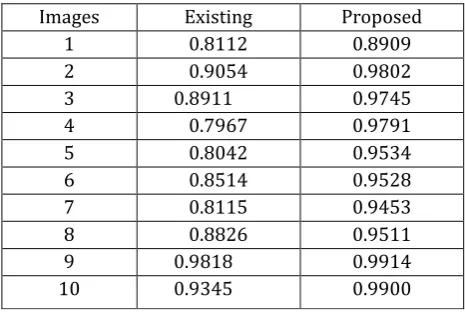
Fig 6indicates the exact evaluation of the SSIM associated with different images dealing with the SVD and WDR method through pre-existing method (blue color) along
with edge restoration method (red color)
Table 1: Structural similarity index matrix
Images Existing Proposed
1 0.8112 0.8909
2 0.9054 0.9802
3 0.8911 0.9745
4 0.7967 0.9791
5 0.8042 0.9534
6 0.8514 0.9528
7 0.8115 0.9453
8 0.8826 0.9511
9 0.9818 0.9914
10 0.9345 0.9900
Table1: implies that SSIM value in the images through the help of proposed method that compared with pre-existing method that results in decreasing of the artifacts within images.
2) Bit Error Rate
This is identified as the rate where the problems arise within the transmission system. This is immediately converted into the number of problems which arise inside the string of a stated range of bits. The definition of bit error rate is converted into a simple formula:
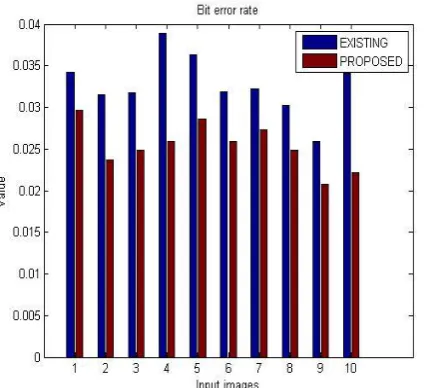
© 2017, IRJET | Impact Factor value: 5.181 | ISO 9001:2008 Certified Journal | Page 1623 Fig 7 indicates the exact evaluation of the BER associated
with different images dealing with the SVD and WDR method through pre-existing method (blue color) along
with edge restoration method (red color)
Table 2: Bit Error Rate
Images Existing Proposed
1 0.0342 0.0297
2 0.0315 0.0237
3 0.0317 0.0248
4 0.0389 0.0259
5 0.0363 0.0286
6 0.0319 0.0259
7 0.0322 0.0273
8 0.0302 0.0248
9 0.0259 0.0208
[image:4.595.61.275.98.292.2]10 0.0341 0.0222
Table 2: implies that BER value in the images through the help of proposed method that compared with pre-existing method that results in decreasing of the artifacts within images
IV.CONCLUSION AND FUTURE WORK
Transform-based compression is commonly usedfor image
compression.This paper proposed the latest algorithm by
using the SVD and WDR compression combined with edge
restoration technique. The newly proposed method utilized
the ordinary images for compression. The latest technique
decreased the ringing artifacts within compressed images and the actual result indicates better improvement. The SVD and WDR compression combined with edge restoration method is computed by using performance evaluation parameters (BER, SSIM).So the main improvement in BER is 0.00732 and in SSIM is 0.09385.
In near future to enhance the results further, some other gradient optimization based technique will also be used. Also proposed technique will be tested on medical and underwater images.
REFERENCES
[1] Yanxin, Yu, and Song Xue. "A remote sensing image
compression method suited to space-borne
application." In Computer Science and Network
Technology (ICCSNT), 2011 International Conference on, vol. 2, pp. 1132-1135. IEEE, 2011.
[2] Shen, Yu, XiepingGao, Linlang Liu, Caixia Li, and Qiying
Cao. "Integer to Integer multiwavelets for lossless
image compression." In Broadband Network and
Multimedia Technology (IC-BNMT), 2011 4th IEEE International Conference on, pp. 217-221. IEEE, 2011.
[3] X.Zhang, Lossy compression and iterative
reconstruction for encrypted image, IEEE Trans .Inf . Forensics Secur.6(2011) 53–58.
[4] Stamm, Matthew C., and KJ Ray Liu. "Anti-forensics of
digital image compression." Information Forensics and
Security, IEEE Transactions on 6, no. 3 (2011): 1050-1065.
[5] Boopathi, G., and S. Arockiasamy. "Image compression:
Wavelet transform using radial basis function (RBF)
neural network." In India Conference (INDICON), 2012
Annual IEEE, pp. 340-344. IEEE, 2012.
[6] Yue, Huanjing, Xiaoyan Sun, Feng Wu, and Jingyu Yang.
"SIFT-based image compression." In Multimedia and
Expo (ICME), 2012 IEEE International Conference on, pp. 473-478. IEEE, 2012.
[7] Pinto, Smitha Joyce, and Jayanand P. Gawande.
"Performance analysis of medical image compression
techniques." In Internet (AH-ICI), 2012 Third Asian
Himalayas International Conference on, pp. 1-4. IEEE, 2012.
[8] Huber-Lerner, Merav, OferHadar, Stanley R. Rotman,
and Revital Huber-Shalem. "Compression of
hyperspectral images containing a sub-pixel target." In Electrical & Electronics Engineers in Israel (IEEEI), 2012 IEEE 27th Convention of, pp. 1-5. IEEE, 2012.
[9] Huber-Lerner, Merav, OferHadar, Stanley R. Rotman,
and Revital Huber-Shalem. "Compression of
hyperspectral images containing a sub-pixel target." In Electrical & Electronics Engineers in Israel (IEEEI), 2012 IEEE 27th Convention of, pp. 1-5. IEEE, 2012. [10] Porwal, Janak. "A 3D→ 4D color space transform for
efficient lossless image compression." In Visual
Communications and Image Processing (VCIP), 2013, pp. 1-6. IEEE, 2013.
© 2017, IRJET | Impact Factor value: 5.181 | ISO 9001:2008 Certified Journal | Page 1624 [12] Ernawan, Ferda, NurAzman Abu, and Nanna Suryana.
"TMT quantization table generation based on psychovisual threshold for image compression." InInformation and Communication Technology (ICoICT), 2013 International Conference of, pp. 202-207. IEEE, 2013.
[13] Mousa, Hamdy M., Mostafa A. Ahmad, and Ashraf B. El-Sisi. "Image compression ratio enhancement based on
conformal mapping." In Computer Engineering &
Systems (ICCES), 2013 8th International Conference on, pp. 280-285. IEEE, 2013.
[14] Thepade, Sudeep D., Jaya H. Dewan, and Anil T. Lohar. "Extended performance comparison of hybrid wavelet transform for image compression with varying
proportions of constituent transforms." In Advanced
Computing Technologies (ICACT), 2013 15th International Conference on, pp. 1-6. IEEE, 2013. [15] Zhiqianga, Li, Sun Xiaoxin, Du Changbin, and Ding Qun.
"JPEG algorithm analysis and application in image
compression encryption of digital chaos."
InInstrumentation, Measurement, Computer, Communication and Control (IMCCC), 2013 Third International Conference on, pp. 185-189. IEEE, 2013. [16] Rufai, Awwal Mohammed, GholamrezaAnbarjafari, and
Hasan Demirel. "Lossy image compression using singular value decomposition and wavelet difference
reduction." In Digital Signal Processing 24 (2014):