© 2017, IRJET | Impact Factor value: 5.181 | ISO 9001:2008 Certified Journal | Page 1708
Study Of Arduino For Irrigation Based Control Using Android App
Pooja P. Karande1, Prachi N. Sawardekar2, Pooja B. Patil3, Z.J.Tamboli4 1Department of Electronics and Telecommunication Engineering Sanjay Ghodawat Institutions, Atigre 2Department of Electronics and Telecommunication Engineering Sanjay Ghodawat Institutions, Atigre 3Department of Electronics and Telecommunication Engineering Sanjay Ghodawat Institutions, Atigre 4Department of Electronics and Telecommunication Engineering Sanjay Ghodawat Institutions, Atigre
---***---Abstract -
The continuous increasing demand of thefood requires the rapid improvement in food production technology. In a Country like India, where the economy is mainly based on agriculture and climatic condition are isotropic, still we are not able to make full use of agriculture resources. The main reason is lack of rains and scarcity of land reservoir water. The continuous abstraction of water from Earth is reducing the water level due to which lot of land is coming slowly in the zones of un-irrigated land.
Key Words: GSM-Global System for Mobile
Communications, CDMA-Code Division Multiple Access, SDK-Software Development Kit,GPRS-General Packet Radio Service, MODEM-Modulator and DEModulator, UART-Universal Asynchronous Receiver/Transmitter, QEMU-Quick EMUlator, USB-Universal Serial Bus, UMTS-Universal Mobile Telecommunication Service,EDGE-Enhanced Data for GSM Evolution.SIM-Subscriber Identity Module.
1.INTRODUCTION: Another very important reason of this is due to proper management of water due to which a significant amount of water goes waste. At the present era, the farmers have been using irrigation technique in India through the manual control in which the farmers irrigate the land at regular intervals. This process sometimes requires more water or sometimes the water reaches late due to which the crops get dried.
Automated irrigation system uses valves to turn motor ON and OFF. These valves may be easily automated by using controllers. Automating farm or nursery irrigation allows farmers to apply the right amount of water at the right time, regardless of the availability of labor to turn valves on and off. In addition, farmers using automation equipment are able to reduce runoff from over watering saturated soils, avoid irrigating at the wrong time of day, which will improve crop performance by ensuring adequate water and nutrients when needed. Automatic irrigation is a valuable tool for accurate soil moisture control in highly specialized greenhouse vegetable production and it is a simple, precise method for irrigation. It also helps in time
saving, removal of human error in adjusting available soil moisture levels and to maximize their net profits.
2. Proposed System-
Fig.I:Proposed system
2.1 HARDWARE DETAILS:
2.1.1 GSM–
Global System for Mobile Communications, by using this technique more user could be accommodated within the available bandwidth.
At present the GSM module is used for Remote Control activities such as Gate Control, Temperature Control etc. GSM/GPRS module consists of a
© 2017, IRJET | Impact Factor value: 5.181 | ISO 9001:2008 Certified Journal | Page 1709 a cellular network, for establishing communication
between the cellular network and the computer. These are manufactured for specific cellular network (GSM/UMTS/CDMA) or specific cellular data standard
(GSM/UMTS/GPRS/EDGE/HSDPA) or technology (GPS/SIM). They use serial communication to interface with the user and need Hayes compatible AT (Attention) commands for communication with the computer (any microprocessor or microcontroller system).[1]
Fig.II: GSM module structure
2.1.2 Arduino–
Arduino is set of development boards that come with pre-tested libraries. The boards are build around AVR microcontroller as base, software libraries to run on the boards are written and made available for free.
2.2 SOFTWARE DETAILS:
2.2.1 Android Software development kit –
Android software development is the process by which new applications are created for the Android operating system. Applications are usually developed in the Java programming language using the Android Software Development Kit. The Android software development kit (SDK) includes a comprehensive set of development tools. These include a debugger, libraries, a handset emulator based on QEMU, documentation, sample code, and tutorials. The SDK also supports older versions of the Android platform in case developers wish to target their applications at older devices. Development tools are downloadable components, so after one has downloaded the latest version and platform, older platforms and tools can also be downloaded for compatibility testing.
© 2017, IRJET | Impact Factor value: 5.181 | ISO 9001:2008 Certified Journal | Page 1710 Fig.III.: Sample of android app
The android app consist of farm1, farm2, farm3 etc. Let us consider farm1, in this we can see the electricity status, motor status & motor condition. Also we can find the last updated time of motor. We can start, pause & stop the motor using this app. The main advantages of this app is that we can give timer to the specific valve.
2.2.2 Code for android App.-
import android.content.Dialog Interface;
import android.widget,EditText;
import android.widget,TextView;
public class MainActivity extends AppCompatActivity
{
String phoneNo=”9912345678”;
Button start,stop,restart;
TextView tv1;
EditText txt1M,1S,2M,2S;
Int f=0;ff=0,k=0,l=0,m=0;
Protected void onCreate(Bundle savedInstance State )
{
Super.onCreate(savedIn savedInstance State );
smsManager=smsManager.getDefault():
start=(Button)findViewById(R.id.start);
stop=(Button)findViewById(R.id.stop);
restart=(Button)findViewById(R.id.restart);
stop.setOnClickListener(new OnClickListener()
{
Public void onClick(View v)
{
F=1;
Stop.setEnabled(false)
Restart.setEnabled(true);
}
Try
{
Ff=0;
if (v1 > 0 || v2 > 0) { if (v1 > 0) {
smsManager.sendTextMessage(phoneNo,
null, "*v1on#", null, null);
Toast.makeText(getApplicationContext(), "Request send for ON Volve 1.",
Toast.LENGTH_LONG).show(); startTimer(); }
if (v2 > 0) {
smsManager.sendTextMessage(phoneNo,
null, "*v2on#", null, null);
Toast.makeText(getApplicationContext(), "Request send for ON Volve 2.",
Toast.LENGTH_LONG).show(); startTimer1(); }
} }
© 2017, IRJET | Impact Factor value: 5.181 | ISO 9001:2008 Certified Journal | Page 1711 }
public void startTimer() { time = v1;
t = new Timer();
task = new TimerTask() { public void run() {
runOnUiThread(new Runnable() {
public void run() { if (f == 0) {
tv1.setText("TIMER 1 : " + time + " " + "TIMER 2 : " + time2 + " ");
if (time > 0) { time -= 1;
start.setEnabled(false); } else {
start.setEnabled(true); stop.setEnabled(true); t.cancel();
t.purge(); task.cancel(); k = 1; }
}
if (k == 1) {
smsManager.sendTextMessage(phoneNo,
null, "*v1off#", null, null);
Toast.makeText(getApplicationContext(), "Request send for OFF Volve 1.",
Toast.LENGTH_LONG).show(); k = 0;
} } };
if (f == 0) {
t.scheduleAtFixedRate(task, 0, 1500); }
}
public void startTimer() { time2 = v2;
t1 = new Timer();
task1 = new TimerTask() {
public void run() {
runOnUiThread(new Runnable() { public void run() {
if (f == 0) {
tv1.setText("TIMER 1 : " + time + " " + "TIMER 2 : " + time2 + " ");
if (time2 > 0) { time2 -= 1;
start.setEnabled(false); } else {
start.setEnabled(true); stop.setEnabled(true);
t1.cancel(); t1.purge(); task1.cancel(); l = 1;
} }
if (l == 1) {
smsManager.sendTextMessage(phoneNo,
null, "*v2off#", null, null);
Toast.makeText(getApplicationContext(), "Request send for OFF Volve 2.", Toast.LENGTH_LONG).show();
l = 0; } } };
if (f == 0) {
t1.scheduleAtFixedRate(task1, 0, 1500); }
} }
2.2.3 Humidity Settings Manager –
© 2017, IRJET | Impact Factor value: 5.181 | ISO 9001:2008 Certified Journal | Page 1712 Fig.IV .Flow chart of humidity
2.2.4 Automatic Motor Controller-
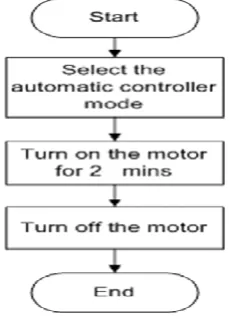
This module is used to control the pump automatically. The pump will be turned on automatically every day at a particular time for 2 minutes, immediately after 2 minutes the pump will turns off. The turning on and off of the pump will work regardless of the moisture rate around the field area. This automatic mode can be set by sending an SMS containing SET2 to the GSM modem in the embedded system connected to the pump.
Fig.V.Flow chart of Automatic Mode
3. Sensor:
3.1 Moisture
sensor-Fig VI. Moisture Sensor
Soil moisture sensors measure the water content in soil. A soil moisture probe is made up of multiple soil moisture sensors. Technologies commonly used in soil moisture sensors include:
Frequency domain sensor such as a capacitance sensor.
Neutron moisture gauges, utilize the moderator properties of water for neutrons.
Electrical resistance of the soil
Soil electrical conductivity is simply measured using two metal conductors spaced apart in the soil except that dissolved salts greatly alter the water conductivity and can confound the measurements. An inexpensive fix is to embed conductors in a porous gypsum block which releases calcium and sulphate ions to swamp the soil background level of ions. The water absorbed by the block is correlated with soil water potential over the range -60 to -600 kPa providing a tertiary indicator for use in medium to heavy soils. Non-dissolving granular matrix sensors are now available with a more exacting specification for the range 0 to -200 kPa and use internal calibration methods to offset variations due to solutes and temperature.
3.2 Current sensor-
[image:5.595.35.239.92.385.2] [image:5.595.103.218.571.731.2]© 2017, IRJET | Impact Factor value: 5.181 | ISO 9001:2008 Certified Journal | Page 1713 Current measurement is of vital importance in many
power and instrumentation systems. Traditionally, current sensing was primarily for circuit protection and control. However, with the advancement in technology, current sensing has emerged as a method to monitor and enhance performance
Fig.VII.Current Transformer
3.2.1 Current Sensing Principles:
A current sensor is a device that detects and converts
current to an easily measured output voltage, which
is proportional to the current through the measured
path.
4. Relays:
Relays are simple switches which are operated
both electrically and mechanically. Relays consist
of a n electromagnet and also a set of contacts. The
switching mechanism is carried out with the help
of the electromagnet. There are also other
operating principles for its working. But they
differ according to their applications. Most of the
devices have the application of relays.
Fig.VIII. Relay circuit
3. Conclusion-
© 2017, IRJET | Impact Factor value: 5.181 | ISO 9001:2008 Certified Journal | Page 1714
4. Acknowledgements-
The goal of this paper is to design “Android based motor control using Arduino and GSM module.” The function has been realized successfully. I wish to place on record my sincere thanks and whole hearted thanks to my guide Prof. Zareen J. Tamboli under whose supervision this dissertation work has been carried out. it was her keen interest encouraging disposition and full co operation that has made it possible for us to complete this work. I wish to place on record our sincere thanks and also acknowledgment and our indebtedness to Prof. Dr.S.R.Chougale HOD of ENTC department, whose critical analysis, careful comments and valuable suggestions have been immense help in completing this work. Lastly we are thankful to all those person ,who have contributed directly or indirectly in completion of this project.
5. References-
[1]. Chandrika Chanda, Surbhi Agarwal Proposed
scheme “A Survey of Automated GSM Based Irrigation
Systems” (ISSN 2250-2459, Volume 2, Issue 10, October 2012)
[2] .Veena Divya K member IACSIT ,Ayush Akhouri,
Chandan Kumar, “A Real time implementation of a GSM
based Automated Irrigation Control System using Drip Irrigation Metholog” International Journal of Scientific & Engineering Research, Volume 4, Issue 5, May 2013 ISSN 2229-5518
[3]. Mahir Dursun and SemihOzden, Wireless
Application of Drip Irrigation Automation Supported by Soil moisture Sensors, 1573-1582, April 2011.Shen Jin, Song Jingling, WanfShengde, Remote Measurement and Control System for Greenhouse Based on GSM_SMS,IEEE international conference on Electronic and Measurement ,2007.
BIOGRAPHIES-
[1]Pooja P. Karande, BE ENTC, Sanjay Ghodawat Institute, Atigre, Kolhapur.
[2]Prachi N. Sawardekar, BE ENTC, Sanjay Ghodawat Institute, Atigre, Kolhapur.
[3]Pooja B. Patil. BE ENTC, Sanjay Ghodawat Institute,Atigre, Kolhapur.
[4]Zareen J. BE ENTC, Sanjay Ghodawat Institute,Atigre, Kolhapur.
2nd Author
Photo
3rd Author
Photo 1’st Author