© 2018, IRJET | Impact Factor value: 6.171 | ISO 9001:2008 Certified Journal | Page 694
MOBILE WIMAX TECHNOLOGY
Arockia Panimalar.S
1, Abirami.P
2, Priyadharshini.P
3, Vijayabharathi.R
41
Assistant Professor, Department of BCA & M.Sc SS, Sri Krishna Arts and Science College, Tamilnadu
2,3,4III BCA Students, Department of BCA & M.Sc SS, Sri Krishna Arts and Science College, Tamilnadu
---***---Abstract – We grant a touch of cellular WiMAX and offer
the overall performance for the fundamental minimal configuration primarily based on the WiMAX discussion board release-1 machine profiles. The cell WiMAX can deliver tens of megabits in line with 2d of capacity consistent with channel from each base station with a baseline configuration. A number of the advanced capabilities consisting of Adaptive Antenna systems (AAS) which can notably improve the overall performance are mentioned however not included within the performance analysis. The excessive data throughput allows green records multiplexing and low records latency. Attributes allows the broadband information offerings inclusive of facts, streaming video and VoIP with high Quality of Service (QoS). The overall performance will permit transparency of high-quality of carrier among cell WiMAX and broadband stressed out services consisting of Cable and DSL, and crucial requirement for the success of the focused cell net utility for mobile WiMAX.
Keywords:
WiMAX, Quality of Service (QoS), AdaptiveAntenna Systems.
1. INTRODUCTION
Mobile WiMAX is a broadband wireless answer that allows convergence of mobile and stuck broadband networks through a not unusual significant place broadband radio get right of entry to technology and bendy community shape. The cell WiMAX Air Interface adopts Orthogonal Frequency branch more than one get proper of access to (OFDMA) for superior multi-path familiar common overall performance in non-line-of-sight environments. The mobile Technical group (MTG) inside the WiMAX discussion board is growing the cell WiMAX device profiles as a way to define the vital and non-obligatory capabilities of the IEEE general which might be necessary to construct a cell WiMAX compliant air interface that may be certified via the WiMAX dialogue board. The cellular WiMAX tool Profile enables cellular systems to be configured based totally on a not unusual base feature set for that reason ensuring baseline capability for terminals and base stations which may be fully interoperable. A few elements of the bottom station profiles are cantered as non-compulsory to provide more flexibility for deployment primarily based on specific deployment situations which could require special configurations which are both capacity-optimized and insurance capacity-optimized.
2. FEATURES OF WIMAX
2.1 High Records Charges
The inclusion of MIMO antenna techniques in conjunction with flexible sub-channelization schemes, advanced Coding and Modulation all enable the cellular WiMAX technology to aid top DL statistics charges up to sixty three Mbps in keeping with quarter and height UL statistics prices up to twenty-eight Mbps in step with quarter in a ten MHz channel.
2.2 Quality of Service (QoS)
The fundamental Premise of the IEEE 802.sixteen MAC structure is QoS. It defines carrier Flows which can map to Diffusers code points or MPLS go with the flow labels that enable quit-to-stop IP based totally QoS. Additionally, sub channelization and MAP-based signalling schemes offer a bendy mechanism for most effective scheduling of space, frequency and time sources over the air interface on a frame-by way of-body basis.
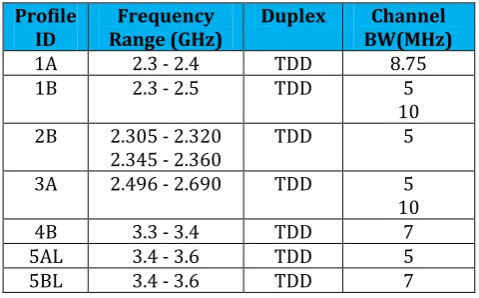
Profile
ID Range (GHz) Frequency Duplex BW(MHz) Channel
1A 2.3 - 2.4 TDD 8.75
1B 2.3 - 2.5 TDD 5
10 2B 2.305 - 2.320
2.345 - 2.360 TDD 5
3A 2.496 - 2.690 TDD 5
10
4B 3.3 - 3.4 TDD 7
5AL 3.4 - 3.6 TDD 5
[image:1.595.314.554.445.594.2]5BL 3.4 - 3.6 TDD 7
Fig 1: Mobile WIMAX Certification
A. Scalability
entry to in rural settings as opposed to enhancing the ability of mobile broadband access in metro and suburban areas.
B. Mobility
Mobile WiMAX enables schemes with latencies less than 50 milliseconds to ensure actual-time programs including VoIP carry out without provider degradation and flexible key management schemes assure that safety is maintained at some point of handover
3. PHYSICAL LAYER DESCRIPTION
3.1 OFDMA Basics
Orthogonal Frequency Department Multiplexing (OFDM) is a multiplexing technique that subdivides the bandwidth into multiple frequency sub-carriers. In an OFDM device, the enter records flow is divided into numerous parallel sub-streams of decreased data price (consequently expanded symbol length) and each sub-circulate is modulated and transmitted on a separate orthogonal sub-provider. The multiplied symbol period improves the robustness of OFDM to delay spread. Moreover, the introduction of the Cyclic Prefix (CP) can absolutely eliminate Inter-Symbol Interference (ISI) as long as the CP period is longer than the channel delay unfolds.
3.2 OFDMA Symbol Shape and Sub-Channelization
The OFDMA image shape includes three types of sub-providers:
i. data sub-carriers for records transmission.
ii. Pilot sub-vendors for estimation and synchronization functions.
iii. Null sub-companies for no transmission; used for guard bands and DC companies.
Using the brand new OFDMA calculator of ICS telecom, the consumer can outline:
i. The number of symbols in the OFDMA body (48 by means of default)
ii. The number of overhead symbols in the Downlink iii. The wide variety of overhead symbols inside the Uplink
iv. The UL/DL length ratio (1:1, 12:25, nine: 28…)
v. The variety of symbols blanketed in the Time Transition gap (TTG)
Based upon these inputs, the software program calculates the number of facts symbols used in DL and UL. The modulation and the amount of OFDMA information sub-providers used in keeping with body, ICS telecom automatically calculate the throughput in DL and UL
Fig 2: DL/UL Duration (1.00 in ICS Telecom)
Fig 3: DL/UL duration (0.5 in ICS Telecom)
Fig 4: DL/UL Duration (0.33 in ICS Telecom)
4. MAC
The MAC changed into designed mainly for the FMP (Factor-to-MultiPoint) wi-fi get admission to environment:
i. In place of a hard and fast 20 MHz bandwidth with fifty two subcarriers as in 802.eleven, WiMAX structures can use variable bandwidths from 1 to 28 MHz with 256 subcarriers (192 information subcarriers) in both certified and unlicensed spectrum.
ii. WiMAX supports sub channelization, which means that in place of transmitting on all 192 information subcarriers, you will transmit on only a subset. Using the same amount of energy over fewer vendors, the system achieves extra range. Because CPE is usually limited in energy, concentrating the electricity over fewer subcarriers inside the uplink can stability the electricity in the uplink and downlink, and allow greater range.
iii. The larger quantity of subcarriers gives WiMAX an advantage over 802.11. The resulting project to the machine design is that the subcarriers are spaced greater carefully together, so there are tighter necessities for section noise and timing jitter. This interprets to a want for higher overall performance synthesizers.
iv. WiMAX makes use of a variable-period guard c language to improve overall performance in multi-path environments. The protect c program language period is a time put off at the start of the packet to make amends for multi-direction interference. With a totally clear channel, the shield c program language period can be shortened, increasing the throughput.
[image:2.595.303.562.57.368.2] [image:2.595.311.559.275.321.2]5. MAIN ADVANTAGES OF MOBILE WIMAX
A) Advanced IP-Primarily Based Structure
WiMAX is a subsequent-era generation so one can facilitate the cell operators’ transition to all-IP networks. Mobile networks are also moving towards an IP center with the LTE and System Architecture Evolution (SAE) efforts. WiMAX completely underpins IMS2 and its 3GPP2 counterpart, Multimedia zone (MMD), rising counterpart so one can empower service carriers to present a broad variety of rich voice and data applications surprisingly and at a low negligible cost. With IMS and MMD, providers can build programs freely of the access generation inside a bendy layered architecture in which software modules might be without trouble changed or reused. The IP center community at the basis of WiMAX will simplify interworking with other IP technology. Support for IMS and MMD will similarly facilitate interworking and do away with current redundancies within the core network. At the start, WiMAX ought to be seamlessly included with present cellular networks
B) Bendy Channel Bandwidth
As the distance between a subscriber and the bottom station (or AP) increases, or because the subscriber begins to transport by using walking or driving in a vehicle, it turns into greater of a mission for that subscriber to transmit efficaciously back to the base station at a given strength degree. The IEEE 802.16-2004 and IEEE 802.16e requirements have bendy channel bandwidths between 1.five and 20 MHz to facilitate transmission over longer stages and to distinct styles of subscriber systems. In addition, this pliability of channel bandwidth is also important for cell making plans, in particular within the certified spectrum. With a devoted antenna, every region has the capacity to reach users with more throughputs over longer tiers than can an Omni-directional antenna. Netto-internet, bendy channel bandwidth is vital for cell making plans. The 802.16-2004 standards have strong industrial backing to go along with its technical abilities is going as much as dozens or loads of users, many greater customers have a tendency to collide.
C) QoS Robust Control
Several functions of the WiMAX protocol make certain sturdy best-of-carrier (QoS) safety for services which include streaming audio and video. As with another form of network, customers have to percentage the records potential of a WiMAX community, however WiMAX’s QoS functions allow service providers to manipulate the traffic based totally on each subscriber’s carrier agreements on a hyperlink-by-hyperlink basis. Service carriers can therefore fee a premium for guaranteed audio/video QoS, beyond the common records rate of a subscriber’s link. One thing of WiMAX QoS provisioning is a grant-request mechanism for letting customers into the community. This mechanism’s operation and value grow to be obvious from a contrast of WiMAX with
the CSMA/CD or CSMA/CA mechanisms utilized in LAN technology which includes 802.eleven. Whilst a CSMA/CA-primarily based wireless LAN has fewer than 10 customers in line with access factor, the community studies little contention for use of airtime. Occasional packet collisions occur, and that they require back-off and retransmissions, but the resulting overhead does not waste a significant amount of bandwidth. If the variety of CSMA/CA get admission to-factor customers again-off and retransmit information. In such surroundings, average community loading factors can easily enhance beyond 20 to 30 percent and customers note delays -in particular in streaming-media offerings. WiMAX avoids such issues via using a supply-request mechanism that allocates a small portion of each transmitted frame as a contention slot. With this contention slot, a subscriber station can input the network with the aid of asking the bottom station to allocate an uplink (UL) slot. The bottom station evaluates the subscriber station’s request inside the context of the subscriber’s provider-degree settlement and allocates a slot wherein the subscriber station can transmit (ship UL packets). The WiMAX supply request mechanism establishes a fixed overhead for airtime contentions and forestalls big numbers of subscribers from interfering with one another. Ordinary, the mechanism permits for a lot better usage of available channel resources. Even if a base station has hundreds of users and a high load thing, the network does not hamper with packet collisions and retransmissions. As more customers are part of a WiMAX network, the base station schedules the subscribers using dynamic scheduling algorithms that the carrier company can outline and regulate to reap the promised stage of carrier to each subscriber.
Any other aspect of WiMAX QoS provisioning is hyperlink-via-link facts-fee manageability. The sign power among base and subscriber stations impacts a wireless hyperlink’s records charge and capability to apply various modulation schemes within the 256 OFDM frameworks. Sign strength depends specifically on the space among the two stations. If the community had been constrained to an unmatched modulation scheme according to provider, subscribers which are farther away from the base station might limit the community’s capacity to use the greenest scheme. WiMAX enables optimization of each subscriber’s statistics rate by means of allowing the bottom station to set modulation schemes on a link-through-hyperlink basis.
D)Advanced Overall Performance
WiMAX meets all the requirements for cellular net get right of entry to. It supports a couple of handoff mechanisms, starting from difficult handoffs (with destroy-earlier than-make hyperlinks) to smooth handoffs (with than-make-earlier than-wreck links), energy-saving mechanisms for cell gadgets, superior QoS and low latency for improved guide of actual-time packages, and superior Authorization, Authentication, and Accounting (AAA) capability. The superior overall performance of cell WiMAX is basically tied to its use of OFDMA, a multiplexing approach well acceptable
to multipath environments that offers community operators higher throughput and ability, incredible flexibility in coping with spectrum assets, and improved indoor WiMAX performance is further improved via the use of Time Department Duplex (TDD), however it can moreover aid Frequency Division Duplex (FDD) which dominates in 3G networks. While FDD continues the uplink and the downlink channels separate infrequency, TDD is a much less complicated, extra efficient mechanism that makes use of a single frequency channel, with uplink and downlink web page site visitors separated thru a guard time.
E) Flexibility
WiMAX changed into designed from the floor as much as be an all-IP era that is optimized for high throughput, real-time information programs and that are not beholden to a legacy infrastructure. WiMAX can be deployed each in deployments, wherein network operators rely solely on WiMAX for the edge infrastructure, and in overlay or complementary networks, wherein operators embed WiMAX inside their networks to growth capability and throughput as essential to deliver proper wi-fi broadband provider. mobile networks based totally on GSM, CDMA, WCDMA and EV-DO use spectrum sources that are restrained and normally too luxurious for price powerful high ability and high-throughput broadband offerings. Cell WiMAX broadband networks provide provider companies a profitable version to installation a couple of fee-added offerings that deliver in extra sales streams. the extra price of bundling new mobile offerings with existing ones is low, as the operators already have an established dating with the subscriber and may leverage their existing marketing, branding and client provider operations to assist the new services.
Worldwide roaming amongst WiMAX service carriers will permit subscribers to access specific networks using the equal tool and a single, familiar interface. International roaming becomes a vital characteristic of the cell service imparting to be able to boom the splendour to the subscribers and generate additional revenues. if they provide access thru their companions using roaming agreements much like those in area for mobile networks, carrier carriers may be able to get the preferred footprint in their market without having to construct an in depth infrastructure. Cellular WiMAX may be deployed in numerous licensed bands (2.three GHz, 2.5 GHz, 3.3 GHz, and 3.4-three.8 GHz) with channel sizes starting from 3.five MHz to 10 MHz. This gives operators the flexibility to apply WiMAX in multiple spectrum bands and with the quantity of spectrum they have got.
F) Value Effectiveness
WiMAX meets the developing mass-market demand for cost-effective, high-throughput broadband Wi-Fi services. The commercial enterprise case for WiMAX is appealing as the cost of the equipment is kept low by way of a combination of interoperable additives primarily based on open
requirements, mass adoption of subscriber units, an attractive IPR shape, and a excessive base station capacity. In turn, its contained infrastructure charges and green spectrum utilization allow carrier vendors to deal with call for from the mass market, through supplying non-public broadband services at a fee point that each enterprise and customer customers will discover appealing. Interoperability brings greater alternatives to network operators and will increase competition among providers. Community operators aren't dependent on a single vendor to offer each base stations and subscriber units, or to determine the tempo and availability of improvements. The value of open-standards equipment tends to decrease rapidly with the increase in extent and the marketplace entry of excessive-volume, low-fee, and providers also is viable to make the combination of wi-fi and WiMAX in a single chipset.
G. Cost & CPE Availability
WiMAX backers regularly speak approximately Cheaper Patron premise Equipment (CPE) embedding WiMAX chips in laptops and cellular devices. But, delivery of this promise continues to be in its infancy. Even if available, early variations are probably to stay steeply-priced until economies of scale are realized. WiMAX continues to be on the hype level and operators want to tread cautiously before investing in a huge manner into setting up networks.
6. CAPACITY EVALUATION ANALYSIS
In evaluating the ability of a mobile WiMAX network, the amount of signal overhead must be considered. This signal overhead is not regular but adjustments with the number of users. In different words, as the subscribers may additionally have distinct talents in their supporting technologies the wished signalling system isn't like one subscriber to the opposite in both DL and UL. In addition, for the reason that gadget helps extraordinary QoS specs, distinct provider provision methodologies are used in resource allocations and scheduling tactics on a subscriber primarily based way. Consequently, the capacity to be had for records transmission is affected by the overhead because of the manipulate message whose size in flip relies upon on several elements together with the range of subscriber stations that are scheduled in a frame. In calculating the real throughput, the above conditions have been put into consideration in our analysis and some simple assumptions made inside the ability assessment are supplied.
6.1Modulation Distribution Assumption
The modulation distribution of the region below cowl must be to be had that allows you to correctly examine the potential of a base station. In keeping with the IEEE-802.16-2000 well known, aid for QPSK, 16QAM and 64QAM are mandatory within the DL with cellular WiMAX. Inside the UL, 64QAM is optional. Each Convolution Code (CC) and Convolution turbo Code (CTC) with variable code fee and repetition coding are supported.
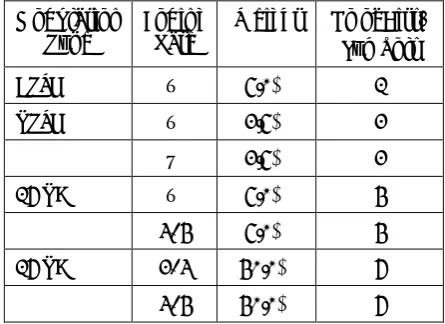
Table 1: Modulation and Coding Supported In Mobile WiMAX
Table 2: Modulation Distribution Assumption
Modulation
Type Coding Rate Weight No of Bits/ Symbols
BPSK ½ 5.0% 1
QPSK ½ 2.5% 2
¾ 2.5% 2
16 QAM ½ 5.0% 4
3/4 5.0% 4
16 QAM 2/3 40.0% 6
3/4 40.0% 6
The raw bandwidth of the DL channel is given by:
BW Raw = FFT Used x PK OCR Ts
7. CONCLUSION
In this paper, mobile WiMAX ability is expected. The algorithm for the calculation of the maximum quantity of customers in keeping with BS is evaluated and the impact of overhead is anticipated. Knowing that the capacity of any network is stricken by overhead, its effect is analyzed and shown because it influences capability calculation and estimation. The essence of Over head elimination technique is to estimate the exact available information price. For the estimation of the average ability, we assumed a modulation and an application distribution inside the region of hobby. With the understanding of the device’s raw capability and the effect of the overheads related to MAC and PHY layers on ability of cellular WiMAX, we have got simulated with our result displaying how the numbers of users are decreased when the data charge of consumer is expanded. We also predicted how the quantity of users increases while the channel bandwidth and cyclic prefix increased.
8. REFERENCES
[1] WiMAX Forum. (August 2006). Mobile WiMAX–Part 1: A technical overview and performance evaluation. [Online].
[2] Scalable OFDMA Engine for WiMAX Application, ALTERA White Paper–Version 2.1, May 2007.
[3]WiMAX Technology and Deployment for Last-Mile Wireless Broadband and Backhaul Applications.
[4] K. Leung, G. Dommety, P. Yegani, and K. Chowdhury, “WiMAX Forum/3GPP2 Proxy Mobile IPv4,” Internet-Draft, Work in Progress.
[5] WiMAX Forum Network Working Group, “WiMAX Forum Network Architecture - Stage 2: Architecture Tenets, Reference Model and Reference Points - Release 1, Version 1.2,” WiMAX Forum, January 2008.
[6] WiMAX Forum Network Working Group, “WiMAX Forum Network Architecture - Stage 3: Detailed Protocols and Procedures - Release 1, Version 1.2,” WiMAX Forum, January 2008.
DL UL
Modulation QPSK, 16QAM,
64QAM QPSK, 16QAM, 64QAM CC ½,2/3,3/4,5/6 ½,2/3,5/6 CTC ½,2/3,3/4,5/6 ½,2/3,5/6 Repetition X2,x4,x6 X2,x4,x6
[image:5.595.48.271.260.422.2]