ATTITUDE OF RICKSHAW PULLERS TOWARDS EDUCATION IN
RELATION TO THEIR LITERACY LEVEL AND ECONOMIC STATUS
Neeraz
Asst. Prof. In Guru Kashi University Talwandi Sabo, Bathinda, Punjab
Sanjay Chandwani
Asst. Prof. In Sadbhavna College of Education, Raikot, Punjab
The present study examined the Attitude of Rickshaw Pullers towards Education in Relation to their Literacy Level and Economic Status. The sample of 500 Rickshaw Pullers was selected purposively, 250 Rickshaw Pullers from Phagwara and 250 from Ludhiana. The sample mostly constituted illiterate or semi-literate people. So the investigator used un-structured interview schedule and rating scale. The face validity, content validity and spilt-half reliability of the interview schedule and rating scale was established by the investigator. The investigator used numerical and descriptive analysis of data between different variables like attitude towards education, literacy level and economic status under the study and found that most of the Rickshaw Pullers are illiterates and migrants from other states of the country for their bread and butter. It is found that most of the Rickshaw Pullers earn in the rage of rupees 4500-6000 per month, but it is a matter of grief that a major part of their income falls into the pocket of the owner of the Rickshaws. Although the centre as well as state governments have launched some schemes and programmes for the welfare of the rickshaw pullers, yet they are not fully aware of the schemes. The literacy level of the rickshaw pullers is very low. About 70% are just like illiterates. Rest of the 20% having Elementary education whereas about 10% are Secondary, Senior Secondary and Graduates. A marginal negative correlation was found between the level of literacy among rickshaw pullers and their attitude towards education. There is a moderate positive correlation between the education of the rickshaw pullers and their economic status.
INTRODUCTION
In the ancient period (Vedic period) the society was classified on caste basis viz. Brahmin, Kshyatriya, Vaishya, and the Shudras. As far as education was concerned these classes were imparted education according to their specified areas of work. The Bharmans being upper class were given education related to religion and philosophy, the Kashatriyas being warrior class were trained in warfare, the Vashayas being business class were trained in trade while Shudras were generally kept away from the field of education. With the passage
of time, the lower classes did not get ample opportunities to acquire basic education and further employment in spite of being provided numerous incentives by the successive governments. As a result the uneducated and financially poor sections of people chose to do the manual work to earn their livelihood. Rickshaw pulling is one of such occupations, which is opted by a number of such people. Rickshaw pullers come from very poor economic backgrounds consistent with the characteristics of chronic poverty. It would come as surprise to many people that some of the rickshaw pullers are graduates, and still they have not got a better job than pulling rickshaws.
Basically there are two categories of rickshaw pullers: self owned rickshaw pullers and rickshaw on rent. Self owned rickshaw pullers are those who have their own rickshaws. Since most rickshaw pullers do not have their own rickshaw, they get on rent. They have to pay a part of their hard daily earnings to the owners and are often exploited. In this way the little earned money does not fulfill the demand of the family, which forced the other members of the family to adopt other means for earning. Most of the women of rickshaw pullers are confined to their own homes. Their work is to cook food, wash cloth and looking their children. Ninety percent of women of the rickshaw pullers are illiterate. Their children couldn’t go to good schools for proper education and many of them suffer from malnutrition. As the rickshaw pullers are not aware of the family planning measures, they tend to have a number of children, which they can hardly afford.
As we see, the rickshaw pullers belong to the lower section of the society. In search of livelihood, they venture into urban and semi- urban areas to make their both ends met. Generally, they belong to the unskilled labour class, which in the absence of adequate job opportunities in the countryside, frequently keep on moving to cities. As pulling of rickshaw does not require any particular skill, most of them get absorbed in this occupation by compulsion of earning livelihood. The present study will be carried out to analyze the various social, educational and economical aspects, which influence the attitude of the rickshaw pullers towards the education.
Scholars Siddiqui, Alamgir and Huq (1990), Afsar,Rita and Hossain (1992), emphasized that rickshaw pullers are mostly migrated from other states, they come for other states for the employment pupose, 20 percent were mostly labourers and workers, some of the rickshaw pullers generally found remunerative occupations. They live in chaotic conditions, insanitation in slum areas, which posed many challenging problems related housing and health socio-economic, cultural and political aspects.
Sen and Begum (1998) concluded in their study that most of the rickshawpullers joined that occupation relatively recently (in last five years) came from higher educational backgrounds than those who have been pulling rickshaws 15 years or more and these groups represent two socially distinctive waves of migrants. Two-third of recent rickshaw pullers is un-educated, compared to 83 percent of the older generations. They are mostly un-educated 58 percent or semi-educated, having never completed primary-level education 17 percent of the remaining, 25 percent, only 2.5 percent reported having finished secondary school, all others either completed primary school but did not continue 9 percent complete secondary education 13 percent. In both respects, rickshaw pullers belong to one to the most deprived social categories.
The economic factors such as unemployment, insufficient, residential accommodation, and meager income had compelled the slum dwellers to leave their native places and migrate to cities. A majority of the respondents in both settlements had first come alone. Later on they brought their families. A majority of them belonged to scheduled castes. They were engaged in low status occupation and their level of education was very low (Aggarwal and Singh 1999).
A study by Habib (2000) explored the fact that convulsion, severe aggression, severe depression, neural and motor problems, hyperactivity, compulsive behaviour and self-injurious behaviour were the main causes of psychotropic drug dependence in rickshaw pullers in Bangladesh. Salivation, frequent fainting, severe sleep disturbance, physical pain, nightmare, lack of concentration, compulsive behaviour, etc, were the associated causes of psychotropic drug dependence of rickshaw pullers.
The changing household fortunes in rural Bangladesh revealed that three major economic activities, employing more than 80 percent of adult sons, were skilled and semi-skilled labour (e.g. masonry and carpentry); wage work in the agricultural and non-agricultural sectors; and occupation such as rickshaw pulling / pushcart driving were investigated by (Sen and Binayak 2003). These occupations provide neither sufficient income nor livelihood security. Working adult daughters of rickshaw pullers were almost wholly employed in garment factories (92 percent), with 4 percent working as domestic help. The occupational profile of the rickshaw puller’s adult children indicates little likelihood of upward mobility.
A survey of rickshaw pullers in Dhaka city 527 rickshaw pullers studied by UNESCO (2006), the demographic and migratory nature of rickshaw pullers before they took up this occupation, their economic status, education background, previous occupation, willingness and preference to change their occupation through literacy/skills training. About 99.2 percent of the rickshaw pullers expressed their keen interest in literacy/skills for a new occupation.
After reviewing the related literature it is observed that lot of work has been conducted by Indian researchers on rickshaw pullers. It is observed that the different researchers such as Singh (1996), Sen and Begum (1998), Aggarwal and Singh (1999), UNESCO (2006) and Sharma (2007) have revealed significant positive relation between their economic status and literacy level.
The rickshaw pullers seem to be illiterate and unable to get some other good jobs. These rickshaw pullers are generally migrants and come from low educated strata of the country. Low literacy level among these rickshaw pullers is one of the major reasons that limit their socialization and pushing towards exploitation. Rickshaw pulling is seen as a menial job and perhaps nobody has ever recognized his or her contribution towards providing cheapest mode of transportation and saving the over polluted environment from further degradation. As most of them are illiterate, they are not aware about their rights and privileges, and are exploited in the hands of police, landlords and shopkeepers. The present study examined the Attitude of Rickshaw Pullers towards Education in Relation to their Literacy Level and Economic Status.
OBJECTIVES OF THE STUDY
2. To study the attitude of rickshaw pullers towards education.
3. To find out the relationship between the literacy level of rickshaw pullers and their attitude towards education.
HYPOTHESES OF THE STUDY
1. Majority of the rickshaw pullers have low level of literacy studying not more than primary school level.
2. There is significant positive correlation between the level of literacy in rickshaw pullers and their attitude towards education.
3. There is significant positive correlation between the economic status of the rickshaw pullers and their literacy level.
SAMPLE
The investigator intended to use simple random sampling technique but it could not be possible because the Muncipal Corporation of Ludhiana and Phagwara cities did not have the list of rickshaws registered in their office. So the investigator used purposive sampling technique to collect the data for the study. A sample of 500 rickshaw pullers was selected purposively for the present study, 250 rickshaw pullers each from the cities of Phagwara and Ludhiana of Punjab state. The sample mostly constituted either literate, illiterate or less educated people. So the investigator personally collected the data using un-structured interview schedule. First of all the rickshaw pullers were explained the purpose of interview being taken.Some of the rickshaw pullers were reluctant to respond to the questions asked, for the reason that they feared of being reported in the police station, or thought that they would be thrown out of the concerned area. On the other hand some of the rickshaw pullers were very excited to answer each and every question asked
TOOLS
Spearman-Brown prophecy formula. The reliability of the interview schedule of the two half –length test was found to be 0.89.The reliability of co-efficient of full length test was found to be 0.94. In the same manner the reliability of rating scale was also calculated and the co-efficient of rating scale full length test was found to be 0.97. The investigator used numerical and descriptive analysis data between different variables like attitude towards education, literacy level and economic status under the study.
RESULTS
1. Descriptive Analysis:
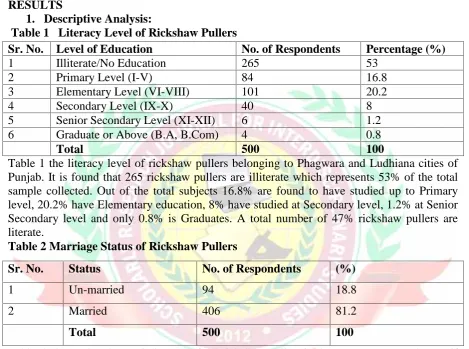
Table 1 Literacy Level of Rickshaw Pullers
Sr. No. Level of Education No. of Respondents Percentage (%)
1 Illiterate/No Education 265 53
2 Primary Level (I-V) 84 16.8
3 Elementary Level (VI-VIII) 101 20.2
4 Secondary Level (IX-X) 40 8
5 Senior Secondary Level (XI-XII) 6 1.2
6 Graduate or Above (B.A, B.Com) 4 0.8
Total 500 100
Table 1 the literacy level of rickshaw pullers belonging to Phagwara and Ludhiana cities of Punjab. It is found that 265 rickshaw pullers are illiterate which represents 53% of the total sample collected. Out of the total subjects 16.8% are found to have studied up to Primary level, 20.2% have Elementary education, 8% have studied at Secondary level, 1.2% at Senior Secondary level and only 0.8% is Graduates. A total number of 47% rickshaw pullers are literate.
Table 2 Marriage Status of Rickshaw Pullers
Sr. No. Status No. of Respondents (%)
1 Un-married 94 18.8
2 Married 406 81.2
[image:5.595.64.534.167.516.2]Total 500 100
[image:5.595.64.534.613.756.2]Table 2 shows that the marital status of the rickshaw pullers is shown. As everyone knows if the family size increases, the demand and needs of the family increase; this has direct load on income of a person. The table shows that 406 rickshaw pullers which are equal to 81.2 % stated that they are married but on the other side 94 respondents which are equal to 18.8% are un-married
Table 3 Rate of Migrant Rickshaw Pullers
Sr. No.
States
No. of Respondents (%)
1 Uttar Pardesh 118 23.6
2 Bihar 238 47.6
3 Haryana 18 3.6
5 Other States 8 1.6
Total 500 100
Table 3 relates that the rate of migrant or proportion of migrant from different states. All the rickshaw pullers are not the residents of Punjab. Only 23.6% are Punjabis. About 50% migrants belong to Bihar whereas 25% are from Uttar Pardesh. A small number of persons belong to Harayana and other states. It means that about 70% rickshaw pullers have migrated from the two states- Bihar and Uttar Pardesh. It shows that the poor economic conditions of these states compelled the people to find their ways and means to migrate to the industrial towns.
Table 4 Reason for Choosing Rickshaw Pulling an Occupation
Sr. No. Reasons No. of Respondents (%)
1 Have no Land 92 18.4
2 Did not get better job 152 30.4
3 Due to illiteracy 49 9.8
4 Due to poverty 207 41.4
Total 500 100
[image:6.595.64.531.72.121.2]Table 4 shows the reason for choosing rickshaw pulling as occupation to make their livelihood. About 18.4% rickshaw pullers express that they have no land to cultivate in their native states, whereas 30.4% say that they don’t get any better job than rickshaw pulling. Some 9.8% stated that they are illiterate and 41.4% are compelled to adopt this occupation due to poverty. This shows that poverty, illiteracy and no chance for better jobs forced them to adopt this occupation, a job that needs no specific skill or talent.
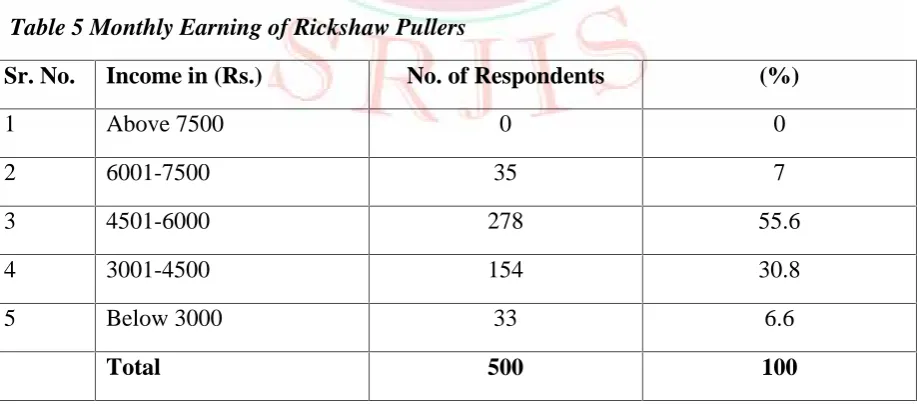
Table 5 Monthly Earning of Rickshaw Pullers
Sr. No. Income in (Rs.) No. of Respondents (%)
1 Above 7500 0 0
2 6001-7500 35 7
3 4501-6000 278 55.6
4 3001-4500 154 30.8
5 Below 3000 33 6.6
Total 500 100
[image:6.595.71.531.246.434.2] [image:6.595.70.529.512.714.2]and 6.6% below Rs. below 3000. The table shows that 86.4% belongs to the class interval income range of Rs. 3000-6000. If a person pays a little amount of rent in the industrial cities, it can be imagined how he can get balance diet to keep him fit and be ready to pull rickshaw to carry a load for the next day, and maintain his rickshaw in good condition. But compulsions of lives as poverty, illiteracy and social obligations towards parents and family compel them to remain in this critical condition. This may also be the reason why they are unable to choose another occupation and continue to be in the same job.
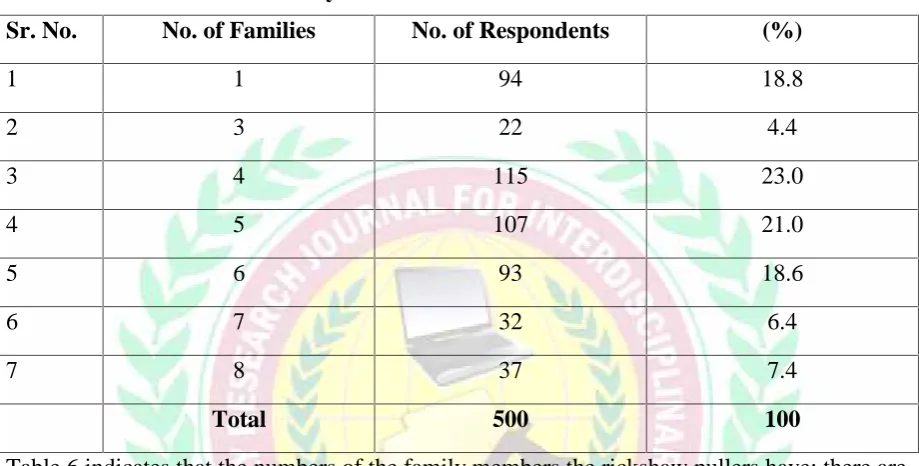
Table 6 Total Number of Family Members of Rickshaw Pullers
Sr. No. No. of Families No. of Respondents (%)
1 1 94 18.8
2 3 22 4.4
3 4 115 23.0
4 5 107 21.0
5 6 93 18.6
6 7 32 6.4
7 8 37 7.4
[image:7.595.69.529.187.420.2]Total 500 100
Table 6 indicates that the numbers of the family members the rickshaw pullers have; there are 18.8% rickshaw pullers who are un-married. Twenty two respondents which is equal to 4.4% have families have three members whereas 23% having four family members. On the other hand there are 21% families having five members in each family. Whereas seven and eight members belongs to there are 6.4% and 7.4% families respectively.
Table 7 Engagement of Rickshaw Pullers in other Part Time Jobs
Sr. No. Enrollment No. of Respondents (%)
1 Part time job 23 4.6
2 Pulling Rickshaw 477 95.4
Total 500 100
[image:7.595.66.540.697.755.2]Table 7 enlists that 95.4% rickshaw pullers earn their income by pulling rickshaws in both the industrial cities Phagwara and Ludhiana. But 4.6% rickshaw pullers seem to adopt this occupation to enhance their income by using rickshaw as a tool of income as part time. Their major income depends upon other occupations rather than rickshaw pulling.
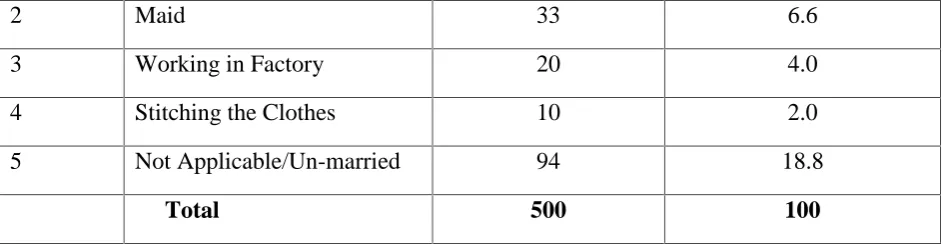
Table 8 Working Status of Wife
Sr. No. Working as No. of Respondents (%)
2 Maid 33 6.6
3 Working in Factory 20 4.0
4 Stitching the Clothes 10 2.0
5 Not Applicable/Un-married 94 18.8
Total 500 100
In table 8 the status of the wife indicates 343 wives of rickshaw pullers are housewives, they keep themselves in the four wall of the house. They don’t participate to enhance the income of their husbands. Only 6.6% wives serve other families as maid, 4.0% working in the factories and 2.0% enhance their income by stitching the clothes. It can also be observed that 94 rickshaw pullers i.e.18.8% is un-married.
Table 9 Fulfillment of Family Needs by Earnings
Sr. No. No. of Respondents (%)
1 Easily Manage 236 47.2
2 Cannot Manage 264 52.8
Total 500 100
[image:8.595.67.539.72.194.2]In table 9 the fulfillment of family needs by their earnings are recorded, which clearly indicates that 47.2% of the rickshaw pullers are satisfied with their income. In table 3 the picture is very clear that 7% falls in the range of Rs. 6000-7500 and 55.6% falls in the income group of 6000-4500. In table 6 it is clear that the wives of 6% rickshaw pullers are maid, 4% working in factories whereas 2% doing the job stitching of clothes. But table 6 it tells us that 18.8% is un-married. In this way 31% wives of rickshaw pullers are helping their families to decrease the finical burden on the rickshaw pullers and that may be the main reason 47.2% rickshaw pullers recorded their ideas that they are satisfied and can easily manage their family needs. On the other hand the group with earnings of Rs. 6000-7500 and 6000-4500 constitute a total percentage of 62.6%. Their earnings also satisfy some of these groups. But as a whole one can judge that they have not tasted the fruit of standard of living and competition of life due to their illiteracy and poverty. On the other hand those rickshaw pullers who are having Elementary Education, Secondary, Senior Secondary and Graduation seem to be not satisfied with their earnings.
Table 10 Status of Opening an Account in a Bank
Sr. No Status No. of Respondents (%)
1 Have an account 56 11.2
2 No account 444 88.8
Total 500 100
[image:8.595.65.530.626.724.2]their accounts in banks. It depicts the financial status and the rate of their savings, which directly or indirectly influences the lives of rickshaw pullers. Only 11.2% are able to deposit their savings in the bank. The rest of them spend their earnings to make their both ends meet.
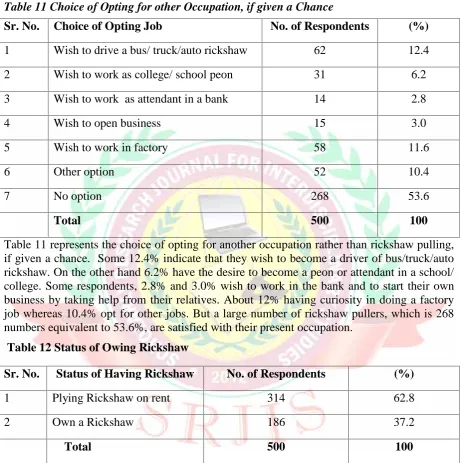
Table 11 Choice of Opting for other Occupation, if given a Chance
Sr. No. Choice of Opting Job No. of Respondents (%)
1 Wish to drive a bus/ truck/auto rickshaw 62 12.4
2 Wish to work as college/ school peon 31 6.2
3 Wish to work as attendant in a bank 14 2.8
4 Wish to open business 15 3.0
5 Wish to work in factory 58 11.6
6 Other option 52 10.4
7 No option 268 53.6
Total 500 100
Table 11 represents the choice of opting for another occupation rather than rickshaw pulling, if given a chance. Some 12.4% indicate that they wish to become a driver of bus/truck/auto rickshaw. On the other hand 6.2% have the desire to become a peon or attendant in a school/ college. Some respondents, 2.8% and 3.0% wish to work in the bank and to start their own business by taking help from their relatives. About 12% having curiosity in doing a factory job whereas 10.4% opt for other jobs. But a large number of rickshaw pullers, which is 268 numbers equivalent to 53.6%, are satisfied with their present occupation.
Table 12 Status of Owing Rickshaw
Sr. No. Status of Having Rickshaw No. of Respondents (%)
1 Plying Rickshaw on rent 314 62.8
2 Own a Rickshaw 186 37.2
Total 500 100
Table 13 shows that a large number of rickshaw pullers, which is 62.8%, are plying rickshaws on rent. But 37.2% are self-owners of rickshaws. This is a clear-cut picture that a part of a large number of rickshaw pullers earnings goes to the owner of the rickshaw. This factor directly affects the economical status of the rickshaw puller. The owners of the rickshaw treat them harshly when they show their inability to pay the rent of rickshaw. They abuse them and sometime they give slap on their mouth. They are ill treated in the society. Sometime the owners do not allow them to carry the rickshaw for pulling. In such cases, their conditions become critical. They become helpless and bow their heads before the owners.
Sr. No Status of Mobile No. of Respondents (%)
1 Own a Mobile Phone 319 63.8
2 No Mobile Phone 181 36.2
Total 500 100
[image:10.595.66.530.72.168.2]Table 13 shows the status of mobile phone possession. In a scientific era everyone desires to have a mobile phone in the society. Irrespective of age, job, social or economical status, mobile phone is becoming a need of everybody. It is helpful to increase ones income by saving time and means of transportation. That is why 319 rickshaw pullers which is equal to 63.8% have their own mobile phones to enhance their income. But 36.2% are found to be having no mobile phones.
Table 14 Awareness of National Rural Employment Guarantee (NREG) Scheme
Sr. No Awareness of NREGA No. of Respondents (%)
1 Know about the scheme 37 7.4
2 Do not know about the scheme 463 92.6
Total 500 100
[image:10.595.68.533.178.760.2]Table 14 represents the information about the awareness of National Rural Employment Grantee Scheme provided by the launched by the central government to uplift the status of the poor sections of the society. Only 7.4% of the rickshaw pullers have the knowledge about is scheme, i.e. the grant of hundred days work and the wages to the rural people. But 92.6% are found ignorant about NREG scheme and they cannot get any benefit from this scheme due to their unawareness. Hence this scheme has no value for the rickshaw pullers to improve their economical status.
Table 15 Awareness of Various Schemes
Sr. No. Awareness of Govt. schemes No. of respondents (%)
1 Issuance of Registration & Identify Card 425 85
2 Construction of Rest House & Rickshaw Shed 411 82.21
3 Provision of Dispensary, Medical Facilities 55 11
4 Sanction of Loans on Easy Installments 377 75.4
5 Rural Landless Employment Guarantee Scheme 40 8.0
6 National Rural Youth for Self-employment 45 9.0
7 National Adult Education Programme 40 8.0
[image:10.595.74.529.472.756.2]9 Mid Day Meal Scheme 93 18.6
Table 15 depicts the picture of awareness about the various schemes launched by the center and states for the betterment of poor section of the society in the village and as well as cities. The data recorded shows that 85% of the rickshaw pullers have the knowledge of issuance of registration and identity card and they act upon the same. 82.21% use the facility of construction of rest house& rickshaw sheds, but only 11% know about the scheme like provision of dispensary and medical facilities. They have the knowledge of scheme of sanction of loans on easy installments, (75.4%) but give the adverse remarks that these schemes are only in papers. In reality none can get benefit from these schemes as the banks or the financial institutions through which these schemes are operated, demand surety bonds and even bribes. Being migrant from other states as well as belonging to poor families they feel helpless to complete the formalities, and hardly get benefit of this scheme. In this way this scheme has no value for them, although they have the knowledge about the same.
Only 8% of the rickshaw pullers know about Rural Landless Employment Guarantee scheme and 9% have the awareness of National Rural Youth of Self-employment programme. Eight percent of them show their interest in National Adult Education Programme, but they cannot get the benefit of this scheme because the rickshaw pullers occupation’s is not time bound. They work from morning to till mid-night and become exhausted. They have no spare time to become beneficiaries of the scheme.
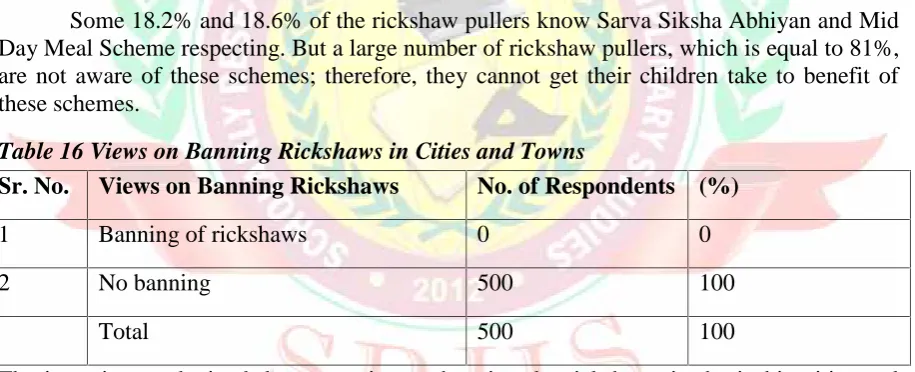
[image:11.595.73.531.358.544.2]Some 18.2% and 18.6% of the rickshaw pullers know Sarva Siksha Abhiyan and Mid Day Meal Scheme respecting. But a large number of rickshaw pullers, which is equal to 81%, are not aware of these schemes; therefore, they cannot get their children take to benefit of these schemes.
Table 16 Views on Banning Rickshaws in Cities and Towns
Sr. No. Views on Banning Rickshaws No. of Respondents (%)
1 Banning of rickshaws 0 0
2 No banning 500 100
Total 500 100
The investigator obtained the suggestion on banning the rickshaws in the in big cities and towns, due to congestion in the market and traffic problems. Surprisingly, all the rickshaw pullers the cent percent, were of the view that it is a matter of their bread and butter. If the rickshaw is banned then they will only add to unemployment problem of the nation. On the other hand they stated that rickshaw pullers do not create the pollution problem, but the petrol/diesel-operated vehicles, do so.
2. Testing of Hypothesis
In order to see the correlation between pertinent variables related to the rickshaw pullers, three hypotheses were formulated. The testing of hypotheses and their interpretation are presented below:
Hypothesis 1
It may be seen from the table 1 earlier that most of the rickshaw pullers i.e. 349 of the total 500 i.e. about 70% are either illiterates or have studied up to primary level (class I-V) only. Some of them might have even dropped before class V and can be treated as illiterates. So a large chunk of the rickshaw pullers are like illiterates. So the hypothesis above that a majority of the rickshaw pullers has low level of literacy stands accepted. Although on the other hand about 2% of the rickshaw pullers have studied beyond senior secondary class, the figure does not hold any significance. This small number of educated people resorting to rickshaw pulling job may be due to the lack of employment opportunity in skilled occupations, or the people have not undergone any kind of special training making them potential workers in other field. There may also be lack of awareness among the poor and unemployed about the kind of opportunities in different fields and the government schemes providing training in skilled occupations. This is explanation is also supported with the explanation made earlier regarding the awareness of some government schemes.
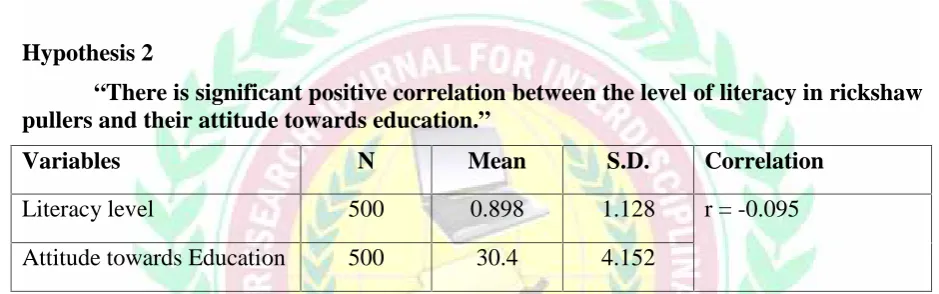
Hypothesis 2
“There is significant positive correlation between the level of literacy in rickshaw pullers and their attitude towards education.”
Variables N Mean S.D. Correlation
Literacy level 500 0.898 1.128 r = -0.095
Attitude towards Education 500 30.4 4.152
The table shows that there is a negative relationship between attitude of rickshaw pullers and their literacy level. The Mean score of literacy level of rickshaw pullers is 0.898 and attitude towards education is 30.4. Their respective S.Ds are 1.128 and 4.152. Although the obtained negative correlation can be treated as just neglible or having no correlation, the two variables, literacy and attitude of rickshaw pullers do not show any relationship. The literacy data of the rickshaw pullers shows that 265 counts are fully illiterate and 84 counts are primary school educated. Since as much as 349 or 70% of rickshaw pullers are either illiterate or just having primary education, it is likely that they might not have reflected a positive view on education, or have shown them just neutral. Without expressing any concern of education, probably they are more concerned with their occupation, their daily bread and butter (struggle for survival) than anything else. Hence the marginal negative correlation or almost zero correlation between literacy level and attitude towards education of rickshaw pullers.
Figure 4.2.1
[image:12.595.61.531.258.405.2]0 . 8 9 8
3 0 . 4
0 5 1 0 1 5 2 0 2 5 3 0 3 5
L i t e r a c y l e v e l A t t i t u d e t o w a r d s E d u c a t i o n
No .of ric ks ha w pu lle rs
M e a n
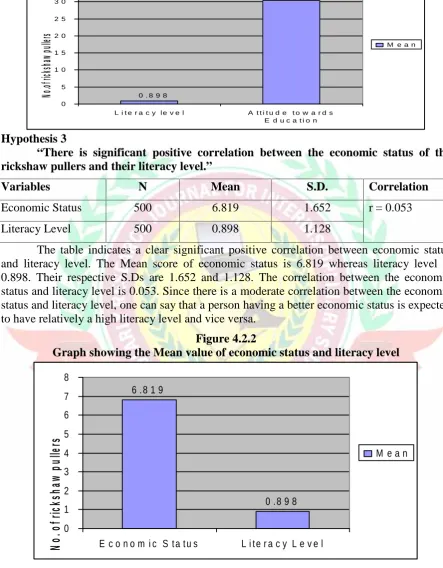
Hypothesis 3
“There is significant positive correlation between the economic status of the
rickshaw pullers and their literacy level.”
Variables N Mean S.D. Correlation
Economic Status 500 6.819 1.652 r = 0.053
Literacy Level 500 0.898 1.128
[image:13.595.71.515.98.667.2]The table indicates a clear significant positive correlation between economic status and literacy level. The Mean score of economic status is 6.819 whereas literacy level is 0.898. Their respective S.Ds are 1.652 and 1.128. The correlation between the economic status and literacy level is 0.053. Since there is a moderate correlation between the economic status and literacy level, one can say that a person having a better economic status is expected to have relatively a high literacy level and vice versa.
Figure 4.2.2
Graph showing the Mean value of economic status and literacy level
6 . 8 1 9
0 . 8 9 8
0 1 2 3 4 5 6 7 8
E c o n o m i c S t a t u s L i t e r a c y L e v e l
N
o
. o
f r
ic
ks
h
aw
p
u
lle
rs
M e a n
Conclusions
Conclusions derived from the present study are:
the industrial towns for their bread and butter. They try their luck in getting some work in factories, schools, colleges or with landlords for manual work. They also approach their friends (if they have) to help them in this regard. If they do not get any help from any side, they take up the job of rickshaw pulling usually by getting a rickshaw on rent basis. This becomes an easy way for them to earn a meal.
2. Most of the rickshaw pullers, about 55.6% earn in the range of rupees 4500-6000 per month, but it is a matter of grief that a major part of their income falls into the pocket of the owner of the rickshaws. Thus they remain in the grip of poverty, despite working from morning till mid-night. They have to pay a part of their income to the police also on many occasions. In order to supplement their income, in some cases the wives of the rickshaw pullers enhance their income by doing jobs in factory, as maid or stitching clothes, but, this number is negligible (12.6%).
3. Although the centre as well as state governments have launched some schemes and programmes for the welfare of the rickshaw pullers, yet they are not fully aware of the schemes due to illiteracy and unable to get the benefit offered by those schemes. A number of rickshaw pullers wish to get the benefit from the scheme like, “Sanction of loans on easy installments” but the process of getting loan from the banks and financial institutions is a biggest problem for them, as the red tapism plays a vital role for the sanction of the loan.
4. The literacy level of the rickshaw pullers is very low. About 70% are just like illiterates. Rest of the 20% having Elementary education whereas about 10% are Secondary, Senior Secondary and Graduates.
5. A marginal negative correlation was found between the level of literacy among rickshaw pullers and their attitude towards education. It seems that because of their illiteracy, they do not attach any value to education. Moreover they are more concerned with their job (daily bread and butter) than education.
6. There is a moderate positive correlation between the education of the rickshaw pullers and their economic status. In other words, the higher the literacy/ education level of a person he / she is expected to have relatively a better economic status.
Bibliography
Afsar Rita and Hossain (1992) Urbanization and Urban Poor in Bangladesh: Issues, Trends and Challenges, Environment and Urbanizationhttp://eau.sagepub.com/
Aggarwal K B and Singh Harnek (1999) The City Slums: An Overview, Social Change (The Initiatives and Intervention) Social Sciences Abstracts, 23
Ahmed and Kazi (1997) Morbidity and disability patterns of destitute households in rural Bangladesh, 1994 and 1995 Monograph series 4 BBS Dhaka
Ansari M S (2006) NET/SLET Education Kalyani Publications : New Delhi.
Dandapani S (2003) Advanced Educational Psychology Anmol Publications: New Delhi 43-55
Gallagher (1992) Rickshaws of Bangladesh, Environment and Urbanization
http://eau.sagepub.com/
Garrett E Henry (2004) Statistics in Psychology and Education Paragon International Publishers 134
Habib(2000) Sexual Behaviour and HIV Knowledge among Long-Distance Truck Communication:[email protected]
John W B and Khan J V (2003) Research in Education Prentice Hall of India: New Delhi
Kothari C R (2004) Research Methodology Methods and Techniques International Publishers New Delhi
Koul L (2006) Methodology of Educational Research Vikas Publishing House: New Delhi 109-186
Mangal S S (2002) Advanced Educational Psychology Tandon Publications : Ludhiana.
Mathur S K (1993) Psychological Foundation of Education Parkash Brothers: Ludhiana 46-50
Mukherjee and Pradhan et.al (2008) Energy Expenditure of Cycle Rickshaw Pullers in Different Places in India Http:// www. Askcache.com
Pandey (1998) DNA Damage in Lymphocytes of Indian Rickshaw Pullers Measured by the alkaline comet assay Http:// www. Askcache.com
Sahu B K (2007) Statistics in Psychology and Education Kalyani Publishers : New Delhi 132-133
Sen and Begum (1998) Methodology for Identifying the Poorest Level, Environment and Urbanization 33-38
Sen and Binayak (2003) Drivers of Escape and Decent: Changing Household Fortunes in Rural Bangladesh, Environment and Urbanization 513-53
Shahriar 2005) Human Capital Base and Pattern of Employment: Evidence from Migrant Workers in Karnataka Social Action 55, 254-270.
Sharma (2007) Status of Rickshaw Pullers in Nepalhttp://72.14.235.132/
Siddiqui, Alamgir and Huq (1990) The Informal Sector Poor of Dhaka city, Environment and Urbanization150
Singh A P and Khosla M (2005) Educational Measurement and Evaluation Vinod Publications : Ludhiana
Singh J P (1987) Educational Differentials in Cityward Migration in India Man in India ICSSR 67, 23-35
Singh K (2003) Technique and Method of Social Survey Research and Statistics Prakashan Kendra : Lucknow 191-192
Trillin and Calvin (2008) Last Days of the Rickshaw National Geographic.
http://wwww.niaslinc.dk.
UNESCO (2006) Rickshaw Pullers in Dhaka Cityhttp://www.unesco.org.bd/
Walia J S (2002) Foundation of Educational Psychology Pal Publications : Amritsar.
Webpage
Http:// encyclopedia 2. the free dictionary.com
Http:// literacy. kent .edu/-nebraskar/research/
Http:// self-knowledge. com
Http:// www. Classism.org/ home- definition
Http:// www. Dictionary.com
http://eau.sagepub.com/