STATE FEEDBACK CONTROLLER AND OBSERVER
DESIGN FOR TCP NETWORK WITH CONSIDERATION
OF UDP FLOW
1
NOUREDDINE EL ALAMI,2RACHID ELLAIA,3KHALID LEFROUNI
1,2,3
Engineering Mohammadia School Mohammed V University Agdal, Rabat, Morocco. E-mail
:
1[email protected], 2 [email protected], [email protected]
ABSTRACT
In this paper we consider the phenomenon of congestion of a router in a communication network, initially, we propose a model of TCP based on the fluid flux model and, secondly, we propose a synthesis of an observer and state feedback to stabilize the system. In this study we have taken into account both the time variant delay and the perturbations due to UDP flow. Such traffic control will be implemented by a mechanism of Active Queue Management (AQM), located at the router.
Keywords: Delay-Dependent Stability, Linear Matrix Inequality (LMI), AQM, TCP network, Stabilization,
Time-Delay Systems.
1. INTRODUCTION
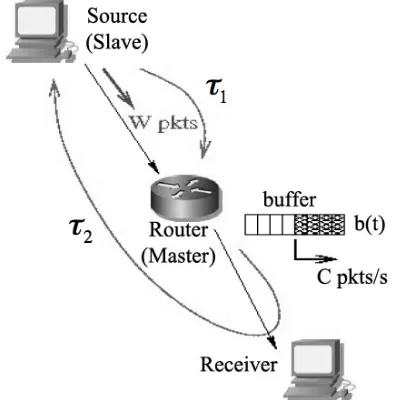
We were interested in this paper at the problem of sharing a communication link between several remote sources. This problem is represented schematically in Figure 1. Each slave has a different communication time according to the path taken by the connection and the delay associated, which leads to variable delays in the time. The denomination "slave" does not refer necessarily to a single machine, but possibly to a set of transmitters geographically close. Many studies have been conducted in order to ensure a certain level of service quality between network users. Indeed, the authors of [17] call the Nyquist criterion to adjust the parameters of RED and PI for an arbitrary number of sources and routers. However, this frequency method does not provide satisfactory results when delays become time-varying.
In [24], a predictive approach is used to compensate the delays. if this study provides a generic formulation of the synthesis of AQM, incorporating various mechanisms (RED, PI, PID with cost LQ), the control law is relatively "heavy" requiring multiple matrix calculations. Although interesting in theory, these methods are difficult to use in practice.
So many studies in the literature [21, 3, 5, 1, 18, 19, 4, 6] had considered the simplistic case where all sources have the same communication time, that is to say the same round-trip time (RTT). In this paper we considered the same case, but with a master-slave modeling taking into account the
[image:1.612.314.511.386.586.2]perturbations due to applications using the UDP protocol.
Figure 1: A single communication in the TCP network
2. MODELLING OF TCP TRAFFIC: THE FLUID-FLOW MODEL
2.1 Preliminaries
The dynamic model of the congestion window of a TCP source, developed by Misra et al [2], and which has been simplified by Hollot et al [18] is as follows:
(1)
where and are respectively the TCP window size, number of TCP sessions, link capacity, probability of dropping packets and the queue length. represents the round-trip time(RTT), and it is defined by
(2) (2)
where and represent respectively the time delay from the source to the router and from the router to the source via the receiver.
Remark 1 The delay contains the quantity
, and so it varies in time, the delay represents only the propagation time from the router to the source, therefore it can be considered constant. However, the constancy of delay is an assumption rarely verified in reality (see e.g., [13, 14, 11]), this leads to consider its potential variations, describing generally the latter by a continuous function of time. Once again, the case of variable delays was the subject of much research (see e.g., [12, 8, 23]).
In this paper, we consider the delay as a differentiable function bounded, which satisfies the following conditions :
(3)
where is a positive real, which represents the upper bound of the derivative of delay
2.2 The Linearized TCP Fluid Model
The operating point is defined by :
therefore, we find the two conditions :
(4)
where verifies the following equalities :
(5)
with denotes the propagation delay.
From the point of equilibrium , we approach the model (1) by the linear model :
(6)
For more details about the linearization, see [7, 9].
2.3 Augmented TCP Fluid Model
For controlling the TCP traffic, during the synthesis of the AQM, we will take into account the traffic unmodeled from applications using the UDP protocol. In order to reduce the effect of this perturbation, insensible to the loss of packets, we will add the term
d
(
t
)
to the dynamic of the queue.(7)
As a result, the linearized TCP Model (6) can be written as follows :
(8)
where is the state vector, is the input , and
.
let the new state vector, such as : .
Model (8) becomes
(9)
(9) where
3. CONTROL SYSTEM WITH OBSERVER
This section will be devoted to the development of a state feedback control, so we will first reconstruct the states of the output measured using an observer. Note that the choice of the observer is very important, seeing that the measured output reached the system with a delay .
Given this fact, and the assumption of linearity of the system, our attention has focused on the consideration of a Luenberger observer whose dynamics can be described by :
(10)
(10) where is a gain whose value to define, must
ensure a sufficiently fast convergence of the estimated state to the real state , in spite of variable delay affecting the measured output .
3.1 Synthesis of State Feedback Control Law
Our problem lies in the synthesis of the gains of the state feedback control and the observer, to ensure the asymptotic stability of the closed loop system and rapid convergence of the estimated state to the actual state of the system.
In the following, we developed conditions allowing the stabilization of the delayed system, then we determine the gains of state feedback stabilizing the system.
The control law developed by the router (Master) from the estimated state has the following form :
(11) where
K
is a linear gain allowing to ensure the asymptotic stability (closed-loop) of the linear system (9). However, we will be focusing first to studying the ideal controller , by considering a perfect observer (such as). Thus our system (9) becomes
(12)
where is the upper bound of the delay , and the function is assumed continuous and differentiable.
To determine the LMI conditions characterizing the asymptotic stability of system (12), we propose the Following theorem :
Theorem 1 Given a state feedback gain , the
system (12) is asymptotically stable, if there exist symmetric positive definite matrices
, and matrices , such that the following LMIs are feasible for
:
(13)
and
(14)
where
(15)
Proof : By writing the system (12) in the form of a model descriptor, we obtain :
Then, by posing and , the system (12) can be rewritten as follows:
(16) (16)
Consider then, following the example of [15], a Lyapunov Krasovskii functional defined by:
where
with
This functional is positive definite because we note that and is assumed to be positive definite.
We will now determine the derivatives of the three terms of V(t) :
using the expression given by (16), we find
otherwise expressed,
(17)
where and are respectively defined by :
Thus, by simple calculations, we find
(18)
Similarly, the derivative of the third term of is given by :
Considering the hypothesis on the upper bound of the derivative of the delay , we deduce
(19)
Substituting (17), (18) and (19) in the expression for the derivative of the Lyapunov functional Krasovskii, we obtain the following inequality:
We now substitute the term , for it, we apply the technique proposed in [22], which establishes for all vectors and for all matrices and
taking
we find :
which implies
(20) Substituting (20) in the expression of ,
after simplification of terms with an integral, we obtain
Then, applying the Schur complement, we find
where and is a matrix given by (13).
Therefore, if the LMIs defined by (13) - (14) are satisfied, then is negative definite.
As well, we have is positive definite, then the system (12) is asymptotically stable for a state feedback gain .
Remark 2 The LMIs conditions of Theorem 1 can
be used to determine the values of allowable delays for which the LMIs (13) - (14) are satisfied for a given state feedback gain .
Remark 3 As our objective is to synthesize a state
feedback control law ensuring the asymptotic stabilization of system (12). The next step is to determine the state feedback gain , thus we propose the following theorem.
Theorem 2 Suppose that, for a positive real ,
there exist symmetric positive definite matrices matrices of dimensions and a matrix of dimension
, satisfying the following LMIs:
(21)
(22)
where
the matrix is given by :
Then, for any delay of the form (3), the asymptotic stability of system (12) is ensured by the state feedback gain :
(23)
Proof : As we saw in the previous section that the conditions LMIs (13) - (14) are satisfied for a given . In this case is unknown, the condition LMI (13) becomes a BMI. We must therefore transform it to a LMI. For this reason, we apply the method proposed in [16]. The first step of this technique is to link the variables and as follows
(24)
and, for any matrix:
For we can define a new matrix
Then, we multiply LMIs (13) - (14), to the right by the matrix respectively left by , and we take
Finally, we obtain the conditions of stabilization provided by the LMIs (21), (22) of this theorem.
3.2 Observer Synthesis
As stated inthe introduction to this chapter, we will construct an estimate of the full state of the slave from the delayed output of the system. By assuming that the pair is observable and that the dynamic of the estimation error is governed by:
(25)
We therefore propose the following theorem, which ensures that the observed state converges quickly enough to the real state, despite the variable delay affecting the measurement.
Theorem 3 Suppose that, for a positive real ,
there exist symmetric positive definite matrices matrices of dimensions and a matrix of dimension
, satisfying the following LMIs:
(26)
(27) (27)
the matrix is given by :
Then the asymptotic convergence to 0 of the error is ensured by the gain
(28)
Proof : By writing the system (25) as a model descriptor, we obtain the following system
with
Considering now the same form of Lyapunov-Krasovskii functional as used in part 3.1, taking into account the variable delay . We thus obtain the following formulation:
with
where
Thus, by applying the same techniques used to prove Theorem 2, we find the LMI (26) and (27). Then by taking , we find the proof of this theorem.
4. ILLUSTRATIVE EXAMPLE
second time, assuming that , we determine the gain ensuring stabilization of closed loop system, in spite of the delay in the control loop, and the perturbation due to UDP flow.
We consider the system presented in [20], where :
with and for , we have , , .
By substituting in (9), we obtain :
(29)
Moreover, we consider that the lines of communication between the master (router) and slave (receiver), induce varying delays and
, characterized by the following values: - Maximum values of delays :
,
- Maximum values of derivatives of delays :
Thus by applying theorem 2 to the system (29) with adjustment parameter , and by using the toolbox of Matlab YALMIP, we can conclude that the LMI (21) and (22) are satisfied for symmetric positive definite matrices follows:
and
Then, by replacing the matrices and in (23), we find that the gain is :
(30)
Moreover, applying Theorem 3 to the system (12) with , we find that the condition LMI (26) is satisfied for the following symmetric positive definite matrices
with
(31)
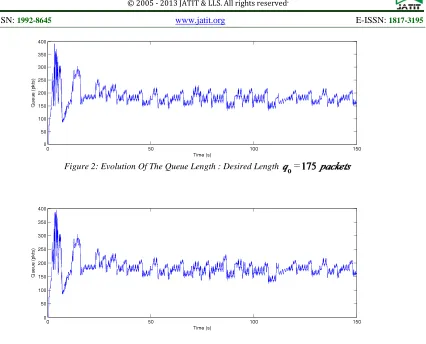
To illustrate the effectiveness of our approach, we use the network simulator NS-2 [10] , knowing that in our example the buffer size is 400, and that the average size of a packet is 500 bytes. Thus, considering the values (30) - (31), relating to gains of state feedback and of the observer, we obtain the Figure 2 illustrating the evolution of the size of the queue.
We can observe that our AQM allows efficient control and maintains the queue length close to its equilibrium value, in spite of the communication delays and .
We will now test the impact of the introduction of an additional traffic, insensible to packet loss, based on UDP. It is generated firstly with a flow of
, secondly with between 70 and 110 seconds. The simulation results given in Figures (3)-(4) shows that when the UDP traffic is intense, we see a slight increase in the queue length in relation to the equilibrium position
. However, once UDP communications have been completed, the operating point is quickly restored.
5. CONCLUSION
In this paper, we have discussed the phenomenon of congestion of router in the TCP network, by considering the case of slowly varying delays, bounded and asymmetric in the loops of control and measurement. Based on Lyapunov-Krasovskii functional and stability criteria defined in the forms of LMI, we have designed a state feedback controller with observer, ensuring asymptotic stabilization system. Finally, we have illustrated the viability of this approach through a numerical example. However, our hypothesis of a variable delay with a zero lower bound is unrealistic (equivalent to assuming that the data transfer through the TCP network can be done instantly) which can lead to a certain conservatism of the results achieved.
REFRENCES:
[1] Y. Fan, F Ren, and C. Lin. Design a pid controller for active queue management. IEEE
International Symposium on Computers and Communication (ISCC), 2:985–990, 2003. [2] V. Misra, W.-B. Gong, and D. Towsley.
Fluid-based analysis of a nerwork of aqm routers supporting tcp flows with an application to red. Proc. ACM SIGCOMM, pages 151–160, 2000. [3] Y. Ariba, Y. Labit, and F. Gouaisbaut.
Congestion control of a single router with an active queue management. International Journal on Advances in Internet Technology, 2(1), 2009.
[4] P. F. Quet and H. Özbay. On the design of aqm supporting tcp flows using robust control theory. IEEE Trans. on Automat. Control, 49:1031–1036, June 2004.
[5] C.K. Chen, Y.C. Hung, T.L. Liao, and J.J. Yan. Design of robust active queue management controllers for a class of tcp communication networks. Information Sciences, 177(19):4059–4071, 2007.
[6] S. Tarbouriech, C. T. Abdallah, and J. Chiasson. Advances in communication control networks. Springer, 2005.
[7] H. S. Low, F. Paganini, and J. C. Doyle. Internet congestion control. IEEE Control Systems Magazine, 22:28–43, Feb 2002.
[8] J. Newbury and K. Morris. Power line carrier systems for industrial control applications. IEEE Transactions on Power Delivery, 14(4):1191–1196, 1999.
[9] K. Fall and K. Varadhan. The ns manual, notes and documentation on the software ns2-simulator. URL: www.isi.edu/nsnam/ns/, 2002. [10] K. Fall, and K. Varadhan. ”the ns manual”,
notes and documentation on the software ns2-simulator. URL: www.isi.edu/nsnam/ns/, November 2011.
[11] E. Witrant, C. Canudas de Wit, and M. Alamir. Remote output stabilization under two channels time-varying delays. Proc. of the 4th IFAC Workshop on Time Delay Systems, 2004. [12] C. E. De Souza, R. E. Palhares, and P. L. D.
Peres. Robust h-infinity filtering for uncertain linear systems with multiple time-varying state : An lmi approach. Conference on Decision and Control, Proceeding of the 38th Conference on Decision and Control, 46(5):2023–2028, 1999. [13] I. Lopez, J. L. Piovesan, C. T. Abdallah, D.
Lee, O. M. Palafox, M. Spong, and R. Sandoval. Pratical issues in networked control systems. ACC’06, pages 4202 – 4207, 2006. [14] A. Seuret, F. Michaut, J. P. Richard, and
synchronization. American Control Conference, 49:American Control Conference, 2006.
[15] E. Fridman, and U. Shaked. An improved stabilization method for linear time-delay systems. IEEE Transactions on Automatic, 47:1931–1937, 2002.
[16] V. Suplin, E. Fridman and U. Shaked. Hinfty control of linear uncertain time-delay systems a pojection approach. Proc. of the CDC, 2004. [17] H. Han, C. V. Hollot, Y. Chait and V. Misra.
Tcp networks stabilized by buffer-based aqms. IEEE INFOCOM, pages 964–974, March 2004. [18] C. V. Hollot, V. Misra, D Towsley, and W.
Gong. A control theoretic analysis of red. IEEE INFOCOM, pages 1510–1519, April 2001.
[19] C. V. Hollot, V. Misra, D Towsley, and W. Gong. On designing improved controllers for aqm routers supporting tcp flows. IEEE INFOCOM, 3:1726–1734, April 2001.
[20] C. V. Hollot, V. Misra, D Towsley, and W. Gong. Analysis and design of controllers for aqm routers supporting tcp flows. IEEE Trans. on Automat. Control, 47:945–959, June 2002. [21] Y. Ariba, F. Gouaisbaut, and Y. Labit.
Controle de congestion d’un routeur par retour d’état. Conference International Francophone d’Automatique (CIFA’08), July 2008.
[22] Y. Moon, P. Park, W.Kwon, and Y. Lee. Delay-dependent robust stabilization of uncertain state delayed systems. International Journal of Control, 74:1447–1455, 2001. [23] Bugong. Xu. On delay-independent stability of
large scale systems with time-delays. IEEE Trans. Automat. Contr, 40(5):930–933, 1995. [24] K. B. Kim. Design of feedback controls
Figure 2: Evolution Of The Queue Length : Desired Length
Figure 3: Observer-Based State-Feedback : The Introduction Of UDP Flows ( ) Between 70 And 110 Seconds
[image:10.612.127.460.268.395.2]
Figure 4: Observer-Based State-Feedback : The Introduction Of UDP Flows ( ) Between 70 And 110 Seconds
[image:10.612.131.460.470.589.2]