DEVELOPMENT OF VIRTUAL MODEL CREATION SYSTEM
BY REAL-TIME FORCE FEEDBACK INTERACTIVE
TECHNOLOGY
QI BIN A,B, YU SUIHUAI A,*, HE WEIPING A, SUN XIAOMING B, FAN WEN A
a School of Mechanical Engineering, Northwestern Polytechnical University, Xi’an, China
b School of Agriculture and Food Engineering, Shandong University of Technology, Zibo,
China
ABSTRACT
The haptic-based sensing technology (HST) has the potential to be a powerful tool in Human-Computer Interaction (HCI). When developing a new product, the trend is to compress product development cycles and reduce costs. Virtual modeling, sometimes referred as digital prototyping, is widely used in industry for simulating the visual appearance and functionalities. Unfortunately, conventional virtual modeling techniques are hard to simulate the physical properties of a real product in user-to-product interactions. Force feedback, also called sensible feeling, is best envisaged as an evolution of virtual modeling. Thus, a novel haptic rendering technology that enables users to perceive tactile feedback from virtual 3-dimensional models is studied. We mainly carried out some innovative studies on the real-time force feedback in HCI by using sensing device based on the virtual model creation system (VMCS). With this in-depth research work, a virtual mechanics simulation model of the feedback force is proposed to solve the real-time force feedback simulation problem of haptic-based virtual model creation method. Finally, VMCS with real-time force feedback interactive technology is completed by using sensing technologies of haptic sensor devices. All these research works provide theories for the further application of virtual model creation method and HST in related industries.
Keywords: Haptic-based Sensing Technology, Haptic Device, Virtual Model Creation
1. INTRODUCTION
HCI is usually associated with the design of computer-based products and systems with focus on usability issues. What makes HCI a bit special in respect of designing computational things is the fact that programming defines acts of use in a sense. Human science covers a wide range of fields and many kinds of sensors are used in the area. The application field for the sensor will also expand in future [1-3]. Computational technology gives us a very rich material to express interaction design form. Consequently, the need to design and deploy new HCI for the computer aided industrial design (CAID) system is evident, especially in support of conceptual design. In addition, the use of CAID in conceptual design should allow designers to concentrate on the creative design aspects rather than applying themselves to the interaction constraints [4-7]. Modeling methods based on strict physical disciplines need much time to deform
objects, which are not suitable for interactive applications [8].
In this paper, we present the research work on HST such as 3D haptic interaction. In addition, HST is integrated and implemented with CAID application, exploring the efficacies of HST during the stage of the virtual model creation process. Some key techniques are also introduced to construct a simple and convenient system, including haptic properties satisfaction, force feedback interaction adjustment, and so on.
2. RELATED WORKS
2.1 Haptic device and mathematic model
since they resemble real physical tools that users are used to. Some professional companies, such as SensAble Technologies Inc., Force Dimension, Quanser and Haption, all have a series of mature commercial haptic products. For example, the PHANToM series devices have been the first commercial haptic products and are still the most popular devices. They are point-based devices having from 3 to 6 degrees of freedom (DOF) and using stylus or thimble as haptic interface [12].
Many Chinese universities and research institutes have done a lot of work in the development of haptic device. Southeast University develops a haptic feedback hand controller with 6-DOF. Tsinghua University develops a 3-DOF force feedback device. Robotics Institute of Beijing University of Aeronautics and Astronautics develops a 1-DOF force feedback interaction device. The Chinese Academy of Sciences Institute of Automation, Harbin Institute of Technology and other institutions also carries on some relevant researches on haptics. In comparison, these investigations are still in their infancy and needs greatly improvement in many performances.
As to the mathematic models (haptics algorithms), the terminology and fundamentals of haptics simulation were both detailed described [13]. A rather high force feedback updating rate, at the order of magnitudes of 1KHz, is necessary to achieve a convincing haptics feedback [14]. Hence, any attempts to emulate physical movement with updating rate less than 1KHz will result in haptics vibrations, leading to the uncomfortable perception of friction and general roughness depending on the frequency range. It is noteworthy that, this is far greater than the necessary threshold requirement for real-time visual display (up to 60 Hz) [15]. The technique of Qt-based virtual clay model system is an algorithm based on material removal rate force feedback rendering [16].
Virtual modeling with haptic rendering technique is concerned with the virtual shape modeling via haptic channel. Haptic modeling systems allow users to touch, feel, manipulate and model objects in a 3D environment that is similar to natural settings. Most of the applications are based on volume representation [17]. Some applications have been developed with the aim of providing haptic interaction with volume dataset, without actually providing realistic force feedback [18,19].
2.2 B-spline surface modeling
B-spline or NURBS surface models are widely used in current CAID applications [20]. Many kinds
of techniques are developed to improve the modeling and editing process. Sederberg et al. demonstrated a deformation method called free-form defree-formation (FFD) for global editing [21]. Coquillart extended this method for more general deformations [22]. Celniker applied finite element method to generate continuous deformable shapes [23]. Welch presented a variational surface modeling technique, allowing the user to define a set of constraints and then finding the solution by minimizing the surface area [24].
3. APPROACH OVERVIEW
3.1 Haptic rendering:
Force feedback is formulated based on the material removal at a given instance. The force can be considered to be proportional to the material removal rate (MRR). A dexel removal rate (DRR) algorithm is proposed to analyze the haptic sculpting force–torque feedbacks [25]. The haptic force response is calculated based on the DRR that is proportional to the dexel volume removal.
When the sculpting tool contacts and does not penetrate the virtual model surface, users can feel the information of the material properties without starting sculpting. In order to simulate this tactility touch feelings, a force can be defined with a range of distance. When the distance between the sculpting tool and the virtual model within the effective distance, it can be considered that the sculpting tool contacts the virtual model’s surface. A constant force like the tool touches virtual model is distributed to the user via PHANToM stylus as following:
f
=
const
(1) As for a uniform or a unique material object model, there is not any difference between MRRand DRR. A component force magnitude
f
can bedefined as proportional to the removed Dexel volume and given by the following formula
(
)
'(
area)
areaf
= ∆
k
xDx
=
kDx
∆ = ∆
x
k x
(2)Where
∆
x
is the height of the Dexel segment,area
Dx
is the cross-section of the Dexel elements,
k
is the predefined cross-section dependent forcecoefficient, and
k
'
is the cross-section independentforce coefficient.
are totally
n
kinds of materials removed in the current instance, the accumulated force feedback is calculated with'
0 0
(
0, 1, 2, ...)
n n
sum i i
i i
f
f
k x
n
= =
=
∑ ∑
=
∆
=
(3) W. Zhu and Y.S. Lee point out that the tool may collide with some environmental models other than the model being sculpted in a comprehensive virtual environment [26]. So, this introduces another problem, which is how to prevent user from penetrating other environmental models. Then the total force can be calculated as
total collision
f
= +
f
f
(4)The calculated force shown with Eq. 4 is distributed to the haptic arms and fed back to the user.
3.2 Haptic modeling:
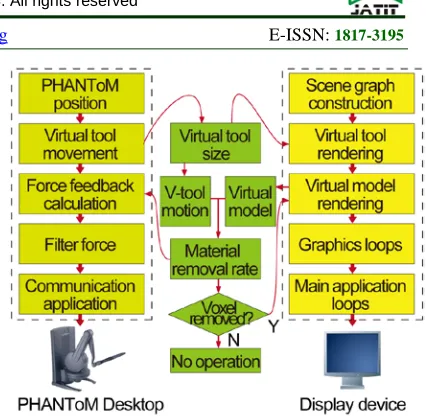
We present an effective framework for 3D virtual model creation environment with haptic interaction. It consists of two 6-DOF devices, Spaceball 5000 and PHANToM Desktop for controlling movement between the modeling tools and the virtual model in the virtual environment. The architecture of this approach is shown in Fig. 1, which consists of the following main components.
● Interaction tasks are assigned for two-handed
6-DOF manipulation with Force Feedback. Based on the analysis of main characteristics of virtual reality environment, we propose a series of classifications for two-handed interaction in virtual model creation, which have the extensive adaptability and usability for bimanual interaction tasks.
● Combinations of these interaction devices.
According to the task distributions for dominant and non-dominant hand, we dispose the conflictions between the interactive devices in our system.
● graphical user interface (GUI) and scene
graph are developed with Qt framework and Open Inventor toolkit.
● Our system can be used to perform a variety
[image:3.612.323.536.64.272.2]of tasks in virtual environments, such as moving, touching, and manipulating rigid or deformable bodies.
Fig. 1. Hierarchic Of Virtual Model Creation System
4. IMPLEMENTATION
4.1 Development platform
As mentioned above, VMCS is constructed with compacted voxel data structure and can be widely used for the product design, such as motorcar, toy, airplane, and so on. At the same time, development group also focuses a lot of attention with numerous troublesome on bugs getting fixed. We adopt MS VC++ 2005 as our integrated development environment (IDE), Open Inventor as the graphical kernel library, Qt framework as the user interface toolkit, and the OpenHaptics library as the haptic feedback function library.
4.2 Qt framework and open inventor toolkit Qt framework is used to develop GUI of VMCS. Qt’s cross-platform capabilities support ensures that Qt applications reach the widest possible market. Open Inventor toolkit is an object-oriented 3D toolkit and used for graphic rendering of different virtual scenes, offering a comprehensive solution to interactive graphics programming problems. The haptics effects, such as spring, damping and so on, are designed with the combination of widely used standard modules, OpenHaptics library. The realization of haptic interaction is adopted with PHANToM Desktop device.
4.3 Force feedback calculation
As to render the virtual force feedback, we calculate it with the following equation,
(
) /
feedback cut
F
= × ×
h
λ
V
t
(5)Where,
F
feedback is the result of force feedbackλ
is the system factors of haptic device;V
cut is the material volume cut by virtual modeling tool;and
t
is the modeling operation time. With Eq.5,haptic feedback can be calculated during the modeling process and transmit to user with PHANToM Desktop.
4.4 Application validate
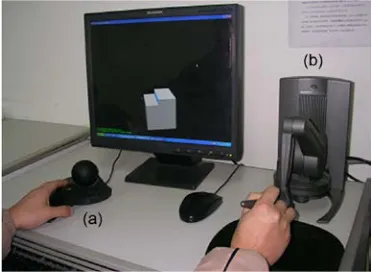
Fig. 2 gives the VMCS which support the 6 degrees of freedom haptic feedback in the Windows XP working environment. Operators (right handedness) was used his left hand to manipulated control ball of 3-D Spaceball mouse, controlled rotate modeling and transform view of the scene in the VMCS; right hand grasped the iron bar of haptic feedback PHANToM Desktop for modeling. This method can realized modeling tool random move and rotate as the real model creation process.
[image:4.612.105.291.308.444.2](A) Spaceball 5000, 3Dconnexion Inc.;(B) Sensable Phantom Desktop, Sensable Technologies Inc.
Fig. 2. VMCS Working Environments
With the incremental cutting, pasting or compensating functionality for rapid transitions between different modeling states, VMCS perfectly increases the modeling efficiency and flexibility. Also, some advanced features of the primitive and wire cutting tools, such as the removal of single layers from a virtual model, enhance the modeling procedure to a level of precision hardly achievable at this level of detail in real modeling. Models constructed with voxels can be exported as either triangular or tetrahedral meshes in .sxf2, .wrl (VRML) or .iv (Open Inventor) file format. The resulting work environment can be utilized beyond the targeted application of virtual model, for example, for the visualization and analysis of medical data.
5. CONCLUSIONS
The existing haptic-based sensing technology method has not introduced the controlling modeling process with haptic feedback. This paper describes a novel haptic human-computer interaction sensing method via two equipments: Spaceball 5000 and PHANToM Desktop. With the combinations of these two equipments and interactive assignment with right hand and left, we construct a haptic modeling system (VMCS), with 6-DOF controlling and force feedback functions. This system builds a virtual model creation environment and realizes the simulation of model creation process in reality. VMCS extends the current existing knowledge of CAID, effectively support the design process at initial stages. Therefore, VMCS can also support the domain of product design by informing users about the differences between real and virtual design.
The further development of the system is focused on increasing the usability and improving the realism of sensations. To increase the usability is to combine haptic rendering and haptic algorithm model modification to speed up the modeling process. As to the increasing of the realism of the implemented haptic rendering system, a combination of real and virtual worlds could be used. This would embed new and interacting technologies to the latent needs of diverse users.
REFERENCES
[1]. Takashi Oyabu, 2011. Sensing Technology on
Human Science. Sensor Letters, 9: 379-383.
[2]. H. Yousef, M. Boukallel, and K. Althoefer,
2011. Tactile sensing for dexterous in-hand
manipulation in robotics—A review. Sensors and Actuators A: Physical, 167 (2): 171-187.
[3]. W. S. Lee, V. Alchanatis, C. Yang, M.
Hirafuji, D. Moshou, and C. Li, 2010. Sensing
technologies for precision specialty crop production. Computer and Electronics in Agriculture, 74(2): 2-33.
[4]. S. Sotiriou and F. X. Bogner, 2008.
Visualizing the Invisible: Augmented Reality as an Innovative Science Education Scheme. Advanced Science Letters, 1 (1):114-122.
[5]. J. Ye, R. I. Campbell, T. Page, and K.S.
Badni, 2006. An investigation into the
[6]. Christiand, and J. Yoon, 2011. Publication History: Incorporating Computer Integrated Manufacturing Systems. Robotics and Computer-Integrated Manufacturing, 27 (2): 235-484.
[7]. P. Bourdot, T. Convard, F. Picon, M. Ammi,
D. Touraine, and J.Vezien, 2010. VR–CAD
integration: Multimodal immersive interaction and advanced haptic paradigms for implicit edition of CAD models. Computer-Aided
Design, 42 (5): 445-461.
[8]. J. P. Pernot, B. Falcidieno, F. Giannini, and J.
C. Leon, 2008. Incorporating free-form
features in aesthetic and engineering product design: State-of-the-art report. Computers in Industry, 59 (6): 626-637.
[9]. G. C. Burdea, 1996. Force and touch feedback
for virtual reality, John Wiley & Sons, New York.
[10].M. Bordegoni, and U. Cugini, 2006. Haptic
modeling in the conceptual phases of product design. Virtual Reality, 9: 192-202.
[11].K. V. Mensvoort, D. J. Hermes, and M. V.
Montfort, 2008. Usability of visually
simulated force feedback. Int. J. Human-Computer Studies., 66(6): 438-451.
[12].M. Bordegoni, G. Colombo, and L.
Formentini, 2006. Haptic technologies for the
conceptual and validation phases of product design. Computers & Graphics, 30: 377-390.
[13].Xavier Provot, 1995. Deformation Constraints
in a Mass-spring Model to Describe Rigid Cloth Behavior. Proc. Graphics Interface, pp: 147-154.
[14].K. Kyung, S. Son, D. Kwon, and M.Kim,
2004. Design of an integrated tactile display
system. Proceedings of IEEE International Conference on Robotics and Automation: 776–781.
[15].Kevin T. McDonnell, and H. Qin, 2002. A
Novel Framework for Physically Based Sculpting and Animation of Free-form Solids.
Lecture Notes in Computer Science, 1-20.
[16].F.X. Yan, Z.X. Hou, D.H. Zhang, and W.K.
Kang, 2009. Virtual Clay Modeling System
with 6-DOF Haptic Feedback. Proc. Materials Science Forum, 628: 155-160.
[17].S. W. Wang and A. E. Kaufman, 1995.
Volume Sculpting. Proc. 1995 Symposium on Interactive 3D Graphics, pp: 151-156.
[18].H. Iwata, and H. Noma, 1993. Volume
Haptization. Proc. Symposium on Research Frontiers in Virtual Reality, pp: 16-23.
[19].R.S. Avila, and L.M. Sobierajski, 1996. A
Haptic Interaction Method for Volume Visualization. Proc. of Seventh Annual IEEE Visualization, pp: 197-204.
[20].Z. Gao, and Ian Gibson, 2006. Haptic
sculpting of multi-resolution B-spline surfaces with shaped tools. Computer-Aided Design, 38: 661-676.
[21].T.W. Sederberg, and S.R. Parry, 1986.
Free-form deFree-formation of solid geometric models.
Proc. Computer Graphics, 20(4): 151-160..
[22].Sabine Coquillart, 1990. Extended free-form
deformation: A sculpturing tool for 3D
geometric modeling. Computer Graphics (SIGGRAPH '90 Proceedings), 24: 187–196.
[23].G. Celniker, and D. Gossard, 1991.
Deformable curve and surface finite element for free-form shape design. Proc. Computer Graphics, 25: 257-266.
[24].W. Welch, and A. Witkin, 1992. Variational
surface modeling. ACM Computer Graphics (Proc. of SIGGRAPH '92), 26 (2): 157–166.
[25].J. Mezger, B. Thomaszewski, S. Pabst, and W.
Strasser, 2009. Interactive physically-based
shape editing. Computer Aided Geometric Design, 26: 680-694.
[26].W. Zhu, and Y. S. Lee, 2004. Dexel-based