ISSN: 1992-8645 www.jatit.org E-ISSN: 1817-3195
OPTIMIZATION METHOD BASED ON DOE AND GRADIENT
ALGORITHM
1XU YIN, *2AIMIN JI, 3 XINLEI HUANG, 4PENGFEI SUN
1,2,3,4 College of Mechanical & Electrical Engineering, Hohai University, Changzhou, Jiangsu Province
213022,P.R. China
E-mail: [email protected], [email protected], [email protected],[email protected]
* Corresponding Author
ABSTRACT
To solve problems that exist in optimal design such as falling into local optimal solution easily and low efficiency in multi-objective optimization, a new approach based on design of experiments (DOE) and gradient optimization (GO) was proposed. The new optimization method is called DPG (DOE Plus GO) which used DOE for preliminary analysis of the function model, and took the optimal values obtained in DOE stage as the initial values of design variables in GO stage so as to reduce the effect on the result of optimization made by the designers’ decision. This paper gave two typical examples of optimization to confirm DPG global, efficient, and accurate with Isight code. Firstly, the bimodal problem was used to test DPG’s global optimization ability, then the multi-objective optimization of the machine tool spindle, which required minimum quality, maximum stiffness, and strength was conducted. The results show the DPG optimization method could not only avoid falling into local solution, but also have an obvious superiority in treating the multi-objective optimization problems.
Keywords: Local Solution, Multi-objective Optimization, Design of Experiments (DOE), Gradient
Optimization (GO), DOE Plus GO (DPG)
1. INTRODUCTION
Optimization technique is an application technology based on mathematics to solve different practical problems. It is widely used in industry, agriculture, national defense, engineering, etc. and produces great economic benefits in resource utilization, structure design, operation management, etc. As a powerful solving method, optimization has rapidly developed into an important applied mathematics discipline.
Although optimization technique seems mature nowadays, there are still optimization problems like falling into local optimal solution easily in the solving process. To solve this problem, WANG Meng[1] further expanded the searching depth of each dimension based on the complex method, and introduced GO thought into the optimization process; YAN Xueli[2] put forward a PSO algorithm with an increasing diversity in sharing particle information, and then combined the global optimal information of the previous rounds with current round to avoid the local solution; LI Min[3] took the directional migration into genetic
algorithm, and promoted optimization accuracy by using the orientation of directional migration theory; WU Linli[4] rewrote the inertia weight and learning factor respectively by combining global and local optimum, simplified the velocity updating formula, then put forward the PSO with global-local best minimum optimization method.
In real life, optimization designs often expect a few objectives can simultaneously to achieve optimal values, which called the multi-objective optimization problems. While solving this kind of problem, people should coordinate between every subgoal optimal values and make a concession mutually to coupling the whole optimal solution. Usually, people can only get effective solution (also called Pareto solution or non-inferior solution) in multi-objective problem.
integrated the weighting method and collaborative optimization method first, and then weighted the multiple targets into a single goal, at last used the collaborative optimization method for solving; Huang[6] put forward multi-objective pareto concurrent subspace optimization (MOPCSSO), which expanded the CSSO from single target to multi-objective; ZHANG Xiang[7] founded a new evaluation function with multi-objective mathematical meaning to deal with the disadvantage in the evaluation function; LEI Xin[8] put forward a new parametric method that regarded the goal of the evaluation function weight coefficient as parameters, pointed out the optimal solution depends on continuous variation of the parameters, and then gave parameters based on requirement to optimize the solution; GUAN Zhihua[9] introduced a method based on fuzzy preference, which used the fuzzy preference to determine the weight of the objective function.
Through the analysis of research status, the problems existed in optimization design can be concluded as falling into local solution easily and low efficient in multi-objective optimization. Section 2 puts forward a new optimization method based on DOE and GO called DPG (DOE Plus GO). In section 3, the bimodal problem with initial values sensitivity and local shape features is used to test the DPG’s feasibility of preventing falling into local solution; then this paper uses the parameter optimization of the machine tool spindle, which is a typical multi-objective problem, to test its efficient and accuracy. Section 4 gives a conclusion that DPG is a method with obvious superiority in dealing with multi-objective optimization problems.
2. DPG OPTIMIZATION METHOD
The DPG in this paper combines DOE and GO algorithm. This method changes the thought of random optimization in the past. Firstly, it uses DOE to optimize feasible region evenly, then transfers the optimization solution in DOE stage to the initial values in GO stage, and uses GO to search for the global solution at last.
Because the DPG method has a variety of algorithmic combinations, this paper takes Latin hypercube design (LHD) and sequential quadratic programming (NLPQL) as the optimization strategy of the DOE and GO stage to verify the feasibility of DPG method.
The theory of LHD [10] is that the method evenly separates each one dimensional coordinate space min max
[ ]
, , 1,
k k
x x k n
∈
into m blocks and records
each block as 1
[ ]
, , 1,
i i k k
x− x i m
∈
. Random select m
points ensure that each level of the factor is researched only once, and a LHD design with n-dimensional space and m points is founded, recorded as M×NLHD.
NLPQL method expands the objective function by second order Taylor series, linearizes the constraint conditions and solves the quadratic programming to get the next design point; then begins a linear search according to the two alternative optimization functions. NLPQL is a stable algorithm and its Hessian matrix is updated by BFGS equation.
The theory of DPG algorithmic combination: LHD+NLPQL is as follows:
Optimization model can be described as follows:
( )
( ) { }
( ) { }
min
. . 0 1 2
0 1
i e
i e
y f x
s t c x i E m
c x i I m m
= = ∈ = ≥ ∈ = + ,, , , , (1)
LHD optimization stage:
Use the known cumulative distribution function ( )
i
x
F x to describe each input
parameter x ii( =1 2,, ,n) , and then separate the ( )
i
x
F x of xi into n blocks which named as
( 1 2 )
i j
S j=,, ,N , each block is represented by probability Pi j, as Eq. (2) shows:
(
)
i j i i j
P =P x∈S (2)
( )
1
1 1 2
N i j j
P i n
=
= =
∑
,, , (3)So under the equal probability interval Pi j=1 /N .
During the Latin hypercube sampling process,
i j
S is on behalf of the representative parameters while the parameters are selected by random
method. Generate n random numbers
( 1, 2 , , )
j
U j= N in interval (0, 1), then use Eq. (4) to change Uj to random numberQjin interval j.
( ) 1
1 / j 1, 2 , ,
j j
U j
Q U j N j N
N N
−
= + − = + = (4)
The Eq. (10) is obviously founded:
ISSN: 1992-8645 www.jatit.org E-ISSN: 1817-3195 (j−1 /) N is the lower bound and j N/ is the
upper bound, so only one random number Qj will
be generated in each interval.
( )
1
1 2
j i j i j
x =F− Q i= ,, ,n (6)
( )
1
j i
F− is the inverse cumulative distribution function of the input variable i.
Search for the xi that makes y s' value become
minimum in DOE stage, and set it as the initial values of all design variables xk(k=1 2,, , n) in the GO stage.
NLPQL optimization stage:
A sub problem of quadratic programming is founded: ( ) ( ) ( ) ( ) ( ) 1 min 2
. . 0
0
T T k k
T i k i k
T i k i k
f x d d H d
s t c x c x d i E
c x c x d i I
∇ +
+ ∇ = ∈
+ ∇ ≥ ∈
(7)
①Hessian matrix k
H is updated by BFGS equation in NLPQL,
( )
( )
( )
( )
( )
( )
( )
( )
11
k k T k T k
T T T
k k k k k k
k k
T T T
k k k k k k
p a d q f x f x
p q q p p p
H I H I
q p q p q p
+ + = = ∇ − ∇ = − − + (8)
②Search direction ( )k
S is solved by Eq. (9),
( )k k ( )
S = −H ∇f x (9) ③Step length α( )k is searched along the ( )k
S , as follows,
( ) ( ) ( )
(
k k k)
min(
( )k ( )k)
o
f x S f x S
α
α α
≥
+ = + (10)
So the next iteration point can be calculated by ( ) ( )
1
k k k k
X+ =X +α S . After several iterations, y
becomes its minimum, and xk is the global
optimization solution.
Now the DPG optimization steps are as follows:
⑴Analyze the optimization problem, found function model after clearly ensuring the situation of specific variables, constants, constraints and objective functions;
⑵Use Isight code to found the model, and then the DOE analysis stage begins:①Confirm test plan: Define test design factors and their properties, select test method like LHD,②Implement test: Begin the operation according to the settled test plan,③Result analysis: Help designers to analyze
the DOE test results and drew the corresponding conclusion;
⑶DOE optimization shows the Pareto diagram that can reflect the degree of response contributed by each effect factors, designers should take more attention to factors with greater contribution ;
⑷Set the optimal solution in DOE stage as the initial values of all design variables in GO stage, so that the local solution caused by the improper selection of initial values will be forbidden, and can also reduce the burden for the designers;
⑸Enter the GO optimization process. Search for new ( )1
X based on direction ( )0
S and step length α( )0
to cast down the value of f until global optimization solution *
x is founded。 The formula to determine the sequence is as follows:
( )k1 ( )k ( ) ( )k k
X + =X +α S (11)
⑹Confirm the formulas of search direction ( )k
S and
step length α( )k
;
⑺Every time that a group of optimal value is received in GO stage will conduct a feasibility verification, if it cannot meet the design requirement, return to Step. 4 and reset all initial values, then continue Step.4~Strp.7 until the feasibility meets the demand;
⑻View the optimization solution of DPG method, and the compare with the former value of parameters to verify the superiority of DPG method.
Fig.1 is the workflow of DPG optimization method.
3. DPG EXAMPLE VERIFICATION
3.1 Bimodal Problem [11]
Objective function:
1 2 3
maxZ= +f f +f (12)
1
2
3
60 / (1 ( 1) ^ 2 ( 3) ^ 2) 20 / (1 ( 1) ^ 2 ( 3) ^ 2)
30 / (1 ^ 2 ( 4) ^ 2)
f X Y
f X Y
f X Y
= + + + −
= + − + −
= + + +
(13)
Constraints: Z>25
Opt i mi z at i on Pr obl em
Es t abl i s h Func t i on Model
DOE Anal y s i s
DOE Pl an
Ex ec ut i on Tes t
Res ul t Anal y s i s
Par amet er Set
Tes t Mat r i x Gener at i on
Tar get Opt i mi z at i on
I mpac t Fac t or
( Pa r et o Di a g r a m)
DOE Opt i mi z at i on
Sol ut i on
Set I ni t i al Val ue
Speed Opt i mi z at i on
Fi nal Des i gn Sc heme
YES NO
Meet Tar get ?
DOE St age
GO St age I s i ght
[image:4.612.88.520.65.366.2]I t er at i v e Pr oc es s
Figure 1 Workflow of DPG Optimization Method
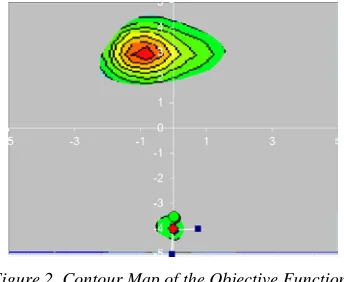
[image:4.612.91.314.73.354.2]First of all, the paper uses traditional method— NLPQL to solve this problem. Set the initial values of the design variable as (0, 3.5− ) , maximum iterations as 40, convergence accuracy as1.0E−6, while others are default. After 21 times iteration, the optimal solution (0, 4 ,− ) Z=31.57 is received. In Fig.2, the value of Z is increased with a gradual change from green to yellow, and then the maximum is red. It is obvious that ( )0, 4 is just a local solution. It is mainly because the wrong choice of the initial point.
Figure 2 Contour Map of the Objective Functions
Then this paper uses DPG method to optimize the problem, LHD+NLPQL model is founded like Fig.3. The model is separated as a top task (DPG-1) and two subsystem tasks (LHD and NLPQL). The
number of test points in LHD stage is set as 30 and NLPQL is the same as above.
Figure 3 Process of Solving Bimodal Problem By DPG
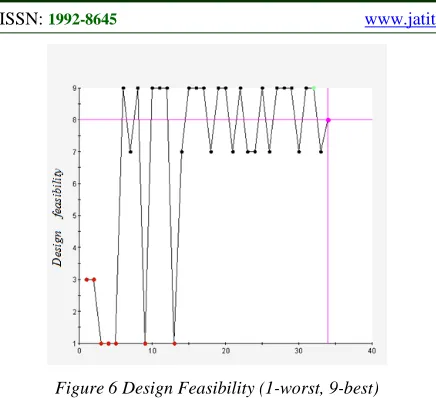
[image:4.612.334.511.419.630.2]After optimizing for 30 times, DOE gets the optimization solution(−1.55, 4.31), going on iterating for 35 times in NLPQL stage, then the global solution(−0.97, 3 ,) Z=64.63 is received. The contour curve of the objective function in Fig.4 shows that after the DOE design, NLPQL searches for the solution only around the point(−1.55, 4.31) . The DPG method not only avoids falling into the local solution, but also provides reasonable initial values automatically to reduce the effect on the optimization caused by the designers’ decision. Fig.5 and Fig.6 show the solving process of bimodal problem.
Figure 4 Contour Curve of the Objective Functions
[image:4.612.108.280.518.659.2]ISSN: 1992-8645 www.jatit.org E-ISSN: 1817-3195
Figure 6 Design Feasibility (1-worst, 9-best)
3.2 Multi-objective Optimization of Machine Tool Spindle
The machine tool spindle optimization is a typical multi-objective problem. Its goal is to minimize the spindle quality and overhanging end deflection in the premise of satisfying the constraint conditions. Therefore, coordination is needed between the optimal values of the two goals to find the Pareto solution.
There are many researches on the optimization problems: LI Yangxing[12] and LU Haitao[13] took the quality of the spindle as the optimization objectives, and used fuzzy optimization algorithm and particle swarm optimization(PSO) for structural optimization; GUO Chenguang[14] completed the spindle parameter optimization by using genetic algorithm(GA) while doing research on the spindle structure and load deformation at the same time; Li[15] used the MATLAB code to analyze the optimization based on the lowest cost and the improved spindle model. LI Wanxiang[16] used MATLAB code to optimize the spindle and received a group of optimization solutions after several times of attempts. These researches above had improved the performance of the spindle to a certain extent, but there is still optimization space due to the limitation of method.
3.2.1 Objective function and constraint conditions
Machine tool spindle is generally a several support hollow step shaft; this paper simplifies the shaft into constant section. As Fig.7 shows, d is the spindle inner diameter, D is the external diameter, l is span, a is the length of overhanging end, y is deflection, and F is the load on the main
shaft overhang end.
Figure 7 Machine Tool Spindle Deformation Diagram
In order to make the comparison between the DPG optimization and the existing methods easier, the example uses the value of parameters in literature [16]: d=45mm , F=15000N , allowable deflection
[ ]
y =0.125mm , allowable shear stress[ ]
τ =220MPa , allowable torsion angle[ ]
θ =0.02rad .Main material density 3
7800kg m/
ρ= , elastic
modulus E=210GPa , shear modulus G=80GPa .
Spindle speedn=80 / minr , input power P=7.5kW . The mathematical model of optimization can be founded according to the above parameters; the design variable is elected as:
[
1 2 3] [
]
T T
X= x x x = D l a (14)
The first objective function minimizes the quality of spindle:
2 2
1 9
1
min ( ) ( )( )
4 10
f X = π D −d l+a ρ
× (15)
The second objective function minimizes the overhanging end deflection:
2
2 4 4
64 ( )
min ( )
3000 ( )
Fa l a
f X
E D d
π
+ =
− (16)
The third objective function minimizes the spindle shear stress:
3
min ( )
n
T f X
W
= (17)
Among them, T is the shaft torque, T=9550 /P n;
n
W is the torsional modulus of section,
4 4
( )
16
n
D d
W
D
π −
= .
In the spindle designing stage, these following constraints will be used:
①Stiffness constraints:
[ ]
1( ) 2( ) 0g X =f X − y ≤ (18)
②The torsion angle of shaft overhang end cannot exceed the allowable value:
[ ]
2 4 4
32 ( )
( ) 0
( )
T l a g X
Gπ D d θ
+
= − ≤
③Strength constraint:
[ ]
3( ) 3( ) 0g X =f X −τ ≤ (20)
④Boundary constraint:
min max
min max
min max
D D D
l l l
a a a
≤ ≤
≤ ≤ ≤ ≤
(21)
3.2.2 Calculation results and analysis
This paper uses DPG to solve the machine tool spindle optimization in Isight code. The initial
value is X =
[
100mm 470mm 110mm]
T and its constraints are Dmin =50mm , Dmax =150mmmin 210
l = mm , lmax =600mm , amin =90mm ,
max 150
a = mm. The options of DOE and GO are just the same as in Example 1.
After 30 rounds of iterations in DOE, the optimization solution
[
100.34 84.48 210]
is [image:6.612.266.514.75.287.2]transferred into GO stage, and then through 73 rounds of gradient optimization iteration, the paper gets the final solution in Table.1.
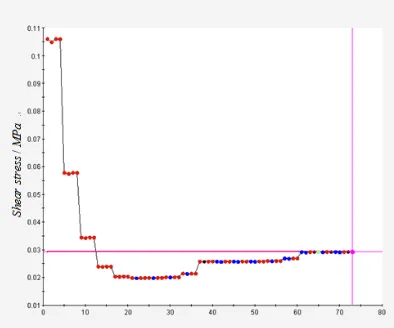
Fig.8, Fig.9 and Fig.10 show the iterative process of the optimal objective functions in the GO stage. The increasing of f1 will lead to the decreasing of f2 and f3, which is the feature of multi-objective problem. The figures prove that DPG method is a very efficient solution to solve the constraint relationship in multi-objective optimization.
Table 1 Comparison Between Optimization Results
Parameter
Optimization
Method Optimize
Proportion DPG Literature
[16]
/
D mm 60.68 63.00
/
l mm 210.00 210.00
/
a mm 90.00 90.00
/
Quality kg 3.046 3.57 14.68%
/
Deflection
mm 0.1246 0.1247 0.08%
/
Shear stress
MPa 29.25 29.25 0
PS: Results are not round due to the contrast need
[image:6.612.325.522.310.493.2]Comparing the optimization results of the DPG method with the previous ones’, although there is no big change in overhanging end deflection and spindle shear stress, but the quality of spindle has been further reduced by a range reached 14.68%. So DPG makes a positive effect in the optimization.
[image:6.612.325.522.520.684.2]Figure 8 Optimization of Quality Function minf1
Figure 9 Optimization of Deflection Functionminf2
Figure 10 Optimization of Spindle Shear Stressminf3
ISSN: 1992-8645 www.jatit.org E-ISSN: 1817-3195
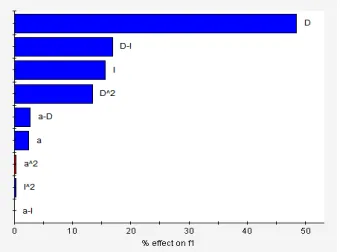
[image:7.612.107.293.132.574.2]Fig.12 and Fig.13 are the Pareto charts received in DOE stage [17], which reflect diameter D is occupying the absolute leading position in influencing the performance of spindle.
Figure 11 Pareto Chart of Optimization Function f1
Figure 12 Pareto Chart of Optimization Function f2
Figure 13 Pareto Chart of Optimization Function f3
4. CONCLUSION
⑴Optimization technique, as an application discipline with highly practical significance, is troubled by problems like falling into local solution, low optimization efficiency, etc. The paper puts forward an optimization method named DPG based on DOE and GO. By using this method, Example.1 received the global solution and in Example.2 the quality of spindle was reduced by 14.68%. The whole optimization processes are proved more comprehensive, more efficient and more accurate.
⑵DPG method not only increases the robustness of optimization solutions, but also reduces the effect on the result made by designers’ decision. DPG makes the transfer of initial values ( )0
X from
DOE stage to GO stage automatic, and reflects the importance of each factor by Pareto chart. In the future, the DPG method should be further improved by using more complicated problems.
ACKNOWLEDGEMENT
The authors wish to acknowledge the support provided by National Natural Science Foundation of China (51175146) and the Fundamental Research Funds for the Central Universities (BZX/12B101-18).
REFRENCES:
[1] Meng WANG and Jian-jun WANG, “An Approach for Solving Complex Local Optimum and Accelerating Calculation”, Computer Applications and Software, Vol. 28, No, 2, 2011, pp. 277-279.
[2] Xue-li YAN, Xue-wu WANG and Zhi-gang LIAN, “A Combine Historical Global and Local Best Particle Swarm Optimization Algorithm”, Journal of East China University of Science and Technology (Natural Science Edition), Vol. 37, No. 4, 2011, pp. 515-516.
[3] Min LI and Hong-chang SHI, “Directional Immigrant Strategy for Local Optimization of Genetic Algorithm”, Ordnance Industry Automation, Vol. 23, No. 5, 2004, pp. 65-66.
[4] Lin-li WU and Hai-na ZHAO, “New Particle Swam Optimization Algorithm with Global-local Best Minimum”, Journal of Computer Applications, Vol. 29, No. 12, 2009, pp. 3270-3272.
[5] R.V.Tappeta , and J.E.Renaud, “Multi-objective Collaborative Optimization”, ASME Journal of Mechanical Design, Vol. 119, No. 3, 1997, pp. 403-411.
[6] C.H.Huang, “Development of Multi-objective Concurrent Subspace Optimization and Visualization Method foe Multidisciplinary Design”[D], New York, N.Y.,USA: Buffalo [7] Xiang ZHANG, “The Appraising Function for
Multi-objective Optimization Design”, Journal of Fujian Agricultural University, Vol. 23, No. 4, 1994, pp. 465-470.
[image:7.612.116.286.146.272.2][9] Zhi-hua GUAN and Min-qiang LI, “An Evolutionary Multi-objective Optimization Algorithm Based on Fuzzy Preferences”, Journal of Tianjin University, Vol. 35, No. 3, 2002, pp. 275-279.
[10] M.D.McKay, R.J.Beckman and W.J.Conover, “A Comparison of Three Methods for Selecting Values of Input Variables in the Analysis of Output from A Computer Code”, Technometrics Vol. 21, No. 2, 1979, pp. 239-245.
[11] Yu-yang LAI, “The Isight Parameter Optimization Theory and Example Explanation”[M], Bei Hang University Press, Beijing, 2012.
[12] Yang-xing LI and Guang-yu LI, “The Fuzzy Optimization Design of Lathe’s Main Spindle”, Coal Mine Machinery, 2003, pp. 3-5.
[13] Hai-tao LU and Yu-ge DONG, “Reliability-based Design Optimization for Machine Tool Spindle with Particle Swarm Algorithm”, Coal Mine Machinery, Vol. 32, No, 8, 2011, pp. 33-35.
[14] Chen-guang GUO, Peng-jia WANG and Peng TIAN, “Optimization Design of CNC Machine Tool Spindle Based on Genetic Algorithm”, Journal of Northeastern University (Natural Science), Vol. 32, No. 6, 2011, pp. 850-853.
[15] Deng-wan LI, Wei-xin DENG and Hong-li GAO, “Study On Parameters Optimization In Numerical Machining of Stainless-Steel Based On MATLAB”, 4th International Conference on Genetic and Evolutionary Computing. Shenzhen: IEEE Computer Society, 2010, pp. 329-332.
[16] Wan-xiang LI, “Engineering Optimization Design and MATLAB Implementation”[M], Qing Hua University Press, Beijing, 2010.