A SPORTS TOURISM RESOURCES COMPREHENSIVE
EVALUATION MODEL BASED ON AHP-FUZZY
1YUKUO WANG, 2LIPING GUO, 3LIMING HUANG
1Department of Physical Education, Hebei Normal University of Science &Technology, Qinhuangdao
066004, Hebei, China 2
College of Foreign Languages, Hebei Normal University of Science &Technology, Qinhuangdao 066004, Hebei, China
3College of Business Administration, Hebei Normal University of Science &Technology, Qinhuangdao
066004, Hebei, China
ABSTRACT
The non-objective and non-scientific evaluation of sports tourism resources has become a bottleneck which restricts the development of sports tourism industry. In order to make the evaluation of sports tourism resources have more comprehensiveness, accuracy and scientificalness and to promote the healthy and sustainable development of sports tourism industry, this paper, based on the AHP-FUZZY mathematics evaluation method, proposes a new sports tourism resources evaluation model through the investigation and research of experts and scholars. This model consists of three index systems and makes weight setting of factors of each index system according to FUZZY mathematics evaluation method, integrating AHP and FUZZY evaluation methods. This comprehensive evaluation model has the advantage of the combination of qualitative and quantitative analysis which avoids the subjectivity of AHP and the dichotomy of FUZZY evaluation method. The results show that using this sports tourism resources evaluation model to evaluate the sports tourism resources of Qinhuangdao is effective, scientific and feasible.
Keywords: Sports Tourism Resources, AHP, Fuzzy Mathematics, Comprehensive Evaluation Model,
Qinhuangdao
1. INTRODUCTION
Sports tourism is a new field created by the joining of sports and tourism industries, which is a new tourism form based on sports resources, aiming to improve body health and attracting people to join in and experience sports activities and natural interest, is a special recreational life style combining sports and tourism and is an important part of sports, tourism and culture industry. Sports tourism resources are the core of developing sports tourism, the correct and objective evaluation of which is the base of developing sports tourism resources. At present, there are three evaluation methods of tourism resources including qualitative, quantitative and comprehensive evaluation, among which, the former two mainly include direct judgment, Analytic Hierarchy Process (AHP), Data Envelopment Analysis (DEA), mathematical programming method and fuzzy evaluation method. Nowadays, many scholars, in the study of evaluation methods, tend to apply comprehensive method, which is to combine two or more evaluation methods to improve the accuracy and
objectivity [1-8]. Since sports tourism resources has uncertainty and fuzziness, if only applying quantitative analysis to sports tourism resources, the evaluation results are not accurate, therefore, this study adopts AHP-FUZZY mathematics evaluation method to construct evaluation model and makes empirical analysis combined with the situations of Qinhuangdao sports tourism resources.
2. SPORTS TOURISM RESOURCES
EVALUATION MODEL
2.1 Construction Process of Sports Tourism Resources Evaluation Model
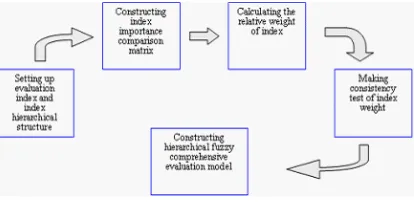
AHP-FUZZY mathematics comprehensive evaluation method is a comprehensive method combing AHP and FUZZY mathematics method to make evaluation, which decomposes the research issues to separate index sets according to layers, calculates index weight according to each index’ relative importance given by experts and finally calculates the comprehensive score of indexes
[9-17]. The steps are as follows: ① setting up the
hierarchical structure of system index and index
matrix of each two according to 1~9 proportional
scaling method; ③ calculating the relative weight of
each index; ④ making consistency test of index
weight C.R
(
C.R0.1)
; ⑤ constructing hierarchical fuzzy comprehensive evaluation model and [image:2.612.92.299.176.285.2]calculating the comprehensive scores. See Figure 1.
Figure 1. Construction Process Of Hierarchical Fuzzy Comprehensive Model
2.2 Sports Tourism Resources Evaluation System
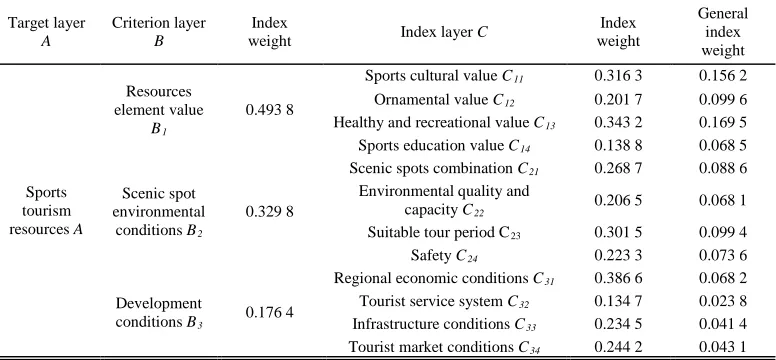
[image:2.612.319.523.400.496.2] [image:2.612.96.302.563.681.2]This system is set up according to the principles of concise scientific, systematic integration, feasibility and comparability and adopts theory analysis and experts consultation method to select evaluation indexes. Theory analysis is mainly used to make relative analysis, comparison and integration of the related issues of sports tourism and to select important elements with strong pertinence as indexes; experts consultation method is used in this procedure: based on the primarily proposed evaluation indexes, 24 Chinese experts are consulted for advice during May to October, 2012 and the primary evaluation indexes are adjusted. The evaluation index system is finally achieved by comprehensively applying these two methods and the indexes, according to the attributes and hierarchical relationship, are divided into: target layer A, criterion layer B and index layer C [18-21]. See Figure 2.
Figure 2. Hierarchical Structure Of Sports Tourism Resources Evaluation
2.3 The Determination of Sports Tourism Resources Evaluation Index Weights
2.3.1 Constructing judgment matrix
AHP is adopted to determine evaluation index weights, and by sending out questionnaires, related experts are asked to make each two comparison of each element’ importance degree in the evaluation of various layers, the results of which are used to establish the distribution weight of AHP judgment matrix. Take evaluation integration layer B for example and construct judgment matrix A.
= 1 7 4 3 1 4 7 1 7 5 3 5 7 1 A
2.3.2 Solution judgment matrix
Take the calculation of the weight of layer B compared with layer A for example, making solution by applying Asymptotic Normalization Coefficient (ANC), the concrete steps are as follows:
① Standardizing each column of judgment matrix A:
∑
= = 3 1 1 11 11 i i a aa (1)
Get: 3 0.488 3 1 7 5 1 1 3 1 1 11 11 = + + = =
∑
= i i a a aCalculating other items successively, get the following matrix: = 0 0.174 3 0.192 8 0.162 3 0.304 5 0.336 8 0.348 7 0.521 2 0.471 4 0.488 A .
② Adding the elements of A according to the row, get vector
ϖ
and its components are:(
1.4813 0.9896 0.5291)
=
ϖ .
③ Normalization processing
ϖ
, get the weight of the related elements of layer B compared with layer A, which is:(
0.4938 0.3298 0.1764)
=
ϖ .
④ Inputting judgment matrix A into matlab6.5 software, calculate and get the maximum characteristic root of judgment matrix A, which is:
6 3.004 max =
2.3.3 Single-layer sequencing and consistency test
Calculating the consistency index of judgment matrix and test the consistency index C.I.:
1 .
. max
− − =
n n I
C
λ
(2) Get:
3 0.002 2
3 -6 3.004 1
.
. max = =
− − =
n n I
C
λ
.To test whether judgment matrix has satisfactory consistency, C.I. will be compared with the mean random consistency index R.I. and the random
consistency proportion C.R. of judgment matrix is got.
. .
. . . .
I R
I C R
C = (3)
Since the dimension is n=3, R.I.=0.58 is known from lookup table, then it has
0.1 9 0.003 0.58
3 0.002 .
. . . .
. = = =
I R
I C R C
Therefore, by consistency test, the above weight of the related elements of layer B compared with layer A is confirmed.
[image:3.612.114.502.281.461.2]Adopting the same method, the weight of the index of layer C compared with layer B is confirmed. See Table 1.
Table 1. Weights Of Sports Tourism Resources Evaluation
Target layer
A
Criterion layer
B
Index
weight Index layer C
Index weight
General index weight
Sports tourism resources A
Resources element value
B1
0.493 8
Sports cultural value C11 0.316 3 0.156 2
Ornamental value C12 0.201 7 0.099 6
Healthy and recreational value C13 0.343 2 0.169 5
Sports education value C14 0.138 8 0.068 5
Scenic spot environmental
conditions B2
0.329 8
Scenic spots combination C21 0.268 7 0.088 6
Environmental quality and capacity C22
0.206 5 0.068 1
Suitable tour period C23 0.301 5 0.099 4
Safety C24 0.223 3 0.073 6
Development conditions B3
0.176 4
Regional economic conditions C31 0.386 6 0.068 2
Tourist service system C32 0.134 7 0.023 8
Infrastructure conditions C33 0.234 5 0.041 4 Tourist market conditions C34 0.244 2 0.043 1
2.4 Fuzzy Evaluation of Sports Tourism Resources
Determine the factor set and evaluation set of evaluation objects. The factor set refers to a common set composed of various factors which influence the evaluation objects.
Top layer evaluation set A={B1, B2, B3}={resources element value, scenic spot environmental conditions, development conditions}.
Index evaluation set B1={C11, C12, C13, C14}={sports cultural value, ornamental value, healthy and recreational value, sports education
value}, B2={C21, C22, C23, C24}={scenic spots combination, environmental quality and capacity, suitable tour period, safety}, B3={C31, C32, C33, C34}={regional economic conditions, tourist service system, infrastructure conditions, tourist market conditions}.
Evaluation set is a quantity set composed of various evaluation results possibly made by evaluator to evaluation objects. When determining the evaluation index membership degree, expert investigation method is used, that is, making scalar quantization to the evaluation factor indexes. See Table2.
Evaluation factor Weights Evaluation grade
Sports cultural value 0.156 2 Very high High Relatively
high General Low
Ornamental value 0.099 6 Very high High Relatively
high General Low
Healthy and recreational
value 0.169 5 Very high High
Relatively
high General Low
Sports education value 0.068 5 Very high High Relatively
high General Low
Scenic spots combination 0.088 6 Outstanding Good Fair Poor Inferior
Environmental quality and
capacity 0.068 1
Extremely
good Good
Relatively
good General Poor
Suitable tour period 0.099 4 Very long Long Relatively
long General Short
Safety 0.073 6 Very high High Relatively high General Low
Regional economic
conditions 0.068 2 Outstanding Good Fair Poor Inferior
Tourist service system 0.023 8 Outstanding Good Fair Poor Inferior
Infrastructure conditions 0.041 4 Outstanding Good Fair Poor Inferior
Tourist market conditions 0.043 1 Outstanding Good Fair Poor Inferior
3. THE COMPREHENSIVE EVALUATION
OF QINHUANGDAO SPORTS TOURISM RESOURCES
3.1 Data Resources of Qinhuangdao Sports Tourism Resources
The adopted data of this study come from the questionnaires sent out during May to August, 2012, and parts of the data come from the Statistical Yearbook of Qinhuangdao 2009, 2010 and 2011. This investigation, according to the characteristics of Qinhuangdao sports tourism scenic spots, selects seven representative scenic spots, such as: national sports feature scenic spot --- Cape Mountain Great Wall; leisure sports scenic spots --- Nandaihe International Amusement Center, the Olympic Avenue Park, the Olympic Center, the Forest Sports Park, Golden Coast Sea Scenery Sports Leisure Park; fitness experience scenic spot --- Ziyun Mountain Skiing Resort, etc.. This study sends out 150 questionnaires to objects including experts engaged in tourism study, managers in the Travel Bureau of Qinhuangdao and of Hebei Province. 146 questionnaires are withdrawn, among which, 138 copies are effective. Then the validity and reliability of the questionnaires are tested.
3.2 The Fuzzy Comprehensive Evaluation of Qinhuangdao Sports Tourism Resources 3.2.1 Determining fuzzy evaluation matrix of
indexes
Related questionnaire is designed according to evaluation indexes, and finally a collection of comments of qualitative indexes is achieved. The various evaluation factors of each scenic spot are evaluated by each evaluator according to
determined evaluation grade standard, and the index membership degree value of each scenic spot is calculated by adopting arithmetic average.
Take Nandaihe International Amusement Center for example, 30% think its sports cultural value is “very high”, the membership degree of which is 0.30; 32% think it is “high”, the membership degree of which is 0.32; 26% think it is “relatively high”, and its membership degree is 0.26; 10% think it is “general”, and its membership degree is 0.10; 2% think it is “poor”, and its membership degree is 0.02. Therefore, the fuzzy evaluation
matrix of C11 is achieved:
[
0.30, 0.32, 0.26, 0.10, 0.02]
.3.2.2 Making comprehensive evaluation
First, making first order comprehensive evaluation according to the formula
Ri Wi
Table 3. Fuzzy Evaluation Of Nandaihe International Amusement Center’s Sports Tourism Resources
Criterion layerB Index layerC
Membership degree of evaluation value
Extremely
good Good
Relatively
good General Poor
Resources element value
B1(0.493 8)
Sports cultural value
C11(0.316 3) 0.30 0.32 0.26 0.10 0.02
Ornamental value
C12(0.201 7) 0.20 0.32 0.36 0.09 0.03
Healthy and recreational value C13(0.343 2)
0.28 0.42 0.18 0.12 0
Sports education value
C14(0.318 8) 0.31 0.28 0.22 0.18 0.01
Scenic spot environmental
conditions
B2(0.329 8)
Scenic spots combination
C21(0.268 7)
0.19 0.38 0.32 0.10 0.01
Environmental quality and
capacity C22(0.206 5) 0.23 0.30 0.35 0.12 0
Suitable tour period
C23(0.301 5) 0.32 0.34 0.30 0.04 0
Safety C24(0.223 3) 0.25 0.31 0.34 0.08 0.02
Development conditions
B3(0.176 4)
Regional economic
conditions C31(0.386 6) 0.18 0.48 0.26 0.06 0.02
Tourist service system
C32(0.134 7) 0.20 0.43 0.32 0.04 0.01
Infrastructure conditions
C33(0.234 5) 0.28 0.38 0.26 0.06 0.02
Tourist market conditions
C34(0.244 2) 0.30 0.35 0.25 0.08 0.02
Notice: The data in brackets are the weight value of each index.
After calculation, it is found that the first order fuzzy comprehensive evaluation result B1 has three single factor fuzzy comprehensive evaluation: B11, B12, B13, then the second order comprehensive evaluation is made, the above first order comprehensive evaluation results of the three single factors together form second order fuzzy comprehensive evaluation judgment matrix R2, thus, the result of the second order fuzzy comprehensive evaluation is:
(
)
×= ×
=Aw Ri 0.4938 0.3298 0.1764 A
7 0.018 2 0.062 6 0.265 1 0.418 4 0.235
2 0.007 6 0.081 8 0.335 5 0.363 9 0.250
8 0.013 9 0.115 2 0.247 4 0.380 7 0.242
(
0.2439 0.3815 0.2671 0.0951 0.0124)
= .
A is the comprehensive evaluation result of Nandaihe International Amusement Center’s sports tourism resources. According to the principle of maximum membership degree, it falls within the grade “good”. Using the same method, the fuzzy evaluation results of other sports tourism scenic spots’ tourism resources are achieved. See Table 4.
Sports Tourism
Scenic Spots Fuzzy evaluation matrix
Single evaluation result
General evaluation
result Resources
element value
Scenic spot environmental
conditions
Development conditions
Nandaihe International
Amusement Center
(0.243 9 0.381 5 0.267 1
0.095 1 0.012 4) Good Good Good Good
The Olympic Avenue Park
(0.235 6 0.361 8 0.287 1
0.086 7 0.028 8) Good Good
Relatively
good Good
The Olympic Center
(0.195 2 0.305 6 0.374 5
0.073 4 0.051 3) Good
Relatively good
Relatively good
Relatively good
The Forest Sports Park
(0.123 5 0.306 7 0.334 3 0.086 6 0.148 9)
Relatively good
Relatively
good General
Relatively good
Ziyun Mountain Skiing Resort
(0.184 6 0.325 5 0.358 6
0.102 3 0.029 0) Good General General
Relatively good
Cape Mountain Great Wall
(0.203 7 0.332 3 0.295 5
0.091 1 0.077 4) Good Good
Relatively
good Good
Golden Coast Sea Scenery Sports
Leisure Park
(0.113 1 0.164 3 0.334 5
0.363 5 0.024 6) Good General General
Relatively good
4. CONCLUSIONS
Constructing multi-layer fuzzy comprehensive model of sports tourism resources can help judge sports tourism resources, decide whether the value of resources is high or low, outstanding or inferior, which provides scientific basis for the development and protection of sports tourism resources. When using this model to make evaluation, the index system can be adjusted according to concrete situations to suit the evaluation of sports tourism resources in other areas. This study only selects seven representative sports tourism scenic spots in Qinhuangdao to make resources evaluation without involving all scenic spots, and in the future, further statistic, analysis and evaluation of resources can be made from more comprehensive angels, the conclusions of which will have greater practical guiding significance and pertinence.
ACKNOWLEDGEMENTS
Thanks for the financial aid of Projects from National social science Foundation of China (No: 12BTY026) of Research Topics of Social Science Development of Hebei Province (No: 201204081 and No: 201203334, No:201204034).
REFERENCES:
[1] Pedrycz, W, Mingli Song, “Analytic Hierarchy Process (AHP) in Group Decision Making and its Optimization with an Allocation of Information Granularity Fuzzy Systems”, IEEE Transactions on, Vol.1, No.3, 2011, pp.527- 539.
[2] Tolga Kaya, Cengiz Kahraman, “Fuzzy multiple criteria forestry decision making based on an integrated VIKOR and AHP approach”, Expert Syst. Appl, Vol.38, No.6, 2011, pp.7326-7333. [3] NihanÇetin Demirel, G.Nilay Yücenur, Tufan
Demirel, “Risk-Based Evaluation of Turkish Agricultural Strategies using Fuzzy AHP and Fuzzy ANP”, Human and Ecological Risk Assessment: An International Journal, Vol.18, No.3, 2012, pp.685-702.
[4] V.V. Tsyganok, S.V. Kadenko, O.V. Andriichuk, “Significance of expert competence consideration in group decision making using AHP”, International Journal of Production Research, Vol.50, No.17, 2012, pp.4785-4792. [5] Ahmad Makui, Zohre Nikkhah, “Designing fuzzy
[6] Bilge Bilgen, Mutlu Şen, “Project selection through fuzzy analytic hierarchy process and a case study on Six Sigma implementation in an automotive industry” Production Planning & Control, Vol.23, No.1, 2012, pp.2-25.
[7] Wuwei Li, “Industrial Characteristics and Innovation Capability: Evidence from Chinese High-Tech Industries”, AISS: Advances in Information Sciences and Service Sciences, Vol.3, No.10, 2011, pp.70-79.
[8] Yanhong Xie, Jianjun Liu, Yufu Ning, Huanbin Sha, “Multi-grade Uncertain Comprehensive Evaluation Method”, AISS: Advances in Information Sciences and Service Sciences, Vol.4, No.6, 2012, pp.1-8.
[9] Ming-Ian Lin, Yuan-Duen Lee, Tsai-Neng Ho, “Applying integrated DEA/AHP to evaluate the economic performance of local governments in China”, European Journal of Operational Research, Vol.209, No.2, 2011, pp.129-140. [10] Yan Yaxin, Jiang Zhenhuan, Liu Xinhua, Li Qi,
“A Novel Approach for Power Enterprise Supply Chain Performance Evaluation Based on Fuzzy Synthetic Evaluation Method”, AISS: Advances in Information Sciences and Service Sciences, Vol.3, No.9, 2011, pp.82-90.
[11] Huiming Lv, “Application of Fuzzy Evaluating Model to the Assessment of Marine Service Industry in Triangular Fuzzy Setting”, AISS: Advances in Information Sciences and Service Sciences, Vol.3, No.9, 2011, pp.162-167. [12] Aliasghar Montazar, Ahmad Gaffari, “An AHP
Model for Crop Planning Within Irrigation Command Areas”, Irrig. and Drain, Vol.61, No.2, 2012, pp.168-177.
[13] Yahia, Nesrine Ben, Bellamine, “Integrating fuzzy case-based reasoning and particle swarm optimization to support decision making” IJCSI: International Journal of Computer Science Issues, Vol.9, No.3, 2012, pp.117-124. [14] Rongzhi Liu, Bei Hu, “Research on the
Industrial Cluster Incubation System for Entrepreneurial Activities: the Construction and Functions”, JDCTA: International Journal of Digital Content Technology and its Applications, Vol.4, No.6, 2010, pp.89-93.
[15] Chen Ming, “Fuzzy Integrated Evaluation Algorithm of Existing Bridge Based on Grid”, AISS: Advances in Information Sciences and Service Sciences, Vol.3, No.4, 2011, pp.141-146.
[16] Tian Jing, Yu Dan, Yu Bing, Ma Shilong, “A Fuzzy Multi-Criteria Group Decision Making Model for Information Source Selection”, AISS: Advances in Information Sciences and Service Sciences, Vol.4, No.6, 2012, pp.184-192. [17] Li Shunxi, Wang Aimin, “An Evaluation of
Chinese Automobile Manufacturers Using the Analytic Hierarchy Process and Catastrophe Theory”, AISS: Advances in Information Sciences and Service Sciences, Vol.4, No.1, 2012, pp.28-36.
[18] Dapeng Zhang, “A quantitative analysis of tourism resource of Huangshi based on AHP-fuzzy comprehensive evaluation method”, Journal of Hubei Normal University (Philosophy and Social Sciences), Vol.29, No.3, 2009, pp.63-68.
[19] Youwen Su, Wenbin, Yang “Evaluation of Tourism Resources on Fuzzy Comprehensive Evaluation for Jingchuan County in Gansu Province”, Journal of Shanxi Normal University (Natural Science Edition), Vol.24, No.1, 2010, pp.90-97.
[20] Juan Li, Feng Li, Guanchen Zhou, Jinquan Wang, “Analysis of Tourist Site Level of Tangshan City based on Rough Set Pair”, JDCTA: International Journal of Digital Content Technology and its Applications, Vol.6, No.16, 2012, pp.146-153.