ISSN: 1992-8645 www.jatit.org E-ISSN: 1817-3195
557
ENTROPY THEORY: AN EFFECTIVE TOOL OF IMPROVING
THE COMPUTATIONAL TRANSLATION
JUANJUAN SUO, HUIQQING TIAN, YANCANG LI
Hebei University of Engineering, Handan 056038, Hebei, China
ABSTRACT
Elimination of the ambiguity is the key to the computational translation. In order to find an effective way to improve the accuracy of the computational translation, the cross entropy was introduced. After the analysis of the reasons of the low accuracy, the information entropy was introduced into the disambiguation. The practice of ambiguity elimination shows the method has high accuracy and this study provides an effective way to improve the computational translation. The study has significance in theory and practice for the development of computational translation.
Keywords: Computational Translation, Ambiguity Elimination, Entropy
1 INTRODUCTION
With the information explosion and economic globalization, international information exchange is surging tremendously. Machine translation is the effective way to solve the problem of the translation of mass information quickly and inexpensively. Machine translation technology has undergone a history of over 70 years since its debut in the United States for collecting intelligence in 1940s. Computational translation is more and more important for the computational linguistics. As one of the computational linguistics research field, the emergence of the machine translation drives the development of the information society.
In the past half century, lots of works have been done on it. And there are many machine translation systems available today. It has the advantages of speed, cost-efficiency, and the ability to deal with sheer volume of translation task [1-2]. However, there is one thing computer can not beat human being, at least at the present time and near future, which is the quality of ambiguity. How to improve the accuracy has significance in theory and practice for the development of the computational linguistics and the information society. Many Scholars have done a lot on the ambiguity elimination [3-7], but we still have a long way to go.
To find an effective method for the improvement of computational linguistics, the entropy theory was employed to the study of the ambiguity elimination. The example shows that the method is simple and effective, and is easy to computer adaptive realization. This research can improve the digital
level of our society, and promote the construction of digital city and harmonious society.
The rest of the paper was organized as follows. Fist, the reasons of the low accuracy of the computational translation was analyzed. And then the basic knowledge of entropy was introduced and then it was employed to the ambiguity elimination. Finally, its efficiency was shown through an example.
2 REASONS OF LOW ACCURACY OF
COMPUTATIONAL TRANSLATION
Computational linguistics has become not only a basic linguistic of the information society. Many experts have pointed out that, as the key and difficult point of computational linguistics, ambiguity is one of the biggest obstacles in the computer analysis and understanding. Many scholars devoted to the research away discrepancy. But we still need to explore new calculate method, to focus on the study of language level, especially need to put forward more effective, perfect ambiguity description and eliminate the theory and the method.
ISSN: 1992-8645 www.jatit.org E-ISSN: 1817-3195
558 generally caused by the same syntactic structure, and it should be eliminated through the text analysis of the subject and the analysis of sentences by other components. In 1993, Lancaster University Corpus Research Center developed automatic SEMTAG. Through automatic classification of the each word, phrase and sentence, the discourse of the semantic features of general appearance and distribution state, and the calculation formula of the original text can be obtained. This method can solve the exact nature of context translation.
Somers pointed out that the main difficulty of machine translation can be summed up in one word: ambiguity, although problems of style and interpretation should not be ignored [9]. Ambiguity is a pervasive phenomenon in human languages. It is very hard to find words that are not at least two way ambiguous, and sentences which are (out of context) several ways ambiguous are the rule, not the exception. The ambiguity can be easily distinguished by human translators in most cases, but can not be distinguished by machines, simply because machines can not understand the text [10]. Ambiguous categories can be classified into the semantic and syntactic ambiguity. Ambiguity, according to sources, is divided into vocabulary ambiguity and structural ambiguity. Vocabulary ambiguity is one of parts of speech ambiguity to carry on the syntactic analysis. It easily leads to the extremely syntactic analysis errors. Meaning ambiguity directly leads to the wrong statement [11]. Syntactic differences between languages make it impossible for word translation. When one single sentence can produce more than one interpretation, the structural ambiguity will appear. Ambiguities exist not only on lexical level but also in syntactical level. Distinctive syntactic difference between Chinese and English is the use of passive voice. Passive voice is not used so commonly in Chinese as in English. Large amount of English passive sentences need translating into active voice in Chinese to match Chinese grammar and syntactical rules. Otherwise, the translation will be rigid or distorted. Structural ambiguity can be categorized according to the‘range’‘depth’of ambiguity. Structural ambiguity is generally caused by the same syntactic structure, and it should be eliminated through the text analysis of the subject and the analysis of sentences by other components. W. John Hutchins and Harold L. Somers put three headings under ambiguity, respectively morphology problems, lexical ambiguity and structure ambiguity. The second category has three components, which are category ambiguity, homograph and polysemy, and transfer ambiguity.
And the third one has two: real structural ambiguity and accidental structural ambiguity. When one word represents more then one speech, or has multiple meanings, or the combination of these two, the lexical ambiguity will appear. Where one word can be interpreted in more than one way is the meaning of lexical ambiguity. And one word would have different translations when being put into different sentences and contexts.
ISSN: 1992-8645 www.jatit.org E-ISSN: 1817-3195
559 proposed a new method of Chinese automatic segmentation that can check all overlapping ambiguity in sentence. This algorithm is based on the principle of Choose Longer Word. It solves the problem that the count of segmentation way is exponentially increasing with the sentence length, and provides a method to handle overlaying ambiguity and overlapping ambiguity separately. Duo to the word limit, we will not repeat the others. They all improve the overall quality of machine translation and promote the development of the computational linguistics.
The essence of the ambiguity is the shortage of the corresponding relation between the expression of the language form and its meaning. Ambiguity arises when there is a certain concept in language A but there is no such concept in Language B or a concept which is described by one single word in one language may have several words to express in another language. When words or sentences are translated into other languages, ambiguities may occur because of cultural, grammar or syntactic differences among languages. This is the inherent characteristics of the natural language and it is one of the characteristic of the difference between natural language and artificial language. Human translators can handle this kind of complexity by investigating the cultural differences and conducting research to produce correct translations. However, if translated by machine, it would be impossible. The studies to natural language processing system has guiding significance to researchers, but the complex of the ambiguity phenomenon needs to put forward more perfect and more suitable methods for the ambiguity description and eliminate. There are many factors contributing to the ambiguity of the machine translation translations other than in linguistic perspective, such as computational problems. The studies to natural language processing system has guiding significance to researchers, but the complex of the ambiguity phenomenon needs to put forward more perfect and more suitable methods for the ambiguity description and eliminate. This is the inherent characteristics of the natural language and it is one of the characteristic of the difference between natural language and artificial language.
3 AMBIGUITY ELIMINATION BY USING
ENTROPY
3.1 Introduction Of Entropy Theory
First proposed in 1864 by R. Clausius, the entropy has 140 years of history. As an important concept, entropy is the best measure to "uncertainty". It is
widely used in natural science and social science. Some scholars put forward that the 21st century is the century of entropy [14].
In 1957, E. T. Jaynes put forward the famous idea of maximum entropy principle. The entropy optimization principle is mainly composed of maximum entropy principle and the cross entropy principle proposed by Kullback. The former comes from Shannon information entropy, the latter is derived from the concept of distance measure in probability. Both are the further development of information entropy.
From the concept of information entropy, we know that when probabilities of the random events are same, the entropy is the maximum. When the
Probability space is
p
0=
(
p
1,
p
2,
L
,
p
m)
, theinformation entropy value is the largest. Because
(
p
p
p
m)
p
0=
1,
2,
L
,
is the maximumprobability distribution of uncertainty, we can define another uncertainty of the measurement, namely "relative measure".
For a distribution:
p
0=
(
p
1,
p
2,
L
,
p
m)
(1)It has the shortest distance with
( )
∑
=
=
mi i
i i
u
p
p
u
p
F
1
ln
,
(2) Then the corresponding uncertainty should also become the biggest. Based on some kind of prior factor, Kullback and Leibler proposed cross entropy
( )
∑
=
=
mi i
i i
u
p
p
u
p
F
1
ln
,
(3) The cross entropy has following characters:
For discrete form of cross entropy, if
n
i
y
x
i,
i≥
0
,
=
1
,
2
,
L
,
and∑
∑
=
≥
ni i n
i
i
y
x
1
,
0
log
)
,
(
=
∑
≥
i i i
y
x
x
Y
X
h
(4)
is the cross entropy of
X
toY
, and
(
)
T n
x
x
x
ISSN: 1992-8645 www.jatit.org E-ISSN: 1817-3195
560
(
)
T n
y
y
y
Y
=
1,
2,
L
,
(5)And
(1)
x
i=
y
i, if and only ifx
i=
y
i;(2) The bigger cross entropy, the greater distance of the distribution.
(3)
,
0
0
log
0
⎟
=
⎠
⎞
⎜
⎝
⎛
q
log
⎜
⎝
⎛
0
⎟
⎠
⎞
=
∞
p
p
.
3.2 Application Of Cross Entropy In Disambiguation
Cross entropy (relative entropy) is a measure of the distance from the two relatively random physical quantities. This paper tried to use the system engineering methods, to the definition of a cross entropy for extended, and introduce it to the extinction of computational linguistics, to provide a more effective away for the ambiguity description and elimination. We have the following algorithm to eliminate ambiguity:
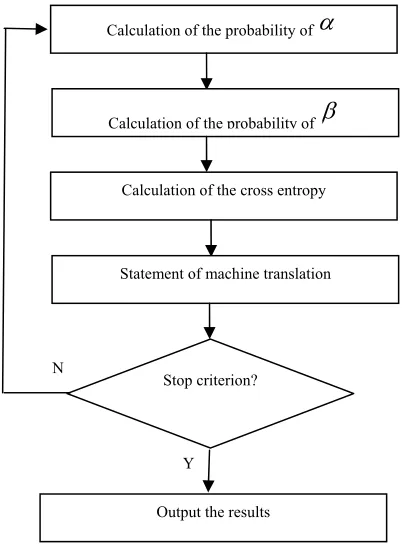
(1) Calculation of the probability value of the statements, as the prior information of training set. From the rules of A→λ, obtain the probability
α
,(
)
( )
i ni
x
P
A
P
Π
=
→
=
1
λ
α
ω
i,
ω
i+1,
L
,
ω
j (6)(2) Calculate the probability of machine translation
β
, as the test set of posterior information.
(
)
jn
i j k i
k
i
P
A
λ
β
α
α
β
Π
Π
+ = −
=
→
=
1 1
1
i
∈
[ ]
1
,
n
(7) 3) Calculation of the cross entropy.
∑
∑
∈ ∈
−
=
c s c s
s
s
P
H
log
(8)
Where
C
is the training set,S
is a sentence inthe library,
P
s is the probability of sentence,S
isthe sentence length.
4) The minimum value cross entropy of information statement as a output of the machine
semantic. That is, if
H
(
T
2P
1)
p
H
(
T
2P
2)
, takeP
1 as a statement of machine translation.5) Take the cross entropy comprehensive
differences
(
)
21
2 1
2
⎥⎦
⎤
⎢⎣
⎡
−
=
D
D
D
as stop
standards,
D
≤
0
.
01
end program. Otherwise, back to step 1). The process of the algorithm is shown in Figure 1.The algorithm takes the latent semantic indexing method to the calculation of the similarity.
[image:4.612.318.519.293.567.2]
Figure 1: Framework Of The Algorithm
3. 3 Test Results
Using the B700 library of American Chrysler Corporation Corpus, we verified the method. The results of the disambiguation method proposed here are shown in Table I.
N
Y
Calculation of the probability of
α
Calculation of the probability of
β
Calculation of the cross entropy
Statement of machine translation
Stop criterion?
ISSN: 1992-8645 www.jatit.org E-ISSN: 1817-3195
561 Table I: Results Of Disambiguation
4 CONCLUSION
How to eliminate the ambiguity is the key to the computational translation. To find an effective way to describe and eliminate the ambiguity, we employed cross entropy to measure the distance from the difference the translations and the original meaning, and proposed the method based on cross entropy. The example shows that the method is simple and effective, and is easy to computer adaptive realization. But it is only a beneficial exploration, and many problems still need to be studied further.
ACKNOWLEDGEMENTS
The work was supported by the Youth Fund Project of Humanities and social science research of Hebei Province Department of Education (SQ125001). And the Fund of Social Science Development Program of Hebei Province (201103205).
REFRENCES:
[1] J. Yao and D.Zhao, “Disambiguation method in Chinese word segmentation based on phrase match”. Journal of Jilin University (Science Edition), Vol. 48, No. 3, 2009, pp. 427-432.
[2] Hausser Roland, “Foundations of
computational linguistics, human-computer communication in natural language”, 2nd Edition, Berlin, New York, Springer, 2001. [3] D.Hindle and M. Rooth, “Structural ambiguity
and lexical relations”, Computational Linguistics, Vol. 19, No. 1, 1993, pp. 103-120.
[4] Sil,i Wang and Bin Wang, “A Chinese overlapping ambiguity resolution method based on coupling degree o f double characters”, Journal of Chinese Information Processing, Vol. 21, No. 14, 2007, pp. 14-17.
[5] D. McCarthy and R. Navigli, “The English lexical substitution task”, Language Resources and Evaluation. Vol. 43, No. 2, 2009, pp. 139-159.
[6] Tomoharu Iwata, Daichi Mochihashi and Hiroshi Sawada, “Learning common grammar from multilingual corpus”, Proc. of the 48th Annual Meeting of the Association for Computational Linguistics (ACL), Uppsala University Uppsala, Sweden, 11-16 July, 2010. pp. 184-188.
[7] Roberto Navigli and Mirella Lapata, “An experimental study on graph connectivity for unsupervised word sense disambiguation”, IEEE Transactions on Pattern Anaylsis and Machine Intelligence, Vol. 32, No. 4, , 2010, pp. 678–692.
[8] Muyun Yang, Shuqi Sun, Junguo Zhu, Sheng Li and Tiejun Zhao, “Improvement of machine translation evaluation by simple linguistically motivated features”, Journal of Computer Science and Technology, Vol. 26, No. 1, 2011, pp. 57-67.
[9] R. Dale, H. Moisl and H. Somers, “A handbook of natural language processing”, New York, Marcel Dekker, 2000.
[10]D. Arnold, L.Balkan, R. L.Humphreys, S. Meijer and L.Sadler, “Machine translation: an introductory guide”, Oxford: Blackwell, 1994. [11]Li Zhang, Liyong Zhang and Xiaomiao Zhang,
“Research on Ambiguous words segmentation algorithm based on improved BP Neural Network”, Journal of Dalian University of Technology, Vol. 47, No. 1, 2007, pp. 131-135. [12]Mahsa Chitsaz and Chaw Seng Woo, “Software agent with reinforcement learning approach for medical image segmentation”, Journal of Computer Science and Technology, Vol. 26, No. 2, 2011, pp. 247-255.
[13]Y. Liu and Z. He, “Algorithm based on SVM and rules for the disambiguation of combinatorial ambiguous phrases”, Journal of Chongqing University, Vol. 28, No. 10, 2005, pp. 53-56.
[14] W. H. Qiu. “Management decision-making and entropy theory”, Beijing, China Mechanical industry press, 2002.
N0. of Corpus B700
Sentence number 746
Word number 9270
Artificial rules disambiguation
Average
ambiguity 1286
Recall ratio 99.17
precision 77.11%
Cross entropy method disambiguation
Average
ambiguity 996
Recall ratio 98.64