ENERGY EFFICIENT CLUSTERING PROTOCOL FOR
COLLECTING
DATA IN WIRELESS SENSOR NETWORK
1L.SUJIHELEN, 2C. JAYAKUMAR
1
Research Scholar, Sathyabama University, Chennai, India
2
Professor, Department of Computer Science & Engineering, R.M.K. Engineering, Chennai, India
E-mail: [email protected], 2 [email protected]
ABSTRACT
Wireless Sensor Network (WSN) is used for collecting the information from the environment. WSN consists of a large number of Sensor Nodes (SN). Each Sensor Nodes in the network are connected by a wireless Channels. All the real time applications of Wireless Sensor Network (WSN) need energy. The nodes in the Wireless sensor networks are battery driven. There are some techniques such as clustering and data aggregation is used for energy efficiency. In the existing Energy Efficient Clustering to Enhanced Lifetime (EECPL) protocol, the reduction in the energy consumption is accomplished by performing data aggregation in the Cluster Members rather than Cluster Heads. Further, ring topology is adopted, in order to enable load balancing in the network. However, it is observed that the delay involved in data transmission is increased which makes it unsuitable for real-time application. In this paper, an Energy Efficient Clustering Protocol is proposed to reduce without compromising Network lifetime. The proposed protocol is compared with the existing EECPL protocol. The performance metrics considered for comparison are average end to end delay, the average energy consumption and network lifetime. NS2 simulation tool is used for the implementation. The proposed protocol outperforms the existing EECPL protocol.
Keywords: Energy Efficient Clustering to Enhanced Lifetime protocol, Cluster Head, Data aggregation, Cluster Member.
1. INTRODUCTION
Wireless Sensor Networks (WSN) are a collection of sensor nodes, each equipped with its own sensors, processor and radio transceiver [6]. Sensor nodes are characterized by limited power supplies, low bandwidth, small memory sizes and limited energy. The primary source of power supply in these nodes is the battery. These sensor nodes can sense and communicate the observed information about the environment to the neighboring nodes or Base Station (BS). The sensor nodes in the WSN will either be static or move within a single WSN. The sensed information are transmitted to the central node for processing. The processed data are sent to the sink node using multi hop communication. The data are remotely accessed by the user [4].
ISSN: 1992-8645 www.jatit.org E-ISSN: 1817-3195
multiple sources. As the number of packets transmitted is reduced in count, the wireless transmission modules are less utilized, the energy consumed by a node is minimized, the lifetime of a network is extended and the delay for a packet transfer is less [9].
The proposed protocol contributes maximum lifespan of the network by reducing the energy consumption in each node and minimizing the overall network delay. It is achieved by an efficient aggregation mechanism which reduces the number of packet transmission. Also by adopting cluster based routing the energy consumption and delay are minimized.
The organization of this paper is as follows. Section- II presents the related work and explains the motivation of the proposed work. Section-III describes the design of the proposed scheme. Section-IV discusses the simulation environment and performance analysis of the proposed protocol. Finally, Section-V deals with the conclusion.
2. RELATED WORK
A number of clustering algorithms have been designed for providing efficient communication. Assistant Opportunistic Routing (As OR) algorithm [1] in which nodes are classified as frame nodes, assistant nodes and unselected nodes. The Source node chooses the assistant nodes. Assistant nodes in the route act as the best possible forwarding nodes. The unselected node does not become a part of the transmission. Frame nodes are selected from the predetermined routes
for storing and forwarding the packets. Average Velocity Based Routing (AVR) [10], in
which each node calculates the velocity value for each of its neighbor nodes by considering the distance between the nodes per unit time.
Reliable Energy Efficient Protocol (REEP) [12] which aims at more reliable and energy efficient paths. The energy of each node is compared with the energy threshold value to check whether the node is ready to participate in the transmission process. This provides reliable transmission of data.
Chain Routing with Even Efficient Consumption (CREEC) [5], which aims to maximize fairness in the network. It is achieved by adopting two concepts, namely throwing data directly to the BS and forwarding through a nearby node. CREEC instructs nodes to spend an equal
amount of throwing energy Eth and forwarding
energy Efw.. K-Hop Overlapping Clustering
Algorithm (KOCA) [8] which overcomes the overlapping multi-hop clustering problem. It is achieved by connecting overlapping clusters based on specific degrees.
Power-Efficient Gathering in Sensor Information System (PEGASIS) [7] where each node communicates only with their closest neighbor and takes turns during transmission. Thus reducing the amount of energy spent per round. Hybrid Energy Efficient Distributed Clustering (HEED) [2] which uses two parameters, residual energy and intra-cluster communication cost to formulate clusters. Residual energy is used probabilistically to select an initial set of CH. Communication cost is used as a parameter by the nodes to become a cluster member.Energy Efficient Clustering protocol to enhance lifetime (EECPL) [3] of wireless sensor network. Initially all nodes broadcast their energy and location information to the BS. The BS runs an algorithm and selects cluster head and cluster sender nodes along with node ID and broadcast this information to the network..
In the proposed Energy Efficient Clustering protocol is to minimize delay without compromising energy efficiency in the network. In the existing EECPL protocol, sensed data is circulated throughout the ring to reach the BS, which in turn increases the energy utilization in the network. Due to the involvement of all the nodes in the data transmission process, the energy consumption in the network is increased. Further increase in bandwidth utilization results due to the allocation of slots to the nodes that are not involved in sensing. The algorithm used for cluster sender election is adopted for Cluster Head rotation in the proposed protocol. This minimizes the overhead on memory utilization. In the existing EECPL protocol the cluster sender forwards data directly to the BS. In many real time applications the BS may not be reachable in a single hop. In the proposed protocol, multi-hop routing is adapted to forward data to the BS. This minimizes the routing overhead. This proposed protocol outperforms the existing EECPL protocol in terms of average end-to-end delay, the average energy consumption and network lifetime.
3. PROPOSED SCHEME
be lost. The network based on ring topology is highly dependent upon the connectivity between nodes. Star topology works with the central controller called Cluster Head (CH) which performs processing of sensed data. CH receives the data from the common nodes and passes the data to BS. The star topology based network works efficiently even the node is dead. The proposed Energy Efficient Clustering Protocol overcomes the limitations of the existing protocols. In the proposed protocol, CHs alone are involved during the aggregation process that reduces the energy utilization and processing time. The fused data from the CH node is transmitted to the Base station in a multi - hop manner which makes routing efficient. The computational complexity will not be increased even when the network becomes scalable.
3.1. Network Model
The network model consists of N number of nodes that are deployed in an M * M terrain. The nodes that are deployed in the terrain are categorized into Cluster Head (CH), Cluster Members (CM), Base station and Overlapping Nodes (OLN). The assumptions made in the design of the protocol are i) all nodes are randomly distributed in a desert environment with a unique ID.
i) Initially the energy of the nodes is considered equal, thus all nodes are homogeneous and have the same capabilities. ii) Nodes in the network are aware of its own location information.
3.2. Proposed protocol
The Clustering and the routing process in the proposed protocol is a function of parameters such as propagation time to reach the base station (T), residual energy (E) and Node degree (D) that are computed by
F(R,C)= fn(T,E,D)
Time to reach the base station (T): It is defined as the time taken from the packet to reach the base station from the node.
Residual Energy (E): It specifies the remaining energy of a node.
Node Degree (D):It is defined as the total number of neighboring nodes of a single sensor node.
E = Total Energy – Energy Spent
The proposed protocol consists of two phases such as Setup phase and the steady phase.
3.3.Setup Phase
In the setup phase initialization, cluster election and cluster formation are carried out using three modules, namely Initialization module, Cluster Head Election module and Cluster Formation module.
3.3.1 Initialization
After the nodes are deployed, an initialization packet is broadcasted by BS. Then the timer present in each node is switched on. The time field of the initial packet is set as 0 and is considered as an initial time of the packet. The nodes that are within the coverage of BS receive the broadcast packet from the BS. The time at which the packet received is updated in the timer. Each node in the network calculates the propagation time using the above equation .
∑
=
−
− +
+ =
0
1 n
i
) n ( n n
c T ) (T T )
T ( ) T (
Where, Tc Current time in the timer N Number of level
3.3.2 Cluster head election
In this phase, the Cluster Head (CH) nodes are elected based on three metrics namely the propagation time to reach BS, residual energy and node degree. After the completion of initialization phase, each node is aware of its propagation time to reach BS (T).
Each node initiates the neighbor discovery process by broadcasting the Route request (RTR) and wait for the Route reply message (RTR reply) from their neighbor nodes. In the RTR request packet the node encapsulates the information such as propagation time to reach BS (T), residual energy and location information. After the completion of neighbor is discovered, a neighbor table containing information about the neighbors is constructed. The selection of CH from node is executed based on three metrics namely the propagation time taken to reach BS, residual energy and node degree. The node that possesses a low propagation time taken to reach BS, maximum residual energy and a maximum node degree is selected as CH. The advantage of considering propagation time to reach a BS (T)rather than the hop count for making the routing decision is that minimizes latency, energy consumption and provides reliability. The residual energy in the node is considered as one of the parameters to ensure the
ISSN: 1992-8645 www.jatit.org E-ISSN: 1817-3195
network lifetime. Finally, node degree takes into account for creating a dense cluster. Dynamically CH is rotated when the energy falls below the threshold value is shown in fig.1.
3.3.3Cluster Formation Module
This module involves formation of clusters by selecting cluster members for each cluster. Once the node is determined as a CH, it will send an advertisement packet to their neighboring nodes. The node that receives advertisement packet from more than one CHs is called Overlapping Nodes (OLN). These nodes select their CH based on the distance parameter. After the decision is made, the common node informs the CH by sending a join request.
Fig. 1 Algorithm for Cluster Head Election
3.3.4. Steady state phase
In this phase data forwarding is executed. The sensor nodes in the cluster sense the event about an environment. CH receives the sensed information from the cluster members. CH on receiving the sensed information, removes redundancy by an efficient data aggregation scheme. The fused data from the CH is routed to the BS through the next hop CH nodes. If the next hop CH nodes are not present within the range of the CH, then an overlapping node acts as a gateway through which the fused data is forwarded to the BS. The next hop CH is selected based on the function of the propagation time taken to reach BS, residual energy and node degree.
4. PERFORMANCE EVALUATION
This section discusses the simulation results obtained from analyzing the performance of the proposed Energy Efficient Clustering protocol and the existing EECPL protocol. The performance
of the proposed system is studied with respect to various metrics such as average end to end delay, the average energy consumption and Network lifetime. It is found that the proposed system outperforms when compared with the existing EECPL protocol. The simulation experiment is carried out in NS 2 with 75 numbers of nodes. The nodes are deployed in a 100 * 100 terrain. Nodes are aware of their locations information and the location of their neighboring nodes. Each node in the scenario is categorized as a cluster member and CH. In cooperation with all the nodes, clusters are formed. A random error model is incorporated in the topology which randomly drops the packets during transmission. All the nodes in the network are considered as homogeneous since they have same transmission range. Among all the nodes in the network, one node is considered as a Base Station (BS). The simulation is carried out at three different intervals of time. The simulation settings for the experiments are given in the Table I.
4.1. Performance Analysis
This section defines the performance metrics that are evaluated during simulation process. After analyzing the performance metrics of both the existing EECPL and proposed System, a comparison is made and the efficient protocol is finalized.
4.1.1 Average End To End Delay
End to End delay in the network is defined as the time taken for the packet to reach from the source node to the destination node. End to End delay is calculated for various clusters by using the equation.
[
]
∑
∑
∑
+= =
=
+ +
+ =
1
1 1
1
m
i pg m
i
pr q n
i s
EECPL D (i) D (i) D (i) D (i)
D
[
]
[
]
[
pr q pg]
q pg n
i
pg s
EECPE
D D D CH
D D ) h ( ) i ( D ) i ( D D
+ + +
+ −
+ +
=
∑
=
Table 1. Simulation Parameters
Where, m-number of Cluster Members, n- Number of nodes that perform sensing (n ≤ m), h- Number of hops, Ds -Sensing delay,Dq - Queuing
delay, Dpr - Processing delay, Dpg - Propagation
delay, CH- Number of Cluster Head CH=1.
It is observed that as the number of cluster member is increased, the proposed protocol takes a constant delay, whereas the existing EECPL’s delay increases with the increased cluster members. Fig. 2, shows the comparison EECPL and proposed protocol for average end to end delay versus the cluster sizes.
4.1.2 Average Energy Consumption
The average energy consumed by a whole network is calculated using the formula .
Fig. 2 Number Of Cluster Members Vs Average End To End Delay
[
]
∑
∑
∑
+= =
=
+ +
+ =
1
1 1
1
m
i
Rx Tx m
i pr n
i s
EECPL E(i) E (i) E (i) E (i)
E
[ ] [ ]
[E (i) E (i)]
h
) E ( n ) i ( E CH ) i ( E ) i ( E E
Rx Tx
Rx pr
n
i
Tx s EECPE
+ +
+ +
+ =
∑
=1
Fig. 3 Number Of Cluster Members Vs Average Energy Consumption In Joule
Where, Es- Energy spent during sensing, ETx-Energy
spent during Transmission, Epr- Energy spent during
Processing, ERx-
The Fig. 3 depicts that when the
number of cluster members is increased, the
proposed System reduces the average energy
consumed on compared against EECPL.
4.1.3 Network Lifetime
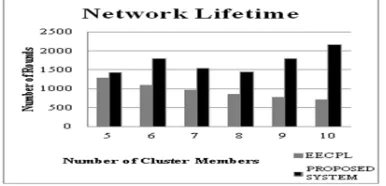
[image:5.595.304.497.523.616.2]The overall network Lifetime is defined as the number of the rounds a node takes to live. In the proposed protocol, the lifetime of the network is extended as the number of rounds is increased when comparing with the existing EECPL protocol.The Fig. 4 shows the comparison of proposed protocol and EECPL for number of rounds versus number of cluster members.
Fig. 4 Number Of Cluster Members Vs Network Lifetime.
V.CONCLUSIONS
In this paper, a new Energy Efficient Clustering protocol has been proposed to reduce the average energy consumed by the network and provide reliability by reducing the overall delay in the network. The performance of the proposed protocol is compared with the existing protocol . The performance metrics considered for
SIMULATION PARAMETER
VALUE
Node count 75
Optimal cluster size 10
Number of clusters 10
Terrain dimension 100 * 100
Mobility Model Random way point model
Speed of a node 1 m/s
Propagation Model TwoRayGround
Transmission range 20 meters
Initial Energy 1 Joule
Transmission Energy 0.000045 Joule
Reception Energy 0.000024 Joule
Idle Energy 0.000001 Joule
Sensing Energy 0.000015 Joule
Processing Energy 0.000024 joule
ISSN: 1992-8645 www.jatit.org E-ISSN: 1817-3195
comparison are average energy consumption, average end to end delay and Network lifetime. On Comparing with the existing protocol, the proposed protocol is found to be efficient in terms of average energy consumption, average end to end delay and Network lifetime. The proposed protocol provides reliability even when node failure is encountered in the network ie, when a node becomes faulty.
REFERENCES
[1]. Chen Wei, Chen Zhi and Pingyi Fan, “AsOR: An Energy Efficient Multi-Hop Opportunistic Routing Protocol for Wireless Sensor Networks over Rayleigh Fading Channels”, IEEE Transactions on Wireless Communications, Vol. 8, No. 5, pp. 2452-2463, May 2009.
[2]. Chia-Hung Lin and Ming-Jer Tsai, “HEED: A Hybrid, Energy-Efficient, Distributed Clustering Approach for Ad Hoc Sensor Networks”, IEEE Transactions on Mobile Computing, Vol. 5, No. 10,pp. 1471-1472, October 2006.
[3]. Fuad Bajaber and Irfan Awan,“ Energy Efficient Clustering protocol to Enhance lifetime of wireless sensor network”, Springer Journal on
Ambient Intelligence and Humanized Computing, pp. 239-248, 23 June 2010.
[4]. Jamal N. AL-Karaki, Ahmed E. Kamal, “Routing techniques in wireless sensor networks:A survey”, IEEE wireless communications, pp. 4-19, December 2004. [5] .Jisoo Shin and Changjin Suh, “CREEC: Chain
Routing with Even Energy Consumption”, KICS Journal of Communications and Networks, Vol. 13, No. 1, pp. 17-25, February 2011.
[6].Sujihelen.L.,Dr.C.Jayakumar, "Authentication solutions for Wireless Sensor Network based on Virtual Certificate Authority", 2013 International Conference on Circuits, Power and Computing Technologies (ICCPCT) , pp.1003,1007, March 2013.
[7]. Mohamed K. Watfa, Omar Mirza and Jad Kawtharani, “BARC: A Battery Aware Reliable Clustering algorithm for sensor networks”, IEEE Journal of Network and Computer Applications, Vol. 32, No. 6, November 2009.
[8]. Ossama Younis, Marwan Krunz and Srinivasan Ramasubramanian, “Node Clustering in wireless sensor networks: Recent Developments
and Deployment challenges”, IEEE Network, pp 20-25, June 2006.
[9]. Siva D.Muruganathan, Daniel C.F. Ma, Rolly I. Bhasin and Abraham O. Fapojuwo, “A Centralized Energy Efficient Routing protocol for Wireless Sensor Networks”, IEEE Radio Communications, pp 8-13, March 2005.
[10].Vivek Katiyar, Narottam Chand and Surender Soni, “ A Survey on Clustering Algorithms for Heterogeneous Sensor Networks”, International journal of Advanced Networking and Applications, Vol. 2, No. 4, pp. 745-754, November 2010.
[11].Willig A, “Wireless Sensor Networks: Concept, Challenges and Approaches”, Electrical and Computer Engineering, Vol. 123, No. 6,
pp. 224-231, 2006.