EXAMINING THE EFFECTIVENESS OF USING WEB-BASED
LEARNING FOR GIFTED STUDENTS: JORDAN AS CASE
STUDY
1
ALI RATIB ALAWAMREH, 2NUR FAZIDAH ELIAS
1,2Faculty Of Information Science And Technology, Universit Kebangsaan Malaysia, 43600 Bangi,
Selangor, Malaysia
E-mail: [email protected], [email protected]
ABSTRACT
Learning Management System (LMS) as a part of e-learning has become very crucial for modern societies. LMS uses several techniques, one of the most used ones is web-based learning. Modern societies are divided into two types of students: i) Regular students, and ii) Gifted students. Gifted students have various distinguished abilities compared with regular ones. In this paper, a model to enhance web-based learning for gifted students in developing countries is proposed. The proposed model consists of three factors which are: i) Intrinsic motivation, ii) Training, and iii) Compatibility. The proposed model also aims to explore the key factors that affect gifted students’ acceptance of web-based learning. The proposed model is applied in Jordan where web-based learning concept was introduced in the 90s. The results gained from applying the proposed model in Jordan shows that the proposed model is accepted.
Keywords: Web-Based Learning, Gifted Students in Jordan, Intrinsic Motivation, Training, Compatibility
1. INTRODUCTION
The evaluation of learning management systems (LMS) is a continuing process all through the development lifecycle [1]. In order to ascertain the problem areas or make deduction on the overall quality of LMS, particularly the web-based learning environment, several formative evaluation approaches may be employed. However, in implementing the web-based learning applications, many of the developmental approaches have an obvious lack to two critical considerations, which are (1) integration of the user interface design with instructional design and (2) development of the evaluation acceptance of framework to improve the overall quality of web-based learning environments [2, 3].
Web-based learning is linked to learning materials delivered in a web browser that includes materials packaged on CD-ROM or other types of media [4]. On the other hand, Web-based learning is considered as an educational managing system that offers innovative and compelling ways in education, enabling stakeholder’s end-user to engage in virtually all aspects of the learning process and teaching [5]. Moreover, web-based learning enables users to interact, collaborate and communicate via various channels including e-mail, discussion forums and online learning sessions. As
such, web based learning becomes a suitable instructional environment for gifted students because unlike their counterparts, gifted students possess distinguished characteristics such as: problem solving and self-directed learning abilities [6, 7]. Thus, gifted students should be equipped with appropriate technology in order to foster their sense of creativity, invention and innovation [8].
In this paper, the researcher evaluates web-based learning for gifted students in developing countries. The literature provides a limited number of studies about web-based learning in developing countries. The available studies do not provide any concrete model or discussion about using web-based learning for gifted students, and the factors that enhances the learning process for this type of students.
The main objective of this study is to identify the factors that affect gifted student’s acceptance of web-based learning. The factors that are discussed and examined in this paper are: i) Intrinsic motivation, ii) Training, and iii) Compatibility.
This paper also presents and examines three hypothesis, which are:
• H1: Intrinsic Motivation (IM) has significant effect on behavioural intention
• H3: Compatibility (CMP) has significant effect on intention to use.
The research questions that are addressed in this paper are:
1) What are the major factors affecting gifted students’ acceptance of Web based learning? 2) What are the differences between gifted and regular students with regard to acceptance of Web based learning?
3) How to propose a suitable Web based learning that takes into account the gifted students?
The rest of this paper is organized as follow: Second section contains several review sub-sections about the topics that are related to the proposed model. Section three contains the proposed model along with testing results. Finally, Section four concludes the paper.
2. WEB-BASED LEARNING
This part contains several review sections that are related to web-based learning. In the first section, a review about the general concept of web-based learning is introduced. The second section presents a review about web-based learning in Jordan. After that, a similar system is explained, which is called EduWave. Finally, two sections are dedicated to present a review about gifted students in Jordan, and the enhancements of learning systems for this type of students.
2.1 Web-Based Learning Motivation
The role played by LMS in improving teaching and learning process is crucial since it transforms the traditional modes of teaching [9]. LMS also makes teaching and learning process more attractive and interesting [9]. Therefore, web-based learning is an all-inclusive e-learning and educational management platform which flawlessly incorporates LMS, Content Management System (CMS), Instructional Management System (IMS), and Student Information Systems (SIS) all in one solution [10][10].
Web-based learning provides users with novel and compelling ways in education where stakeholders are able to engross themselves in virtually all aspects of the teaching and learning process [11]. This mode of learning is anchored by international industry standards (SCORM and SIF), learning objects and learning outcomes, and it offers a multitude of potent tools such as communication and collaboration, authoring,
assessment, tracking, grading and reporting. Web-based learning is designed to manage implementations on a large scale, and caters to millions of users in numerous countries and regions. There is also a widespread adoption of web-based learning tools among a number of universities and colleges, and by using these tools, the quality of education for users will be enhanced and improved, satisfying a significant amount of learning skills, while ensuring consistency throughout the departments and the university. Apart from that, teachers and instructors who are unfamiliar with web-based learning will also be assisted and supported [12]. Nonetheless, Al-Shboul [12] reported that there are significant potential drawbacks of implementing these tools:
• Firstly, there are concerns that the tools are being implemented without taking into consideration the well-being of students and instructors. In addition to that, it is found that institutions are implementing these technologies albeit having no knowledge on their impact on the institution, administrators, instructors, and students [13]. Therefor Technology enables gifted students to hypothesize and inductively pursue several solutions to problems they are enjoying learning through exploration experimentation and investigation.
• Secondly, technology increases the sophistication of products that gifted students can generate and create by allowing these students to function in roles similar to practicing professionals [13].
2.2 Web-Based Learning In Jordan
2.3 Eduwave Software In Jordan
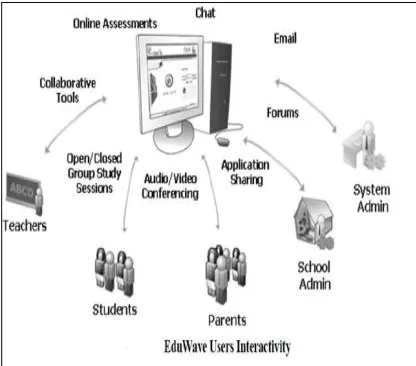
[image:3.595.87.295.266.449.2]EduWave is an web- based learning and educational managing system that is user-friendly. It provides users with learning that is innovative and compelling [5]. Through EduWave, users can engage in virtually all facets of the learning process and teaching. As such, EduWave e-Learning system offers a great deal of benefits to its stakeholders [15, 16]. Figure 1 shows the structure of EduWave system.
Figure 1: EduWave in Jordan
As illustrated in Figure 1, EduWave allows interaction, collaboration and communication between students, teachers, school administration, and parents, all of which are made possible via various channels including e-mail, discussion forums and online learning sessions.
EduWave provides assistance to students in improving their performance, tracking their progress and enjoying their learning experience. Apart from that, EduWave also provides students with access to their learning material and textbooks that are modified and presented in rich media format irrespective of time and location [15].
Moreover, EduWave is a system that is easy to learn and use, and this puts the entire world of education to the computer screen. Aside from that, learning becomes more fun and engaging to students, while teaching becomes far more effective and innovative. Additionally, as EduWave offers innovative and compelling ways in education, stakeholders are able to engross themselves in virtually all aspects of the teaching and learning process. There are many benefits of EduWave
web-based learning system to stakeholders including students, teachers, parents, school administrators at , district, and ministry levels. As for students, there are several all-inclusive tools and learning resources in EduWave that could assist them in tracking their progress, improving their performance and enjoying their learning experience. Furthermore, the system allows students to have interaction with their peers and teachers using various communication and collaboration tools. Students can also sit for online tests and retrieve their learning materials, assignment and marks at any time that is convenient to them [5].
As for the teacher, by using the administration education tools in EduWave, they are able to manage and utilize their time better. This makes the teaching more efficient and thus, teachers will have more room for innovation creativity. Further, in supporting the role of education, EduWave offers a vast collection of instructional design authoring, professional development tools and resources. Additionally, aside from having the ability to manage the content of learning and curricula, EduWave enables teachers to create their own teaching materials with ease, contact with their students using the systems’ multiple communication channels, and use variety of assessment and evaluation tools to help them measure the performance and progress of individual student [17].
2.4 Gifted Students In Jordan
Giftedness and talent are regarded as the assets for high academic achievement. Students who are gifted and talented face no visible obstacles in learning and participating at schools and in society. However, the education system and attitudes of the society can retard these students’ abilities [18].
self and make appropriate decisions with regard to future career choices.
In Jordan, there are foundations and criteria for selecting students who are gifted. The nominated student is one that has successfully completed Sixth Grade and fulfills the following criteria [19]:
i. Scores average of 95% in the subjects of Science, Mathematics, and English language, and the overall rate of 95%.
ii. The student's achievement record for the three previous years shows stable and steady progress in various materials (English, science and mathematics). Unstable and unsteady progress can indicate possibility of failure and lack of continuity.
iii. Has passed school interview for gifted students, and gained guardian's approval.
A developing country, such as Jordan, suffers from having limited resources [20, 21]. Therefore, the country is relying more on the development of the human resources than the economic resources. Also like other developing countries, Jordan’s social and educational system faces many obstacles that restrain the equal access to education for all students.
2.5 Enhancing Web-Based Learning For Gifted
Students
Web-based learning comprises of content in web browser plus activities, and actual learning materials available in format in the web. As indicated by Tsai and Machado [22], web-based learning shares similarity with curriculum or the textbooks in a sense that the content determines whether a book is a report, novel, or a textbooks [23]. Additionally, design is important for web-based learning. As indicated by Yang et al. [24], Artino [25] and Liaw [26], a better web-based learning design incorporates plans or strategies that focus on structuring the e-learning or online course environment that supports and helps students in directing and regulating their own learning. Aside from that, the design also stimulates and maintains students’ interest, motivation and engagement in the classroom [27-29]. To get suitable web based learning for gifted students, certain criteria have to be followed due to their deferent abilities compared with regular students. These criteria may include the following:
A. Training on approach, pedagogy and technology is vital to improve human skills and it is also vital to have efficient energy resources and renewable energy technologies. Further, it is
crucial to have educated and trained man-power at all levels to ensure successful implementation of sustainable technology. Promoting training and information to the potential users of efficient energy is also important [30, 31]. B. Format, instructions and expectations should be
clear so that students can self-direct their own learning appropriately and acquire the skills of autonomous learning and self-reliance learning. Moreover, Thomson [32] stressed that web-based learning should be encouraging, supportive, caring, nice, fair, and friendly so that it will always ensure good communication with the talented student [32].
C. The multiple adaptations put emphasis on delivering a web-based learning environment comprising of varied learning goals and experiences that match with learners’ previous academic experiences. The environment of web-based learning environment is entrenched in learning paths and this can motivate learners to start exploring and creating their own knowledge. Aside from that, the environment of multimedia learning can enhance learners’ motivations and stimulate learners' positive emotions. Consequently, as indicated by Chen [33], the regions of human related memory in learners’ brain will be initiated and triggered and this significantly influences learners’ brain’s activities and learning processes. D. Albeit the increase in the use of e-learning,
distance learning, web-based learning, and virtual schools, as indicated by Allen and Seaman [34], the majority of students are still learning in classrooms. However, this is not necessarily a drawback because teachers can indeed make use of their classroom instruction to stimulate students’ creative thinking through the use of tools that the students are already familiar with [35]. In this way, teachers can still encourage creativity in the classroom. Moreover, Wilson [36] and Shaheen [37] stressed that creativity should be acknowledged and appreciated and there should be changes in educational processes starting with innovation in curricula that incorporates creativity [38, 39]. As such, the regular classroom teachers should be equipped with the knowledge on creativity so that they understand the creative process, know the characteristics of creative students and are able to facilitate creative thinking and creative performance of their students [40, 41].
link new materials with their previous learning experiences by interacting with learning environment [42]. Several researches have shown that interaction leads the learning process in the improvement of academic achievement and stimulates learners’ motivation. Simultaneously through interaction, the efficiency of learning can be enhanced, while learning strategies can be developed through the control of the learning content and previous orders of the web-based environment. Further, by being active participants in learning, learners focus on their own learning process, and they are able to perceive accomplishment and satisfaction more easily [43-45]. More than a decade ago, the initiation of information communication technology (ICT) and e-Learning resources into Jordanian classrooms as a support for innovative teaching practice was launched by the Ministry of Education of Jordan [46], and recently, UNESCO has awarded a prize to Jordan’s Education Initiative on the application of ICT in Education. This groundbreaking education project in the schools in Jordan is established on using the power of ICT with the proven methods of learning as an attempt to transform the school’s learning environment
3 PROPOSED MODEL OF WEB BASED
LEARNING FOR GIFTED STUDENTS
This section illustrates the most used factors that affects web-based learning acceptance for gifted students. These factors are: i) Intrinsic Motivation, ii) Training, and iii) Compatibility. The proposed model is validated using both existing data, from the previous studies, and data obtained in two new surveys. This model postulates that three direct variables to determine the behavioral intent of technology
3.1 Model Factors
i. Intrinsic motivation: It refers to the motivation
that comes from inside an individual instead from any outside rewards, like grades or money. The motivation comes from the pleasure one gets from the task or from the sense of satisfaction in completing or even working on a task [47].
The concept of intrinsic motivation which was originated with William James, was used to illustrate various types of human behaviours [48]. The terms “Interest” and “instincts of constructiveness” reflect the concepts of self-determination and competence, which today define intrinsic motivation[49].
The theory of self-determination include the three innate psychological needs, which are the need for competence, relatedness, and autonomy [50]. Engagement research has addressed how learning activities can be structured to promote student motivation (challenge, choice, and efficacy). Giving students choices about what tasks to engage in enhances intrinsic motivation among the students [51]. Additionally, students need to learn by engaging in learning activities that are interesting and meaningful to them
ii. Training: Using software as web-based
learning is simplifying routine tasks relieves teachers, students, school administration, and staff of ministry of education from time-consuming administrative burdens, enabling them to[52]:
a) Manage student data electronically in an effective manner.
b) Receive and correct homework /projects in electronic format.
c) Communicate with students and parents. d) Track and monitor student attendance
and performance.
e) Manage enrolments and disseminate information. Increase productivity through enhanced ICT skills.
iii. Compatibility: research into factors
affecting the acceptance of the Internet as a learning tool highlighted the importance of web-based learning system as a compatible with learning styles for the user [53].Cheung etc al [54]performed an analogous study in relation to the web-based learning system specifically. In this study, compatibility was emphasized as the most significant factor affecting the acceptance of technology particularly e Learning. Previous studies pointed to that compatibility was important and a significant factor affecting user intentions to accept, foremost through the intermediaries of perceived usefulness and perceived of ease, respectively[54-56].
3.2 Conceptual Model
Figure 2 shows the proposed model. This model consists of the presented three factors, besides behavioural intention and use behaviour components.
[image:6.595.304.512.141.409.2]
web based learning when the social environment encourages its use" [58-60]. Previous studies indicated that intention to use and use behavior has tested for acceptance technology with users [61].
Figure 2: Conceptual Model
3.3 Model Verification
In this section, the researcher attempts to identify the major factors that affecting the gifted student acceptance of Web based learning.
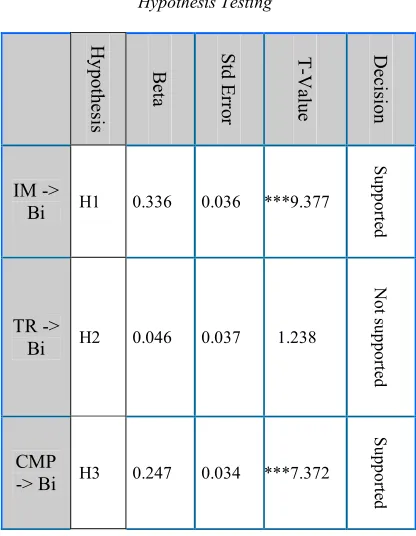
Table 1 depicting determinants influencing the gifted student acceptance of Web based learning. In this regard, this study has proposed a set of hypotheses. The structural model is used to test hypotheses. As shown in the table the results of the structural model, path coefficient values are shown for every path, or relationship, between each independent construct and its dependent construct. In order to test the significance of the path coefficients in the structural model, t-statistics for all path coefficients were extracted using a bootstrapping analysis in SmartPLS.
Table 1: Structural Model: Path Coefficients And Hypothesis Testing
H
y
p
o
th
es
is
B
et
a
S
td
E
rr
o
r
T
-V
al
u
e
D
ec
is
io
n
IM ->
Bi H1 0.336 0.036 ***9.377
S
u
p
p
o
rte
d
TR ->
Bi H2 0.046 0.037 1.238
N
o
t s
u
p
p
o
rte
d
CMP
-> Bi H3 0.247 0.034 ***7.372
S
u
p
p
o
rte
d
Notes: t values are calculated through
bootstrapping routine with 523 cases and 5000 samples. *P< 0.1, ** P < 0.05, ***P < 0.01 (One-Tailed test).
The main the gifted student acceptance of Web based learning model proposed in this research comprised of 3 constructs that work in different causal levels. As shown in table 1 all hypothesis are supported the theoretical foundation.
H1 Intrinsic motivation (IM) has significant effect on behavioural intention
This section investigates the relationship between the intrinsic motivation (IM) and the behavioural intention constructs. To support the investigation, the above hypotheses were tested as depicted in Figure 3. Results from the PLS Analysis showed that the Intrinsic motivation had a significant positive effect (B= 0.336, p< 0.01) on the behavioural intention.
Compatibility
Training
Intrinsic motivation
Behavior Intention
[image:6.595.90.292.176.446.2]Figure 3: Intrinsic Motivation
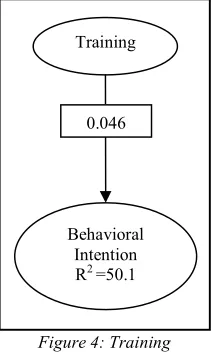
H2: the training (TR) has significant effect on behaviour intention
[image:7.595.84.511.78.309.2]This section investigates the relationship between the training (TR) and the behavioural intention constructs. To support the investigation, the above hypotheses were tested as depicted in Figure 4. Results from the PLS Analysis showed the training had no a significant effect (B= 0.046, p>.10) on the behavioural intention.
Figure 4: Training
H3: Compatibility (CMP) has significant effect on intention to use
This section investigates the relationship between the Compatibility (CMP) and the behavioural intention constructs. To support the investigation, the above hypotheses were tested as depicted in Figure5. Results from the PLS Analysis showed that the Compatibility had a significant positive effect (B= 0.247, p< 0.01) on the behavioural intention
Figure 5: Compatibility
4. CONCLUSION
In a nutshell, regular students and gifted students are different from one another and thus, educators and web-based learning creators must take this factor into consideration. Special care and attention must be given to gifted students to enable them to pave the way to innovation so that in the future.
It was observed that there is a scarcity of specific studies that explore specific ways to take advantage of the potentials and abilities of gifted students in developing countries. The descriptive statistics of whole sample were then examined, following by statistical assumptions relevant to the model and hypotheses testing.
The basic analyses of the sample data resulted in a good feel for the data, and showed that the sample was applicable for further analysis via both Descriptive analysis and EFA using SPSS, and variance-based SEM technique, using PLS.
The findings revealed that all the independent variables were found to be statistically correlated to each other. Further, Standard multiple regression was conducted in order to investigate the relationships between independent variables. intrinsic motivation, and compatibility variables were found to positively contribute to the behavioral intention and training had no a significant effect on the behavioral intention to ue web based learning
ACKNOWLEDGEMENT:
This research was funded by means of Malaysia Ministry of Education under the Exploratory Research Grant Scheme (ERGS) project code
CMP
Behavioral Intention R2 =50.1 0.247
Training
Behavioral Intention R2 =50.1 0.046
IM
[image:7.595.137.243.429.606.2]ERGS/1/2013/ICT01/UKM/02/3. The authors take the responsibility for the contents.
REFRENCES:
[1] Antonis, K., et al., Evaluation of the effectiveness of a web-based learning design for adult computer science courses.
Education, IEEE Transactions on, 2011. 54(3): p. 374-380.
[2] Ssemugabi, S., Usability evaluation of a web-based e-learning application: a study
of two evaluation methods, 2009.
[3] Nam, C. and T. Smith-Jackson, Web-based learning environment: A theory-based design process for development and
evaluation. Journal of Information
Technology Education: Research, 2007. 6(1): p. 23-43.
[4] Rafaeli, S., et al., QSIA–a Web-based environment for learning, assessing and
knowledge sharing in communities.
Computers & Education, 2004. 43(3): p. 273-289.
[5] Al-Shboul, M., Teachers’ perceptions of the use of EduWave e-Learning system in
public schools in Jordan. The Journal of
Human Resource and Adult Learning, 2012. 8(2): p. 167-181.
[6] Kim, S. and B. Seo, The Development of e-Learning Platform for Gifted Children
Education. Published on International
Journal for Educational Media and Technology, 2009. 3(1): p. 39-51.
[7] Pajares, F. and L. Graham, Self-efficacy, motivation constructs, and mathematics performance of entering middle school
students. Contemporary educational
psychology, 1999. 24(2): p. 124-139. [8] Bocconi, S., P. Kampylis, and Y. Punie,
Innovating teaching and learning
practices: Key elements for developing
creative classrooms in Europe. E-Learning
Papers, 2012(30).
[9] Buabeng-Andoh, C., Factors influencing teachers' adoption and integration of
information and communication
technology into teaching: A review of the
literature. International Journal of
Education and Development using Information and Communication Technology, 2012. 8(1): p. 136.
[10]Abuhmaid, A., ICT Training Courses for Teacher Professional Development in
Jordan. Turkish Online Journal of
Educational Technology-TOJET, 2011. 10(4): p. 195-210.
[11]Al-Shboul, M., Teachers' Perceptions of the Use of EduWave E-Learning System in
Public Schools in Jordan. 2012.
[12]Al-Shboul, M., The level of e-Learning integration at The University of Jordan:
Challenges and opportunities.
International Education Studies, 2013. 6(4): p. p93.
[13]Njenga, J.K. and L.C.H. Fourie, The myths
about e‐learning in higher education.
British Journal of Educational Technology, 2010. 41(2): p. 199-212. [14]Al-So’ub, M., The Study Aimed at
Developing the Teaching Competences of Social Education Teachers through a Training Programme in Karak
Al-Mazar Education Directorate. Dirasat:
Educational Sciences, 2010. 36(1). [15]Al-Shboul, D.M., Teachers' Perceptions of
the Use of EduWave E-Learning System in
Public Schools in Jordan, The Journal of
Human Resource and Adult Learning, , 2012. Vol. 8, Num.
[16]Mashhour, A. and Z. Saleh, Evaluating E-Learning in Jordanian Institutions: Why Is
It Lagging? Quarterly Review of Distance
Education, 2010. 11(4).
[17]MOMANI, A., E. ABU-SHANAB, and N. ABABNEH. E-LEARNING SYSTEMS’ACCEPTANCE: THE CASE
OF EDUWAVE IN JORDAN. in
Conference proceedings of" eLearning
and Software for Education". 2012.
[18]Hielat, M.Q. and A.M. Al-Shabatat,
Comparing Academically Gifted and Non-Gifted Students’ Supportive Environments
in Jordan. International Interdisciplinary
Journal of Education, 2012. 1(6).
[19]Alfarah, Y.F., Communication Skills
among Gifted Students in Jordan. Gifted
and Talented International, 2013: p. 255. [20]Akkari, A., Education in the Middle East
and North Africa: The Current Situation
and Future Challenges. International
Education Journal, 2004. 5(2): p. 144-153. [21]Wiley, D., C. Green, and L. Soares,
Dramatically Bringing down the Cost of
Education with OER: How Open
Education Resources Unlock the Door to
Free Learning. Center for American
[22]Van Sluys, M., et al., Comparative
analyses of the complete genome
sequences of Pierce's disease and citrus variegated chlorosis strains of Xylella
fastidiosa. Journal of Bacteriology, 2003.
185(3): p. 1018-1026.
[23]Tsai, S. and P. Machado, E-Learning
basics: Essay. Elearn magazine, 2002.
2002(7): p. 3.
[24]Frazer, K.A., et al., A second generation human haplotype map of over 3.1 million
SNPs. Nature, 2007. 449(7164): p.
851-861.
[25]Ioannou, A. and A.R. Artino Jr, Learn more, stress less: Exploring the benefits of
collaborative assessment. College Student
Journal, 2010. 44(1): p. 189.
[26]Liaw, Y.-F., et al., Asian-Pacific consensus statement on the management of chronic hepatitis B: a 2008 update.
Hepatology international, 2008. 2(3): p. 263-283.
[27]Artino, A., Practical guidelines for online
instructors. TechTrends, 2008. 52(3): p.
37-45.
[28]Yang, Z. and Q. Liu, Research and development of web-based virtual online
classroom. Computers & Education, 2007.
48(2): p. 171-184.
[29]Liaw, S.-S., G.-D. Chen, and H.-M. Huang, Users’ attitudes toward Web-based collaborative learning systems for
knowledge management. Computers &
Education, 2008. 50(3): p. 950-961. [30]Hui, S. and K. Cheung, Developing a
web-based learning environment for building energy efficiency and solar design in Hong
Kong. Solar energy, 1999. 67(1): p.
151-159.
[31]El-Zraigat, I.A., Counseling Gifted and Talented Students in Jordanian Inclusive Schools: Conclusion and Implication.
International Journal of Special Education, 2012. 27(2): p. 57-63.
[32]Thomson, D.L., Beyond the classroom walls: Teachers' and students' perspectives on how online learning can meet the needs
of gifted students. Journal of Advanced
Academics, 2010. 21(4): p. 662-712. [33]Lo, J.-J., Y.-C. Chan, and S.-W. Yeh,
Designing an adaptive web-based learning system based on students’ cognitive styles
identified online. Computers & Education,
2012. 58(1): p. 209-222.
[34]Allen, I.E., J. Seaman, and R. Garrett,
Blending in: The extent and promise of
blended education in the United States.
2007: ERIC.
[35]Allen, I.E. and J. Seaman, Online Nation:
Five Years of Growth in Online Learning.
2007: ERIC.
[36]Martin, J.A., et al., Births: final data for
2009. National vital statistics reports: from
the Centers for Disease Control and Prevention, National Center for Health Statistics, National Vital Statistics System, 2011. 60(1): p. 1-70.
[37]Lin, Y.-S., Fostering creativity through education–a conceptual framework of
creative pedagogy. Creative Education,
2011. 2(03): p. 149.
[38]Shaheen, R., Creativity and education.
Creative Education, 2010. 1(03): p. 166. [39]Wilson, A., Creativity in primary
education. 2009: SAGE.
[40]Aljughaiman, A. and e. mowrer‐reynolds,
Teachers' conceptions of creativity and
creative students. The Journal of Creative
Behavior, 2005. 39(1): p. 17-34.
[41]de Souza Fleith, D., Teacher and student perceptions of creativity in the classroom
environment. Roeper Review, 2000. 22(3):
p. 148-153.
[42]Salmon, G., E-tivities: The key to active
online learning. 2013: Routledge.
[43]Chen, Y.-C., The Design of Web-Based Learning Environment to Actively Connect
Human Brain and Goble Brain.
Procedia-Social and Behavioral Sciences, 2012. 64: p. 515-524.
[44]Williams, K.C. and C.C. Williams, Five key ingredients for improving student
motivation. Research in Higher Education
Journal, 2011. 12: p. 1-23.
[45]Zhu, C., M. Valcke, and T. Schellens, A
cross-cultural study of online
collaborative learning. Multicultural
Education & Technology Journal, 2009. 3(1): p. 33-46.
[46]Light, D., The Role of ICT in Enhancing
Education in Developing Countries:
Findings from an Evaluation of The Intel® Teach Essentials Course in India, Turkey,
and Chile. Journal of Education for
International Development, 2009. 4(2): p. 52-66.
[47]Huitt, W., Motivation to learn: An
overview. Educational Psychology
[48]Shepard, R.N., Ecological constraints on
internal representation: resonant
kinematics of perceiving, imagining,
thinking, and dreaming. Psychological
review, 1984. 91(4): p. 417.
[49]Shroff, R.H., et al., STUDENT E-LEARNING INTRINSIC MOTIVATION: A
QUALITATIVE ANALYSIS.
Communications of the Association for Information Systems, 2007. 19.
[50]Reis, H.T., et al., Daily well-being: The role of autonomy, competence, and
relatedness. Personality and Social
Psychology Bulletin, 2000. 26(4): p. 419-435.
[51]Eisenberger, R. and J. Aselage,
Incremental effects of reward on
experienced performance pressure:
Positive outcomes for intrinsic interest and
creativity. Journal of Organizational
Behavior, 2009. 30(1): p. 95-117.
[52]Al-Zoubi, S.M. and M.S.B.A. Rahman,
The Effects of a Training Program in Improving Instructional Competencies for Special Education Teachers in Jordan.
Educational Research (ISSN: 2141-5161), 2011. 2(3): p. 1021-1030.
[53]Chen, J.-L., The effects of education
compatibility and technological
expectancy on e-learning acceptance.
Computers & Education, 2011. 57(2): p. 1501-1511.
[54]Cheung, R. and D. Vogel, Predicting user acceptance of collaborative technologies: An extension of the technology acceptance
model for e-learning. Computers &
Education, 2013. 63: p. 160-175.
[55]Ho Cheong, J. and M.-C. Park, Mobile
internet acceptance in Korea. Internet
research, 2005. 15(2): p. 125-140.
[56]Seymour, E., A. Ridley, and J. Noonan,
Assessing the role of a four-stage approach for improving the compatibility of Environmental Management Systems
and Quality Assurance. Animal
Production Science, 2007. 47(3): p. 333-345.
[57]Nysveen, H., P.E. Pedersen, and H. Thorbjørnsen, Explaining intention to use mobile chat services: moderating effects of
gender. Journal of consumer Marketing,
2005. 22(5): p. 247-256.
[58]Chan, S. and M. Lu, Understanding internet banking adoption and use
behavior: A Hong Kong perspective. 2004.
[59]Lin, C.-P. and B. Anol, Learning online social support: an investigation of network information technology based on UTAUT.
CyberPsychology & behavior, 2008. 11(3): p. 268-272.
[60]Kim, C., M. Mirusmonov, and I. Lee, An
empirical examination of factors
influencing the intention to use mobile
payment. Computers in Human Behavior,
2010. 26(3): p. 310-322.
[61]Ishibashi, H., S. Hihara, and A. Iriki,
Acquisition and development of monkey
tool-use: behavioral and kinematic
analyses. Canadian journal of physiology