WEIGHTED QUANTUM PARTICLE SWARM
OPTIMIZATION TO ASSOCIATION RULE MINING AND PSO
TO CLUSTERING
1D.GOKILA, 2DR.S.RAJALAKSHMI 1
Assistant Professor, Department of Computer Science and Engineering, Jay Shriram Group of Institutions, Tamilnadu, India.
2
Associate Professor & HOD, Department of Computer Science and Engineering, Jay Shriram Group of Institutions, Tamilnadu, India.
E-mail: [email protected], [email protected],
ABSTRACT
In the area of association rule mining (ARM), the most major algorithms is Apriori algorithm. In the existing Apriori algorithm minimum support and confidence are determined subjectively or through trial and error method so, the algorithm lacks the objectiveness and efficiency. To improve the efficiency of association rules, Particle Swarm Optimization (PSO) algorithm is projected, which gives feasible threshold values for minimum support and confidence. In the PSO algorithm, initially it looks for the optimum fitness value of each particle and then finds their corresponding support and confidence as minimum threshold values. The difficulty of PSO algorithm is that, it guesses that the items have the same implication without taking into account of their weight/attributes within a transaction or within the whole item space. To overcome this drawback, this paper proposes a weighted quantum particle swarm optimization algorithm (WQPSO) with weighted mean best position according to fitness values of the particles. WQPSO algorithm provides faster local convergence, fallout in better balance between the global and local searching of the algorithm, so it generates good performance. The proposed WQPSO algorithm is experienced with several benchmark functions and compared with standard PSO. The experimental result shows the supremacy of WQPSO and it is verified by applying the FoodMart2000 database of Microsoft SQL Server 2000. Likewise, in clustering, there are many unsupervised clustering algorithms have been developed one such algorithm is K-means which is simple and straightforward. The main drawback of the K-means algorithm is that, the result is sensitive to the selection of the initial cluster centroids and may converge to the local optima. This is solved by PSO as it performs globalized search and produces clusters with high intra class similarity.
Keywords: Data mining, Association Rule Mining, Particle Swarm Optimization, K-Means, Weighted Quantum Particle Swarm Optimization, Clustering
1. INTRODUCTION
With the growth of information technology, there are various kinds of information databases, such as scientific data, trading data, financial data, and marketing contract data. To effectively analyze and apply these data and find the significant hidden information from these databases have become very important issues. Data mining technique [1] has been the most broadly discussed and frequently applied tool in current decades. It can be considered into a number of models, including association rules, clustering and classification. Among these representation, association rule mining is the most broadly applied method. The Apriori algorithm is
suggest a WQPSO [3] algorithm with weighted mean best position according to fitness values of the particles. The proposed WQPSO algorithm is experienced with several benchmark functions and evaluated with standard PSO. For the point of assessment, this study first employs the embedded database of Microsoft SQL Server 2000 to assess the proposed algorithm. In another side, the K-means algorithm (Kaufman & Rousseeuw, 1990) is a well-known approach to clustering. Its popularity depends on its simplicity and computational efficiency. However, that approach tends to fixate on local optima near the initial cluster centers, which are assigned randomly. So this paper explores the applicability of PSO and its variants to cluster data vectors. In the progression of doing so, the aim of the paper is:
• to propose WQPSO algorithm for
association rule mining
• to compare the performance of PSO with
WQPSO
• to show that the standard PSO algorithm
can be used to cluster arbitrary data, and
• to compare the performance of PSO and
its variants with standard K-means algorithm.
The rest of this study is planned as follows. Section 2 explain the Related Work, the projected method PSO and WQPSO algorithm for association rule mining is explained in Section 3.Section 4 describes about K-means and PSO algorithm for Clustering. The conclusion is finally made in Section 5.
2. LITERATURE REVIEW
This section briefly illustrate about the active algorithm in association rule mining.
Agrawal et al. [4] introduced the Apriori algorithm, it is helpful to catch the frequent itemsets from a transaction dataset and obtain association rules. Once frequent itemsets are obtained, then it is easy to generate association rules with confidence larger than or equal to a user specified minimum confidence.It says, ‘if an itemset is not frequent, any of its superset is not at all frequent’. Although, in some cases with a lot of frequent itemsets, huge itemsets, or very low minimum support,till now it suffers from the cost of generating a huge number of candidate sets. In view of the fact that the processing of the Apriori
algorithm requires loads of time, its computational efficiency is a very important issue.
Savasere et al. [5] proposed the Partition algorithm. The algorithm carried out in two phases. First phase, the Partition algorithm rationally divides the database into a number of non-overlapping partitions. The partitions are measured one at a time and all large itemsets for that partition are generated. At the end of phase I, these large itemsets are combined to generate a set of all potential large itemsets. Phase II, the actual support for these itemsets is shaped and the large itemsets are recognized. The partition sizes are selected such that each partition can be accommodated in the main memory so that the partitions are read only once in each phase. An important, role of our approach is that it drastically reduces the I/O overhead associated with previous algorithms. But the problem is, additional work is needed to accurately estimate the number of partitions.
Toivonen et al. [6] proposed the sampling algorithm. It relates the level-wise method to the sample, along with a lesser minimum support threshold, to quarry the superset of a large itemset. A quite clear way of reducing the database activity of knowledge discovery is to use only a random sample of the relation and to find approximate regularities. Samples are little enough to be hold totally in main memory can provide reasonably accurate results. This method creates exact association rules, but in some cases it does not create all the association rules, (i.e.) some misplaced association rules might continue to exist.
Genetic Algorithm (GA) [7] was developed by Holland et al. Genetic Algorithm is stochastic search algorithm modeled on the process of natural selection, which underlines biological progress. By using Genetic Algorithm (GAs) the system can predict the rules which contain negative attributes in the generated rules along with more than one attribute in consequent part. The major benefit of using GAs in the discovery of prediction rules is that they perform global search and its complexity is less compared to other algorithms. But, it have some drawbacks, they are (a) GAs are very slow (b) In presence of noise, convergence is hard and the local optimization technique might be useless (c) Models with many parameters are computationally expensive (d) They cannot always find the exact solution but they always find best solution.
ACO algorithm is useful for the specific problem of minimizing the number of association rules. Drawbacks of the Ant Colony Optimization are, theoretical analysis is difficult and Probability distribution of ACO changes by iteration.
K-means is one of the simplest unsupervised learning algorithms that solve the well known clustering problem. The process follows a straightforward and easy way to classify a given data set through a definite number of clusters (assume k clusters) fixed a priori. The main thought is to illustrate k centroids, one for every cluster. The centroids should be located in a cunning way because of different location causes diverse result. The main disadvantage of the K-means algorithm is that the result is sensitive to the selection of the initial cluster centroids and may converge to the local optima.
3. ASSOCIATION RULE MINING
3.1 Particle Swarm Optimization (PSO)
Kennedy and Eberhart [9] et al. projected the particle swarm optimization (PSO) algorithm. The main idea of PSO is created from the study of fauna behavior. It imitates the behaviors of bird flocking. Consider the following: a group of birds are arbitrarily searching for food in a region. There is only one piece of food in the region being searched. No one knows where the food is. However, the birds do know how faraway the food is during all iterations. The most useful strategy is to chase the bird which is nearest to the food. PSO learned from such a situation and used to solve the optimization problems.
In PSO, each single solution is a “bird” or “particle” in the search region. All particles have fitness values, which are assessed by the fitness function. Particles fly through the problem space by following the current best particles. PSO is initialized with a group of random particles (solutions) and then look for the optima by updating generations. During each iteration, each particle is updated by following the two “best” values. The first is the best solution (fitness) it has achieved so far. This value is called “pbest” .The other “best” value is tracked by the particle swarm optimizer is the best value obtained so far by any particle in the populace. This best value is a global best and is called “gbest.” After finding the two best values, each particle updates its equivalent speed and location with Equations. (1) and (2), as follows:
vnewid = voldid + c1 rand() (pbest – xid) +
c2
rand() (gbest - xid) (1)
xnewid = xoldid + vnewid (2) The variable definitions are as follows: vid is the particle velocity of the idth particle; xid is the idth, or current particle; i is the particle’s number; d is the dimension of searching space. rand ( ) is a random number in (0, 1); c1 is the individual factor; c2 is the societal factor. Usually c1 and c2 are set to be 2.
3.1.1 Particle swarm optimization algorithm
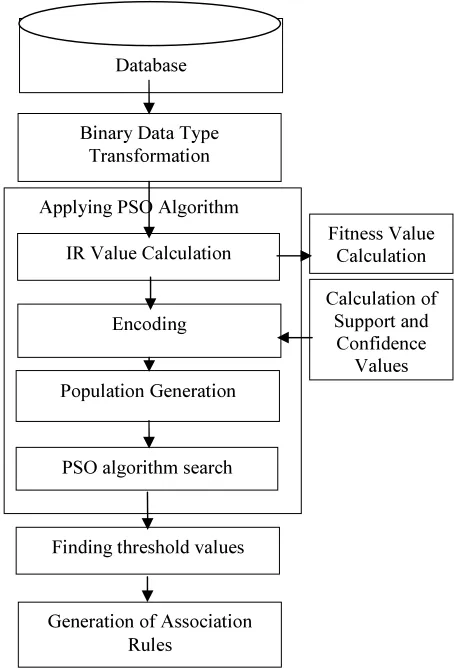
[image:3.595.326.553.387.722.2]The proposed algorithm comprises two parts, preprocessing and mining [9]. The first part provides procedures related to calculating the fitness values of the particle group. The data are distorted and stored in a binary format. Then, the exploration range of the particle swarm is set using IR (itemset range) value. In the next part of the algorithm, the PSO algorithm is working to mine the association rules.
Figure 1: PSO- Association Rule Mining Algorithm
Applying PSO Algorithm Database
Binary Data Type Transformation
Population Generation
Finding threshold values
Fitness Value Calculation
Calculation of Support and
Confidence Values Encoding
IR Value Calculation
Generation of Association Rules
In that, First starts with particle swarm encoding, it is similar to chromosome encoding of genetic algorithms. Then generate a population of particle swarms according to the calculated fitness value. The PSO searching procedure proceeds until the stopping condition is reached, which implies the best particle is found. The support and confidence of the best particle can indicate the minimum support and minimum confidence. After that apply these threshold values for association rule generation.Fig.1 demonstrates the algorithm structure
3.1.2 Methodology 3.1.2.1 Preprocessing
Preprocessing is a significant step for a successful data mining approach, which spots the missing values for the given input. In some cases there may be a possibility of incomplete data, inconsistent data or noisy data in the data set. In this approach binary transformation technique is used as the preprocessing technique. This approach can speed up the database scanning operation, and it is helpful to calculate support and confidence values more easily and quickly.
3.1.2.2 IR value calculation
Here the IR value is calculated for the data received from the preprocessing technique. In order to increase the search efficiency IR analysis is used to choose the rule length generated by chromosomes in particle swarm progress. IR analysis avoids searching for large number of association rules, which have no meaning in the process of particle swarm progression. This method deal with the front and back partition points of each and every chromosome, and the range determined by these two points is called the IR, which is exposed as follows:-
IR = [log (mTransNum(m)) + log(nTransNum(n))] (Trans(m, n) /TotalTrans)
(3)
In the above equation, the “m” and “n” value should posses the condition that m ≠ n and m< n. “m” denote the length of the itemset and TransNum(m) denotes the number of transaction records containing m products. “n” is the length of the itemset, and TransNum(n) refers the number of transaction records having n products. Trans (m, n) refers to the number of transaction records obtaining m to n products. TotalTrans represents the total number of transactions.
3.1.2.3 Applying PSO algorithm
The Particle Swarm optimization algorithm has been proposed to calculate the threshold values.
The algorithmic process is quite similar to that of genetic algorithms, but the proposed procedures include only encoding, fitness value calculation, population generation, best particle search, and termination condition. The process of generating the association rules using the PSO is done in the following ways. Initially the encoding on the obtained itemsets has been performed. Then the fitness values for the encoded itemsets are obtained. The equation for fitness value calculation is given below:-
Fitness (k) = confidence (k) × log (support (k) × length (k) + 1)
(4)
The particle with the highest fitness value is taken and their support and confidence can represent the minimum support and minimum confidence and then use that threshold values for association rule mining.
3.1.2.4 Association rule mining
In this step association rule mining approach has been presented using the apriori algorithm. The Apriori Algorithm is an influential algorithm to generate the association rules. It is a two step process. First, frequent itemsets are generated by means of the join and prune step. Second, based on the frequent itemsets, the association rules are mined.
3.2 Weighted Quantum Particle Swarm Optimization (WQPSO)
then allocate the weightage also in decreasing order.
3.3 Results of ARM
[image:5.595.94.298.264.403.2]PSO algorithm not only gives us a slight edge on the accuracy of the result it also reduces the computational cost. In the WQPSO procedure, the elite members are given more weightage compared to the ordinary members of the swarm. While PSO gives us quicker and accurate results, WQPSO promises us even more accurate results, but with a slightly higher computational cost.
Figure 2: Comparison Of PSO And WQPSO
In Fig.2 the results obtained by WQPSO are compared with PSO, it shows WQPSO yields fairly quicker result with quicker convergence (i.e.) WQPSO is successful in having better global search capability in comparison to PSO and hence a better optimal result is obtained using WQPSO. It is verified by applying the FoodMart2000 database of Microsoft SQL Server 2000.
4. CLUSTERING
Cluster analysis is a technology which can classify the similar sample points into the same group from a data set. The clustering aims at identifying and extracting significant groups in underlying data. In the field of clustering, K-means algorithm is the most popularly used algorithm to find a partition that minimizes mean square error (MSE) measure. Although K-means is an extensively useful clustering algorithm, it suffers from several drawbacks. The main drawback of the K-means algorithm is that the result is sensitive to the selection of the initial cluster centroids and may converge to the local optima. This is solved by PSO [11] as it performs globalized search.
4.1 PSO in Clustering
1. Initialize each particle to randomly selected cluster centroids.
2. For each data vector Zp
3. Calculate the Euclidean distance d(Zp,Ci,j) to all cluster centroids Cij
(5)
4. Assign Zp to cluster Cij such that d(Zp,Ci,j) should be minimumn
5. Evaluate the fitness function for each particle.
(6)
Where is the number of data vectors belonging to cluster Cij and Nc denotes the number of cluster centroids i.e. the number of clusters to be formed
6. Compare every particle’s fitness value with previous particle’s best solution
(pbest). If current solution is better than
previous value (pbest), then update pbest
with current solution.
7. Compare fitness evaluation with the population’s overall previous best. If current value is better than the gbest (the global version of the best value), then reset
gbest to the current particle’s value and
position.
8. The particle with gbest value is taken and their cluster is the best cluster with maximum intra cluster similarity
9. Repeat Step2 to Step 6 until the predefined number of iterations is completed.
4.2 Results of Clustering
Christopher (2008) [12] study shows that the aim of clustering is to attain high intra-cluster similarity and low inter-cluster similarity. To begin consider there are two clustering results:
C = the correct vector of bit masks = {c1, c2, c3…cn}
K= the vector of bit mask results of some algorithm = {k1, k2, k3…km}
Then create a “matching matrix”, M = [ aij ]. The matching matrix is just the number of cells that from result C are in cluster i, and from result K are in cluster j. So i goes from 1→n, and j goes from 1→m. N is then the total number of cells.
F= (2 * precision * recall) / (precision + recall) (7)
Where,
Precision (P) = cells correctly put into a cluster / total cells put into the cluster (8)
Recall (R) = cells correctly put into a cluster / All the cells that should have been in
the cluster (9)
In form of equation:
P(ci,kj) = aij / | kj | which is the number of cells in that were in both cluster i and j (from correct answer C and clustering result K, respectively) divided by the number of cells that are in cluster j.
R(ci,kj) = aij / | ci | which is the number of cells in that were in both cluster i and j divided by the number of cells that are in cluster i (in this case the correct number of cells).
So then
F(ci,kj) = 2 * R(ci,kj) * P(ci,kj) /
(R(ci,kj) + P(ci,kj)) (10)
[image:6.595.96.514.80.461.2]This is the F score for the comparison of one cluster to another
[image:6.595.88.294.478.624.2]Figure 3: Performance Comparison based on Precision Value
Figure 4: Performance Comparison based on Recall Value
Figure.5: Performance Comparison based on F_Measure
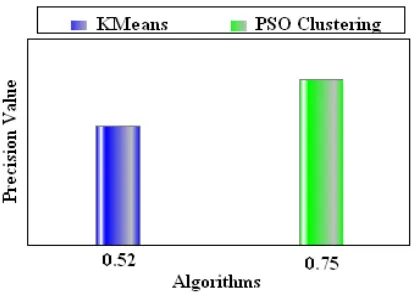
The above Experimental results show that PSO clustering performs better than the Kmeans algorithm. Breast Cancer dataset from UCI machine learning repository is used to calculate the precision, recall and F_Measure value.
5. CONCLUSION
association rule techniques that can outperform the proposed approach. Clustering is also a basis of many knowledge discovery tasks such as machine learning, statistics, data mining, and pattern recognition. The well-known K-means algorithm, suffers from several drawbacks due to its choice of initializations. In order to overcome K-Means shortcomings, PSO can be considered as a choice. PSO performs global search and k-means is responsible for local search. The process of the proposed algorithm is such that the strength and ability of preventing from being trapped in local optimums is improved. Computational experiments show that the proposed algorithm of this study is effective, robust, easy to tune and tolerably efficient as compared with other approaches. To improve the obtained results of the proposed algorithm, it can increase local search ability around the best found position by the algorithm.
REFERENCES:
[1] J. Han, M. Kamber, Data Mining: Concepts and Techniques, Morgan Kaufmann, New York, 2000.
[2] M.P. Song, G.C. Gu, “Research on particle swarm optimization”: a review, in: Proceedings of the IEEE International Conference on Machine Learning and Cybernetics, 2004, pp. 2236–2241
[3] Maolong Xi, Jun Sun , Wenbo Xu, “An improved quantum-behaved particle swarm optimization algorithm with weighted mean best position”, Elsevier- Applied Mathematics and Computation 205 ,2008,pp. 751–759
[4] R. Agrawal, T. Imielinski, A. Swami, “Mining association rules between sets of items in large databases”, ACM SIGMOD Record 22 1993, pp. 207–216.
[5] A. Savasere, E. Omiecinski, S. Navathe, “An efficient algorithm for mining association rules in large database”, in: Proceedings of
the 21st VLDB Conference, 1995, pp. 432–
444.
[6] H. Toivonen, “Sampling large databases for association rules”, in: Proceedings of the 22nd VLDB Conference, 1996, pp. 134–145. [7] Pei M., Goodman E.D., Punch F, “Feature
Extraction using genetic algorithm”, Case Center for Computer-Aided Engineering and Manufacturing, Department of Computer Science, 2000.
[8] Badri Patel, Vijay K Chaudhari, Rajneesh K Karan, YK Rana, “Optimization of Association Rule Mining Apriori algorithm using ACO” in: International Journal of Soft Computing and Engineering (IJSCE), Vol-1, Issue-1, 2011,pp 24-26
[9] R.J Kuo,C.M. Chao, Y.T Chiu, “Application of particle swarm optimization to association rule mining”, Elsevier-Applied soft computing, Vol 11,2011, pp 326-336 [10] Ashwin Mishra, DR. S. N. Omkar,
“Singularity analysis and comparitive study of six degree of freedom stewart platform as a robotic arm by heuristic algorithms and simulated annealing”, International Journal of Engineering Science and Technology (IJEST), Vol. 3, No. 1,2011,pp. 644-659 [11] Suresh Chandra Satapathy, Gunanidhi
Pradhan, Sabyasachi Pattnaik, JVR Murthy, PVGD Prasad Reddy, “Performance Comparisons of PSO based Clustering”, InterJRI Computer Science and Networking, Vol. 1, Issue 1, July 2009,pp 18-23